This video is part of an EAP
course for students enrolled
in pre-Master Program
Presented by
Dr.Heba M.Abdullah
TEFL Lecturer ,
Faculty of Graduate Studies for
Education ,Cairo University
Using the Internet for
Search
1. Remember that the internet contains vast
amounts of information, so the following tips
are essential.
 Use educational and government websites with internet
suffixes: .edu, .ac or .gov as they are generally considered
more credible.
 Avoid online material that is published through
commercial sites (sites with a .com or .co suffix) as they
may be biased.
 Websites of non-commercial organizations usually have a
.org suffix. Cite Widely known and respected
organizations, such as the United Nations.
 Be wary of other organizations set up to
promote a particular view or cause. They may be
biased so indicate this possibility in your essay if
you cite them.
 try using synonyms (= words that have a very
similar meaning) or related words. Instead of
management, for example, type leadership.
 Do not include instruction words or small words
such as ‘the’, out , for , and in, only include
content words in the search.
Knowing who the experts are if they
( Research Gate-Academia –Google Scholar)
 Have professional qualifications showing they have the
knowledge and training to write about the topic
 Are connected to or work for a recognized and respected
organization, for example a
 University, a research institute, a government department,
or professional association
 Have their work published by recognized publishing houses,
journals or organizations
 Are cited in other academic works
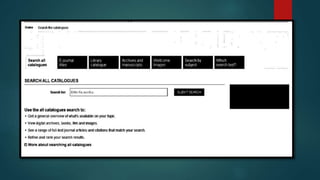
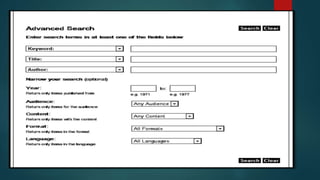
Finding information in the library
Library catalogues
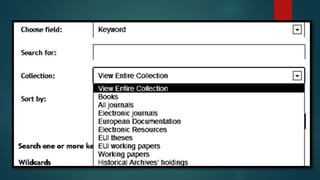
A library catalogue is a list of all of the
materials in the library. The library catalogue
will list a wide variety of materials: books, e-
books, journals, e journals, newspapers,
doctoral theses and so on. Look at the
following pictures.
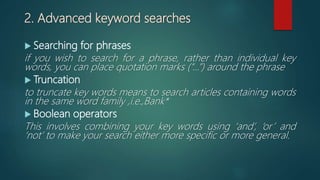
2. Advanced keyword searches
 Searching for phrases
if you wish to search for a phrase, rather than individual key
words, you can place quotation marks (“…”) around the phrase
 Truncation
to truncate key words means to search articles containing words
in the same word family ,i.e.,Bank*
 Boolean operators
This involves combining your key words using ‘and’, ‘or’ and
‘not’ to make your search either more specific or more general.
Thanks for watching the video
For more information
Join our language learning community
via www.edulang-eg.com

Using the internet for search

  • 1.
    This video ispart of an EAP course for students enrolled in pre-Master Program
  • 2.
    Presented by Dr.Heba M.Abdullah TEFLLecturer , Faculty of Graduate Studies for Education ,Cairo University
  • 3.
  • 4.
    1. Remember thatthe internet contains vast amounts of information, so the following tips are essential.  Use educational and government websites with internet suffixes: .edu, .ac or .gov as they are generally considered more credible.  Avoid online material that is published through commercial sites (sites with a .com or .co suffix) as they may be biased.  Websites of non-commercial organizations usually have a .org suffix. Cite Widely known and respected organizations, such as the United Nations.
  • 5.
     Be waryof other organizations set up to promote a particular view or cause. They may be biased so indicate this possibility in your essay if you cite them.  try using synonyms (= words that have a very similar meaning) or related words. Instead of management, for example, type leadership.  Do not include instruction words or small words such as ‘the’, out , for , and in, only include content words in the search.
  • 6.
    Knowing who theexperts are if they ( Research Gate-Academia –Google Scholar)  Have professional qualifications showing they have the knowledge and training to write about the topic  Are connected to or work for a recognized and respected organization, for example a  University, a research institute, a government department, or professional association  Have their work published by recognized publishing houses, journals or organizations  Are cited in other academic works
  • 7.
    Finding information inthe library Library catalogues A library catalogue is a list of all of the materials in the library. The library catalogue will list a wide variety of materials: books, e- books, journals, e journals, newspapers, doctoral theses and so on. Look at the following pictures.
  • 11.
    2. Advanced keywordsearches  Searching for phrases if you wish to search for a phrase, rather than individual key words, you can place quotation marks (“…”) around the phrase  Truncation to truncate key words means to search articles containing words in the same word family ,i.e.,Bank*  Boolean operators This involves combining your key words using ‘and’, ‘or’ and ‘not’ to make your search either more specific or more general.
  • 12.
    Thanks for watchingthe video For more information Join our language learning community via www.edulang-eg.com