DebatingPresented to Dr. LouELRC 7505Trish Baudoin and Tom Eldringhoff
PurposeCross Curriculum unit for Senior English and Philosophy Course.Instruct students on how to debate a topic using research supported evidenceEnglish Course research brief writingPhilosophy Course defining debating arguing using Rationale
Target LearnersSeniors in high school planning to attend college.Students are in a college prep atmosphere (AP courses or college prep school) and are serious about their studies.Comfortable with technologyHighly motivated to learn by their desire to be prepared when they enter into the collegiate atmosphere.Challenging material helps these students excel, whereas, easier material sometimes gets a lack of effort because of its lack of challenge.
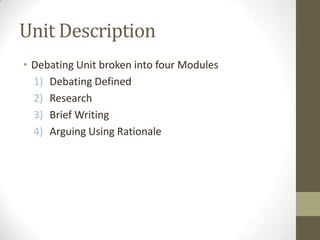
Unit DescriptionDebating Unit broken into four ModulesDebating DefinedResearchBrief WritingArguing Using Rationale
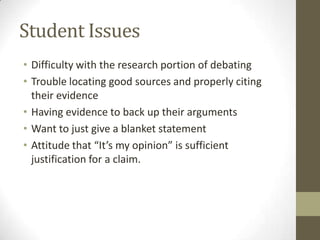
Student IssuesDifficulty with the research portion of debatingTrouble locating good sources and properly citing their evidenceHaving evidence to back up their argumentsWant to just give a blanket statementAttitude that “It’s my opinion” is sufficient justification for a claim.
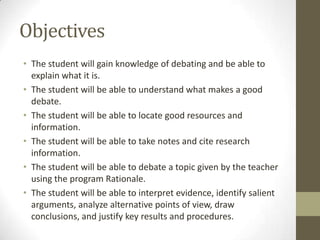
ObjectivesThe student will gain knowledge of debating and be able to explain what it is.The student will be able to understand what makes a good debate.The student will be able to locate good resources and information.The student will be able to take notes and cite research information.The student will be able to debate a topic given by the teacher using the program Rationale.The student will be able to interpret evidence, identify salient arguments, analyze alternative points of view, draw conclusions, and justify key results and procedures.
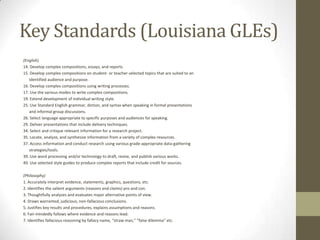
Key Standards (Louisiana GLEs)(English)14. Develop complex compositions, essays, and reports.15. Develop complex compositions on student- or teacher-selected topics that are suited to an       identified audience and purpose.16. Develop complex compositions using writing processes.17. Use the various modes to write complex compositions.19. Extend development of individual writing style.25. Use Standard English grammar, diction, and syntax when speaking in formal presentations       and informal group discussions.26. Select language appropriate to specific purposes and audiences for speaking.29. Deliver presentations that include delivery techniques.34. Select and critique relevant information for a research project.35. Locate, analyze, and synthesize information from a variety of complex resources.37. Access information and conduct research using various grade-appropriate data-gathering       strategies/tools.39. Use word processing and/or technology to draft, revise, and publish various works.40. Use selected style guides to produce complex reports that include credit for sources. (Philosophy)1. Accurately interpret evidence, statements, graphics, questions, etc.2. Identifies the salient arguments (reasons and claims) pro and con.3. Thoughtfully analyzes and evaluates major alternative points of view.4. Draws warranted, judicious, non-fallacious conclusions.5. Justifies key results and procedures, explains assumptions and reasons.6. Fair-mindedly follows where evidence and reasons lead.7. Identifies fallacious reasoning by fallacy name, “straw man,” “false dilemma” etc.
Design StrategiesSet up Unit in a WikiHome Page allows access to each ModuleSideBar allows navigation through the siteEach lesson links to the next lessonStudent Folders set up to turn in graded work
Tools UsedYouTube VideosOriginal VideosNoodle ToolsAdobe CaptivateRationalePower Point (SlideShare)Google Docs (Form)RubiStar
StrategiesSignaling RationaleRedundancy : videos, slide (parts of a brief)Pre-Training: Rationale CaptivatePersonalization, and Debate videos (see “Redundancy” above).Coherence:Slides removed excess wordsSegmenting:Wiki use, with links to lessons, allows user pacingModality: throughout Captivate demosPersonalization: Use of “you” and informal voice in Captivate and student created videos.
Productwww.debate101.pbworks.com
EvaluationsQuizzesActivitiesResearch Skills – citations and notecardsBriefArgument Map
Future DevelopmentList of possible debate topicsProduce videos of students taking the course debating a topic.Create interactive voting by comment while watching a debate.Better pre-training quizzes.Create video argumentation that can be used to lobby government officials about a topic important to students.Create an assignment that has students create a debating form for rating a debater’s performance.
ConclusionStrengthsAccess to information anytime and anywhere with internet accessNot limited to just classroom time with a teacherUses dual channelsMove at own paceCan go back and look at previous informationWiki is fun to digital nativesLimitationsAccess to technologyAccess to information

Debating

  • 1.
    DebatingPresented to Dr.LouELRC 7505Trish Baudoin and Tom Eldringhoff
  • 2.
    PurposeCross Curriculum unitfor Senior English and Philosophy Course.Instruct students on how to debate a topic using research supported evidenceEnglish Course research brief writingPhilosophy Course defining debating arguing using Rationale
  • 3.
    Target LearnersSeniors inhigh school planning to attend college.Students are in a college prep atmosphere (AP courses or college prep school) and are serious about their studies.Comfortable with technologyHighly motivated to learn by their desire to be prepared when they enter into the collegiate atmosphere.Challenging material helps these students excel, whereas, easier material sometimes gets a lack of effort because of its lack of challenge.
  • 4.
    Unit DescriptionDebating Unitbroken into four ModulesDebating DefinedResearchBrief WritingArguing Using Rationale
  • 5.
    Student IssuesDifficulty withthe research portion of debatingTrouble locating good sources and properly citing their evidenceHaving evidence to back up their argumentsWant to just give a blanket statementAttitude that “It’s my opinion” is sufficient justification for a claim.
  • 6.
    ObjectivesThe student willgain knowledge of debating and be able to explain what it is.The student will be able to understand what makes a good debate.The student will be able to locate good resources and information.The student will be able to take notes and cite research information.The student will be able to debate a topic given by the teacher using the program Rationale.The student will be able to interpret evidence, identify salient arguments, analyze alternative points of view, draw conclusions, and justify key results and procedures.
  • 7.
    Key Standards (LouisianaGLEs)(English)14. Develop complex compositions, essays, and reports.15. Develop complex compositions on student- or teacher-selected topics that are suited to an       identified audience and purpose.16. Develop complex compositions using writing processes.17. Use the various modes to write complex compositions.19. Extend development of individual writing style.25. Use Standard English grammar, diction, and syntax when speaking in formal presentations       and informal group discussions.26. Select language appropriate to specific purposes and audiences for speaking.29. Deliver presentations that include delivery techniques.34. Select and critique relevant information for a research project.35. Locate, analyze, and synthesize information from a variety of complex resources.37. Access information and conduct research using various grade-appropriate data-gathering       strategies/tools.39. Use word processing and/or technology to draft, revise, and publish various works.40. Use selected style guides to produce complex reports that include credit for sources. (Philosophy)1. Accurately interpret evidence, statements, graphics, questions, etc.2. Identifies the salient arguments (reasons and claims) pro and con.3. Thoughtfully analyzes and evaluates major alternative points of view.4. Draws warranted, judicious, non-fallacious conclusions.5. Justifies key results and procedures, explains assumptions and reasons.6. Fair-mindedly follows where evidence and reasons lead.7. Identifies fallacious reasoning by fallacy name, “straw man,” “false dilemma” etc.
  • 8.
    Design StrategiesSet upUnit in a WikiHome Page allows access to each ModuleSideBar allows navigation through the siteEach lesson links to the next lessonStudent Folders set up to turn in graded work
  • 9.
    Tools UsedYouTube VideosOriginalVideosNoodle ToolsAdobe CaptivateRationalePower Point (SlideShare)Google Docs (Form)RubiStar
  • 10.
    StrategiesSignaling RationaleRedundancy :videos, slide (parts of a brief)Pre-Training: Rationale CaptivatePersonalization, and Debate videos (see “Redundancy” above).Coherence:Slides removed excess wordsSegmenting:Wiki use, with links to lessons, allows user pacingModality: throughout Captivate demosPersonalization: Use of “you” and informal voice in Captivate and student created videos.
  • 11.
  • 12.
    EvaluationsQuizzesActivitiesResearch Skills –citations and notecardsBriefArgument Map
  • 13.
    Future DevelopmentList ofpossible debate topicsProduce videos of students taking the course debating a topic.Create interactive voting by comment while watching a debate.Better pre-training quizzes.Create video argumentation that can be used to lobby government officials about a topic important to students.Create an assignment that has students create a debating form for rating a debater’s performance.
  • 14.
    ConclusionStrengthsAccess to informationanytime and anywhere with internet accessNot limited to just classroom time with a teacherUses dual channelsMove at own paceCan go back and look at previous informationWiki is fun to digital nativesLimitationsAccess to technologyAccess to information