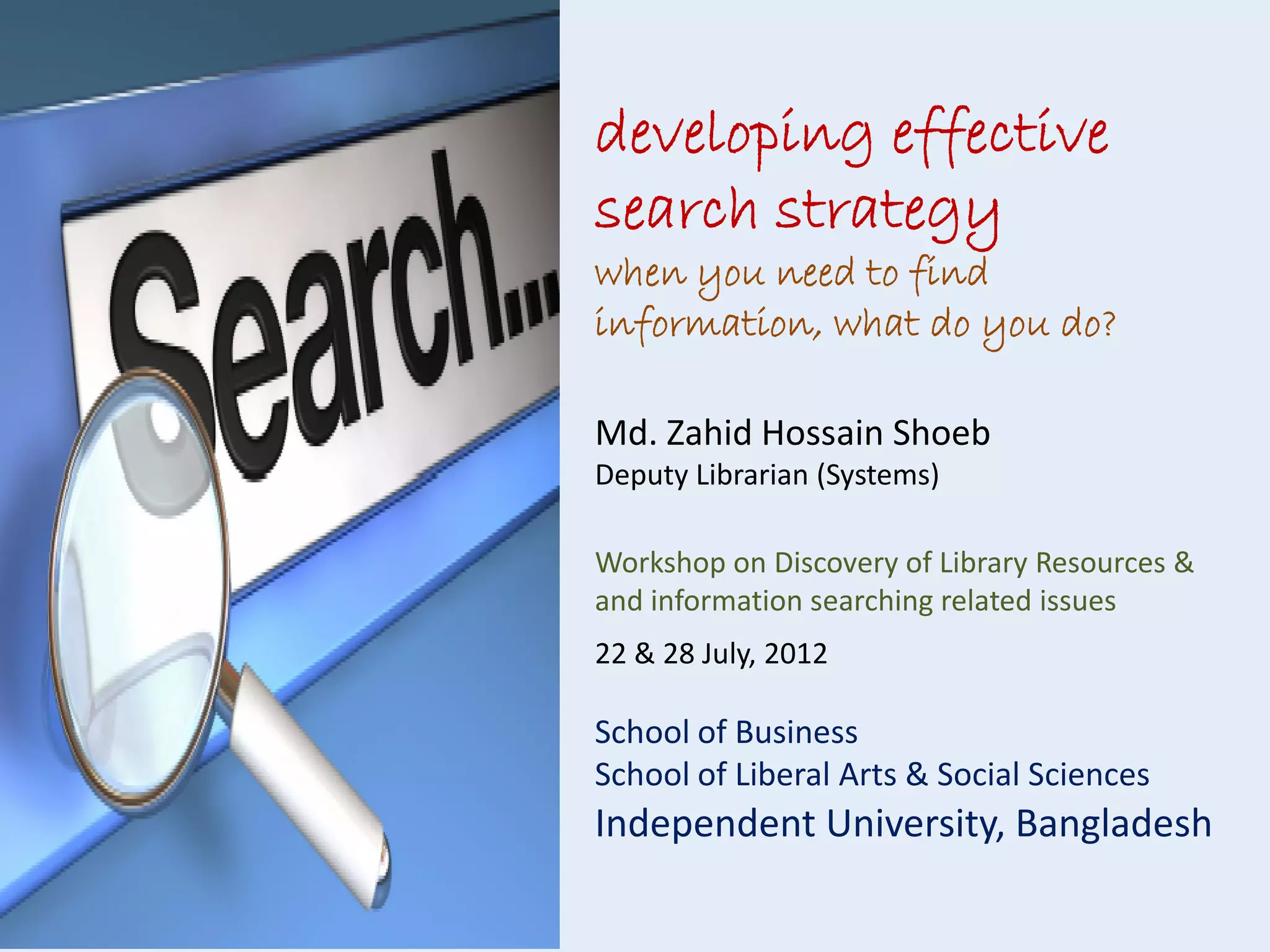
developing effective
search strategy
when you need to find
information, what do you do?
Md. Zahid Hossain Shoeb
Deputy Librarian (Systems)
Workshop on Discovery of Library Resources &
and information searching related issues
22 & 28 July, 2012

School of Business
School of Liberal Arts & Social Sciences

Independent University, Bangladesh
Topics to be covered today
o Search Strategies
o Topic Determination
o Concepts
o Keywords
o Search Techniques
o Evaluating Sources
o Final words
Search Strategies
Determine/summerize the topic
Identify main concepts
Check for background information
Develop a list of keywords and phrases
Search in databases, on the Internet, in library
catalogs
o Evaluate resources
o Keep publication/origination information organized
o
o
o
o
o
Topic Determination
o The research scope/course/assignment may guide to
the choice of a topic
o Topic should be as specific as possible
o A very broad topic may need narrowing
o A very specific topic may need expansion
Topic Determination
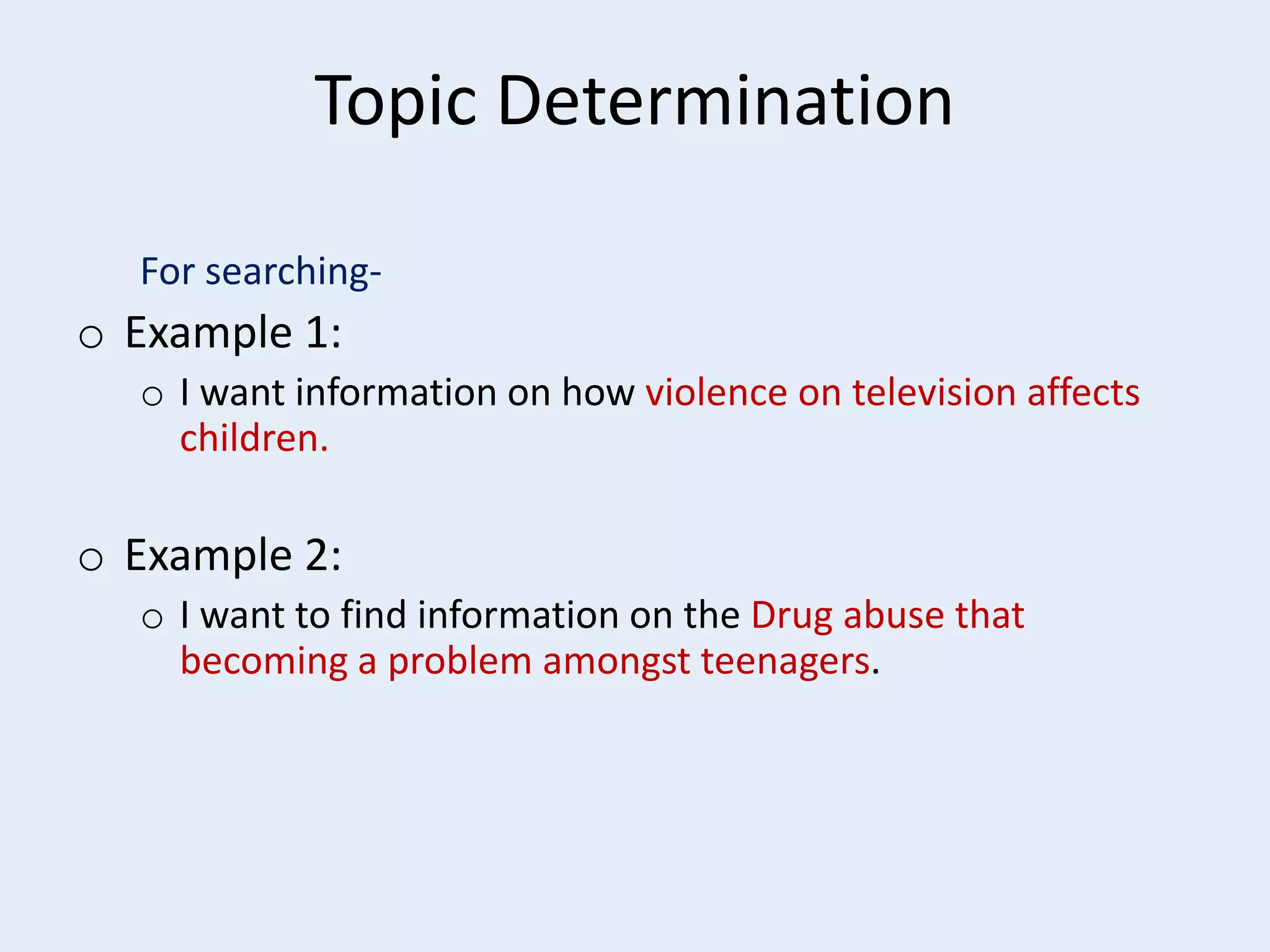
For searching-

o Example 1:
o I want information on how violence on television affects
children.

o Example 2:
o I want to find information on the Drug abuse that
becoming a problem amongst teenagers.
Concepts
o Concepts are the main ideas of the topic
o The main concepts should be represented in the
topic summary
o Concepts make up each unique search topic
o Most topics can be broken down into two or three
main concepts
o Note that we may have to rewrite the problem
statement – but don’t lose any meaning!!
Concepts
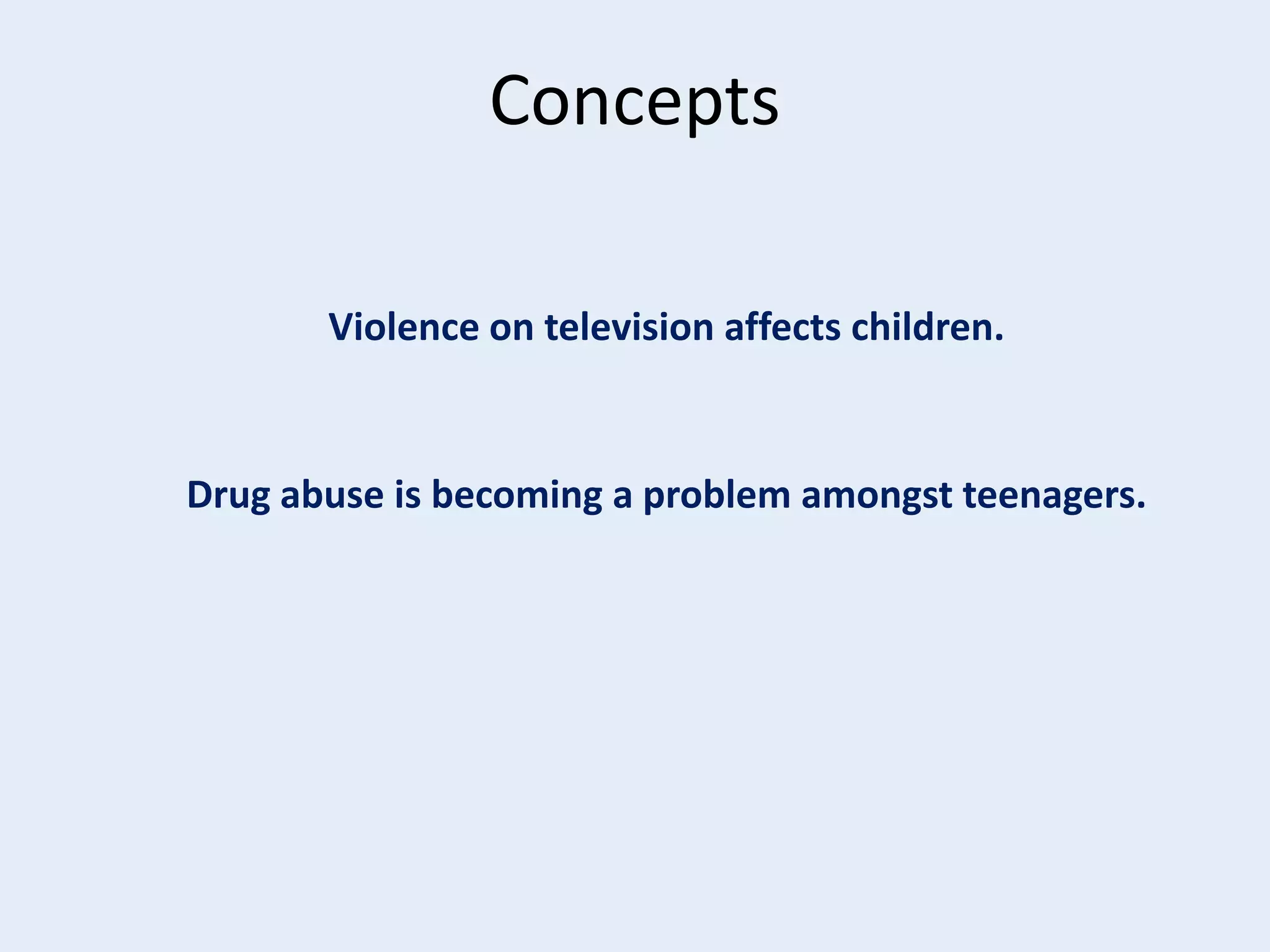
Violence on television affects children.

Drug abuse is becoming a problem amongst teenagers.
Concepts
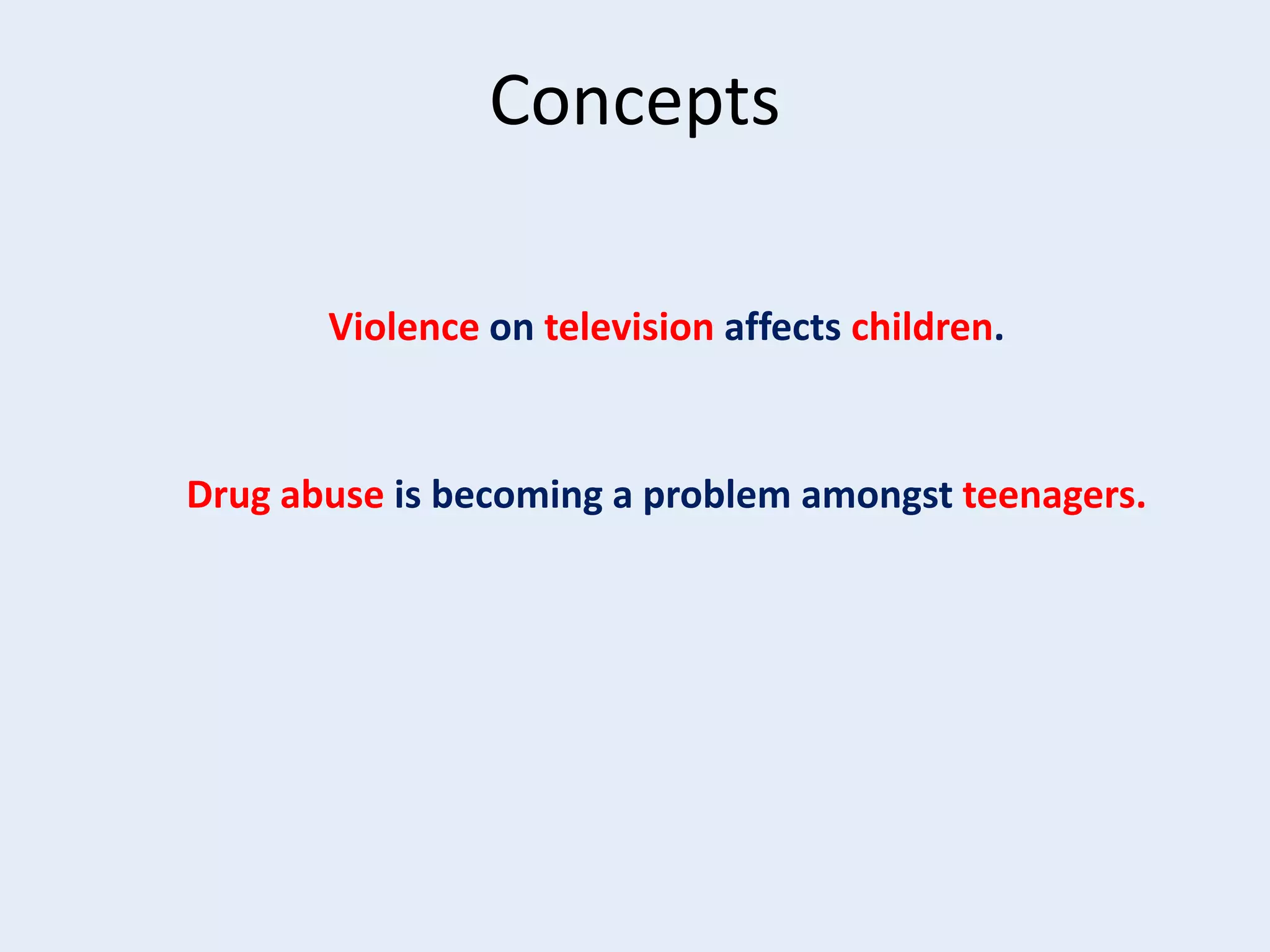
Violence on television affects children.

Drug abuse is becoming a problem amongst teenagers.
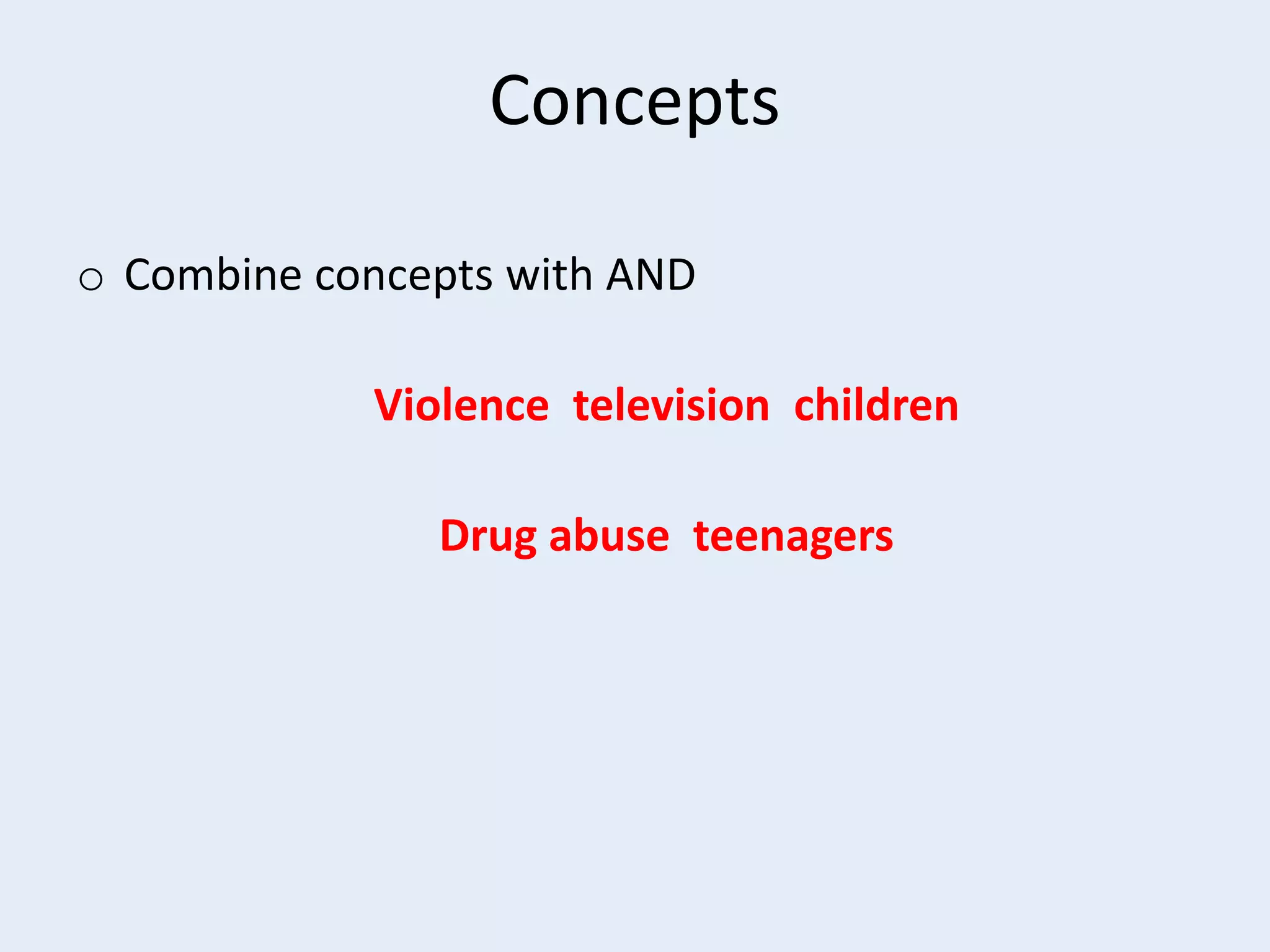
Concepts
o Combine concepts with AND
Violence television children
Drug abuse teenagers
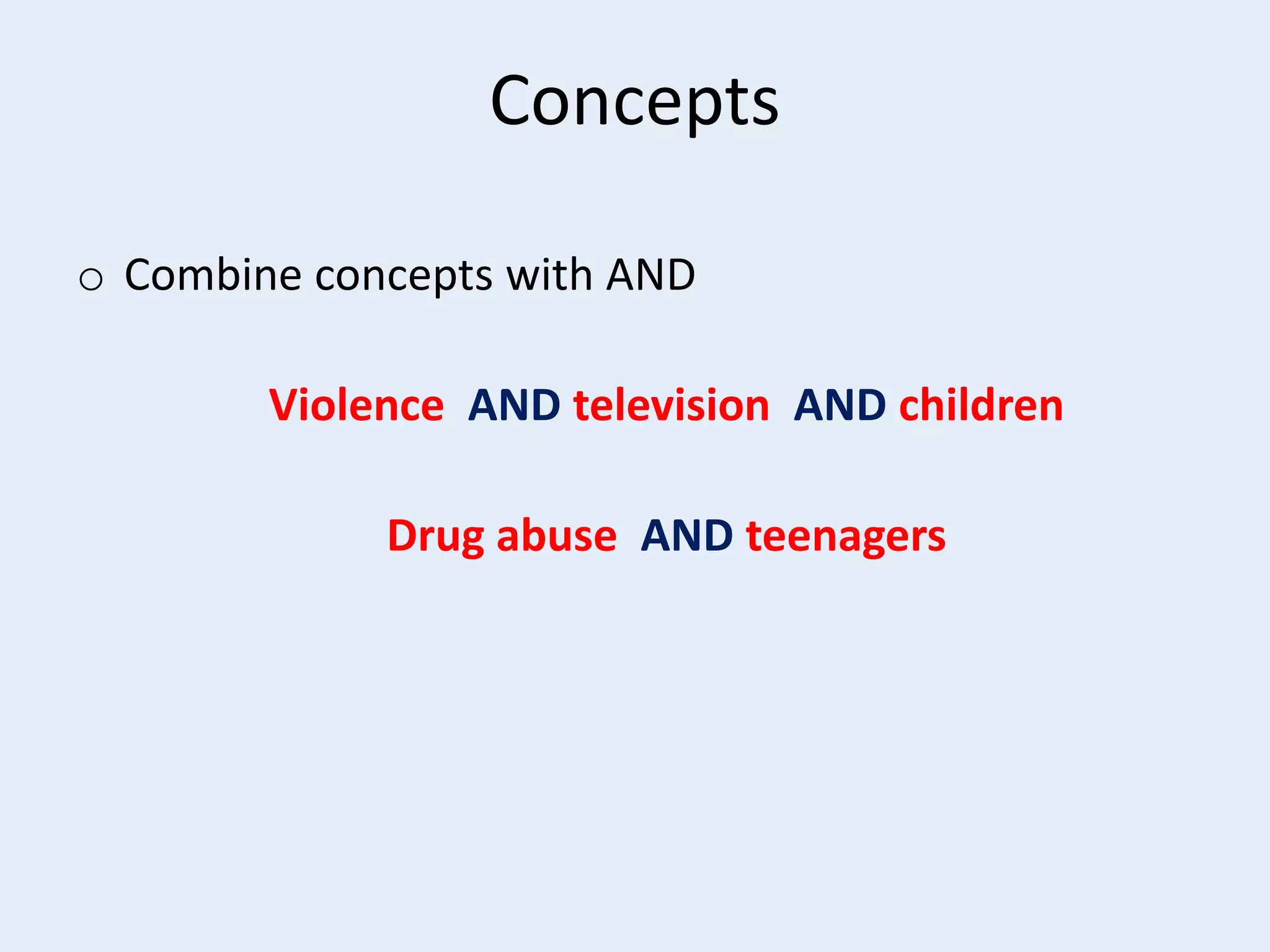
Concepts
o Combine concepts with AND
Violence AND television AND children
Drug abuse AND teenagers
Background Information
o Encyclopedias, textbooks, dictionaries and
periodicals provide background information for our
research topic
o These sources help develop a list of keywords to use
for searching in databases, library catalogs, indexes
and on the Internet
Keywords
o Keywords are the basis of finding information in the
electronic environment – they are discrete.
o Initially, choose words that represent the concepts
directly from the problem statement.
o Choose alternative words for the concepts – known as
synonyms. Choosing synonyms is a bigger problem.
o The success of the search depends on the keywords we
use and how they are combined
o People have some basic intuitions, but overall using
keywords effectively is something that needs to be
taught and reinforced.
Keywords
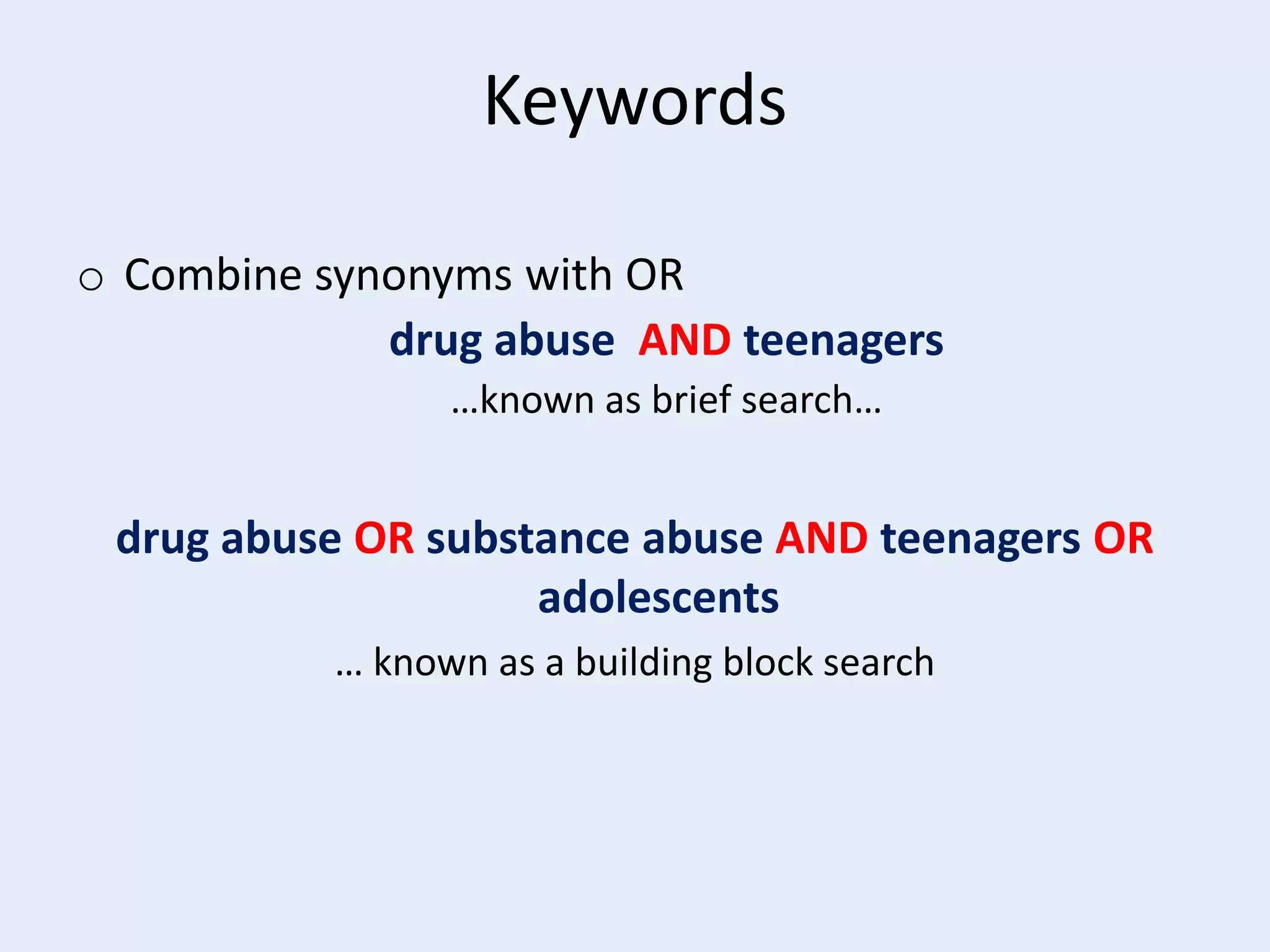
o Combine synonyms with OR
drug abuse AND teenagers
…known as brief search…

drug abuse OR substance abuse AND teenagers OR
adolescents
… known as a building block search
More about Concepts
Is censorship or banning of books in Islamic
countries affecting the development of the
book as a literary form in Islamic countries?
More about Concepts
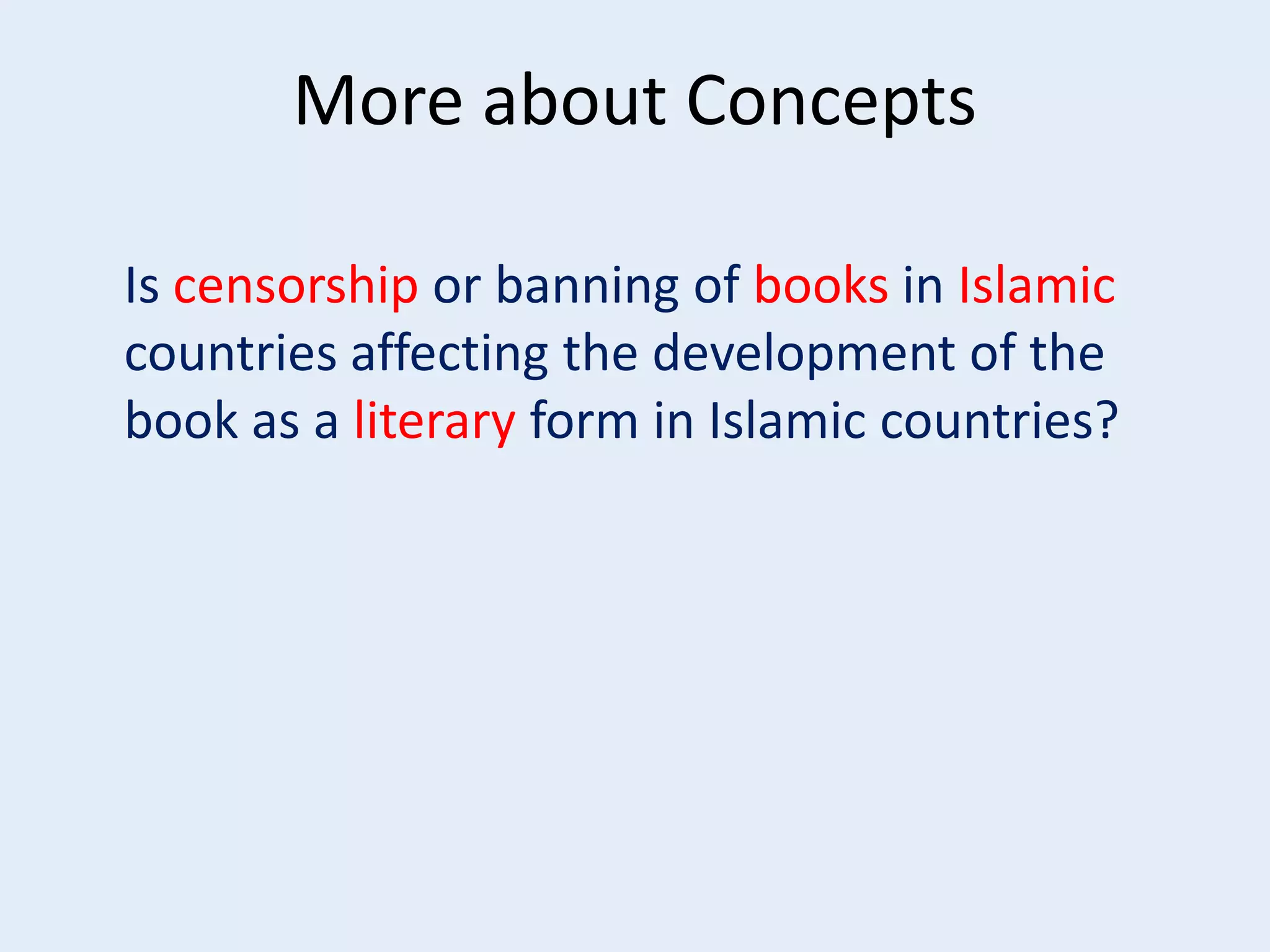
Is censorship or banning of books in Islamic
countries affecting the development of the
book as a literary form in Islamic countries?
More about Concepts
o Censorship and books and Islamic are obvious
choices, but this omits the critical part of the
question, i.e. development of the book as a literary
form.
o Censorship and books and Islamic and literary
includes all the concepts, but four concept search
results are often too narrow.
o Thus a better search may be censorship and literary
and Islamic, or two separate searches, i.e. one on
censorship of books, and another on the
development of literature.
More about Concepts
Curriculum integration currently dominates
the discussion on information literacy in
university settings.
May we critically discuss the idea of curriculum integrated
information literacy and whether it should receive so much
attention?
More about Concepts
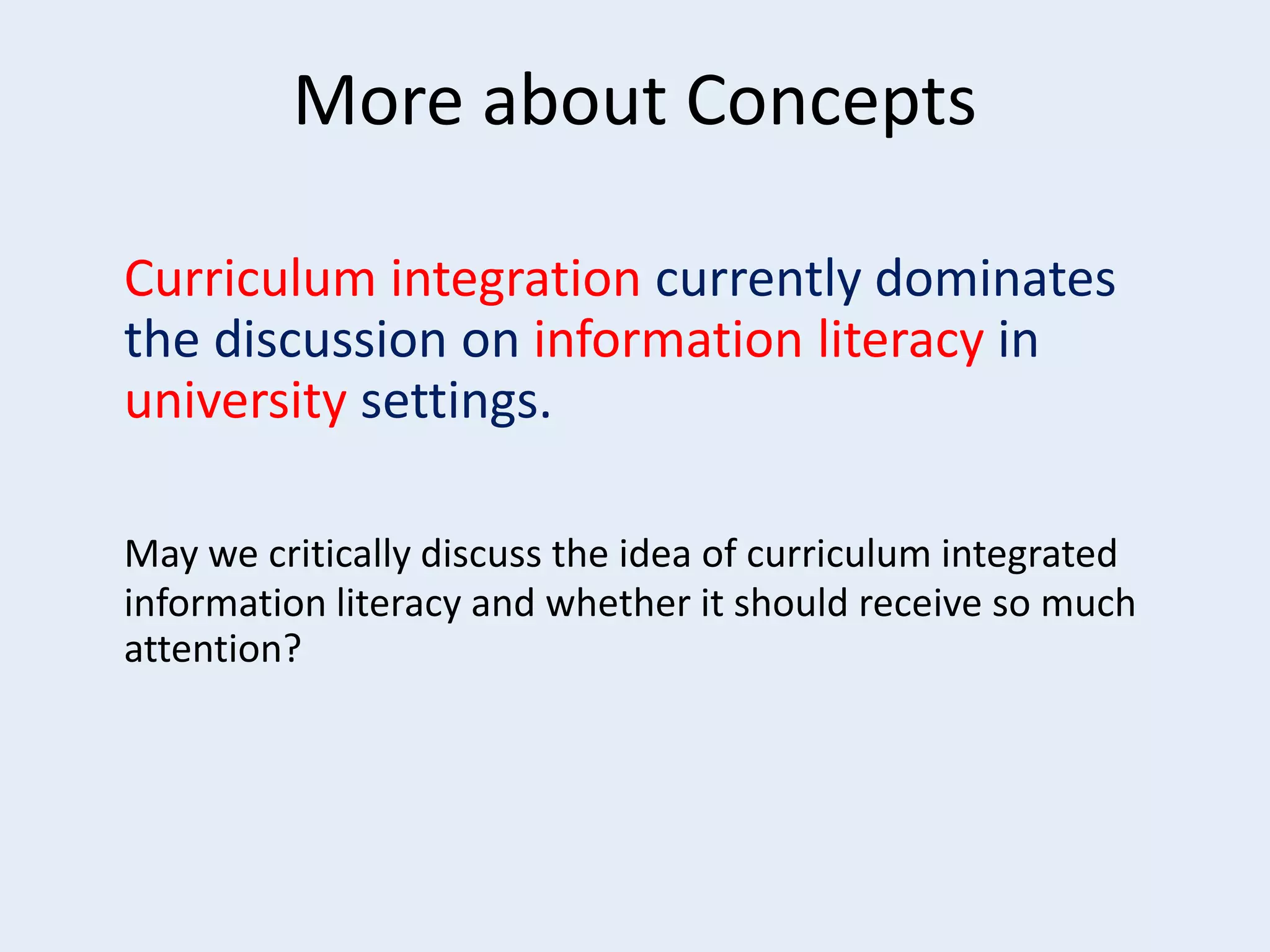
Curriculum integration currently dominates
the discussion on information literacy in
university settings.
May we critically discuss the idea of curriculum integrated
information literacy and whether it should receive so much
attention?
More about Concepts
o Curriculum integration, information literacy and
university are the obvious choices, but this leaves out
a part of the question, i.e. whether it should receive
so much attention.
o Why does it receive so much attention? This is
because curriculum integration supposedly leads to
better learning outcomes.
o The search could therefore become curriculum
integration, information literacy and learning
outcomes.
More about Concepts
o The last example shows that we may have to
“rewrite”, i.e. reinterpret, the question to determine
its real meaning.
o This means that some of our concepts may have to
be represented by keywords that are not actually in
the problem statement.
Search Techniques
Several techniques for database, catalog and Internet
searches include:
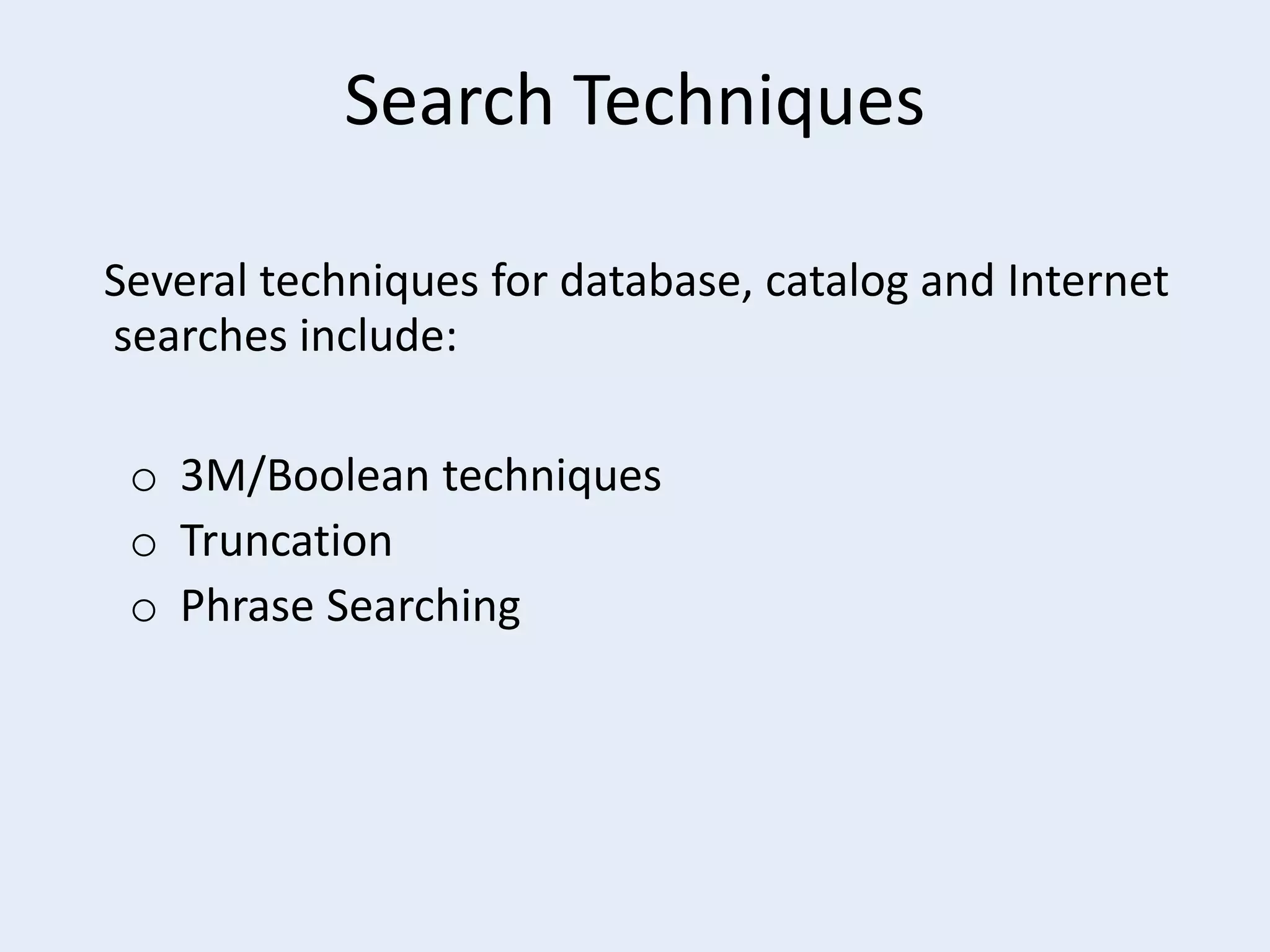
o 3M/Boolean techniques
o Truncation
o Phrase Searching
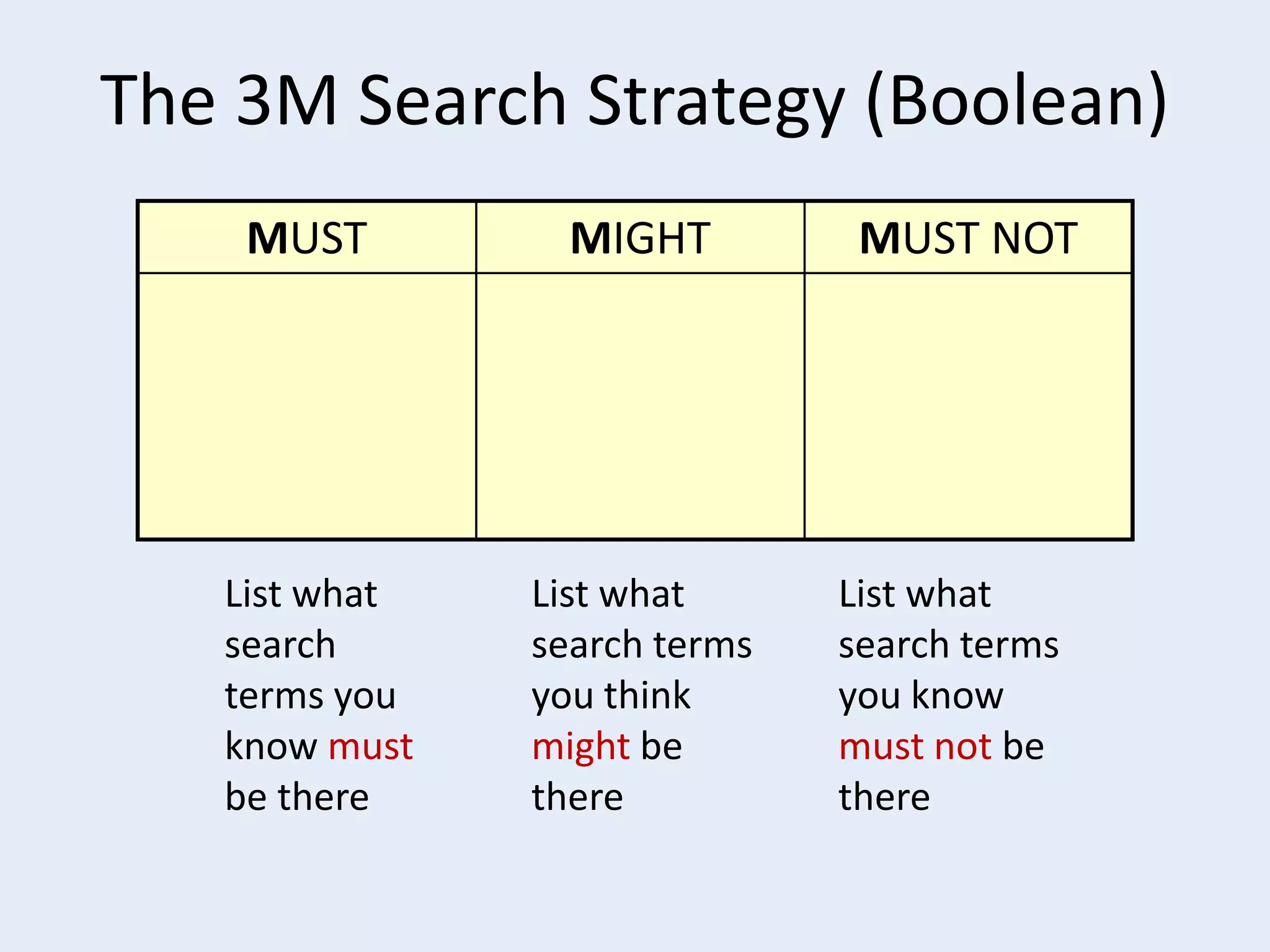
The 3M Search Strategy (Boolean)
MUST

MIGHT

List what
search
terms you
know must
be there

List what
search terms
you think
might be
there

MUST NOT

List what
search terms
you know
must not be
there
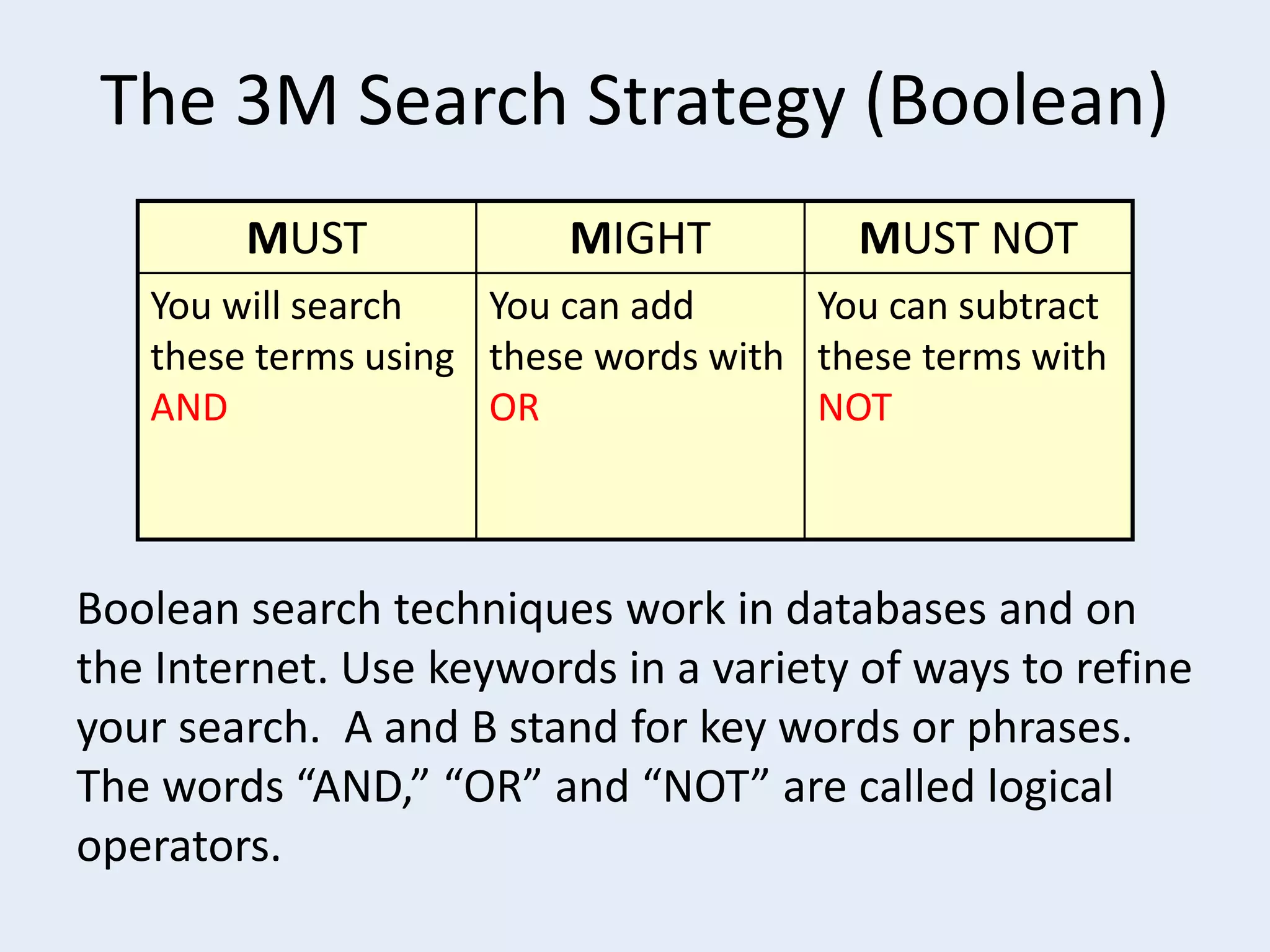
The 3M Search Strategy (Boolean)
MUST

MIGHT

MUST NOT

You will search
You can add
You can subtract
these terms using these words with these terms with
AND
OR
NOT

Boolean search techniques work in databases and on
the Internet. Use keywords in a variety of ways to refine
your search. A and B stand for key words or phrases.
The words “AND,” “OR” and “NOT” are called logical
operators.
Boolean Search
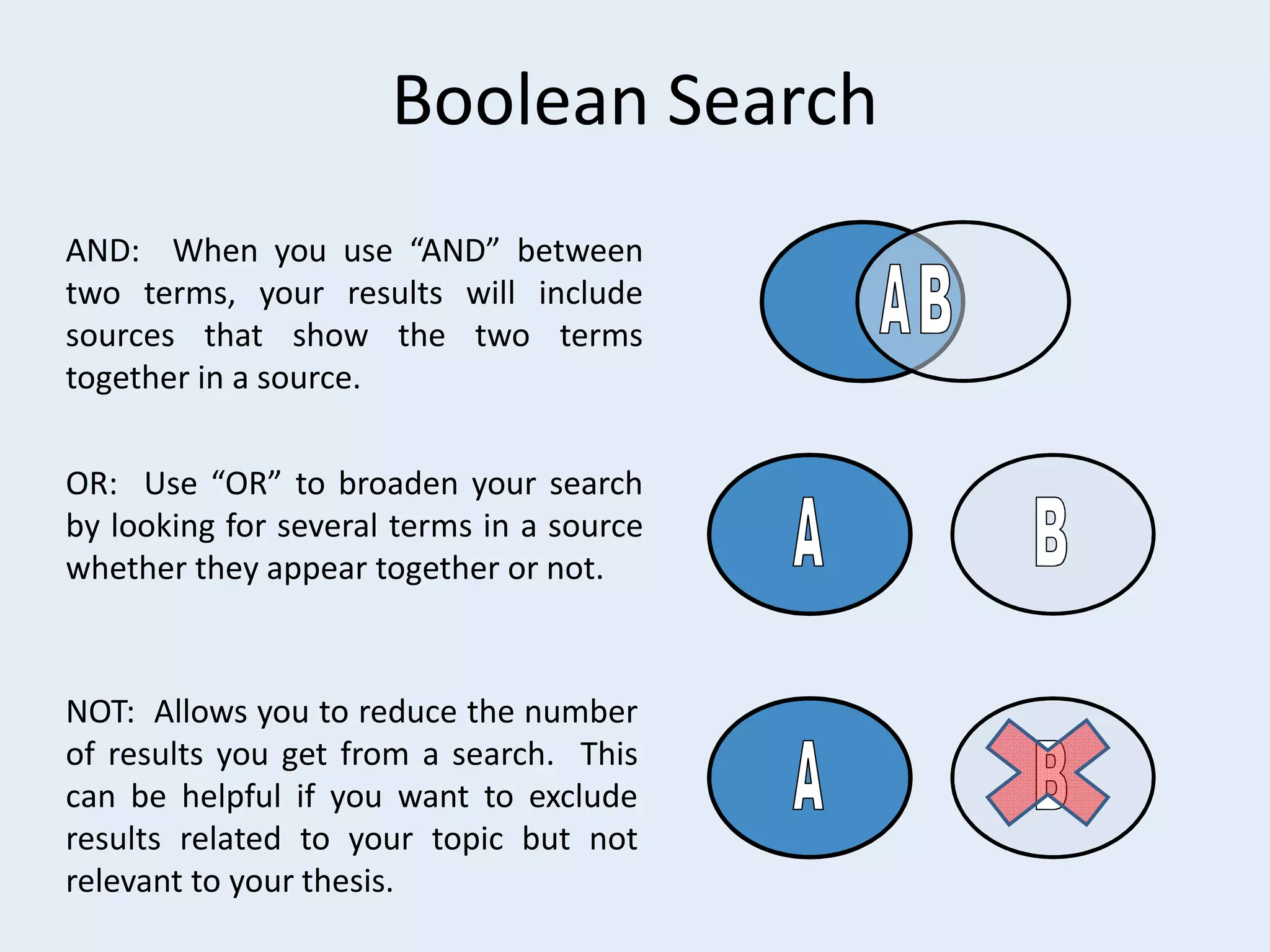
AND: When you use “AND” between
two terms, your results will include
sources that show the two terms
together in a source.
OR: Use “OR” to broaden your search
by looking for several terms in a source
whether they appear together or not.

NOT: Allows you to reduce the number
of results you get from a search. This
can be helpful if you want to exclude
results related to your topic but not
relevant to your thesis.
Truncation
o Use the root of a word to broaden your search
responses.
o Using the root Psych* will result in the following:
o
o
o
o
o

Psychology
Psychological
Psychologist
Psychiatry
Psychiatrist
Phrase Searching
o Using quotation marks (“”) makes it possible to
search for important phrases instead of individual
keywords
o Phrase: “Bangladesh Flood”
o As Keywords: Bangladesh and Flood
o Phrase: “Welfare Reform”
o As Keywords: Welfare and Reform
o Phrase: “Private University”
o As Keywords: Private and University
Examples
o Using AND, OR, NOT, with * and “”
o “Coll*” AND “Welfare Reform” OR poverty NOT
welfare
o Some databases or search engines may use symbols
in place of the Boolean terms:
o “Higher Education” + (and) technology - (not)
computers
Internet
o The Internet can be useful as a research tool
o The large majority of Internet sites are for commercial
purposes and frequently are less valuable as a source
of information
o Unlike databases, no authoritative entity reviews and
evaluates material on the Internet
o The researcher must carefully evaluate information
retrieved from the Web
Internet Search Suggestions
o Try different search engines
o Use a variety of keywords
o Use Boolean techniques, truncation and phrase
searching
o Carefully evaluate web sites
o Use the search engine “Help” menu to save time
Library Catalog
o Library catalogs allow a user to search for all types of
materials
o Available resources include books, periodicals,
audio/video resources, databases, web sites and
other electronic resources
o Electronic catalog searches help with time
management
Evaluating Sources
When evaluating any resource, consider:
o
o
o
o
o

Authority
Accuracy
Objectivity
Currency
Coverage
Evaluating Sources
o Authority
Is there an author? Is the page signed?
Is the author qualified? An expert?
Who is the sponsor?
Is the sponsor of the page reputable? How reputable?
Is there a link to information about the author or the
sponsor?
o If the page includes neither a signature nor indicates a
sponsor, is there any other way to determine its origin?
o
o
o
o
o
Evaluating Sources
o Authority
• Rationale
– Anyone can publish anything on the web.
– It is often hard to determine a web page's authorship.
– Even if a page is signed, qualifications are not usually provided.
– Sponsorship is not always indicated.
Evaluating Sources
o Accuracy
o Is the information reliable and error-free?
o Is there an editor or someone who verifies/checks the
information?
• Rationale
– Unlike traditional print resources, web resources rarely have
editors or fact-checkers.
– Currently, no web standards exist to ensure accuracy.
Evaluating Sources
o Objectivity
o Does the information show a minimum of bias?
o Is the page designed to sway opinion?
o Is there any advertising on the page?
• Rationale
– Frequently the goals of the sponsors/authors are not clearly
stated.
– Often the Web serves as a virtual “Paltan Maidan", a soapbox.
Evaluating Sources
o Currency
o Is the page dated?
o If so, when was the last update?
o How current are the links? Have some expired or moved?
• Rationale
– Publication or revision dates are not always provided.
– If a date is provided, it may have various meanings. For
example,
• It may indicate when the material was first written
• It may indicate when the material was first placed on the Web
• It may indicate when the material was last revised
Evaluating Sources
o Coverage
o What topics are covered?
o What does this page offer that is not found elsewhere?
o How in-depth is the material?
• Rationale
– Web coverage often differs from print coverage.
– Frequently, it's difficult to determine the extent of coverage of
a topic from a web page. The page may or may not include links
to other web pages or print references.
– Sometimes web information is "just for fun", a hoax, someone's
personal expression that may be of interest to no one, or even
outright silliness.
Evaluating Sources
Further consideration:
o Audience
o Too technical or too elementary

o Type of source
o Primary/secondary/tertiary

o Documentation
o Bibliography, footnotes, additional links, viewpoints

o Use of language
o Standard/ colloquial
Final Words
o In general, it is better to have more information than
too little
o Look for a variety of materials
o Use a variety of keywords
o Look at the works authors use in their resource lists
o Use general and specific databases
o Plan for enough time to return to research in case
your approach changes or you need more
information
IUB Workshop on Effective Search Strategies

IUB Workshop on Effective Search Strategies

  • 1.
    developing effective search strategy whenyou need to find information, what do you do? Md. Zahid Hossain Shoeb Deputy Librarian (Systems) Workshop on Discovery of Library Resources & and information searching related issues 22 & 28 July, 2012 School of Business School of Liberal Arts & Social Sciences Independent University, Bangladesh
  • 2.
    Topics to becovered today o Search Strategies o Topic Determination o Concepts o Keywords o Search Techniques o Evaluating Sources o Final words
  • 3.
    Search Strategies Determine/summerize thetopic Identify main concepts Check for background information Develop a list of keywords and phrases Search in databases, on the Internet, in library catalogs o Evaluate resources o Keep publication/origination information organized o o o o o
  • 4.
    Topic Determination o Theresearch scope/course/assignment may guide to the choice of a topic o Topic should be as specific as possible o A very broad topic may need narrowing o A very specific topic may need expansion
  • 5.
    Topic Determination For searching- oExample 1: o I want information on how violence on television affects children. o Example 2: o I want to find information on the Drug abuse that becoming a problem amongst teenagers.
  • 6.
    Concepts o Concepts arethe main ideas of the topic o The main concepts should be represented in the topic summary o Concepts make up each unique search topic o Most topics can be broken down into two or three main concepts o Note that we may have to rewrite the problem statement – but don’t lose any meaning!!
  • 7.
    Concepts Violence on televisionaffects children. Drug abuse is becoming a problem amongst teenagers.
  • 8.
    Concepts Violence on televisionaffects children. Drug abuse is becoming a problem amongst teenagers.
  • 9.
    Concepts o Combine conceptswith AND Violence television children Drug abuse teenagers
  • 10.
    Concepts o Combine conceptswith AND Violence AND television AND children Drug abuse AND teenagers
  • 11.
    Background Information o Encyclopedias,textbooks, dictionaries and periodicals provide background information for our research topic o These sources help develop a list of keywords to use for searching in databases, library catalogs, indexes and on the Internet
  • 12.
    Keywords o Keywords arethe basis of finding information in the electronic environment – they are discrete. o Initially, choose words that represent the concepts directly from the problem statement. o Choose alternative words for the concepts – known as synonyms. Choosing synonyms is a bigger problem. o The success of the search depends on the keywords we use and how they are combined o People have some basic intuitions, but overall using keywords effectively is something that needs to be taught and reinforced.
  • 13.
    Keywords o Combine synonymswith OR drug abuse AND teenagers …known as brief search… drug abuse OR substance abuse AND teenagers OR adolescents … known as a building block search
  • 14.
    More about Concepts Iscensorship or banning of books in Islamic countries affecting the development of the book as a literary form in Islamic countries?
  • 15.
    More about Concepts Iscensorship or banning of books in Islamic countries affecting the development of the book as a literary form in Islamic countries?
  • 16.
    More about Concepts oCensorship and books and Islamic are obvious choices, but this omits the critical part of the question, i.e. development of the book as a literary form. o Censorship and books and Islamic and literary includes all the concepts, but four concept search results are often too narrow. o Thus a better search may be censorship and literary and Islamic, or two separate searches, i.e. one on censorship of books, and another on the development of literature.
  • 17.
    More about Concepts Curriculumintegration currently dominates the discussion on information literacy in university settings. May we critically discuss the idea of curriculum integrated information literacy and whether it should receive so much attention?
  • 18.
    More about Concepts Curriculumintegration currently dominates the discussion on information literacy in university settings. May we critically discuss the idea of curriculum integrated information literacy and whether it should receive so much attention?
  • 19.
    More about Concepts oCurriculum integration, information literacy and university are the obvious choices, but this leaves out a part of the question, i.e. whether it should receive so much attention. o Why does it receive so much attention? This is because curriculum integration supposedly leads to better learning outcomes. o The search could therefore become curriculum integration, information literacy and learning outcomes.
  • 20.
    More about Concepts oThe last example shows that we may have to “rewrite”, i.e. reinterpret, the question to determine its real meaning. o This means that some of our concepts may have to be represented by keywords that are not actually in the problem statement.
  • 21.
    Search Techniques Several techniquesfor database, catalog and Internet searches include: o 3M/Boolean techniques o Truncation o Phrase Searching
  • 22.
    The 3M SearchStrategy (Boolean) MUST MIGHT List what search terms you know must be there List what search terms you think might be there MUST NOT List what search terms you know must not be there
  • 23.
    The 3M SearchStrategy (Boolean) MUST MIGHT MUST NOT You will search You can add You can subtract these terms using these words with these terms with AND OR NOT Boolean search techniques work in databases and on the Internet. Use keywords in a variety of ways to refine your search. A and B stand for key words or phrases. The words “AND,” “OR” and “NOT” are called logical operators.
  • 24.
    Boolean Search AND: Whenyou use “AND” between two terms, your results will include sources that show the two terms together in a source. OR: Use “OR” to broaden your search by looking for several terms in a source whether they appear together or not. NOT: Allows you to reduce the number of results you get from a search. This can be helpful if you want to exclude results related to your topic but not relevant to your thesis.
  • 25.
    Truncation o Use theroot of a word to broaden your search responses. o Using the root Psych* will result in the following: o o o o o Psychology Psychological Psychologist Psychiatry Psychiatrist
  • 26.
    Phrase Searching o Usingquotation marks (“”) makes it possible to search for important phrases instead of individual keywords o Phrase: “Bangladesh Flood” o As Keywords: Bangladesh and Flood o Phrase: “Welfare Reform” o As Keywords: Welfare and Reform o Phrase: “Private University” o As Keywords: Private and University
  • 27.
    Examples o Using AND,OR, NOT, with * and “” o “Coll*” AND “Welfare Reform” OR poverty NOT welfare o Some databases or search engines may use symbols in place of the Boolean terms: o “Higher Education” + (and) technology - (not) computers
  • 28.
    Internet o The Internetcan be useful as a research tool o The large majority of Internet sites are for commercial purposes and frequently are less valuable as a source of information o Unlike databases, no authoritative entity reviews and evaluates material on the Internet o The researcher must carefully evaluate information retrieved from the Web
  • 29.
    Internet Search Suggestions oTry different search engines o Use a variety of keywords o Use Boolean techniques, truncation and phrase searching o Carefully evaluate web sites o Use the search engine “Help” menu to save time
  • 30.
    Library Catalog o Librarycatalogs allow a user to search for all types of materials o Available resources include books, periodicals, audio/video resources, databases, web sites and other electronic resources o Electronic catalog searches help with time management
  • 31.
    Evaluating Sources When evaluatingany resource, consider: o o o o o Authority Accuracy Objectivity Currency Coverage
  • 32.
    Evaluating Sources o Authority Isthere an author? Is the page signed? Is the author qualified? An expert? Who is the sponsor? Is the sponsor of the page reputable? How reputable? Is there a link to information about the author or the sponsor? o If the page includes neither a signature nor indicates a sponsor, is there any other way to determine its origin? o o o o o
  • 33.
    Evaluating Sources o Authority •Rationale – Anyone can publish anything on the web. – It is often hard to determine a web page's authorship. – Even if a page is signed, qualifications are not usually provided. – Sponsorship is not always indicated.
  • 34.
    Evaluating Sources o Accuracy oIs the information reliable and error-free? o Is there an editor or someone who verifies/checks the information? • Rationale – Unlike traditional print resources, web resources rarely have editors or fact-checkers. – Currently, no web standards exist to ensure accuracy.
  • 35.
    Evaluating Sources o Objectivity oDoes the information show a minimum of bias? o Is the page designed to sway opinion? o Is there any advertising on the page? • Rationale – Frequently the goals of the sponsors/authors are not clearly stated. – Often the Web serves as a virtual “Paltan Maidan", a soapbox.
  • 36.
    Evaluating Sources o Currency oIs the page dated? o If so, when was the last update? o How current are the links? Have some expired or moved? • Rationale – Publication or revision dates are not always provided. – If a date is provided, it may have various meanings. For example, • It may indicate when the material was first written • It may indicate when the material was first placed on the Web • It may indicate when the material was last revised
  • 37.
    Evaluating Sources o Coverage oWhat topics are covered? o What does this page offer that is not found elsewhere? o How in-depth is the material? • Rationale – Web coverage often differs from print coverage. – Frequently, it's difficult to determine the extent of coverage of a topic from a web page. The page may or may not include links to other web pages or print references. – Sometimes web information is "just for fun", a hoax, someone's personal expression that may be of interest to no one, or even outright silliness.
  • 38.
    Evaluating Sources Further consideration: oAudience o Too technical or too elementary o Type of source o Primary/secondary/tertiary o Documentation o Bibliography, footnotes, additional links, viewpoints o Use of language o Standard/ colloquial
  • 39.
    Final Words o Ingeneral, it is better to have more information than too little o Look for a variety of materials o Use a variety of keywords o Look at the works authors use in their resource lists o Use general and specific databases o Plan for enough time to return to research in case your approach changes or you need more information