UnderstandingYour
Assignment & Getting
Started with Research
The Basics of Beginning a Research Paper
Today’s Goals
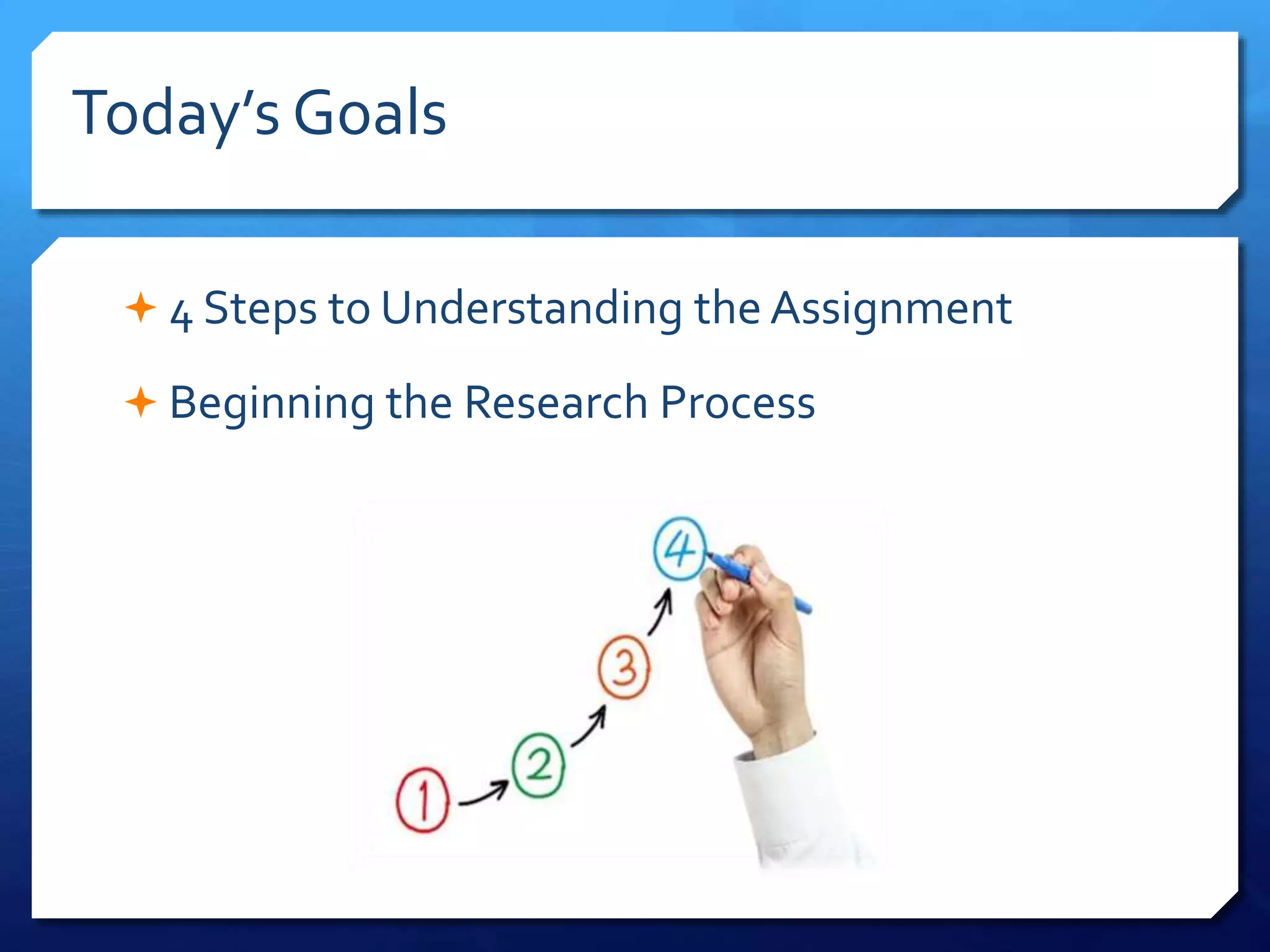
 4 Steps to Understanding the Assignment
 Beginning the Research Process
What is the first thing
you do after you get a
research assignment?
Please type your answer in the chat box.
Step One:
Read the Assignment
Read and
Highlight key
aspects
Read the Assignment and Highlight Key
Aspects
 Take your time and focus on reading
• Notate anything you are unsure of to ask your professor
 Highlight the key aspects
• Due date
• Requirements
• Topic suggestions, etc.
Image source: https://www.iconfinder.com/icons/17933/highlight_marker_icon
StepTwo:
Identify what the
assignment is asking you
to do…
Type and Scope of
the assignment …
Also begin thinking
about your
interests
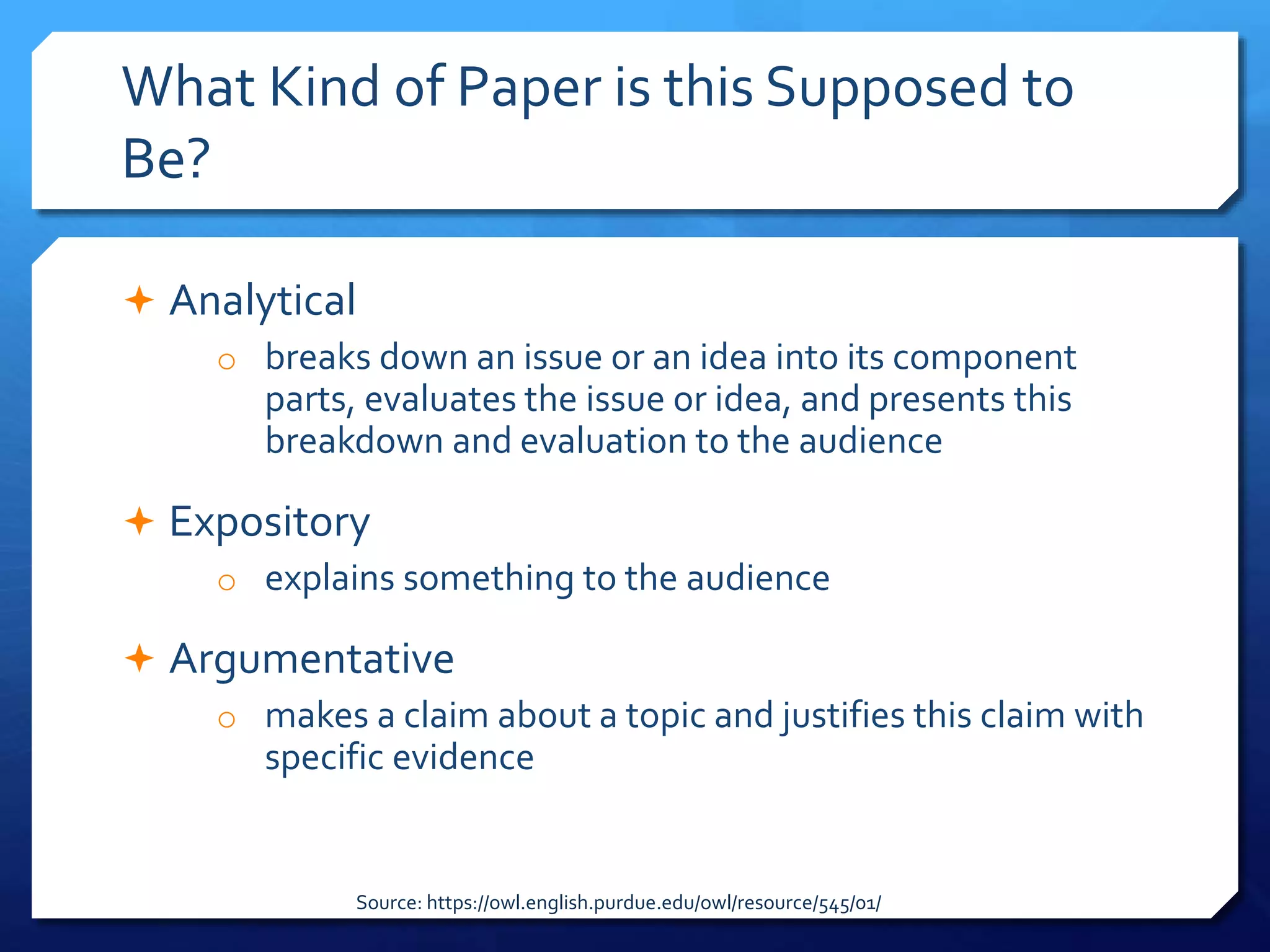
What Kind of Paper is this Supposed to
Be?
 Analytical
o breaks down an issue or an idea into its component
parts, evaluates the issue or idea, and presents this
breakdown and evaluation to the audience
 Expository
o explains something to the audience
 Argumentative
o makes a claim about a topic and justifies this claim with
specific evidence
Source: https://owl.english.purdue.edu/owl/resource/545/01/
What is the Scope of the Assignment?
 What is the format of the paper?
 How many pages should you write?
 How should the information be presented?
 What type and how many sources are required?
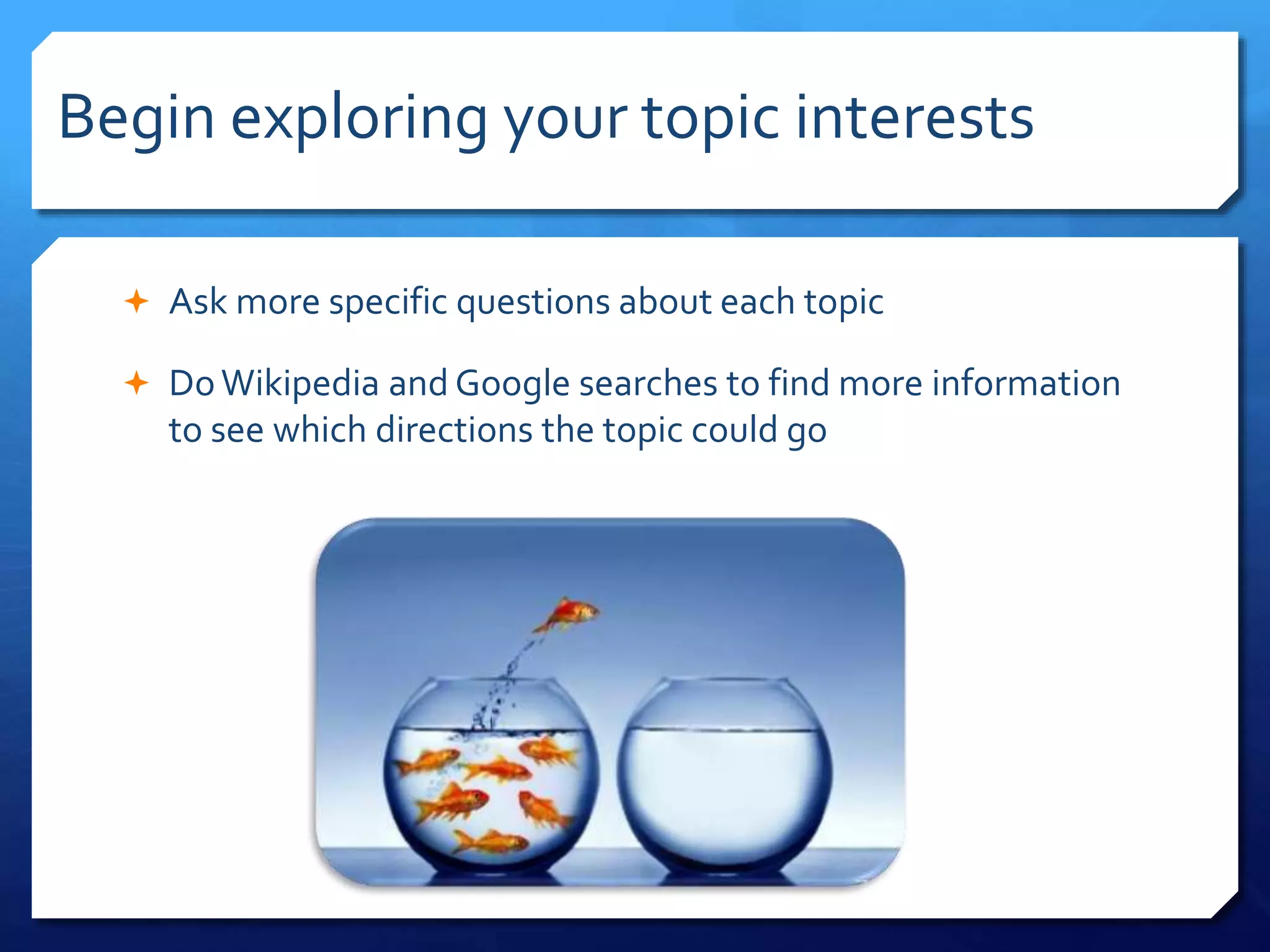
Begin exploring your topic interests
 Ask more specific questions about each topic
 DoWikipedia and Google searches to find more information
to see which directions the topic could go
StepThree:
Preliminary Research
Move beyond
Google and
Keep your
requirements in
mind
Before you settle on a topic, conduct
more extensive research
 Move beyond Google and consult more scholarly
resources
 Keeping in mind:
• Length of your paper
• Number of sources needed as references
 The research will tell you if there are enough
sources available to meet those requirements.
Where would you go to
do more research
beyond Google?
What are some scholarly sources you
know of?
Please type your answer in the chat box.
Step Four:
Reread the assignment to
chose one topic
Find the
Sweet Spot
A good topic choice must be doable
 Too general or too broad
of a topic:
• Overwhelming amount of
information.
• Would take too long for
the amount of time you
have.
o FIX: be more specific
(choose a sub group or
particular factor)
 Too narrow or too specific:
• You can’t find enough
information on it to meet
requirements for length or
number of reference
sources.
o FIX: be more general
(identify what field or
group it belongs to)
Find the Sweet Spot
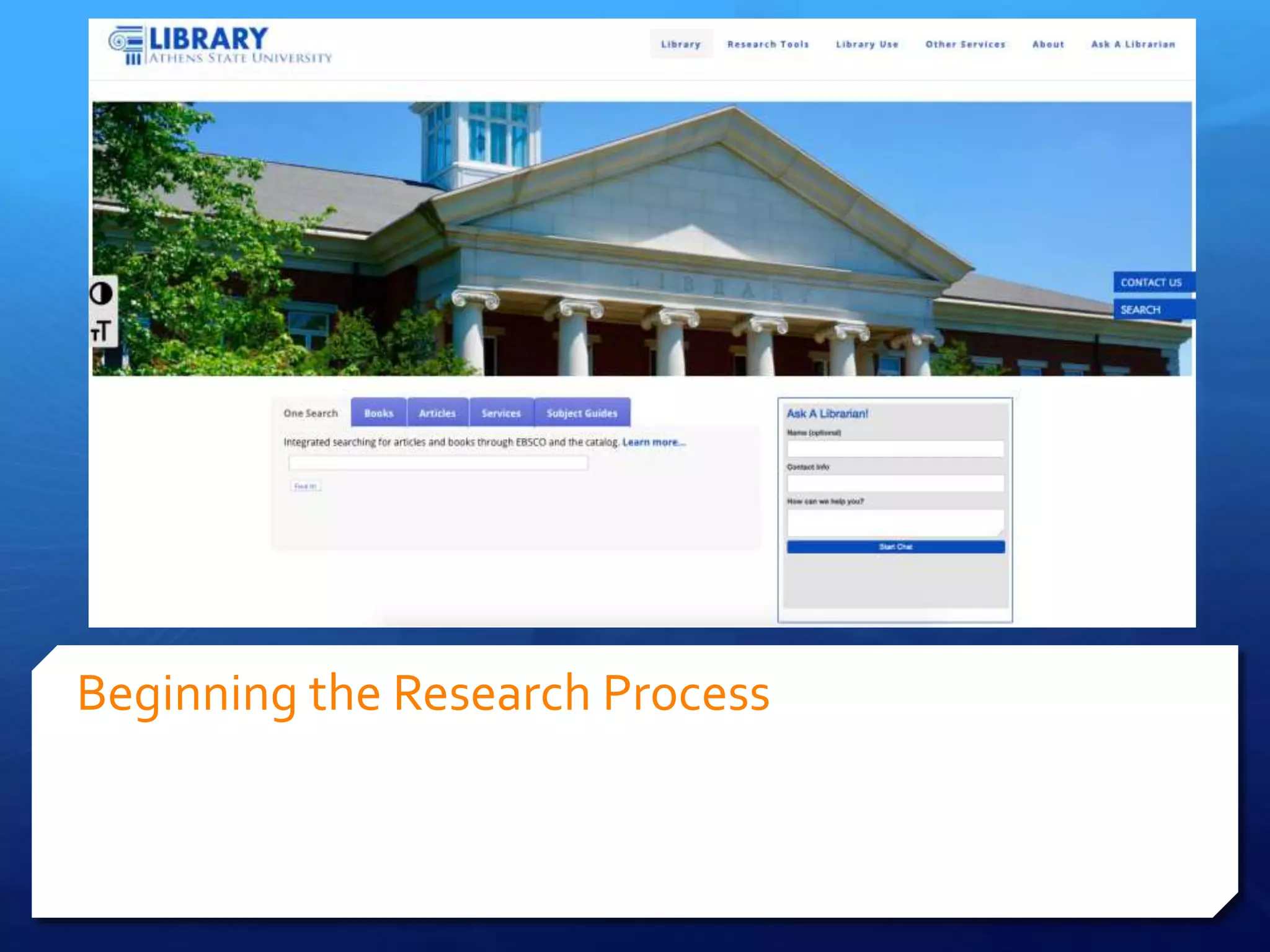
Beginning the Research Process
FormulateYour Research Question
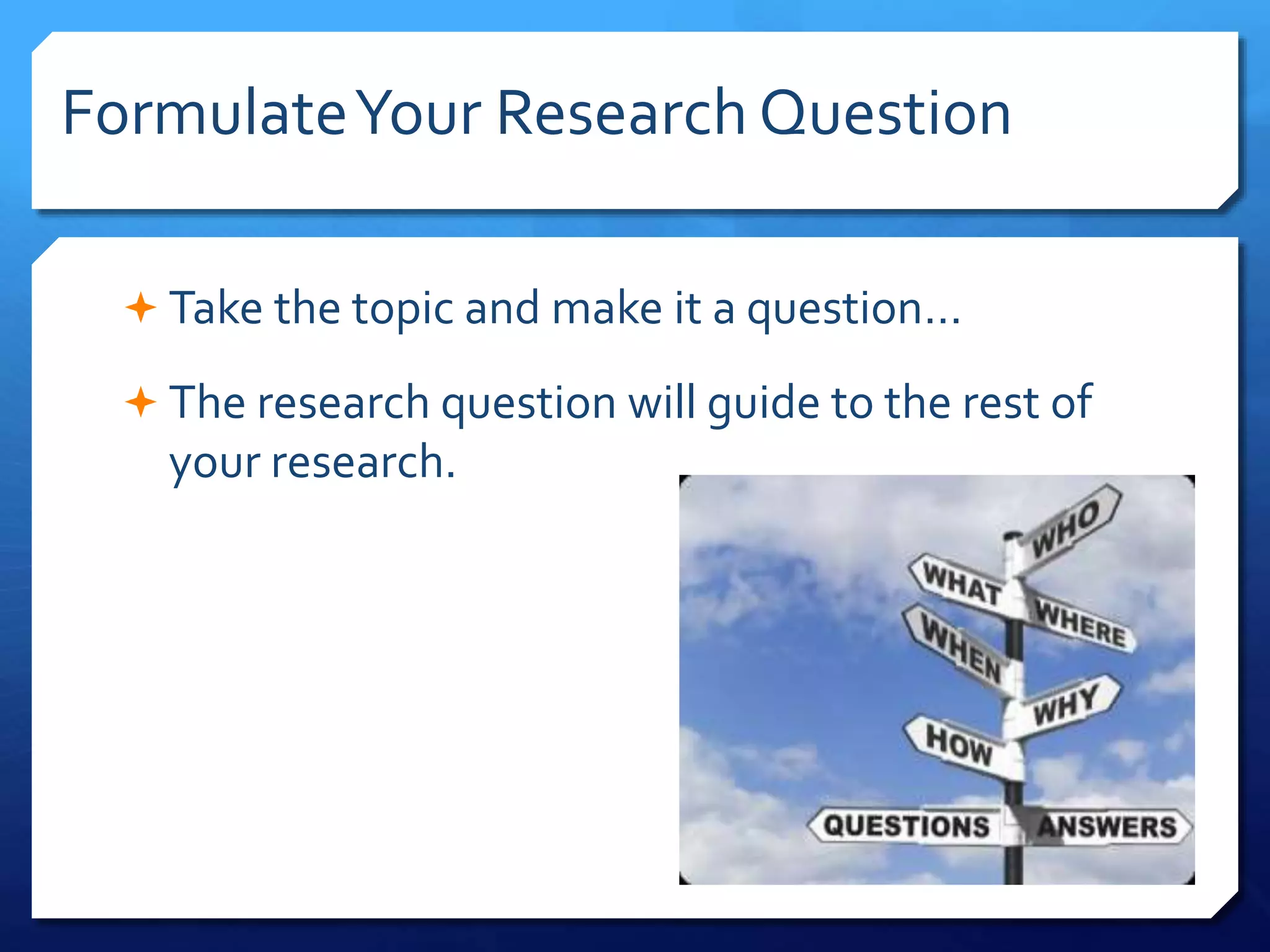
 Take the topic and make it a question…
 The research question will guide to the rest of
your research.
Identifying Keywords
 From the question,
identify the significant
terms.
 These terms are the
keywords you will use to
search for sources in the
library databases.
 Populating more
keywords:
• Identify the synonyms
and antonyms to your
keywords
• Use a thesaurus
• Brainstorming
Image source: https://www.cpcom.com/google-gone-dark-keyword-data-2/
How has perspective in
Renaissance art helped
artists and viewers alike
to perceive and create
art?
Raise your hand if you can identify the
keywords in this question.
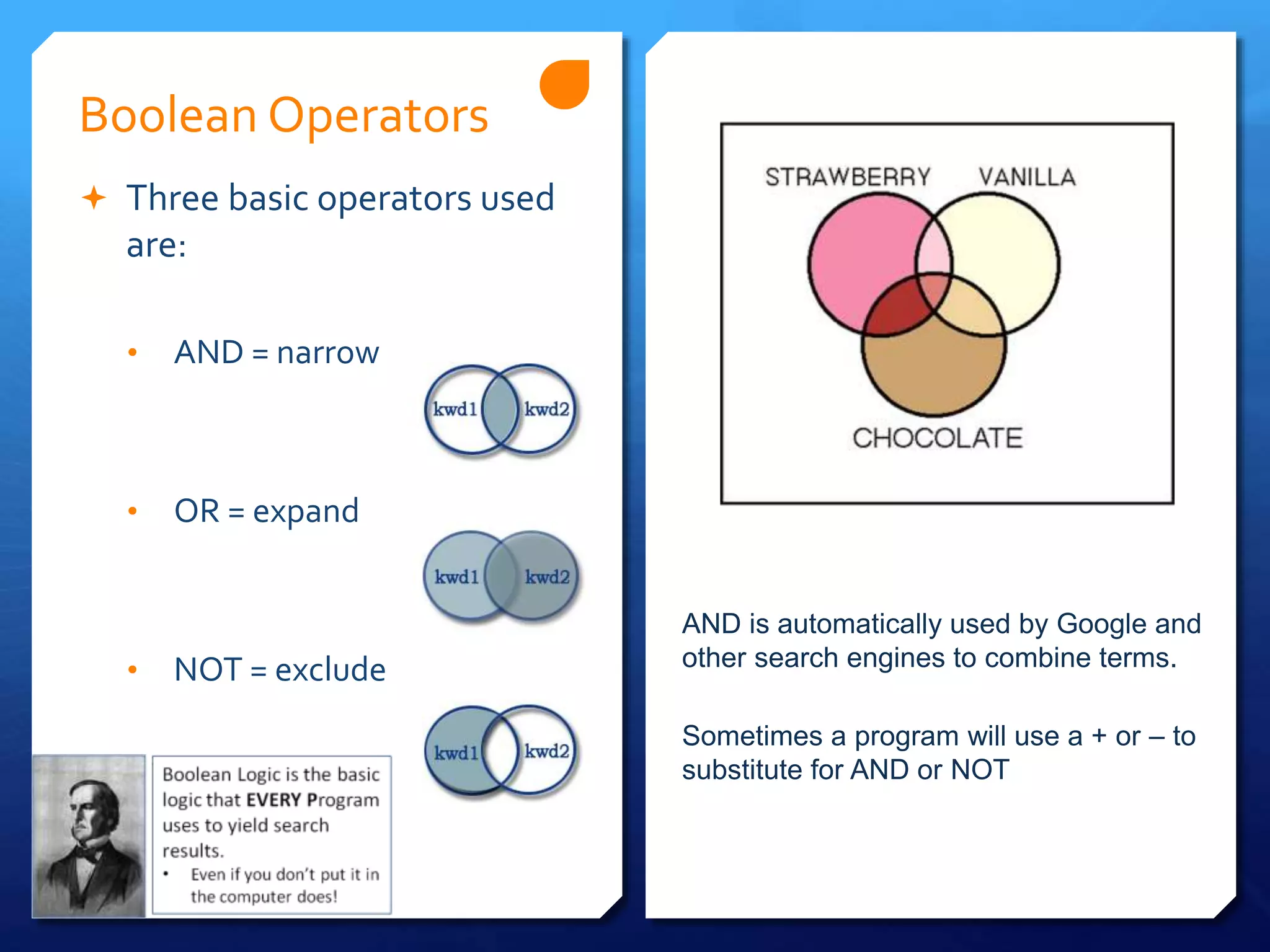
Boolean Operators
 Three basic operators used
are:
• AND = narrow
• OR = expand
• NOT = exclude
AND is automatically used by Google and
other search engines to combine terms.
Sometimes a program will use a + or – to
substitute for AND or NOT
Library Databases
 Boolean operators are used in the library databases.
 Perform a keyword search to see how many articles you can
find .
 Automatically limit your results to
• Scholarly/Peer Review
• Date range
• Full text
Database Searches
Live Demo
Some Other Considerations
 Can I find the full text versions of the articles?
 Are the books checked out that I need?
 Are they at the Athens State Library?
 Can I get sources using Interlibrary Loan (ILL)?
 Do I have time enough to wait for an ILL delivery?
 If necessary, do I have the money to obtain the materials I need?
 Are the articles too old or too recent?
Image source: http://www.weibull.com/basics/rcm.htm
Preliminary Reading & Note-taking Skills
How to Skim/Scan Research
 Read headings, keywords, diagrams, illustrations for
overview of the chapter
 Read intro paragraph/sentence
 Scan for keywords
 Read concluding paragraph/sentence
Image source: http://www.wikihow.com/Avoid-Distractions-While-Studying
Important Sections: Books
 Table of Contents
• List of chapters
o Sometimes have sub content
• Scan to identify chapters relevant to what you want
 Indexes
• Scan for keywords or topics
o Identify specific pages the keyword is on
 Bibliography
• Look at what they cited and see if it is relevant to what you are
doing
• Go find and read those materials
Image source: http://www.huffingtonpost.com/megan-dallacamina/10-books-about-women-feminism-and-work_b_9046628.html
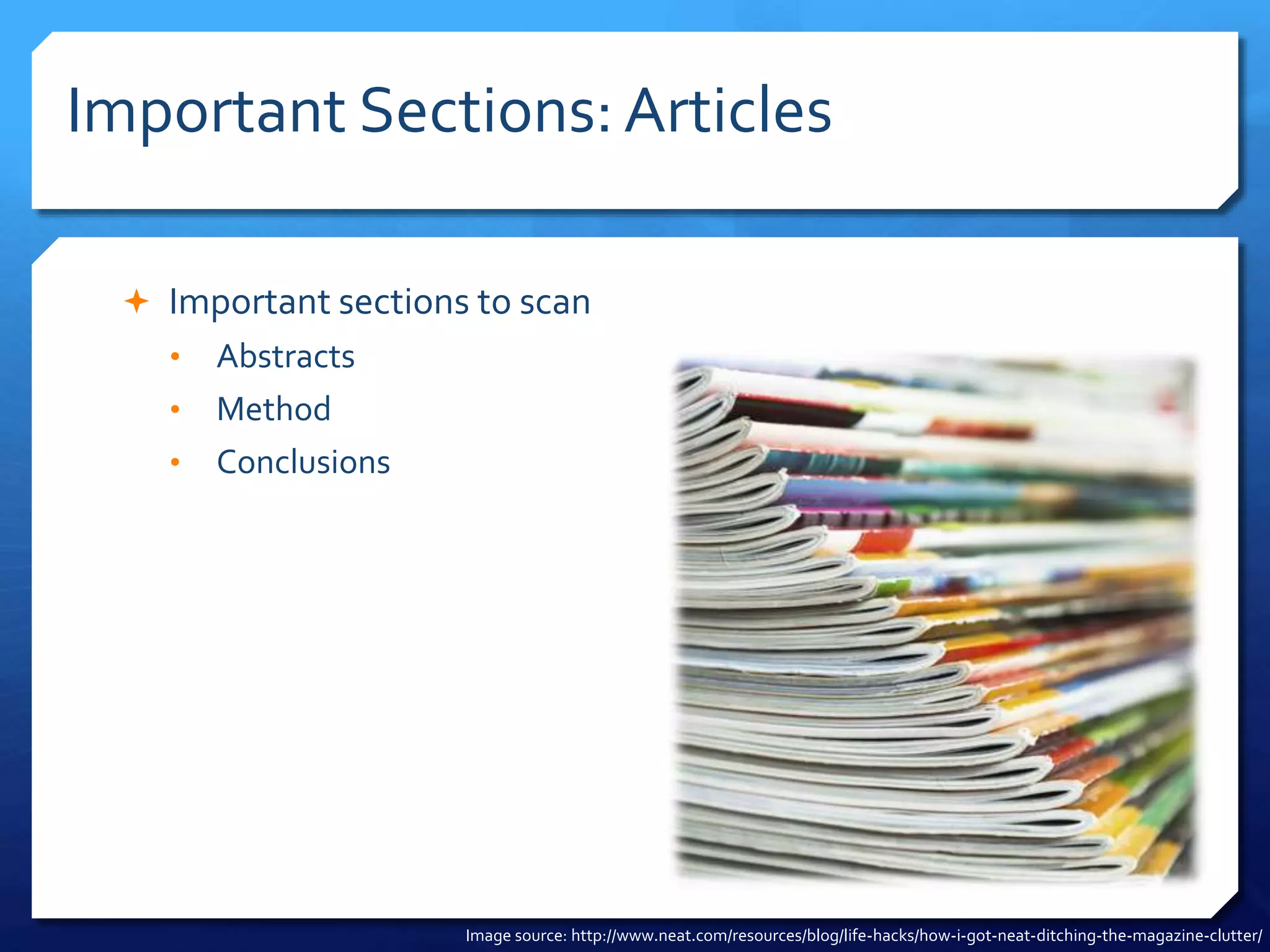
Important Sections: Articles
 Important sections to scan
• Abstracts
• Method
• Conclusions
Image source: http://www.neat.com/resources/blog/life-hacks/how-i-got-neat-ditching-the-magazine-clutter/
In Summary
 Read the assignment
• Identify what you need to
do to make a good grade
 Preliminary Research
 Choose your topic
• Make a research question
• Identify keywords
 BeginYour Research
 Library Databases
• Off campus access
• Limiting
• Downloading or Emailing
 Read Sources andTake
Notes
• Skim/Scan important
areas
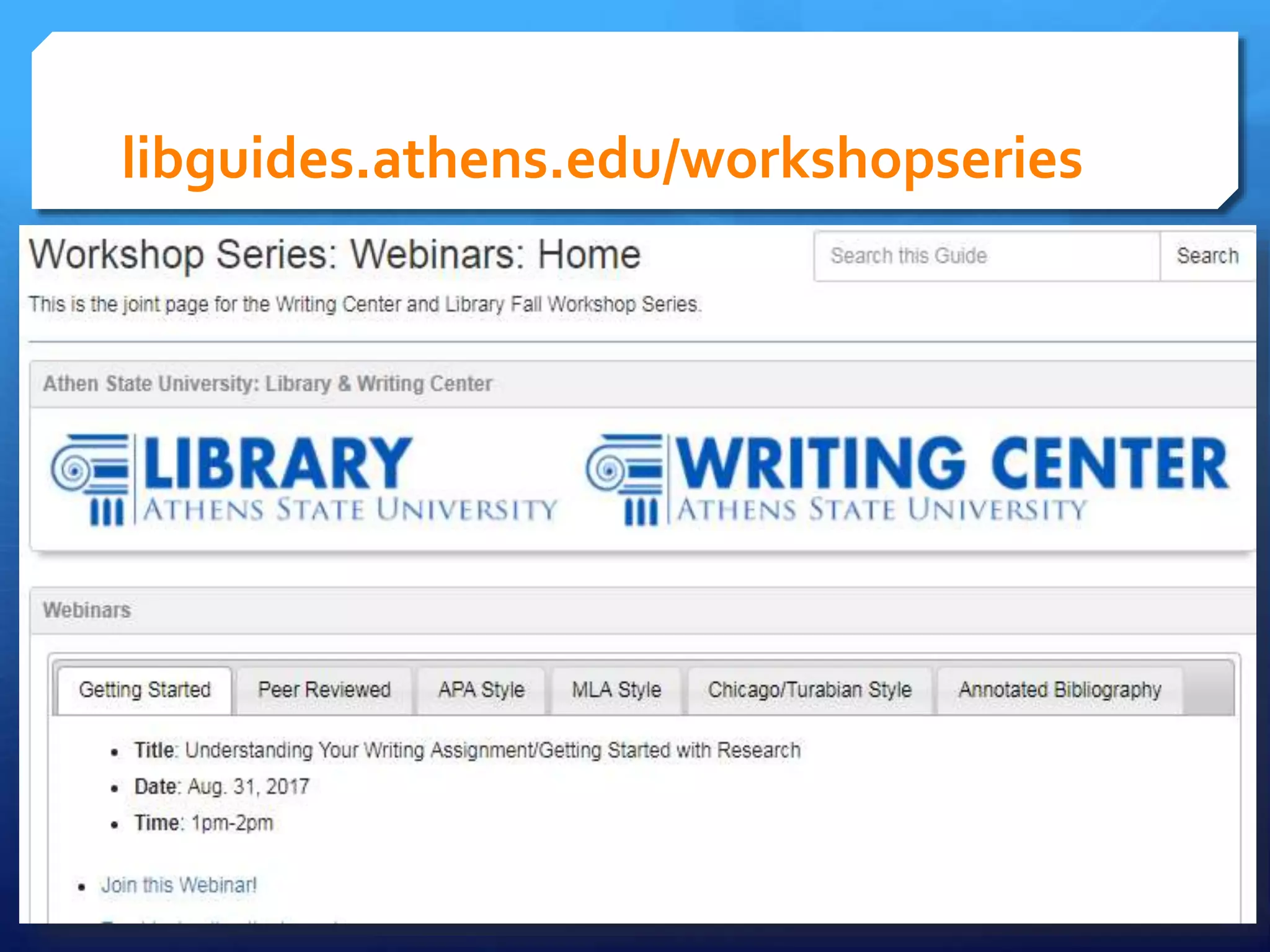
libguides.athens.edu/workshopseries
Phone: 256-216-6661
e-mail: refdesk@athens.edu
Online: www.athens.edu/library
Phone: 256-216-6665
e-mail: writing.center@athens.edu
Online: www.athens.edu/writing-center
Template by K. Riley. Slide creation by Casey Hillis.

Getting started

  • 1.
    UnderstandingYour Assignment & Getting Startedwith Research The Basics of Beginning a Research Paper
  • 2.
    Today’s Goals  4Steps to Understanding the Assignment  Beginning the Research Process
  • 3.
    What is thefirst thing you do after you get a research assignment? Please type your answer in the chat box.
  • 4.
    Step One: Read theAssignment Read and Highlight key aspects
  • 5.
    Read the Assignmentand Highlight Key Aspects  Take your time and focus on reading • Notate anything you are unsure of to ask your professor  Highlight the key aspects • Due date • Requirements • Topic suggestions, etc. Image source: https://www.iconfinder.com/icons/17933/highlight_marker_icon
  • 6.
    StepTwo: Identify what the assignmentis asking you to do… Type and Scope of the assignment … Also begin thinking about your interests
  • 7.
    What Kind ofPaper is this Supposed to Be?  Analytical o breaks down an issue or an idea into its component parts, evaluates the issue or idea, and presents this breakdown and evaluation to the audience  Expository o explains something to the audience  Argumentative o makes a claim about a topic and justifies this claim with specific evidence Source: https://owl.english.purdue.edu/owl/resource/545/01/
  • 8.
    What is theScope of the Assignment?  What is the format of the paper?  How many pages should you write?  How should the information be presented?  What type and how many sources are required?
  • 9.
    Begin exploring yourtopic interests  Ask more specific questions about each topic  DoWikipedia and Google searches to find more information to see which directions the topic could go
  • 10.
    StepThree: Preliminary Research Move beyond Googleand Keep your requirements in mind
  • 11.
    Before you settleon a topic, conduct more extensive research  Move beyond Google and consult more scholarly resources  Keeping in mind: • Length of your paper • Number of sources needed as references  The research will tell you if there are enough sources available to meet those requirements.
  • 12.
    Where would yougo to do more research beyond Google? What are some scholarly sources you know of? Please type your answer in the chat box.
  • 13.
    Step Four: Reread theassignment to chose one topic Find the Sweet Spot
  • 14.
    A good topicchoice must be doable  Too general or too broad of a topic: • Overwhelming amount of information. • Would take too long for the amount of time you have. o FIX: be more specific (choose a sub group or particular factor)  Too narrow or too specific: • You can’t find enough information on it to meet requirements for length or number of reference sources. o FIX: be more general (identify what field or group it belongs to) Find the Sweet Spot
  • 15.
  • 16.
    FormulateYour Research Question Take the topic and make it a question…  The research question will guide to the rest of your research.
  • 17.
    Identifying Keywords  Fromthe question, identify the significant terms.  These terms are the keywords you will use to search for sources in the library databases.  Populating more keywords: • Identify the synonyms and antonyms to your keywords • Use a thesaurus • Brainstorming Image source: https://www.cpcom.com/google-gone-dark-keyword-data-2/
  • 18.
    How has perspectivein Renaissance art helped artists and viewers alike to perceive and create art? Raise your hand if you can identify the keywords in this question.
  • 19.
    Boolean Operators  Threebasic operators used are: • AND = narrow • OR = expand • NOT = exclude AND is automatically used by Google and other search engines to combine terms. Sometimes a program will use a + or – to substitute for AND or NOT
  • 20.
    Library Databases  Booleanoperators are used in the library databases.  Perform a keyword search to see how many articles you can find .  Automatically limit your results to • Scholarly/Peer Review • Date range • Full text
  • 21.
  • 22.
    Some Other Considerations Can I find the full text versions of the articles?  Are the books checked out that I need?  Are they at the Athens State Library?  Can I get sources using Interlibrary Loan (ILL)?  Do I have time enough to wait for an ILL delivery?  If necessary, do I have the money to obtain the materials I need?  Are the articles too old or too recent? Image source: http://www.weibull.com/basics/rcm.htm
  • 23.
    Preliminary Reading &Note-taking Skills
  • 24.
    How to Skim/ScanResearch  Read headings, keywords, diagrams, illustrations for overview of the chapter  Read intro paragraph/sentence  Scan for keywords  Read concluding paragraph/sentence Image source: http://www.wikihow.com/Avoid-Distractions-While-Studying
  • 25.
    Important Sections: Books Table of Contents • List of chapters o Sometimes have sub content • Scan to identify chapters relevant to what you want  Indexes • Scan for keywords or topics o Identify specific pages the keyword is on  Bibliography • Look at what they cited and see if it is relevant to what you are doing • Go find and read those materials Image source: http://www.huffingtonpost.com/megan-dallacamina/10-books-about-women-feminism-and-work_b_9046628.html
  • 26.
    Important Sections: Articles Important sections to scan • Abstracts • Method • Conclusions Image source: http://www.neat.com/resources/blog/life-hacks/how-i-got-neat-ditching-the-magazine-clutter/
  • 27.
    In Summary  Readthe assignment • Identify what you need to do to make a good grade  Preliminary Research  Choose your topic • Make a research question • Identify keywords  BeginYour Research  Library Databases • Off campus access • Limiting • Downloading or Emailing  Read Sources andTake Notes • Skim/Scan important areas
  • 28.
  • 29.
    Phone: 256-216-6661 e-mail: refdesk@athens.edu Online:www.athens.edu/library Phone: 256-216-6665 e-mail: writing.center@athens.edu Online: www.athens.edu/writing-center Template by K. Riley. Slide creation by Casey Hillis.

Editor's Notes