The paper is a BOOK REVIEW & MUST include ALL of the
following
Write a Book Review on the book
SQueezed: Why Our Families Can’t Afford America by Alissa
Quart
Requirements:
Write a 700-800 word review of the book.
The book review should summarize the main points and
arguments of the book.
Discuss how the author did the research for the book.
analyze the strengths and potential ways the book might be
improved. What should come out most clearly is that you
understand why the author wrote the book.
what you think and feel about the arguments presented in it, and
why you think/feel that way.
™
INTRODUCTION TO
JAVA
PROGRAMMING AND
DATA STRUCTURES
COMPREHENSIVE VERSION
Twelfth Edition
Y. Daniel Liang
Georgia Southern University
A01_LIAN9966_12_SE_FM.indd 1 28/09/19 3:26 PM
To Samantha, Michael, and Michelle
LLE ISBN
ISBN-10: 0-13-651996-2
ISBN-13: 978-0-13-651996-6
SE
ISBN-10: 0-13-652023-5
ISBN-13: 978-0-13-652023-8
Microsoft and/or its respective suppliers make no
representations about the suitability of the information
contained
in the documents and related graphics published as part of the
services for any purpose. All such documents and
related graphics are provided “as is” without warranty of any
kind. Microsoft and/or its respective suppliers hereby
disclaim all warranties and conditions with regard to this
information, including all warranties and conditions of
merchantability, whether express, implied or statutory, fitness
for a particular purpose, title and non-infringement.
In no event shall Microsoft and/or its respective suppliers be
liable for any special, indirect or consequential
damages or any damages whatsoever resulting from loss of use,
data or profits, whether in an action of contract,
negligence or other tortious action, arising out of or in
connection with the use or performance of information
available from the services.
The documents and related graphics contained herein could
include technical inaccuracies or typographical errors.
Changes are periodically added to the information herein.
Microsoft and/or its respective suppliers may make
improvements and/or changes in the product(s) and/or the
program(s) described herein at any time. Partial screen
shots may be viewed in full within the software version
specified.
Microsoft® and Windows® are registered trademarks of the
Microsoft Corporation in the U.S.A. and other
countries. This book is not sponsored or endorsed by or
affiliated with the Microsoft Corporation.
Copyright © 2020, 2018, 2015 by Pearson Education, Inc. or its
affiliates, 221 River Street, Hoboken, NJ 07030.
All Rights Reserved. Manufactured in the United States of
America. This publication is protected by copyright, and
permission should be obtained from the publisher prior to any
prohibited reproduction, storage in a retrieval system,
or transmission in any form or by any means, electronic,
mechanical, photocopying, recording, or otherwise. For
information regarding permissions, request forms, and the
appropriate contacts within the Pearson Education Global
Rights and Permissions department, please visit
www.pearsoned.com/permissions/.
Acknowledgments of third-party content appear on the
appropriate page within the text
PEARSON, ALWAYS LEARNING, and MYLAB are exclusive
trademarks owned by Pearson Education, Inc. or
its affiliates in the U.S. and/or other countries.
Unless otherwise indicated herein, any third-party trademarks,
logos, or icons that may appear in this work are the
property of their respective owners, and any references to third-
party trademarks, logos, icons, or other trade dress
are for demonstrative or descriptive purposes only. Such
references are not intended to imply any sponsorship,
endorsement, authorization, or promotion of Pearson’s products
by the owners of such marks, or any relationship
between the owner and Pearson Education, Inc., or its affiliates,
authors, licensees, or distributors.
Library of Congress Cataloging-in-Publication Data
Names: Liang, Y. Daniel, author.
Title: Java programming and data structures / Y. Daniel Liang,
Georgia
Southern University.
Other titles: Introduction to Java programming and data
structures
Description: Twelfth edition. Comprehensive version |
Hoboken, NJ :
Pearson, 2019. | Revised edition of: Introduction to Java
programming
and data structures / Y. Daniel Liang, Georgia Southern
University. Eleventh edition. Comprehensive version. 2018.
| Includes
bibliographical references and index.
Identifiers: LCCN 2019038073 | ISBN 9780136520238
(paperback)
Subjects: LCSH: Java (Computer program language)
Classification: LCC QA76.73.J38 L52 2019 | DDC 005.13/3–
dc23
LC record available at https://lccn.loc.gov/2019038073
ScoutAutomatedPrintCode
A01_LIAN9966_12_SE_FM.indd 2 28/09/19 3:26 PM
iii
Dear Reader,
Many of you have provided feedback on earlier editions of this
book, and your comments and
suggestions have greatly improved the book. This edition has
been substantially enhanced in
presentation, organization, examples, exercises, and
supplements.
The book is fundamentals first by introducing basic
programming concepts and techniques
before designing custom classes. The fundamental concepts and
techniques of selection
statements, loops, methods, and arrays are the foundation for
programming. Building this
strong foundation prepares students to learn object-oriented
programming and advanced Java
programming.
This book teaches programming in a problem-driven way that
focuses on problem solv-
ing rather than syntax. We make introductory programming
interesting by using thought-
provoking problems in a broad context. The central thread of
early chapters is on problem
solving. Appropriate syntax and library are introduced to enable
readers to write programs for
solving the problems. To support the teaching of programming
in a problem-driven way, the
book provides a wide variety of problems at various levels of
difficulty to motivate students.
To appeal to students in all majors, the problems cover many
application areas, including
math, science, business, financial, gaming, animation, and
multimedia.
The book seamlessly integrates programming, data structures,
and algorithms into one text.
It employs a practical approach to teach data structures. We
first introduce how to use various
data structures to develop efficient algorithms, and then show
how to implement these data
structures. Through implementation, students gain a deep
understanding on the efficiency of
data structures and on how and when to use certain data
structures. Finally, we design and
implement custom data structures for trees and graphs.
The book is widely used in the introductory programming, data
structures, and algorithms
courses in the universities around the world. This
comprehensive version covers fundamen-
tals of programming, object-oriented programming, GUI
programming, data structures, algo-
rithms, concurrency, networking, database, and Web
programming. It is designed to prepare
students to become proficient Java programmers. A brief
version (Introduction to Java Pro-
gramming, Brief Version, Twelfth Edition) is available for a
first course on programming,
commonly known as CS1. The brief version contains the first 18
chapters of the comprehen-
sive version. An AP version of the book is also available for
high school students taking an
AP Computer Science course.
The best way to teach programming is by example, and the only
way to learn programming
is by doing. Basic concepts are explained by example and a
large number of exercises with
various levels of difficulty are provided for students to practice.
For our programming courses,
we assign programming exercises after each lecture.
Our goal is to produce a text that teaches problem solving and
programming in a broad
context using a wide variety of interesting examples. If you
have any comments on and
suggestions for improving the book, please email me.
Sincerely,
Y. Daniel Liang
[email protected]
www.pearsonhighered.com/liang
fundamentals-first
problem-driven
data structures
comprehensive version
brief version
AP Computer Science
examples and exercises
PREFACE
A01_LIAN9966_12_SE_FM.indd 3 28/09/19 3:26 PM
iv Prefa ce
ACM/IEEE Curricular 2013 and ABET
Course Assessment
The new ACM/IEEE Computer Science Curricular 2013 defines
the Body of Knowledge
organized into 18 Knowledge Areas. To help instructors design
the courses based on this
book, we provide sample syllabi to identify the Knowledge
Areas and Knowledge Units.
The sample syllabi are for a three semester course sequence
and serve as an example for
institutional customization. The sample syllabi are accessible
from the Instructor Resource
Website.
Many of our users are from the ABET-accredited programs. A
key component of the
ABET accreditation is to identify the weakness through
continuous course assessment
against the course outcomes. We provide sample course
outcomes for the courses and sam-
ple exams for measuring course outcomes on the Instructor
Resource Website.
What’s New in This Edition?
This edition is completely revised in every detail to enhance
clarity, presentation, content,
examples, and exercises. The major improvements are as
follows:
■■ Updated to Java 9, 10, and 11. Examples are improved and
simplified by using the new
features in Java 9, 10, 11.
■■ The GUI chapters are updated to JavaFX 11. The examples
are revised. The user interfaces
in the examples and exercises are now resizable and displayed
in the center of the window.
■■ More examples and exercises in the data structures chapters
use Lambda expressions to
simplify coding.
■■ Both Comparable and Comparator are used to compare
elements in Heap, Priority-
Queue, BST, and AVLTree. This is consistent with the Java API
and is more useful and
flexible.
■■ String matching algorithms are introduced in Chapter 22.
■■ VideoNotes are updated.
■■ Provided additional exercises not printed in the book. These
exercises are available for
instructors only.
Please visit www.pearsonhighered.com/liang for a complete list
of new features as well as
correlations to the previous edition.
Pedagogical Features
The book uses the following elements to help students get the
most from the material:
■■ The Objectives at the beginni ng of each chapter list what
students should learn from
the chapter. This will help them determine whether they have
met the objectives after
completing the chapter.
■■ The Introduction opens the discussion with a thought-
provoking question to motivate the
reader to delve into the chapter.
■■ Key Points highlight the important concepts covered in each
section.
■■ Check Points provide review questions to help students track
their progress as they read
through the chapter and evaluate their learning.
A01_LIAN9966_12_SE_FM.indd 4 28/09/19 3:26 PM
Preface v
■■ Problems and Case Studies, carefully chosen and presented
in an easy-to-follow style,
teach problem solving and programming concepts. The book
uses many small, simple, and
stimulating examples to demonstrate important ideas.
■■ The Chapter Summary reviews the important subjects that
students should understand
and remember. It helps them reinforce the key concepts they
have learned in the chapter.
■■ Quizzes are accessible online, grouped by sections, for
students to do self-test on
programming concepts and techniques.
■■ Programming Exercises are grouped by sections to provide
students with opportunities
to apply the new skills they have learned on their own. The
level of difficulty is rated as
easy (no asterisk), moderate (*), hard (**), or challenging
(***). The trick of learning
programming is practice, practice, and practice. To that end, the
book provides a great
many exercises. Additionally, more than 200 programming
exercises with solutions are
provided to the instructors on the Instructor Resource Website.
These exercises are not
printed in the text.
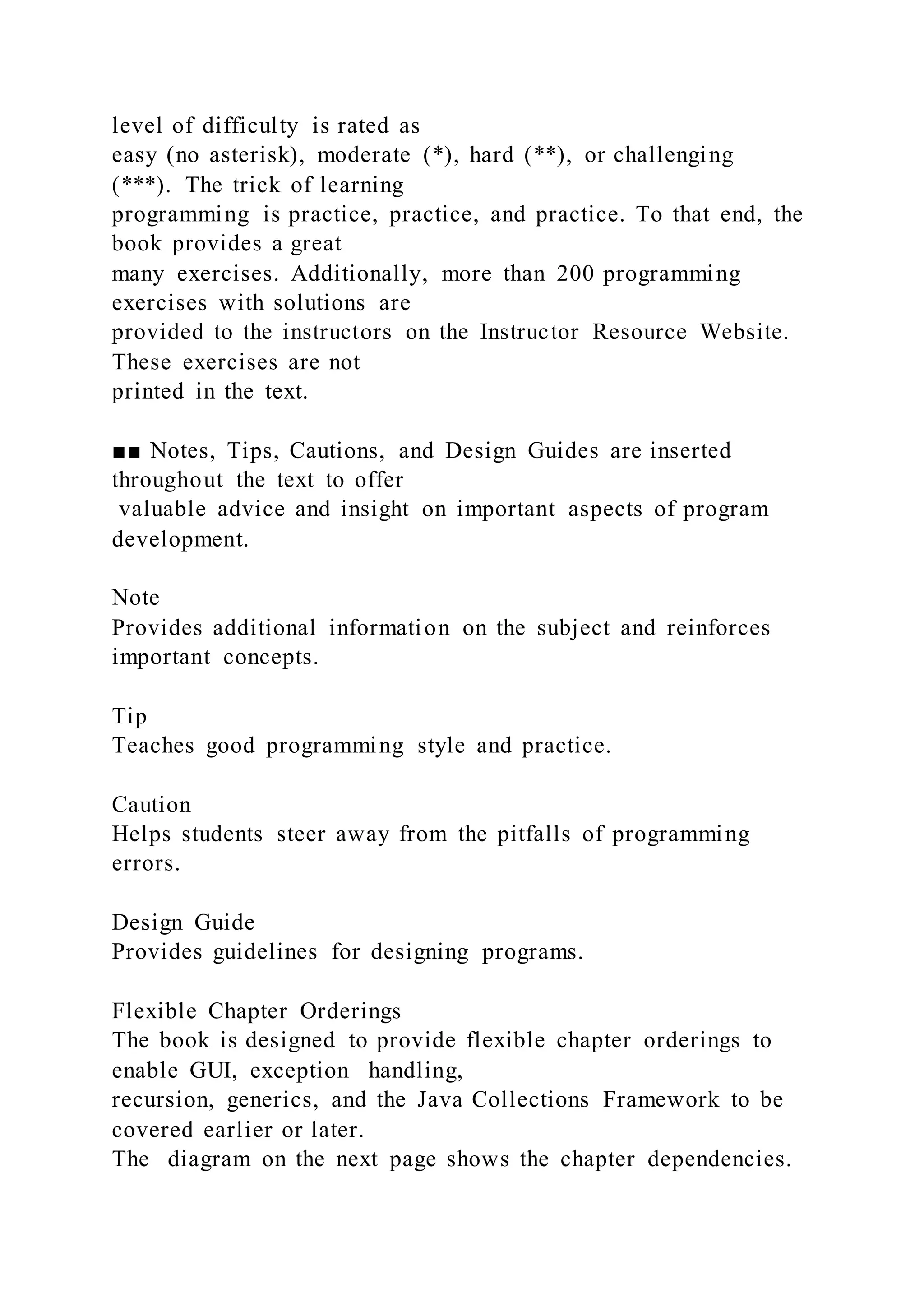
■■ Notes, Tips, Cautions, and Design Guides are inserted
throughout the text to offer
valuable advice and insight on important aspects of program
development.
Note
Provides additional information on the subject and reinforces
important concepts.
Tip
Teaches good programming style and practice.
Caution
Helps students steer away from the pitfalls of programming
errors.
Design Guide
Provides guidelines for designing programs.
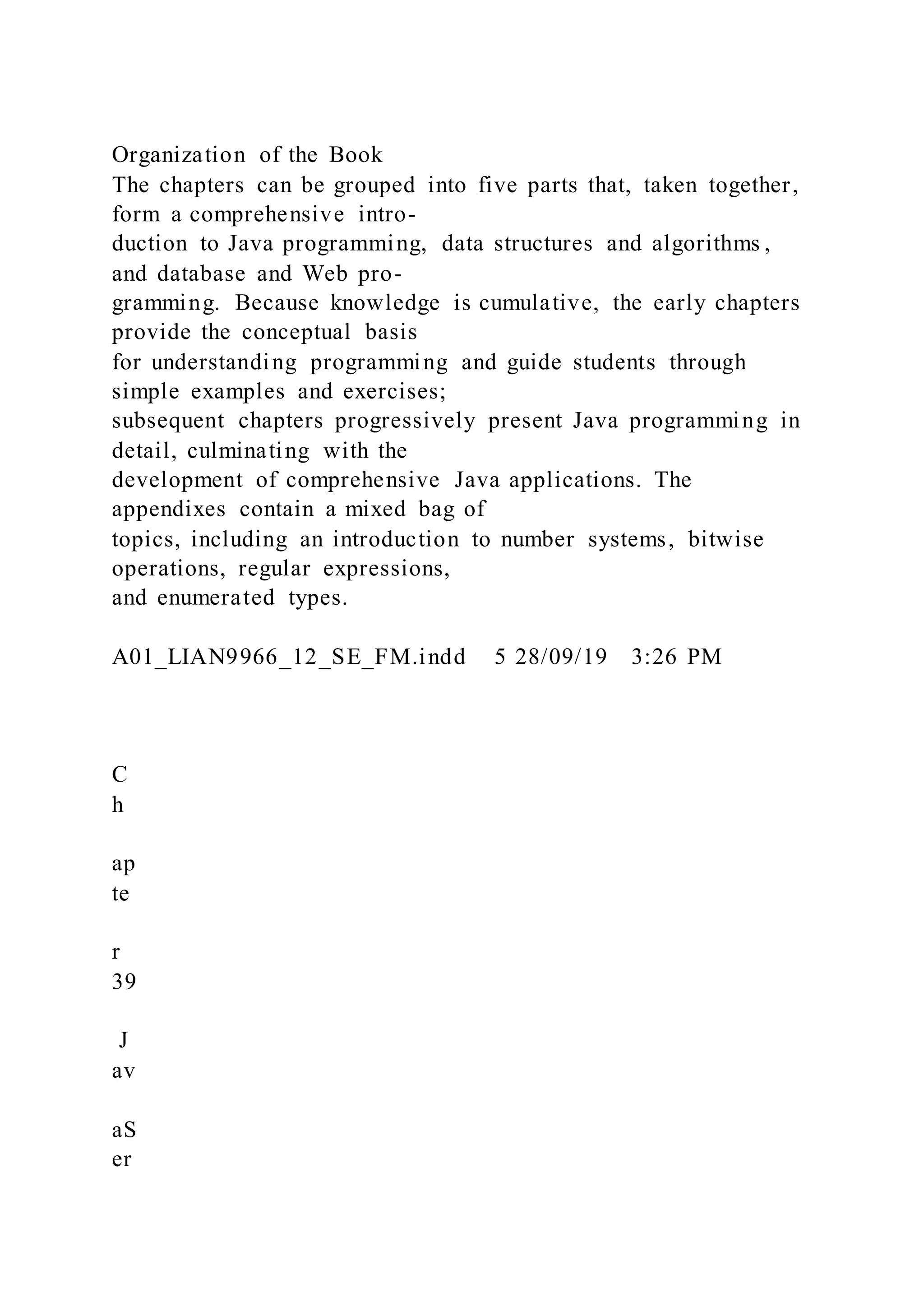
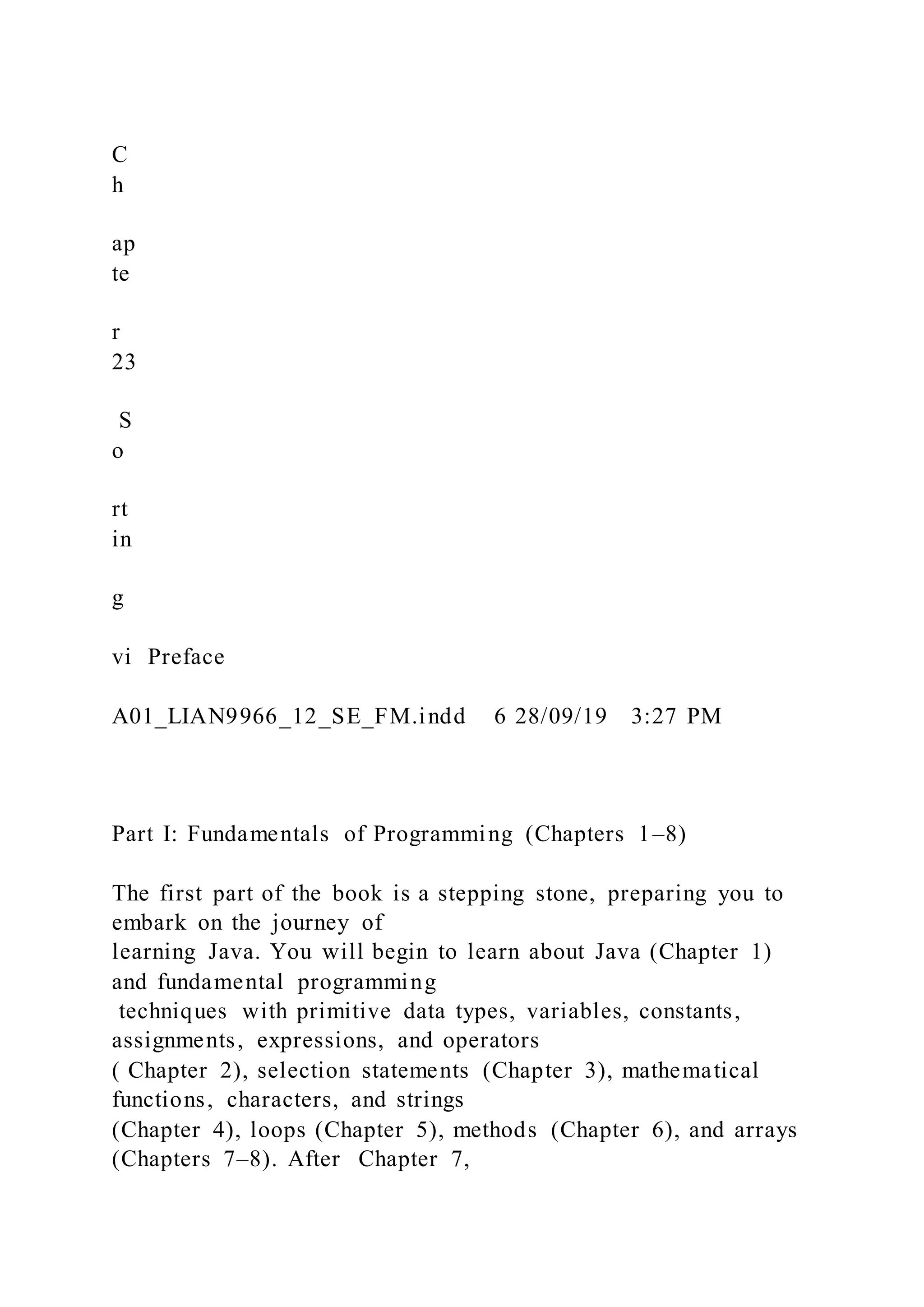
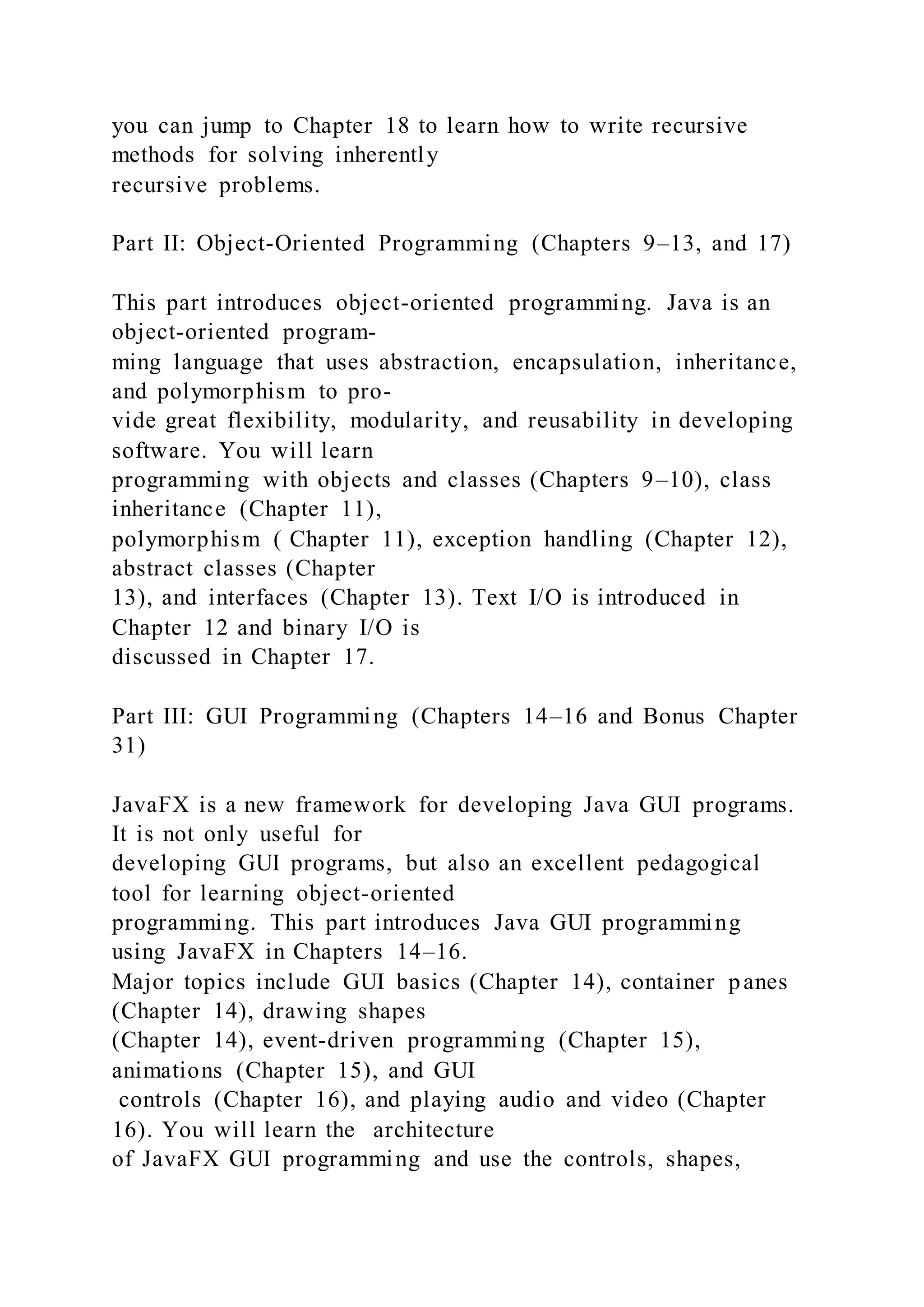
Flexible Chapter Orderings
The book is designed to provide flexible chapter orderings to
enable GUI, exception handling,
recursion, generics, and the Java Collections Framework to be
covered earlier or later.
The diagram on the next page shows the chapter dependencies.
Organization of the Book
The chapters can be grouped into five parts that, taken together,
form a comprehensive intro-
duction to Java programming, data structures and algorithms ,
and database and Web pro-
gramming. Because knowledge is cumulative, the early chapters
provide the conceptual basis
for understanding programming and guide students through
simple examples and exercises;
subsequent chapters progressively present Java programming in
detail, culminating with the
development of comprehensive Java applications. The
appendixes contain a mixed bag of
topics, including an introduction to number systems, bitwise
operations, regular expressions,
and enumerated types.
A01_LIAN9966_12_SE_FM.indd 5 28/09/19 3:26 PM
C
h
ap
te
r
39
J
av
aS
er
ve
r
F
ac
es
C
h
ap
te
r
40
R
M
I
C
h
ap
te
r
41
W
eb
S
er
vi
ce
s
C
h
ap
te
r
44
T
es
ti
n
g
U
si
n
g
JU
n
it
C
h
ap
te
r
38
J
av
aS
er
ve
r
P
ag
es
C
h
ap
te
r
25
B
in
ar
y
S
ea
rc
h
T
re
es
C
h
ap
te
r
26
A
V
L
T
re
es
C
h
ap
te
r
29
W
ei
gh
te
d
G
ra
p
h
s
an
d
A
p
p
li
ca
ti
o
n
s
C
h
ap
te
r
28
G
ra
p
h
s
an
d
A
p
p
li
ca
ti
o
n
s
C
h
ap
te
r
21
S
et
s
an
d
M
ap
s
C
h
ap
te
r
22
D
ev
el
o
p
p
in
g
E
ff
ic
ie
n
t
A
lg
o
ri
th
m
s
C
h
ap
te
r
1
In
tr
o
d
u
ct
io
n
t
o
C
o
m
p
u
te
rs
, P
ro
gr
am
s,
a
n
d
J
av
a
C
h
ap
te
r
2
E
le
m
en
ta
ry
P
ro
gr
am
m
in
g
C
h
ap
te
r
5
L
o
o
p
s
C
h
ap
te
r
7
S
in
gl
e-
D
im
en
si
o
n
al
A
rr
ay
s
C
h
ap
te
r
8
M
u
lt
id
im
en
si
o
n
al
A
rr
ay
s
C
h
ap
te
r
4
M
at
h
em
at
ic
al
F
u
n
ct
io
n
s,
C
h
ar
ac
te
rs
,
a
n
d
S
tr
in
gs
P
ar
t
I:
F
u
n
d
am
en
ta
ls
o
f
P
ro
gr
am
m
in
g
C
h
ap
te
r
3
S
el
ec
ti
o
n
s
C
h
ap
te
r
9
O
b
je
ct
s
an
d
C
la
ss
es
C
h
ap
te
r
17
B
in
ar
y
I/
O
N
o
te
: C
h
ap
te
rs
1
–1
8
ar
e
in
t
h
e
b
ri
ef
v
er
si
o
n
o
f
th
is
b
o
o
k
.
N
o
te
: C
h
ap
te
rs
1
–3
0
ar
e
in
t
h
e
co
m
p
re
h
en
si
ve
v
er
si
o
n
.
N
o
te
: C
h
ap
te
rs
3
1–
44
a
re
b
o
n
u
s
ch
ap
te
rs
a
va
il
ab
le
f
ro
m
t
h
e
C
o
m
p
an
io
n
W
eb
si
te
.
C
h
ap
te
r
10
T
h
in
k
in
g
in
O
b
je
ct
s
C
h
ap
te
r
11
I
n
h
er
it
an
ce
a
n
d
P
o
ly
m
o
rp
h
is
m
C
h
ap
te
r
12
E
xc
ep
ti
o
n
H
an
d
li
n
g
a
n
d
T
ex
t
I/
O
C
h
ap
te
r
13
A
b
st
ra
ct
C
la
ss
es
a
n
d
I
n
te
rf
ac
es
C
h
ap
te
r
6
M
et
h
o
d
s
P
ar
t
II
: O
b
je
ct
-O
ri
en
te
d
P
ro
gr
am
m
in
g
C
h
ap
te
r
32
M
u
lt
it
h
re
ad
in
g
an
d
P
ar
al
le
l P
ro
gr
am
m
in
g
C
h
ap
te
r
36
I
n
te
rn
at
io
n
al
iz
at
io
n
C
h
ap
te
r
33
N
et
w
o
rk
in
g
C
h
ap
te
r
34
J
av
a
D
at
ab
as
e
P
ro
gr
am
m
in
g
C
h
ap
te
r
35
A
d
va
n
ce
d
J
av
a
D
at
ab
as
e
P
ro
gr
am
m
in
g
C
h
ap
te
r
37
S
er
vl
et
s
P
ar
t
V
: A
d
va
n
ce
d
J
av
a
P
ro
gr
am
m
in
g
C
h
ap
te
r
14
J
av
aF
X
B
as
ic
s
C
h
ap
te
r
15
E
ve
n
t-
D
ri
ve
n
P
ro
gr
am
m
in
g
an
d
A
n
im
at
io
n
s
C
h
ap
te
r
20
L
is
ts
, S
ta
ck
s,
Q
u
eu
es
,
a
n
d
P
ri
o
ri
ty
Q
u
eu
es
C
h
ap
te
r
16
J
av
aF
X
C
o
n
tr
o
ls
a
n
d
M
u
lt
im
ed
ia
C
h
ap
te
r
31
A
d
va
n
ce
d
J
av
aF
X
a
n
d
F
X
M
L
P
ar
t
II
I:
G
U
I
P
ro
gr
am
m
in
g
C
h
ap
te
r
18
R
ec
u
rs
io
n
C
h
7
C
h
ap
te
r
19
G
en
er
ic
s
C
h
ap
te
r
24
I
m
p
le
m
en
ti
n
g
L
is
ts
,
S
ta
ck
s,
Q
u
eu
es
, a
n
d
P
ri
o
ri
ty
Q
u
eu
es
P
ar
t
IV
: D
at
a
S
tr
u
ct
u
re
s
an
d
A
lg
o
ri
th
m
s
C
h
1
3
C
h
1
6
C
h
9
C
ha
pt
er
3
0
A
gg
re
ga
te
O
pe
ra
ti
on
s
an
d
C
o
ll
ec
ti
o
n
S
tr
ea
m
s
C
h
ap
te
r
42
2
-4
T
re
es
a
n
d
B
-
T
re
es
C
h
ap
te
r
43
R
ed
-B
la
ck
T
re
es
C
h
ap
te
r
27
H
as
h
in
g
C
h
ap
te
r
23
S
o
rt
in
g
vi Preface
A01_LIAN9966_12_SE_FM.indd 6 28/09/19 3:27 PM
Part I: Fundamentals of Programming (Chapters 1–8)
The first part of the book is a stepping stone, preparing you to
embark on the journey of
learning Java. You will begin to learn about Java (Chapter 1)
and fundamental programming
techniques with primitive data types, variables, constants,
assignments, expressions, and operators
( Chapter 2), selection statements (Chapter 3), mathematical
functions, characters, and strings
(Chapter 4), loops (Chapter 5), methods (Chapter 6), and arrays
(Chapters 7–8). After Chapter 7,
you can jump to Chapter 18 to learn how to write recursive
methods for solving inherently
recursive problems.
Part II: Object-Oriented Programming (Chapters 9–13, and 17)
This part introduces object-oriented programming. Java is an
object-oriented program-
ming language that uses abstraction, encapsulation, inheritance,
and polymorphism to pro-
vide great flexibility, modularity, and reusability in developing
software. You will learn
programming with objects and classes (Chapters 9–10), class
inheritance (Chapter 11),
polymorphism ( Chapter 11), exception handling (Chapter 12),
abstract classes (Chapter
13), and interfaces (Chapter 13). Text I/O is introduced in
Chapter 12 and binary I/O is
discussed in Chapter 17.
Part III: GUI Programming (Chapters 14–16 and Bonus Chapter
31)
JavaFX is a new framework for developing Java GUI programs.
It is not only useful for
developing GUI programs, but also an excellent pedagogical
tool for learning object-oriented
programming. This part introduces Java GUI programming
using JavaFX in Chapters 14–16.
Major topics include GUI basics (Chapter 14), container panes
(Chapter 14), drawing shapes
(Chapter 14), event-driven programming (Chapter 15),
animations (Chapter 15), and GUI
controls (Chapter 16), and playing audio and video (Chapter
16). You will learn the architecture
of JavaFX GUI programming and use the controls, shapes,
panes, image, and video to develop
useful applications. Chapter 31 covers advanced features in
JavaFX.
Part IV: Data Structures and Algorithms (Chapters 18–30 and
Bonus Chapters 42–43)
This part covers the main subjects in a typical data structures
and algorithms course. Chapter 18
introduces recursion to write methods for solving inherently
recursive problems. Chapter 19 presents
how generics can improve software reliability. Chapters 20 and
21 introduce the Java Collection
Framework, which defines a set of useful API for data
structures. Chapter 22 discusses measur-
ing algorithm efficiency in order to choose an appropriate
algorithm for applications. Chapter 23
describes classic sorting algorithms. You will learn how to
implement several classic data struc-
tures lists, queues, and priority queues in Chapter 24. Chapters
25 and 26 introduce binary search
trees and AVL trees. Chapter 27 presents hashing and
implementing maps and sets using hashing.
Chapters 28 and 29 introduce graph applications. Chapter 30
introduces aggregate operations for
collection streams. The 2-4 trees, B-trees, and red-black trees
are covered in Bonus Chapters 42–43.
Part V: Advanced Java Programming (Chapters 32-41, 44)
This part of the book is devoted to advanced Java programming.
Chapter 32 treats the use of
multithreading to make programs more responsive and
interactive and introduces parallel pro-
gramming. Chapter 33 discusses how to write programs that talk
with each other from different
hosts over the Internet. Chapter 34 introduces the use of Java to
develop database projects.
Chapter 35 delves into advanced Java database programming.
Chapter 36 covers the use of
internationalization support to develop projects for international
audiences. Chapters 37 and
38 introduce how to use Java servlets and JavaServer Pages to
generate dynamic content from
Web servers. Chapter 39 introduces modern Web application
development using JavaServer
Faces. Chapter 40 introduces remote method invocation and
Chapter 41 discusses Web ser-
vices. Chapter 44 introduces testing Java programs using JUnit.
Preface vii
A01_LIAN9966_12_SE_FM.indd 7 28/09/19 3:27 PM
Appendixes
This part of the book covers a mixed bag of topics. Appendix A
lists Java keywords. Appendix B
gives tables of ASCII characters and their associated codes in
decimal and in hex. Appen-
dix C shows the operator precedence. Appendix D summarizes
Java modifiers and their usage.
Appendix E discusses special floating-point values. Appendix F
introduces number systems and
conversions among binary, decimal, and hex numbers. Finally,
Appendix G introduces bitwise
operations. Appendix H introduces regular expressions.
Appendix I covers enumerated types.
Java Development Tools
You can use a text editor, such as the Windows Notepad or
WordPad, to create Java programs
and to compile and run the programs from the command
window. You can also use a Java
development tool, such as NetBeans or Eclipse. These tools
support an integrated develop-
ment environment (IDE) for developing Java programs quickly.
Editing, compiling, building,
executing, and debugging programs are integrated in one
graphical user interface. Using these
tools effectively can greatly increase your programming
productivity. NetBeans and Eclipse
are easy to use if you follow the tutorials. Tutorials on
NetBeans and Eclipse can be found in
the supplements on the Companion Website
www.pearsonhighered.com/liang.
Student Resource Website
The Student Resource Website
(www.pearsonhighered.com/liang) contains the following

resources:
■■ Answers to CheckPoint questions
■■
Solution
s to majority of even-numbered programming exercises
■■ Source code for the examples in the book
■■ Interactive quiz (organized by sections for each chapter)

■■ Supplements
■■ Debugging tips
■■ Video notes
■■ Algorithm animations
■■ Errata
Supplements
The text covers the essential subjects. The supplements extend
the text to introduce additional
topics that might be of interest to readers. The supplements are
available from the Companion
Website.
Instructor Resource Website
The Instructor Resource Website, accessible from
www.pearsonhighered.com/liang, contains the
following resources:
■■ Microsoft PowerPoint slides with interactive buttons to view
full-color, syntax-highlighted
source code and to run programs without leaving the slides.
■■

The paper is a book review & must include all of the following

  • 1.
    The paper isa BOOK REVIEW & MUST include ALL of the following Write a Book Review on the book SQueezed: Why Our Families Can’t Afford America by Alissa Quart Requirements: Write a 700-800 word review of the book. The book review should summarize the main points and arguments of the book. Discuss how the author did the research for the book. analyze the strengths and potential ways the book might be improved. What should come out most clearly is that you understand why the author wrote the book. what you think and feel about the arguments presented in it, and why you think/feel that way. ™ INTRODUCTION TO JAVA PROGRAMMING AND DATA STRUCTURES COMPREHENSIVE VERSION Twelfth Edition
  • 2.
    Y. Daniel Liang GeorgiaSouthern University A01_LIAN9966_12_SE_FM.indd 1 28/09/19 3:26 PM To Samantha, Michael, and Michelle LLE ISBN ISBN-10: 0-13-651996-2 ISBN-13: 978-0-13-651996-6 SE ISBN-10: 0-13-652023-5 ISBN-13: 978-0-13-652023-8 Microsoft and/or its respective suppliers make no representations about the suitability of the information contained in the documents and related graphics published as part of the services for any purpose. All such documents and related graphics are provided “as is” without warranty of any kind. Microsoft and/or its respective suppliers hereby disclaim all warranties and conditions with regard to this information, including all warranties and conditions of merchantability, whether express, implied or statutory, fitness for a particular purpose, title and non-infringement. In no event shall Microsoft and/or its respective suppliers be liable for any special, indirect or consequential damages or any damages whatsoever resulting from loss of use, data or profits, whether in an action of contract, negligence or other tortious action, arising out of or in connection with the use or performance of information available from the services.
  • 3.
    The documents andrelated graphics contained herein could include technical inaccuracies or typographical errors. Changes are periodically added to the information herein. Microsoft and/or its respective suppliers may make improvements and/or changes in the product(s) and/or the program(s) described herein at any time. Partial screen shots may be viewed in full within the software version specified. Microsoft® and Windows® are registered trademarks of the Microsoft Corporation in the U.S.A. and other countries. This book is not sponsored or endorsed by or affiliated with the Microsoft Corporation. Copyright © 2020, 2018, 2015 by Pearson Education, Inc. or its affiliates, 221 River Street, Hoboken, NJ 07030. All Rights Reserved. Manufactured in the United States of America. This publication is protected by copyright, and permission should be obtained from the publisher prior to any prohibited reproduction, storage in a retrieval system, or transmission in any form or by any means, electronic, mechanical, photocopying, recording, or otherwise. For information regarding permissions, request forms, and the appropriate contacts within the Pearson Education Global Rights and Permissions department, please visit www.pearsoned.com/permissions/. Acknowledgments of third-party content appear on the appropriate page within the text PEARSON, ALWAYS LEARNING, and MYLAB are exclusive trademarks owned by Pearson Education, Inc. or its affiliates in the U.S. and/or other countries. Unless otherwise indicated herein, any third-party trademarks, logos, or icons that may appear in this work are the
  • 4.
    property of theirrespective owners, and any references to third- party trademarks, logos, icons, or other trade dress are for demonstrative or descriptive purposes only. Such references are not intended to imply any sponsorship, endorsement, authorization, or promotion of Pearson’s products by the owners of such marks, or any relationship between the owner and Pearson Education, Inc., or its affiliates, authors, licensees, or distributors. Library of Congress Cataloging-in-Publication Data Names: Liang, Y. Daniel, author. Title: Java programming and data structures / Y. Daniel Liang, Georgia Southern University. Other titles: Introduction to Java programming and data structures Description: Twelfth edition. Comprehensive version | Hoboken, NJ : Pearson, 2019. | Revised edition of: Introduction to Java programming and data structures / Y. Daniel Liang, Georgia Southern University. Eleventh edition. Comprehensive version. 2018. | Includes bibliographical references and index. Identifiers: LCCN 2019038073 | ISBN 9780136520238 (paperback) Subjects: LCSH: Java (Computer program language) Classification: LCC QA76.73.J38 L52 2019 | DDC 005.13/3– dc23 LC record available at https://lccn.loc.gov/2019038073 ScoutAutomatedPrintCode A01_LIAN9966_12_SE_FM.indd 2 28/09/19 3:26 PM
  • 5.
    iii Dear Reader, Many ofyou have provided feedback on earlier editions of this book, and your comments and suggestions have greatly improved the book. This edition has been substantially enhanced in presentation, organization, examples, exercises, and supplements. The book is fundamentals first by introducing basic programming concepts and techniques before designing custom classes. The fundamental concepts and techniques of selection statements, loops, methods, and arrays are the foundation for programming. Building this strong foundation prepares students to learn object-oriented programming and advanced Java programming. This book teaches programming in a problem-driven way that focuses on problem solv- ing rather than syntax. We make introductory programming interesting by using thought- provoking problems in a broad context. The central thread of early chapters is on problem solving. Appropriate syntax and library are introduced to enable readers to write programs for solving the problems. To support the teaching of programming in a problem-driven way, the book provides a wide variety of problems at various levels of difficulty to motivate students. To appeal to students in all majors, the problems cover many
  • 6.
    application areas, including math,science, business, financial, gaming, animation, and multimedia. The book seamlessly integrates programming, data structures, and algorithms into one text. It employs a practical approach to teach data structures. We first introduce how to use various data structures to develop efficient algorithms, and then show how to implement these data structures. Through implementation, students gain a deep understanding on the efficiency of data structures and on how and when to use certain data structures. Finally, we design and implement custom data structures for trees and graphs. The book is widely used in the introductory programming, data structures, and algorithms courses in the universities around the world. This comprehensive version covers fundamen- tals of programming, object-oriented programming, GUI programming, data structures, algo- rithms, concurrency, networking, database, and Web programming. It is designed to prepare students to become proficient Java programmers. A brief version (Introduction to Java Pro- gramming, Brief Version, Twelfth Edition) is available for a first course on programming, commonly known as CS1. The brief version contains the first 18 chapters of the comprehen- sive version. An AP version of the book is also available for high school students taking an AP Computer Science course. The best way to teach programming is by example, and the only way to learn programming
  • 7.
    is by doing.Basic concepts are explained by example and a large number of exercises with various levels of difficulty are provided for students to practice. For our programming courses, we assign programming exercises after each lecture. Our goal is to produce a text that teaches problem solving and programming in a broad context using a wide variety of interesting examples. If you have any comments on and suggestions for improving the book, please email me. Sincerely, Y. Daniel Liang [email protected] www.pearsonhighered.com/liang fundamentals-first problem-driven data structures comprehensive version brief version AP Computer Science examples and exercises PREFACE A01_LIAN9966_12_SE_FM.indd 3 28/09/19 3:26 PM
  • 8.
    iv Prefa ce ACM/IEEECurricular 2013 and ABET Course Assessment The new ACM/IEEE Computer Science Curricular 2013 defines the Body of Knowledge organized into 18 Knowledge Areas. To help instructors design the courses based on this book, we provide sample syllabi to identify the Knowledge Areas and Knowledge Units. The sample syllabi are for a three semester course sequence and serve as an example for institutional customization. The sample syllabi are accessible from the Instructor Resource Website. Many of our users are from the ABET-accredited programs. A key component of the ABET accreditation is to identify the weakness through continuous course assessment against the course outcomes. We provide sample course outcomes for the courses and sam- ple exams for measuring course outcomes on the Instructor Resource Website. What’s New in This Edition? This edition is completely revised in every detail to enhance clarity, presentation, content, examples, and exercises. The major improvements are as follows: ■■ Updated to Java 9, 10, and 11. Examples are improved and simplified by using the new features in Java 9, 10, 11.
  • 9.
    ■■ The GUIchapters are updated to JavaFX 11. The examples are revised. The user interfaces in the examples and exercises are now resizable and displayed in the center of the window. ■■ More examples and exercises in the data structures chapters use Lambda expressions to simplify coding. ■■ Both Comparable and Comparator are used to compare elements in Heap, Priority- Queue, BST, and AVLTree. This is consistent with the Java API and is more useful and flexible. ■■ String matching algorithms are introduced in Chapter 22. ■■ VideoNotes are updated. ■■ Provided additional exercises not printed in the book. These exercises are available for instructors only. Please visit www.pearsonhighered.com/liang for a complete list of new features as well as correlations to the previous edition. Pedagogical Features The book uses the following elements to help students get the most from the material: ■■ The Objectives at the beginni ng of each chapter list what students should learn from the chapter. This will help them determine whether they have met the objectives after completing the chapter.
  • 10.
    ■■ The Introductionopens the discussion with a thought- provoking question to motivate the reader to delve into the chapter. ■■ Key Points highlight the important concepts covered in each section. ■■ Check Points provide review questions to help students track their progress as they read through the chapter and evaluate their learning. A01_LIAN9966_12_SE_FM.indd 4 28/09/19 3:26 PM Preface v ■■ Problems and Case Studies, carefully chosen and presented in an easy-to-follow style, teach problem solving and programming concepts. The book uses many small, simple, and stimulating examples to demonstrate important ideas. ■■ The Chapter Summary reviews the important subjects that students should understand and remember. It helps them reinforce the key concepts they have learned in the chapter. ■■ Quizzes are accessible online, grouped by sections, for students to do self-test on programming concepts and techniques. ■■ Programming Exercises are grouped by sections to provide students with opportunities to apply the new skills they have learned on their own. The
  • 11.
    level of difficultyis rated as easy (no asterisk), moderate (*), hard (**), or challenging (***). The trick of learning programming is practice, practice, and practice. To that end, the book provides a great many exercises. Additionally, more than 200 programming exercises with solutions are provided to the instructors on the Instructor Resource Website. These exercises are not printed in the text. ■■ Notes, Tips, Cautions, and Design Guides are inserted throughout the text to offer valuable advice and insight on important aspects of program development. Note Provides additional information on the subject and reinforces important concepts. Tip Teaches good programming style and practice. Caution Helps students steer away from the pitfalls of programming errors. Design Guide Provides guidelines for designing programs. Flexible Chapter Orderings The book is designed to provide flexible chapter orderings to enable GUI, exception handling, recursion, generics, and the Java Collections Framework to be covered earlier or later. The diagram on the next page shows the chapter dependencies.
  • 12.
    Organization of theBook The chapters can be grouped into five parts that, taken together, form a comprehensive intro- duction to Java programming, data structures and algorithms , and database and Web pro- gramming. Because knowledge is cumulative, the early chapters provide the conceptual basis for understanding programming and guide students through simple examples and exercises; subsequent chapters progressively present Java programming in detail, culminating with the development of comprehensive Java applications. The appendixes contain a mixed bag of topics, including an introduction to number systems, bitwise operations, regular expressions, and enumerated types. A01_LIAN9966_12_SE_FM.indd 5 28/09/19 3:26 PM C h ap te r 39 J av aS er
  • 13.
  • 14.
  • 15.
  • 16.
  • 17.
  • 18.
  • 19.
  • 20.
  • 21.
  • 22.
  • 23.
  • 24.
  • 25.
  • 26.
  • 27.
  • 28.
  • 29.
  • 30.
  • 31.
  • 32.
  • 33.
  • 34.
  • 35.
  • 36.
  • 37.
  • 38.
  • 39.
  • 40.
  • 41.
  • 42.
  • 43.
  • 44.
  • 45.
  • 46.
  • 47.
  • 48.
  • 49.
  • 50.
  • 51.
  • 52.
  • 53.
  • 54.
  • 55.
  • 56.
  • 57.
  • 58.
  • 59.
    C h ap te r 23 S o rt in g vi Preface A01_LIAN9966_12_SE_FM.indd 628/09/19 3:27 PM Part I: Fundamentals of Programming (Chapters 1–8) The first part of the book is a stepping stone, preparing you to embark on the journey of learning Java. You will begin to learn about Java (Chapter 1) and fundamental programming techniques with primitive data types, variables, constants, assignments, expressions, and operators ( Chapter 2), selection statements (Chapter 3), mathematical functions, characters, and strings (Chapter 4), loops (Chapter 5), methods (Chapter 6), and arrays (Chapters 7–8). After Chapter 7,
  • 60.
    you can jumpto Chapter 18 to learn how to write recursive methods for solving inherently recursive problems. Part II: Object-Oriented Programming (Chapters 9–13, and 17) This part introduces object-oriented programming. Java is an object-oriented program- ming language that uses abstraction, encapsulation, inheritance, and polymorphism to pro- vide great flexibility, modularity, and reusability in developing software. You will learn programming with objects and classes (Chapters 9–10), class inheritance (Chapter 11), polymorphism ( Chapter 11), exception handling (Chapter 12), abstract classes (Chapter 13), and interfaces (Chapter 13). Text I/O is introduced in Chapter 12 and binary I/O is discussed in Chapter 17. Part III: GUI Programming (Chapters 14–16 and Bonus Chapter 31) JavaFX is a new framework for developing Java GUI programs. It is not only useful for developing GUI programs, but also an excellent pedagogical tool for learning object-oriented programming. This part introduces Java GUI programming using JavaFX in Chapters 14–16. Major topics include GUI basics (Chapter 14), container panes (Chapter 14), drawing shapes (Chapter 14), event-driven programming (Chapter 15), animations (Chapter 15), and GUI controls (Chapter 16), and playing audio and video (Chapter 16). You will learn the architecture of JavaFX GUI programming and use the controls, shapes,
  • 61.
    panes, image, andvideo to develop useful applications. Chapter 31 covers advanced features in JavaFX. Part IV: Data Structures and Algorithms (Chapters 18–30 and Bonus Chapters 42–43) This part covers the main subjects in a typical data structures and algorithms course. Chapter 18 introduces recursion to write methods for solving inherently recursive problems. Chapter 19 presents how generics can improve software reliability. Chapters 20 and 21 introduce the Java Collection Framework, which defines a set of useful API for data structures. Chapter 22 discusses measur- ing algorithm efficiency in order to choose an appropriate algorithm for applications. Chapter 23 describes classic sorting algorithms. You will learn how to implement several classic data struc- tures lists, queues, and priority queues in Chapter 24. Chapters 25 and 26 introduce binary search trees and AVL trees. Chapter 27 presents hashing and implementing maps and sets using hashing. Chapters 28 and 29 introduce graph applications. Chapter 30 introduces aggregate operations for collection streams. The 2-4 trees, B-trees, and red-black trees are covered in Bonus Chapters 42–43. Part V: Advanced Java Programming (Chapters 32-41, 44) This part of the book is devoted to advanced Java programming. Chapter 32 treats the use of multithreading to make programs more responsive and interactive and introduces parallel pro- gramming. Chapter 33 discusses how to write programs that talk with each other from different
  • 62.
    hosts over theInternet. Chapter 34 introduces the use of Java to develop database projects. Chapter 35 delves into advanced Java database programming. Chapter 36 covers the use of internationalization support to develop projects for international audiences. Chapters 37 and 38 introduce how to use Java servlets and JavaServer Pages to generate dynamic content from Web servers. Chapter 39 introduces modern Web application development using JavaServer Faces. Chapter 40 introduces remote method invocation and Chapter 41 discusses Web ser- vices. Chapter 44 introduces testing Java programs using JUnit. Preface vii A01_LIAN9966_12_SE_FM.indd 7 28/09/19 3:27 PM Appendixes This part of the book covers a mixed bag of topics. Appendix A lists Java keywords. Appendix B gives tables of ASCII characters and their associated codes in decimal and in hex. Appen- dix C shows the operator precedence. Appendix D summarizes Java modifiers and their usage. Appendix E discusses special floating-point values. Appendix F introduces number systems and conversions among binary, decimal, and hex numbers. Finally, Appendix G introduces bitwise operations. Appendix H introduces regular expressions. Appendix I covers enumerated types. Java Development Tools
  • 63.
    You can usea text editor, such as the Windows Notepad or WordPad, to create Java programs and to compile and run the programs from the command window. You can also use a Java development tool, such as NetBeans or Eclipse. These tools support an integrated develop- ment environment (IDE) for developing Java programs quickly. Editing, compiling, building, executing, and debugging programs are integrated in one graphical user interface. Using these tools effectively can greatly increase your programming productivity. NetBeans and Eclipse are easy to use if you follow the tutorials. Tutorials on NetBeans and Eclipse can be found in the supplements on the Companion Website www.pearsonhighered.com/liang. Student Resource Website The Student Resource Website (www.pearsonhighered.com/liang) contains the following resources: ■■ Answers to CheckPoint questions ■■ Solution s to majority of even-numbered programming exercises ■■ Source code for the examples in the book
  • 64.
    ■■ Interactive quiz(organized by sections for each chapter) ■■ Supplements ■■ Debugging tips ■■ Video notes ■■ Algorithm animations ■■ Errata Supplements The text covers the essential subjects. The supplements extend the text to introduce additional topics that might be of interest to readers. The supplements are available from the Companion Website. Instructor Resource Website The Instructor Resource Website, accessible from www.pearsonhighered.com/liang, contains the following resources: ■■ Microsoft PowerPoint slides with interactive buttons to view
  • 65.
    full-color, syntax-highlighted source codeand to run programs without leaving the slides. ■■