Keeping your team on the crest of the wave Coaching in a leadership role Carol Brooks   Derbyshire County Council
What is coaching? “ The practice of coaching may be described as a profession which helps individuals or organisations to achieve optimal performance, overcomes obstacles and barriers to growth, and reach specific goals and challenges as a means to fulfilment personal & professional development, work/life balance and prevention”.  Association for Coaching
How did it come about? “ I cannot teach anyone anything – I can only make him think”.  Socrates Freud and Jung Maslow and Perlz Self-directed learning Performance coaching Focuses on raising awareness and self-knowledge
The Leadership Role "Leadership is not a person or a position. It is a complex moral relationship between people, based on trust, obligation, commitment, emotion, and a shared vision of the good."  Joanne Ciulla (1998)  "The growth and development of people is the highest calling of leadership."  Harvey S. Firestone "You manage things, you lead people."  Admiral Grace Murray Hooper, US naval officer (1906-1992)   "A leader is best when people barely know that he exists, … 'Fail to honour people they fail to honour you.' But of a good leader, who talks little, when his work is done, his aim fulfilled, they will all say, 'We did this ourselves.'"  Lao Tzu, Chinese founder of Taoism, author (6th Century BC)
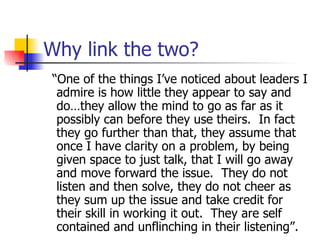
Why link the two? “ One of the things I’ve noticed about leaders I admire is how little they appear to say and do…they allow the mind to go as far as it possibly can before they use theirs.  In fact they go further than that, they assume that once I have clarity on a problem, by being given space to just talk, that I will go away and move forward the issue.  They do not listen and then solve, they do not cheer as they sum up the issue and take credit for their skill in working it out.  They are self contained and unflinching in their listening”.
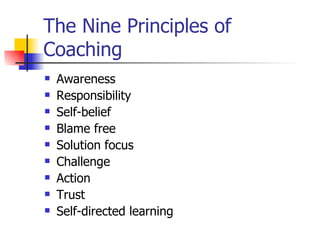
The Nine Principles of Coaching Awareness Responsibility Self-belief Blame free Solution focus Challenge Action Trust Self-directed learning
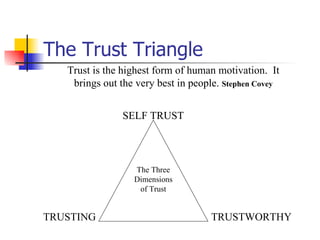
The Trust Triangle Trust is the highest form of human motivation.  It brings out the very best in people.   Stephen Covey SELF TRUST TRUSTWORTHY TRUSTING The Three Dimensions of Trust
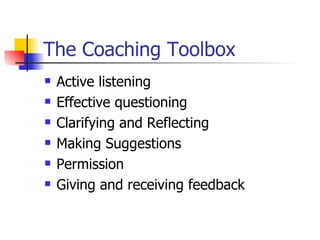
The Coaching Toolbox Active listening Effective questioning Clarifying and Reflecting Making Suggestions Permission Giving and receiving feedback
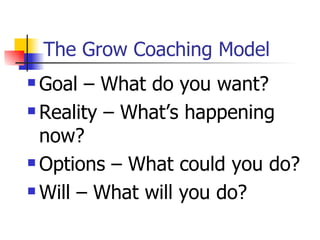
The Grow Coaching Model Goal – What do you want? Reality – What’s happening now? Options – What could you do? Will – What will you do?
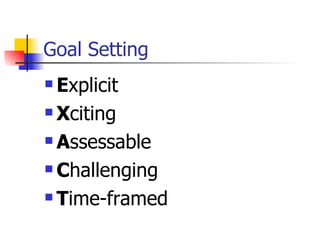
Goal Setting E xplicit X citing A ssessable C hallenging T ime-framed
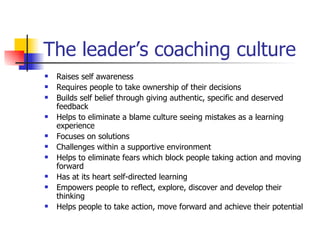
The leader’s coaching culture Raises self awareness Requires people to take ownership of their decisions Builds self belief through giving authentic, specific and deserved feedback  Helps to eliminate a blame culture seeing mistakes as a learning experience Focuses on solutions Challenges within a supportive environment Helps to eliminate fears which block people taking action and moving forward Has at its heart self-directed learning Empowers people to reflect, explore, discover and develop their thinking Helps people to take action, move forward and achieve their potential
Acknowledgments Many thanks to wonderful coach training by Deb Barnard – Relational Dynamics 1st

Using coaching in a leadership role

  • 1.
    Keeping your teamon the crest of the wave Coaching in a leadership role Carol Brooks Derbyshire County Council
  • 2.
    What is coaching?“ The practice of coaching may be described as a profession which helps individuals or organisations to achieve optimal performance, overcomes obstacles and barriers to growth, and reach specific goals and challenges as a means to fulfilment personal & professional development, work/life balance and prevention”. Association for Coaching
  • 3.
    How did itcome about? “ I cannot teach anyone anything – I can only make him think”. Socrates Freud and Jung Maslow and Perlz Self-directed learning Performance coaching Focuses on raising awareness and self-knowledge
  • 4.
    The Leadership Role"Leadership is not a person or a position. It is a complex moral relationship between people, based on trust, obligation, commitment, emotion, and a shared vision of the good." Joanne Ciulla (1998)  "The growth and development of people is the highest calling of leadership." Harvey S. Firestone "You manage things, you lead people." Admiral Grace Murray Hooper, US naval officer (1906-1992) "A leader is best when people barely know that he exists, … 'Fail to honour people they fail to honour you.' But of a good leader, who talks little, when his work is done, his aim fulfilled, they will all say, 'We did this ourselves.'" Lao Tzu, Chinese founder of Taoism, author (6th Century BC)
  • 5.
    Why link thetwo? “ One of the things I’ve noticed about leaders I admire is how little they appear to say and do…they allow the mind to go as far as it possibly can before they use theirs. In fact they go further than that, they assume that once I have clarity on a problem, by being given space to just talk, that I will go away and move forward the issue. They do not listen and then solve, they do not cheer as they sum up the issue and take credit for their skill in working it out. They are self contained and unflinching in their listening”.
  • 6.
    The Nine Principlesof Coaching Awareness Responsibility Self-belief Blame free Solution focus Challenge Action Trust Self-directed learning
  • 7.
    The Trust TriangleTrust is the highest form of human motivation. It brings out the very best in people. Stephen Covey SELF TRUST TRUSTWORTHY TRUSTING The Three Dimensions of Trust
  • 8.
    The Coaching ToolboxActive listening Effective questioning Clarifying and Reflecting Making Suggestions Permission Giving and receiving feedback
  • 9.
    The Grow CoachingModel Goal – What do you want? Reality – What’s happening now? Options – What could you do? Will – What will you do?
  • 10.
    Goal Setting Explicit X citing A ssessable C hallenging T ime-framed
  • 11.
    The leader’s coachingculture Raises self awareness Requires people to take ownership of their decisions Builds self belief through giving authentic, specific and deserved feedback Helps to eliminate a blame culture seeing mistakes as a learning experience Focuses on solutions Challenges within a supportive environment Helps to eliminate fears which block people taking action and moving forward Has at its heart self-directed learning Empowers people to reflect, explore, discover and develop their thinking Helps people to take action, move forward and achieve their potential
  • 12.
    Acknowledgments Many thanksto wonderful coach training by Deb Barnard – Relational Dynamics 1st