












Leadership“No amount of darkness can dim the light of  just one candle”Puyallup School  DistrictAugust 19, 2009gsharratt@wsu.edu
There is no elevator to success.You must take the stairs . . .one step at a time.
“Change means movement;movement means friction.”Saul Alinsky(en.thinkexist.com)
Never mistake motionfor action.Ernest Hemingway
“You are today where your thoughts have brought you. You will be tomorrow where your thoughts take you.”James Allen (www.brainyquote.com)
A school is . . . A building of four walls with the future inside.
“Instead of helping some kids beat the odds . . .. . . why don’t we just change the odds?”Geoff Canada, Founder, Harlem Children’s Zone (2004)
Demographics are notdestiny
A lot of people have gone farther than they thought they could . . . because someone else thought they would.
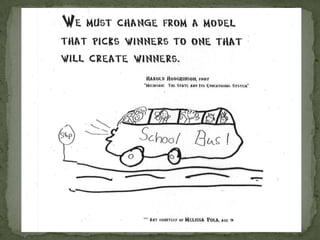
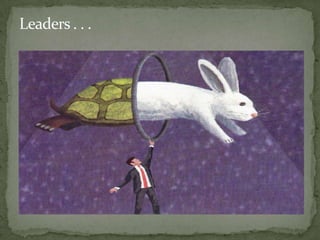
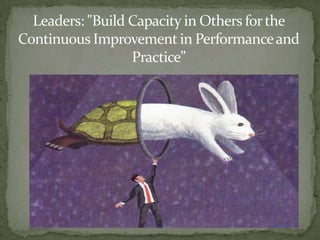
How would you caption this drawing?
Leaders . . .
Leaders: "Build Capacity in Others for the Continuous Improvement in Performance and Practice”
The Leadership Challenge“The quality of leadership in our schools has seldom mattered more . . . principals and superintendents have the job not only of managing our schools, but also of leading them through an era of profound social change that has required fundamental rethinking of what schools do and how they do it.”Arthur Levine (2005)
Leaders Who Build Capacity“An approach to educational change that has the twin purposes of	(1) enhancing student achievement and   (2) strengthening the schools capacity for     managing change.”Hopkins et al. (1994)
“Leadership Matters!”It matters a great deal in leading a learning culture where staff and students improve in practice and performance.
What is the purpose of educational leadership?
“The purpose of leadership is the improvement of instructional practice, regardless of one’s role.”Richard Elmore (Harvard University)
Leadership is . . .“Doing right things right.”Kenneth Leithwood, 2004
As a leader, what are the “right things” to do in you building?What evidence do you have that you are “doing the right things right?”
Leading with the “Right Work”“The right work at both the school level and the district level is to do something that impacts the classroom.”Waters & Marzano (2006)
Leaders build capacity, not dependency.
When Educators Learn - Students Learn“Leaders are responsible for building the capacity in individuals, teams, and organizations to be leaders and learners.”Hirsh & Killion (2009)
Leaders Build Capacity“Members of authentic learning communities can solve their most complex and pressing problems by tapping into their own capacity and internal expertise.”“Individuals in dependency-prone environments lose their identify as professionals and become complicit workers, which removes individual commitment and investment in the outcomes.”Hirsh & Killion (2009)
What lies within . . .“. . .  The prescriptions for improving schools must not come primarily from outside of schools. The most lasting and important changes will come from within and will draw on the great resources within schools.”Roland Barth (2005)
Adult behavior changes when . . . If you want to change people’s behavior, “You need to create a community around them, where these new beliefs could be practical, expressed and nurtured” (p. 173).Fullan (2005)
How do you build capacity in others for their continued improvement?How do you create dependency?
BreakJohnny Carson
As a Leader You Know . . .What gets measured gets done.What gets rewardedgets repeated.
What do you measure to ensure it gets completed?What do you reward to ensure it gets repeated?
You Get What You RewardIf you want teamwork . . . recognize collaboration.If you want quality performance . . . recognize results achieved.If you want employees toaim high . . .recognize meeting stretch goals	and don’t punish those who fall a little short.
You Get What You RewardIf you want problem-solving . . . recognize problem identification and resolution.If you want creativity . . .recognize and value creative ideas.If you want knowledge sharing . . . recognize and model agency expertise.If you want effective training . . . recognize and job-embedded skills used in the work of staff and student improvement.
The Five PracticesJames M. Kouzes and Barry Z. PosnerSanta Clara UniversityModel the Way Inspire a Shared VisionChallenge the ProcessEnable Others to ActEncourage the Heart
Model the Way“The action that made the most difference was setting a personal example.”Idan Baqr-Sade, BridgeWaveSetting the ExampleClarifying ValuesFind your voice by clarifying your personal valuesAffirm shared values. Unity is forged, not forcedPersonify the shared valuesTeach others to model the values
Inspire a Shared Vision“You have to paint a powerfully compelling picture of the future for people to want to align with the vision.”Vicky Ngo-Roberti, VMware, Inc.Envisioning the FutureEnlisting OthersEnvision the future by imagining exciting and ennobling possibilitiesFind a common purpose by listening to othersEnlist others in the common vision by appealing to shared aspirationsAnimate the vision through speaking from the heart with positive communication
Challenge the Process“Leaders are not afraid to take risks and step outside of their comfort zone.”Chris Hintz, Cisco SystemsExperiment and Take RisksSearch for OpportunitiesExperiment and take risks by constantly generating small wins and learning from mistakesLearn from experienceSeize the initiative and seek innovative ways to change, grow and improveExercise insight and let ideas flow freely from the outside in
Enable Others to Act“To be successful, teams must adopt a www.com (we will win) mind-set, and not an imm.com (I, me, myself) mind-set.”Lily Cheng, PACE Learning & ConsultancyStrengthen OthersFoster CollaborationFoster collaboration by promoting cooperative goals and building trustFacilitate relationships. Every significant relationship should be treated as if it will last a lifetimeHelping others take ownership  in and responsibility for the success of the group by enhancing their competence and confidence
Enhance self-determination of others by helping them develop competence and confidence Encourage the Heart“Through appreciation and celebration we show people that they are significant and their contributions are vital to our overall success.”Soumya Mitra, EMC CorporationCelebratingRecognize ContributionsCelebrate the values and victories by creating a spirit of community
Be personally involved.  Nothing communicates more clearly than what the leaders do
Stories by their nature are public forms of communication.
Recognize contributions by showing appreciation for individual excellence
Personalize recognition. Saying “thank you” goes a long way in sustaining high performance
People are just more willing to follow someone they like and trust“It is always worthwhile to make others aware of their worth.”							Macolm Forbes (Management Tid Bytes, 2004)
Break
Coaching Are you coachable?
“In the end, we cannot become what we need to be by remaining what we are.”Max DePree (1989)
Why Leadership Coaching?“Coaching done well, holds enormous potential for creating lasting change – something school systems have struggled with for so long.”Reiss (2007)
“Coaching is the process and a relationship that empowers individuals to explore their innermost thoughts, strengths, beliefs, and goals to create outer results.”Reiss (2007)
“Everyone involved in the continuous improvement of school systems needs to be constantly improving – not only students but also every staff member, every leader needs to be engaged in ongoing learning about themselves and how they can contribute to improvement in their schools, systems, and communities.”Reiss (2007)
Staff Development and Coaching“The research on effective staff development has shown little impact of traditional training programs on creating change in the classroom.It recommends models that provide ongoing support and are job embedded, and it specifically recommends coaching.”Reiss (2007)
“Coaching people to unleash their aspirations, move beyond what they already think and know, and maximize their results is one of the highest aspirations of what it is to be human.”Robert Hargrove (2000)
“To create a high performance team, we must replace typical management activities like supervising, monitoring, checking, and controlling with new behaviors like coaching and communicating.”Ray  Smith, CEO, Bell Atlantic
Coaching defined as . . .The term comes from a French word meaning, “to transport people from one place to another.”The Cambridge Dictionary (2006)Now the term is used to describe a person, a process, a role, and a profession.  A modern interpretation would refer to a person being moved to a higher level of competence, confidence, or performance.”Reiss (2007)
Coaching is . . . “an alliance between two people: The coachee, who wants or can benefit from coaching, and the coach who is skilled and experienced in listening deeply to what the coachee wants and what’s in the way of achieving it.”“Coaches are skilled at inspiring people to see and perform at their highest potential.”Reiss (2007)
“Most successful pros have mentors, coaches, and others who motivate, activate, and inspire them to great performances.”Bobby McGree (2001)Olympic running coach
“Athletes tend to assume that training and talent precede performance, and that a strong mental approach is something you either have or don’t have. The truth is, the harder you train mentally, the better you perform physically and your improvements will go as far as your mind will take you.”McGee (2001)
“I’m not a coach of players,I’m a coach of leaders.”Coach “K”Duke Basketball
What are the attributes of a good leadership coach?Active listenerNonjudgmentalPossibility thinkerCompassionateInspirationalPersonableIntuitiveSincereTrustworthyRisk takerAction OrientedFocused on ResultsKnows core coaching competencesCurious
What are the attributes of someone who can be coached to improvement?Open to improvementSelf-confidentRisk takerPersistentOpen-mindedTrustingSkilled listenerEffective communicatorLooks into the futureGoal setting and goal completerAWSP Workshop (2006)
What are the system benefits of leadership coaching?Increased organizational strengthIncreased leadership retentionIncreased productivityIncreased qualityImproved working relationshipsImproved teamworkImproved job satisfactionReduced conflict Increased commitment to the organizationIncreased personal and professional growthReiss (2007)
What are the personal benefits of coaching to the coach?  To the coachee?Strengthen their leadership competencies Increase in their confidenceImprove in their performanceFurther develop a skill strengthExplore a new approach to leading and learningPrepare for a new positionTarget a specific weakness for improvementBalance personal and professional relationshipsReiss (2007)
Benefit of coaching to school system“School systems that embrace coaching can experience stronger, more confident leadership, more aligned systems, and a continuous improvement culture that involves all educators working toward significant goals, everyday.”Reiss (2007)
Creating the Magic at Walt Disney World“The highest customer satisfaction is recorded in those areas of the company where cast members rate their leaders as ‘outstanding’ atcoaching, listening, empowerment.”recognition and
Thoughts on LeadershipListen to me
Put me in the game
Some assembly is required
Stay on main street
Inspire me
Share the big picture

Puyallup School District August 19, 2009

  • 1.
    Leadership“No amount ofdarkness can dim the light of just one candle”Puyallup School DistrictAugust 19, 2009gsharratt@wsu.edu
  • 2.
    There is noelevator to success.You must take the stairs . . .one step at a time.
  • 3.
    “Change means movement;movementmeans friction.”Saul Alinsky(en.thinkexist.com)
  • 4.
    Never mistake motionforaction.Ernest Hemingway
  • 5.
    “You are todaywhere your thoughts have brought you. You will be tomorrow where your thoughts take you.”James Allen (www.brainyquote.com)
  • 6.
    A school is. . . A building of four walls with the future inside.
  • 8.
    “Instead of helpingsome kids beat the odds . . .. . . why don’t we just change the odds?”Geoff Canada, Founder, Harlem Children’s Zone (2004)
  • 9.
  • 10.
    A lot ofpeople have gone farther than they thought they could . . . because someone else thought they would.
  • 11.
    How would youcaption this drawing?
  • 12.
  • 13.
    Leaders: "Build Capacityin Others for the Continuous Improvement in Performance and Practice”
  • 14.
    The Leadership Challenge“Thequality of leadership in our schools has seldom mattered more . . . principals and superintendents have the job not only of managing our schools, but also of leading them through an era of profound social change that has required fundamental rethinking of what schools do and how they do it.”Arthur Levine (2005)
  • 15.
    Leaders Who BuildCapacity“An approach to educational change that has the twin purposes of (1) enhancing student achievement and (2) strengthening the schools capacity for managing change.”Hopkins et al. (1994)
  • 16.
    “Leadership Matters!”It mattersa great deal in leading a learning culture where staff and students improve in practice and performance.
  • 17.
    What is thepurpose of educational leadership?
  • 18.
    “The purpose ofleadership is the improvement of instructional practice, regardless of one’s role.”Richard Elmore (Harvard University)
  • 19.
    Leadership is .. .“Doing right things right.”Kenneth Leithwood, 2004
  • 20.
    As a leader,what are the “right things” to do in you building?What evidence do you have that you are “doing the right things right?”
  • 21.
    Leading with the“Right Work”“The right work at both the school level and the district level is to do something that impacts the classroom.”Waters & Marzano (2006)
  • 22.
  • 23.
    When Educators Learn- Students Learn“Leaders are responsible for building the capacity in individuals, teams, and organizations to be leaders and learners.”Hirsh & Killion (2009)
  • 24.
    Leaders Build Capacity“Membersof authentic learning communities can solve their most complex and pressing problems by tapping into their own capacity and internal expertise.”“Individuals in dependency-prone environments lose their identify as professionals and become complicit workers, which removes individual commitment and investment in the outcomes.”Hirsh & Killion (2009)
  • 25.
    What lies within. . .“. . . The prescriptions for improving schools must not come primarily from outside of schools. The most lasting and important changes will come from within and will draw on the great resources within schools.”Roland Barth (2005)
  • 26.
    Adult behavior changeswhen . . . If you want to change people’s behavior, “You need to create a community around them, where these new beliefs could be practical, expressed and nurtured” (p. 173).Fullan (2005)
  • 27.
    How do youbuild capacity in others for their continued improvement?How do you create dependency?
  • 28.
  • 29.
    As a LeaderYou Know . . .What gets measured gets done.What gets rewardedgets repeated.
  • 30.
    What do youmeasure to ensure it gets completed?What do you reward to ensure it gets repeated?
  • 31.
    You Get WhatYou RewardIf you want teamwork . . . recognize collaboration.If you want quality performance . . . recognize results achieved.If you want employees toaim high . . .recognize meeting stretch goals and don’t punish those who fall a little short.
  • 32.
    You Get WhatYou RewardIf you want problem-solving . . . recognize problem identification and resolution.If you want creativity . . .recognize and value creative ideas.If you want knowledge sharing . . . recognize and model agency expertise.If you want effective training . . . recognize and job-embedded skills used in the work of staff and student improvement.
  • 33.
    The Five PracticesJamesM. Kouzes and Barry Z. PosnerSanta Clara UniversityModel the Way Inspire a Shared VisionChallenge the ProcessEnable Others to ActEncourage the Heart
  • 34.
    Model the Way“Theaction that made the most difference was setting a personal example.”Idan Baqr-Sade, BridgeWaveSetting the ExampleClarifying ValuesFind your voice by clarifying your personal valuesAffirm shared values. Unity is forged, not forcedPersonify the shared valuesTeach others to model the values
  • 35.
    Inspire a SharedVision“You have to paint a powerfully compelling picture of the future for people to want to align with the vision.”Vicky Ngo-Roberti, VMware, Inc.Envisioning the FutureEnlisting OthersEnvision the future by imagining exciting and ennobling possibilitiesFind a common purpose by listening to othersEnlist others in the common vision by appealing to shared aspirationsAnimate the vision through speaking from the heart with positive communication
  • 36.
    Challenge the Process“Leadersare not afraid to take risks and step outside of their comfort zone.”Chris Hintz, Cisco SystemsExperiment and Take RisksSearch for OpportunitiesExperiment and take risks by constantly generating small wins and learning from mistakesLearn from experienceSeize the initiative and seek innovative ways to change, grow and improveExercise insight and let ideas flow freely from the outside in
  • 37.
    Enable Others toAct“To be successful, teams must adopt a www.com (we will win) mind-set, and not an imm.com (I, me, myself) mind-set.”Lily Cheng, PACE Learning & ConsultancyStrengthen OthersFoster CollaborationFoster collaboration by promoting cooperative goals and building trustFacilitate relationships. Every significant relationship should be treated as if it will last a lifetimeHelping others take ownership in and responsibility for the success of the group by enhancing their competence and confidence
  • 38.
    Enhance self-determination ofothers by helping them develop competence and confidence Encourage the Heart“Through appreciation and celebration we show people that they are significant and their contributions are vital to our overall success.”Soumya Mitra, EMC CorporationCelebratingRecognize ContributionsCelebrate the values and victories by creating a spirit of community
  • 39.
    Be personally involved. Nothing communicates more clearly than what the leaders do
  • 40.
    Stories by theirnature are public forms of communication.
  • 41.
    Recognize contributions byshowing appreciation for individual excellence
  • 42.
    Personalize recognition. Saying“thank you” goes a long way in sustaining high performance
  • 43.
    People are justmore willing to follow someone they like and trust“It is always worthwhile to make others aware of their worth.” Macolm Forbes (Management Tid Bytes, 2004)
  • 44.
  • 45.
  • 46.
    “In the end,we cannot become what we need to be by remaining what we are.”Max DePree (1989)
  • 47.
    Why Leadership Coaching?“Coachingdone well, holds enormous potential for creating lasting change – something school systems have struggled with for so long.”Reiss (2007)
  • 48.
    “Coaching is theprocess and a relationship that empowers individuals to explore their innermost thoughts, strengths, beliefs, and goals to create outer results.”Reiss (2007)
  • 49.
    “Everyone involved inthe continuous improvement of school systems needs to be constantly improving – not only students but also every staff member, every leader needs to be engaged in ongoing learning about themselves and how they can contribute to improvement in their schools, systems, and communities.”Reiss (2007)
  • 50.
    Staff Development andCoaching“The research on effective staff development has shown little impact of traditional training programs on creating change in the classroom.It recommends models that provide ongoing support and are job embedded, and it specifically recommends coaching.”Reiss (2007)
  • 51.
    “Coaching people tounleash their aspirations, move beyond what they already think and know, and maximize their results is one of the highest aspirations of what it is to be human.”Robert Hargrove (2000)
  • 52.
    “To create ahigh performance team, we must replace typical management activities like supervising, monitoring, checking, and controlling with new behaviors like coaching and communicating.”Ray Smith, CEO, Bell Atlantic
  • 53.
    Coaching defined as. . .The term comes from a French word meaning, “to transport people from one place to another.”The Cambridge Dictionary (2006)Now the term is used to describe a person, a process, a role, and a profession. A modern interpretation would refer to a person being moved to a higher level of competence, confidence, or performance.”Reiss (2007)
  • 54.
    Coaching is .. . “an alliance between two people: The coachee, who wants or can benefit from coaching, and the coach who is skilled and experienced in listening deeply to what the coachee wants and what’s in the way of achieving it.”“Coaches are skilled at inspiring people to see and perform at their highest potential.”Reiss (2007)
  • 55.
    “Most successful proshave mentors, coaches, and others who motivate, activate, and inspire them to great performances.”Bobby McGree (2001)Olympic running coach
  • 56.
    “Athletes tend toassume that training and talent precede performance, and that a strong mental approach is something you either have or don’t have. The truth is, the harder you train mentally, the better you perform physically and your improvements will go as far as your mind will take you.”McGee (2001)
  • 57.
    “I’m not acoach of players,I’m a coach of leaders.”Coach “K”Duke Basketball
  • 58.
    What are theattributes of a good leadership coach?Active listenerNonjudgmentalPossibility thinkerCompassionateInspirationalPersonableIntuitiveSincereTrustworthyRisk takerAction OrientedFocused on ResultsKnows core coaching competencesCurious
  • 59.
    What are theattributes of someone who can be coached to improvement?Open to improvementSelf-confidentRisk takerPersistentOpen-mindedTrustingSkilled listenerEffective communicatorLooks into the futureGoal setting and goal completerAWSP Workshop (2006)
  • 60.
    What are thesystem benefits of leadership coaching?Increased organizational strengthIncreased leadership retentionIncreased productivityIncreased qualityImproved working relationshipsImproved teamworkImproved job satisfactionReduced conflict Increased commitment to the organizationIncreased personal and professional growthReiss (2007)
  • 61.
    What are thepersonal benefits of coaching to the coach? To the coachee?Strengthen their leadership competencies Increase in their confidenceImprove in their performanceFurther develop a skill strengthExplore a new approach to leading and learningPrepare for a new positionTarget a specific weakness for improvementBalance personal and professional relationshipsReiss (2007)
  • 62.
    Benefit of coachingto school system“School systems that embrace coaching can experience stronger, more confident leadership, more aligned systems, and a continuous improvement culture that involves all educators working toward significant goals, everyday.”Reiss (2007)
  • 63.
    Creating the Magicat Walt Disney World“The highest customer satisfaction is recorded in those areas of the company where cast members rate their leaders as ‘outstanding’ atcoaching, listening, empowerment.”recognition and
  • 64.
  • 65.
    Put me inthe game
  • 66.
  • 67.
  • 68.
  • 69.