Objectives to know
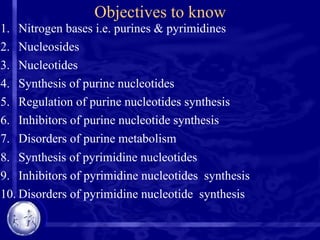
1.Nitrogen bases i.e. purines & pyrimidines
2. Nucleosides
3. Nucleotides
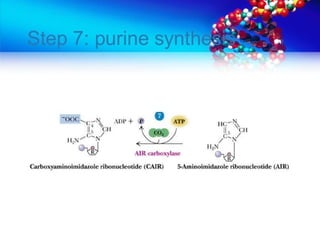
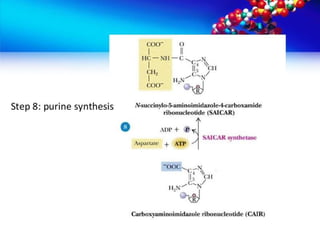
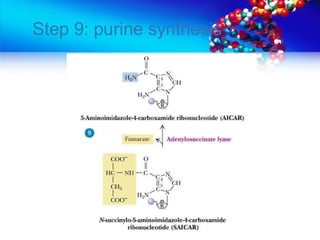
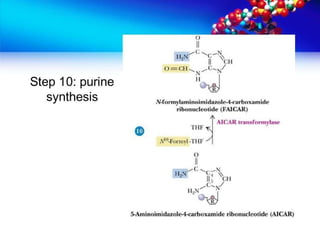
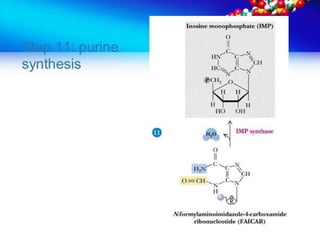
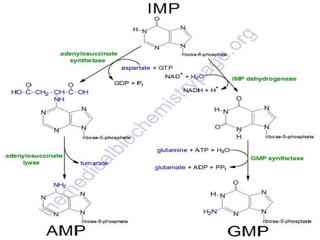
4. Synthesis of purine nucleotides
5. Regulation of purine nucleotides synthesis
6. Inhibitors of purine nucleotide synthesis
7. Disorders of purine metabolism
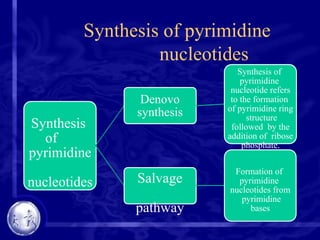
8. Synthesis of pyrimidine nucleotides
9. Inhibitors of pyrimidine nucleotides synthesis
10. Disorders of pyrimidine nucleotide synthesis
3.
Pyrimidines and Purines
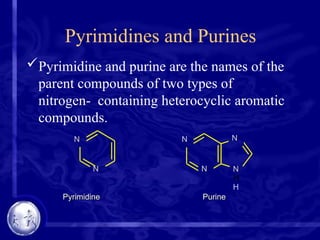
Pyrimidineand purine are the names of the
parent compounds of two types of
nitrogen- containing heterocyclic aromatic
compounds.
N
N N
N
N
N
H
Pyrimidine Purine
4.
Important Pyrimidines
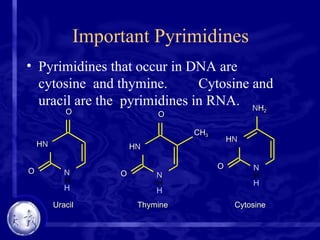
• Pyrimidinesthat occur in DNA are
cytosine and thymine. Cytosine and
uracil are the pyrimidines in RNA.
HN
N
H
O
O
Uracil
HN
N
H
O
O
CH3
Thymine
HN
N
H
NH2
O
Cytosine
5.
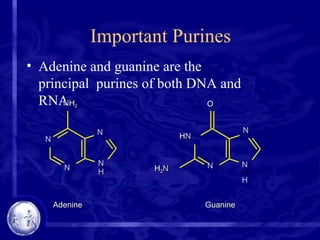
Important Purines
• Adenineand guanine are the
principal purines of both DNA and
RNA.
Adenine
N
N
NH2
N
N
H
Guanine
O
HN
N
H
N
N
H2N
6.
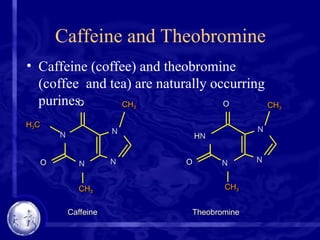
Caffeine and Theobromine
•Caffeine (coffee) and theobromine
(coffee and tea) are naturally occurring
purines.
Caffeine
N
N
O
N
N
H3C
O
CH3
CH3
Theobromine
O
HN
N
N
N
CH3
CH3
O
7.
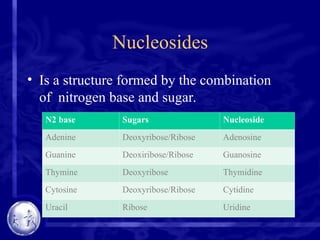
Nucleosides
• Is astructure formed by the combination
of nitrogen base and sugar.
N2 base Sugars Nucleoside
Adenine Deoxyribose/Ribose Adenosine
Guanine Deoxiribose/Ribose Guanosine
Thymine Deoxyribose Thymidine
Cytosine Deoxyribose/Ribose Cytidine
Uracil Ribose Uridine
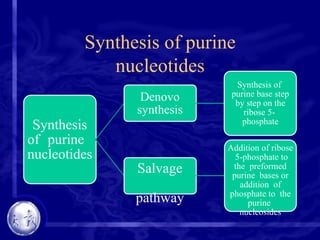
Synthesis of purine
nucleotides
Synthesis
ofpurine
nucleotides
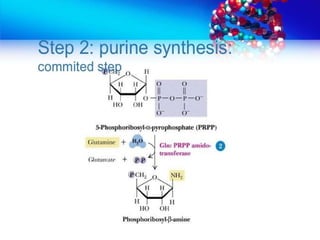
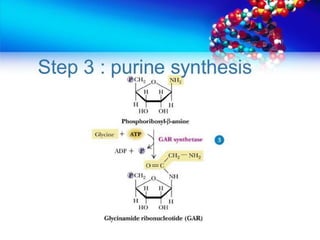
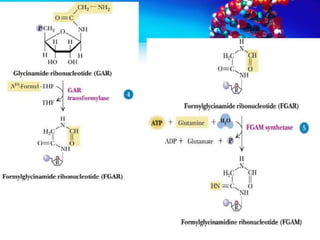
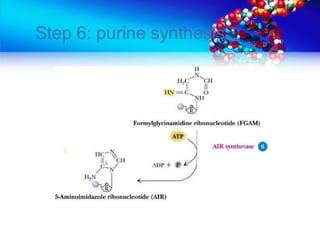
Denovo
synthesis
Synthesis of
purine base step
by step on the
ribose 5-
phosphate
Salvage
pathway
Addition of ribose
5-phosphate to
the preformed
purine bases or
addition of
phosphate to the
purine
nucleosides
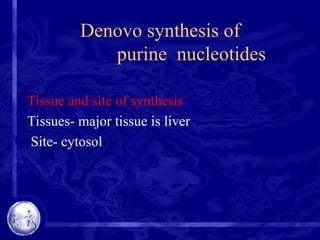
Denovo synthesis of
purinenucleotides
Tissue and site of synthesis
Tissues- major tissue is liver
Site- cytosol
23.
Inhibitors
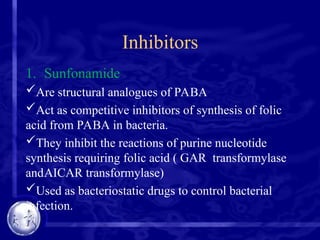
1. Sunfonamide
Are structuralanalogues of PABA
Act as competitive inhibitors of synthesis of folic
acid from PABA in bacteria.
They inhibit the reactions of purine nucleotide
synthesis requiring folic acid ( GAR transformylase
andAICAR transformylase)
Used as bacteriostatic drugs to control bacterial
infection.
24.
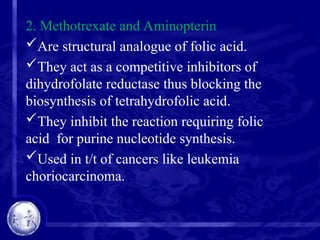
2. Methotrexate andAminopterin
Are structural analogue of folic acid.
They act as a competitive inhibitors of
dihydrofolate reductase thus blocking the
biosynthesis of tetrahydrofolic acid.
They inhibit the reaction requiring folic
acid for purine nucleotide synthesis.
Used in t/t of cancers like leukemia
choriocarcinoma.
25.
3. Trimethoprim
structural analogueof folic acid.
Acts as a competitive inhibitors of
dihydrofolate reductase in bacteria thus
blocking the biosynthesis of tetrahydrofolic
acid.
Inhibit the reaction requiring folic acid to
purine nucleotide synthesis.
Used in the t/t of bacterial infections and
UTI.
26.
4. 6-mercaptopurine
is astructural analogue of purine bases.
is converted to 6- thioionosine
monophosphate by the enzyme HGPRT,
called lethal synthesis.
6-thio IMP inhibits the conversion of IMP
to AMP and GMP.
6-thio IMP also feed back inhibits
glutamine PRPP amidotransferase.
Used as an anticancer drug.
27.
5. Thioguanine
Is aguanine analogue.
It is converted to 6-thio GMP by the
enzyme HGPRT.
6-thio GMP inhibits the conversion of IMP
to GMP.
Also inhibits glutamine PRPP
amidotransferase.
Used as an anticancer drug.
28.
6. Azaserine
is astructural analogue of glutamine.
is a glutamine antagonist.
inhibits the enzyme reactions in purine and
pyrimidine nucleotide synthesis that utilize
glutamine as a substrste.
it is highly toxic to the cells so it is not
used clinically as a drug.
29.
Regulation
1. Intracellular conc.Of PRPP-
depends upon 2 factors i.e. its synthesis & utilization.
Synthesis depends on-
Availability of R-5-P.
Action of enzyme PRPP synthetase. Utilization
depends on-
Denovo synthesis.
Salvage pathway.
30.
2. Activity ofenzyme PRPP amidotransferase.
Increased activity of PRPP amidotransferase
leads to Increased synthesis of AMP amd GMP,
which feedbackly inhibit the enzyme PRPP
amidotransferase.
3. Both AMP and GMP inhibit their own
formation by feedback inhibition of
adenylosuccinate synthetase and IMP
dehydrogenase.
31.
Salvage pathway
It refersto the formation of purine nucleotides
by the
1.Addition of ribose phosphate ( from PRPP)
to the preformed purine bases.
2.Addition of phosphate to the preformed
purine nucleosides.
32.
Significance
Salvage pathway providea pathway for the
utilization of purine bases derived from
diet (exogenous) and normal turnover of
the nucleic acids.
In erythrocytes, denovo syntheis of purine
nucleotides does not occur because of
absence of PRPP amidotransferase.
The requirement of purine nucleotides is
met by the salvage pathway.
33.
Synthesis of purinenucleotides from purine
bases
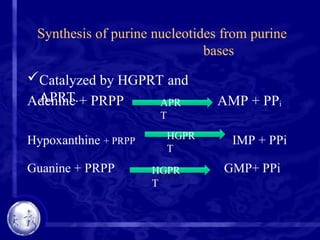
Catalyzed by HGPRT and
APRT.
Adenine + PRPP AMP + PPi
Hypoxanthine + PRPP IMP + PPi
Guanine + PRPP GMP+ PPi
APR
T
HGPR
T
HGPR
T
34.
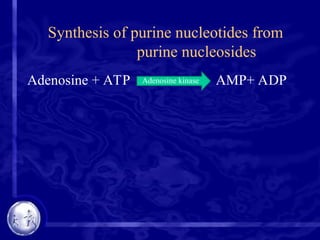
Synthesis of purinenucleotides from
purine nucleosides
Adenosine + ATP AMP+ ADP
Adenosine kinase
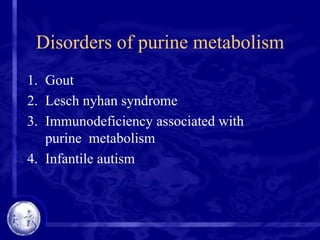
Disorders of purinemetabolism
1. Gout
2. Lesch nyhan syndrome
3. Immunodeficiency associated with
purine metabolism
4. Infantile autism
37.
Gout
Metabolic disorders associatedwith
overproduction of uric acid.
At physiological form, uric acid is found
in more soluble form as sodium urate.
In severe hyperuricemia, crystal of sodium
urate get deposited in the soft tissues,
particularly in joints. Such deposits are
commonly known as tophi.
38.
This causes inflammationof joints
resulting in gouty arthritis.
The prevalence of gout is about 3 per 1000
persons, mostly affecting males.
Post menopausal women, however are as
susceptable as men for this disease.
Historically, gout was found to be
associated with high living, over eating and
alcohol consumption.
Lead poisoning also causes gout by
decreasing uric acid excretion.
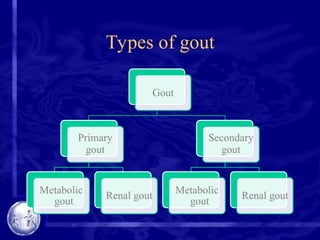
Primary metabolic gout
Itis an inborn error of purine
metabolism due to overproduction of
uric acid.
Causes:
1.Increased activity of PRPP synthetase
2.Overactivity of PRPP amidotransferase
3.HGPRT deficiency
4.Glucose 6-phosphatase deficiency
5.Elevation of glutathione reductase
41.
Primary renal gout
Itis due to failure of uric acid excretion
from the body so that uric acid level in
the body gets increased.
42.
Secondary metabolic
gout
Secondary goutis due to secondary to
certain diseases like leukemia,
polycythemia, lymphoma, psoriasis and
increased tissue breakdown like in
trauma, starvation etc.
43.
Secondary renal gout
Itis due to secondary to defective
glomerular filtration of urate due
to generalized renal failure.
44.
Tratment of gout
Isby
1. Use of colchicine & uricosuric drugs.
To remove urates from the joint, colchine
is the drug of choice.
To remove the urates from the body,
urocosuric drugs such as probenecid,
sulfinpyrazole, salicylates etc are used.
2. Use of allopurinol-inhibits the activity of
enzyme xanthine oxidase as a result of
which uric acid is not produced.
45.
Lesch Nyhan syndrome
Fistdescribed tn 1964 by Michael Lesch( a
medical student) and William L. Nyhan (his
teacher).
It is X linked metabolic disorder since the
structural genes for HGPRT is located on the X
chromosome.
It affects only males and is characterized by
excessive uric acid production and neurological
abnormalities such as mental retardation,
aggressive behaviour, learning disability etc.
The patients of this disorder have an irresistible
urge to bite their fingers and lips,ofen causing
self-mutilation.
46.
Biochemical basis
HGPRT deficiencyspares the utilization of
PRPP through salvage and the accumulated
PRPP takes part in the purine biosynthesis
by the denovo pathway finally leading to
hyperuricemia.
The biochemical basis for neurological
abnormalities are big enegma till date.
Indeed, it is surprising that the deficiency
of a single enzyme can cause such an
abnormal behavioural changes.
47.
few explanationsare putforth in this
regard.
Neurological symptoms may be due to
decreased availability of purines to the
developing brain which has a low capacity
for denovo purine synthesis and hence
depends on purine salvage pathway for the
supply of purine nucleotides it requires.
48.
Treatment
allopurinol is usedto treat hyperuricemia
but it has no effect on the neurological
menefestation in theses patients.
Treatment for the neuro-behavioural
features are limited to behavioural therapy
and providing protective physical device
to prevet self-mutilation.
49.
Immunodeficiency diseases associated
withpurine metabolism
Two different immunodeficiency
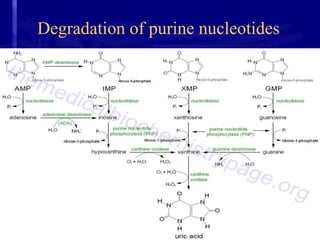
disorders associated with degredation of
purine nucleotides are known.
The enzyme defects are adenosine
deaminase and purine nucleoside
phosphorylase, involved in uric acid
synthesis.
50.
The deficiency ofADA causes SCID
involving T- cell and usually B- cell
dysfunction.
It is explained that ADA deficiency
results in the accumulation of Datp which
is an inhibitor of ribonucleotide reductase
and thus DNA synthesis, replication are
adversely affected.
Different modes of t/t such as blood
transfusion, bone marrow transplantation
are tried to cure the diseases but with
limited effects.
51.
But, like inany other inborn error, the real hope
for the future is only gene therapy.
In 1990, a 5 year old girl suffering from SCID
was successfully cured by transfecting the
ADA gene into stem cells of the patients.
This is considered as landmark in the history of
trating inborn errors of metabolism.
The deficiency of purine nucleoside
phosphorylase is associated with impairement
of T cell function but has no effect on B cell
function.
It is believed that d GTP inhibits the
development of normal T-cells.
52.
Infantile Autism
Recently itwas observed that children
suffering from infantile autism exihibited
increased excretion of uric acid but
surprisingly the serum concentrations are
within normal limits.
The biochemical basis for this is
unknown.
An oral dose of uridine is tried in the t/t.
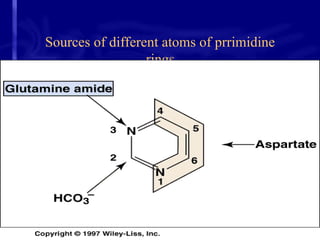
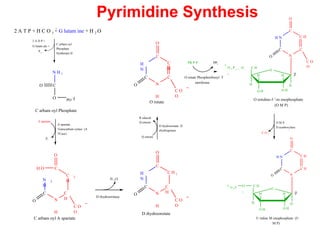
Denovo synthesis ofpyrimidine
nucleotides
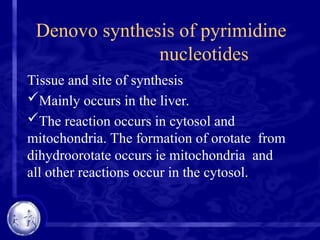
Tissue and site of synthesis
Mainly occurs in the liver.
The reaction occurs in cytosol and
mitochondria. The formation of orotate from
dihydroorotate occurs ie mitochondria and
all other reactions occur in the cytosol.
56.
-
2 A TP + H C O 3 + G lutam ine + H 2 O
C
O
O 3
PO
-2
N H 2
C arbam oyl Phosphate
N
H
2
C
N
H
C
H
C
H
2
H O C
C O
O
O
O
C arbam oyl A spartate
H
N
C
N
H
C
H
C H 2
C
C O
O
O
O
D ihydroorotate
H
N
C
N
H
C
C
H
C
C O
O
O
O
O rotate
H N
C
N
C
C H
C
C O
O
O
O
H
H
O H O H
H H
O
2-
O 3 P O C H
2
O rotidine-5 '-m onophosphate
(O M P)
H N
C
N
C H
C H
C
O
O
H
H
O H O H
H H
O
O C H
2
2-
O 3 P
U ridine M onophosphate (U
M P)
2 A D P +
G lutam ate +
Pi
C arbam oyl
Phosphate
Synthetase II
A spartate
Transcarbam oylase (A
TCase)
A spartate
Pi
H 2 O
D ihydroorotase
Q uinone
R educed
Q uinone
D ihydroorotate D
ehydrogenase
PR P P PPi
O rotate Phosphoribosyl T
ransferase
C O 2
O M P
D ecarboxylase
Pyrimidine Synthesis
59.
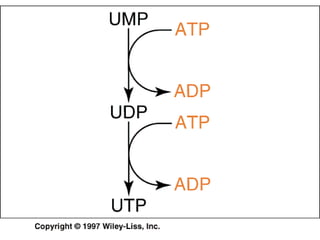
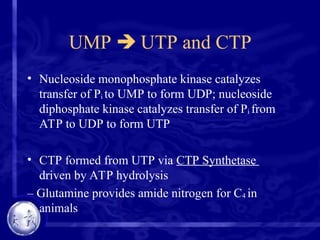
UMP UTPand CTP
• Nucleoside monophosphate kinase catalyzes
transfer of Pi to UMP to form UDP; nucleoside
diphosphate kinase catalyzes transfer of Pi from
ATP to UDP to form UTP
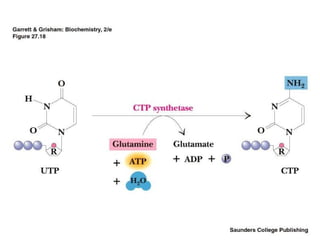
• CTP formed from UTP via CTP Synthetase
driven by ATP hydrolysis
– Glutamine provides amide nitrogen for C4 in
animals
Regulation of pyrimidinesynthesis
In bacteria, aspartate transcarbamoylase catalyses
a committed step in pyrimidine biosynthesis.
Aspartate transcarbamoylase is a good example
of an enzyme controlled by feedback mechanism
by the end product CTP.
In certain bacteria, UTP also inhibits aspartate
transcarbamoylase. ATP, however stimulates
aspartate transcarbamoylase activity.
62.
Carbamoyl phosphate synthaseII is the
regulatory enzyme of pyrimidine synthesis
in animals.
It is activated by PRPP and ATP and
inhibited by UDP and UTP.
OMP decarboxylase inhibited by UMP
and CMP, also controls pyrimidine
formation.
Salvage pathway
Salvage pathwayof pyrimidine nucleotide
synthesis refers to the formation of
pyrimidine nucleotides from pyrimidine
bases.
Significance
Salvage pathway provide a pathway for the
utilization of pyrimidine bases derived
from diet(exogenous) and normal turnover
of nucleic acids.
65.
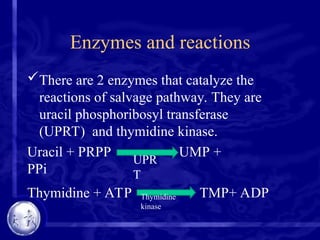
Enzymes and reactions
Thereare 2 enzymes that catalyze the
reactions of salvage pathway. They are
uracil phosphoribosyl transferase
(UPRT) and thymidine kinase.
Uracil + PRPP UMP +
PPi
Thymidine + ATP TMP+ ADP
UPR
T
Thymidine
kinase
66.
Disorders of pyrimidinemetabolism
Disorders of pyrimidine metabolism
includes:
Orotic aciduria
Reye’s syndrome
67.
Orotic aciduria
Is arare metabolic disorder characterized by the
excretion of orotic acid in urine, severe anemia
and retarded growth.
It is due to the deficiency of the enzymes orotate
phosphoribosyl transferase and OMP
decarboxylase of pyrimidine synthesis.
Both these enzymes activities are present on a
single protein as domains (bifunctional
enzyme).
68.
Treatment
Feeding diet richin uridine or cytidine is
an effective t/t of orotic aciduria.
These compounds provide pyrimidine
nucleotides required for DNA and RNA
synthesis.
69.
Reye’s syndrome
Is consideredas a secondary orotic
aciduria.
It is believed that a defect in ornithine
transcarbamoylase (of urea cycle) causes
the accumulation of carbamoyl phosphate.
This is then diverted for the increased
synthesis and excretion of orotic acid.