

Useful
Microorganism
s
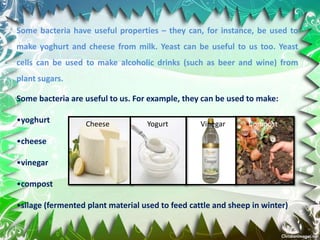
Some bacteria have useful properties – they can, for instance, be used to
make yoghurt and cheese from milk. Yeast can be useful to us too. Yeast
cells can be used to make alcoholic drinks (such as beer and wine) from
plant sugars.
Some bacteria are useful to us. For example, they can be used to make:
•yoghurt
•cheese
•vinegar
•compost
•silage (fermented plant material used to feed cattle and sheep in winter)
Cheese Yogurt Vinegar Compost
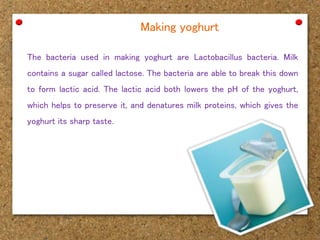
Making yoghurt
The bacteria used in making yoghurt are Lactobacillus bacteria. Milk
contains a sugar called lactose. The bacteria are able to break this down
to form lactic acid. The lactic acid both lowers the pH of the yoghurt,
which helps to preserve it, and denatures milk proteins, which gives the
yoghurt its sharp taste.
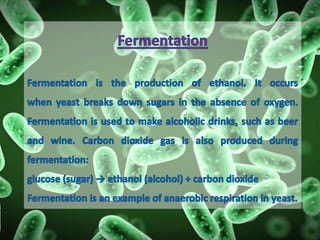
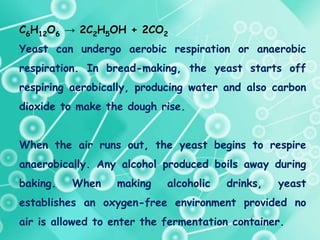
C6H12O6 → 2C2H5OH + 2CO2
Yeast can undergo aerobic respiration or anaerobic
respiration. In bread-making, the yeast starts off
respiring aerobically, producing water and also carbon
dioxide to make the dough rise.
When the air runs out, the yeast begins to respire
anaerobically. Any alcohol produced boils away during
baking. When making alcoholic drinks, yeast
establishes an oxygen-free environment provided no
air is allowed to enter the fermentation container.
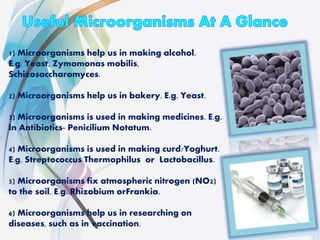
1) Microorganisms help us in making alcohol.
E.g. Yeast, Zymomonas mobilis,
Schizosaccharomyces.
2) Microorganisms help us in bakery. E.g. Yeast.
3) Microorganisms is used in making medicines. E.g.
In Antibiotics- Penicilium Notatum.
4) Microorganisms is used in making curd/Yoghurt.
E.g. Streptococcus Thermophilus or Lactobacillus.
5) Microorganisms fix atmospheric nitrogen (NO2)
to the soil. E.g. Rhizobium orFrankia.
6) Microorganisms help us in researching on
diseases, such as in vaccination.
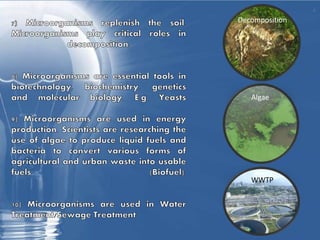
Decomposition
Algae
WWTP

Useful microorganisms

  • 1.
  • 2.
    Some bacteria haveuseful properties – they can, for instance, be used to make yoghurt and cheese from milk. Yeast can be useful to us too. Yeast cells can be used to make alcoholic drinks (such as beer and wine) from plant sugars. Some bacteria are useful to us. For example, they can be used to make: •yoghurt •cheese •vinegar •compost •silage (fermented plant material used to feed cattle and sheep in winter) Cheese Yogurt Vinegar Compost
  • 3.
    Making yoghurt The bacteriaused in making yoghurt are Lactobacillus bacteria. Milk contains a sugar called lactose. The bacteria are able to break this down to form lactic acid. The lactic acid both lowers the pH of the yoghurt, which helps to preserve it, and denatures milk proteins, which gives the yoghurt its sharp taste.
  • 5.
    C6H12O6 → 2C2H5OH+ 2CO2 Yeast can undergo aerobic respiration or anaerobic respiration. In bread-making, the yeast starts off respiring aerobically, producing water and also carbon dioxide to make the dough rise. When the air runs out, the yeast begins to respire anaerobically. Any alcohol produced boils away during baking. When making alcoholic drinks, yeast establishes an oxygen-free environment provided no air is allowed to enter the fermentation container.
  • 6.
    1) Microorganisms helpus in making alcohol. E.g. Yeast, Zymomonas mobilis, Schizosaccharomyces. 2) Microorganisms help us in bakery. E.g. Yeast. 3) Microorganisms is used in making medicines. E.g. In Antibiotics- Penicilium Notatum. 4) Microorganisms is used in making curd/Yoghurt. E.g. Streptococcus Thermophilus or Lactobacillus. 5) Microorganisms fix atmospheric nitrogen (NO2) to the soil. E.g. Rhizobium orFrankia. 6) Microorganisms help us in researching on diseases, such as in vaccination.
  • 7.