MICROBES IN HUMAN
WELFARE
SHUBHADEEP BHATTACHARJEE
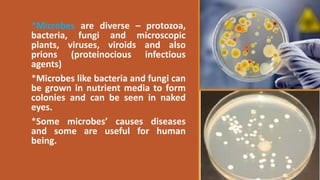
*Microbes are diverse – protozoa,
bacteria, fungi and microscopic
plants, viruses, viroids and also
prions (proteinocious infectious
agents)
*Microbes like bacteria and fungi can
be grown in nutrient media to form
colonies and can be seen in naked
eyes.
*Some microbes’ causes diseases
and some are useful for human
being.
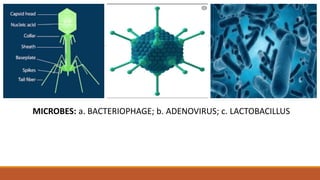
MICROBES: a. BACTERIOPHAGE; b. ADENOVIRUS; c. LACTOBACILLUS
MICROBES IN HOUSEHOLD
PRODUCTS
I. CURD:
A common example is the production of curd from
milk.
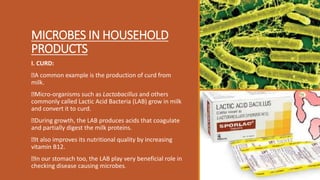
Micro-organisms such as Lactobacillus and others
commonly called Lactic Acid Bacteria (LAB) grow in milk
and convert it to curd.
During growth, the LAB produces acids that coagulate
and partially digest the milk proteins.
It also improves its nutritional quality by increasing
vitamin B12.
In our stomach too, the LAB play very beneficial role in
checking disease causing microbes.
II. DOUGH FOR MAKING FOODS
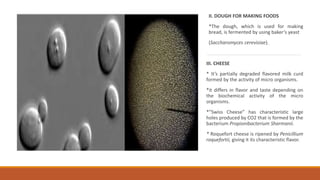
*The dough, which is used for making
bread, is fermented by using baker’s yeast
(Saccharomyces cerevisiae).
III. CHEESE
* It’s partially degraded flavored milk curd
formed by the activity of micro organisms.
*it differs in flavor and taste depending on
the biochemical activity of the micro
organisms.
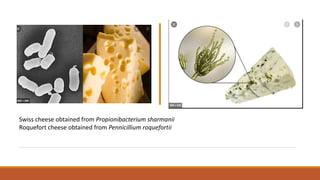
*”Swiss Cheese” has characteristic large
holes produced by CO2 that is formed by the
bacterium Propionibacterium Sharmanii.
* Roquefort cheese is ripened by Penicillium
roquefortii, giving it its characteristic flavor.
Swiss cheese obtained from Propionibacterium sharmanii
Roquefort cheese obtained from Pennicillium roquefortii
Iv. TODDY
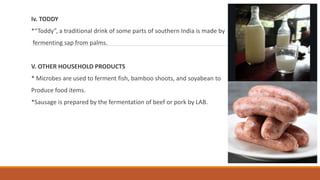
*“Toddy”, a traditional drink of some parts of southern India is made by
fermenting sap from palms.
V. OTHER HOUSEHOLD PRODUCTS
* Microbes are used to ferment fish, bamboo shoots, and soyabean to
Produce food items.
*Sausage is prepared by the fermentation of beef or pork by LAB.
MICROBES IN
INDUSTRIAL PRODUCTS
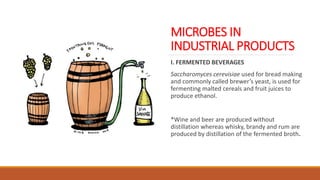
I. FERMENTED BEVERAGES
Saccharomyces cerevisiae used for bread making
and commonly called brewer’s yeast, is used for
fermenting malted cereals and fruit juices to
produce ethanol.
*Wine and beer are produced without
distillation whereas whisky, brandy and rum are
produced by distillation of the fermented broth.
II. ANTIBIOTICS
* Antibiotics are chemical substances, which
are produced by some microbes and can kill
or retard the growth of other disease causing
microbes.
*Pencillin was the first antibiotic to be
discovered and it was a chance discovery.
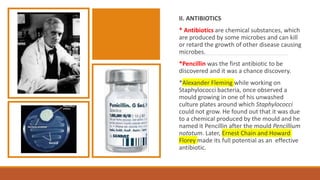
*Alexander Fleming while working on
Staphylococci bacteria, once observed a
mould growing in one of his unwashed
culture plates around which Staphylococci
could not grow. He found out that it was due
to a chemical produced by the mould and he
named it Pencillin after the mould Pencillium
notatum. Later, Ernest Chain and Howard
Florey made its full potential as an effective
antibiotic.
III. ORGANIC ACIDS & ALCOHOL
IV. ENZYMES
*Lipase – used in laundry detergents
*Pectinase and protease – used in bottled juices
*Streptokinase (Streptococcus bacterium) – used as clot buster
(to remove clots)
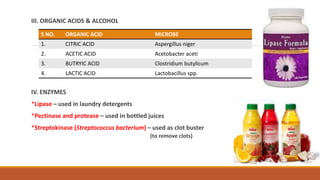
S NO. ORGANIC ACID MICROBE
1. CITRIC ACID Aspergillus niger
2. ACETIC ACID Acetobacter aceti
3. BUTRYIC ACID Clostridium butylicum
4. LACTIC ACID Lactobacillus spp.
V. BIO ACTIVE MOLECULES
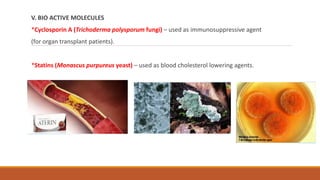
*Cyclosporin A (Trichoderma polysporum fungi) – used as immunosuppressive agent
(for organ transplant patients).
*Statins (Monascus purpureus yeast) – used as blood cholesterol lowering agents.
MICROBES IN SEWAGE TREATMENT
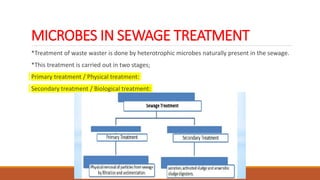
*Treatment of waste waster is done by heterotrophic microbes naturally present in the sewage.
*This treatment is carried out in two stages;
Primary treatment / Physical treatment:
Secondary treatment / Biological treatment:
I. PRIMARY TREATMENT/ PHYSICAL
TREATMENT
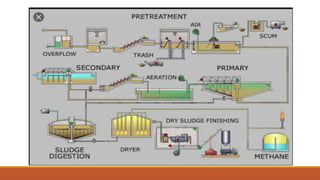
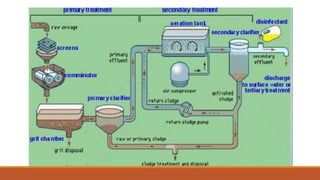
*It involves physical removal of particles from the sewage
through filtration and sedimentation.
*Sequential filtration – to remove floating debris
*Sedimentation – to remove grit (soil and small pebbles)
*All solids that settle form the primary sludge, and the
supernatant forms the effluent.
*The effluent from the primary settling tank is taken for
secondary treatment.
II. SECONDARY TREATMENT/ BIOLOGICAL
TREATMENT
*The primary effluent is passed into large aeration tanks. This
allows vigorous growth of aerobic microbes into flocs.
*While growing, these microbes consume the major part of
the organic matter in the effluent.
*This significantly reduces the BOD (biochemical oxygen
demand) of the effluent.
*BOD is a measure of the organic matter present in the
water.
*The greater the BOD of wastewater, more is its polluting
potential.
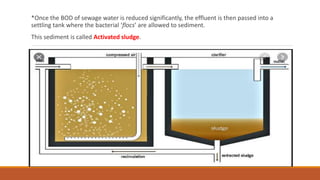
*Once the BOD of sewage water is reduced significantly, the effluent is then passed into a
settling tank where the bacterial ‘flocs’ are allowed to sediment.
This sediment is called Activated sludge.
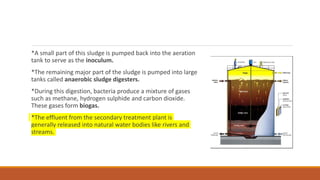
*A small part of this sludge is pumped back into the aeration
tank to serve as the inoculum.
*The remaining major part of the sludge is pumped into large
tanks called anaerobic sludge digesters.
*During this digestion, bacteria produce a mixture of gases
such as methane, hydrogen sulphide and carbon dioxide.
These gases form biogas.
*The effluent from the secondary treatment plant is
generally released into natural water bodies like rivers and
streams.
*microbes play a major role in treating millions of gallons of wastewater everyday across the
globe.
*Till date, no manmade technology has been able to rival the microbial treatment of sewage.
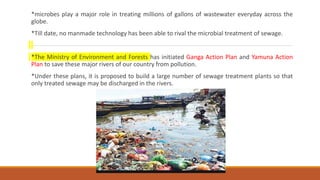
*The Ministry of Environment and Forests has initiated Ganga Action Plan and Yamuna Action
Plan to save these major rivers of our country from pollution.
*Under these plans, it is proposed to build a large number of sewage treatment plants so that
only treated sewage may be discharged in the rivers.
MICROBES IN THE
PRODUCTION OF BIOGAS
*Biogas is mixture of gases produced by the
microbial activity and which may be used
as fuel.
*Certain bacteria, which grow anaerobically
on cellulosic material, produce large
amount of methane along with CO2 and
H2.
*These bacteria are collectively called
Methanogens (Methanobacterium).
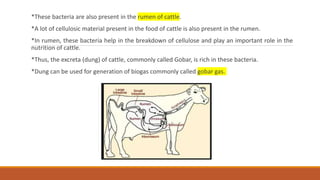
*These bacteria are also present in the rumen of cattle.
*A lot of cellulosic material present in the food of cattle is also present in the rumen.
*In rumen, these bacteria help in the breakdown of cellulose and play an important role in the
nutrition of cattle.
*Thus, the excreta (dung) of cattle, commonly called Gobar, is rich in these bacteria.
*Dung can be used for generation of biogas commonly called gobar gas.
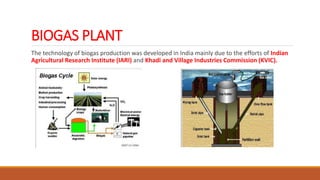
BIOGAS PLANT
The technology of biogas production was developed in India mainly due to the efforts of Indian
Agricultural Research Institute (IARI) and Khadi and Village Industries Commission (KVIC).
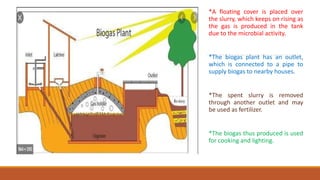
*A floating cover is placed over
the slurry, which keeps on rising as
the gas is produced in the tank
due to the microbial activity.
*The biogas plant has an outlet,
which is connected to a pipe to
supply biogas to nearby houses.
*The spent slurry is removed
through another outlet and may
be used as fertilizer.
*The biogas thus produced is used
for cooking and lighting.
MICROBES AS
BIOCONTROL AGENTS
Biological control of pests and diseases:
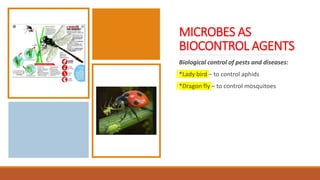
*Lady bird – to control aphids
*Dragon fly – to control mosquitoes
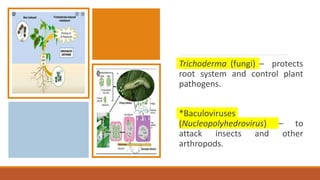
Trichoderma (fungi) – protects
root system and control plant
pathogens.
*Baculoviruses
(Nucleopolyhedrovirus) – to
attack insects and other
arthropods.
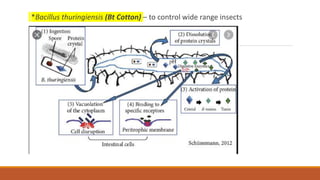
*Bacillus thuringiensis (Bt Cotton) – to control wide range insects
MICROBES AS
BIOFERTILIZERS
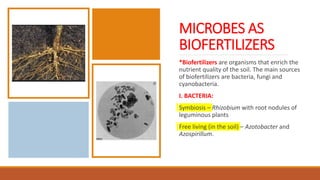
*Biofertilizers are organisms that enrich the
nutrient quality of the soil. The main sources
of biofertilizers are bacteria, fungi and
cyanobacteria.
I. BACTERIA:
Symbiosis – Rhizobium with root nodules of
leguminous plants
Free living (in the soil) – Azotobacter and
Azospirillum.
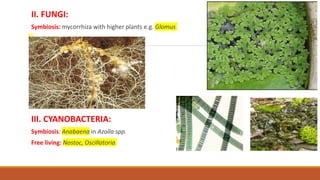
II. FUNGI:
Symbiosis: mycorrhiza with higher plants e.g. Glomus
III. CYANOBACTERIA:
Symbiosis: Anabaena in Azolla spp.
Free living: Nostoc, Oscillatoria

Microbes in human welfare

  • 1.
  • 2.
    *Microbes are diverse– protozoa, bacteria, fungi and microscopic plants, viruses, viroids and also prions (proteinocious infectious agents) *Microbes like bacteria and fungi can be grown in nutrient media to form colonies and can be seen in naked eyes. *Some microbes’ causes diseases and some are useful for human being.
  • 3.
    MICROBES: a. BACTERIOPHAGE;b. ADENOVIRUS; c. LACTOBACILLUS
  • 4.
    MICROBES IN HOUSEHOLD PRODUCTS I.CURD: A common example is the production of curd from milk. Micro-organisms such as Lactobacillus and others commonly called Lactic Acid Bacteria (LAB) grow in milk and convert it to curd. During growth, the LAB produces acids that coagulate and partially digest the milk proteins. It also improves its nutritional quality by increasing vitamin B12. In our stomach too, the LAB play very beneficial role in checking disease causing microbes.
  • 5.
    II. DOUGH FORMAKING FOODS *The dough, which is used for making bread, is fermented by using baker’s yeast (Saccharomyces cerevisiae). III. CHEESE * It’s partially degraded flavored milk curd formed by the activity of micro organisms. *it differs in flavor and taste depending on the biochemical activity of the micro organisms. *”Swiss Cheese” has characteristic large holes produced by CO2 that is formed by the bacterium Propionibacterium Sharmanii. * Roquefort cheese is ripened by Penicillium roquefortii, giving it its characteristic flavor.
  • 6.
    Swiss cheese obtainedfrom Propionibacterium sharmanii Roquefort cheese obtained from Pennicillium roquefortii
  • 7.
    Iv. TODDY *“Toddy”, atraditional drink of some parts of southern India is made by fermenting sap from palms. V. OTHER HOUSEHOLD PRODUCTS * Microbes are used to ferment fish, bamboo shoots, and soyabean to Produce food items. *Sausage is prepared by the fermentation of beef or pork by LAB.
  • 8.
    MICROBES IN INDUSTRIAL PRODUCTS I.FERMENTED BEVERAGES Saccharomyces cerevisiae used for bread making and commonly called brewer’s yeast, is used for fermenting malted cereals and fruit juices to produce ethanol. *Wine and beer are produced without distillation whereas whisky, brandy and rum are produced by distillation of the fermented broth.
  • 9.
    II. ANTIBIOTICS * Antibioticsare chemical substances, which are produced by some microbes and can kill or retard the growth of other disease causing microbes. *Pencillin was the first antibiotic to be discovered and it was a chance discovery. *Alexander Fleming while working on Staphylococci bacteria, once observed a mould growing in one of his unwashed culture plates around which Staphylococci could not grow. He found out that it was due to a chemical produced by the mould and he named it Pencillin after the mould Pencillium notatum. Later, Ernest Chain and Howard Florey made its full potential as an effective antibiotic.
  • 10.
    III. ORGANIC ACIDS& ALCOHOL IV. ENZYMES *Lipase – used in laundry detergents *Pectinase and protease – used in bottled juices *Streptokinase (Streptococcus bacterium) – used as clot buster (to remove clots) S NO. ORGANIC ACID MICROBE 1. CITRIC ACID Aspergillus niger 2. ACETIC ACID Acetobacter aceti 3. BUTRYIC ACID Clostridium butylicum 4. LACTIC ACID Lactobacillus spp.
  • 11.
    V. BIO ACTIVEMOLECULES *Cyclosporin A (Trichoderma polysporum fungi) – used as immunosuppressive agent (for organ transplant patients). *Statins (Monascus purpureus yeast) – used as blood cholesterol lowering agents.
  • 12.
    MICROBES IN SEWAGETREATMENT *Treatment of waste waster is done by heterotrophic microbes naturally present in the sewage. *This treatment is carried out in two stages; Primary treatment / Physical treatment: Secondary treatment / Biological treatment:
  • 14.
    I. PRIMARY TREATMENT/PHYSICAL TREATMENT *It involves physical removal of particles from the sewage through filtration and sedimentation. *Sequential filtration – to remove floating debris *Sedimentation – to remove grit (soil and small pebbles) *All solids that settle form the primary sludge, and the supernatant forms the effluent. *The effluent from the primary settling tank is taken for secondary treatment.
  • 15.
    II. SECONDARY TREATMENT/BIOLOGICAL TREATMENT *The primary effluent is passed into large aeration tanks. This allows vigorous growth of aerobic microbes into flocs. *While growing, these microbes consume the major part of the organic matter in the effluent. *This significantly reduces the BOD (biochemical oxygen demand) of the effluent. *BOD is a measure of the organic matter present in the water. *The greater the BOD of wastewater, more is its polluting potential.
  • 16.
    *Once the BODof sewage water is reduced significantly, the effluent is then passed into a settling tank where the bacterial ‘flocs’ are allowed to sediment. This sediment is called Activated sludge.
  • 17.
    *A small partof this sludge is pumped back into the aeration tank to serve as the inoculum. *The remaining major part of the sludge is pumped into large tanks called anaerobic sludge digesters. *During this digestion, bacteria produce a mixture of gases such as methane, hydrogen sulphide and carbon dioxide. These gases form biogas. *The effluent from the secondary treatment plant is generally released into natural water bodies like rivers and streams.
  • 19.
    *microbes play amajor role in treating millions of gallons of wastewater everyday across the globe. *Till date, no manmade technology has been able to rival the microbial treatment of sewage. *The Ministry of Environment and Forests has initiated Ganga Action Plan and Yamuna Action Plan to save these major rivers of our country from pollution. *Under these plans, it is proposed to build a large number of sewage treatment plants so that only treated sewage may be discharged in the rivers.
  • 20.
    MICROBES IN THE PRODUCTIONOF BIOGAS *Biogas is mixture of gases produced by the microbial activity and which may be used as fuel. *Certain bacteria, which grow anaerobically on cellulosic material, produce large amount of methane along with CO2 and H2. *These bacteria are collectively called Methanogens (Methanobacterium).
  • 21.
    *These bacteria arealso present in the rumen of cattle. *A lot of cellulosic material present in the food of cattle is also present in the rumen. *In rumen, these bacteria help in the breakdown of cellulose and play an important role in the nutrition of cattle. *Thus, the excreta (dung) of cattle, commonly called Gobar, is rich in these bacteria. *Dung can be used for generation of biogas commonly called gobar gas.
  • 22.
    BIOGAS PLANT The technologyof biogas production was developed in India mainly due to the efforts of Indian Agricultural Research Institute (IARI) and Khadi and Village Industries Commission (KVIC).
  • 23.
    *A floating coveris placed over the slurry, which keeps on rising as the gas is produced in the tank due to the microbial activity. *The biogas plant has an outlet, which is connected to a pipe to supply biogas to nearby houses. *The spent slurry is removed through another outlet and may be used as fertilizer. *The biogas thus produced is used for cooking and lighting.
  • 24.
    MICROBES AS BIOCONTROL AGENTS Biologicalcontrol of pests and diseases: *Lady bird – to control aphids *Dragon fly – to control mosquitoes
  • 25.
    Trichoderma (fungi) –protects root system and control plant pathogens. *Baculoviruses (Nucleopolyhedrovirus) – to attack insects and other arthropods.
  • 26.
    *Bacillus thuringiensis (BtCotton) – to control wide range insects
  • 27.
    MICROBES AS BIOFERTILIZERS *Biofertilizers areorganisms that enrich the nutrient quality of the soil. The main sources of biofertilizers are bacteria, fungi and cyanobacteria. I. BACTERIA: Symbiosis – Rhizobium with root nodules of leguminous plants Free living (in the soil) – Azotobacter and Azospirillum.
  • 28.
    II. FUNGI: Symbiosis: mycorrhizawith higher plants e.g. Glomus III. CYANOBACTERIA: Symbiosis: Anabaena in Azolla spp. Free living: Nostoc, Oscillatoria