

Slides prepared by: Muralidhar Shingri
The applications of biotechnology include
therapeutics,
diagnostics and
genetically modified crops for agriculture,
processed food,
bioremediation,
waste treatment, and
energy production.
Slides prepared by: Muralidhar Shingri
Three critical research areas of
biotechnology are;
• Providing the best catalyst in the form of
improved organism usually a microbe or pure
enzyme.
• Creating optimal conditions through
engineering for a catalyst to act, and
• Downstream processing technologies to
purify the protein / organic compound.
Slides prepared by: Muralidhar Shingri
The three options that can be thought for
increasing food production are:
• Agro-chemical based agriculture
• Organic agriculture; and
• Genetically engineered crop-based
agriculture.
Slides prepared by: Muralidhar Shingri
• The Green Revolution has
succeeded in tripling the food
supply
• but yet it was not enough to feed
the growing human population.
• Scientists have decided that use of
genetically modified crops is a
possible solution.
Slides prepared by: Muralidhar Shingri
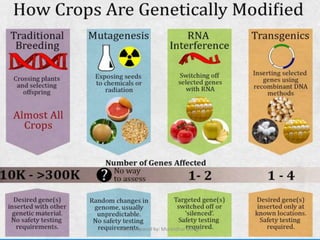
Genetically Modified Organisms (GMO)
Plants, bacteria, fungi and animals whose genes
have been altered by manipulation are called
Genetically Modified Organisms (GMO).
Genetic modification has;
• Made crops more tolerant to abiotic stresses
• Reduced reliance on chemical pesticides
• Helped to reduce post-harvest losses
• Increased efficiency of mineral usage by plants
• Enhanced nutritional value of food, eg., Vitamin
‘A’ enriched rice.
Slides prepared by: Muralidhar Shingri
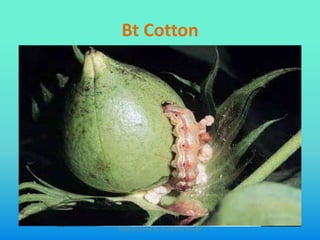
Bt Cotton
Slides prepared by: Muralidhar Shingri
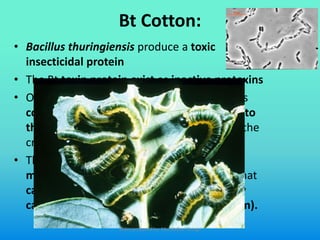
Bt Cotton:
• Bacillus thuringiensis produce a toxic
insecticidal protein
• The Bt toxin protein exist as inactive protoxins
• Once an insect ingest the inactive toxin, it is
converted into an active form of toxin due to
the alkaline pH of the gut which solubilise the
crystals.
• The activated toxin binds to the surface of
midgut epithelial cells and creates pores that
cause cell swelling and lysis and eventually
cause death of the insect (cotton boll worm).
Slides prepared by: Muralidhar Shingri
• Bt toxin genes were isolated from B.
thuringiensis and incorporated into the
several crop plants such as cotton. The
toxin is coded by a gene named ‘cry’.
• There are a number of them, for example,
the proteins encoded by the genes cryIAc
and cryIIAb control bollworms and
• cryIAb controls corn borer.
Slides prepared by: Muralidhar Shingri
• Bt toxin gene has been cloned from
the bacteria and been expressed in
plants to provide resistance to
insects,
• without the need for insecticides;
• In effect created a bio-pesticide.
• Examples are Bt cotton, Bt corn,
rice, tomato, potato and soyabean
etc.
Slides prepared by: Muralidhar Shingri
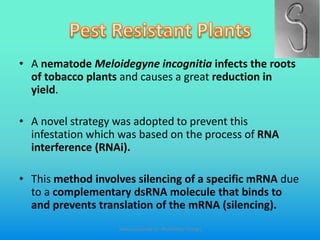
• A nematode Meloidegyne incognitia infects the roots
of tobacco plants and causes a great reduction in
yield.
• A novel strategy was adopted to prevent this
infestation which was based on the process of RNA
interference (RNAi).
• This method involves silencing of a specific mRNA due
to a complementary dsRNA molecule that binds to
and prevents translation of the mRNA (silencing).
Slides prepared by: Muralidhar Shingri
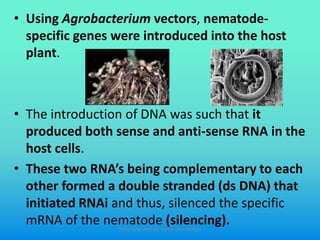
• Using Agrobacterium vectors, nematode-
specific genes were introduced into the host
plant.
• The introduction of DNA was such that it
produced both sense and anti-sense RNA in the
host cells.
• These two RNA’s being complementary to each
other formed a double stranded (ds DNA) that
initiated RNAi and thus, silenced the specific
mRNA of the nematode (silencing).Slides prepared by: Muralidhar Shingri
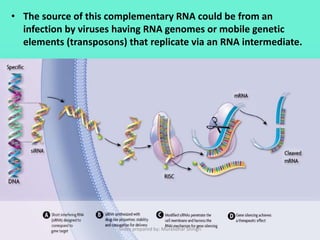
• The source of this complementary RNA could be from an
infection by viruses having RNA genomes or mobile genetic
elements (transposons) that replicate via an RNA intermediate.
Slides prepared by: Muralidhar Shingri
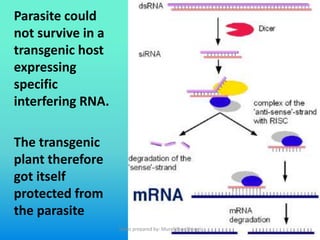
Parasite could
not survive in a
transgenic host
expressing
specific
interfering RNA.
The transgenic
plant therefore
got itself
protected from
the parasite
Slides prepared by: Muralidhar Shingri
• The rDNA technological processes have made
immense impact in the area of healthcare by
enabling mass production of safe and more
effective therapeutic drugs.
• At present, about 30 recombinant therapeutics
have been approved for human use the world
over.
• In India, 12 of these are presently being
marketed.
Slides prepared by: Muralidhar Shingri
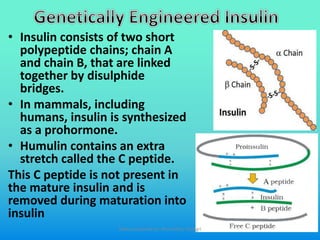
• Insulin consists of two short
polypeptide chains; chain A
and chain B, that are linked
together by disulphide
bridges.
• In mammals, including
humans, insulin is synthesized
as a prohormone.
• Humulin contains an extra
stretch called the C peptide.
This C peptide is not present in
the mature insulin and is
removed during maturation into
insulin
Slides prepared by: Muralidhar Shingri
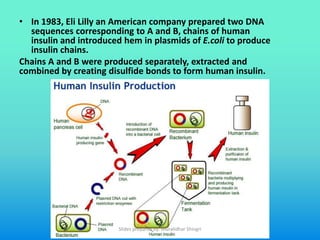
• In 1983, Eli Lilly an American company prepared two DNA
sequences corresponding to A and B, chains of human
insulin and introduced hem in plasmids of E.coli to produce
insulin chains.
Chains A and B were produced separately, extracted and
combined by creating disulfide bonds to form human insulin.
Slides prepared by: Muralidhar Shingri
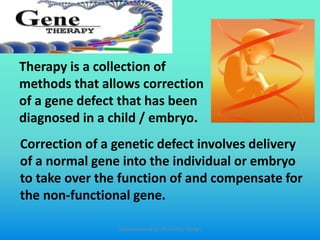
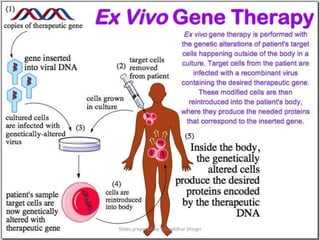
Therapy is a collection of
methods that allows correction
of a gene defect that has been
diagnosed in a child / embryo.
Correction of a genetic defect involves delivery
of a normal gene into the individual or embryo
to take over the function of and compensate for
the non-functional gene.
Slides prepared by: Muralidhar Shingri
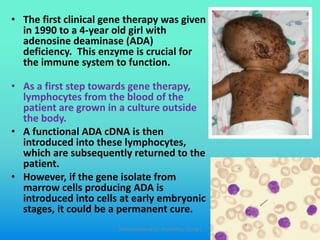
• The first clinical gene therapy was given
in 1990 to a 4-year old girl with
adenosine deaminase (ADA)
deficiency. This enzyme is crucial for
the immune system to function.
• As a first step towards gene therapy,
lymphocytes from the blood of the
patient are grown in a culture outside
the body.
• A functional ADA cDNA is then
introduced into these lymphocytes,
which are subsequently returned to the
patient.
• However, if the gene isolate from
marrow cells producing ADA is
introduced into cells at early embryonic
stages, it could be a permanent cure.
Slides prepared by: Muralidhar Shingri
PCR
A very low concentration of a bacteria or virus
can be detected by amplification of their nucleic
acid by PCR.
PCR is now routinely used to detect HIV in
suspected AIDS patients.
It is being used to detect mutations in genes in
suspected cancer patients too.
Slides prepared by: Muralidhar Shingri
ELISA
Enzyme-Linked Immunosorbent Assay
It is based on the principle of antigen-antibody
interaction.
Infection by pathogen can be detected by
presence of antigens or by detecting the
antibodies synthesized against the pathogen.
Slides prepared by: Muralidhar Shingri
Transgenic Animals:
• Animals that have their DNA manipulated to
possess and express an extra (foreign) gene
Slides prepared by: Muralidhar Shingri
b) Study of disease:
Many transgenic animals are designed to
increase our understanding of how genes
contribute to the development of disease.
so that investigation of new treatments for
diseases is made possible.
Slides prepared by: Muralidhar Shingri
a) Normal physiology and development:
Transgenic animals can be specifically designed
to allow the study of how genes are regulated
and how they affect the normal functions of
the body and its development.
Slides prepared by: Muralidhar Shingri
c) Biological products:
• Transgenic animals that produce useful biological
products can be created by the introduction of
the portion of DNA (gene) which codes for a
particular product such as human protein (alpha
– 1-antitrypsin) used to treat emphysema.
• The first transgenic cow, Rosie, produced human
protein-enriched milk (alpha-lactalbumin - 2.4 gm
/ litre).
Slides prepared by: Muralidhar Shingri
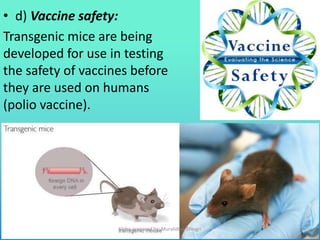
• d) Vaccine safety:
Transgenic mice are being
developed for use in testing
the safety of vaccines before
they are used on humans
(polio vaccine).
Slides prepared by: Muralidhar Shingri
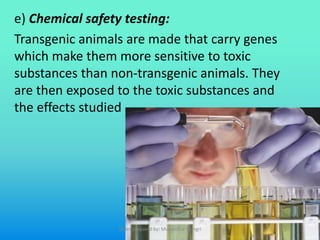
e) Chemical safety testing:
Transgenic animals are made that carry genes
which make them more sensitive to toxic
substances than non-transgenic animals. They
are then exposed to the toxic substances and
the effects studied
Slides prepared by: Muralidhar Shingri
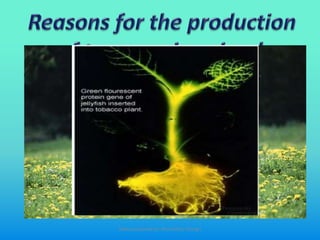
a) Normal physiology and development
b) Study of disease
c) Biological products
d) Vaccine safety
e) Chemical safety testing
Slides prepared by: Muralidhar Shingri
Ethical Issues:
• The Indian Government has set up
organizations such as GEAC (Genetic
Engineering Approval Committee)
• It will make decisions regarding the validity of
GM research and the safety of introducing
GM-organisms for public services.
Slides prepared by: Muralidhar Shingri
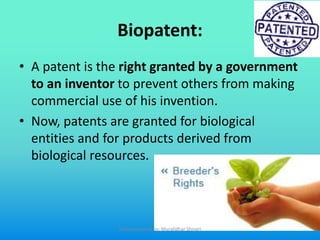
Biopatent:
• A patent is the right granted by a government
to an inventor to prevent others from making
commercial use of his invention.
• Now, patents are granted for biological
entities and for products derived from
biological resources.
Slides prepared by: Muralidhar Shingri
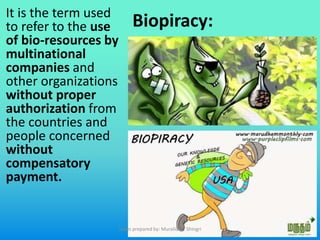
Biopiracy:It is the term used
to refer to the use
of bio-resources by
multinational
companies and
other organizations
without proper
authorization from
the countries and
people concerned
without
compensatory
payment.
Slides prepared by: Muralidhar Shingri
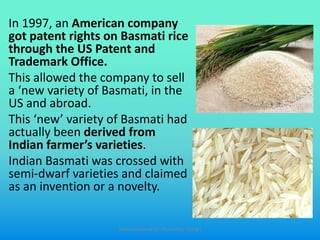
In 1997, an American company
got patent rights on Basmati rice
through the US Patent and
Trademark Office.
This allowed the company to sell
a ‘new variety of Basmati, in the
US and abroad.
This ‘new’ variety of Basmati had
actually been derived from
Indian farmer’s varieties.
Indian Basmati was crossed with
semi-dwarf varieties and claimed
as an invention or a novelty.
Slides prepared by: Muralidhar Shingri
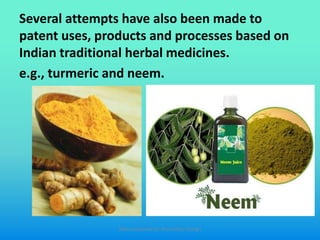
Several attempts have also been made to
patent uses, products and processes based on
Indian traditional herbal medicines.
e.g., turmeric and neem.
Slides prepared by: Muralidhar Shingri

Biotechnology and its applications

  • 1.
    Slides prepared by:Muralidhar Shingri
  • 2.
    The applications ofbiotechnology include therapeutics, diagnostics and genetically modified crops for agriculture, processed food, bioremediation, waste treatment, and energy production. Slides prepared by: Muralidhar Shingri
  • 3.
    Three critical researchareas of biotechnology are; • Providing the best catalyst in the form of improved organism usually a microbe or pure enzyme. • Creating optimal conditions through engineering for a catalyst to act, and • Downstream processing technologies to purify the protein / organic compound. Slides prepared by: Muralidhar Shingri
  • 4.
    The three optionsthat can be thought for increasing food production are: • Agro-chemical based agriculture • Organic agriculture; and • Genetically engineered crop-based agriculture. Slides prepared by: Muralidhar Shingri
  • 5.
    • The GreenRevolution has succeeded in tripling the food supply • but yet it was not enough to feed the growing human population. • Scientists have decided that use of genetically modified crops is a possible solution. Slides prepared by: Muralidhar Shingri
  • 6.
    Genetically Modified Organisms(GMO) Plants, bacteria, fungi and animals whose genes have been altered by manipulation are called Genetically Modified Organisms (GMO). Genetic modification has; • Made crops more tolerant to abiotic stresses • Reduced reliance on chemical pesticides • Helped to reduce post-harvest losses • Increased efficiency of mineral usage by plants • Enhanced nutritional value of food, eg., Vitamin ‘A’ enriched rice. Slides prepared by: Muralidhar Shingri
  • 7.
    Slides prepared by:Muralidhar Shingri
  • 8.
    Bt Cotton Slides preparedby: Muralidhar Shingri
  • 9.
    Bt Cotton: • Bacillusthuringiensis produce a toxic insecticidal protein • The Bt toxin protein exist as inactive protoxins • Once an insect ingest the inactive toxin, it is converted into an active form of toxin due to the alkaline pH of the gut which solubilise the crystals. • The activated toxin binds to the surface of midgut epithelial cells and creates pores that cause cell swelling and lysis and eventually cause death of the insect (cotton boll worm). Slides prepared by: Muralidhar Shingri
  • 10.
    • Bt toxingenes were isolated from B. thuringiensis and incorporated into the several crop plants such as cotton. The toxin is coded by a gene named ‘cry’. • There are a number of them, for example, the proteins encoded by the genes cryIAc and cryIIAb control bollworms and • cryIAb controls corn borer. Slides prepared by: Muralidhar Shingri
  • 11.
    • Bt toxingene has been cloned from the bacteria and been expressed in plants to provide resistance to insects, • without the need for insecticides; • In effect created a bio-pesticide. • Examples are Bt cotton, Bt corn, rice, tomato, potato and soyabean etc. Slides prepared by: Muralidhar Shingri
  • 12.
    • A nematodeMeloidegyne incognitia infects the roots of tobacco plants and causes a great reduction in yield. • A novel strategy was adopted to prevent this infestation which was based on the process of RNA interference (RNAi). • This method involves silencing of a specific mRNA due to a complementary dsRNA molecule that binds to and prevents translation of the mRNA (silencing). Slides prepared by: Muralidhar Shingri
  • 13.
    • Using Agrobacteriumvectors, nematode- specific genes were introduced into the host plant. • The introduction of DNA was such that it produced both sense and anti-sense RNA in the host cells. • These two RNA’s being complementary to each other formed a double stranded (ds DNA) that initiated RNAi and thus, silenced the specific mRNA of the nematode (silencing).Slides prepared by: Muralidhar Shingri
  • 14.
    • The sourceof this complementary RNA could be from an infection by viruses having RNA genomes or mobile genetic elements (transposons) that replicate via an RNA intermediate. Slides prepared by: Muralidhar Shingri
  • 15.
    Parasite could not survivein a transgenic host expressing specific interfering RNA. The transgenic plant therefore got itself protected from the parasite Slides prepared by: Muralidhar Shingri
  • 16.
    • The rDNAtechnological processes have made immense impact in the area of healthcare by enabling mass production of safe and more effective therapeutic drugs. • At present, about 30 recombinant therapeutics have been approved for human use the world over. • In India, 12 of these are presently being marketed. Slides prepared by: Muralidhar Shingri
  • 17.
    • Insulin consistsof two short polypeptide chains; chain A and chain B, that are linked together by disulphide bridges. • In mammals, including humans, insulin is synthesized as a prohormone. • Humulin contains an extra stretch called the C peptide. This C peptide is not present in the mature insulin and is removed during maturation into insulin Slides prepared by: Muralidhar Shingri
  • 18.
    • In 1983,Eli Lilly an American company prepared two DNA sequences corresponding to A and B, chains of human insulin and introduced hem in plasmids of E.coli to produce insulin chains. Chains A and B were produced separately, extracted and combined by creating disulfide bonds to form human insulin. Slides prepared by: Muralidhar Shingri
  • 19.
    Therapy is acollection of methods that allows correction of a gene defect that has been diagnosed in a child / embryo. Correction of a genetic defect involves delivery of a normal gene into the individual or embryo to take over the function of and compensate for the non-functional gene. Slides prepared by: Muralidhar Shingri
  • 20.
    Slides prepared by:Muralidhar Shingri
  • 21.
    • The firstclinical gene therapy was given in 1990 to a 4-year old girl with adenosine deaminase (ADA) deficiency. This enzyme is crucial for the immune system to function. • As a first step towards gene therapy, lymphocytes from the blood of the patient are grown in a culture outside the body. • A functional ADA cDNA is then introduced into these lymphocytes, which are subsequently returned to the patient. • However, if the gene isolate from marrow cells producing ADA is introduced into cells at early embryonic stages, it could be a permanent cure. Slides prepared by: Muralidhar Shingri
  • 22.
    Slides prepared by:Muralidhar Shingri
  • 23.
    PCR A very lowconcentration of a bacteria or virus can be detected by amplification of their nucleic acid by PCR. PCR is now routinely used to detect HIV in suspected AIDS patients. It is being used to detect mutations in genes in suspected cancer patients too. Slides prepared by: Muralidhar Shingri
  • 24.
    ELISA Enzyme-Linked Immunosorbent Assay Itis based on the principle of antigen-antibody interaction. Infection by pathogen can be detected by presence of antigens or by detecting the antibodies synthesized against the pathogen. Slides prepared by: Muralidhar Shingri
  • 25.
    Transgenic Animals: • Animalsthat have their DNA manipulated to possess and express an extra (foreign) gene Slides prepared by: Muralidhar Shingri
  • 26.
    b) Study ofdisease: Many transgenic animals are designed to increase our understanding of how genes contribute to the development of disease. so that investigation of new treatments for diseases is made possible. Slides prepared by: Muralidhar Shingri
  • 27.
    a) Normal physiologyand development: Transgenic animals can be specifically designed to allow the study of how genes are regulated and how they affect the normal functions of the body and its development. Slides prepared by: Muralidhar Shingri
  • 28.
    c) Biological products: •Transgenic animals that produce useful biological products can be created by the introduction of the portion of DNA (gene) which codes for a particular product such as human protein (alpha – 1-antitrypsin) used to treat emphysema. • The first transgenic cow, Rosie, produced human protein-enriched milk (alpha-lactalbumin - 2.4 gm / litre). Slides prepared by: Muralidhar Shingri
  • 29.
    • d) Vaccinesafety: Transgenic mice are being developed for use in testing the safety of vaccines before they are used on humans (polio vaccine). Slides prepared by: Muralidhar Shingri
  • 30.
    e) Chemical safetytesting: Transgenic animals are made that carry genes which make them more sensitive to toxic substances than non-transgenic animals. They are then exposed to the toxic substances and the effects studied Slides prepared by: Muralidhar Shingri
  • 31.
    a) Normal physiologyand development b) Study of disease c) Biological products d) Vaccine safety e) Chemical safety testing Slides prepared by: Muralidhar Shingri
  • 32.
    Ethical Issues: • TheIndian Government has set up organizations such as GEAC (Genetic Engineering Approval Committee) • It will make decisions regarding the validity of GM research and the safety of introducing GM-organisms for public services. Slides prepared by: Muralidhar Shingri
  • 33.
    Slides prepared by:Muralidhar Shingri
  • 34.
    Biopatent: • A patentis the right granted by a government to an inventor to prevent others from making commercial use of his invention. • Now, patents are granted for biological entities and for products derived from biological resources. Slides prepared by: Muralidhar Shingri
  • 35.
    Biopiracy:It is theterm used to refer to the use of bio-resources by multinational companies and other organizations without proper authorization from the countries and people concerned without compensatory payment. Slides prepared by: Muralidhar Shingri
  • 36.
    In 1997, anAmerican company got patent rights on Basmati rice through the US Patent and Trademark Office. This allowed the company to sell a ‘new variety of Basmati, in the US and abroad. This ‘new’ variety of Basmati had actually been derived from Indian farmer’s varieties. Indian Basmati was crossed with semi-dwarf varieties and claimed as an invention or a novelty. Slides prepared by: Muralidhar Shingri
  • 37.
    Several attempts havealso been made to patent uses, products and processes based on Indian traditional herbal medicines. e.g., turmeric and neem. Slides prepared by: Muralidhar Shingri
  • 38.
    Slides prepared by:Muralidhar Shingri