USEFUL
MICROORGANISMS
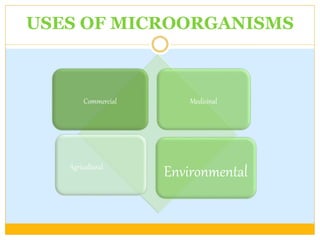
Commercial Medicinal
Agricultural
Environmental
USES OF MICROORGANISMS
COMMERCIAL USES
1.DAIRY
INDUSTRY
•Used in making curd and cheese.
•Bacteria causes curdling of the milk.
•Milk contain Lactose sugar & casein protein.
Lactose Bacteria Lactic Acid Acidic Milk Casein Low pH Coagulation
Commonly used bacteria:
Lactobacillus & Streptococcus
Commercially
RENNET is used for
curdling, obtained
from calf stomach
2.
PROCESSING
INDUSTRY
Bacteria are used for
processing of Tea, coffee and
Tobacco. Where fermentation
is a part of whole process
3. BEVERAGE
INDUSTRY
Yeast helps to convert Natural sugars in cereals,
fruits into Alcohol through Fermentation.
Similarly Acetic Acid (Vinegar) is also manufactured..
4. BAKING
INDUSTRY
DRY YEAST
Yeast uses the sugar in the flour as food and converts it
into Carbon dioxide and Alcohol. This CO2 creates the
bubbles and hence the sponginess.
MEDICINAL USE
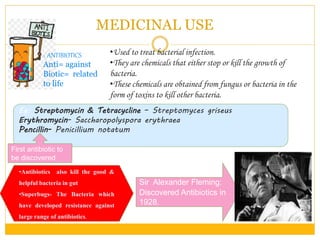
1. ANTIBIOTICS
Anti= against
Biotic= related
to life
•Used to treat bacterial infection.
•They are chemicals that either stop or kill the growth of
bacteria.
•These chemicals are obtained from fungus or bacteria in the
form of toxins to kill other bacteria.
Eg: Streptomycin & Tetracycline – Streptomyces griseus
Erythromycin- Saccharopolyspora erythraea
Pencillin- Penicillium notatum
First antibiotic to
be discovered
•Antibiotics also kill the good &
helpful bacteria in gut
•Superbugs- The Bacteria which
have developed resistance against
large range of antibiotics.
Sir Alexander Fleming:
Discovered Antibiotics in
1928.
2. VACCINES
Terms to Know
1. Immunity: Body’s mechanism to fight against any foreign body like pathogen that
enters inside.
2. Antibodies: Bio molecules (Proteins) produced WBCs which fight against the
pathogen. They retain some memory cells to produce antibodies any time later.
3. Antigen: Antibody generating- the part of the pathogen or whole pathogen that
causes the infection and production of Antibodies in the body.
It is a biological preparation of killed or weakened
pathogen which generates antibody against itself in the
healthy body.
Sir Edward
Jenner, invented
Vaccine. First
vaccine was against
SMALLPOX
eg: BCG- T.B, DPT- Diptheria, Pertussis & Tetanus
Polio, Hepatitis, Chickenpox etc.
Pathogen enters the
body= ANTIGEN
The immune system
WBC become active.
WBC produce
ANTIBODIES &
Memory cells
Antibodies fight
the antigen.
WHAT MAKES UP OUR IMMUNITY???
ANTIBODY
3. FOOD SUPPLEMENTS
Certain macro & micro algae are rich in minerals ,proteins &
other nutrients, so they are commercially sold as food
supplements.
Chlorella, Spirulina
4. HUMAN BODY
•Human body contain trillions of microorganisms. They make
the normal flora of human body.
•Some are helpful while some are harmful.
•Some common microbes are: Staphylococcus. aureus, E. coli,
Candida.albicans etc.
USEFUL
•Bacillus.subtilis on
skin - produces
Bacitracin, a toxin.
toxic to other M.O
•L. acidophillus, E. coli
found in intestine and
help in digestion
Probiotics- preparation of viable microorganism
which increases the number of good bacteria in our
intestine.
A natural probiotic is yogurt.
AGRICULTURAL
USE
Nitrogen fixation- conversion of
atmospheric N2 into NH3 (ammonia) by
nitrogen fixing bacteria viz Rhizobium,
Cynobacteria, Pseudomonas.
Ammonification-conversion of
protein into ammonia after
decomposition of dead organic
matter.
Nitrification- conversion of NH3
(ammonia) into nitrites (NO2
-) & then to
Nitrates NO3
- by nitrifying bacteria like
Nitrosomonas, Nitrobacter, Nitrococcus
Denitrification- conversion of
Nitrates back to atmospheric
Nitrogen.
ENVIRONMENTAL USES
AEROBIC BACTERIA
are used in sewage
treatment.
Bacteria have been used
to clean up oil spills in
sea & oceans.
ANEROBIC BACTERIA
are used to produce
methane and manure.
DISEASE CAUSING MICROBES
 The microbes which infect & cause disease in animals and plants are called
PATHOGENS.
 These microbes can enter the body through various ways viz food, water, air,
insects, direct contact with infected person.
 The pathogens after entering the body starts multiplying inside the host body
and produces some toxins.
 These toxins affect different parts of the body.
 The body’s immune system fights against these microbes and toxins, but some
still remain these cause the disease.
 A body with inefficient (low) immune system catches the disease more quickly
than others.
 The diseases which spread from an infected person to a healthy person by any
means are called COMMUNICABLE DISEASES
Example of Malaria
The female
Anopheles mosquito
carrying Plasmodium
Parasite bites a
healthy person
It injects the parasite
in to the body, which
infects the Liver. The
plasmodium
multiplies .
These plasmodium
now flow in the
bloodstream and
infect RBC.
Symptoms of malaria
are shown.
Example of Carriers
Malaria (Protozoa) -Anopheles mosquito
Dengue (Virus)- Aedes aegypti Mosquito
Plague (Bacteria: Yersinia pestis)- Rodent flea
Communicable
Diseases
Mode of
Transmission
Causative Agent
Common Cold Air Virus
Influenza (Flu) Air Virus
Chicken pox Air, Physical contact with
infected person
Virus- Varicella zoster
Polio myelitis Air & Water Polio Virus
Typhoid Contaminated food Bacteria
Tuberculosis Air Bacteria
Cholera Contaminated food &
water
Bacteria
Ringworm Physical contact with
infected Person
Fungi & Protozoan
Swine Flu infected person H1N1 Virus
Bird Flu Infected bird droplets
in Air
H5N1, H7N9
Diseases in Animals
Disease Animal
Affected
Causative
Agent
Anthrax Cattle, sheep,
horses
Bacillus anthracis
Botulism Same As above Clostridium
botulinum
Rinderpest Cattle Virus
Foot & Mouth
disease
Cows, pig, sheep,
Deer
Picornavirus
Diseases in Plants
Early blight in Tomatoes-
Alternaria solani
Citrus canker in citrus fruit-
Xanthomonas axonopodis
FOOD SPOILAGE
Presence of microbes in food leads to infection and indigestion in the body.
Examples: Clostridium, Staphylococcus, Aspergillus.
Signs of Food Spoilage-
1. Change in color of the food
2. Change in odour
3. Sour taste
4. Slimy layer
5. Gas formation
FOOD PRESERVATION
The process of treating food to stop or slow down their spoilage while
maintaining their nutritional value, texture and flavour.
Examples: Canning, Dehydration, Boiling, Cold Storage, Freezing, salt
sugar, vinegar or oil curing, Food Irradiation Technology.
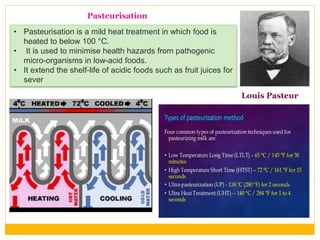
• Pasteurisation is a mild heat treatment in which food is
heated to below 100 °C.
• It is used to minimise health hazards from pathogenic
micro-organisms in low-acid foods.
• It extend the shelf-life of acidic foods such as fruit juices for
sever
Pasteurisation
Louis Pasteur
Chemical preservatives
Useful microbes

Useful microbes

  • 1.
  • 2.
  • 3.
    COMMERCIAL USES 1.DAIRY INDUSTRY •Used inmaking curd and cheese. •Bacteria causes curdling of the milk. •Milk contain Lactose sugar & casein protein. Lactose Bacteria Lactic Acid Acidic Milk Casein Low pH Coagulation Commonly used bacteria: Lactobacillus & Streptococcus Commercially RENNET is used for curdling, obtained from calf stomach 2. PROCESSING INDUSTRY Bacteria are used for processing of Tea, coffee and Tobacco. Where fermentation is a part of whole process
  • 4.
    3. BEVERAGE INDUSTRY Yeast helpsto convert Natural sugars in cereals, fruits into Alcohol through Fermentation. Similarly Acetic Acid (Vinegar) is also manufactured.. 4. BAKING INDUSTRY DRY YEAST Yeast uses the sugar in the flour as food and converts it into Carbon dioxide and Alcohol. This CO2 creates the bubbles and hence the sponginess.
  • 6.
    MEDICINAL USE 1. ANTIBIOTICS Anti=against Biotic= related to life •Used to treat bacterial infection. •They are chemicals that either stop or kill the growth of bacteria. •These chemicals are obtained from fungus or bacteria in the form of toxins to kill other bacteria. Eg: Streptomycin & Tetracycline – Streptomyces griseus Erythromycin- Saccharopolyspora erythraea Pencillin- Penicillium notatum First antibiotic to be discovered •Antibiotics also kill the good & helpful bacteria in gut •Superbugs- The Bacteria which have developed resistance against large range of antibiotics. Sir Alexander Fleming: Discovered Antibiotics in 1928.
  • 7.
    2. VACCINES Terms toKnow 1. Immunity: Body’s mechanism to fight against any foreign body like pathogen that enters inside. 2. Antibodies: Bio molecules (Proteins) produced WBCs which fight against the pathogen. They retain some memory cells to produce antibodies any time later. 3. Antigen: Antibody generating- the part of the pathogen or whole pathogen that causes the infection and production of Antibodies in the body. It is a biological preparation of killed or weakened pathogen which generates antibody against itself in the healthy body. Sir Edward Jenner, invented Vaccine. First vaccine was against SMALLPOX eg: BCG- T.B, DPT- Diptheria, Pertussis & Tetanus Polio, Hepatitis, Chickenpox etc.
  • 8.
    Pathogen enters the body=ANTIGEN The immune system WBC become active. WBC produce ANTIBODIES & Memory cells Antibodies fight the antigen. WHAT MAKES UP OUR IMMUNITY??? ANTIBODY
  • 9.
    3. FOOD SUPPLEMENTS Certainmacro & micro algae are rich in minerals ,proteins & other nutrients, so they are commercially sold as food supplements. Chlorella, Spirulina 4. HUMAN BODY •Human body contain trillions of microorganisms. They make the normal flora of human body. •Some are helpful while some are harmful. •Some common microbes are: Staphylococcus. aureus, E. coli, Candida.albicans etc. USEFUL •Bacillus.subtilis on skin - produces Bacitracin, a toxin. toxic to other M.O •L. acidophillus, E. coli found in intestine and help in digestion Probiotics- preparation of viable microorganism which increases the number of good bacteria in our intestine. A natural probiotic is yogurt.
  • 10.
    AGRICULTURAL USE Nitrogen fixation- conversionof atmospheric N2 into NH3 (ammonia) by nitrogen fixing bacteria viz Rhizobium, Cynobacteria, Pseudomonas. Ammonification-conversion of protein into ammonia after decomposition of dead organic matter. Nitrification- conversion of NH3 (ammonia) into nitrites (NO2 -) & then to Nitrates NO3 - by nitrifying bacteria like Nitrosomonas, Nitrobacter, Nitrococcus Denitrification- conversion of Nitrates back to atmospheric Nitrogen.
  • 11.
    ENVIRONMENTAL USES AEROBIC BACTERIA areused in sewage treatment. Bacteria have been used to clean up oil spills in sea & oceans. ANEROBIC BACTERIA are used to produce methane and manure.
  • 12.
    DISEASE CAUSING MICROBES The microbes which infect & cause disease in animals and plants are called PATHOGENS.  These microbes can enter the body through various ways viz food, water, air, insects, direct contact with infected person.  The pathogens after entering the body starts multiplying inside the host body and produces some toxins.  These toxins affect different parts of the body.  The body’s immune system fights against these microbes and toxins, but some still remain these cause the disease.  A body with inefficient (low) immune system catches the disease more quickly than others.  The diseases which spread from an infected person to a healthy person by any means are called COMMUNICABLE DISEASES
  • 14.
    Example of Malaria Thefemale Anopheles mosquito carrying Plasmodium Parasite bites a healthy person It injects the parasite in to the body, which infects the Liver. The plasmodium multiplies . These plasmodium now flow in the bloodstream and infect RBC. Symptoms of malaria are shown. Example of Carriers Malaria (Protozoa) -Anopheles mosquito Dengue (Virus)- Aedes aegypti Mosquito Plague (Bacteria: Yersinia pestis)- Rodent flea
  • 15.
    Communicable Diseases Mode of Transmission Causative Agent CommonCold Air Virus Influenza (Flu) Air Virus Chicken pox Air, Physical contact with infected person Virus- Varicella zoster Polio myelitis Air & Water Polio Virus Typhoid Contaminated food Bacteria Tuberculosis Air Bacteria Cholera Contaminated food & water Bacteria Ringworm Physical contact with infected Person Fungi & Protozoan Swine Flu infected person H1N1 Virus Bird Flu Infected bird droplets in Air H5N1, H7N9
  • 16.
    Diseases in Animals DiseaseAnimal Affected Causative Agent Anthrax Cattle, sheep, horses Bacillus anthracis Botulism Same As above Clostridium botulinum Rinderpest Cattle Virus Foot & Mouth disease Cows, pig, sheep, Deer Picornavirus Diseases in Plants Early blight in Tomatoes- Alternaria solani Citrus canker in citrus fruit- Xanthomonas axonopodis
  • 17.
    FOOD SPOILAGE Presence ofmicrobes in food leads to infection and indigestion in the body. Examples: Clostridium, Staphylococcus, Aspergillus. Signs of Food Spoilage- 1. Change in color of the food 2. Change in odour 3. Sour taste 4. Slimy layer 5. Gas formation FOOD PRESERVATION The process of treating food to stop or slow down their spoilage while maintaining their nutritional value, texture and flavour. Examples: Canning, Dehydration, Boiling, Cold Storage, Freezing, salt sugar, vinegar or oil curing, Food Irradiation Technology.
  • 18.
    • Pasteurisation isa mild heat treatment in which food is heated to below 100 °C. • It is used to minimise health hazards from pathogenic micro-organisms in low-acid foods. • It extend the shelf-life of acidic foods such as fruit juices for sever Pasteurisation Louis Pasteur
  • 19.