Uses of Computers
in Epidemiology
Dr. Chirag R Sonkusare
Senior Resident
Department of Community Medicine
Government Medical College, Gondia
Uses of Computers in Epidemiology
1) Data Collection and Management
2) Statistical Analysis
3) Disease Surveillance
4) Geographic Information Systems
(GIS)
5) Modeling and Simulation
6) Outbreak Investigation
7) Genome Sequencing
8) Telemedicine and Tele-epidemiology
9) Communication and Information
Dissemination
10) Forecasting
11) Research and Publication
12) Education and Training
13) Public Health Management
Data Collection and
Management
• Computers are used to collect, store,
and manage vast amounts of data
related to health, disease incidence,
and demographics.
• Electronic health records and
databases help epidemiologists track
and analyze disease trends.
Statistical Analysis
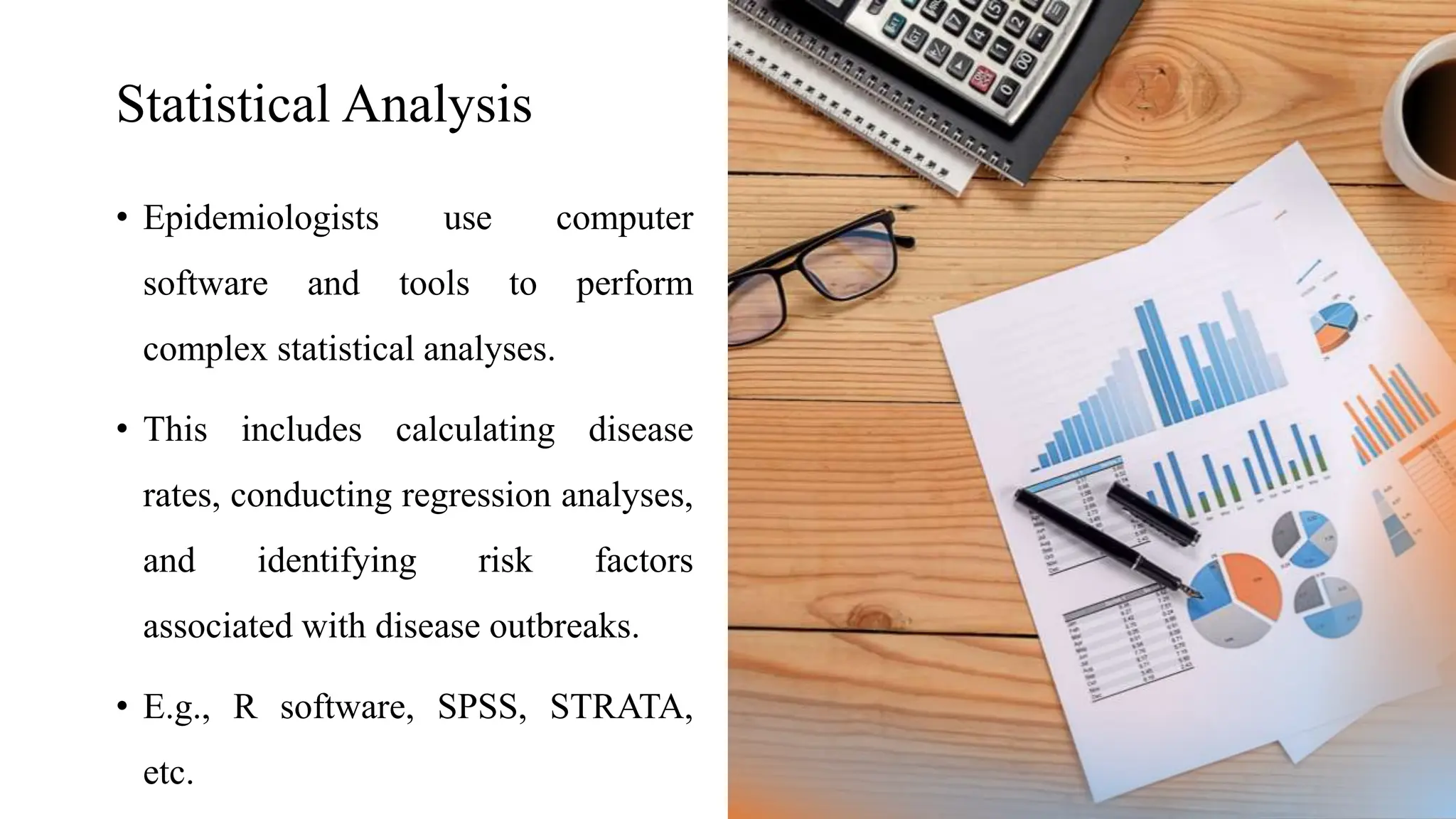
• Epidemiologists use computer
software and tools to perform
complex statistical analyses.
• This includes calculating disease
rates, conducting regression analyses,
and identifying risk factors
associated with disease outbreaks.
• E.g., R software, SPSS, STRATA,
etc.
Disease Surveillance
• Computers are essential for real-time
disease surveillance systems.
• These systems monitor the spread of
diseases and provide early warnings to
public health authorities, helping them
respond quickly to potential outbreaks.
• E.g., IDSP, HMIS, IHIP Portal.
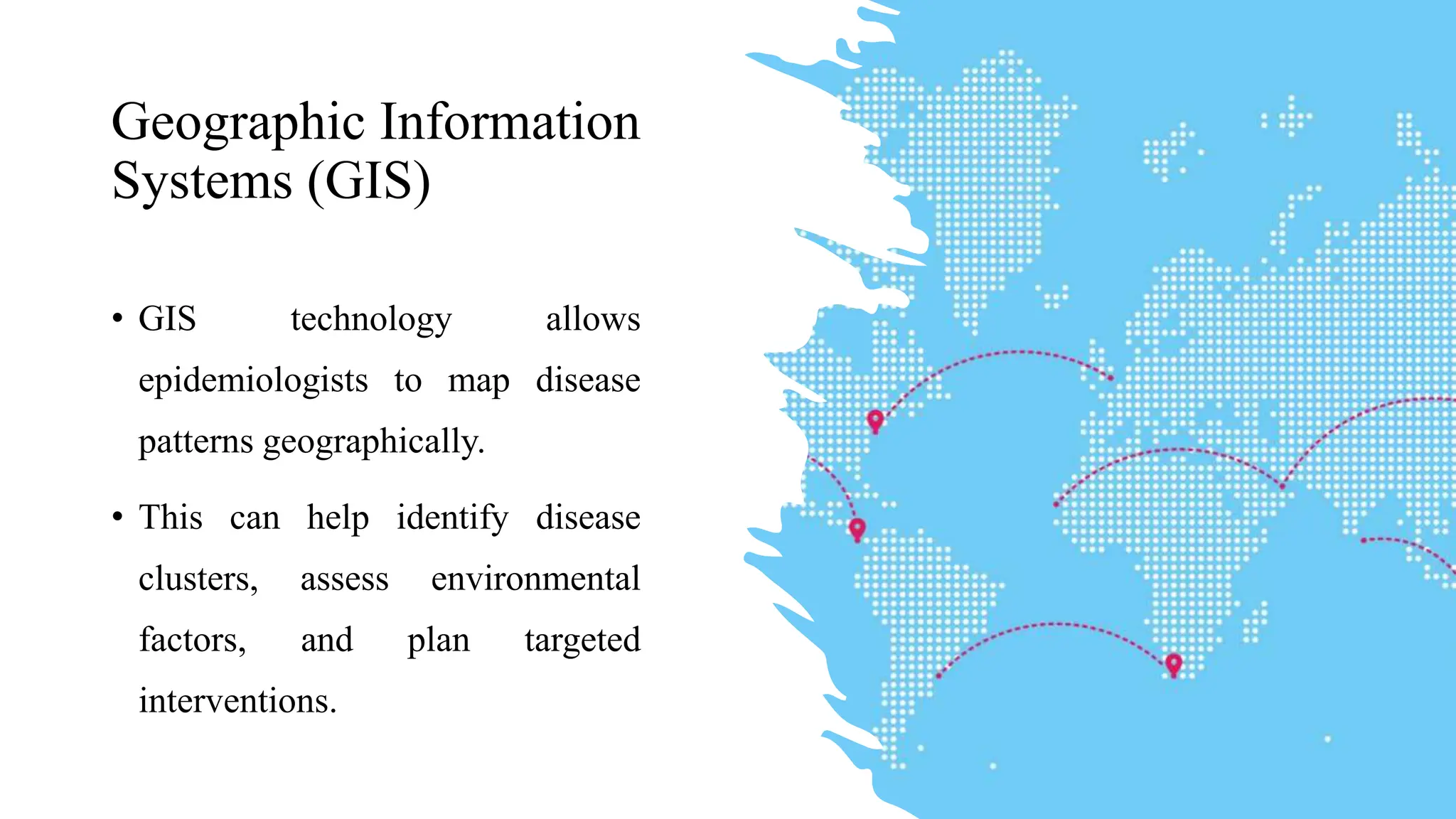
Geographic Information
Systems (GIS)
• GIS technology allows
epidemiologists to map disease
patterns geographically.
• This can help identify disease
clusters, assess environmental
factors, and plan targeted
interventions.
Modeling and Simulation
• Computer models and simulations are
used to predict the spread of diseases,
assess the impact of interventions, and
plan for resource allocation during
outbreaks.
• Epidemiological models can be complex
and require significant computational
power.
Outbreak Investigation
• Computers assist in the rapid
investigation of disease outbreaks.
• Epidemiologists can use data analysis
software to trace the source of an
outbreak and identify potential vectors of
transmission.
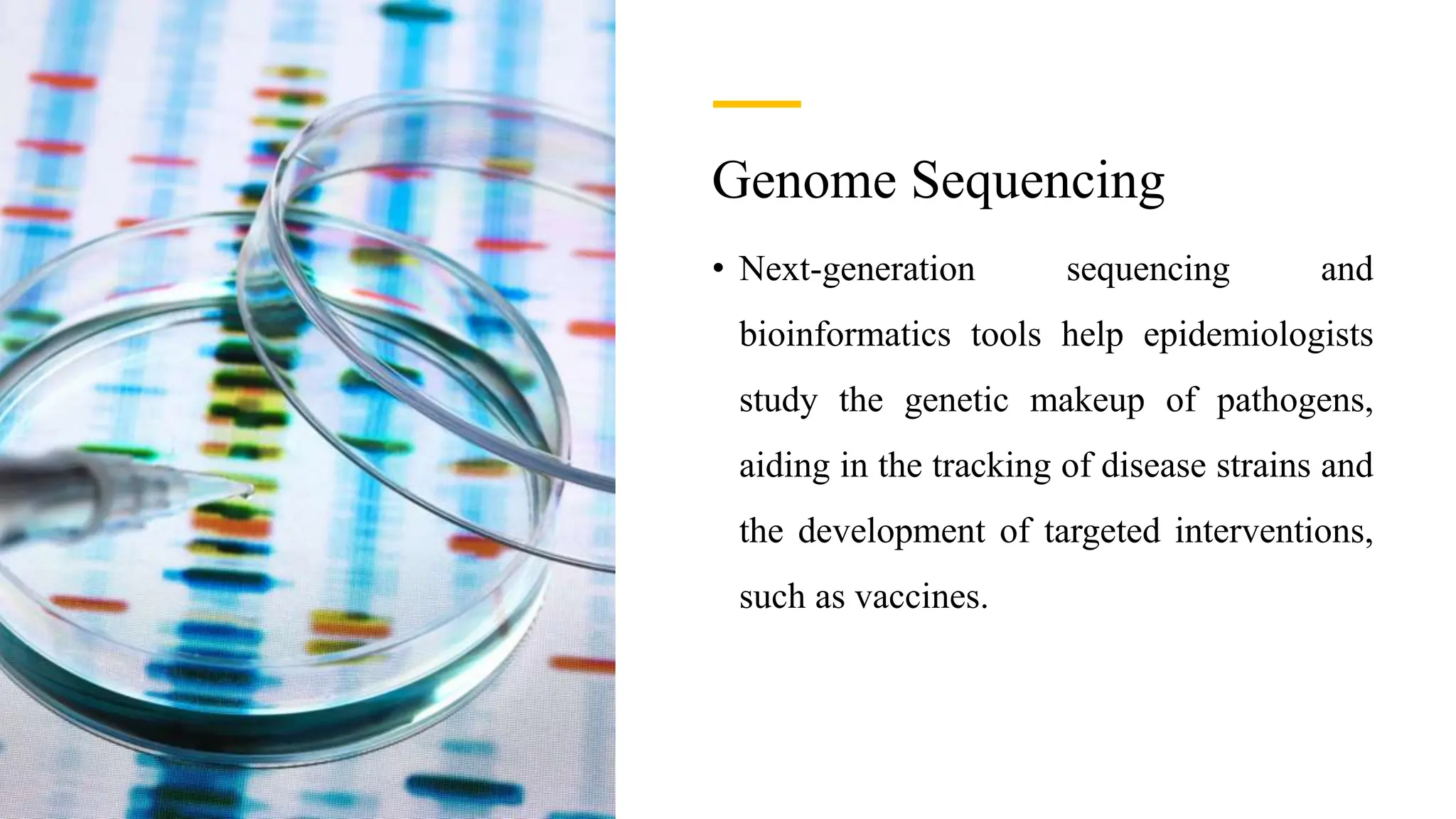
Genome Sequencing
• Next-generation sequencing and
bioinformatics tools help epidemiologists
study the genetic makeup of pathogens,
aiding in the tracking of disease strains and
the development of targeted interventions,
such as vaccines.
Telemedicine and
Tele-epidemiology
• Telemedicine platforms, driven by
computer technology, enable remote
consultations, data exchange, and
monitoring of patients.
• This is particularly important during
disease outbreaks when in-person
contact may be limited times.
Communication and
Information Dissemination
• Computers play a critical role in
disseminating information to the public
and healthcare professionals during
public health crises.
• Websites, apps, and social media are
used to provide information and
guidelines.
Forecasting
• Epidemiologists use computer-based
forecasting models to predict disease
trends, which can inform public
health policies and resource
allocation.
Research and Publication
• Computers facilitate the research
process by providing access to
scientific literature, data analysis
software, and tools for preparing
research manuscripts and reports.
Public Health
Management
• Computers are used for
administrative tasks, such as
resource allocation, budgeting,
and tracking healthcare
resources, to support public
health decision-making.
Application of computers in epidemilogy.pptx

Application of computers in epidemilogy.pptx

  • 1.
    Uses of Computers inEpidemiology Dr. Chirag R Sonkusare Senior Resident Department of Community Medicine Government Medical College, Gondia
  • 2.
    Uses of Computersin Epidemiology 1) Data Collection and Management 2) Statistical Analysis 3) Disease Surveillance 4) Geographic Information Systems (GIS) 5) Modeling and Simulation 6) Outbreak Investigation 7) Genome Sequencing 8) Telemedicine and Tele-epidemiology 9) Communication and Information Dissemination 10) Forecasting 11) Research and Publication 12) Education and Training 13) Public Health Management
  • 3.
    Data Collection and Management •Computers are used to collect, store, and manage vast amounts of data related to health, disease incidence, and demographics. • Electronic health records and databases help epidemiologists track and analyze disease trends.
  • 4.
    Statistical Analysis • Epidemiologistsuse computer software and tools to perform complex statistical analyses. • This includes calculating disease rates, conducting regression analyses, and identifying risk factors associated with disease outbreaks. • E.g., R software, SPSS, STRATA, etc.
  • 5.
    Disease Surveillance • Computersare essential for real-time disease surveillance systems. • These systems monitor the spread of diseases and provide early warnings to public health authorities, helping them respond quickly to potential outbreaks. • E.g., IDSP, HMIS, IHIP Portal.
  • 6.
    Geographic Information Systems (GIS) •GIS technology allows epidemiologists to map disease patterns geographically. • This can help identify disease clusters, assess environmental factors, and plan targeted interventions.
  • 7.
    Modeling and Simulation •Computer models and simulations are used to predict the spread of diseases, assess the impact of interventions, and plan for resource allocation during outbreaks. • Epidemiological models can be complex and require significant computational power.
  • 8.
    Outbreak Investigation • Computersassist in the rapid investigation of disease outbreaks. • Epidemiologists can use data analysis software to trace the source of an outbreak and identify potential vectors of transmission.
  • 9.
    Genome Sequencing • Next-generationsequencing and bioinformatics tools help epidemiologists study the genetic makeup of pathogens, aiding in the tracking of disease strains and the development of targeted interventions, such as vaccines.
  • 10.
    Telemedicine and Tele-epidemiology • Telemedicineplatforms, driven by computer technology, enable remote consultations, data exchange, and monitoring of patients. • This is particularly important during disease outbreaks when in-person contact may be limited times.
  • 11.
    Communication and Information Dissemination •Computers play a critical role in disseminating information to the public and healthcare professionals during public health crises. • Websites, apps, and social media are used to provide information and guidelines.
  • 12.
    Forecasting • Epidemiologists usecomputer-based forecasting models to predict disease trends, which can inform public health policies and resource allocation.
  • 13.
    Research and Publication •Computers facilitate the research process by providing access to scientific literature, data analysis software, and tools for preparing research manuscripts and reports.
  • 14.
    Public Health Management • Computersare used for administrative tasks, such as resource allocation, budgeting, and tracking healthcare resources, to support public health decision-making.