Vaccine Logistics
By
Shyam S. Sonecha
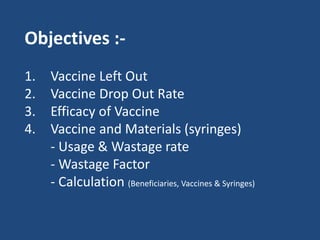
Objectives :-
1. Vaccine Left Out
2. Vaccine Drop Out Rate
3. Efficacy of Vaccine
4. Vaccine and Materials (syringes)
- Usage & Wastage rate
- Wastage Factor
- Calculation (Beneficiaries, Vaccines & Syringes)
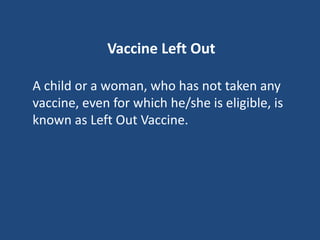
Vaccine Left Out
A child or a woman, who has not taken any
vaccine, even for which he/she is eligible, is
known as Left Out Vaccine.
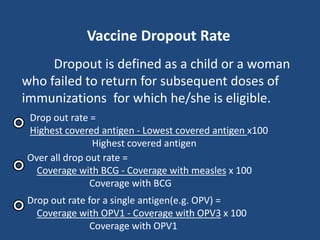
Vaccine Dropout Rate
Dropout is defined as a child or a woman
who failed to return for subsequent doses of
immunizations for which he/she is eligible.
Drop out rate =
Highest covered antigen - Lowest covered antigen x100
Highest covered antigen
Over all drop out rate =
Coverage with BCG - Coverage with measles x 100
Coverage with BCG
Drop out rate for a single antigen(e.g. OPV) =
Coverage with OPV1 - Coverage with OPV3 x 100
Coverage with OPV1
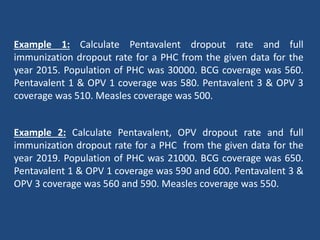
Example 1: Calculate Pentavalent dropout rate and full
immunization dropout rate for a PHC from the given data for the
year 2015. Population of PHC was 30000. BCG coverage was 560.
Pentavalent 1 & OPV 1 coverage was 580. Pentavalent 3 & OPV 3
coverage was 510. Measles coverage was 500.
Example 2: Calculate Pentavalent, OPV dropout rate and full
immunization dropout rate for a PHC from the given data for the
year 2019. Population of PHC was 21000. BCG coverage was 650.
Pentavalent 1 & OPV 1 coverage was 590 and 600. Pentavalent 3 &
OPV 3 coverage was 560 and 590. Measles coverage was 550.
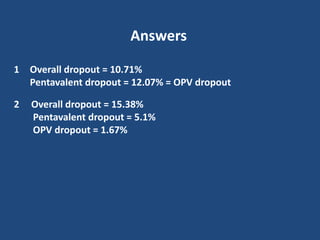
Answers
1 Overall dropout = 10.71%
Pentavalent dropout = 12.07% = OPV dropout
2 Overall dropout = 15.38%
Pentavalent dropout = 5.1%
OPV dropout = 1.67%
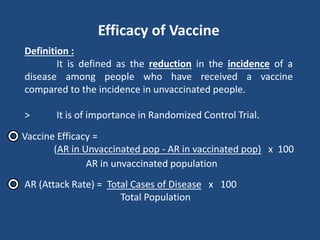
Definition :
It is defined as the reduction in the incidence of a
disease among people who have received a vaccine
compared to the incidence in unvaccinated people.
> It is of importance in Randomized Control Trial.
Efficacy of Vaccine
Vaccine Efficacy =
(AR in Unvaccinated pop - AR in vaccinated pop) x 100
AR in unvaccinated population
AR (Attack Rate) = Total Cases of Disease x 100
Total Population
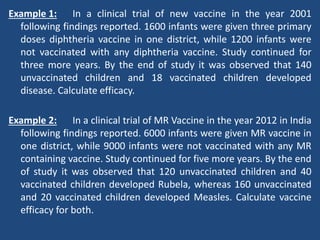
Example 1: In a clinical trial of new vaccine in the year 2001
following findings reported. 1600 infants were given three primary
doses diphtheria vaccine in one district, while 1200 infants were
not vaccinated with any diphtheria vaccine. Study continued for
three more years. By the end of study it was observed that 140
unvaccinated children and 18 vaccinated children developed
disease. Calculate efficacy.
Example 2: In a clinical trial of MR Vaccine in the year 2012 in India
following findings reported. 6000 infants were given MR vaccine in
one district, while 9000 infants were not vaccinated with any MR
containing vaccine. Study continued for five more years. By the end
of study it was observed that 120 unvaccinated children and 40
vaccinated children developed Rubela, whereas 160 unvaccinated
and 20 vaccinated children developed Measles. Calculate vaccine
efficacy for both.
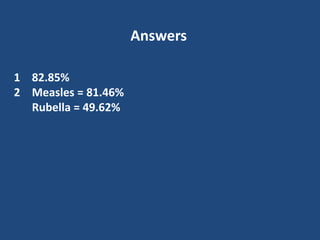
Answers
1 82.85%
2 Measles = 81.46%
Rubella = 49.62%
Usage Rate for a vaccine (%)
= (Doses Administeredx100)/Doses issued
Wastage Rate for a vaccine (%)
= 100 – Usage Rate
= 100 – [(Doses Administeredx100)/Doses issued]
Definition :
Wastage rate(%) is the proportion of vaccine
(and other injection items) that is wasted due to
variety of reasons to that which was appropriately
used (i.e. number of infants vaccinated).
Wastage Factor
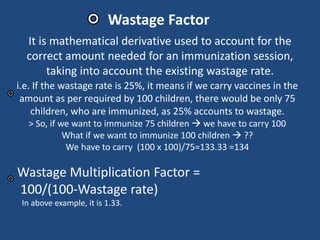
It is mathematical derivative used to account for the
correct amount needed for an immunization session,
taking into account the existing wastage rate.
i.e. If the wastage rate is 25%, it means if we carry vaccines in the
amount as per required by 100 children, there would be only 75
children, who are immunized, as 25% accounts to wastage.
> So, if we want to immunize 75 children  we have to carry 100
What if we want to immunize 100 children  ??
We have to carry (100 x 100)/75=133.33 =134
Wastage Multiplication Factor =
100/(100-Wastage rate)
In above example, it is 1.33.
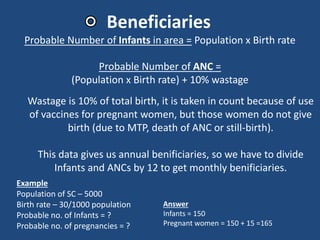
Beneficiaries
Probable Number of Infants in area = Population x Birth rate
Probable Number of ANC =
(Population x Birth rate) + 10% wastage
Wastage is 10% of total birth, it is taken in count because of use
of vaccines for pregnant women, but those women do not give
birth (due to MTP, death of ANC or still-birth).
This data gives us annual benificiaries, so we have to divide
Infants and ANCs by 12 to get monthly benificiaries.
Example
Population of SC – 5000
Birth rate – 30/1000 population
Probable no. of Infants = ?
Probable no. of pregnancies = ?
Answer
Infants = 150
Pregnant women = 150 + 15 =165
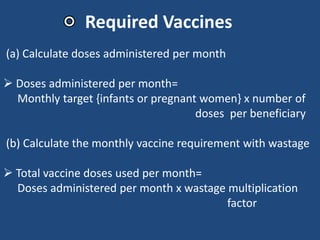
(a) Calculate doses administered per month
 Doses administered per month=
Monthly target {infants or pregnant women} x number of
doses per beneficiary
(b) Calculate the monthly vaccine requirement with wastage
 Total vaccine doses used per month=
Doses administered per month x wastage multiplication
factor
Required Vaccines
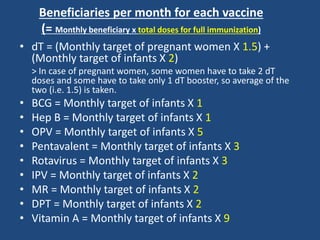
• dT = (Monthly target of pregnant women X 1.5) +
(Monthly target of infants X 2)
> In case of pregnant women, some women have to take 2 dT
doses and some have to take only 1 dT booster, so average of the
two (i.e. 1.5) is taken.
• BCG = Monthly target of infants X 1
• Hep B = Monthly target of infants X 1
• OPV = Monthly target of infants X 5
• Pentavalent = Monthly target of infants X 3
• Rotavirus = Monthly target of infants X 3
• IPV = Monthly target of infants X 2
• MR = Monthly target of infants X 2
• DPT = Monthly target of infants X 2
• Vitamin A = Monthly target of infants X 9
Beneficiaries per month for each vaccine
(= Monthly beneficiary x total doses for full immunization)
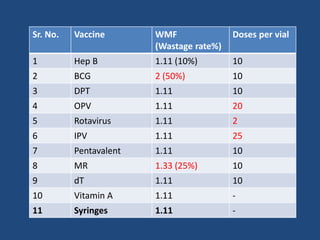
Sr. No. Vaccine WMF
(Wastage rate%)
Doses per vial
1 Hep B 1.11 (10%) 10
2 BCG 2 (50%) 10
3 DPT 1.11 10
4 OPV 1.11 20
5 Rotavirus 1.11 2
6 IPV 1.11 25
7 Pentavalent 1.11 10
8 MR 1.33 (25%) 10
9 dT 1.11 10
10 Vitamin A 1.11 -
11 Syringes 1.11 -
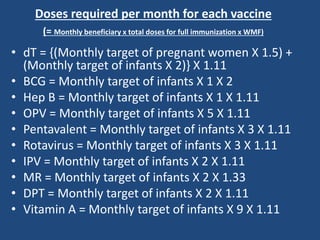
• dT = {(Monthly target of pregnant women X 1.5) +
(Monthly target of infants X 2)} X 1.11
• BCG = Monthly target of infants X 1 X 2
• Hep B = Monthly target of infants X 1 X 1.11
• OPV = Monthly target of infants X 5 X 1.11
• Pentavalent = Monthly target of infants X 3 X 1.11
• Rotavirus = Monthly target of infants X 3 X 1.11
• IPV = Monthly target of infants X 2 X 1.11
• MR = Monthly target of infants X 2 X 1.33
• DPT = Monthly target of infants X 2 X 1.11
• Vitamin A = Monthly target of infants X 9 X 1.11
Doses required per month for each vaccine
(= Monthly beneficiary x total doses for full immunization x WMF)
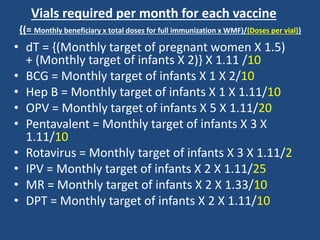
• dT = {(Monthly target of pregnant women X 1.5)
+ (Monthly target of infants X 2)} X 1.11 /10
• BCG = Monthly target of infants X 1 X 2/10
• Hep B = Monthly target of infants X 1 X 1.11/10
• OPV = Monthly target of infants X 5 X 1.11/20
• Pentavalent = Monthly target of infants X 3 X
1.11/10
• Rotavirus = Monthly target of infants X 3 X 1.11/2
• IPV = Monthly target of infants X 2 X 1.11/25
• MR = Monthly target of infants X 2 X 1.33/10
• DPT = Monthly target of infants X 2 X 1.11/10
Vials required per month for each vaccine
{(= Monthly beneficiary x total doses for full immunization x WMF)/(Doses per vial)}
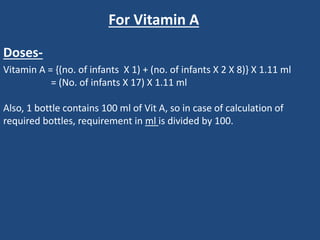
Vitamin A = {(no. of infants X 1) + (no. of infants X 2 X 8)} X 1.11 ml
= (No. of infants X 17) X 1.11 ml
Also, 1 bottle contains 100 ml of Vit A, so in case of calculation of
required bottles, requirement in ml is divided by 100.
For Vitamin A
Doses-
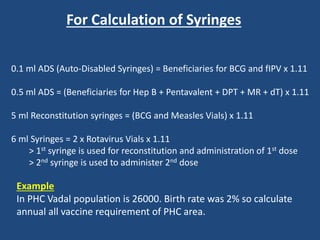
For Calculation of Syringes
0.1 ml ADS (Auto-Disabled Syringes) = Beneficiaries for BCG and fIPV x 1.11
0.5 ml ADS = (Beneficiaries for Hep B + Pentavalent + DPT + MR + dT) x 1.11
5 ml Reconstitution syringes = (BCG and Measles Vials) x 1.11
6 ml Syringes = 2 x Rotavirus Vials x 1.11
> 1st syringe is used for reconstitution and administration of 1st dose
> 2nd syringe is used to administer 2nd dose
Example
In PHC Vadal population is 26000. Birth rate was 2% so calculate
annual all vaccine requirement of PHC area.
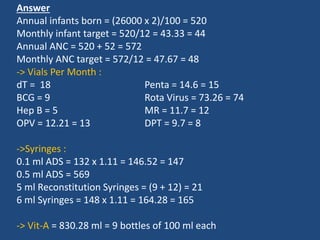
Answer
Annual infants born = (26000 x 2)/100 = 520
Monthly infant target = 520/12 = 43.33 = 44
Annual ANC = 520 + 52 = 572
Monthly ANC target = 572/12 = 47.67 = 48
-> Vials Per Month :
dT = 18 Penta = 14.6 = 15
BCG = 9 Rota Virus = 73.26 = 74
Hep B = 5 MR = 11.7 = 12
OPV = 12.21 = 13 DPT = 9.7 = 8
->Syringes :
0.1 ml ADS = 132 x 1.11 = 146.52 = 147
0.5 ml ADS = 569
5 ml Reconstitution Syringes = (9 + 12) = 21
6 ml Syringes = 148 x 1.11 = 164.28 = 165
-> Vit-A = 830.28 ml = 9 bottles of 100 ml each

Vaccine Logistics

  • 1.
  • 2.
    Objectives :- 1. VaccineLeft Out 2. Vaccine Drop Out Rate 3. Efficacy of Vaccine 4. Vaccine and Materials (syringes) - Usage & Wastage rate - Wastage Factor - Calculation (Beneficiaries, Vaccines & Syringes)
  • 3.
    Vaccine Left Out Achild or a woman, who has not taken any vaccine, even for which he/she is eligible, is known as Left Out Vaccine.
  • 4.
    Vaccine Dropout Rate Dropoutis defined as a child or a woman who failed to return for subsequent doses of immunizations for which he/she is eligible. Drop out rate = Highest covered antigen - Lowest covered antigen x100 Highest covered antigen Over all drop out rate = Coverage with BCG - Coverage with measles x 100 Coverage with BCG Drop out rate for a single antigen(e.g. OPV) = Coverage with OPV1 - Coverage with OPV3 x 100 Coverage with OPV1
  • 5.
    Example 1: CalculatePentavalent dropout rate and full immunization dropout rate for a PHC from the given data for the year 2015. Population of PHC was 30000. BCG coverage was 560. Pentavalent 1 & OPV 1 coverage was 580. Pentavalent 3 & OPV 3 coverage was 510. Measles coverage was 500. Example 2: Calculate Pentavalent, OPV dropout rate and full immunization dropout rate for a PHC from the given data for the year 2019. Population of PHC was 21000. BCG coverage was 650. Pentavalent 1 & OPV 1 coverage was 590 and 600. Pentavalent 3 & OPV 3 coverage was 560 and 590. Measles coverage was 550.
  • 6.
    Answers 1 Overall dropout= 10.71% Pentavalent dropout = 12.07% = OPV dropout 2 Overall dropout = 15.38% Pentavalent dropout = 5.1% OPV dropout = 1.67%
  • 7.
    Definition : It isdefined as the reduction in the incidence of a disease among people who have received a vaccine compared to the incidence in unvaccinated people. > It is of importance in Randomized Control Trial. Efficacy of Vaccine Vaccine Efficacy = (AR in Unvaccinated pop - AR in vaccinated pop) x 100 AR in unvaccinated population AR (Attack Rate) = Total Cases of Disease x 100 Total Population
  • 8.
    Example 1: Ina clinical trial of new vaccine in the year 2001 following findings reported. 1600 infants were given three primary doses diphtheria vaccine in one district, while 1200 infants were not vaccinated with any diphtheria vaccine. Study continued for three more years. By the end of study it was observed that 140 unvaccinated children and 18 vaccinated children developed disease. Calculate efficacy. Example 2: In a clinical trial of MR Vaccine in the year 2012 in India following findings reported. 6000 infants were given MR vaccine in one district, while 9000 infants were not vaccinated with any MR containing vaccine. Study continued for five more years. By the end of study it was observed that 120 unvaccinated children and 40 vaccinated children developed Rubela, whereas 160 unvaccinated and 20 vaccinated children developed Measles. Calculate vaccine efficacy for both.
  • 9.
    Answers 1 82.85% 2 Measles= 81.46% Rubella = 49.62%
  • 10.
    Usage Rate fora vaccine (%) = (Doses Administeredx100)/Doses issued Wastage Rate for a vaccine (%) = 100 – Usage Rate = 100 – [(Doses Administeredx100)/Doses issued] Definition : Wastage rate(%) is the proportion of vaccine (and other injection items) that is wasted due to variety of reasons to that which was appropriately used (i.e. number of infants vaccinated).
  • 11.
    Wastage Factor It ismathematical derivative used to account for the correct amount needed for an immunization session, taking into account the existing wastage rate. i.e. If the wastage rate is 25%, it means if we carry vaccines in the amount as per required by 100 children, there would be only 75 children, who are immunized, as 25% accounts to wastage. > So, if we want to immunize 75 children  we have to carry 100 What if we want to immunize 100 children  ?? We have to carry (100 x 100)/75=133.33 =134 Wastage Multiplication Factor = 100/(100-Wastage rate) In above example, it is 1.33.
  • 12.
    Beneficiaries Probable Number ofInfants in area = Population x Birth rate Probable Number of ANC = (Population x Birth rate) + 10% wastage Wastage is 10% of total birth, it is taken in count because of use of vaccines for pregnant women, but those women do not give birth (due to MTP, death of ANC or still-birth). This data gives us annual benificiaries, so we have to divide Infants and ANCs by 12 to get monthly benificiaries. Example Population of SC – 5000 Birth rate – 30/1000 population Probable no. of Infants = ? Probable no. of pregnancies = ? Answer Infants = 150 Pregnant women = 150 + 15 =165
  • 13.
    (a) Calculate dosesadministered per month  Doses administered per month= Monthly target {infants or pregnant women} x number of doses per beneficiary (b) Calculate the monthly vaccine requirement with wastage  Total vaccine doses used per month= Doses administered per month x wastage multiplication factor Required Vaccines
  • 14.
    • dT =(Monthly target of pregnant women X 1.5) + (Monthly target of infants X 2) > In case of pregnant women, some women have to take 2 dT doses and some have to take only 1 dT booster, so average of the two (i.e. 1.5) is taken. • BCG = Monthly target of infants X 1 • Hep B = Monthly target of infants X 1 • OPV = Monthly target of infants X 5 • Pentavalent = Monthly target of infants X 3 • Rotavirus = Monthly target of infants X 3 • IPV = Monthly target of infants X 2 • MR = Monthly target of infants X 2 • DPT = Monthly target of infants X 2 • Vitamin A = Monthly target of infants X 9 Beneficiaries per month for each vaccine (= Monthly beneficiary x total doses for full immunization)
  • 15.
    Sr. No. VaccineWMF (Wastage rate%) Doses per vial 1 Hep B 1.11 (10%) 10 2 BCG 2 (50%) 10 3 DPT 1.11 10 4 OPV 1.11 20 5 Rotavirus 1.11 2 6 IPV 1.11 25 7 Pentavalent 1.11 10 8 MR 1.33 (25%) 10 9 dT 1.11 10 10 Vitamin A 1.11 - 11 Syringes 1.11 -
  • 16.
    • dT ={(Monthly target of pregnant women X 1.5) + (Monthly target of infants X 2)} X 1.11 • BCG = Monthly target of infants X 1 X 2 • Hep B = Monthly target of infants X 1 X 1.11 • OPV = Monthly target of infants X 5 X 1.11 • Pentavalent = Monthly target of infants X 3 X 1.11 • Rotavirus = Monthly target of infants X 3 X 1.11 • IPV = Monthly target of infants X 2 X 1.11 • MR = Monthly target of infants X 2 X 1.33 • DPT = Monthly target of infants X 2 X 1.11 • Vitamin A = Monthly target of infants X 9 X 1.11 Doses required per month for each vaccine (= Monthly beneficiary x total doses for full immunization x WMF)
  • 17.
    • dT ={(Monthly target of pregnant women X 1.5) + (Monthly target of infants X 2)} X 1.11 /10 • BCG = Monthly target of infants X 1 X 2/10 • Hep B = Monthly target of infants X 1 X 1.11/10 • OPV = Monthly target of infants X 5 X 1.11/20 • Pentavalent = Monthly target of infants X 3 X 1.11/10 • Rotavirus = Monthly target of infants X 3 X 1.11/2 • IPV = Monthly target of infants X 2 X 1.11/25 • MR = Monthly target of infants X 2 X 1.33/10 • DPT = Monthly target of infants X 2 X 1.11/10 Vials required per month for each vaccine {(= Monthly beneficiary x total doses for full immunization x WMF)/(Doses per vial)}
  • 18.
    Vitamin A ={(no. of infants X 1) + (no. of infants X 2 X 8)} X 1.11 ml = (No. of infants X 17) X 1.11 ml Also, 1 bottle contains 100 ml of Vit A, so in case of calculation of required bottles, requirement in ml is divided by 100. For Vitamin A Doses-
  • 19.
    For Calculation ofSyringes 0.1 ml ADS (Auto-Disabled Syringes) = Beneficiaries for BCG and fIPV x 1.11 0.5 ml ADS = (Beneficiaries for Hep B + Pentavalent + DPT + MR + dT) x 1.11 5 ml Reconstitution syringes = (BCG and Measles Vials) x 1.11 6 ml Syringes = 2 x Rotavirus Vials x 1.11 > 1st syringe is used for reconstitution and administration of 1st dose > 2nd syringe is used to administer 2nd dose Example In PHC Vadal population is 26000. Birth rate was 2% so calculate annual all vaccine requirement of PHC area.
  • 20.
    Answer Annual infants born= (26000 x 2)/100 = 520 Monthly infant target = 520/12 = 43.33 = 44 Annual ANC = 520 + 52 = 572 Monthly ANC target = 572/12 = 47.67 = 48 -> Vials Per Month : dT = 18 Penta = 14.6 = 15 BCG = 9 Rota Virus = 73.26 = 74 Hep B = 5 MR = 11.7 = 12 OPV = 12.21 = 13 DPT = 9.7 = 8 ->Syringes : 0.1 ml ADS = 132 x 1.11 = 146.52 = 147 0.5 ml ADS = 569 5 ml Reconstitution Syringes = (9 + 12) = 21 6 ml Syringes = 148 x 1.11 = 164.28 = 165 -> Vit-A = 830.28 ml = 9 bottles of 100 ml each