A CRISIS IN CONFIDENCE, 1969-1980 America:  Past and Present Chapter 31
Nixon in Power Apparent success in first term  Triumphs in foreign affairs Nixon cuts himself off from Congress, his own cabinet, and the nation
Reshaping the Great Society Nixon and the Great Society more efficient administration shift responsibility to the states shift school desegregation to the courts Shift to conservative Supreme Court appointment of conservatives and moderates Burger Court similar to Warren Court Pace of change slows but continues
Nixonomics Nixon and inflation inflation spurred by Vietnam  federal spending cuts interest rates forced up  1970--Nixon-induced recession  1971--wage and price controls Economy revives
Building a Republican Majority Nixon obsessed about reelection  Inactive on desegregation to win South  Attack cultural revolution to win “middle America” Democrats retain majority by joining crusade against drugs, crime
In Search of D é tente Foreign-policy assumptions Cold War to be managed, not won America must make a strategic retreat improve relations with China to neutralize Russia February 1972--Nixon visits China
In Search of D é tente: Outcome of China Visit February 1972--U.S. recognition of Communist China set in motion May 1972--Russians sign SALT I Apparent mutual desire to reduce Cold War tensions
Ending the Vietnam War Nixon’s plan gradual reduction of American troops intensify American bombing  hard line at the peace talks 1970--invasion of Cambodia January, 1973--peace talks conclude with disguised American surrender
The Crisis of Democracy June, 1972--Nixon agents arrested for attempted Watergate break-in Nixon stonewalled the press about White House involvement even instructed aides to lie under oath
The Election of 1972 Nixon’s opponents American Independent George Wallace--shot and disabled, followers vote for Nixon Democrat George McGovern--nomination alienates middle class Nixon landslide suggests new alignment middle class shifting to Republicans African Americans, Jews, the poor remain strongly Democratic
 
The Watergate Scandal Summer 1973--Senate investigation damaging Senate hearings on cover-up White House tapes discovered  Summer 1974 Nixon must relinquish tapes House Judiciary committee recommends impeachment  August 9, 1974--Nixon resigns
The Watergate Scandal: Consequences Demonstrates growing power of the executive branch  Illustrates vitality of institutions the press the federal judiciary Congress
Energy and the Economy U.S. way of life based on cheap energy 1970s energy crisis sparks inflation
The October War October, 1973--Yom Kippur War pits Egypt, Syria against Israel U.S. supplies weapons to Israel  Arab oil nations retaliate with boycott prices of gasoline and home heating fuel rose sharply
The Oil Shocks Effects of soaring oil prices  consumer spending plunges recession by 1974 inflation persists through 1970s Tax cut aids recovery 1979--Iranian Revolution causes second surge in oil prices
The Oil Shocks:  Price Increases of Crude Oil and Gasoline, 1973-1985
The Search for an Energy Policy Ford tries to encourage production Carter tries to encourage conservation Congressional legislation to encourage production, e.g. Alaska pipeline encourage conservation, e.g. gas rationing Energy problem persists
The Great Inflation Oil prices drive inflation price of goods soars real income declines Attempted government controls result in record high interest rates
The Shifting American Economy U.S. share of world markets declines U.S. heavy industry declines High technology prospers Businesses tend to diversify
Private Lives—Public Issues Traditional American family gives way to more diverse living arrangements Number of working women increases sharply Gay rights movement emerges
The Changing American Family:  Family Life by 1990 21% of women solely in childrearing 30% of married coupes without children 25% of households consist of one adult Birthrate begins to climb after 15-year fall Divorce rate levels and drops slightly
The Changing American Family:  New Family Structure Many never marry or postpone marriage Most mothers work outside the home Proportion of single-parent households doubled Women without partners head 1/3 of impoverished families  Children comprise 40% of the poor
Types of Households in the United States, 2000
Gains and Setbacks for Women Rapid movement of women into work force Breakthroughs for women leaders in industry, higher education Roe v. Wade  strengthens reproductive rights women appointed to Supreme Court Resistance most women remain in female-dominated jobs wages only 77.5% of men’s earnings Equal Rights Amendment fails  abortion widely stigmatized
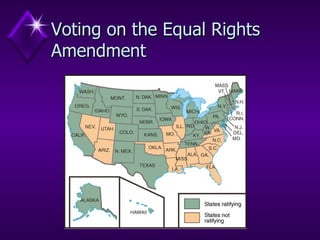
Voting on the Equal Rights Amendment
The Gay Liberation Movement 1969--Stonewall Riot sparks gay rights movement 1980--Democrats include gay rights plank 1980s--AIDS activism 1987--600,000 march on Washington 1993--“Don’t Ask, Don’t Tell” policy a setback 1996--Defense of Marriage Act prohibits state recognition of same-sex unions 2000--Vermont legalizes same-sex “civil unions”
 
Politics After Watergate Watergate erodes public trust Confrontation leaves nation leaderless
The Ford Administration Pardon of Nixon unpopular Democratic Congress alienated disclosure of illegal CIA activities under Kennedy and Johnson opposes Democratic bills protecting the environment and civil rights
The 1976 Campaign Ford damaged by Watergate Democrat Jimmy Carter wins close vote former governor of Georgia campaigns as outsider calls for decency, morality in government
 
Disenchantment with Carter Carter displays lack of political vision Outsider status hampers effectiveness 1979--Carter blames American people for "national malaise"
From Détente to Renewed Cold War U.S. international dominance declined sharply in the 1970s Internal and external events weakened foreign policy
Retreat in Asia April 1975--North Vietnam captures Saigon U.S. response--evacuation, no aid  Subsequent incidents met with caution, restraint
Accommodation in Latin America 1977--treaty returns Panama Canal to Panama 1979--U.S. refuses aid to Nicaraguan government against Sandinistas  Carter assists El Salvador against Marxist rebels
The Quest for Peace in the Middle East Carter’s success 1978--Camp David Accords  1979--Israeli-Egyptian peace treaty Carter’s failure 1979--Iranian Revolution  November--U.S. embassy in Teheran invaded, 58 Americans taken hostage Carter fails to secure hostages’ release
The Cold War Resumes Carter, Brzezinski shift from Détente condemn Soviet human rights abuses new missile systems deployed increased aid to China  December, 1979--Russians invade  Afghanistan
A Failed Presidency Carter lost public confidence during the Iranian hostage crisis Double-digit inflation also contributed to voter disappointment

Nixon to present

  • 1.
    A CRISIS INCONFIDENCE, 1969-1980 America: Past and Present Chapter 31
  • 2.
    Nixon in PowerApparent success in first term Triumphs in foreign affairs Nixon cuts himself off from Congress, his own cabinet, and the nation
  • 3.
    Reshaping the GreatSociety Nixon and the Great Society more efficient administration shift responsibility to the states shift school desegregation to the courts Shift to conservative Supreme Court appointment of conservatives and moderates Burger Court similar to Warren Court Pace of change slows but continues
  • 4.
    Nixonomics Nixon andinflation inflation spurred by Vietnam federal spending cuts interest rates forced up 1970--Nixon-induced recession 1971--wage and price controls Economy revives
  • 5.
    Building a RepublicanMajority Nixon obsessed about reelection Inactive on desegregation to win South Attack cultural revolution to win “middle America” Democrats retain majority by joining crusade against drugs, crime
  • 6.
    In Search ofD é tente Foreign-policy assumptions Cold War to be managed, not won America must make a strategic retreat improve relations with China to neutralize Russia February 1972--Nixon visits China
  • 7.
    In Search ofD é tente: Outcome of China Visit February 1972--U.S. recognition of Communist China set in motion May 1972--Russians sign SALT I Apparent mutual desire to reduce Cold War tensions
  • 8.
    Ending the VietnamWar Nixon’s plan gradual reduction of American troops intensify American bombing hard line at the peace talks 1970--invasion of Cambodia January, 1973--peace talks conclude with disguised American surrender
  • 9.
    The Crisis ofDemocracy June, 1972--Nixon agents arrested for attempted Watergate break-in Nixon stonewalled the press about White House involvement even instructed aides to lie under oath
  • 10.
    The Election of1972 Nixon’s opponents American Independent George Wallace--shot and disabled, followers vote for Nixon Democrat George McGovern--nomination alienates middle class Nixon landslide suggests new alignment middle class shifting to Republicans African Americans, Jews, the poor remain strongly Democratic
  • 11.
  • 12.
    The Watergate ScandalSummer 1973--Senate investigation damaging Senate hearings on cover-up White House tapes discovered Summer 1974 Nixon must relinquish tapes House Judiciary committee recommends impeachment August 9, 1974--Nixon resigns
  • 13.
    The Watergate Scandal:Consequences Demonstrates growing power of the executive branch Illustrates vitality of institutions the press the federal judiciary Congress
  • 14.
    Energy and theEconomy U.S. way of life based on cheap energy 1970s energy crisis sparks inflation
  • 15.
    The October WarOctober, 1973--Yom Kippur War pits Egypt, Syria against Israel U.S. supplies weapons to Israel Arab oil nations retaliate with boycott prices of gasoline and home heating fuel rose sharply
  • 16.
    The Oil ShocksEffects of soaring oil prices consumer spending plunges recession by 1974 inflation persists through 1970s Tax cut aids recovery 1979--Iranian Revolution causes second surge in oil prices
  • 17.
    The Oil Shocks: Price Increases of Crude Oil and Gasoline, 1973-1985
  • 18.
    The Search foran Energy Policy Ford tries to encourage production Carter tries to encourage conservation Congressional legislation to encourage production, e.g. Alaska pipeline encourage conservation, e.g. gas rationing Energy problem persists
  • 19.
    The Great InflationOil prices drive inflation price of goods soars real income declines Attempted government controls result in record high interest rates
  • 20.
    The Shifting AmericanEconomy U.S. share of world markets declines U.S. heavy industry declines High technology prospers Businesses tend to diversify
  • 21.
    Private Lives—Public IssuesTraditional American family gives way to more diverse living arrangements Number of working women increases sharply Gay rights movement emerges
  • 22.
    The Changing AmericanFamily: Family Life by 1990 21% of women solely in childrearing 30% of married coupes without children 25% of households consist of one adult Birthrate begins to climb after 15-year fall Divorce rate levels and drops slightly
  • 23.
    The Changing AmericanFamily: New Family Structure Many never marry or postpone marriage Most mothers work outside the home Proportion of single-parent households doubled Women without partners head 1/3 of impoverished families Children comprise 40% of the poor
  • 24.
    Types of Householdsin the United States, 2000
  • 25.
    Gains and Setbacksfor Women Rapid movement of women into work force Breakthroughs for women leaders in industry, higher education Roe v. Wade strengthens reproductive rights women appointed to Supreme Court Resistance most women remain in female-dominated jobs wages only 77.5% of men’s earnings Equal Rights Amendment fails abortion widely stigmatized
  • 26.
    Voting on theEqual Rights Amendment
  • 27.
    The Gay LiberationMovement 1969--Stonewall Riot sparks gay rights movement 1980--Democrats include gay rights plank 1980s--AIDS activism 1987--600,000 march on Washington 1993--“Don’t Ask, Don’t Tell” policy a setback 1996--Defense of Marriage Act prohibits state recognition of same-sex unions 2000--Vermont legalizes same-sex “civil unions”
  • 28.
  • 29.
    Politics After WatergateWatergate erodes public trust Confrontation leaves nation leaderless
  • 30.
    The Ford AdministrationPardon of Nixon unpopular Democratic Congress alienated disclosure of illegal CIA activities under Kennedy and Johnson opposes Democratic bills protecting the environment and civil rights
  • 31.
    The 1976 CampaignFord damaged by Watergate Democrat Jimmy Carter wins close vote former governor of Georgia campaigns as outsider calls for decency, morality in government
  • 32.
  • 33.
    Disenchantment with CarterCarter displays lack of political vision Outsider status hampers effectiveness 1979--Carter blames American people for "national malaise"
  • 34.
    From Détente toRenewed Cold War U.S. international dominance declined sharply in the 1970s Internal and external events weakened foreign policy
  • 35.
    Retreat in AsiaApril 1975--North Vietnam captures Saigon U.S. response--evacuation, no aid Subsequent incidents met with caution, restraint
  • 36.
    Accommodation in LatinAmerica 1977--treaty returns Panama Canal to Panama 1979--U.S. refuses aid to Nicaraguan government against Sandinistas Carter assists El Salvador against Marxist rebels
  • 37.
    The Quest forPeace in the Middle East Carter’s success 1978--Camp David Accords 1979--Israeli-Egyptian peace treaty Carter’s failure 1979--Iranian Revolution November--U.S. embassy in Teheran invaded, 58 Americans taken hostage Carter fails to secure hostages’ release
  • 38.
    The Cold WarResumes Carter, Brzezinski shift from Détente condemn Soviet human rights abuses new missile systems deployed increased aid to China December, 1979--Russians invade Afghanistan
  • 39.
    A Failed PresidencyCarter lost public confidence during the Iranian hostage crisis Double-digit inflation also contributed to voter disappointment