LATE 1970S
DEBATE OVER 26TH AMENDMENT
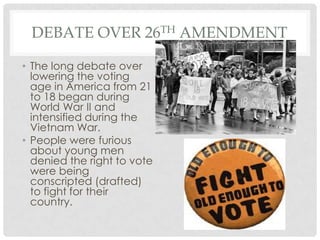
• The long debate over
lowering the voting
age in America from 21
to 18 began during
World War II and
intensified during the
Vietnam War.
• People were furious
about young men
denied the right to vote
were being
conscripted (drafted)
to fight for their
country.
26TH AMENDMENT RATIFIED
• In the 1970 case Oregon v.
Mitchell, a divided U.S.
Supreme Court ruled that
Congress had the right to
regulate the minimum age
in federal elections, but not
at the state and local level.
• Because of increasing
support for a Constitutional
amendment, Congress
passed the 26th
Amendment in March 1971;
the states promptly ratified.
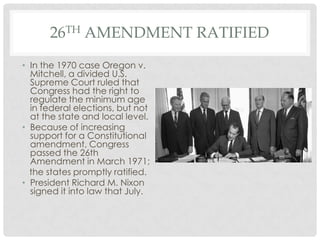
• President Richard M. Nixon
signed it into law that July.
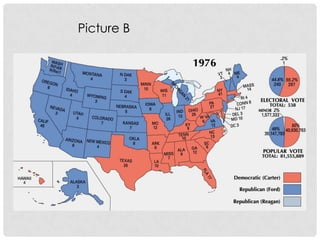
Picture B
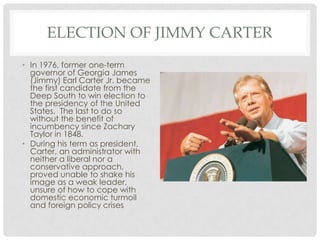
ELECTION OF JIMMY CARTER
• In 1976, former one-term
governor of Georgia James
(Jimmy) Earl Carter Jr. became
the first candidate from the
Deep South to win election to
the presidency of the United
States. The last to do so
without the benefit of
incumbency since Zachary
Taylor in 1848.
• During his term as president,
Carter, an administrator with
neither a liberal nor a
conservative approach,
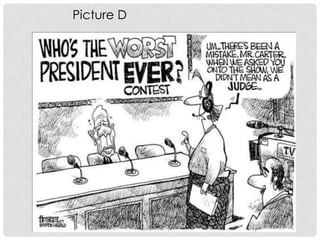
proved unable to shake his
image as a weak leader,
unsure of how to cope with
domestic economic turmoil
and foreign policy crises
DOMESTIC ISSUES
• Domestic issues that dominated the nation during
the Carter years were unemployment, inflation, and
energy.
• Like Ford, when Carter started as President, the
unemployment rate was 7%, and the annual
inflation rate was 6.8%.
CARTER’S DOMESTIC PROGRAM
Energy Crisis – to deal with this crisis,
Carter created the Department of
Energy. Increased the oil in the
nation’s ―Strategic Petroleum
Reserve‖. Wanted a special tax for
large automobiles and power to
ration gas, Congress said no to his
wants
Stagflation – Inflation and interest
rates soared in 1979, due to the oil
crisis. Carter cut federal spending,
but inflation did not come down until
two years later during the Reagan
Presidency
Environment – Carter provided funds
to clean up toxic dumps. Following
the Three Mile Island nuclear reactor
leak in 1979, Carter created the
Nuclear Regulatory Commission to
develop stricter standards for the
peaceful use of nuclear energy.
Diversity – Carter appointed women
and minority members to govt.
positions. He sponsored bill requiring
schools provide instruction to students
in their native language while trying
to learn English.
• Carter had promised to reduce unemployment,
cut the inflation rate, and balance the budget. He
failed in all three areas.
• By 1980, unemployment was over 8%, inflation was
about 12%, and the projected budget deficit was
nearly $59 billion.
Picture C
DOMESTIC ISSUES (CONT.)
• Carter had no better luck in dealing with a shortage
of oil import supplies in 1979 caused by the
overthrow of the shah of Iran.
• The United States had been plagued by rising
energy costs ever since the 1973 Arab oil embargo.
• Carter submitted a comprehensive energy bill to
Congress designed to reduce U.S. dependence on
foreign oil with the statement that "nothing less than
the moral equivalent of war" was at stake, he was
unable to rally support.
DOMESTIC ISSUES (CONT.)
• In the fall of 1978, he settled for a much weaker
piece of legislation than he knew was necessary.
• When gas prices began to skyrocket in the summer
of 1979, there was little he could do except urge
conservation and a gasoline rationing system
through the newly created Department of Energy.
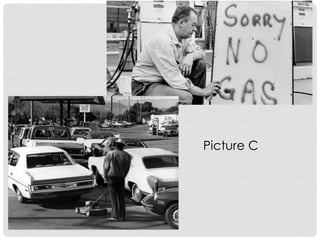
• The rationing system failed to avoid fuel shortages:
tempers flared in long gasoline station lines, prices
continued to soar, and Carter was blamed
Picture D
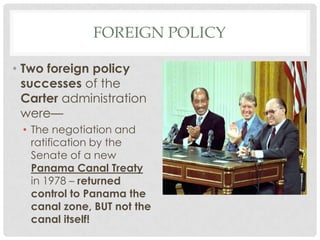
FOREIGN POLICY
• Two foreign policy
successes of the
Carter administration
were—
• The negotiation and
ratification by the
Senate of a new
Panama Canal Treaty
in 1978 – returned
control to Panama the
canal zone, BUT not the
canal itself!
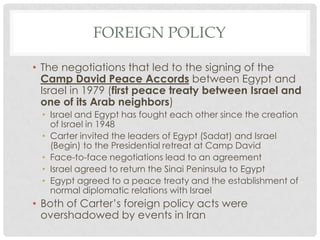
• The negotiations that led to the signing of the
Camp David Peace Accords between Egypt and
Israel in 1979 (first peace treaty between Israel and
one of its Arab neighbors)
• Israel and Egypt has fought each other since the creation
of Israel in 1948
• Carter invited the leaders of Egypt (Sadat) and Israel
(Begin) to the Presidential retreat at Camp David
• Face-to-face negotiations lead to an agreement
• Israel agreed to return the Sinai Peninsula to Egypt
• Egypt agreed to a peace treaty and the establishment of
normal diplomatic relations with Israel
• Both of Carter’s foreign policy acts were
overshadowed by events in Iran
FOREIGN POLICY
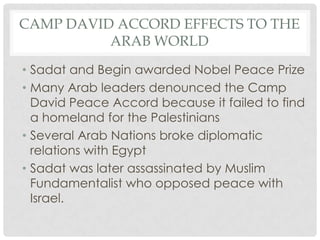
• Sadat and Begin awarded Nobel Peace Prize
• Many Arab leaders denounced the Camp
David Peace Accord because it failed to find
a homeland for the Palestinians
• Several Arab Nations broke diplomatic
relations with Egypt
• Sadat was later assassinated by Muslim
Fundamentalist who opposed peace with
Israel.
CAMP DAVID ACCORD EFFECTS TO THE
ARAB WORLD
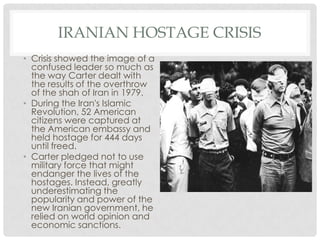
IRANIAN HOSTAGE CRISIS
• Crisis showed the image of a
confused leader so much as
the way Carter dealt with
the results of the overthrow
of the shah of Iran in 1979.
• During the Iran's Islamic
Revolution, 52 American
citizens were captured at
the American embassy and
held hostage for 444 days
until freed.
• Carter pledged not to use
military force that might
endanger the lives of the
hostages. Instead, greatly
underestimating the
popularity and power of the
new Iranian government, he
relied on world opinion and
economic sanctions.
OTHER FOREIGN POLICY
• In addition, after the Soviet Union invaded
neighboring Afghanistan in order to create a new
communist government
• This ended the détente Nixon had with the Soviet
Union
• Carter ordered further economic sanctions, NO
GRAIN sales to the Soviets
• Boycotted the 1980 Olympic Games in Moscow
• Postponed ratification of a new arms control
agreement known as SALT II
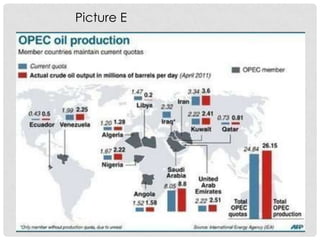
Picture E
OPEC
• Founded in 1960, the Organization of Petroleum
Exporting Countries (OPEC) are nations whose main
export income comes from the sale of petroleum.
• OPEC seeks to unify the petroleum policies of these
nations, protect the members' mutual interests, and
stabilize international oil prices.
• OPEC's control of such a valuable resource has also
made the organization an important international
political actor at times.
OPEC (CONT.)
• In 1973, OPEC used its control of oil production most
effectively to influence world politics.
• It was able to do this in part because the demand for oil
in the industrial nations greatly exceeded supply.
• In support of the Arab invasion of Israel that occurred in
October 1973, the Arab oil producing countries decided
to cut their oil production so long as Israel continued to
occupy Arab lands.
• Though individual nations took more drastic action
(Saudi Arabia imposed a total embargo on the United
States because of its support of Israel), OPEC as a whole
raised oil prices by some 300% by the end of the year
Picture
F
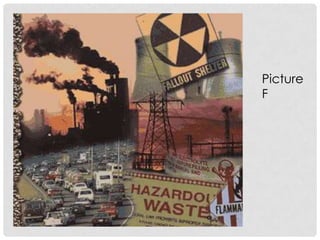
ENVIRONMENTALISM
• The Environmental Protection Agency (EPA) is an
independent agency responsible for controlling
pollution of the air and water, as well as
environmental damage from solid waste,
pesticides, radiation, and toxic substances.
• The EPA was founded in 1970 as part of
Reorganization Plan No. 3 to coordinate the
government's efforts to protect the environment
EPA (CONT.)
• Also known as the Environmental Species
Conservation Act, this law was enacted on
December 28, 1973.
• It became a milestone in the environmental
conservation movement, offering federal
protection to a broad range of animals and plants
threatened with extinction due to past
environmental carelessness.
Picture
G
Picture H
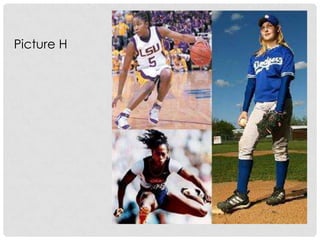
TITLE IX (9)
• This law banned sex discrimination in educational
programs that receive federal funds.
• Because of pressure from some Ivy League schools,
Title IX (9) contains an exception for undergraduate
admissions to private colleges.
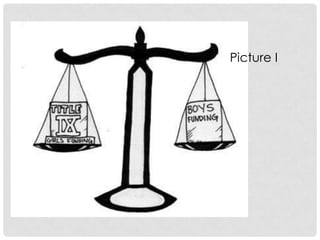
Picture I
TITLE IX (CONT.)
• The bill addressed discrimination in athletics, where
the law evoked particularly strong opposition;
admission to specific university classes; and
pregnant students' maternity leave and their rights
to continue their education.
• The specific Title IX regulations were released in 1974
and then revised in 1975.

Late 1970s

  • 1.
  • 2.
    DEBATE OVER 26THAMENDMENT • The long debate over lowering the voting age in America from 21 to 18 began during World War II and intensified during the Vietnam War. • People were furious about young men denied the right to vote were being conscripted (drafted) to fight for their country.
  • 3.
    26TH AMENDMENT RATIFIED •In the 1970 case Oregon v. Mitchell, a divided U.S. Supreme Court ruled that Congress had the right to regulate the minimum age in federal elections, but not at the state and local level. • Because of increasing support for a Constitutional amendment, Congress passed the 26th Amendment in March 1971; the states promptly ratified. • President Richard M. Nixon signed it into law that July.
  • 4.
  • 5.
    ELECTION OF JIMMYCARTER • In 1976, former one-term governor of Georgia James (Jimmy) Earl Carter Jr. became the first candidate from the Deep South to win election to the presidency of the United States. The last to do so without the benefit of incumbency since Zachary Taylor in 1848. • During his term as president, Carter, an administrator with neither a liberal nor a conservative approach, proved unable to shake his image as a weak leader, unsure of how to cope with domestic economic turmoil and foreign policy crises
  • 6.
    DOMESTIC ISSUES • Domesticissues that dominated the nation during the Carter years were unemployment, inflation, and energy. • Like Ford, when Carter started as President, the unemployment rate was 7%, and the annual inflation rate was 6.8%.
  • 7.
    CARTER’S DOMESTIC PROGRAM EnergyCrisis – to deal with this crisis, Carter created the Department of Energy. Increased the oil in the nation’s ―Strategic Petroleum Reserve‖. Wanted a special tax for large automobiles and power to ration gas, Congress said no to his wants Stagflation – Inflation and interest rates soared in 1979, due to the oil crisis. Carter cut federal spending, but inflation did not come down until two years later during the Reagan Presidency Environment – Carter provided funds to clean up toxic dumps. Following the Three Mile Island nuclear reactor leak in 1979, Carter created the Nuclear Regulatory Commission to develop stricter standards for the peaceful use of nuclear energy. Diversity – Carter appointed women and minority members to govt. positions. He sponsored bill requiring schools provide instruction to students in their native language while trying to learn English.
  • 8.
    • Carter hadpromised to reduce unemployment, cut the inflation rate, and balance the budget. He failed in all three areas. • By 1980, unemployment was over 8%, inflation was about 12%, and the projected budget deficit was nearly $59 billion.
  • 9.
  • 10.
    DOMESTIC ISSUES (CONT.) •Carter had no better luck in dealing with a shortage of oil import supplies in 1979 caused by the overthrow of the shah of Iran. • The United States had been plagued by rising energy costs ever since the 1973 Arab oil embargo. • Carter submitted a comprehensive energy bill to Congress designed to reduce U.S. dependence on foreign oil with the statement that "nothing less than the moral equivalent of war" was at stake, he was unable to rally support.
  • 11.
    DOMESTIC ISSUES (CONT.) •In the fall of 1978, he settled for a much weaker piece of legislation than he knew was necessary. • When gas prices began to skyrocket in the summer of 1979, there was little he could do except urge conservation and a gasoline rationing system through the newly created Department of Energy. • The rationing system failed to avoid fuel shortages: tempers flared in long gasoline station lines, prices continued to soar, and Carter was blamed
  • 12.
  • 13.
    FOREIGN POLICY • Twoforeign policy successes of the Carter administration were— • The negotiation and ratification by the Senate of a new Panama Canal Treaty in 1978 – returned control to Panama the canal zone, BUT not the canal itself!
  • 14.
    • The negotiationsthat led to the signing of the Camp David Peace Accords between Egypt and Israel in 1979 (first peace treaty between Israel and one of its Arab neighbors) • Israel and Egypt has fought each other since the creation of Israel in 1948 • Carter invited the leaders of Egypt (Sadat) and Israel (Begin) to the Presidential retreat at Camp David • Face-to-face negotiations lead to an agreement • Israel agreed to return the Sinai Peninsula to Egypt • Egypt agreed to a peace treaty and the establishment of normal diplomatic relations with Israel • Both of Carter’s foreign policy acts were overshadowed by events in Iran FOREIGN POLICY
  • 15.
    • Sadat andBegin awarded Nobel Peace Prize • Many Arab leaders denounced the Camp David Peace Accord because it failed to find a homeland for the Palestinians • Several Arab Nations broke diplomatic relations with Egypt • Sadat was later assassinated by Muslim Fundamentalist who opposed peace with Israel. CAMP DAVID ACCORD EFFECTS TO THE ARAB WORLD
  • 16.
    IRANIAN HOSTAGE CRISIS •Crisis showed the image of a confused leader so much as the way Carter dealt with the results of the overthrow of the shah of Iran in 1979. • During the Iran's Islamic Revolution, 52 American citizens were captured at the American embassy and held hostage for 444 days until freed. • Carter pledged not to use military force that might endanger the lives of the hostages. Instead, greatly underestimating the popularity and power of the new Iranian government, he relied on world opinion and economic sanctions.
  • 17.
    OTHER FOREIGN POLICY •In addition, after the Soviet Union invaded neighboring Afghanistan in order to create a new communist government • This ended the détente Nixon had with the Soviet Union • Carter ordered further economic sanctions, NO GRAIN sales to the Soviets • Boycotted the 1980 Olympic Games in Moscow • Postponed ratification of a new arms control agreement known as SALT II
  • 18.
  • 19.
    OPEC • Founded in1960, the Organization of Petroleum Exporting Countries (OPEC) are nations whose main export income comes from the sale of petroleum. • OPEC seeks to unify the petroleum policies of these nations, protect the members' mutual interests, and stabilize international oil prices. • OPEC's control of such a valuable resource has also made the organization an important international political actor at times.
  • 20.
    OPEC (CONT.) • In1973, OPEC used its control of oil production most effectively to influence world politics. • It was able to do this in part because the demand for oil in the industrial nations greatly exceeded supply. • In support of the Arab invasion of Israel that occurred in October 1973, the Arab oil producing countries decided to cut their oil production so long as Israel continued to occupy Arab lands. • Though individual nations took more drastic action (Saudi Arabia imposed a total embargo on the United States because of its support of Israel), OPEC as a whole raised oil prices by some 300% by the end of the year
  • 21.
  • 22.
    ENVIRONMENTALISM • The EnvironmentalProtection Agency (EPA) is an independent agency responsible for controlling pollution of the air and water, as well as environmental damage from solid waste, pesticides, radiation, and toxic substances. • The EPA was founded in 1970 as part of Reorganization Plan No. 3 to coordinate the government's efforts to protect the environment
  • 23.
    EPA (CONT.) • Alsoknown as the Environmental Species Conservation Act, this law was enacted on December 28, 1973. • It became a milestone in the environmental conservation movement, offering federal protection to a broad range of animals and plants threatened with extinction due to past environmental carelessness.
  • 24.
  • 25.
  • 26.
    TITLE IX (9) •This law banned sex discrimination in educational programs that receive federal funds. • Because of pressure from some Ivy League schools, Title IX (9) contains an exception for undergraduate admissions to private colleges.
  • 27.
  • 28.
    TITLE IX (CONT.) •The bill addressed discrimination in athletics, where the law evoked particularly strong opposition; admission to specific university classes; and pregnant students' maternity leave and their rights to continue their education. • The specific Title IX regulations were released in 1974 and then revised in 1975.