Urolithiasis Imaging
PPT BY BASHEER HASAN OUDAH
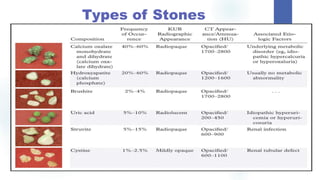
Types of Stones
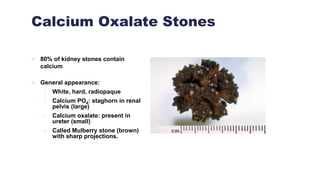
Calcium Oxalate Stones
๏ต 80% of kidney stones contain
calcium
๏ต General appearance:
1. White, hard, radiopaque
2. Calcium PO4: staghorn in renal
pelvis (large)
3. Calcium oxalate: present in
ureter (small)
4. Called Mulberry stone (brown)
with sharp projections.
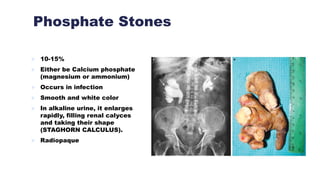
Phosphate Stones
๏ต 10-15%
๏ต Either be Calcium phosphate
(magnesium or ammonium)
๏ต Occurs in infection
๏ต Smooth and white color
๏ต In alkaline urine, it enlarges
rapidly, filling renal calyces
and taking their shape
(STAGHORN CALCULUS).
๏ต Radiopaque
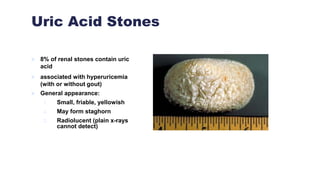
Uric Acid Stones
๏ต 8% of renal stones contain uric
acid
๏ต associated with hyperuricemia
(with or without gout)
๏ต General appearance:
1. Small, friable, yellowish
2. May form staghorn
3. Radiolucent (plain x-rays
cannot detect)
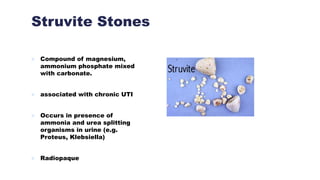
Struvite Stones
๏ต Compound of magnesium,
ammonium phosphate mixed
with carbonate.
๏ต associated with chronic UTI
๏ต Occurs in presence of
ammonia and urea splitting
organisms in urine (e.g.
Proteus, Klebsiella)
๏ต Radiopaque
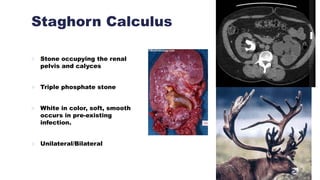
Staghorn Calculus
๏ต Stone occupying the renal
pelvis and calyces
๏ต Triple phosphate stone
๏ต White in color, soft, smooth
occurs in pre-existing
infection.
๏ต Unilateral/Bilateral
๏ต Caliceal calculi that are non-obstructing are usually
asymptomatic.
Patients with small caliceal calculi may still have gross or
microscopic hematuria and may have colic symptoms despite
the lack of imaging findings suggestive of obstruction.
Calculi causing Hydronephrosis
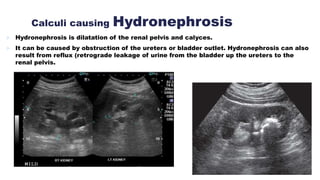
๏ต Hydronephrosis is dilatation of the renal pelvis and calyces.
๏ต It can be caused by obstruction of the ureters or bladder outlet. Hydronephrosis can also
result from reflux (retrograde leakage of urine from the bladder up the ureters to the
renal pelvis.
Ureteric Calculus
1. Always of Renal Origin
2. Commonly of elongated shape
3. Can get impacted at 3 constrictions of
ureter
4. Can cause:
Obstruction
Hydronephrosis
Infection
Ureteral Stricture
5. C/F:
Colicky Pain (from loin to tip genitalia)
along genitofemoral nerve.
Hematuria, dysuria, frequency,
strangury
Tenderness in iliac fossa
Bladder Calculus
1. Primary vesical calculus:
โ€ข occurs in sterile urine
โ€ข Comes down from kidney through ureter
and gets enlarged in bladder (usually
oxalate stone).
โ€ข Can irritate bladder mucosa causing
hematuria
2. Secondary vesical calculus:
โ€ข Occurs in presence of infection
(commonest bladder stone)
โ€ข Usually phosphate stone, occurs in
bladder only
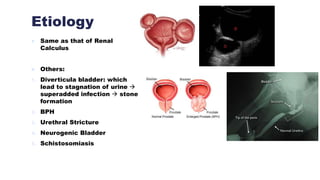
Etiology
๏ต Same as that of Renal
Calculus
๏ต Others:
1. Diverticula bladder: which
lead to stagnation of urine ๏ƒ 
superadded infection ๏ƒ  stone
formation
2. BPH
3. Urethral Stricture
4. Neurogenic Bladder
5. Schistosomiasis
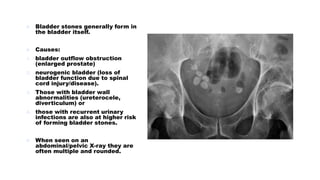
๏ต Bladder stones generally form in
the bladder itself.
๏ต Causes:
1. bladder outflow obstruction
(enlarged prostate)
2. neurogenic bladder (loss of
bladder function due to spinal
cord injury/disease).
3. Those with bladder wall
abnormalities (ureterocele,
diverticulum) or
4. those with recurrent urinary
infections are also at higher risk
of forming bladder stones.
๏ต When seen on an
abdominal/pelvic X-ray they are
often multiple and rounded.
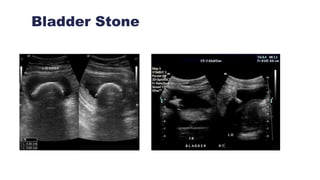
Bladder Stone
๏ต Note that this stone has a
faint longitudinal lucency
which is the nidus around
which the stone developed.
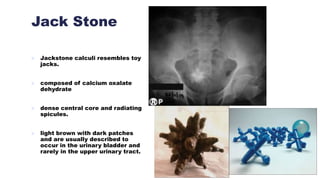
Jack Stone
๏ต Jackstone calculi resembles toy
jacks.
๏ต composed of calcium oxalate
dehydrate
๏ต dense central core and radiating
spicules.
๏ต light brown with dark patches
and are usually described to
occur in the urinary bladder and
rarely in the upper urinary tract.
Bladder Stone
Conditions Mimicking
Calculi
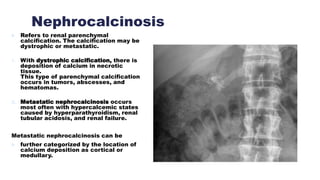
Nephrocalcinosis
๏ต Refers to renal parenchymal
calcification. The calcification may be
dystrophic or metastatic.
1. With dystrophic calcification, there is
deposition of calcium in necrotic
tissue.
This type of parenchymal calcification
occurs in tumors, abscesses, and
hematomas.
2. Metastatic nephrocalcinosis occurs
most often with hypercalcemic states
caused by hyperparathyroidism, renal
tubular acidosis, and renal failure.
Metastatic nephrocalcinosis can be
๏ต further categorized by the location of
calcium deposition as cortical or
medullary.
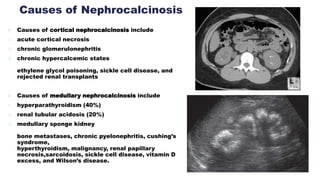
Causes of Nephrocalcinosis
๏ต Causes of cortical nephrocalcinosis include
1. acute cortical necrosis
2. chronic glomerulonephritis
3. chronic hypercalcemic states
ethylene glycol poisoning, sickle cell disease, and
rejected renal transplants
๏ต Causes of medullary nephrocalcinosis include
1. hyperparathyroidism (40%)
2. renal tubular acidosis (20%)
3. medullary sponge kidney
bone metastases, chronic pyelonephritis, cushingโ€™s
syndrome,
hyperthyroidism, malignancy, renal papillary
necrosis,sarcoidosis, sickle cell disease, vitamin D
excess, and Wilsonโ€™s disease.
Phleboliths
๏ต Calcification within venous
structures.
๏ต Common in the pelvis where they
may mimic ureteric calculi, and
are also encountered frequently in
venous malformations.
๏ต Round in shape (but not always)
of a similar size that would
correspond to the diameter of
pelvic veins
1. look like a ring of bone
2. tend to occur laterally around the
urinary bladder
3. appear as focal calcifications,
often with radiolucent centers
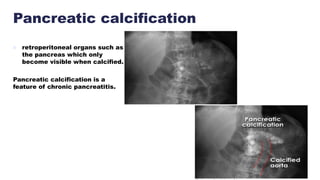
Pancreatic calcification
๏ต retroperitoneal organs such as
the pancreas which only
become visible when calcified.
Pancreatic calcification is a
feature of chronic pancreatitis.
Adrenal Calcification
๏ต Adrenal (suprarenal)
calcification is an uncommon
finding and is usually
incidental. Most often it is
considered a result of
previous haemorrhage or
tuberculosis.
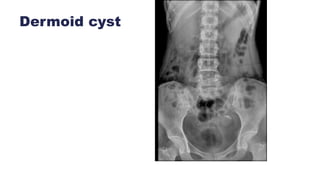
Dermoid cyst
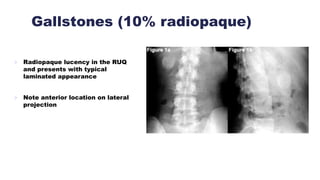
Gallstones (10% radiopaque)
๏ต Radiopaque lucency in the RUQ
and presents with typical
laminated appearance
๏ต Note anterior location on lateral
projection
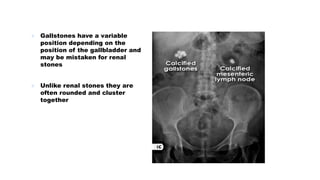
๏ต Gallstones have a variable
position depending on the
position of the gallbladder and
may be mistaken for renal
stones
๏ต Unlike renal stones they are
often rounded and cluster
together
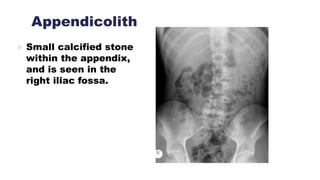
Appendicolith
๏ต Small calcified stone
within the appendix,
and is seen in the
right iliac fossa.
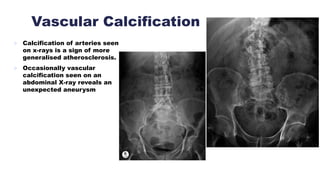
Vascular Calcification
๏ต Calcification of arteries seen
on x-rays is a sign of more
generalised atherosclerosis.
๏ต Occasionally vascular
calcification seen on an
abdominal X-ray reveals an
unexpected aneurysm
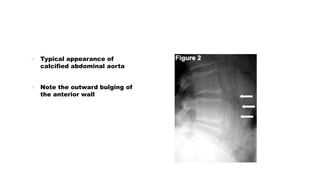
๏ต Typical appearance of
calcified abdominal aorta
๏ต Note the outward bulging of
the anterior wall
Renal Tuberculosis
๏ต Genitourinary tract
tuberculosis. Lobar
calcification in a large
destroyed right kidney in a
patient with renal
tuberculosis. Note the
involvement of the right ureter
Miscellaneous X-Ray Abdomen
Calcification
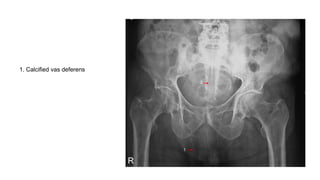
1. Calcified vas deferens
The calcified arrowed structures are likely
to be calcified injection sites.
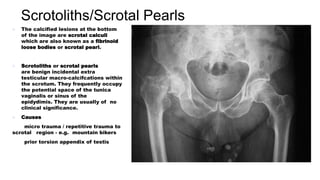
๏ต The calcified lesions at the bottom
of the image are scrotal calculi
which are also known as a fibrinoid
loose bodies or scrotal pearl.
๏ต Scrotoliths or scrotal pearls
are benign incidental extra
testicular macro-calcifcations within
the scrotum. They frequently occupy
the potential space of the tunica
vaginalis or sinus of the
epidydimis. They are usually of no
clinical significance.
๏ต Causes
micro trauma / repetitive trauma to
scrotal region - e.g. mountain bikers
prior torsion appendix of testis
Scrotoliths/Scrotal Pearls
Thanks for listening
Any Questions ?

Ppt by Basheer Oudah urolithiasis imaging

  • 1.
    Urolithiasis Imaging PPT BYBASHEER HASAN OUDAH
  • 2.
  • 3.
    Calcium Oxalate Stones ๏ต80% of kidney stones contain calcium ๏ต General appearance: 1. White, hard, radiopaque 2. Calcium PO4: staghorn in renal pelvis (large) 3. Calcium oxalate: present in ureter (small) 4. Called Mulberry stone (brown) with sharp projections.
  • 4.
    Phosphate Stones ๏ต 10-15% ๏ตEither be Calcium phosphate (magnesium or ammonium) ๏ต Occurs in infection ๏ต Smooth and white color ๏ต In alkaline urine, it enlarges rapidly, filling renal calyces and taking their shape (STAGHORN CALCULUS). ๏ต Radiopaque
  • 5.
    Uric Acid Stones ๏ต8% of renal stones contain uric acid ๏ต associated with hyperuricemia (with or without gout) ๏ต General appearance: 1. Small, friable, yellowish 2. May form staghorn 3. Radiolucent (plain x-rays cannot detect)
  • 6.
    Struvite Stones ๏ต Compoundof magnesium, ammonium phosphate mixed with carbonate. ๏ต associated with chronic UTI ๏ต Occurs in presence of ammonia and urea splitting organisms in urine (e.g. Proteus, Klebsiella) ๏ต Radiopaque
  • 7.
    Staghorn Calculus ๏ต Stoneoccupying the renal pelvis and calyces ๏ต Triple phosphate stone ๏ต White in color, soft, smooth occurs in pre-existing infection. ๏ต Unilateral/Bilateral
  • 8.
    ๏ต Caliceal calculithat are non-obstructing are usually asymptomatic. Patients with small caliceal calculi may still have gross or microscopic hematuria and may have colic symptoms despite the lack of imaging findings suggestive of obstruction.
  • 9.
    Calculi causing Hydronephrosis ๏ตHydronephrosis is dilatation of the renal pelvis and calyces. ๏ต It can be caused by obstruction of the ureters or bladder outlet. Hydronephrosis can also result from reflux (retrograde leakage of urine from the bladder up the ureters to the renal pelvis.
  • 10.
    Ureteric Calculus 1. Alwaysof Renal Origin 2. Commonly of elongated shape 3. Can get impacted at 3 constrictions of ureter 4. Can cause: Obstruction Hydronephrosis Infection Ureteral Stricture 5. C/F: Colicky Pain (from loin to tip genitalia) along genitofemoral nerve. Hematuria, dysuria, frequency, strangury Tenderness in iliac fossa
  • 13.
    Bladder Calculus 1. Primaryvesical calculus: โ€ข occurs in sterile urine โ€ข Comes down from kidney through ureter and gets enlarged in bladder (usually oxalate stone). โ€ข Can irritate bladder mucosa causing hematuria 2. Secondary vesical calculus: โ€ข Occurs in presence of infection (commonest bladder stone) โ€ข Usually phosphate stone, occurs in bladder only
  • 14.
    Etiology ๏ต Same asthat of Renal Calculus ๏ต Others: 1. Diverticula bladder: which lead to stagnation of urine ๏ƒ  superadded infection ๏ƒ  stone formation 2. BPH 3. Urethral Stricture 4. Neurogenic Bladder 5. Schistosomiasis
  • 15.
    ๏ต Bladder stonesgenerally form in the bladder itself. ๏ต Causes: 1. bladder outflow obstruction (enlarged prostate) 2. neurogenic bladder (loss of bladder function due to spinal cord injury/disease). 3. Those with bladder wall abnormalities (ureterocele, diverticulum) or 4. those with recurrent urinary infections are also at higher risk of forming bladder stones. ๏ต When seen on an abdominal/pelvic X-ray they are often multiple and rounded.
  • 16.
    Bladder Stone ๏ต Notethat this stone has a faint longitudinal lucency which is the nidus around which the stone developed.
  • 17.
    Jack Stone ๏ต Jackstonecalculi resembles toy jacks. ๏ต composed of calcium oxalate dehydrate ๏ต dense central core and radiating spicules. ๏ต light brown with dark patches and are usually described to occur in the urinary bladder and rarely in the upper urinary tract.
  • 18.
  • 19.
  • 20.
    Nephrocalcinosis ๏ต Refers torenal parenchymal calcification. The calcification may be dystrophic or metastatic. 1. With dystrophic calcification, there is deposition of calcium in necrotic tissue. This type of parenchymal calcification occurs in tumors, abscesses, and hematomas. 2. Metastatic nephrocalcinosis occurs most often with hypercalcemic states caused by hyperparathyroidism, renal tubular acidosis, and renal failure. Metastatic nephrocalcinosis can be ๏ต further categorized by the location of calcium deposition as cortical or medullary.
  • 21.
    Causes of Nephrocalcinosis ๏ตCauses of cortical nephrocalcinosis include 1. acute cortical necrosis 2. chronic glomerulonephritis 3. chronic hypercalcemic states ethylene glycol poisoning, sickle cell disease, and rejected renal transplants ๏ต Causes of medullary nephrocalcinosis include 1. hyperparathyroidism (40%) 2. renal tubular acidosis (20%) 3. medullary sponge kidney bone metastases, chronic pyelonephritis, cushingโ€™s syndrome, hyperthyroidism, malignancy, renal papillary necrosis,sarcoidosis, sickle cell disease, vitamin D excess, and Wilsonโ€™s disease.
  • 22.
    Phleboliths ๏ต Calcification withinvenous structures. ๏ต Common in the pelvis where they may mimic ureteric calculi, and are also encountered frequently in venous malformations. ๏ต Round in shape (but not always) of a similar size that would correspond to the diameter of pelvic veins 1. look like a ring of bone 2. tend to occur laterally around the urinary bladder 3. appear as focal calcifications, often with radiolucent centers
  • 23.
    Pancreatic calcification ๏ต retroperitonealorgans such as the pancreas which only become visible when calcified. Pancreatic calcification is a feature of chronic pancreatitis.
  • 24.
    Adrenal Calcification ๏ต Adrenal(suprarenal) calcification is an uncommon finding and is usually incidental. Most often it is considered a result of previous haemorrhage or tuberculosis.
  • 25.
  • 26.
    Gallstones (10% radiopaque) ๏ตRadiopaque lucency in the RUQ and presents with typical laminated appearance ๏ต Note anterior location on lateral projection
  • 27.
    ๏ต Gallstones havea variable position depending on the position of the gallbladder and may be mistaken for renal stones ๏ต Unlike renal stones they are often rounded and cluster together
  • 28.
    Appendicolith ๏ต Small calcifiedstone within the appendix, and is seen in the right iliac fossa.
  • 29.
    Vascular Calcification ๏ต Calcificationof arteries seen on x-rays is a sign of more generalised atherosclerosis. ๏ต Occasionally vascular calcification seen on an abdominal X-ray reveals an unexpected aneurysm
  • 30.
    ๏ต Typical appearanceof calcified abdominal aorta ๏ต Note the outward bulging of the anterior wall
  • 31.
    Renal Tuberculosis ๏ต Genitourinarytract tuberculosis. Lobar calcification in a large destroyed right kidney in a patient with renal tuberculosis. Note the involvement of the right ureter
  • 32.
  • 33.
  • 34.
    The calcified arrowedstructures are likely to be calcified injection sites.
  • 35.
    ๏ต The calcifiedlesions at the bottom of the image are scrotal calculi which are also known as a fibrinoid loose bodies or scrotal pearl. ๏ต Scrotoliths or scrotal pearls are benign incidental extra testicular macro-calcifcations within the scrotum. They frequently occupy the potential space of the tunica vaginalis or sinus of the epidydimis. They are usually of no clinical significance. ๏ต Causes micro trauma / repetitive trauma to scrotal region - e.g. mountain bikers prior torsion appendix of testis Scrotoliths/Scrotal Pearls
  • 37.

Editor's Notes

  • #7ย Drug-induced stone disease precipitate in urine causing stone formation. Include indinavir; atazanavir; triamterene; silicate (overuse of antacids containing magnesium silicate); and sulfa drugs.
  • #8ย Bilateral can cause renal failure (edema feet, oligouria)
  • #10ย Scan shows mild dilatation of the pelvis as well as the calyces of the right kidney suggesting mild hydronephrosis. The left kidney also appears to be affected similarly. This must be differentiated from mild dilatation of the renal pelvis alone, which is physiological and transient; this means that on emptying of the urinary bladder, this appearance should disappear. Multiple lower-pole and renal pelvic echoreflective calculi showing acoustic shadowing are associated mild hydronephrosis.
  • #12ย Lower one 1/3rd of ureter
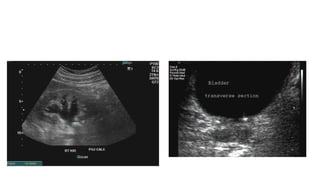
  • #13ย Sonography of the abdomen showed hydronephrosis of the right kidney with a moderately large calculus (14mm.) at the right Pelvi-ureteric junction (arrows). Such calculi cause partial obstruction of the renal pelvis and may cause severe ureteric colic. 2nd image shows multiple, small calculi (3 to 4 mm. in size) in both ureters.
  • #15ย Diverticula bladder - out pouching of bladder. Focal herniations of the urothelium and submucosa and usually occur in the setting of chronic elevation of intravesical pressure. Pelvic ultrasound shows a large out pouching (D) of the bladder wall and mucosa projecting from the lumen of the bladder (B). Penile โ€“ Bulbar โ€“ Membranous โ€“ Prostatic Urethra Neurogenic bladder is often associated with spinal cord diseases (Syringomyelia), injuries, and neural tube defects including spina bifida. It may also be caused by brain tumors, and by peripheral nerve diseases. In urinary schistosomiasis the eggs in the bladder may become focuses of stone formation; fibrosis may extend to the pelvic organs, and there may be secondary bacterial infection of the urinary tract.
  • #17ย densely radio-opaque, calculi may be single or multiple and often large. Frequently lamination is observed internally, like the skin of an onion.
  • #19ย An irregular, echogenic, shadowing structure is seen within the bladder. The appearance of the structure resembles a toy jack - hence the designation jackstone.
  • #21ย Medullary sponge kidney where the sharp areas of calcification and uneven distribution may be seen The renal parenchyma contains clusters of small calcific densities.
  • #22ย B, Sagittal sonogram shows extensive medullary calcification in a patient with renal tubular acidosis.
  • #23ย The larger calcified arrowed structure is almost definitely a phlebolith which is a calcific ring in the wall of a pelvic vein. The smaller calcific structure is also probably a phlebolith but has some of the features of a renal stone in terms of its position and shape.
  • #24ย This X-ray shows soft tissue calcification which follows the anatomical position of the pancreas and crosses the midline. Also note calcification of the abdominal aorta which is of normal calibre
  • #25ย The adrenal (suprarenal) glands form a triangle shape lying directly above the kidneys.
  • #26ย RADIOGRAPH KUB A faint radiopacity is seen overlying right renal shadow. Two arc like calcifications are seen in the pelvis on both sides. Sub-optimal bowel preparation . Pro-peritoneal fat lines are maintained. Visualized renal shadows is normal. Visualized psoas shadows are normal. Visualized bones and joints are normal. IMPRESSION:ย  ? Right renal / GB calculus Two tubo-ovarian stromal fibroid calcifications. Mature cystic teratomas are encapsulated tumours with mature tissue or organ components. They are composed of well-differentiated derivations from three germ cell layers (ectoderm, mesoderm, and endoderm). Ectoderm โ€“ hair, teeth, nails
  • #28ย This X-ray also shows an incidental calcified mesenteric node which may also mimic renal stones
  • #29ย an appendicolith (uncommon feature of appendicitis) is highly predictive of the diagnosis in patients presenting with abdominal pain, and is also thought to be associated with a higher risk of gangrene or perforation.
  • #30ย There is striking calcification of the aorta and iliac vessels. This is a sign of generalised atherosclerosis elsewhere in the body. There is calcification of the dilated aortic wall. As in this case often only one side of the aneurysm is visible - the other projected over the spine.
  • #34ย 2. missing posterior sacral elements/ spina bifida occulta
  • #38ย This image was taken to assess fetal position and fetal maturity before the development of ultrasound imaging. Note the breach presentation.