Nephrolithiasis Pediatric GU Review UCSD Pediatric Urology George Chiang MD Sara Marietti MD Outlined from  The Kelalis-King-Belman Textbook of Clinical Pediatric Urology 2007 (not for reproduction, distribution, or sale without consent)
Classification  Enzyme Disorders Primary Hyperoxaluria Type I: glyoxylic aciduria Type II: glyceric aciduria Xanthinuria 1,8-Dihydroxyadeniuria Lesch-Nyhan syndrome
Classification Renal tubular syndromes Cystinuria Renal tubular acidosis Hypercalcemic states HyperPTH Immobilization

Classification Uric Acid Lithiasis Enteric urolithiasis Idiopathic calcium oxalate urolithiasis Hypercalciuria (Absorptive and Renal) Hyperoxaluria Hyperuricosuria Hypocitraturia  Medications
Classification Endemic bladder stone formation Secondary urolithiasis Infection Obstruction Structural abnormalities Urinary diversion procedures Foreign body
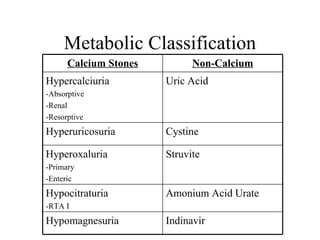
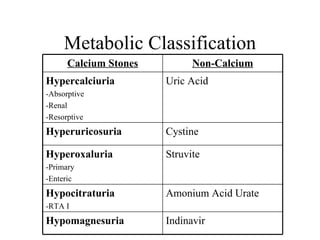
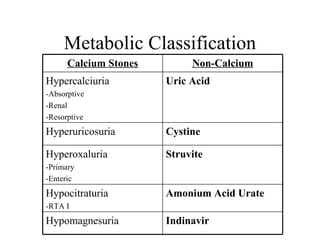
Metabolic Classification Calcium Stones Non-Calcium Hypercalciuria -Absorptive -Renal -Resorptive Uric Acid Hyperuricosuria Cystine Hyperoxaluria -Primary -Enteric Struvite Hypocitraturia -RTA I Amonium Acid Urate Hypomagnesuria Indinavir
Pathophysiology Formation of stone Urinary volume pH Presence of promoters or inhibitors of lithogenesis Central event is supersaturation Crystallization occurs via homogenous vs. heterogenous nucleation
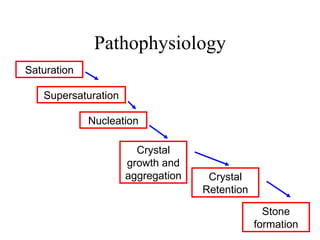
Pathophysiology Saturation Crystal growth and aggregation Supersaturation Crystal Retention Stone formation Nucleation
Presentation Renal colic occurs in 40-75% of children Hematuria in 33-90% of children Urethral stones present with terminal hematuria or inability to void
Presentation Factors Size of stone Location of stone Degree of obstruction Presence of infection Presence/absence of normal contralateral kidney
Presentation H and P Prematurity (lasix, formulas) Medications  Concurrent illnesses (neoplasms, CF) Recurrent skeletal fractures Nutritional habits  Family history
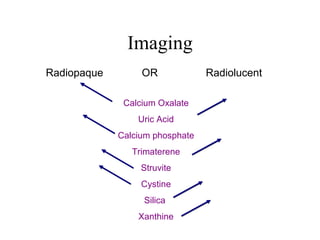
Imaging Radiopaque OR Radiolucent Calcium Oxalate Uric Acid Calcium phosphate Trimaterene Struvite Cystine Silica  Xanthine
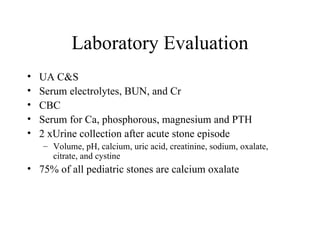
Laboratory Evaluation UA C&S Serum electrolytes, BUN, and Cr CBC Serum for Ca, phosphorous, magnesium and PTH 2 xUrine collection after acute stone episode Volume, pH, calcium, uric acid, creatinine, sodium, oxalate, citrate, and cystine 75% of all pediatric stones are calcium oxalate
Metabolic Classification Calcium Stones Non-Calcium Hypercalciuria -Absorptive -Renal -Resorptive Uric Acid Hyperuricosuria Cystine Hyperoxaluria -Primary -Enteric Struvite Hypocitraturia -RTA I Amonium Acid Urate Hypomagnesuria Indinavir
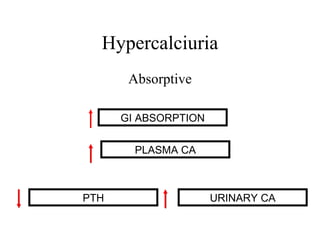
Hypercalciuria Absorptive GI ABSORPTION PLASMA CA PTH URINARY CA
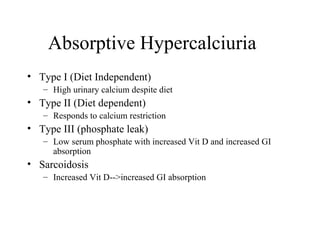
Absorptive Hypercalciuria Type I (Diet Independent) High urinary calcium despite diet Type II (Diet dependent) Responds to calcium restriction Type III (phosphate leak) Low serum phosphate with increased Vit D and increased GI absorption Sarcoidosis Increased Vit D-->increased GI absorption
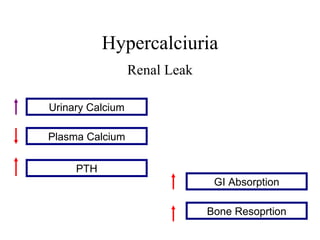
Hypercalciuria Renal Leak Urinary Calcium PTH GI Absorption Bone Resoprtion Plasma Calcium
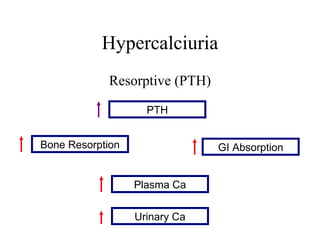
Hypercalciuria Resorptive (PTH) PTH Urinary Ca Bone Resorption GI Absorption Plasma Ca
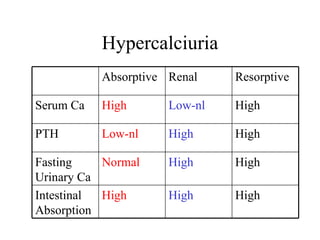
Hypercalciuria Intestinal Absorption Fasting Urinary Ca PTH Serum Ca Resorptive Renal Absorptive High High High High High High High Low-nl High Normal Low-nl High
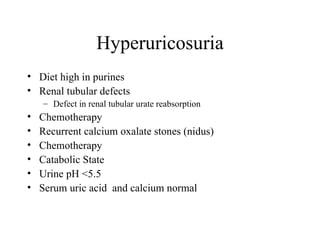
Hyperuricosuria Diet high in purines Renal tubular defects Defect in renal tubular urate reabsorption Chemotherapy Recurrent calcium oxalate stones (nidus) Chemotherapy Catabolic State Urine pH <5.5 Serum uric acid  and calcium normal
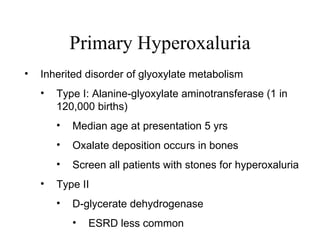
Primary Hyperoxaluria Inherited disorder of glyoxylate metabolism Type I: Alanine-glyoxylate aminotransferase (1 in 120,000 births) Median age at presentation 5 yrs Oxalate deposition occurs in bones  Screen all patients with stones for hyperoxaluria Type II D-glycerate dehydrogenase ESRD less common
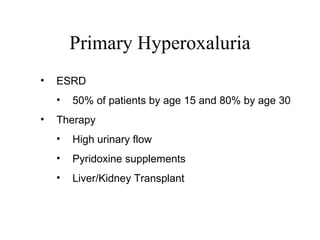
Primary Hyperoxaluria ESRD 50% of patients by age 15 and 80% by age 30 Therapy High urinary flow Pyridoxine supplements Liver/Kidney Transplant
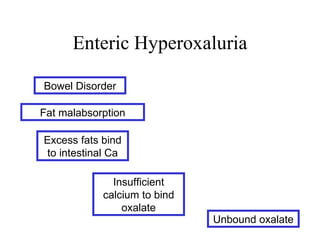
Enteric Hyperoxaluria Bowel Disorder Fat malabsorption Excess fats bind to intestinal Ca Insufficient calcium to bind oxalate Unbound oxalate
Hypocitraturia Citrate is potent stone inhibitor Caused by acidosis (RTA) Hypokalemia High animal protein diet UTI
RTA Type I  Defect in distal tubule to excrete acid Dx with systemic acidosis and urine pH>5.5 Osteomalacia in children Infants: growth retardation/vomitting/diarrhea Type II Defect in bicarb reabsorption (nephrocalcinosis not seen) Type IV Nephrocalcinosis not seen
Type I RTA May be a secondary manifestation Sjogren’s, Wilson’s, PBC, Jejunoileal bypass Hypokalemic,hyperchloremic metabolic acidosis Diagnostic workup indicated when nephrocalcinosis or recurrent nephrolithiasis Ammonium chloride load testing (urinary pH should fall below 5.5) Stones composed of calcium phosphate
Calcium Stones Misc Immobilization of children is most common cause of secondary hypercalciuria Hypomagnesuria increases solubility of Ca, phosphate Most common cause is IBD
Metabolic Classification Calcium Stones Non-Calcium Hypercalciuria -Absorptive -Renal -Resorptive Uric Acid Hyperuricosuria Cystine Hyperoxaluria -Primary -Enteric Struvite Hypocitraturia -RTA I Amonium Acid Urate Hypomagnesuria Indinavir
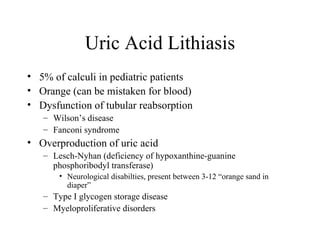
Uric Acid Lithiasis 5% of calculi in pediatric patients Orange (can be mistaken for blood) Dysfunction of tubular reabsorption Wilson’s disease Fanconi syndrome Overproduction of uric acid Lesch-Nyhan (deficiency of hypoxanthine-guanine phosphoribodyl transferase) Neurological disabilties, present between 3-12 “orange sand in diaper” Type I glycogen storage disease  Myeloproliferative disorders
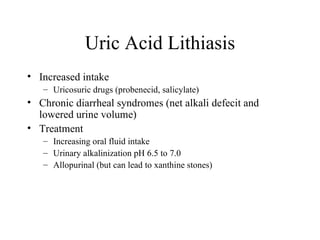
Uric Acid Lithiasis Increased intake Uricosuric drugs (probenecid, salicylate) Chronic diarrheal syndromes (net alkali defecit and lowered urine volume) Treatment Increasing oral fluid intake Urinary alkalinization pH 6.5 to 7.0 Allopurinal (but can lead to xanthine stones)
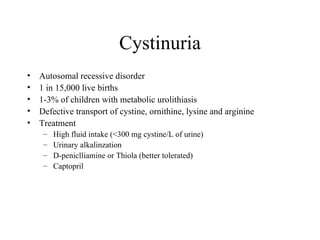
Cystinuria Autosomal recessive disorder 1 in 15,000 live births 1-3% of children with metabolic urolithiasis Defective transport of cystine, ornithine, lysine and arginine Treatment High fluid intake (<300 mg cystine/L of urine) Urinary alkalinzation D-peniclliamine or Thiola (better tolerated) Captopril
Xanthinuria Enzymatic deficiency of xanthine dehydrogenase Urolithiasis, arthropathy, myopathy, crystal nephropathy, or renal failure
Infection Stones 2-3% of stones in pediatric population Urinary pH >6.8 (urease) Proteus, pseudomonas, klebsiella, streptococcus, mycoplasma Treatment Hemiacidrin irrigation Acetohydroxamic acid (urease inhibitor)
Misc Stones Triamterene stones Sulfadiazine stones Indinavir stones
Dietary Recommendations Maintain urine output >2 L/day or >20 cc/kg/day No added salt Avoid calcium restriction Avoid excessive protein intake 5 servings per day of high potassium Daily allowance of phosphorous/magnesium
 
Pediatric GU Review II Endourology for stone disease
Etiology/Epidemiology 1 in 1000 to 1 in 7600 pediatric admissions Spontaneous passage rate of 66% Most pediatric stones are calcium oxalate Anatomic abnormalities are discovered in 10-40% of children evaluated for stones
Etiology/Epidemiology Common urine abnormalities: Hypercalciuria Hypocitraturia Hypomagnesuria Low urine volume (goal 35 cc/kg/day) Conservative management for stones <4 mm Proactive treatment of stones >5 mm should be considered
Treatment Options ESWL Up to 75-98% stone free rates at 3 months with stones up to 2.5 cm Children can pass larger stone fragments than adults Long term functional studies on pediatric patients show no change in RPF or height after 4 yrs Abdominal/flank discomfort in early post-op period should have eval for hematoma/obstruction  Hemoptysis in small stature and skeletal deformities (styrofoam padding) Prone positioning may be necessary
Treatment Options ESWL relative contraindications Morbid obesity Large stone burden Increased stone density Congenital skeletal/renal abnormalities Previously failed ESWL
Treatment Options Ureteroscopy First reported in 1929 by Young 2 types of ureteroscopes: mini-rigid and flexible Varying lengths Distal tip as small as 4.7 Fr Working channel 3.6 Fr
Treatment Options Ureteroscopy: Instruments Stone retrieval devices can vary Size, position, and condition (impacted?) Grasping forceps will disengage from a stone if it is lodged (more effective for solitary stone) Helical basket for steinstrasse  Nitinol baskets for caliceal stones and lower pole stones
Treatment Options Intracorporeal lithotripsy Ultrasonic lithotripsy (1953) Ballistic (pneumatic) Electrohydraulic (EHL) Laser (1992)
Treatment Options Ureteroscopy technique Dilation required in up to 30% Graduated single shaft dilator from 6 to 10 Fr (dilate to 2 Fr sizes greater than diameter of endoscope) May require passive dilation with stent  Smallest access sheath 9.5 Fr Presence of previous reimplant can require initial cannulation with actively deflecting guidewire Recurrent reflux after URS has never been reported Intrarenal access after UPJ repair is straightforward  Impacted stones may require dislodging into proximal dilated ureter for lithotripsy
Treatment Options Percutaneous Endourology 11 Fr and 15 Fr peel away sheaths have been used A 24 Fr adult defect equals a 72 Fr defect in a child A larger sheath is necessary for treatment of larger stones >3 cm Multiple punctures may be needed Upper pole access can cause pneumo/hydrothorax Uncontrolled hemorrhage refractory to a tamponade balloon requires angiography Dilutional hyponatremia is possible
Treatment Strategies Renal Calculi ESWL for stones <1 cm Contraindication with UPJ obstruction, caliceal diverticulum, or infundibular stenosis Less effective for ectopic or horseshoe kidneys Overall, best suited for solitary renal stones <1.5 cm not contained within an abnormal lower pole calyx or abnormal renal anatomy
Treatment Strategies Renal Calculi Percutaneous approach Intrarenal stones >1 cm, multiple large calculi, urinary tract malformations, previous reconstruction ?Sandwich approach Laparoscopy with failure of percutaneous access
Treatment Strategies Ureteral calculi ESWL effective 54-100% Ureteroscopic lithotripsy is 77-100%  Orifice dilation only necessary 33% Becoming first line for ureteral stones Percutaneous approach with impacted stones, significant hydro, or urosepsis
Treatment Strategies Bladder Calculi Open cystolithotomy Cystolithopaxy EHL can perf augmented bladder Percutaneous approach
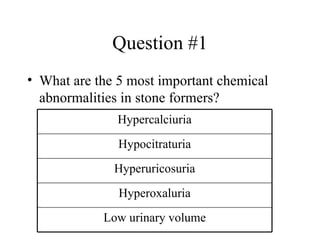
Question #1 What are the 5 most important chemical abnormalities in stone formers? Low urinary volume Hyperoxaluria Hyperuricosuria Hypocitraturia Hypercalciuria
Question #2 What is the strongest chemical promoter of stone production? Oxalate
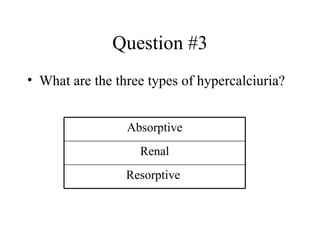
Question #3 What are the three types of hypercalciuria? Resorptive  Renal Absorptive
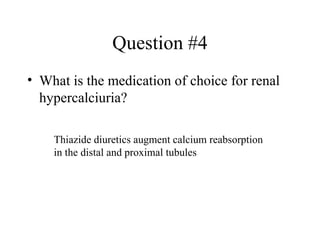
Question #4 What is the medication of choice for renal hypercalciuria? Thiazide diuretics augment calcium reabsorption in the distal and proximal tubules
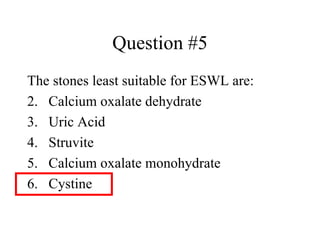
Question #5 The stones least suitable for ESWL are: Calcium oxalate dehydrate Uric Acid Struvite Calcium oxalate monohydrate Cystine
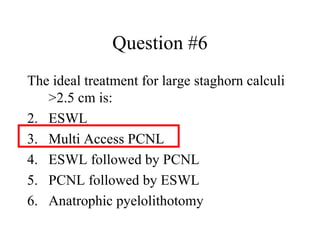
Question #6 The ideal treatment for large staghorn calculi >2.5 cm is: ESWL  Multi Access PCNL ESWL followed by PCNL PCNL followed by ESWL Anatrophic pyelolithotomy
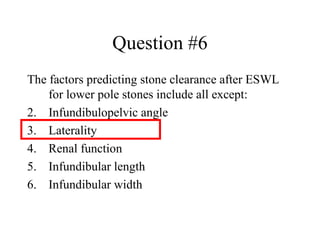
Question #6 The factors predicting stone clearance after ESWL for lower pole stones include all except: Infundibulopelvic angle Laterality Renal function Infundibular length Infundibular width
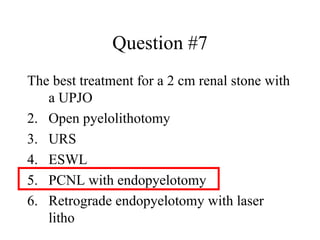
Question #7 The best treatment for a 2 cm renal stone with a UPJO Open pyelolithotomy URS ESWL PCNL with endopyelotomy Retrograde endopyelotomy with laser litho
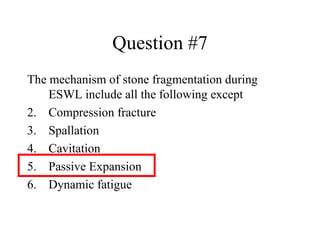
Question #7 The mechanism of stone fragmentation during ESWL include all the following except Compression fracture Spallation Cavitation Passive Expansion Dynamic fatigue
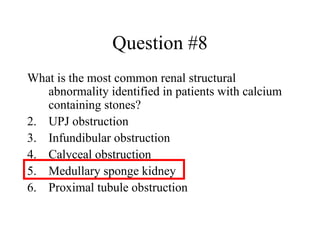
Question #8 What is the most common renal structural abnormality identified in patients with calcium containing stones? UPJ obstruction Infundibular obstruction Calyceal obstruction Medullary sponge kidney Proximal tubule obstruction
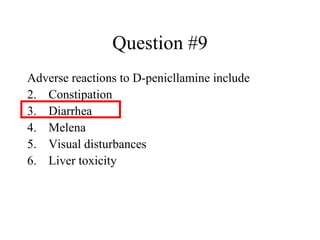
Question #9 Adverse reactions to D-penicllamine include Constipation Diarrhea Melena Visual disturbances Liver toxicity
Question #10 Urease-producing bacteria hydrolyze urea to which of the following? Uric acid Carbon monoxide Carbon dioxide Ammonium and carbon dioxide

Pedi gu review nephrolithiasis

  • 1.
    Nephrolithiasis Pediatric GUReview UCSD Pediatric Urology George Chiang MD Sara Marietti MD Outlined from The Kelalis-King-Belman Textbook of Clinical Pediatric Urology 2007 (not for reproduction, distribution, or sale without consent)
  • 2.
    Classification EnzymeDisorders Primary Hyperoxaluria Type I: glyoxylic aciduria Type II: glyceric aciduria Xanthinuria 1,8-Dihydroxyadeniuria Lesch-Nyhan syndrome
  • 3.
    Classification Renal tubularsyndromes Cystinuria Renal tubular acidosis Hypercalcemic states HyperPTH Immobilization
  • 4.
    Classification Uric AcidLithiasis Enteric urolithiasis Idiopathic calcium oxalate urolithiasis Hypercalciuria (Absorptive and Renal) Hyperoxaluria Hyperuricosuria Hypocitraturia Medications
  • 5.
    Classification Endemic bladderstone formation Secondary urolithiasis Infection Obstruction Structural abnormalities Urinary diversion procedures Foreign body
  • 6.
    Metabolic Classification CalciumStones Non-Calcium Hypercalciuria -Absorptive -Renal -Resorptive Uric Acid Hyperuricosuria Cystine Hyperoxaluria -Primary -Enteric Struvite Hypocitraturia -RTA I Amonium Acid Urate Hypomagnesuria Indinavir
  • 7.
    Pathophysiology Formation ofstone Urinary volume pH Presence of promoters or inhibitors of lithogenesis Central event is supersaturation Crystallization occurs via homogenous vs. heterogenous nucleation
  • 8.
    Pathophysiology Saturation Crystalgrowth and aggregation Supersaturation Crystal Retention Stone formation Nucleation
  • 9.
    Presentation Renal colicoccurs in 40-75% of children Hematuria in 33-90% of children Urethral stones present with terminal hematuria or inability to void
  • 10.
    Presentation Factors Sizeof stone Location of stone Degree of obstruction Presence of infection Presence/absence of normal contralateral kidney
  • 11.
    Presentation H andP Prematurity (lasix, formulas) Medications Concurrent illnesses (neoplasms, CF) Recurrent skeletal fractures Nutritional habits Family history
  • 12.
    Imaging Radiopaque ORRadiolucent Calcium Oxalate Uric Acid Calcium phosphate Trimaterene Struvite Cystine Silica Xanthine
  • 13.
    Laboratory Evaluation UAC&S Serum electrolytes, BUN, and Cr CBC Serum for Ca, phosphorous, magnesium and PTH 2 xUrine collection after acute stone episode Volume, pH, calcium, uric acid, creatinine, sodium, oxalate, citrate, and cystine 75% of all pediatric stones are calcium oxalate
  • 14.
    Metabolic Classification CalciumStones Non-Calcium Hypercalciuria -Absorptive -Renal -Resorptive Uric Acid Hyperuricosuria Cystine Hyperoxaluria -Primary -Enteric Struvite Hypocitraturia -RTA I Amonium Acid Urate Hypomagnesuria Indinavir
  • 15.
    Hypercalciuria Absorptive GIABSORPTION PLASMA CA PTH URINARY CA
  • 16.
    Absorptive Hypercalciuria TypeI (Diet Independent) High urinary calcium despite diet Type II (Diet dependent) Responds to calcium restriction Type III (phosphate leak) Low serum phosphate with increased Vit D and increased GI absorption Sarcoidosis Increased Vit D-->increased GI absorption
  • 17.
    Hypercalciuria Renal LeakUrinary Calcium PTH GI Absorption Bone Resoprtion Plasma Calcium
  • 18.
    Hypercalciuria Resorptive (PTH)PTH Urinary Ca Bone Resorption GI Absorption Plasma Ca
  • 19.
    Hypercalciuria Intestinal AbsorptionFasting Urinary Ca PTH Serum Ca Resorptive Renal Absorptive High High High High High High High Low-nl High Normal Low-nl High
  • 20.
    Hyperuricosuria Diet highin purines Renal tubular defects Defect in renal tubular urate reabsorption Chemotherapy Recurrent calcium oxalate stones (nidus) Chemotherapy Catabolic State Urine pH <5.5 Serum uric acid and calcium normal
  • 21.
    Primary Hyperoxaluria Inheriteddisorder of glyoxylate metabolism Type I: Alanine-glyoxylate aminotransferase (1 in 120,000 births) Median age at presentation 5 yrs Oxalate deposition occurs in bones Screen all patients with stones for hyperoxaluria Type II D-glycerate dehydrogenase ESRD less common
  • 22.
    Primary Hyperoxaluria ESRD50% of patients by age 15 and 80% by age 30 Therapy High urinary flow Pyridoxine supplements Liver/Kidney Transplant
  • 23.
    Enteric Hyperoxaluria BowelDisorder Fat malabsorption Excess fats bind to intestinal Ca Insufficient calcium to bind oxalate Unbound oxalate
  • 24.
    Hypocitraturia Citrate ispotent stone inhibitor Caused by acidosis (RTA) Hypokalemia High animal protein diet UTI
  • 25.
    RTA Type I Defect in distal tubule to excrete acid Dx with systemic acidosis and urine pH>5.5 Osteomalacia in children Infants: growth retardation/vomitting/diarrhea Type II Defect in bicarb reabsorption (nephrocalcinosis not seen) Type IV Nephrocalcinosis not seen
  • 26.
    Type I RTAMay be a secondary manifestation Sjogren’s, Wilson’s, PBC, Jejunoileal bypass Hypokalemic,hyperchloremic metabolic acidosis Diagnostic workup indicated when nephrocalcinosis or recurrent nephrolithiasis Ammonium chloride load testing (urinary pH should fall below 5.5) Stones composed of calcium phosphate
  • 27.
    Calcium Stones MiscImmobilization of children is most common cause of secondary hypercalciuria Hypomagnesuria increases solubility of Ca, phosphate Most common cause is IBD
  • 28.
    Metabolic Classification CalciumStones Non-Calcium Hypercalciuria -Absorptive -Renal -Resorptive Uric Acid Hyperuricosuria Cystine Hyperoxaluria -Primary -Enteric Struvite Hypocitraturia -RTA I Amonium Acid Urate Hypomagnesuria Indinavir
  • 29.
    Uric Acid Lithiasis5% of calculi in pediatric patients Orange (can be mistaken for blood) Dysfunction of tubular reabsorption Wilson’s disease Fanconi syndrome Overproduction of uric acid Lesch-Nyhan (deficiency of hypoxanthine-guanine phosphoribodyl transferase) Neurological disabilties, present between 3-12 “orange sand in diaper” Type I glycogen storage disease Myeloproliferative disorders
  • 30.
    Uric Acid LithiasisIncreased intake Uricosuric drugs (probenecid, salicylate) Chronic diarrheal syndromes (net alkali defecit and lowered urine volume) Treatment Increasing oral fluid intake Urinary alkalinization pH 6.5 to 7.0 Allopurinal (but can lead to xanthine stones)
  • 31.
    Cystinuria Autosomal recessivedisorder 1 in 15,000 live births 1-3% of children with metabolic urolithiasis Defective transport of cystine, ornithine, lysine and arginine Treatment High fluid intake (<300 mg cystine/L of urine) Urinary alkalinzation D-peniclliamine or Thiola (better tolerated) Captopril
  • 32.
    Xanthinuria Enzymatic deficiencyof xanthine dehydrogenase Urolithiasis, arthropathy, myopathy, crystal nephropathy, or renal failure
  • 33.
    Xanthinuria Enzymatic deficiencyof xanthine dehydrogenase Urolithiasis, arthropathy, myopathy, crystal nephropathy, or renal failure
  • 34.
    Infection Stones 2-3%of stones in pediatric population Urinary pH >6.8 (urease) Proteus, pseudomonas, klebsiella, streptococcus, mycoplasma Treatment Hemiacidrin irrigation Acetohydroxamic acid (urease inhibitor)
  • 35.
    Misc Stones Triamterenestones Sulfadiazine stones Indinavir stones
  • 36.
    Dietary Recommendations Maintainurine output >2 L/day or >20 cc/kg/day No added salt Avoid calcium restriction Avoid excessive protein intake 5 servings per day of high potassium Daily allowance of phosphorous/magnesium
  • 37.
  • 38.
    Pediatric GU ReviewII Endourology for stone disease
  • 39.
    Etiology/Epidemiology 1 in1000 to 1 in 7600 pediatric admissions Spontaneous passage rate of 66% Most pediatric stones are calcium oxalate Anatomic abnormalities are discovered in 10-40% of children evaluated for stones
  • 40.
    Etiology/Epidemiology Common urineabnormalities: Hypercalciuria Hypocitraturia Hypomagnesuria Low urine volume (goal 35 cc/kg/day) Conservative management for stones <4 mm Proactive treatment of stones >5 mm should be considered
  • 41.
    Treatment Options ESWLUp to 75-98% stone free rates at 3 months with stones up to 2.5 cm Children can pass larger stone fragments than adults Long term functional studies on pediatric patients show no change in RPF or height after 4 yrs Abdominal/flank discomfort in early post-op period should have eval for hematoma/obstruction Hemoptysis in small stature and skeletal deformities (styrofoam padding) Prone positioning may be necessary
  • 42.
    Treatment Options ESWLrelative contraindications Morbid obesity Large stone burden Increased stone density Congenital skeletal/renal abnormalities Previously failed ESWL
  • 43.
    Treatment Options UreteroscopyFirst reported in 1929 by Young 2 types of ureteroscopes: mini-rigid and flexible Varying lengths Distal tip as small as 4.7 Fr Working channel 3.6 Fr
  • 44.
    Treatment Options Ureteroscopy:Instruments Stone retrieval devices can vary Size, position, and condition (impacted?) Grasping forceps will disengage from a stone if it is lodged (more effective for solitary stone) Helical basket for steinstrasse Nitinol baskets for caliceal stones and lower pole stones
  • 45.
    Treatment Options Intracorporeallithotripsy Ultrasonic lithotripsy (1953) Ballistic (pneumatic) Electrohydraulic (EHL) Laser (1992)
  • 46.
    Treatment Options Ureteroscopytechnique Dilation required in up to 30% Graduated single shaft dilator from 6 to 10 Fr (dilate to 2 Fr sizes greater than diameter of endoscope) May require passive dilation with stent Smallest access sheath 9.5 Fr Presence of previous reimplant can require initial cannulation with actively deflecting guidewire Recurrent reflux after URS has never been reported Intrarenal access after UPJ repair is straightforward Impacted stones may require dislodging into proximal dilated ureter for lithotripsy
  • 47.
    Treatment Options PercutaneousEndourology 11 Fr and 15 Fr peel away sheaths have been used A 24 Fr adult defect equals a 72 Fr defect in a child A larger sheath is necessary for treatment of larger stones >3 cm Multiple punctures may be needed Upper pole access can cause pneumo/hydrothorax Uncontrolled hemorrhage refractory to a tamponade balloon requires angiography Dilutional hyponatremia is possible
  • 48.
    Treatment Strategies RenalCalculi ESWL for stones <1 cm Contraindication with UPJ obstruction, caliceal diverticulum, or infundibular stenosis Less effective for ectopic or horseshoe kidneys Overall, best suited for solitary renal stones <1.5 cm not contained within an abnormal lower pole calyx or abnormal renal anatomy
  • 49.
    Treatment Strategies RenalCalculi Percutaneous approach Intrarenal stones >1 cm, multiple large calculi, urinary tract malformations, previous reconstruction ?Sandwich approach Laparoscopy with failure of percutaneous access
  • 50.
    Treatment Strategies Ureteralcalculi ESWL effective 54-100% Ureteroscopic lithotripsy is 77-100% Orifice dilation only necessary 33% Becoming first line for ureteral stones Percutaneous approach with impacted stones, significant hydro, or urosepsis
  • 51.
    Treatment Strategies BladderCalculi Open cystolithotomy Cystolithopaxy EHL can perf augmented bladder Percutaneous approach
  • 52.
    Question #1 Whatare the 5 most important chemical abnormalities in stone formers? Low urinary volume Hyperoxaluria Hyperuricosuria Hypocitraturia Hypercalciuria
  • 53.
    Question #2 Whatis the strongest chemical promoter of stone production? Oxalate
  • 54.
    Question #3 Whatare the three types of hypercalciuria? Resorptive Renal Absorptive
  • 55.
    Question #4 Whatis the medication of choice for renal hypercalciuria? Thiazide diuretics augment calcium reabsorption in the distal and proximal tubules
  • 56.
    Question #5 Thestones least suitable for ESWL are: Calcium oxalate dehydrate Uric Acid Struvite Calcium oxalate monohydrate Cystine
  • 57.
    Question #6 Theideal treatment for large staghorn calculi >2.5 cm is: ESWL Multi Access PCNL ESWL followed by PCNL PCNL followed by ESWL Anatrophic pyelolithotomy
  • 58.
    Question #6 Thefactors predicting stone clearance after ESWL for lower pole stones include all except: Infundibulopelvic angle Laterality Renal function Infundibular length Infundibular width
  • 59.
    Question #7 Thebest treatment for a 2 cm renal stone with a UPJO Open pyelolithotomy URS ESWL PCNL with endopyelotomy Retrograde endopyelotomy with laser litho
  • 60.
    Question #7 Themechanism of stone fragmentation during ESWL include all the following except Compression fracture Spallation Cavitation Passive Expansion Dynamic fatigue
  • 61.
    Question #8 Whatis the most common renal structural abnormality identified in patients with calcium containing stones? UPJ obstruction Infundibular obstruction Calyceal obstruction Medullary sponge kidney Proximal tubule obstruction
  • 62.
    Question #9 Adversereactions to D-penicllamine include Constipation Diarrhea Melena Visual disturbances Liver toxicity
  • 63.
    Question #10 Urease-producingbacteria hydrolyze urea to which of the following? Uric acid Carbon monoxide Carbon dioxide Ammonium and carbon dioxide