PATHOLOGY OF
URETHRAL
STRICTURES
DR. NWAFULUME OBIORA
UNIVERSITY OF NIGERIA
TEACHING HOSPITAL
OUTLINE
• Introduction/ Definition
• Aetiology
• Classification
• Pathology
• Pathophysiology
• Differential diagnoses
• Complications
Introduction/Definition
•Urethral stricture is a scarring
process involving the spongy erectile
tissue of the corpus spongiosum.
•It is an abnormal narrowing or loss of
distensibility of the anterior urethra
due to spongiofibrosis at the site of
injury or inflammation.
Introduction/Definition
•Urethral strictures are fibrotic
narrowings composed of collagen &
fibroblasts.
•The fibrosis usually extends into the
corpus spongiosum causing
spongiofibrosis.
Introduction/Definition
•Posterior urethral stricture is an
obliterative process as result of fibrosis,
and is generally the effect of distraction in
that area caused by either trauma or
radical prostatectomy.
AETIOLOGY
• Infective:
• Gonococcal urethritis
• Non-gonococcal
urethritis
• Tuberculous
urethritis
• Schistosomiasis
• Inflammatory:
• Toxic catheter reactions
• BXO
• Traumatic
• External trauma-
straddle injuries,
penetrating injuries
(gunshot, stabs)
• Urethral
instrumentation
• Foreign
body/calculus
AETIOLOGY
•Congenital (rare)
•Pin-hole meatus
•Non-meatal strictures
•Neoplastic
• urethral carcinoma
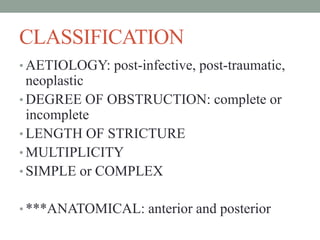
CLASSIFICATION
• AETIOLOGY: post-infective, post-traumatic,
neoplastic
• DEGREE OF OBSTRUCTION: complete or
incomplete
• LENGTH OF STRICTURE
• MULTIPLICITY
• SIMPLE or COMPLEX
• ***ANATOMICAL: anterior and posterior
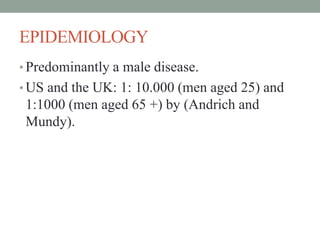
EPIDEMIOLOGY
• Predominantly a male disease.
• US and the UK: 1: 10.000 (men aged 25) and
1:1000 (men aged 65 +) by (Andrich and
Mundy).
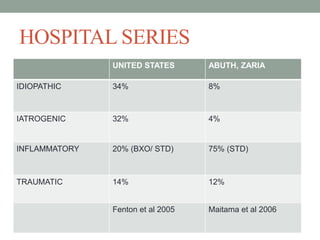
HOSPITAL SERIES
UNITED STATES ABUTH, ZARIA
IDIOPATHIC 34% 8%
IATROGENIC 32% 4%
INFLAMMATORY 20% (BXO/ STD) 75% (STD)
TRAUMATIC 14% 12%
Fenton et al 2005 Maitama et al 2006
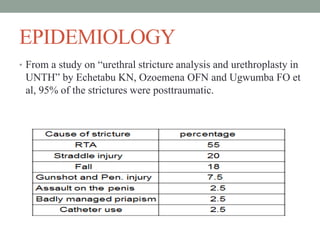
EPIDEMIOLOGY
• From a study on “urethral stricture analysis and urethroplasty in
UNTH” by Echetabu KN, Ozoemena OFN and Ugwumba FO et
al, 95% of the strictures were posttraumatic.
PATHOGENESIS
•Any form of inflammation capable of
causing injury to the lamina propria of
the urothelium is likely to cause
progressive fibrosis of the epithelium
with subsequent involvement of the
underlying corpus spongiosum
(spongiofibrosis).
PATHOGENESIS
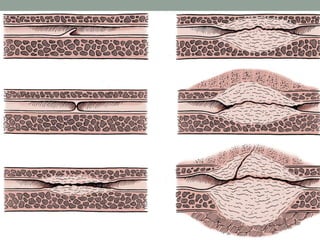
•The injury with varying location, length
and thickness causes fibrotic scar
formation (replacing the normal
urothelium), narrowing of the urethral
lumen following contraction, and may
culminate in obliteration, and more rarely
fistula formation or abscessation.
PATHOGENESIS
•Urethral stricture is formed when the urethra
heals by proliferation of fibroblasts which later
contract.
•Post-inflammatory strictures occur in the
mostly in the bulbous urethra (60·70%) because
its dilatation and angulation.
•Next is the penile urethra and then the glanular
urethra.
•Instrumental injury usually occurs at the bulb.
PATHOPHYSIOLOGY
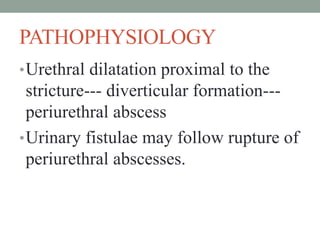
•Urethral dilatation proximal to the
stricture--- diverticular formation---
periurethral abscess
•Urinary fistulae may follow rupture of
periurethral abscesses.
PATHOPHYSIOLOGY
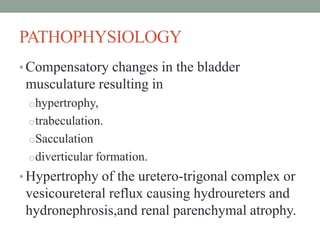
• Compensatory changes in the bladder
musculature resulting in
ohypertrophy,
otrabeculation.
oSacculation
odiverticular formation.
• Hypertrophy of the uretero-trigonal complex or
vesicoureteral reflux causing hydroureters and
hydronephrosis,and renal parenchymal atrophy.
PATHOPHYSIOLOGY
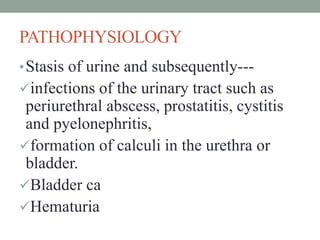
•Stasis of urine and subsequently---
infections of the urinary tract such as
periurethral abscess, prostatitis, cystitis
and pyelonephritis,
formation of calculi in the urethra or
bladder.
Bladder ca
Hematuria
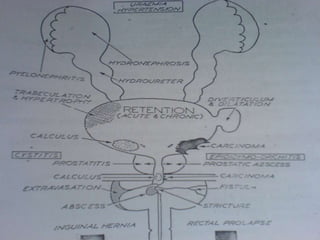
COMPLICATIONS OF STRICTURE
• Retention of urine
• Urethral diverticulum
• Urethral fistula
• Watery can perineum
• Hernia, Haemorrhoids ,and Rectal prolapse
• Urethral or vesical calculi
• Infections- prostatitis, seminal vesiculitis, epididymo-
orchitis
• Obstructive uropathy
• Renal failure
DIFFERENTIAL DIAGNOSES
• Benign Prostatic Enlargement
• Carcinoma Prostate
• Carcinoma bladder
• Urethral Carcinoma
• Chronic prostatitis

Pathology of Urethral strictures

  • 1.
    PATHOLOGY OF URETHRAL STRICTURES DR. NWAFULUMEOBIORA UNIVERSITY OF NIGERIA TEACHING HOSPITAL
  • 2.
    OUTLINE • Introduction/ Definition •Aetiology • Classification • Pathology • Pathophysiology • Differential diagnoses • Complications
  • 3.
    Introduction/Definition •Urethral stricture isa scarring process involving the spongy erectile tissue of the corpus spongiosum. •It is an abnormal narrowing or loss of distensibility of the anterior urethra due to spongiofibrosis at the site of injury or inflammation.
  • 4.
    Introduction/Definition •Urethral strictures arefibrotic narrowings composed of collagen & fibroblasts. •The fibrosis usually extends into the corpus spongiosum causing spongiofibrosis.
  • 5.
    Introduction/Definition •Posterior urethral strictureis an obliterative process as result of fibrosis, and is generally the effect of distraction in that area caused by either trauma or radical prostatectomy.
  • 6.
    AETIOLOGY • Infective: • Gonococcalurethritis • Non-gonococcal urethritis • Tuberculous urethritis • Schistosomiasis • Inflammatory: • Toxic catheter reactions • BXO • Traumatic • External trauma- straddle injuries, penetrating injuries (gunshot, stabs) • Urethral instrumentation • Foreign body/calculus
  • 7.
    AETIOLOGY •Congenital (rare) •Pin-hole meatus •Non-meatalstrictures •Neoplastic • urethral carcinoma
  • 8.
    CLASSIFICATION • AETIOLOGY: post-infective,post-traumatic, neoplastic • DEGREE OF OBSTRUCTION: complete or incomplete • LENGTH OF STRICTURE • MULTIPLICITY • SIMPLE or COMPLEX • ***ANATOMICAL: anterior and posterior
  • 9.
    EPIDEMIOLOGY • Predominantly amale disease. • US and the UK: 1: 10.000 (men aged 25) and 1:1000 (men aged 65 +) by (Andrich and Mundy).
  • 10.
    HOSPITAL SERIES UNITED STATESABUTH, ZARIA IDIOPATHIC 34% 8% IATROGENIC 32% 4% INFLAMMATORY 20% (BXO/ STD) 75% (STD) TRAUMATIC 14% 12% Fenton et al 2005 Maitama et al 2006
  • 11.
    EPIDEMIOLOGY • From astudy on “urethral stricture analysis and urethroplasty in UNTH” by Echetabu KN, Ozoemena OFN and Ugwumba FO et al, 95% of the strictures were posttraumatic.
  • 12.
    PATHOGENESIS •Any form ofinflammation capable of causing injury to the lamina propria of the urothelium is likely to cause progressive fibrosis of the epithelium with subsequent involvement of the underlying corpus spongiosum (spongiofibrosis).
  • 13.
    PATHOGENESIS •The injury withvarying location, length and thickness causes fibrotic scar formation (replacing the normal urothelium), narrowing of the urethral lumen following contraction, and may culminate in obliteration, and more rarely fistula formation or abscessation.
  • 14.
    PATHOGENESIS •Urethral stricture isformed when the urethra heals by proliferation of fibroblasts which later contract. •Post-inflammatory strictures occur in the mostly in the bulbous urethra (60·70%) because its dilatation and angulation. •Next is the penile urethra and then the glanular urethra. •Instrumental injury usually occurs at the bulb.
  • 16.
    PATHOPHYSIOLOGY •Urethral dilatation proximalto the stricture--- diverticular formation--- periurethral abscess •Urinary fistulae may follow rupture of periurethral abscesses.
  • 17.
    PATHOPHYSIOLOGY • Compensatory changesin the bladder musculature resulting in ohypertrophy, otrabeculation. oSacculation odiverticular formation. • Hypertrophy of the uretero-trigonal complex or vesicoureteral reflux causing hydroureters and hydronephrosis,and renal parenchymal atrophy.
  • 18.
    PATHOPHYSIOLOGY •Stasis of urineand subsequently--- infections of the urinary tract such as periurethral abscess, prostatitis, cystitis and pyelonephritis, formation of calculi in the urethra or bladder. Bladder ca Hematuria
  • 20.
    COMPLICATIONS OF STRICTURE •Retention of urine • Urethral diverticulum • Urethral fistula • Watery can perineum • Hernia, Haemorrhoids ,and Rectal prolapse • Urethral or vesical calculi • Infections- prostatitis, seminal vesiculitis, epididymo- orchitis • Obstructive uropathy • Renal failure
  • 21.
    DIFFERENTIAL DIAGNOSES • BenignProstatic Enlargement • Carcinoma Prostate • Carcinoma bladder • Urethral Carcinoma • Chronic prostatitis