Mirizzi syndrome
Prasanna Gowda
PVS Memorial Hospital
Kochi, Kerala
• Extrinsic biliary compression syndrome
• It occurs in 0.3% to 3% of patients undergoing
cholecystectomy
• Reported incidence in underdeveloped countries ranges from
4.7% to 5.7%
• Treatment is associated with potentially serious surgical
complications such as bile duct injury
Professor Pablo Luis Mirizzi (1893-1964)
Kehr in 1905 First description of
partial biliary obstruction
secondary to cystic duct
stone
Pablo Luis Mirizzi in 1940 Proposed muscular
sphincter in the common
hepatic duct
Peustow in 1942 Internal biliary fistulas
Behrend 1950 Cholecystobiliary fistulas
Pathogenesis
• Recurrent impaction of gallstones in the cystic duct or infundibulum
• Repeated episodes of acute cholecystitis
• Adhesion between gall bladder and CHD
• External compression of the bile duct
• Gallstones will cause a pressure ulcer and necrosis, eroding into the
bile duct and producing a cholecystobiliary fistula
• cholecystoenteric fistula
Mirizzi syndrome anatomy
• Gall bladder
• Thick or thin atrophic walls
• Impacted gallstones at the infundibulum Or
• at the Hartmann's pouch
• Cystic duct
• Obliterated cystic duct
• Occasional absence of cystic duct
• A long cystic duct running parallel to
• the common bile duct with low insertion
• Bile duct
• Partial obstruction by external compression or by a gallstone
eroding into the bile duct
• Normal caliber distal bile duct with walls of normal thickness
• A dilated proximal bile duct with thick inflamed walls
• Fistula
• Cholecystocholedochal fistula
• Cholecystoenteric fistula
Clinical manifestation
• Age group: 53 to 70
• Females: 70%
• Pain
• Obstructive jaundice
• Fever (Cholangitis, Pancreatitis)
• Gall stone ileus
Laboratory finding
• Hyperbilirubinemia
• Elevated aminotransaminase levels
• Alkaline phosphatase levels range from normal to about
three- to ten-fold rise
• Leukocytosis (acute cholecystitis, cholangitis or pancreatitis)
• CA19-9: consistently found in patients with Mirizzi
syndrome type Ⅱ or higher
• CA19-9 must be interpreted cautiously in patients with
suspected biliary malignancy
Classification systems
• McSherry classification (based on ERCP, 1982)
• Type I : a partial or complete external obstruction of the CHD
• Type II : Cholecystoduodenal fistula
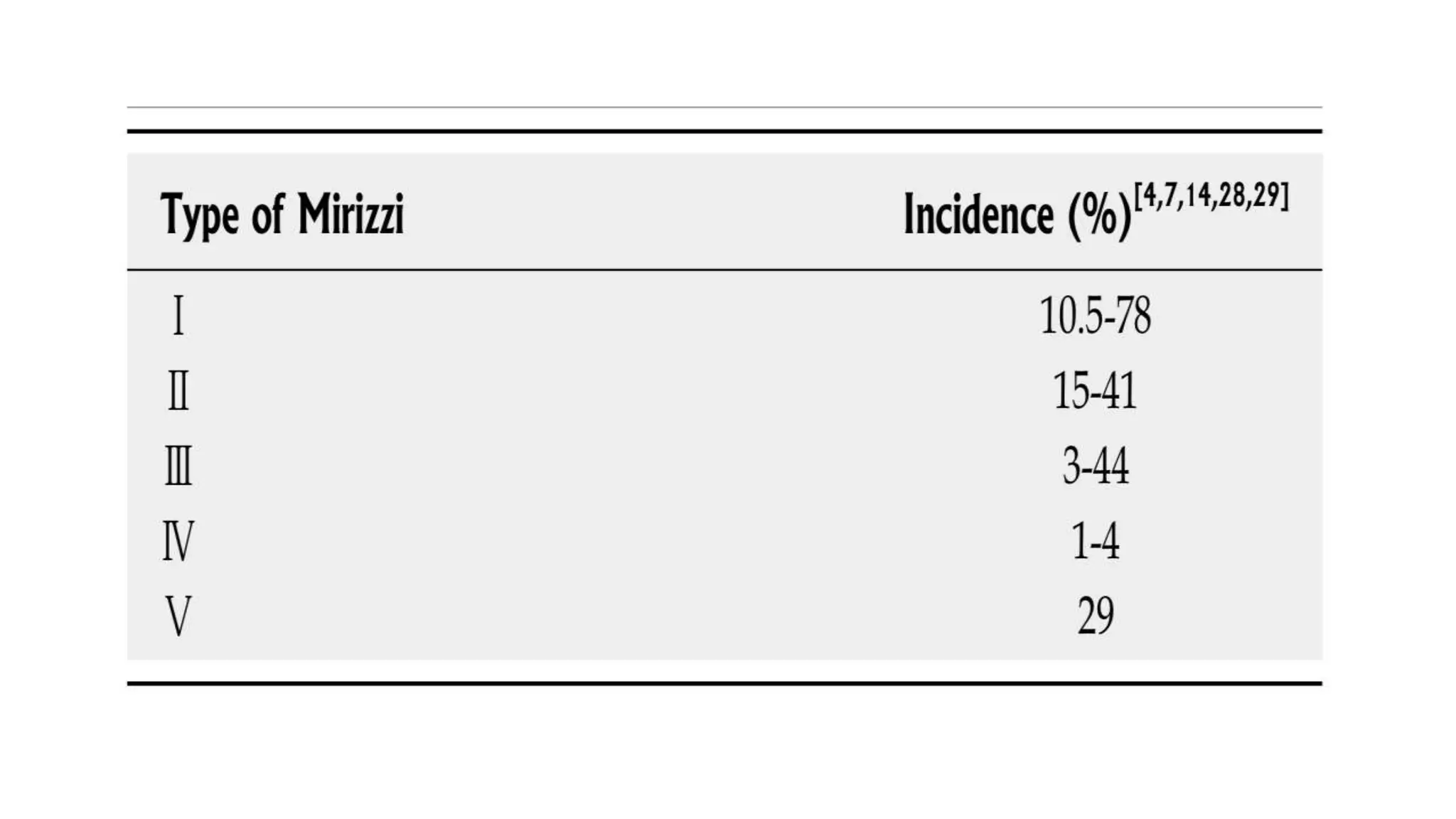
Type I
Type II
Type III
Type IV
Type V
Csendes classification
Differential diagnosis
• Gallbladder cancer
• Cholangiocarcinoma
• Sclerosing cholangitis
• Metastatic disease
Diagnosis
• High index of suspicion
• Preoperative diagnosis of Mirizzi syndrome is difficult
• If preoperative diagnosis is not made, intraoperative
recognition and proper management is essential
• Inadequate recognition of this condition leads to high
preoperative morbidity and mortality
• The incidence of bile duct injuries in patients operated on
with Mirizzi syndrome without preoperative diagnosis could
be as high as 17%
• Imaging studies are the mainstay of pre-operative diagnosis
Ultrasonography
• A contracted gallbladder
• Thick or extremely thin walls with gall-stones impacted in
the infundibulum
• The hepatic duct would be dilated in its extra and intrahepatic
portions above the level of the obstruction site
• The common bile duct would be within normal size under the
level of obstruction
• Diagnostic accuracy for ultrasonography in Mirizzi syndrome
is 29%
• Sensitivity varying from 8.3% to 27%
Computed tomography
• CT scan has a sensitivity similar to USG
• May show a characteristic irregular cavity adjacent to the
neck of GB containing the protruding stone
• Helpful in diagnosing other causes of obstructive jaundice
such as
• GB cancer
• cholangiocarcinoma
• metastatic tumour
Magnetic resonance cholangio-pancreatography (MRCP)
• Typical features of Mirizzi syndrome can be shown by MRCP
such as the
• Extrinsic narrowing of the common hepatic duct,
• Gallstone in the cystic duct,
• Dilatation of the intrahepatic and common hepatic ducts,
and a
• Normal CBD.
• Extent of the inflammatory process in Calot’s triangle
• Fistula
• Diagnostic accuracy for MRCP is 50%
Endoscopic retrograde cholangiopancreatography (ERCP)
• Cholangiography remains the most reliable method
• The diagnostic accuracy is around 55% to 90%
• Excavating defect on the lateral wall of the CBD at the level
of the cystic duct or GB neck
• The advantage of ERCP
• Clearing concomitant bile duct stones
• Insertion of a biliary stent or nasobiliary catheter both of
which may serve a temporising role and may help in intra-
operative identification of the CBD
Intraoperative diagnosis
• Over 50% of cases are diagnosed during surgery
• Shrunken gallbladder with distorted anatomy
• Impacted stone at the neck or infundibulum
• Obliterated Calot's triangle,
• Intraoperative cholangiography could be useful but difficult
to do
• Intraoperative ultrasonography is a useful tool
Treatment
• Formidable challenge
• Severe inflammation and edematous tissues
• Thick dense adhesions
• Distorted anatomy
• cholecystobiliary fistula
• Individualized depending on the stage of the disease
Type I
• Classic cholecystectomy
• Subtotal cholecystectomy in difficult cases
• Fundus first approach is appropriate
• The cystic duct is identified from inside the open gallbladder
and explored seeking residual gallstones.
• If the cystic duct is obliterated, no attempt should be made to
open it.
• Cystic duct is secured without further dissection
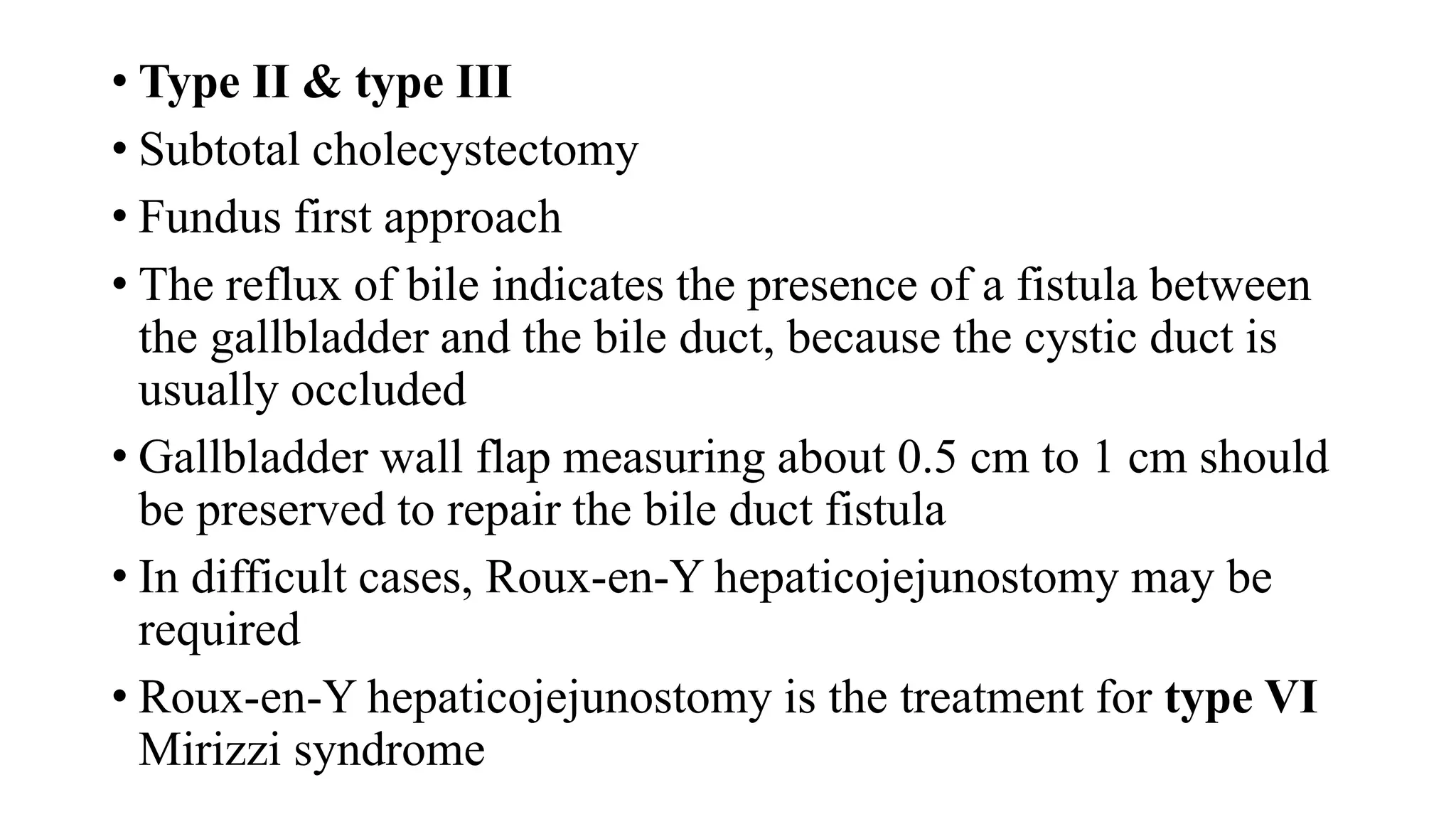
• Type II & type III
• Subtotal cholecystectomy
• Fundus first approach
• The reflux of bile indicates the presence of a fistula between
the gallbladder and the bile duct, because the cystic duct is
usually occluded
• Gallbladder wall flap measuring about 0.5 cm to 1 cm should
be preserved to repair the bile duct fistula
• In difficult cases, Roux-en-Y hepaticojejunostomy may be
required
• Roux-en-Y hepaticojejunostomy is the treatment for type VI
Mirizzi syndrome
Type V a
• Division and simple suture with an absorbable material of the
bilioenteric fistulae over the affected viscera
• Cholecystectomy either total or subtotal
• Roux-en-Y hepaticojejunostomy
Type Ⅴb
• Treat the acute condition first (gallstone ileus)
• Second stage: after the patient has recovered from surgery
• (3 or more months later), approach the gallbladder according
to the presence or absence of external compression of the bile
duct or cholecystobiliary fistula
Laparoscopic surgery
• Controversial
• Considered technically challenging
• High conversion rates
• Increased risk of bile duct injuries
• Lateral traction on the infundibulum of GB does not open up
the Calot's triangle
• Selected cases of Mirizzi Type I
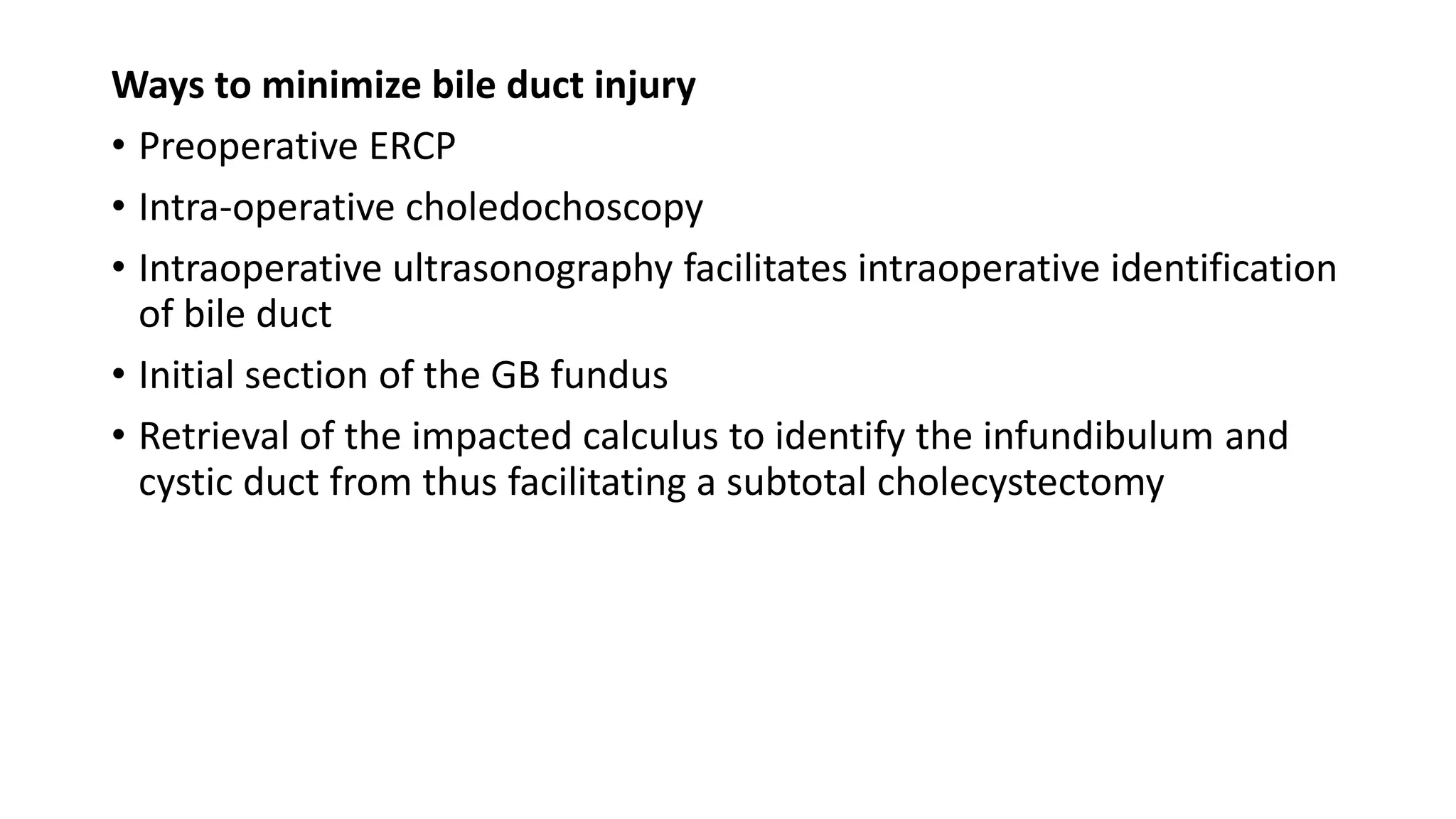
Ways to minimize bile duct injury
• Preoperative ERCP
• Intra-operative choledochoscopy
• Intraoperative ultrasonography facilitates intraoperative identification
of bile duct
• Initial section of the GB fundus
• Retrieval of the impacted calculus to identify the infundibulum and
cystic duct from thus facilitating a subtotal cholecystectomy
CONCLUSION
• Rare complication of long standing cholelithiasis
• Most common presentation is pain or jaundice
• Cholecystectomy is the treatment of choice
• A pre-operative identification helps in operative planning and
minimize complications
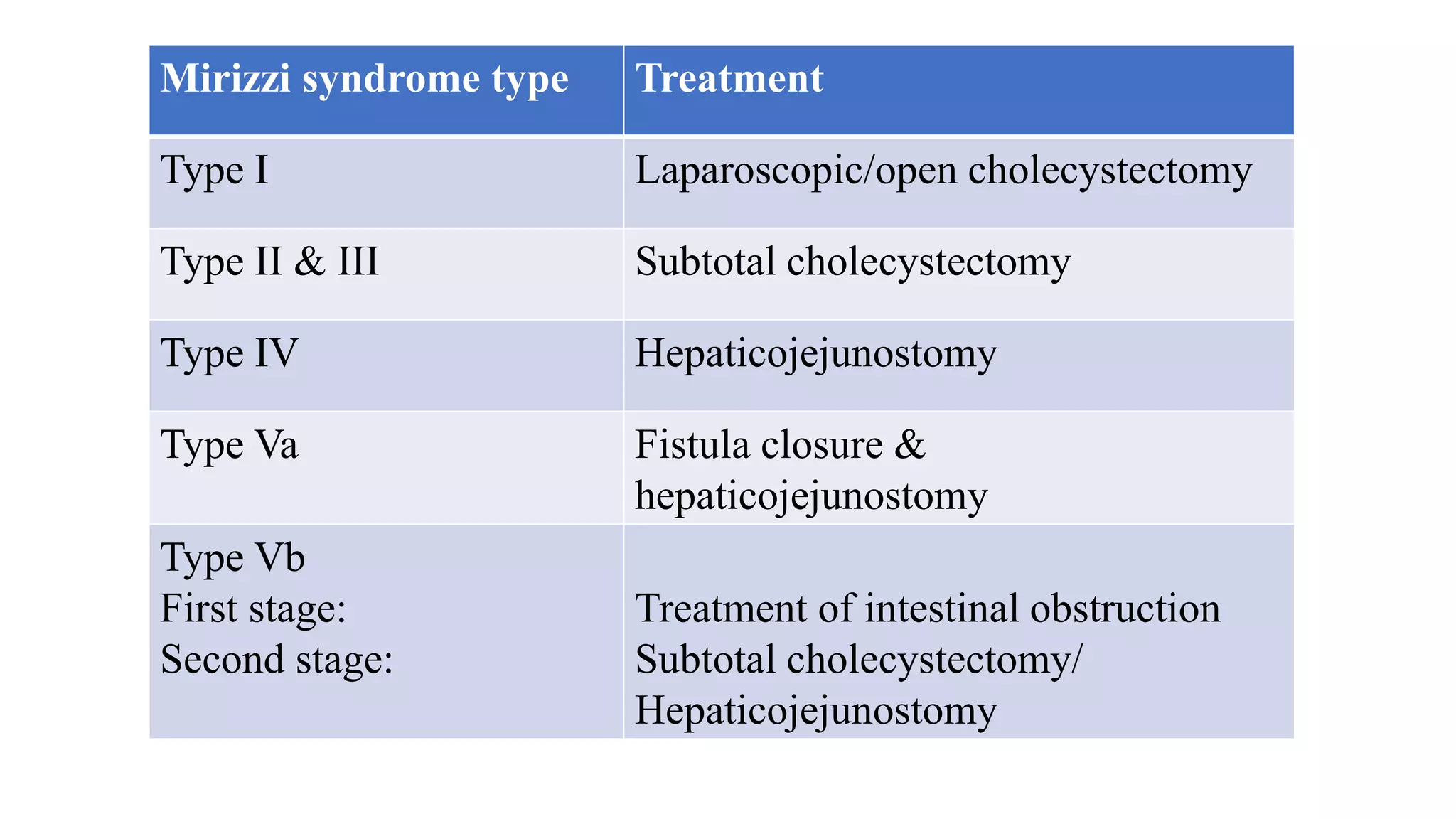
Mirizzi syndrome type Treatment
Type I Laparoscopic/open cholecystectomy
Type II & III Subtotal cholecystectomy
Type IV Hepaticojejunostomy
Type Va Fistula closure &
hepaticojejunostomy
Type Vb
First stage:
Second stage:
Treatment of intestinal obstruction
Subtotal cholecystectomy/
Hepaticojejunostomy
Mirizzi syndrome ppt

Mirizzi syndrome ppt

  • 1.
    Mirizzi syndrome Prasanna Gowda PVSMemorial Hospital Kochi, Kerala
  • 2.
    • Extrinsic biliarycompression syndrome • It occurs in 0.3% to 3% of patients undergoing cholecystectomy • Reported incidence in underdeveloped countries ranges from 4.7% to 5.7% • Treatment is associated with potentially serious surgical complications such as bile duct injury
  • 3.
    Professor Pablo LuisMirizzi (1893-1964)
  • 4.
    Kehr in 1905First description of partial biliary obstruction secondary to cystic duct stone Pablo Luis Mirizzi in 1940 Proposed muscular sphincter in the common hepatic duct Peustow in 1942 Internal biliary fistulas Behrend 1950 Cholecystobiliary fistulas
  • 6.
    Pathogenesis • Recurrent impactionof gallstones in the cystic duct or infundibulum • Repeated episodes of acute cholecystitis • Adhesion between gall bladder and CHD • External compression of the bile duct • Gallstones will cause a pressure ulcer and necrosis, eroding into the bile duct and producing a cholecystobiliary fistula • cholecystoenteric fistula
  • 7.
    Mirizzi syndrome anatomy •Gall bladder • Thick or thin atrophic walls • Impacted gallstones at the infundibulum Or • at the Hartmann's pouch • Cystic duct • Obliterated cystic duct • Occasional absence of cystic duct • A long cystic duct running parallel to • the common bile duct with low insertion
  • 8.
    • Bile duct •Partial obstruction by external compression or by a gallstone eroding into the bile duct • Normal caliber distal bile duct with walls of normal thickness • A dilated proximal bile duct with thick inflamed walls • Fistula • Cholecystocholedochal fistula • Cholecystoenteric fistula
  • 9.
    Clinical manifestation • Agegroup: 53 to 70 • Females: 70% • Pain • Obstructive jaundice • Fever (Cholangitis, Pancreatitis) • Gall stone ileus
  • 10.
    Laboratory finding • Hyperbilirubinemia •Elevated aminotransaminase levels • Alkaline phosphatase levels range from normal to about three- to ten-fold rise • Leukocytosis (acute cholecystitis, cholangitis or pancreatitis) • CA19-9: consistently found in patients with Mirizzi syndrome type Ⅱ or higher • CA19-9 must be interpreted cautiously in patients with suspected biliary malignancy
  • 11.
    Classification systems • McSherryclassification (based on ERCP, 1982) • Type I : a partial or complete external obstruction of the CHD • Type II : Cholecystoduodenal fistula
  • 12.
    Type I Type II TypeIII Type IV Type V Csendes classification
  • 14.
    Differential diagnosis • Gallbladdercancer • Cholangiocarcinoma • Sclerosing cholangitis • Metastatic disease
  • 15.
    Diagnosis • High indexof suspicion • Preoperative diagnosis of Mirizzi syndrome is difficult • If preoperative diagnosis is not made, intraoperative recognition and proper management is essential • Inadequate recognition of this condition leads to high preoperative morbidity and mortality • The incidence of bile duct injuries in patients operated on with Mirizzi syndrome without preoperative diagnosis could be as high as 17% • Imaging studies are the mainstay of pre-operative diagnosis
  • 16.
    Ultrasonography • A contractedgallbladder • Thick or extremely thin walls with gall-stones impacted in the infundibulum • The hepatic duct would be dilated in its extra and intrahepatic portions above the level of the obstruction site • The common bile duct would be within normal size under the level of obstruction • Diagnostic accuracy for ultrasonography in Mirizzi syndrome is 29% • Sensitivity varying from 8.3% to 27%
  • 17.
    Computed tomography • CTscan has a sensitivity similar to USG • May show a characteristic irregular cavity adjacent to the neck of GB containing the protruding stone • Helpful in diagnosing other causes of obstructive jaundice such as • GB cancer • cholangiocarcinoma • metastatic tumour
  • 18.
    Magnetic resonance cholangio-pancreatography(MRCP) • Typical features of Mirizzi syndrome can be shown by MRCP such as the • Extrinsic narrowing of the common hepatic duct, • Gallstone in the cystic duct, • Dilatation of the intrahepatic and common hepatic ducts, and a • Normal CBD. • Extent of the inflammatory process in Calot’s triangle • Fistula • Diagnostic accuracy for MRCP is 50%
  • 19.
    Endoscopic retrograde cholangiopancreatography(ERCP) • Cholangiography remains the most reliable method • The diagnostic accuracy is around 55% to 90% • Excavating defect on the lateral wall of the CBD at the level of the cystic duct or GB neck • The advantage of ERCP • Clearing concomitant bile duct stones • Insertion of a biliary stent or nasobiliary catheter both of which may serve a temporising role and may help in intra- operative identification of the CBD
  • 20.
    Intraoperative diagnosis • Over50% of cases are diagnosed during surgery • Shrunken gallbladder with distorted anatomy • Impacted stone at the neck or infundibulum • Obliterated Calot's triangle, • Intraoperative cholangiography could be useful but difficult to do • Intraoperative ultrasonography is a useful tool
  • 21.
    Treatment • Formidable challenge •Severe inflammation and edematous tissues • Thick dense adhesions • Distorted anatomy • cholecystobiliary fistula • Individualized depending on the stage of the disease
  • 22.
    Type I • Classiccholecystectomy • Subtotal cholecystectomy in difficult cases • Fundus first approach is appropriate • The cystic duct is identified from inside the open gallbladder and explored seeking residual gallstones. • If the cystic duct is obliterated, no attempt should be made to open it. • Cystic duct is secured without further dissection
  • 23.
    • Type II& type III • Subtotal cholecystectomy • Fundus first approach • The reflux of bile indicates the presence of a fistula between the gallbladder and the bile duct, because the cystic duct is usually occluded • Gallbladder wall flap measuring about 0.5 cm to 1 cm should be preserved to repair the bile duct fistula • In difficult cases, Roux-en-Y hepaticojejunostomy may be required • Roux-en-Y hepaticojejunostomy is the treatment for type VI Mirizzi syndrome
  • 24.
    Type V a •Division and simple suture with an absorbable material of the bilioenteric fistulae over the affected viscera • Cholecystectomy either total or subtotal • Roux-en-Y hepaticojejunostomy
  • 26.
    Type Ⅴb • Treatthe acute condition first (gallstone ileus) • Second stage: after the patient has recovered from surgery • (3 or more months later), approach the gallbladder according to the presence or absence of external compression of the bile duct or cholecystobiliary fistula
  • 27.
    Laparoscopic surgery • Controversial •Considered technically challenging • High conversion rates • Increased risk of bile duct injuries • Lateral traction on the infundibulum of GB does not open up the Calot's triangle • Selected cases of Mirizzi Type I
  • 28.
    Ways to minimizebile duct injury • Preoperative ERCP • Intra-operative choledochoscopy • Intraoperative ultrasonography facilitates intraoperative identification of bile duct • Initial section of the GB fundus • Retrieval of the impacted calculus to identify the infundibulum and cystic duct from thus facilitating a subtotal cholecystectomy
  • 29.
    CONCLUSION • Rare complicationof long standing cholelithiasis • Most common presentation is pain or jaundice • Cholecystectomy is the treatment of choice • A pre-operative identification helps in operative planning and minimize complications
  • 30.
    Mirizzi syndrome typeTreatment Type I Laparoscopic/open cholecystectomy Type II & III Subtotal cholecystectomy Type IV Hepaticojejunostomy Type Va Fistula closure & hepaticojejunostomy Type Vb First stage: Second stage: Treatment of intestinal obstruction Subtotal cholecystectomy/ Hepaticojejunostomy