CHAPTER 3
SEAWATER: ITS MAKEUP
AND MOVEMENTS
Rain
Snow
Purest
sources
of water:
1 ~ Snow
2 ~ Rain
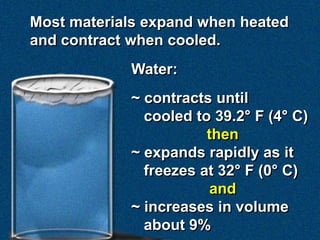
Most materials expand when heated
and contract when cooled.
Water:
~ contracts until
cooled to 39.2° F (4° C)
then
~ expands rapidly as it
freezes at 32° F (0° C)
and
~ increases in volume
about 9%
Without expansion, ice would sink.
Water would freeze from the bottom up.
Evolution would have been different.
Expanding ice floats, serves as an
insulation barrier, and holds heat in
the water below.
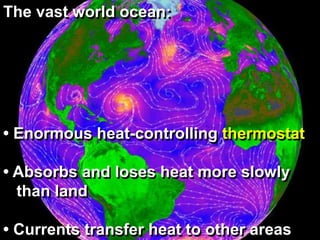
The vast world ocean:
• Enormous heat-controlling thermostat
• Absorbs and loses heat more slowly
than land
• Currents transfer heat to other areas
Gary, Indiana
~ cooler in
summer
~ warmer in
winter
Near coasts or Great Lakes, people
know that near the water it is:
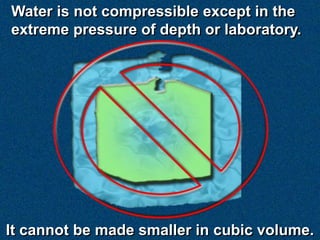
Water is not compressible except in the
extreme pressure of depth or laboratory.
It cannot be made smaller in cubic volume.
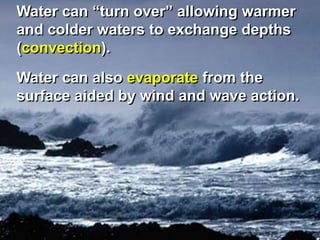
Water can “turn over” allowing warmer
and colder waters to exchange depths
(convection).
Water can also evaporate from the
surface aided by wind and wave action.
Seawater’s ability to
transmit light is
fundamentally
important to life
in the oceans.
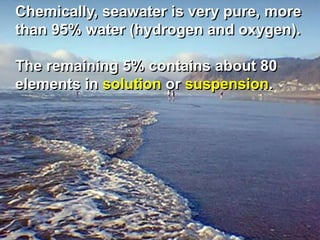
Chemically, seawater is very pure, more
than 95% water (hydrogen and oxygen).
The remaining 5% contains about 80
elements in solution or suspension.
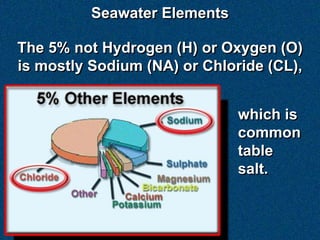
Seawater Elements
5% Other Elements
95% Hydrogen and Oxygen
O H2
Seawater Elements
which is
common
table
salt.
The 5% not Hydrogen (H) or Oxygen (O)
is mostly Sodium (NA) or Chloride (CL),
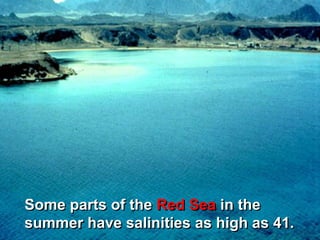
Some parts of the Red Sea in the
summer have salinities as high as 41.
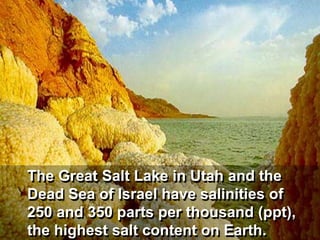
The Great Salt Lake in Utah and the
Dead Sea of Israel have salinities of
250 and 350 parts per thousand (ppt),
the highest salt content on Earth.
Every year, 80,000 cubic miles of
seawater are drawn off by evaporation
and condensation. 24,000 returns to
continents as rain, sleet, and snow.
The cycle of evaporation and
condensation that controls the
distribution of the Earth’s water
as it evaporates from bodies
of water, condenses, precipitates,
and returns to those bodies of
water
Hydrologic Cycle
(a.k.a. Water Cycle)
Plants on land
also add to the
amount of water
vapor entering
the air in a
process called
transpiration.
Today, only magnesium (Mg) and
bromine (Br) are taken commercially
from seawater.
A full one-third lighter than aluminum,
magnesium is used to manufacture
lightweight alloys for airplanes and
satellites.
Bromine is used in the oil/gas drilling
industry and, in combination with other
elements, to manufacture flame
retardants.
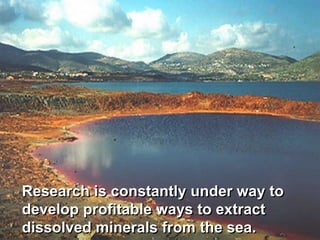
Research is constantly under way to
develop profitable ways to extract
dissolved minerals from the sea.
This is the area of oceanography and
metallurgy that will undoubtedly expand
as continental mineral resources are
used up.
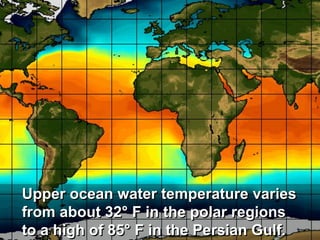
Upper ocean water temperature varies
from about 32° F in the polar regions
to a high of 85° F in the Persian Gulf.
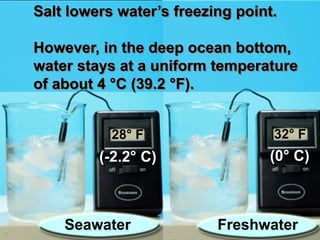
(0° C)(-2.2° C)
Salt lowers water’s freezing point.
However, in the deep ocean bottom,
water stays at a uniform temperature
of about 4 °C (39.2 °F).
28° F 32° F
FreshwaterSeawater
bathy + thermo + graph
depth temperature record
Bathythermographs, commonly called
BTs, are instruments used to check
water temperatures at various depths.
An instrument that makes a record
of the temperature at various depths
in the ocean
Bathythermograph
Navy XBT
Most Navy combatants have
expendable BTs (XBTs) to
take readings.
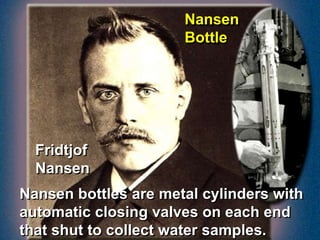
Fridtjof
Nansen
Nansen
Bottle
Nansen bottles are metal cylinders with
automatic closing valves on each end
that shut to collect water samples.
A waterproof container for taking
samples of ocean water, several
usually being lowered open on a
line and each being closed at the
desired depth by the action of a
falling weight
Nansen bottle
When valves close,
a mercury column
outside the bottle
captures the
temperature.
After surfacing
the samples,
operators can
test for salinity,
chemical content,
and minute
marine life.
Nansen
Bottle
In shallow places, ocean water appears
light green, while in deeper water it
seems to be blue, gray, or dark green.
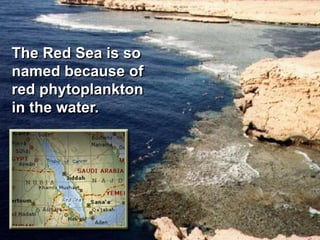
The Red Sea is so
named because of
red phytoplankton
in the water.
The Yellow Sea is so named because
of the yellow silt carried into it by
rivers in northern China.
ULTRAVIOLET
Sunlight consists of a range (spectrum)
of different wavelengths of energy.
Radiation with wavelengths
longer than visible light but
shorter than radio waves
Infrared
Radiation with wavelengths
shorter than visible light but
longer than X rays
Ultraviolet
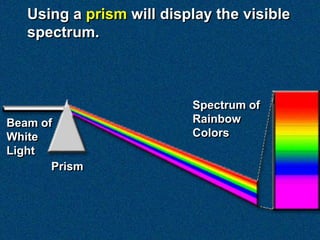
Spectrum of
Rainbow
Colors
Beam of
White
Light
Prism
Using a prism will display the visible
spectrum.
The atmosphere filter keeps out most
of the dangerous ultraviolet rays.
Water vapor and carbon dioxide absorb
much of the infrared rays and blanket
the Earth with life sustaining warmth.
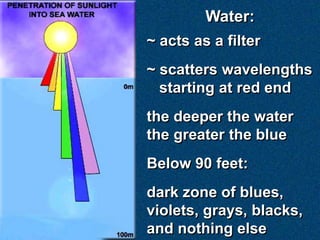
Water:
~ acts as a filter
~ scatters wavelengths
starting at red end
the deeper the water
the greater the blue
Below 90 feet:
dark zone of blues,
violets, grays, blacks,
and nothing else
Zone Comments
Lighted
Twilight
Dark
3 to 330
260 to 655
Below 655
Life in the sea is
bountiful
No effective plant
production
No plants grow
and animal life
consists of
carnivores and
detritus feeders
Depth (in feet)
Ocean Light Environments
Waves are caused by any energy
source that disturbs the water
surface.
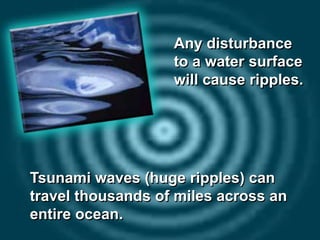
Any disturbance
to a water surface
will cause ripples.
Tsunami waves (huge ripples) can
travel thousands of miles across an
entire ocean.
Wind is the most common cause of
ordinary waves. Sailors often call
wind-driven waves “sea” or the state
of the sea.
Swells:
may indicate an approaching storm
are quite common before hurricanes
A long wave on water that
moves continuously without
breaking
Swells
• Wind speed
+ Duration of wind
+ Length of fetch
= determines wave height
The distance over which a wind
blows
The distance traveled by waves
with no obstruction
Fetch
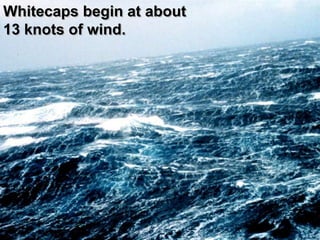
Whitecaps begin at about
13 knots of wind.
12 to 15 foot waves
~ common during a strong storm
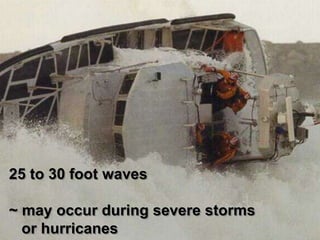
25 to 30 foot waves
~ may occur during severe storms
or hurricanes
Wave Terminology
Wave height
(H)
Period
past a given point
Wave Type
Wind
Swell
Tsunami
Period
2 to 5 seconds
12 to 15 seconds
10 minutes to 1 hour
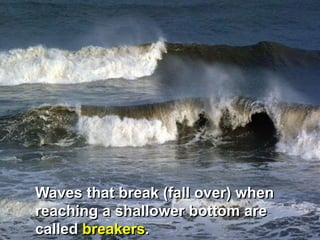
Waves that break (fall over) when
reaching a shallower bottom are
called breakers.
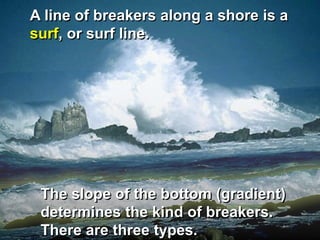
A line of breakers along a shore is a
surf, or surf line.
The slope of the bottom (gradient)
determines the kind of breakers.
There are three types.
A spilling breaker develops where there
is a mild, gradual, almost flat bottom
shape. It can be seen advancing as a
line of foam.
A plunging breaker occurs where
there is a steep bottom slope. Such
a gradient creates huge surfs, like in
Hawaii, that are the joy of surfers.
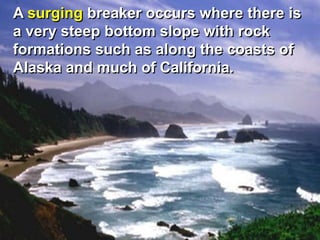
A surging breaker occurs where there is
a very steep bottom slope with rock
formations such as along the coasts of
Alaska and much of California.
Knowledge of each is crucial to naval
and marine amphibious operations.
Sea Waves - Swell - Surf Conditions
On an average beach, a 4-foot surf is
considered the “critical” height for
safe amphibious landings.
Above that height, boats may broach,
To veer or cause to veer broadside
to the wind and waves
.
Erosion
Local action of waves, tides, and
currents shape coastal landforms.
Erosion
Rocky Outcropping
People who have had the misfortune of having
a beach cottage undermined or washed away
during gales and hurricanes know what this
means.
Cape Cod,
Massachusetts
Waves and currents
produced by waves
cause most shoreline
change.
The U.S. coastline is
eroding about 1 foot
a year.
However, in other places like the
Mississippi River Delta, waves and
currents build shoreline with
sediment accumulation.
New Orleans,
Louisiana
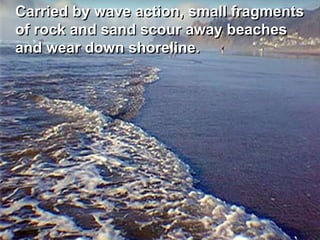
Carried by wave action, small fragments
of rock and sand scour away beaches
and wear down shoreline.
When one part of the wave line develops
drag and changes direction or bends in
shallower water this is refraction,
critical in amphibious assault landings.
Waves align with bottom contours and
conform to general slope of coastline.
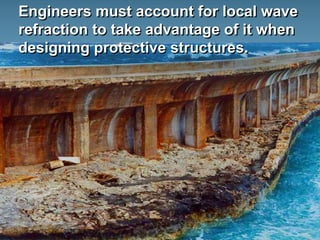
Engineers must account for local wave
refraction to take advantage of it when
designing protective structures.
Most common harbor protection is a
breakwater (line of big rocks) sometimes
with steel-reinforced concrete.
The protective structure of stone or
concrete; extends from shore into
the water to prevent a beach from
washing away
A barrier that protects a harbor or
shore from the full impact of waves
Breakwater
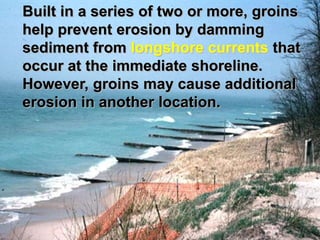
Another common structure is a groin,
walls of stone or wooden pilings built
at right angles to a shoreline.
Cape May, New Jersey
Built in a series of two or more, groins
help prevent erosion by damming
sediment from longshore currents that
occur at the immediate shoreline.
However, groins may cause additional
erosion in another location.
Sandbars become navigational hazards.
Rip currents are strong, seaward
moving currents. They occur when
opposing longshore currents meet.
A strong, narrow surface current
that flows rapidly away from the
shore, returning the water carried
landward by waves
Also called rip tide, tiderip
Rip Current
Rip current and undertow are not the
same forces.
Undertow is the natural seaward and
downward thrust of a wave as it breaks.
Rip currents occur at the junction of
opposing longshore currents.
Some rip currents move at speeds up
to 2 miles an hour.
Rip currents:
~ rarely over 100 feet wide
~ swim parallel to the shore
~ don’t panic
Ocean currents have profound effects
on people, weather, and food cycles.
Studying ocean currents can be complex.
Earth’s atmosphere (winds) and
oceans (currents) are linked.
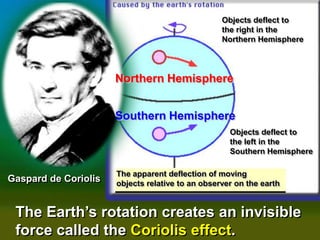
Gaspard de Coriolis
The Earth’s rotation creates an invisible
force called the Coriolis effect.
Southern Hemisphere
Northern Hemisphere
Objects deflect to
the left in the
Southern Hemisphere
The apparent deflection of moving
objects relative to an observer on the earth
Objects deflect to
the right in the
Northern Hemisphere
The apparent deflection of particles
in motion with respect to the Earth
Caused by the rotation of the Earth
Appears as a clockwise deflection
the Northern Hemisphere, counter-
clockwise in the Southern
Hemisphere
Coriolis Effect
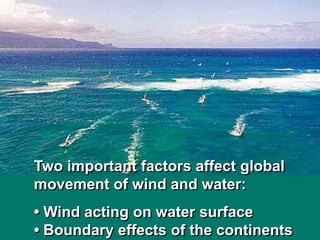
Two important factors affect global
movement of wind and water:
• Wind acting on water surface
• Boundary effects of the continents
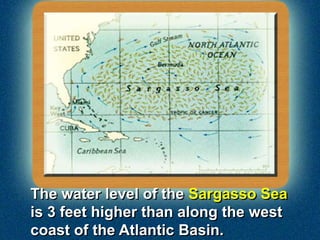
The water level of the Sargasso Sea
is 3 feet higher than along the west
coast of the Atlantic Basin.
Ocean current movement is a result of
convection and surface wind systems.
Of the two, surface wind has a greater
role in effecting global water movement.
Surface winds and landmass locations
produce prevailing wind systems.
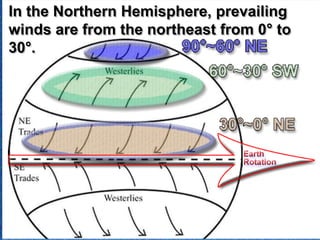
In the Northern Hemisphere, prevailing
winds are from the northeast from 0° to
30°.
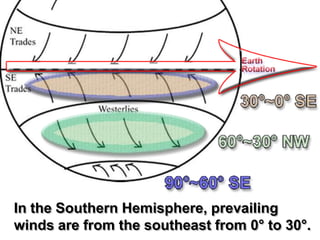
In the Southern Hemisphere, prevailing
winds are from the southeast from 0° to 30°.
Keep in mind:
Winds ~ described by coming from.
Currents ~ described by flowing to.
Thus:
A colonial sailor using Ben Franklin’s
map to catch the Gulf Stream flowing NE,
with prevailing winds (SW at 40° N Lat),
could have following winds and a speedy
trip.
A NE current and a SW wind are headed
in the same direction.
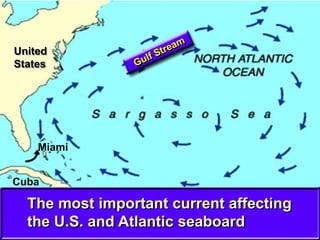
United
States
Cuba
Miami
The most important current affecting
the U.S. and Atlantic seaboard
Warm ocean current of northern
Atlantic Ocean off North America
Originates in Caribbean, passes
through Straits of Florida, flows
northward along southeast United
States veers northeastward at
Cape Hatteras into Atlantic Ocean
and splits to form North Atlantic
Drift and Canary Current
Gulf Stream
An oval 2,000 miles E-W by 1,000 miles
N-S, Sargasso Sea forms an oceanic
desert with specially adapted plant life.
Icebergs calving from Western
Greenland Glaciers travel south
on the Labrador Current into the
North Atlantic shipping lanes.
The north traveling Gulf Stream
eventually melts them.
The currents of the Gulf Stream and
North Atlantic Drift warm the regional
climate more than any other area at
similar latitude.
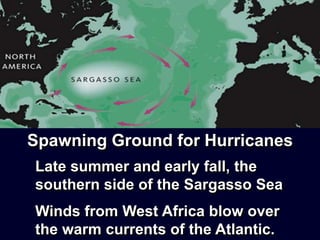
Late summer and early fall, the
southern side of the Sargasso Sea
Winds from West Africa blow over
the warm currents of the Atlantic.
Spawning Ground for Hurricanes
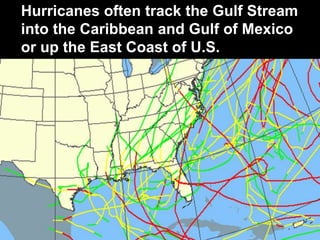
Hurricanes often track the Gulf Stream
into the Caribbean and Gulf of Mexico
or up the East Coast of U.S.
China
Philippines
Japan
Indian
Ocean South Pacific
Ocean
North Pacific
Ocean
Kuroshio
Current
Typhoons are the Pacific equivalent
of Atlantic hurricanes, with the
Western Pacific averaging 20 per
year.
China
Japan
Philippines
Korea
Similar to Atlantic hurricanes, Pacific
typhoons follow the warm current
running near land.
The warm Kuroshio current meets the
cold, south bound Oyashio current and
turns East across North Pacific.
Hitting the continent, it becomes the
Alaska current traveling North and the
California current moving South.
Winds set major currents in motion with
friction, but a counterforce of gravity and
Coriolis effect (higher latitudes) often
create opposite motion in deeper water.
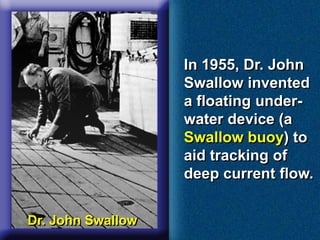
In 1955, Dr. John
Swallow invented
a floating under-
water device (a
Swallow buoy) to
aid tracking of
deep current flow.
Dr. John Swallow
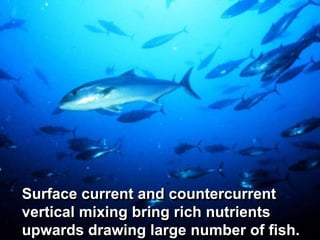
Surface current and countercurrent
vertical mixing bring rich nutrients
upwards drawing large number of fish.
Distinct layers influence underwater
sound transmission, important in
undersea warfare.
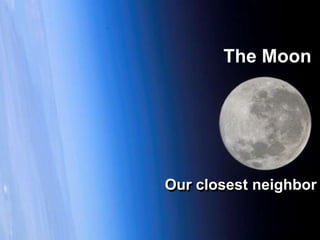
The Moon
Our closest neighbor
A weaker but much closer influence, the
Moon’s gravitational pull is the main force
acting on the world’s oceans cycling the
rise and fall of ocean tides.
The periodic variation in the surface
level of the oceans and of bays,
gulfs, inlets, and estuaries, caused
by gravitational attraction of the
Moon and Sun, and occurring about
every 12 hours
Tide
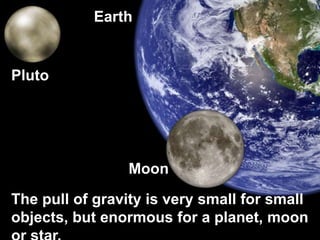
Moon
Pluto
Earth
The pull of gravity is very small for small
objects, but enormous for a planet, moon
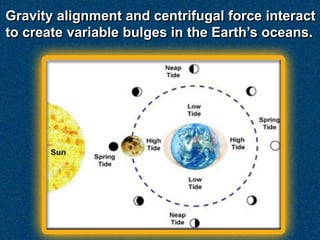
Gravity alignment and centrifugal force interact
to create variable bulges in the Earth’s oceans.
The Sun causes
tides also, but
with only about
two-fifths of the
Moon’s effect.
As the Earth rotates, the new and full moons
produce the high and low ranges of tides
because the Moon and Sun are working
together. These tides are called spring tides.
Exceptionally high and low tides
that occur at the time of the new
moon or the full moon when the
Sun, Moon, and Earth are
approximately aligned
Spring Tide
As the Moon orbits the Earth, halfway between
the spring tides (Moon aligns with Sun) are the
neap tides when the gravitational pulls are not
working together. These are tides of minimal
differences.
Tide that occurs when the difference
between high and low tide is least;
the lowest level of high tide
Neap tides comes twice a month in
the first and third quarters of the
Moon.
Neap Tide
The ebb of a tide is the fall of the
tide, that is, the moving of the tide
away from the shore.
Receding or outgoing tide
The period between high water
and the succeeding low water
Ebb Tide
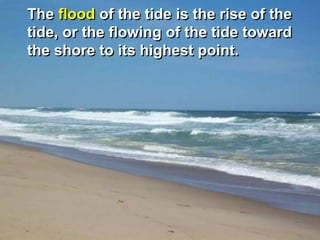
The flood of the tide is the rise of the
tide, or the flowing of the tide toward
the shore to its highest point.
Incoming or rising tide
The period between low water
and the succeeding high water
Flood Tide
High tides occur twice a day (every 12
hours 25 minutes) in most parts of the
world - a high tide nearest the Moon
and a lower high tide on the opposite
side of the Earth.
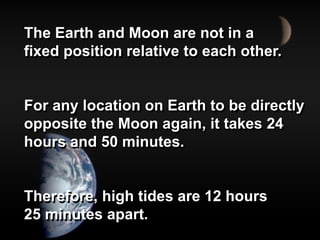
The Earth and Moon are not in a
fixed position relative to each other.
For any location on Earth to be directly
opposite the Moon again, it takes 24
hours and 50 minutes.
Therefore, high tides are 12 hours
25 minutes apart.
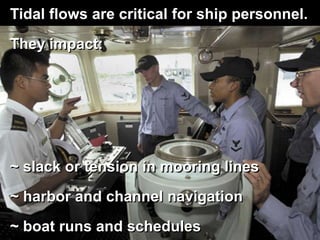
Tidal flows are critical for ship personnel.
They impact:
~ slack or tension in mooring lines
~ harbor and channel navigation
~ boat runs and schedules
Tides in mid-ocean are measurable
only with scientific instruments.
Boston
(12 feet ±)
Bay of
Fundy
(50 feet +)
Norfolk
(<6 feet)
Tidal ranges vary
from location to
location. In some
cases, especially
in high northern
latitudes, ranges
are extreme.
High Tide
Low Tide
Spring tide at the
Bay of Fundy often
exceeds 50 feet.
Island of
Mont-St.-Michel,
France
Mont-St.-Michel is surrounded by 10 miles
of sand at low tide, but when the 41-foot
tide rises, the water moves shoreward at
210 feet per minute.
The Inchon, Korea harbor encloses
its piers with graving basins or docks
that hold in the 40-foot tidal waters.
A tidal phenomenon in which the
leading edge of the incoming tide
forms a wave (or waves) of water
that travel up a river against the
direction of the current
As such, it is a true tidal wave (not
to be confused with a tsunami).
Tidal Bore
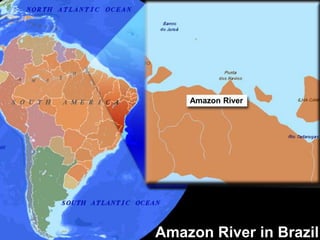
Amazon River in Brazil
Amazon River
Hangchow (Tsientang) River
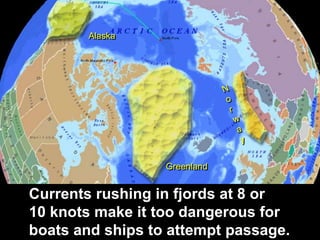
Fjords in Greenland, Norway, Alaska,
and Chile are examples.
Dangerous tidal currents occur in
other world locations with big inlets
and narrow entrances.
A long, narrow, deep inlet of the sea
between steep slopes
Fjord
Currents rushing in fjords at 8 or
10 knots make it too dangerous for
boats and ships to attempt passage.
Alaska
Greenland
Tidal currents
through Great
Barrier Reef
channels
reach up to
10 knots.
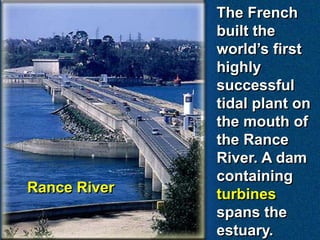
The French
built the
world’s first
highly
successful
tidal plant on
the mouth of
the Rance
River. A dam
containing
turbines
spans the
estuary.
Rance River
Rance River
Deben
As the tides rise, they spin the turbines
that drive banks of generators. When
the dam in the basin is full, water is
released through sluice gates.
For centuries, the Dutch have reclaimed
land from the sea with dikes and pumps.
The largest project was enclosing
the Zuyder Zee.
• Generates electricity by tidal flow
• Creates freshwater lakes
• Protects shoreline from North Sea
• Reclaims land from the sea
• Creates a coastal highway and
connects isolated islands
• Completed in
1978 across the
Rhine, Meuse,
and Scheldt
Rivers
Delta
Estuary Plan
Rotterdam
Netherlands
Rhine River
Germany
A.1. FALSE.
Q.1. TRUE or FALSE. Pure water is
composed of two (2) atoms of
oxygen and one (1) atom of
hydrogen.
A.2. FALSE.
Q.2. TRUE or FALSE. Plants and
animals can live indefinitely
without water.
A.3. Solid, Liquid, and gas
Q.3. Name the three forms in which
water can exist.
A.4. TRUE.
Q.4. TRUE or FALSE. Water will only
exist in the liquid state in a
temperature range from 32 °F to
212 °F at standard sea level
pressure.
A.5. Sodium, hydrogen, oxygen, and
chlorine
Q.5. What are the major components
of seawater?
A.6. TRUE.
Q.6. TRUE or FALSE. Sound travels
faster in water than in air.
A.7. Salinity
Q.7. What is the term used to
describe the dissolved salts in
seawater?
A.8. FALSE.
Q.8. TRUE or FALSE. The
bathythermograph was
designed to measure the salinity
of the water more accurately.
A.9. Nansen bottle
Q.9. What is the name of the
instrument that captures salt
water at depth?
A.10. The Dead Sea between Israel
and Jordan
Q.10. What body of water has the
highest salt content of any on
Earth?
A.11. The passage of water through
a plant from the roots through
the vascular system to the
atmosphere
Q.11. What is transpiration?
A.12. Wind speed, duration of the
wind, and length of the fetch
Q.12. What three (3) principal factors
does wave height depend?
A.13. The slope or gradient of the
bottom
Q.13. As a wave moves ashore, what
determines the kind of breaker
it will become?
A.14. Walls of stone or wood pilings
built at right angles to a
shoreline to prevent erosion
by longshore currents
Q.14. What is a groin, and what is it
used for?
A.15. A swimmer should swim
parallel to the shore (across
the current) since a rip current
is rarely more than 100 feet
wide.
Q.15. If caught in a rip current, what
should a swimmer do?
A.16. The Coriolis Effect is the
apparent deflection of a body
in motion with respect to the
Earth caused by the rotation of
the Earth. In the Northern
Hemisphere, this is to the right
(clockwise direction).
Q.16. What is the Coriolis Effect?
A.17. Gyres
Q.17. What do we call the circular
system of currents that rotate
clockwise in the Northern
Hemisphere and
counterclockwise in the
Southern Hemisphere?
A.18. The Gulf Stream
Q.18. What is the most important
current affecting the U.S. East
Coast?
A.19. The existence of
countercurrents. He found that
a strong undercurrent ran
counter to the South
Equatorial Current in the
Pacific existed in the deep
ocean.
Q.19. What did Townsend Cromwell
discover in 1952?
A.20. The Moon
Q.20. What is the main cause of the
rise and fell (ebb and flow) of
the ocean tides?
A.21. Spring tides
Q.21. What do we call tides when
they are at their highest and
lowest?
A.22. Spring tides occur at new and
full moons when the Sun,
Earth, and Moon are aligned
and the gravitational pull of the
Sun and Moon are working
together.
Q.22. What phase(s) is the Moon in
during the spring tides?
A.23. Neap tides
Q.23. What do we call tides whose
range is less than average?
A.24. 12 hours and 25 minutes
Q.24. Approximately how long is it
between high tides (or low
tides)?
A.25. A tidal bore
Q.25. What do we call an abrupt rise
of tidal water that moves
rapidly inland from the mouth
of a river estuary?

Seawater

  • 1.
    CHAPTER 3 SEAWATER: ITSMAKEUP AND MOVEMENTS
  • 2.
  • 3.
    Most materials expandwhen heated and contract when cooled. Water: ~ contracts until cooled to 39.2° F (4° C) then ~ expands rapidly as it freezes at 32° F (0° C) and ~ increases in volume about 9%
  • 4.
    Without expansion, icewould sink. Water would freeze from the bottom up. Evolution would have been different. Expanding ice floats, serves as an insulation barrier, and holds heat in the water below.
  • 5.
    The vast worldocean: • Enormous heat-controlling thermostat • Absorbs and loses heat more slowly than land • Currents transfer heat to other areas
  • 6.
    Gary, Indiana ~ coolerin summer ~ warmer in winter Near coasts or Great Lakes, people know that near the water it is:
  • 7.
    Water is notcompressible except in the extreme pressure of depth or laboratory. It cannot be made smaller in cubic volume.
  • 8.
    Water can “turnover” allowing warmer and colder waters to exchange depths (convection). Water can also evaporate from the surface aided by wind and wave action.
  • 9.
    Seawater’s ability to transmitlight is fundamentally important to life in the oceans.
  • 10.
    Chemically, seawater isvery pure, more than 95% water (hydrogen and oxygen). The remaining 5% contains about 80 elements in solution or suspension.
  • 11.
    Seawater Elements 5% OtherElements 95% Hydrogen and Oxygen O H2
  • 12.
    Seawater Elements which is common table salt. The5% not Hydrogen (H) or Oxygen (O) is mostly Sodium (NA) or Chloride (CL),
  • 13.
    Some parts ofthe Red Sea in the summer have salinities as high as 41.
  • 14.
    The Great SaltLake in Utah and the Dead Sea of Israel have salinities of 250 and 350 parts per thousand (ppt), the highest salt content on Earth.
  • 15.
    Every year, 80,000cubic miles of seawater are drawn off by evaporation and condensation. 24,000 returns to continents as rain, sleet, and snow.
  • 16.
    The cycle ofevaporation and condensation that controls the distribution of the Earth’s water as it evaporates from bodies of water, condenses, precipitates, and returns to those bodies of water Hydrologic Cycle (a.k.a. Water Cycle)
  • 17.
    Plants on land alsoadd to the amount of water vapor entering the air in a process called transpiration.
  • 18.
    Today, only magnesium(Mg) and bromine (Br) are taken commercially from seawater. A full one-third lighter than aluminum, magnesium is used to manufacture lightweight alloys for airplanes and satellites. Bromine is used in the oil/gas drilling industry and, in combination with other elements, to manufacture flame retardants.
  • 19.
    Research is constantlyunder way to develop profitable ways to extract dissolved minerals from the sea.
  • 20.
    This is thearea of oceanography and metallurgy that will undoubtedly expand as continental mineral resources are used up.
  • 21.
    Upper ocean watertemperature varies from about 32° F in the polar regions to a high of 85° F in the Persian Gulf.
  • 22.
    (0° C)(-2.2° C) Saltlowers water’s freezing point. However, in the deep ocean bottom, water stays at a uniform temperature of about 4 °C (39.2 °F). 28° F 32° F FreshwaterSeawater
  • 23.
    bathy + thermo+ graph depth temperature record Bathythermographs, commonly called BTs, are instruments used to check water temperatures at various depths.
  • 24.
    An instrument thatmakes a record of the temperature at various depths in the ocean Bathythermograph
  • 25.
    Navy XBT Most Navycombatants have expendable BTs (XBTs) to take readings.
  • 26.
    Fridtjof Nansen Nansen Bottle Nansen bottles aremetal cylinders with automatic closing valves on each end that shut to collect water samples.
  • 27.
    A waterproof containerfor taking samples of ocean water, several usually being lowered open on a line and each being closed at the desired depth by the action of a falling weight Nansen bottle
  • 28.
    When valves close, amercury column outside the bottle captures the temperature. After surfacing the samples, operators can test for salinity, chemical content, and minute marine life. Nansen Bottle
  • 29.
    In shallow places,ocean water appears light green, while in deeper water it seems to be blue, gray, or dark green.
  • 30.
    The Red Seais so named because of red phytoplankton in the water.
  • 31.
    The Yellow Seais so named because of the yellow silt carried into it by rivers in northern China.
  • 32.
    ULTRAVIOLET Sunlight consists ofa range (spectrum) of different wavelengths of energy.
  • 33.
    Radiation with wavelengths longerthan visible light but shorter than radio waves Infrared
  • 34.
    Radiation with wavelengths shorterthan visible light but longer than X rays Ultraviolet
  • 35.
    Spectrum of Rainbow Colors Beam of White Light Prism Usinga prism will display the visible spectrum.
  • 36.
    The atmosphere filterkeeps out most of the dangerous ultraviolet rays. Water vapor and carbon dioxide absorb much of the infrared rays and blanket the Earth with life sustaining warmth.
  • 37.
    Water: ~ acts asa filter ~ scatters wavelengths starting at red end the deeper the water the greater the blue Below 90 feet: dark zone of blues, violets, grays, blacks, and nothing else
  • 38.
    Zone Comments Lighted Twilight Dark 3 to330 260 to 655 Below 655 Life in the sea is bountiful No effective plant production No plants grow and animal life consists of carnivores and detritus feeders Depth (in feet) Ocean Light Environments
  • 39.
    Waves are causedby any energy source that disturbs the water surface.
  • 40.
    Any disturbance to awater surface will cause ripples. Tsunami waves (huge ripples) can travel thousands of miles across an entire ocean.
  • 41.
    Wind is themost common cause of ordinary waves. Sailors often call wind-driven waves “sea” or the state of the sea.
  • 42.
    Swells: may indicate anapproaching storm are quite common before hurricanes
  • 43.
    A long waveon water that moves continuously without breaking Swells
  • 44.
    • Wind speed +Duration of wind + Length of fetch = determines wave height
  • 45.
    The distance overwhich a wind blows The distance traveled by waves with no obstruction Fetch
  • 46.
    Whitecaps begin atabout 13 knots of wind.
  • 47.
    12 to 15foot waves ~ common during a strong storm
  • 48.
    25 to 30foot waves ~ may occur during severe storms or hurricanes
  • 49.
  • 50.
    Period past a givenpoint Wave Type Wind Swell Tsunami Period 2 to 5 seconds 12 to 15 seconds 10 minutes to 1 hour
  • 51.
    Waves that break(fall over) when reaching a shallower bottom are called breakers.
  • 52.
    A line ofbreakers along a shore is a surf, or surf line. The slope of the bottom (gradient) determines the kind of breakers. There are three types.
  • 53.
    A spilling breakerdevelops where there is a mild, gradual, almost flat bottom shape. It can be seen advancing as a line of foam.
  • 54.
    A plunging breakeroccurs where there is a steep bottom slope. Such a gradient creates huge surfs, like in Hawaii, that are the joy of surfers.
  • 55.
    A surging breakeroccurs where there is a very steep bottom slope with rock formations such as along the coasts of Alaska and much of California.
  • 56.
    Knowledge of eachis crucial to naval and marine amphibious operations. Sea Waves - Swell - Surf Conditions
  • 57.
    On an averagebeach, a 4-foot surf is considered the “critical” height for safe amphibious landings. Above that height, boats may broach, To veer or cause to veer broadside to the wind and waves .
  • 58.
    Erosion Local action ofwaves, tides, and currents shape coastal landforms.
  • 59.
  • 60.
    People who havehad the misfortune of having a beach cottage undermined or washed away during gales and hurricanes know what this means.
  • 61.
    Cape Cod, Massachusetts Waves andcurrents produced by waves cause most shoreline change. The U.S. coastline is eroding about 1 foot a year.
  • 62.
    However, in otherplaces like the Mississippi River Delta, waves and currents build shoreline with sediment accumulation. New Orleans, Louisiana
  • 63.
    Carried by waveaction, small fragments of rock and sand scour away beaches and wear down shoreline.
  • 64.
    When one partof the wave line develops drag and changes direction or bends in shallower water this is refraction, critical in amphibious assault landings. Waves align with bottom contours and conform to general slope of coastline.
  • 65.
    Engineers must accountfor local wave refraction to take advantage of it when designing protective structures.
  • 66.
    Most common harborprotection is a breakwater (line of big rocks) sometimes with steel-reinforced concrete.
  • 67.
    The protective structureof stone or concrete; extends from shore into the water to prevent a beach from washing away A barrier that protects a harbor or shore from the full impact of waves Breakwater
  • 68.
    Another common structureis a groin, walls of stone or wooden pilings built at right angles to a shoreline. Cape May, New Jersey
  • 69.
    Built in aseries of two or more, groins help prevent erosion by damming sediment from longshore currents that occur at the immediate shoreline. However, groins may cause additional erosion in another location.
  • 70.
  • 71.
    Rip currents arestrong, seaward moving currents. They occur when opposing longshore currents meet.
  • 72.
    A strong, narrowsurface current that flows rapidly away from the shore, returning the water carried landward by waves Also called rip tide, tiderip Rip Current
  • 73.
    Rip current andundertow are not the same forces. Undertow is the natural seaward and downward thrust of a wave as it breaks. Rip currents occur at the junction of opposing longshore currents. Some rip currents move at speeds up to 2 miles an hour.
  • 74.
    Rip currents: ~ rarelyover 100 feet wide ~ swim parallel to the shore ~ don’t panic
  • 75.
    Ocean currents haveprofound effects on people, weather, and food cycles. Studying ocean currents can be complex.
  • 76.
    Earth’s atmosphere (winds)and oceans (currents) are linked.
  • 77.
    Gaspard de Coriolis TheEarth’s rotation creates an invisible force called the Coriolis effect. Southern Hemisphere Northern Hemisphere Objects deflect to the left in the Southern Hemisphere The apparent deflection of moving objects relative to an observer on the earth Objects deflect to the right in the Northern Hemisphere
  • 78.
    The apparent deflectionof particles in motion with respect to the Earth Caused by the rotation of the Earth Appears as a clockwise deflection the Northern Hemisphere, counter- clockwise in the Southern Hemisphere Coriolis Effect
  • 79.
    Two important factorsaffect global movement of wind and water: • Wind acting on water surface • Boundary effects of the continents
  • 80.
    The water levelof the Sargasso Sea is 3 feet higher than along the west coast of the Atlantic Basin.
  • 81.
    Ocean current movementis a result of convection and surface wind systems. Of the two, surface wind has a greater role in effecting global water movement. Surface winds and landmass locations produce prevailing wind systems.
  • 82.
    In the NorthernHemisphere, prevailing winds are from the northeast from 0° to 30°.
  • 83.
    In the SouthernHemisphere, prevailing winds are from the southeast from 0° to 30°.
  • 84.
    Keep in mind: Winds~ described by coming from. Currents ~ described by flowing to. Thus: A colonial sailor using Ben Franklin’s map to catch the Gulf Stream flowing NE, with prevailing winds (SW at 40° N Lat), could have following winds and a speedy trip. A NE current and a SW wind are headed in the same direction.
  • 85.
    United States Cuba Miami The most importantcurrent affecting the U.S. and Atlantic seaboard
  • 86.
    Warm ocean currentof northern Atlantic Ocean off North America Originates in Caribbean, passes through Straits of Florida, flows northward along southeast United States veers northeastward at Cape Hatteras into Atlantic Ocean and splits to form North Atlantic Drift and Canary Current Gulf Stream
  • 87.
    An oval 2,000miles E-W by 1,000 miles N-S, Sargasso Sea forms an oceanic desert with specially adapted plant life.
  • 89.
    Icebergs calving fromWestern Greenland Glaciers travel south on the Labrador Current into the North Atlantic shipping lanes. The north traveling Gulf Stream eventually melts them.
  • 90.
    The currents ofthe Gulf Stream and North Atlantic Drift warm the regional climate more than any other area at similar latitude.
  • 91.
    Late summer andearly fall, the southern side of the Sargasso Sea Winds from West Africa blow over the warm currents of the Atlantic. Spawning Ground for Hurricanes
  • 92.
    Hurricanes often trackthe Gulf Stream into the Caribbean and Gulf of Mexico or up the East Coast of U.S.
  • 93.
  • 94.
    Typhoons are thePacific equivalent of Atlantic hurricanes, with the Western Pacific averaging 20 per year.
  • 95.
    China Japan Philippines Korea Similar to Atlantichurricanes, Pacific typhoons follow the warm current running near land.
  • 96.
    The warm Kuroshiocurrent meets the cold, south bound Oyashio current and turns East across North Pacific. Hitting the continent, it becomes the Alaska current traveling North and the California current moving South.
  • 97.
    Winds set majorcurrents in motion with friction, but a counterforce of gravity and Coriolis effect (higher latitudes) often create opposite motion in deeper water.
  • 98.
    In 1955, Dr.John Swallow invented a floating under- water device (a Swallow buoy) to aid tracking of deep current flow. Dr. John Swallow
  • 99.
    Surface current andcountercurrent vertical mixing bring rich nutrients upwards drawing large number of fish.
  • 100.
    Distinct layers influenceunderwater sound transmission, important in undersea warfare.
  • 101.
  • 102.
    A weaker butmuch closer influence, the Moon’s gravitational pull is the main force acting on the world’s oceans cycling the rise and fall of ocean tides.
  • 103.
    The periodic variationin the surface level of the oceans and of bays, gulfs, inlets, and estuaries, caused by gravitational attraction of the Moon and Sun, and occurring about every 12 hours Tide
  • 104.
    Moon Pluto Earth The pull ofgravity is very small for small objects, but enormous for a planet, moon
  • 105.
    Gravity alignment andcentrifugal force interact to create variable bulges in the Earth’s oceans.
  • 106.
    The Sun causes tidesalso, but with only about two-fifths of the Moon’s effect.
  • 107.
    As the Earthrotates, the new and full moons produce the high and low ranges of tides because the Moon and Sun are working together. These tides are called spring tides.
  • 108.
    Exceptionally high andlow tides that occur at the time of the new moon or the full moon when the Sun, Moon, and Earth are approximately aligned Spring Tide
  • 109.
    As the Moonorbits the Earth, halfway between the spring tides (Moon aligns with Sun) are the neap tides when the gravitational pulls are not working together. These are tides of minimal differences.
  • 110.
    Tide that occurswhen the difference between high and low tide is least; the lowest level of high tide Neap tides comes twice a month in the first and third quarters of the Moon. Neap Tide
  • 111.
    The ebb ofa tide is the fall of the tide, that is, the moving of the tide away from the shore.
  • 112.
    Receding or outgoingtide The period between high water and the succeeding low water Ebb Tide
  • 113.
    The flood ofthe tide is the rise of the tide, or the flowing of the tide toward the shore to its highest point.
  • 114.
    Incoming or risingtide The period between low water and the succeeding high water Flood Tide
  • 115.
    High tides occurtwice a day (every 12 hours 25 minutes) in most parts of the world - a high tide nearest the Moon and a lower high tide on the opposite side of the Earth.
  • 116.
    The Earth andMoon are not in a fixed position relative to each other. For any location on Earth to be directly opposite the Moon again, it takes 24 hours and 50 minutes. Therefore, high tides are 12 hours 25 minutes apart.
  • 117.
    Tidal flows arecritical for ship personnel. They impact: ~ slack or tension in mooring lines ~ harbor and channel navigation ~ boat runs and schedules
  • 118.
    Tides in mid-oceanare measurable only with scientific instruments.
  • 119.
    Boston (12 feet ±) Bayof Fundy (50 feet +) Norfolk (<6 feet) Tidal ranges vary from location to location. In some cases, especially in high northern latitudes, ranges are extreme.
  • 120.
    High Tide Low Tide Springtide at the Bay of Fundy often exceeds 50 feet.
  • 121.
  • 122.
    Mont-St.-Michel is surroundedby 10 miles of sand at low tide, but when the 41-foot tide rises, the water moves shoreward at 210 feet per minute.
  • 123.
    The Inchon, Koreaharbor encloses its piers with graving basins or docks that hold in the 40-foot tidal waters.
  • 124.
    A tidal phenomenonin which the leading edge of the incoming tide forms a wave (or waves) of water that travel up a river against the direction of the current As such, it is a true tidal wave (not to be confused with a tsunami). Tidal Bore
  • 125.
    Amazon River inBrazil Amazon River
  • 126.
  • 127.
    Fjords in Greenland,Norway, Alaska, and Chile are examples. Dangerous tidal currents occur in other world locations with big inlets and narrow entrances.
  • 128.
    A long, narrow,deep inlet of the sea between steep slopes Fjord
  • 129.
    Currents rushing infjords at 8 or 10 knots make it too dangerous for boats and ships to attempt passage. Alaska Greenland
  • 130.
    Tidal currents through Great BarrierReef channels reach up to 10 knots.
  • 131.
    The French built the world’sfirst highly successful tidal plant on the mouth of the Rance River. A dam containing turbines spans the estuary. Rance River
  • 132.
  • 133.
    As the tidesrise, they spin the turbines that drive banks of generators. When the dam in the basin is full, water is released through sluice gates.
  • 134.
    For centuries, theDutch have reclaimed land from the sea with dikes and pumps.
  • 135.
    The largest projectwas enclosing the Zuyder Zee.
  • 136.
    • Generates electricityby tidal flow • Creates freshwater lakes • Protects shoreline from North Sea • Reclaims land from the sea • Creates a coastal highway and connects isolated islands • Completed in 1978 across the Rhine, Meuse, and Scheldt Rivers Delta Estuary Plan
  • 137.
  • 138.
    A.1. FALSE. Q.1. TRUEor FALSE. Pure water is composed of two (2) atoms of oxygen and one (1) atom of hydrogen.
  • 139.
    A.2. FALSE. Q.2. TRUEor FALSE. Plants and animals can live indefinitely without water.
  • 140.
    A.3. Solid, Liquid,and gas Q.3. Name the three forms in which water can exist.
  • 141.
    A.4. TRUE. Q.4. TRUEor FALSE. Water will only exist in the liquid state in a temperature range from 32 °F to 212 °F at standard sea level pressure.
  • 142.
    A.5. Sodium, hydrogen,oxygen, and chlorine Q.5. What are the major components of seawater?
  • 143.
    A.6. TRUE. Q.6. TRUEor FALSE. Sound travels faster in water than in air.
  • 144.
    A.7. Salinity Q.7. Whatis the term used to describe the dissolved salts in seawater?
  • 145.
    A.8. FALSE. Q.8. TRUEor FALSE. The bathythermograph was designed to measure the salinity of the water more accurately.
  • 146.
    A.9. Nansen bottle Q.9.What is the name of the instrument that captures salt water at depth?
  • 147.
    A.10. The DeadSea between Israel and Jordan Q.10. What body of water has the highest salt content of any on Earth?
  • 148.
    A.11. The passageof water through a plant from the roots through the vascular system to the atmosphere Q.11. What is transpiration?
  • 149.
    A.12. Wind speed,duration of the wind, and length of the fetch Q.12. What three (3) principal factors does wave height depend?
  • 150.
    A.13. The slopeor gradient of the bottom Q.13. As a wave moves ashore, what determines the kind of breaker it will become?
  • 151.
    A.14. Walls ofstone or wood pilings built at right angles to a shoreline to prevent erosion by longshore currents Q.14. What is a groin, and what is it used for?
  • 152.
    A.15. A swimmershould swim parallel to the shore (across the current) since a rip current is rarely more than 100 feet wide. Q.15. If caught in a rip current, what should a swimmer do?
  • 153.
    A.16. The CoriolisEffect is the apparent deflection of a body in motion with respect to the Earth caused by the rotation of the Earth. In the Northern Hemisphere, this is to the right (clockwise direction). Q.16. What is the Coriolis Effect?
  • 154.
    A.17. Gyres Q.17. Whatdo we call the circular system of currents that rotate clockwise in the Northern Hemisphere and counterclockwise in the Southern Hemisphere?
  • 155.
    A.18. The GulfStream Q.18. What is the most important current affecting the U.S. East Coast?
  • 156.
    A.19. The existenceof countercurrents. He found that a strong undercurrent ran counter to the South Equatorial Current in the Pacific existed in the deep ocean. Q.19. What did Townsend Cromwell discover in 1952?
  • 157.
    A.20. The Moon Q.20.What is the main cause of the rise and fell (ebb and flow) of the ocean tides?
  • 158.
    A.21. Spring tides Q.21.What do we call tides when they are at their highest and lowest?
  • 159.
    A.22. Spring tidesoccur at new and full moons when the Sun, Earth, and Moon are aligned and the gravitational pull of the Sun and Moon are working together. Q.22. What phase(s) is the Moon in during the spring tides?
  • 160.
    A.23. Neap tides Q.23.What do we call tides whose range is less than average?
  • 161.
    A.24. 12 hoursand 25 minutes Q.24. Approximately how long is it between high tides (or low tides)?
  • 162.
    A.25. A tidalbore Q.25. What do we call an abrupt rise of tidal water that moves rapidly inland from the mouth of a river estuary?