CHAPTER 2
APPROACHES TO LEADERSHIP
AUTHORITY
The power or right to give commands,
enforce obedience, take action, or
make final decisions.”
In the Unites States
Navy Authority means
the person in charge
BURDENS OF COMMAND
RESPONSIBILITY
ACCOUNTABILIY
Authority in civilian life does not
carry the same amount of
accountability.

CEO
POLICE
TEACHER
PREACHER
Dependable
Worthy of reliance or trust
Consistent in performance
or behavior
Authoritarian
Characterized by or favoring
absolute obedience to authority,
as against individual freedom
Does not care about what people
think, as long as they follow
orders.
Democratic
Every one gets to provide input,
discussions
Works best when you have time to
analyze input from all team
members
Effective leadership is
based on results , not
effort.
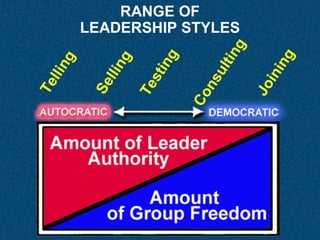
Jo
i

ng
ni
ng

Co
ns
ul
ti

Se
llin
g
Te
st
in
g

Te
llin
g

RANGE OF
LEADERSHIP STYLES
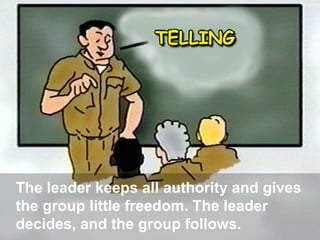
The leader keeps all authority and gives
the group little freedom. The leader
decides, and the group follows.
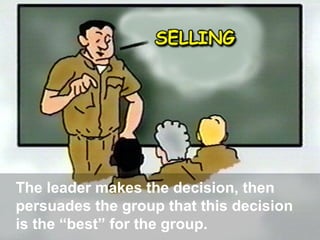
The leader makes the decision, then
persuades the group that this decision
is the “best” for the group.
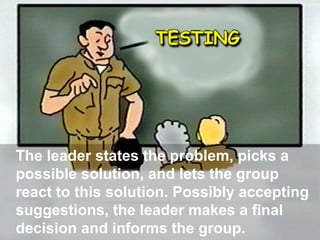
The leader states the problem, picks a
possible solution, and lets the group
react to this solution. Possibly accepting
suggestions, the leader makes a final
decision and informs the group.
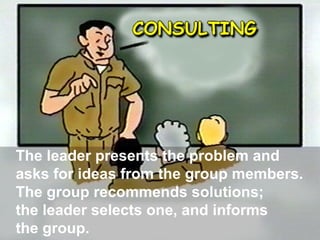
The leader presents the problem and
asks for ideas from the group members.
The group recommends solutions;
the leader selects one, and informs
the group.
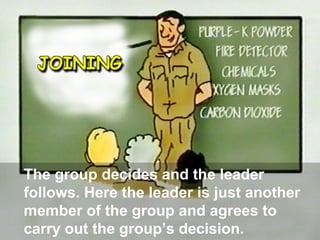
The group decides and the leader
follows. Here the leader is just another
member of the group and agrees to
carry out the group’s decision.
Delegate
To commit or entrust to another
To authorize and send (another
person) as one's representative
You can delegate authority, but
never responsibility
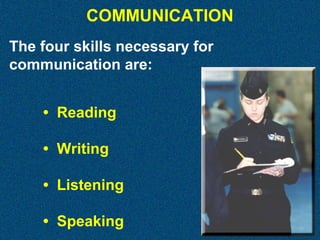
COMMUNICATION
The four skills necessary for
communication are:
• Reading
• Writing
• Listening
• Speaking
READING
When reading
longer articles,
books, or
instructions,
save time, effort, and get a better
understanding by:
~ scanning the material first to pick out
the main ideas
~ then reread for details
WRITING
There are four important steps to follow
for effective writing:
1. Clarify your purpose.
2. Limit the subject.
3. List your ideas.
4. Organize your ideas into groups.
WRITING
There are four important steps to follow
for effective writing:
1. Clarify your purpose. Be able to say
why you are writing, who will read it,
and what you expect the reader to do
after reading it.
WRITING
There are four important steps to follow
for effective writing:
2. Limit the subject. Material should be
limited to what suits your purpose as
stated in Step 1. Do not waste the
readers’ time with extra material.
WRITING
There are four important steps to follow
for effective writing:
3. List your ideas. You want to list
ideas that will get across to your
reader. As you read and research,
write down ideas and change them
later if necessary.
WRITING
There are four important steps to follow
for effective writing:
4. Organize your ideas into groups.
Main ideas are followed by important
subheadings, then supporting
information. An outline will help keep
you on course and save time when
you actually start writing.
WRITING
There are four important steps to follow
for effective writing:
1. Clarify your purpose.
2. Limit the subject.
3. List your ideas.
4. Organize your ideas into groups.
your leadership and organizational
skills will be evident in the text.
LISTENING
Four rules to becoming a better listener:
1. Get ready to listen.
2. Take responsibility for understanding.
3. Listen to understand rather than to
disagree.
4. Listen for the main ideas.
LISTENING
1. Get ready to listen. Do not place all
the responsibility on the speaker.
You must be alert!
LISTENING
2. Take responsibility for understanding.
In your mind put the speaker’s ideas
in your own words.
LISTENING
3. Listen to understand rather than to
disagree. Listen and wait; try to
understand first and evaluate second.
Emotions should not cloud the
matter. Question only after a speech
or lesson is finished.
LISTENING
4. Listen for the main ideas. If you are
listening to a teacher or other
speaker, take notes. Come to classes
and lectures prepared to do so.
Taking notes will make you more alert
for the main ideas.
LISTENING
If you use these four rules,
1. Get ready to listen.
2. Take responsibility for understanding.
3. Listen to understand rather than to
disagree.
4. Listen for the main ideas.
you will gain more knowledge and
understanding. It is still the best way.
SPEAKING
Five basic steps for an effective speech:
1. Determine the purpose of the speech.
2. Narrow the scope of your topic.
3. Choose a subject of interest to you
and your audience.
4. Make an outline to organize your
speech.
5. Practice your speech.
SPEAKING

1. Determine the purpose of the speech.
Having “zeroed in” on your purpose,
stick to it. Do not wander in your
research or your writing.
SPEAKING
2. Narrow the scope of your topic. Do
not try to cover too much in one
speech. You will bore your listeners
if you do. Most good speeches can be
given in 15 minutes or less.
SPEAKING
3. Choose a subject of interest to you
and your audience. Keep in mind the
maturity of your audience. Do not
rely just on what you know about the
subject. Do some research. Be sure
your information is correct.
SPEAKING
4. Make an outline to organize your
speech. Note facts and figures so
you don’t make mistakes.
SPEAKING
5. Practice your speech. Say it in front
of a mirror or use a tape recorder.
Time it. Listen to yourself. Plan to
use gestures. “Running through”
your speech will give you confidence.
SPEAKING
Preparing with these five basic steps,
1. Determine the purpose of the speech.
2. Narrow the scope of your topic.
3. Choose a subject of interest to you
and your audience.
4. Make an outline to organize your
speech.
5. Practice your speech.
will give you additional confidence to
deliver an effective speech as a leader.
SPEAKING
The best speeches use what is called
three part communication or:

3 Part Comm.
Introduction
Body
Close
SPEAKING
Introduction
Tell your audience what
you are going to tell them.
SPEAKING
Body
Tell them. In other words, present
your speech. Hit the key points or
phrases in the same order you
offered in the introduction. This is
a “road map” they can follow.
SPEAKING
Close
Tell your audience what you told them.
This reinforces the key points you were
making in the body of your speech and
refreshes their memory. It also offers
an excellent method of wrapping up
and ending a speech with a “Thank
You!”
SPEAKING
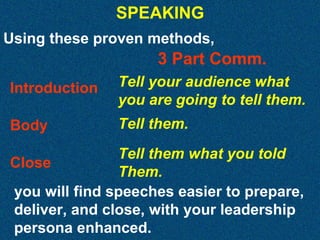
Using these proven methods,

3 Part Comm.
Introduction

Tell your audience what
you are going to tell them.

Body

Tell them.

Tell them what you told
Close
Them.
you will find speeches easier to prepare,
deliver, and close, with your leadership
persona enhanced.
Q.1. What does authority mean in
the Navy?
Q.1. What does authority mean in
the Navy?
A.1. The person in charge
Q.2. What is the definition of
"authority?"
Q.2. What is the definition of
"authority?"
A.2. The power or right to give
commands, enforce obedience,
take action, or make final
decisions
Q.3. In the Navy, authority comes
with what?
Q.3. In the Navy, authority comes
with what?
A.3. Responsibility and
accountability
Q.4. What is the difference between
civilian authority and naval
authority?
Q.4. What is the difference between
civilian authority and naval
authority?
A.4. Civilian leaders may be held
accountable in many cases only
if they break the law. Naval
authority is held accountable for
all that occurs in that command.
Q.5. Why do parents have authority
over their children?
Q.5. Why do parents have authority
over their children?
A.5. They are responsible for your
actions.
Q.6. Describe an autocratic leader.

A.6. The autocratic leader does not
allow input or discussion.
Q.7. Describe a democratic leader.
A.7. The democratic leader allows
the unit to have input.
Q.8. What are the two extreme
styles of leadership, and what
are the features of each?
Q.8. What are the two extreme
styles of leadership, and what
are the features of each?
A.8. Autocratic is centered on the
leader and Democratic means
participation of followers, as
well as the leader, in the
leadership process.
Q.9. Upon what is effective
leadership based?
Q.9. Upon what is effective
leadership based?

A.9. Results
Q.10. What are the five approaches
to leadership?
Q.10. What are the five approaches
to leadership?
A.10. a. Telling
b. Selling
c. Testing
d. Consulting
e. Joining
Q.11. Which style of leadership
is better, autocratic or
democratic?
Q.11. Which style of leadership is
better, autocratic or
democratic?
A.11. Each one has a purpose, and
it is necessary to use the one
that will suit the situation.
Q.12. What are the four skills
necessary for effective
communication?
Q.12. What are the four skills
necessary for effective
communication?
A.12. 1. Reading
2. Writing
3. Listening
4. Speaking
Q.13. What are the four important
steps for effective writing?
Q.13. What are the four important
steps for effective writing?
A.13. 1. Clarify your purpose
2. Limit the subject
3. List ideas
4. Organize ideas
Q.14. What are the four rules for
being a good listener?
Q.14. What are the four rules for
being a good listener?
A.14. 1. Get ready to listen
2. Take the responsibility for
understanding
3. Listen to understand
4. Listen for the main ideas
Q.15. What are the five basic steps
to follow in preparing
a speech?
Q.15. What are the five basic steps
to follow in preparing a
speech?
A.15. 1. Determine the purpose
2. Narrow the scope of your
topic
3. Choose a subject of interest
4. Make an outline
5. Practice your speech
Q.16. Why is it important to know
the audience that you are
addressing?
Q.16. Why is it important to know
the audience that you are
addressing?
A.16. So that you can speak on
their level

Ns2 leadershipc2 just the basics

  • 1.
  • 2.
    AUTHORITY The power orright to give commands, enforce obedience, take action, or make final decisions.”
  • 3.
    In the UnitesStates Navy Authority means the person in charge
  • 4.
  • 5.
    Authority in civilianlife does not carry the same amount of accountability. CEO POLICE TEACHER PREACHER
  • 6.
    Dependable Worthy of relianceor trust Consistent in performance or behavior
  • 7.
    Authoritarian Characterized by orfavoring absolute obedience to authority, as against individual freedom Does not care about what people think, as long as they follow orders.
  • 8.
    Democratic Every one getsto provide input, discussions Works best when you have time to analyze input from all team members
  • 9.
    Effective leadership is basedon results , not effort.
  • 10.
  • 11.
    The leader keepsall authority and gives the group little freedom. The leader decides, and the group follows.
  • 12.
    The leader makesthe decision, then persuades the group that this decision is the “best” for the group.
  • 13.
    The leader statesthe problem, picks a possible solution, and lets the group react to this solution. Possibly accepting suggestions, the leader makes a final decision and informs the group.
  • 14.
    The leader presentsthe problem and asks for ideas from the group members. The group recommends solutions; the leader selects one, and informs the group.
  • 15.
    The group decidesand the leader follows. Here the leader is just another member of the group and agrees to carry out the group’s decision.
  • 16.
    Delegate To commit orentrust to another To authorize and send (another person) as one's representative You can delegate authority, but never responsibility
  • 17.
    COMMUNICATION The four skillsnecessary for communication are: • Reading • Writing • Listening • Speaking
  • 18.
    READING When reading longer articles, books,or instructions, save time, effort, and get a better understanding by: ~ scanning the material first to pick out the main ideas ~ then reread for details
  • 19.
    WRITING There are fourimportant steps to follow for effective writing: 1. Clarify your purpose. 2. Limit the subject. 3. List your ideas. 4. Organize your ideas into groups.
  • 20.
    WRITING There are fourimportant steps to follow for effective writing: 1. Clarify your purpose. Be able to say why you are writing, who will read it, and what you expect the reader to do after reading it.
  • 21.
    WRITING There are fourimportant steps to follow for effective writing: 2. Limit the subject. Material should be limited to what suits your purpose as stated in Step 1. Do not waste the readers’ time with extra material.
  • 22.
    WRITING There are fourimportant steps to follow for effective writing: 3. List your ideas. You want to list ideas that will get across to your reader. As you read and research, write down ideas and change them later if necessary.
  • 23.
    WRITING There are fourimportant steps to follow for effective writing: 4. Organize your ideas into groups. Main ideas are followed by important subheadings, then supporting information. An outline will help keep you on course and save time when you actually start writing.
  • 24.
    WRITING There are fourimportant steps to follow for effective writing: 1. Clarify your purpose. 2. Limit the subject. 3. List your ideas. 4. Organize your ideas into groups. your leadership and organizational skills will be evident in the text.
  • 25.
    LISTENING Four rules tobecoming a better listener: 1. Get ready to listen. 2. Take responsibility for understanding. 3. Listen to understand rather than to disagree. 4. Listen for the main ideas.
  • 26.
    LISTENING 1. Get readyto listen. Do not place all the responsibility on the speaker. You must be alert!
  • 27.
    LISTENING 2. Take responsibilityfor understanding. In your mind put the speaker’s ideas in your own words.
  • 28.
    LISTENING 3. Listen tounderstand rather than to disagree. Listen and wait; try to understand first and evaluate second. Emotions should not cloud the matter. Question only after a speech or lesson is finished.
  • 29.
    LISTENING 4. Listen forthe main ideas. If you are listening to a teacher or other speaker, take notes. Come to classes and lectures prepared to do so. Taking notes will make you more alert for the main ideas.
  • 30.
    LISTENING If you usethese four rules, 1. Get ready to listen. 2. Take responsibility for understanding. 3. Listen to understand rather than to disagree. 4. Listen for the main ideas. you will gain more knowledge and understanding. It is still the best way.
  • 31.
    SPEAKING Five basic stepsfor an effective speech: 1. Determine the purpose of the speech. 2. Narrow the scope of your topic. 3. Choose a subject of interest to you and your audience. 4. Make an outline to organize your speech. 5. Practice your speech.
  • 32.
    SPEAKING 1. Determine thepurpose of the speech. Having “zeroed in” on your purpose, stick to it. Do not wander in your research or your writing.
  • 33.
    SPEAKING 2. Narrow thescope of your topic. Do not try to cover too much in one speech. You will bore your listeners if you do. Most good speeches can be given in 15 minutes or less.
  • 34.
    SPEAKING 3. Choose asubject of interest to you and your audience. Keep in mind the maturity of your audience. Do not rely just on what you know about the subject. Do some research. Be sure your information is correct.
  • 35.
    SPEAKING 4. Make anoutline to organize your speech. Note facts and figures so you don’t make mistakes.
  • 36.
    SPEAKING 5. Practice yourspeech. Say it in front of a mirror or use a tape recorder. Time it. Listen to yourself. Plan to use gestures. “Running through” your speech will give you confidence.
  • 37.
    SPEAKING Preparing with thesefive basic steps, 1. Determine the purpose of the speech. 2. Narrow the scope of your topic. 3. Choose a subject of interest to you and your audience. 4. Make an outline to organize your speech. 5. Practice your speech. will give you additional confidence to deliver an effective speech as a leader.
  • 38.
    SPEAKING The best speechesuse what is called three part communication or: 3 Part Comm. Introduction Body Close
  • 39.
    SPEAKING Introduction Tell your audiencewhat you are going to tell them.
  • 40.
    SPEAKING Body Tell them. Inother words, present your speech. Hit the key points or phrases in the same order you offered in the introduction. This is a “road map” they can follow.
  • 41.
    SPEAKING Close Tell your audiencewhat you told them. This reinforces the key points you were making in the body of your speech and refreshes their memory. It also offers an excellent method of wrapping up and ending a speech with a “Thank You!”
  • 42.
    SPEAKING Using these provenmethods, 3 Part Comm. Introduction Tell your audience what you are going to tell them. Body Tell them. Tell them what you told Close Them. you will find speeches easier to prepare, deliver, and close, with your leadership persona enhanced.
  • 43.
    Q.1. What doesauthority mean in the Navy?
  • 44.
    Q.1. What doesauthority mean in the Navy? A.1. The person in charge
  • 45.
    Q.2. What isthe definition of "authority?"
  • 46.
    Q.2. What isthe definition of "authority?" A.2. The power or right to give commands, enforce obedience, take action, or make final decisions
  • 47.
    Q.3. In theNavy, authority comes with what?
  • 48.
    Q.3. In theNavy, authority comes with what? A.3. Responsibility and accountability
  • 49.
    Q.4. What isthe difference between civilian authority and naval authority?
  • 50.
    Q.4. What isthe difference between civilian authority and naval authority? A.4. Civilian leaders may be held accountable in many cases only if they break the law. Naval authority is held accountable for all that occurs in that command.
  • 51.
    Q.5. Why doparents have authority over their children?
  • 52.
    Q.5. Why doparents have authority over their children? A.5. They are responsible for your actions.
  • 53.
    Q.6. Describe anautocratic leader.
  • 54.
    Q.6. Describe anautocratic leader. A.6. The autocratic leader does not allow input or discussion.
  • 55.
    Q.7. Describe ademocratic leader.
  • 56.
    Q.7. Describe ademocratic leader. A.7. The democratic leader allows the unit to have input.
  • 57.
    Q.8. What arethe two extreme styles of leadership, and what are the features of each?
  • 58.
    Q.8. What arethe two extreme styles of leadership, and what are the features of each? A.8. Autocratic is centered on the leader and Democratic means participation of followers, as well as the leader, in the leadership process.
  • 59.
    Q.9. Upon whatis effective leadership based?
  • 60.
    Q.9. Upon whatis effective leadership based? A.9. Results
  • 61.
    Q.10. What arethe five approaches to leadership?
  • 62.
    Q.10. What arethe five approaches to leadership? A.10. a. Telling b. Selling c. Testing d. Consulting e. Joining
  • 63.
    Q.11. Which styleof leadership is better, autocratic or democratic?
  • 64.
    Q.11. Which styleof leadership is better, autocratic or democratic? A.11. Each one has a purpose, and it is necessary to use the one that will suit the situation.
  • 65.
    Q.12. What arethe four skills necessary for effective communication?
  • 66.
    Q.12. What arethe four skills necessary for effective communication? A.12. 1. Reading 2. Writing 3. Listening 4. Speaking
  • 67.
    Q.13. What arethe four important steps for effective writing?
  • 68.
    Q.13. What arethe four important steps for effective writing? A.13. 1. Clarify your purpose 2. Limit the subject 3. List ideas 4. Organize ideas
  • 69.
    Q.14. What arethe four rules for being a good listener?
  • 70.
    Q.14. What arethe four rules for being a good listener? A.14. 1. Get ready to listen 2. Take the responsibility for understanding 3. Listen to understand 4. Listen for the main ideas
  • 71.
    Q.15. What arethe five basic steps to follow in preparing a speech?
  • 72.
    Q.15. What arethe five basic steps to follow in preparing a speech? A.15. 1. Determine the purpose 2. Narrow the scope of your topic 3. Choose a subject of interest 4. Make an outline 5. Practice your speech
  • 73.
    Q.16. Why isit important to know the audience that you are addressing?
  • 74.
    Q.16. Why isit important to know the audience that you are addressing? A.16. So that you can speak on their level