FLASH CHROMATOGRAPHY 
BY: Gauthami. K.B 
Roll no: 256213886009 
M.pharmacy 1st yr (pharmaceutics) 
Pharmaceutical Analytical Techniques 
Under the guidance of 
UTTAM sir 
AND 
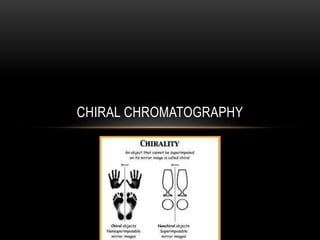
CHIRAL CHROMATOGRAPHY
FLASH CHROMATOGRAPHY
INTRODUCTION 
• Flash chromatography, also known as medium pressure chromatography 
was introduced by CLARK 
• It is alternative to slow and often inefficient gravity-fed chromatography. 
• Flash chromatography differs from the conventional technique in two ways: 
1. first, slightly smaller silica gel particles (250- 400 mesh)are used 
2. second, due to restricted flow of solvent caused by the small gel particles, 
pressurized gas (ca.10-15 psi) is used to drive the solvent through the 
column of stationary phase. 
• The net result is a rapid(“over in a flash”) and high resolution 
chromatography.
STEPS INVOLVED IN FLASH CHROMATOGRAPHY 
• Selecting a Solvent System 
• Determining the Quantity of Silica Gel Required 
• Packing the Column 
• Applying the Sample 
• Eluting the Sample
• Selecting a Solvent System: 
• The compound of interest should have a TLC Rf of ≈0.15 to 0.20 
in the solvent system, choose binary (two component) solvent 
systems with one solvent having a higher polarity than the other 
are usually best, since they allow for easy adjustment of the 
average polarity of the eluent. 
• The ratio of solvents determines the polarity of the solvent 
system, and hence the rates of elution of the compounds to be 
separated. 
• Higher polarity of solvent increases rate of elution for ALL 
compounds. 
• Common binary solvent systems in order of increasing polarity 
are dichloromethane/hexane, ether/hexane, hexane/ethyl 
acetate, and dichloromethane/methanol.
CONTD… 
• Some solvents list according to their increasing eluting 
power 1) cyclohexane 2)pet. ether 3)Pentane 4) 
Dichloromethane 5)Ethyl ether 6)Ethyl acetate 
7)Ethanol 7)Water 8)Acetone 9)Acetic acid 
10)methanol. 
• If Rf is ≈0.2, you will need a volume of solvent ≈5X the 
volume of the dry silica gel in order to run your column.
• Determining the Quantity of Silica Gel 
Required 
• The amount of silica gel depends on the Rf 
difference of the compounds to be separated, 
and on the amount of sample. 
• For ngrams of sample, you should use 30 to 
100 ngrams of silica gel. For easier 
separations, ratios closer to 30 : 1 are 
effective, for difficult separations, more silica 
gel is often required. 
• However, by using more silica gel, the length 
of time required for the chromatography is 
extended.
• Selecting the column and column diameter Plastic 
column : 
• Recommended length 46cm, Diameter - depends on 
sample size and the difference in Rf value. 
• Packing the Column: 
• Obtain a glass column and make sure that it has either a 
glass frit or a plug of cotton wool directly above the 
stopcock to prevent the silica gel from escaping from the 
column through the stopcock.
• Next, put a ~1/2 in. layer of clean sand above the plug of glass 
wool. Make sure the surface is flat. Then pour in the silica gel 
using a funnel. 
• Two methods for packing the column are: 
1)wet packing 
2)dry packing
• Applying the Sample: 
• Loading the sample is important . 
• Application of sample can be made by the small Pasteur pipette. 
• Allow the solvent which remains above the silica to drain down 
until it is flush with the surface of the silica. 
• If the top surface of the silica gel is not flat, gently tap the side 
of the column until it is. 
• Dissolve sample into the minimum volume of the elution 
solvent. Apply this to the top of the column, being careful not to 
disturb the top of the silica. 
• Add a small amount of sand to protect the top surface of the 
silica when you add more solvent.
• Eluting the Sample: 
• Add elution solvent to the column. 
• Apply pressure to force the solvent through the column. 
• The pressure should be the minimum necessary to keep a 
steady stream coming out of the column. 
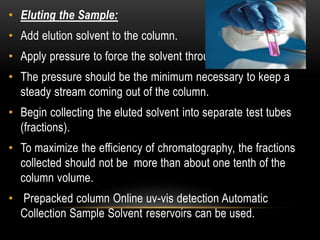
• Begin collecting the eluted solvent into separate test tubes 
(fractions). 
• To maximize the efficiency of chromatography, the fractions 
collected should not be more than about one tenth of the 
column volume. 
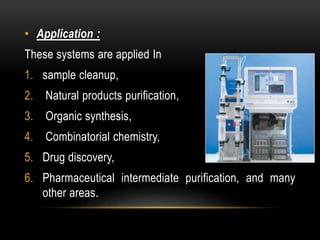
• Prepacked column Online uv-vis detection Automatic 
Collection Sample Solvent reservoirs can be used.
• Locating the Sample: 
• Use TLC to determine 
which fractions contain 
your compound. 
• Combine the fractions that 
contain your sample 
together in a flask, then 
concentrate the sample.
• Detection: 
• Detection is usually done by UV-Vis detectors. 
• Fully automated method with user-friendly software Online UV – 
Vis detectors are used. 
• Modern online FC systems have improved the method by 
incorporating reusable plastic cartridges prepacked with the 
sorbent, ultraviolet (UV) detection, computer software control, 
mobile phase gradients, and automated fraction collection. 
• Normal phase (NP) FC of polar compounds on silica gel 
columns is still the most widely used mode, but reversed phase 
(RP), ion exchange, and other types of sorbents are becoming 
used more frequently.
• Application : 
These systems are applied In 
1. sample cleanup, 
2. Natural products purification, 
3. Organic synthesis, 
4. Combinatorial chemistry, 
5. Drug discovery, 
6. Pharmaceutical intermediate purification, and many 
other areas.
CHIRAL CHROMATOGRAPHY
INTRODUCTION 
• Chiral Chromatography is a branch of chromatography that is 
oriented towards the exclusive separation of chiral 
substances. 
• Certain stereoisomers that differ only in the spatial 
arrangement of their atoms and in their capacity for rotating 
the plane of polarized light are termed optically active or 
chiral and the individual isomers are called enantiomers. 
• Enantiomeric separations are achieved in chiral 
chromatography by the judicious use of chiral phases. 
• The mobile phase can be a gas or liquid giving rise to chiral 
gas chromatography and chiral liquid chromatography.
PRINCIPLE OF ENANTIOMER SEPARATION 
• On transfer of a pair of enantiomers into asymmetric 
environment, two diastereomeric species are formed 
with distinct physicochemical property profile. On the 
basis of which physical separation into individual 
enantiomers may be achieved.
• Chiral selector (SO):- 
• Capable of undergoing covalent or non-covalent 
interaction with the individual enantiomer (Selectand 
SAs) 
Depending on the nature of the interaction stabilizing 
the respective diastereomer. SA-SO species.
• Enantiomer separation strategies:- 
• Indirect enantiomer separation 
• Direct enantiomer separation 
• Indirect enantiomer separation:- Chiral Derivatization 
agent (CDAs):- Transformation of the SAs of interest into 
covalent diastereomer by conversion with suitably 
reactive SOs. Followed by separation of diastereomeric 
product with achiral chromatographic techniques. 
• Applicable only to enantiomer presenting a single or more 
but selectively addressable functional group suitable for 
derivatization.
• Direct enantiomer separation:- 1) Chiral mobile phase 
additive 2) chiral stationary phase mode 
• Chiral mobile phase additive (CMPA): A combination of 
an chiral stationary and a chiral mobile phase is 
employed. 
• On introduction of a mixture of enantiomers into this 
system, the individual of enantiomers form diastereomeric 
complex with the chiral mobile phase additive. 
• This diastereomeric complex may exhibit distinct 
association / dissociation rate, thermodynamics stability, 
and physiochemical property therefore may be separated 
on an appropriate a chiral stationary phase..
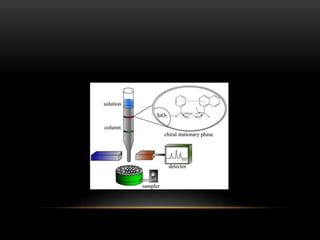
• chiral stationary phase mode: Consists of an inert 
chromatographic support matrix incorporating 
chemically or physically immobilized SO species. 
• CSPs may be created by a variety of SO immobilization 
technique. 
1. Covalent attachment on to the surface of suitably 
prefunctionalized carrier materials. 
2. Physical fixation employing coating technique. 
3. Incorporation into polymeric network by 
copolymerization or combination of this procedures
• CSPs provide several operational advantages over 
CMAs based enantiomers separation: 
1. stability of CSPs more and flexibility with respect to 
method optimization parameter. 
2. Used for wide range of mobile phase solvent and 
modifiers. 
3. also used for gradient elution and variable temp. 
protocol
• Classification of Chiral Stationary Phase: 
• Type-1 Organic Polymer -Pure -Polymer coating on 
inorganic support -Grafted polymer. 
• Type-2 Carrier material modified with Chiral moieties - 
inorganic material mainly silica gel modified on the 
surface. -organic polymer network grafted with chiral 
molecules. 
• Type-3 Imprinted material -imprinted polymer -inorganic 
material imprinted on the polymer.
DETECTORS 
• Commonly detectors used in chiral 
chromatography: 
• Polarimeter 
• Optical rotatory dispersion detector 
• Circular dichroism detector.
• Applications:- 
• Quinine and Quinidine 
• Atropine and Hyoscyamine 
• Cetrizine and Levo-cetrizine 
• Omeprazole and Esomeprazole(more effective in 
GERD) 
• Dopamine and levodopamine 
• D-Amphetamine and Amphetamine 
• Dextromethorphan and Levo-methorphan
CONCLUSION 
• Modern flash chromatography is applicable to a wide 
range of compound types. 
• Saves time and solvents. 
• HPLC linear gradients can be transformed into step 
gradients in flash chromatography. 
• Flash chromatography can be a reliable and cost-effective 
alternative to preparative HPLC.
CONTD.. 
• Chiral chromatography has become a preferred method 
for rapidly separation enantiopure compounds in the 
pharmaceutical industry, largely owing to the speed 
with which a chromatographic method can be 
developed and executed as well as the comparatively 
small labour requirements of the chromatographic 
approach. 
• The use of chiral chromatography within the field of 
organic synthesis can be expected to increase as the 
technique becomes more familiar to synthetic chemists.
REFERENCES 
• Peter Atkins & Julio de Paula, Aitkin's Physical Chemistry 7 the Ed., Oxford, New York 
(2002) Chapter 22 AR Genaro 
• Remington: The Science and Practice of Pharmacy 20 the Ed. 
• Lippincott Williams & Wilkins (2000) Part 4 DG Peters, JM Hayes, GM Hefted, Chemical 
Separations and Measurements, Saunders, Philadelphia(1974) Chapter 17 
• http://www.chromatography.amershambiosciences.com. 
• Chiral chromatography by T.E.Beesely
THANK YOU

Flash and chiral chromatography

  • 1.
    FLASH CHROMATOGRAPHY BY:Gauthami. K.B Roll no: 256213886009 M.pharmacy 1st yr (pharmaceutics) Pharmaceutical Analytical Techniques Under the guidance of UTTAM sir AND CHIRAL CHROMATOGRAPHY
  • 2.
  • 3.
    INTRODUCTION • Flashchromatography, also known as medium pressure chromatography was introduced by CLARK • It is alternative to slow and often inefficient gravity-fed chromatography. • Flash chromatography differs from the conventional technique in two ways: 1. first, slightly smaller silica gel particles (250- 400 mesh)are used 2. second, due to restricted flow of solvent caused by the small gel particles, pressurized gas (ca.10-15 psi) is used to drive the solvent through the column of stationary phase. • The net result is a rapid(“over in a flash”) and high resolution chromatography.
  • 4.
    STEPS INVOLVED INFLASH CHROMATOGRAPHY • Selecting a Solvent System • Determining the Quantity of Silica Gel Required • Packing the Column • Applying the Sample • Eluting the Sample
  • 5.
    • Selecting aSolvent System: • The compound of interest should have a TLC Rf of ≈0.15 to 0.20 in the solvent system, choose binary (two component) solvent systems with one solvent having a higher polarity than the other are usually best, since they allow for easy adjustment of the average polarity of the eluent. • The ratio of solvents determines the polarity of the solvent system, and hence the rates of elution of the compounds to be separated. • Higher polarity of solvent increases rate of elution for ALL compounds. • Common binary solvent systems in order of increasing polarity are dichloromethane/hexane, ether/hexane, hexane/ethyl acetate, and dichloromethane/methanol.
  • 6.
    CONTD… • Somesolvents list according to their increasing eluting power 1) cyclohexane 2)pet. ether 3)Pentane 4) Dichloromethane 5)Ethyl ether 6)Ethyl acetate 7)Ethanol 7)Water 8)Acetone 9)Acetic acid 10)methanol. • If Rf is ≈0.2, you will need a volume of solvent ≈5X the volume of the dry silica gel in order to run your column.
  • 7.
    • Determining theQuantity of Silica Gel Required • The amount of silica gel depends on the Rf difference of the compounds to be separated, and on the amount of sample. • For ngrams of sample, you should use 30 to 100 ngrams of silica gel. For easier separations, ratios closer to 30 : 1 are effective, for difficult separations, more silica gel is often required. • However, by using more silica gel, the length of time required for the chromatography is extended.
  • 8.
    • Selecting thecolumn and column diameter Plastic column : • Recommended length 46cm, Diameter - depends on sample size and the difference in Rf value. • Packing the Column: • Obtain a glass column and make sure that it has either a glass frit or a plug of cotton wool directly above the stopcock to prevent the silica gel from escaping from the column through the stopcock.
  • 9.
    • Next, puta ~1/2 in. layer of clean sand above the plug of glass wool. Make sure the surface is flat. Then pour in the silica gel using a funnel. • Two methods for packing the column are: 1)wet packing 2)dry packing
  • 10.
    • Applying theSample: • Loading the sample is important . • Application of sample can be made by the small Pasteur pipette. • Allow the solvent which remains above the silica to drain down until it is flush with the surface of the silica. • If the top surface of the silica gel is not flat, gently tap the side of the column until it is. • Dissolve sample into the minimum volume of the elution solvent. Apply this to the top of the column, being careful not to disturb the top of the silica. • Add a small amount of sand to protect the top surface of the silica when you add more solvent.
  • 11.
    • Eluting theSample: • Add elution solvent to the column. • Apply pressure to force the solvent through the column. • The pressure should be the minimum necessary to keep a steady stream coming out of the column. • Begin collecting the eluted solvent into separate test tubes (fractions). • To maximize the efficiency of chromatography, the fractions collected should not be more than about one tenth of the column volume. • Prepacked column Online uv-vis detection Automatic Collection Sample Solvent reservoirs can be used.
  • 12.
    • Locating theSample: • Use TLC to determine which fractions contain your compound. • Combine the fractions that contain your sample together in a flask, then concentrate the sample.
  • 13.
    • Detection: •Detection is usually done by UV-Vis detectors. • Fully automated method with user-friendly software Online UV – Vis detectors are used. • Modern online FC systems have improved the method by incorporating reusable plastic cartridges prepacked with the sorbent, ultraviolet (UV) detection, computer software control, mobile phase gradients, and automated fraction collection. • Normal phase (NP) FC of polar compounds on silica gel columns is still the most widely used mode, but reversed phase (RP), ion exchange, and other types of sorbents are becoming used more frequently.
  • 14.
    • Application : These systems are applied In 1. sample cleanup, 2. Natural products purification, 3. Organic synthesis, 4. Combinatorial chemistry, 5. Drug discovery, 6. Pharmaceutical intermediate purification, and many other areas.
  • 15.
  • 16.
    INTRODUCTION • ChiralChromatography is a branch of chromatography that is oriented towards the exclusive separation of chiral substances. • Certain stereoisomers that differ only in the spatial arrangement of their atoms and in their capacity for rotating the plane of polarized light are termed optically active or chiral and the individual isomers are called enantiomers. • Enantiomeric separations are achieved in chiral chromatography by the judicious use of chiral phases. • The mobile phase can be a gas or liquid giving rise to chiral gas chromatography and chiral liquid chromatography.
  • 18.
    PRINCIPLE OF ENANTIOMERSEPARATION • On transfer of a pair of enantiomers into asymmetric environment, two diastereomeric species are formed with distinct physicochemical property profile. On the basis of which physical separation into individual enantiomers may be achieved.
  • 19.
    • Chiral selector(SO):- • Capable of undergoing covalent or non-covalent interaction with the individual enantiomer (Selectand SAs) Depending on the nature of the interaction stabilizing the respective diastereomer. SA-SO species.
  • 20.
    • Enantiomer separationstrategies:- • Indirect enantiomer separation • Direct enantiomer separation • Indirect enantiomer separation:- Chiral Derivatization agent (CDAs):- Transformation of the SAs of interest into covalent diastereomer by conversion with suitably reactive SOs. Followed by separation of diastereomeric product with achiral chromatographic techniques. • Applicable only to enantiomer presenting a single or more but selectively addressable functional group suitable for derivatization.
  • 21.
    • Direct enantiomerseparation:- 1) Chiral mobile phase additive 2) chiral stationary phase mode • Chiral mobile phase additive (CMPA): A combination of an chiral stationary and a chiral mobile phase is employed. • On introduction of a mixture of enantiomers into this system, the individual of enantiomers form diastereomeric complex with the chiral mobile phase additive. • This diastereomeric complex may exhibit distinct association / dissociation rate, thermodynamics stability, and physiochemical property therefore may be separated on an appropriate a chiral stationary phase..
  • 22.
    • chiral stationaryphase mode: Consists of an inert chromatographic support matrix incorporating chemically or physically immobilized SO species. • CSPs may be created by a variety of SO immobilization technique. 1. Covalent attachment on to the surface of suitably prefunctionalized carrier materials. 2. Physical fixation employing coating technique. 3. Incorporation into polymeric network by copolymerization or combination of this procedures
  • 23.
    • CSPs provideseveral operational advantages over CMAs based enantiomers separation: 1. stability of CSPs more and flexibility with respect to method optimization parameter. 2. Used for wide range of mobile phase solvent and modifiers. 3. also used for gradient elution and variable temp. protocol
  • 24.
    • Classification ofChiral Stationary Phase: • Type-1 Organic Polymer -Pure -Polymer coating on inorganic support -Grafted polymer. • Type-2 Carrier material modified with Chiral moieties - inorganic material mainly silica gel modified on the surface. -organic polymer network grafted with chiral molecules. • Type-3 Imprinted material -imprinted polymer -inorganic material imprinted on the polymer.
  • 27.
    DETECTORS • Commonlydetectors used in chiral chromatography: • Polarimeter • Optical rotatory dispersion detector • Circular dichroism detector.
  • 28.
    • Applications:- •Quinine and Quinidine • Atropine and Hyoscyamine • Cetrizine and Levo-cetrizine • Omeprazole and Esomeprazole(more effective in GERD) • Dopamine and levodopamine • D-Amphetamine and Amphetamine • Dextromethorphan and Levo-methorphan
  • 29.
    CONCLUSION • Modernflash chromatography is applicable to a wide range of compound types. • Saves time and solvents. • HPLC linear gradients can be transformed into step gradients in flash chromatography. • Flash chromatography can be a reliable and cost-effective alternative to preparative HPLC.
  • 30.
    CONTD.. • Chiralchromatography has become a preferred method for rapidly separation enantiopure compounds in the pharmaceutical industry, largely owing to the speed with which a chromatographic method can be developed and executed as well as the comparatively small labour requirements of the chromatographic approach. • The use of chiral chromatography within the field of organic synthesis can be expected to increase as the technique becomes more familiar to synthetic chemists.
  • 31.
    REFERENCES • PeterAtkins & Julio de Paula, Aitkin's Physical Chemistry 7 the Ed., Oxford, New York (2002) Chapter 22 AR Genaro • Remington: The Science and Practice of Pharmacy 20 the Ed. • Lippincott Williams & Wilkins (2000) Part 4 DG Peters, JM Hayes, GM Hefted, Chemical Separations and Measurements, Saunders, Philadelphia(1974) Chapter 17 • http://www.chromatography.amershambiosciences.com. • Chiral chromatography by T.E.Beesely
  • 32.