






MEd Module:
Leadership and Management of
    Learning in Education


           LBL - Session 3
   Presenter: Dr Muavia Gallie (PhD)
            27 March 2010

                                       1


              Content
1. Introduction;
2. Homework reflection;
3. Curriculum Management;
4. Instructional Management
5. Conclusion.
                                       2


                                           1
1. Introduction

                                                  3


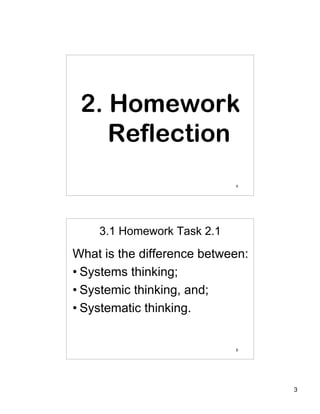
       Activity 1 - 10 minutes
Define the role of the following persons in the
  process of teaching and learning:
• National department officials;
• Provincial department officials;
• District officials:
  - Institutional Development Officials;
  - Curriculum Officials;
• Schools:
  - Principal and Deputy principal;
  - Heads of Department;
  - Teachers.
                                                  4


                                                      2
2. Homework
    Reflection
                            5


    3.1 Homework Task 2.1
What is the difference between:
• Systems thinking;
• Systemic thinking, and;
• Systematic thinking.


                            6


                                  3
3.2 Homework Task 2.2


                         7


    3.
Curriculum
Management
                         8


                             4
Origin of the New
     Curriculum in South
            Africa

                                                           9


    1. Here are some special terms used with OBE
• Alignment - The process that educators use to get all parts of
  the teaching and learning process to DIRECTLY MATCH
  each other. This is an important part of OBE and improves the
  focus, consistency and effectiveness of instruction.
• Assessment - The process that educators use to gather
  information about learner learning and performance. It may
  involve familiar methods like paper/pencil testing, or include
  other kinds of ‘alternative’ approaches that more directly tap
  particular kinds of learning. For example, driving a care safely
  or operating a computer efficiently and accurately. Having
  learners carry out actions that demonstrate what they can do
  with information is becoming widely used as a better indicator
  of performance ability and competence than paper/pencil
  testing alone.                                            10


                                                                     5
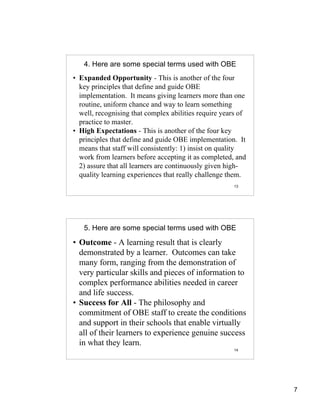
2. Here are some special terms used with OBE
• Clarity of focus - This is one of the key principles that define
  and guide Outcome-Based models. It requires teachers to
  clearly define what they want successful learning results look
  like and to focus and organise everything they and the learners
  do on that desired result.
• Context - The actual physical setting, situation,
  circumstances, or conditions in which learning and its
  successful demonstration are to take place.
• Criterion - An essential part or condition that must be present
  in a successful demonstration of learner learning. If that
  essential component is missing or inadequate, the
  demonstration is judged to be incomplete. For example, if
  correct spelling is a criterion for publishing an article, the
  article cannot be published if it has any misspelled words.  11


    3. Here are some special terms used with OBE
• Critical Outcomes - Usually a set of learning
  demonstrations expected of all students in an OBE
  model. These outcomes establish the focus and
  priorities for all of the curriculum, instruction and
  assessments.
• Designing Back - This is another of the four key
  principles that define and guide OBE implementation.
  It is the process of designing and organising curriculum
  and instruction back from the intended outcome, or
  learning result. The phrase commonly used is: “Design
  down from where you want the learners to successfully
  end up.”
                                                           12


                                                                     6
4. Here are some special terms used with OBE
• Expanded Opportunity - This is another of the four
  key principles that define and guide OBE
  implementation. It means giving learners more than one
  routine, uniform chance and way to learn something
  well, recognising that complex abilities require years of
  practice to master.
• High Expectations - This is another of the four key
  principles that define and guide OBE implementation. It
  means that staff will consistently: 1) insist on quality
  work from learners before accepting it as completed, and
  2) assure that all learners are continuously given high-
  quality learning experiences that really challenge them.
                                                      13


   5. Here are some special terms used with OBE

• Outcome - A learning result that is clearly
  demonstrated by a learner. Outcomes can take
  many form, ranging from the demonstration of
  very particular skills and pieces of information to
  complex performance abilities needed in career
  and life success.
• Success for All - The philosophy and
  commitment of OBE staff to create the conditions
  and support in their schools that enable virtually
  all of their learners to experience genuine success
  in what they learn.
                                                      14


                                                              7
1. OBE Systems Design
     A. Curriculum Design
  Review current curriculum,
 develop learning programmes
 and learning activities which
 align with Critical Outcomes

                                                           15


      2. OBE Systems Design
B. Teaching Practices
1. In OBE, time is no longer the principal factor which
   controls access to learning. At every level, staff members
   will develop ways to reallocate the time available to
   expand opportunities for learning.
2. Teachers will make decisions which will help learners
   accomplish COs. Clarify learning activities, using
   appropriate assessments, preparing activities which focus
   on Outcomes, and providing expanded opportunities for
   success.
3. Several initiatives could supply a basis for supporting
   improved teaching practice. They include Classroom
   Facilitation, Inclusive Education Strategies, Cooperative
   Group Strategies, etc.
                                                           16


                                                                8
3. OBE Systems Design
C.Assessment
1. Assessment will be used to validate
   accomplishment of Outcomes. This process will
   eventually replace grades, which are designed to
   compare and rank learners. While some outcomes
   may be assessed through testing, others will be
   assessed by observing learners perform tasks which
   are evaluated according to pre-set criteria.
2. Use of criterion-referenced reports will become
   increasingly useful in planning teaching and
   reporting to learners and parents.
                                                  17


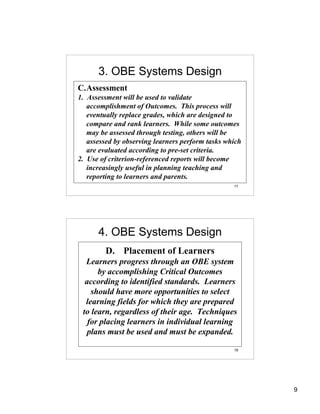
      4. OBE Systems Design
        D. Placement of Learners
  Learners progress through an OBE system
      by accomplishing Critical Outcomes
  according to identified standards. Learners
    should have more opportunities to select
  learning fields for which they are prepared
 to learn, regardless of their age. Techniques
   for placing learners in individual learning
   plans must be used and must be expanded.

                                                  18


                                                        9
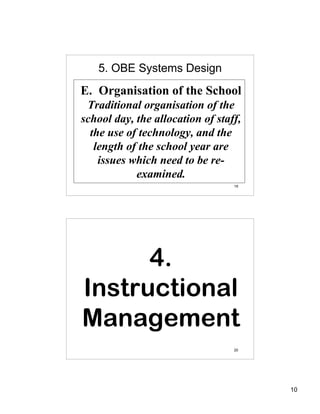
5. OBE Systems Design
E. Organisation of the School
 Traditional organisation of the
school day, the allocation of staff,
  the use of technology, and the
   length of the school year are
    issues which need to be re-
            examined.
                                  19


      4.
Instructional
Management
                                  20


                                       10
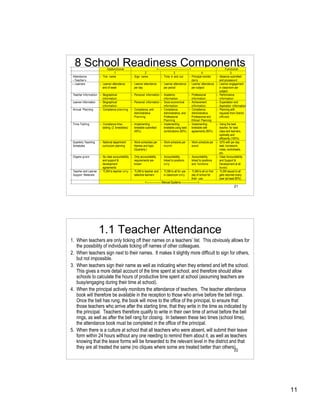
8 School Readiness Components
                                    Dysfunctional                               <------------------------------------ >                                Functional
                                         1                           2                             3                            4                          5
1.    Attendance            •   Tick name                 •   Sign name              • Time in and out               • Principal monitor     •   Absence submitted
      • Teacher s                                                                                                       daily                    and process e d
     •  Learners            •   Learner attendance        •   Learner attendance • Learner attendance • Learner attendance                   •   Learner engagement
                                end of week                   per day                   per period                      per subject              in classroom per
                                                                                                                                                 subject
2.    Teacher Information   •   Biographical              •   Personal information     •   Academic               •   Professional           •   Performance
                                information                                                information                information                information
3.    Learner Information   •   Biographical              •   Personal information     •   Socio-economical       •   Achievement            •   Expectation and
                                information                                                information                information                Aspiration information
4.    Annual Planning       •   Compliance planning       •   Compliance, and          •   Compliance,            •   Compliance,            •   Planning with
                                                              Administrative               Administrative, and        Administrative,            requests from District
                                                              Planning                     Professional               Professional and           officials
                                                                                           Planning                   Ethical Planning
5.    Time-Tabling          •   Compliance time-          •   Implementing             •   Implementing           •   Implementing           •   Using the best
                                tabling (2 timetables)        timetable submitted          timetable using best       timetable with             teacher, for best
                                                              (40%)                        combinations (60%)         agreements (80%)           class and learners,
                                                                                                                                                 optimally and
                                                                                                                                                 efficiently (100%)
6,    Quarterly Teaching    •   National department       •   Work-schedules per       •   Work-schedule per      •   Work-schedule per      •   QTS with per day
      Schedules                 curriculum planning           themes and topic             month                      week                       task, homework,
                                                              (Quarterly )                                                                       notes, worksheets,
                                                                                                                                                 etc.
7,    Organo-gram           •   No clear accountability   •   Only accountability      •   Accountability         •   Accountability         •   Clear Accountability
                                and support &                 requirements are             linked to positions        linked to positions        and Support &
                                development                   known                        only                       and functions              Development at all
                                agreements                                                                                                       levels
8.    Teacher and Learner   •   TLSM to teacher o n l y   •   TLSM to teacher and      •   TLSM to all for use    •   TLSM to all on first   •   TLSM issued to all
      Support Materials                                       selective learners           in classroom o n l y       day of school for          gets returned every
                                                                                                                      their use                  year (at least 80%)
                                                                        <----------------- Manual Systems ------------------->
                                                                                                                                                             21


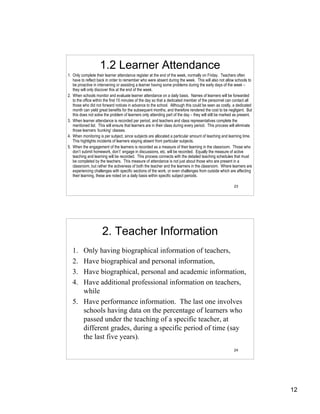
                            1.1 Teacher Attendance
     1. When teachers are only ticking off their names on a teachers’ list. This obviously allows for
        the possibility of individuals ticking off names of other colleagues.
     2. When teachers sign next to their names. It makes it slightly more difficult to sign for others,
        but not impossible.
     3. When teachers sign their name as well as indicating when they entered and left the school.
        This gives a more detail account of the time spent at school, and therefore should allow
        schools to calculate the hours of productive time spent at school (assuming teachers are
        busy/engaging during their time at school).
     4. When the principal actively monitors the attendance of teachers. The teacher attendance
        book will therefore be available in the reception to those who arrive before the bell rings.
        Once the bell has rung, the book will move to the office of the principal, to ensure that
        those teachers who arrive after the starting time, that they write in the time as indicated by
        the principal. Teachers therefore qualify to write in their own time of arrival before the bell
        rings, as well as after the bell rang for closing. In between these two times (school time),
        the attendance book must be completed in the office of the principal.
     5. When there is a culture at school that all teachers who were absent, will submit their leave
        form within 24 hours without any one needing to remind them about it, as well as teachers
        knowing that the leave forms will be forwarded to the relevant level in the district and that
        they are all treated the same (no cliques where some are treated better than others).   22


                                                                                                                                                                          11
1.2 Learner Attendance
1. Only complete their learner attendance register at the end of the week, normally on Friday. Teachers often
   have to reflect back in order to remember who were absent during the week. This will also not allow schools to
   be proactive in intervening or assisting a learner having some problems during the early days of the week –
   they will only discover this at the end of the week.
2. When schools monitor and evaluate learner attendance on a daily basis. Names of learners will be forwarded
   to the office within the first 15 minutes of the day so that a dedicated member of the personnel can contact all
   those who did not forward notices in advance to the school. Although this could be seen as costly, a dedicated
   month can yield great benefits for the subsequent months, and therefore rendered the cost to be negligent. But
   this does not solve the problem of learners only attending part of the day – they will still be marked as present.
3. When learner attendance is recorded per period, and teachers and class representatives complete the
   mentioned list. This will ensure that learners are in their class during every period. This process will eliminate
   those learners ‘bunking’ classes.
4. When monitoring is per subject, since subjects are allocated a particular amount of teaching and learning time.
   This highlights incidents of learners staying absent from particular subjects.
5. When the engagement of the learners is recorded as a measure of their learning in the classroom. Those who
   don’t submit homework, don’t’ engage in discussions, etc. will be recorded. Equally the measure of active
   teaching and learning will be recorded. This process connects with the detailed teaching schedules that must
   be completed by the teachers. This measure of attendance is not just about those who are present in a
   classroom, but rather the activeness of both the teacher and the learners in the classroom. Where learners are
   experiencing challenges with specific sections of the work, or even challenges from outside which are affecting
   their learning, these are noted on a daily basis within specific subject periods.

                                                                                                         23


                     2. Teacher Information
   1. Only having biographical information of teachers,
   2. Have biographical and personal information,
   3. Have biographical, personal and academic information,
   4. Have additional professional information on teachers,
      while
   5. Have performance information. The last one involves
      schools having data on the percentage of learners who
      passed under the teaching of a specific teacher, at
      different grades, during a specific period of time (say
      the last five years).
                                                                                                         24


                                                                                                                        12
3. Learner Information
1. Only the biographical information of learners, but
2. Will add personal information,
3. Add socio-economic information of the learner and thus
   understands that ‘child headed’ learners must be
   accommodated differently than their fellow classmates
   without those challenges,
4. Will track the learner achievements over a particular
   period (normally academic information will be linked
   with academic years, and not with specific learners), and
5. Will add the expectations and aspirations of learners,
   meaning that they will know what learners want to do
   when they leave schools, and therefore don’t organise the
   school based on the capacity of the teachers (subject
   choices) but rather the needs of the learners.         25


             4. Annual Planning
1. A planning process that is aimed at satisfying the
   minimum requirement as stipulated by the districts,
2. Will include planning both compliance wise and
   administrative needs,
3. Will include professional planning,
4. Will incude ethical planning and
5. Will be planning based on the needs of the school, by
   incorporating the support and development services of
   the district officials. The last type of planning include
   a process where the school will submit a request to the
   district (for both the district director and district
   subject support personnel) to assist during specific
   dates and times during particular quarters in the year.26


                                                               13
5. Timetabling
1. When the school has two timetables, one for the district and the
   other for usage during the year. Normally the timetable
   submitted to the district will include the workload allocation as
   required by the ELRC agreements, while the second will not
   comply with the agreements.
2. When the school implements just one timetable, but only value
   sticking to the timetable about 40% during the year. Having
   sorter days and periods is at the order of the day.
3. Will value the implementation of the timetable time about 60%,
4. Will value it 80% of the time, while
5. Will value it 100% of the time. At a level five, all teachers
   regard the timetable as the ‘heart’ around which every activity
   will be structured. They don’t sacrifice teaching and learning
   time as organised within the timetable.
                                                              27


           6. Teaching Schedules
 1. When schools use the national department
    curriculum planning for themselves,
 2. Will have work schedules per theme and/or
    topic for every quarter,
 3. Will have work schedules per month,
 4. Will have work schedules per week, while
 5. Will have work schedules per day, indicating
    every task, homework, notes, worksheets, etc.
    in advance. If teachers are absent, their
    colleagues will know what to teach during such
    periods, and not just ‘baby sit’ the class.
                                                              28


                                                                       14
7. Organogram
1. A positional organogram, indicating the appointment
   positions of staff and others,
2. Only indicates the accountability of subordinates
   towards their immediate seniors,
3. Indicates accountability linked to the positions of staff
   (beyond their immediate senior),
4. When the accountability is linked to the position as
   well as the functions that need to be performed by
   staff, and
5. Includes both the accountability of staff as well as the
   support and development available from seniors
                                                        29


       8. Teaching and Learning
           Support Materials
1. When teacher is the only one with TLSM,
2. When the teacher and a selective number of
   learners will have TLSM,
3. When all have TLSM, but the learners can’t
   take the books home,
4. When all the TLSM are issued on the first day
   of school, for use during the year, and
5. When the school has a central management
   system of issueing and collecting TLSM, and
   will have a return of TLSM of at least 80%. 30


                                                               15
5.
Conclusion
                            31


Average SRC of 21 Schools


                            32


                                 16
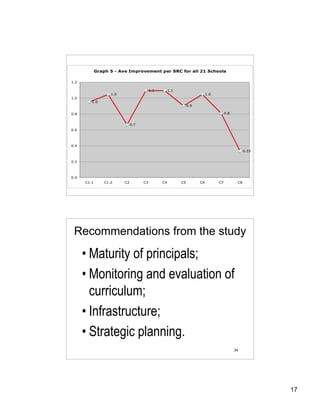
Average Improvement per SRC


                              33


Recommendations from the study

 • Maturity of principals;
 • Monitoring and evaluation of
   curriculum;
 • Infrastructure;
 • Strategic planning.
                              34


                                   17
‘Helicoper view’ of CM days
• 195 schools days (39 weeks);
• 32 weeks of Teaching and
  learning;
• 64 days of Teaching (sharing
  facts and information);
• 96 days of ‘Facilitation of
  Learning’ (know-how,
  comprehension and wisdom);             35


           Homework 3.1
 • Record the ‘curriculum choices’ at
   your school;
 • Indicate why these curriculum
   choices were made to be part of your
   school (is it based on teacher or
   learner needs?);
 • If your had YOUR OWN CHOICE,
   would it be different. If yes, indicate
   your choice, and why. If no, indicate
   why, and motivate your reason(s).
                                         36


                                              18
Homework 3.2
    • Collect a set of all the national
      curriculum statements that are
      applicable to your school.
    • By working with your Maths HoD
      and teachers at your school,
      compare our Maths NCS with that
      of the Illinois Maths assessment
      framework. Write an A4 report on
      it.
                                                                                                   37


                               Assignment 3
Saturday 27 March 2010   Managing the Curriculum in South Africa, from         Write an essay on one of the
                         national to school level                              three frameworks needed in
VENUE: Room L1                                                                 the process of managing
09:00 to 12:00           •   What is the current focus of our curriculum in    curriculum in South Africa.
Break: 12:00 to 13:00         South Africa? What type of proof is available?   You should use the data that
13:00 to 15:00           • What is the current curriculum management           you collected from your case
                            framework? At what level is this function          school to mot ivate and/or
                            performed, by whom, and when?                      support your arguments. The
                         • What is the current teaching (instructional)
                                                                               essay       mus t        include
                            management framework? At what level is this
                            function performed, by whom, and when?             references of a t least 10
                         • What is the current learning management             articles recent (not old er that
                            framework? At what level is this function          5 years) within the field of
                            performed, by whom, and when?
                                                                               focus.


                                                                               Due date: 8 May 2 0 1 0


                                                                                                   38


                                                                                                                  19
Quote of the Day!

  You can call a
donkey a horse 100
 times; it will still
   not make the
 donkey a horse.                           39


           Contact details:
• E-mail: muavia@mweb.co.za;

• Fax: 0866720520

• Cell: 0828229494 (only emergencies)

• Powerpoint website: www.slideshare.net


  Thank You!                               40


                                                20

UP LBL Session 3

  • 1.
    MEd Module: Leadership andManagement of Learning in Education LBL - Session 3 Presenter: Dr Muavia Gallie (PhD) 27 March 2010 1 Content 1. Introduction; 2. Homework reflection; 3. Curriculum Management; 4. Instructional Management 5. Conclusion. 2 1
  • 2.
    1. Introduction 3 Activity 1 - 10 minutes Define the role of the following persons in the process of teaching and learning: • National department officials; • Provincial department officials; • District officials: - Institutional Development Officials; - Curriculum Officials; • Schools: - Principal and Deputy principal; - Heads of Department; - Teachers. 4 2
  • 3.
    2. Homework Reflection 5 3.1 Homework Task 2.1 What is the difference between: • Systems thinking; • Systemic thinking, and; • Systematic thinking. 6 3
  • 4.
    3.2 Homework Task2.2 7 3. Curriculum Management 8 4
  • 5.
    Origin of theNew Curriculum in South Africa 9 1. Here are some special terms used with OBE • Alignment - The process that educators use to get all parts of the teaching and learning process to DIRECTLY MATCH each other. This is an important part of OBE and improves the focus, consistency and effectiveness of instruction. • Assessment - The process that educators use to gather information about learner learning and performance. It may involve familiar methods like paper/pencil testing, or include other kinds of ‘alternative’ approaches that more directly tap particular kinds of learning. For example, driving a care safely or operating a computer efficiently and accurately. Having learners carry out actions that demonstrate what they can do with information is becoming widely used as a better indicator of performance ability and competence than paper/pencil testing alone. 10 5
  • 6.
    2. Here aresome special terms used with OBE • Clarity of focus - This is one of the key principles that define and guide Outcome-Based models. It requires teachers to clearly define what they want successful learning results look like and to focus and organise everything they and the learners do on that desired result. • Context - The actual physical setting, situation, circumstances, or conditions in which learning and its successful demonstration are to take place. • Criterion - An essential part or condition that must be present in a successful demonstration of learner learning. If that essential component is missing or inadequate, the demonstration is judged to be incomplete. For example, if correct spelling is a criterion for publishing an article, the article cannot be published if it has any misspelled words. 11 3. Here are some special terms used with OBE • Critical Outcomes - Usually a set of learning demonstrations expected of all students in an OBE model. These outcomes establish the focus and priorities for all of the curriculum, instruction and assessments. • Designing Back - This is another of the four key principles that define and guide OBE implementation. It is the process of designing and organising curriculum and instruction back from the intended outcome, or learning result. The phrase commonly used is: “Design down from where you want the learners to successfully end up.” 12 6
  • 7.
    4. Here aresome special terms used with OBE • Expanded Opportunity - This is another of the four key principles that define and guide OBE implementation. It means giving learners more than one routine, uniform chance and way to learn something well, recognising that complex abilities require years of practice to master. • High Expectations - This is another of the four key principles that define and guide OBE implementation. It means that staff will consistently: 1) insist on quality work from learners before accepting it as completed, and 2) assure that all learners are continuously given high- quality learning experiences that really challenge them. 13 5. Here are some special terms used with OBE • Outcome - A learning result that is clearly demonstrated by a learner. Outcomes can take many form, ranging from the demonstration of very particular skills and pieces of information to complex performance abilities needed in career and life success. • Success for All - The philosophy and commitment of OBE staff to create the conditions and support in their schools that enable virtually all of their learners to experience genuine success in what they learn. 14 7
  • 8.
    1. OBE SystemsDesign A. Curriculum Design Review current curriculum, develop learning programmes and learning activities which align with Critical Outcomes 15 2. OBE Systems Design B. Teaching Practices 1. In OBE, time is no longer the principal factor which controls access to learning. At every level, staff members will develop ways to reallocate the time available to expand opportunities for learning. 2. Teachers will make decisions which will help learners accomplish COs. Clarify learning activities, using appropriate assessments, preparing activities which focus on Outcomes, and providing expanded opportunities for success. 3. Several initiatives could supply a basis for supporting improved teaching practice. They include Classroom Facilitation, Inclusive Education Strategies, Cooperative Group Strategies, etc. 16 8
  • 9.
    3. OBE SystemsDesign C.Assessment 1. Assessment will be used to validate accomplishment of Outcomes. This process will eventually replace grades, which are designed to compare and rank learners. While some outcomes may be assessed through testing, others will be assessed by observing learners perform tasks which are evaluated according to pre-set criteria. 2. Use of criterion-referenced reports will become increasingly useful in planning teaching and reporting to learners and parents. 17 4. OBE Systems Design D. Placement of Learners Learners progress through an OBE system by accomplishing Critical Outcomes according to identified standards. Learners should have more opportunities to select learning fields for which they are prepared to learn, regardless of their age. Techniques for placing learners in individual learning plans must be used and must be expanded. 18 9
  • 10.
    5. OBE SystemsDesign E. Organisation of the School Traditional organisation of the school day, the allocation of staff, the use of technology, and the length of the school year are issues which need to be re- examined. 19 4. Instructional Management 20 10
  • 11.
    8 School ReadinessComponents Dysfunctional <------------------------------------ > Functional 1 2 3 4 5 1. Attendance • Tick name • Sign name • Time in and out • Principal monitor • Absence submitted • Teacher s daily and process e d • Learners • Learner attendance • Learner attendance • Learner attendance • Learner attendance • Learner engagement end of week per day per period per subject in classroom per subject 2. Teacher Information • Biographical • Personal information • Academic • Professional • Performance information information information information 3. Learner Information • Biographical • Personal information • Socio-economical • Achievement • Expectation and information information information Aspiration information 4. Annual Planning • Compliance planning • Compliance, and • Compliance, • Compliance, • Planning with Administrative Administrative, and Administrative, requests from District Planning Professional Professional and officials Planning Ethical Planning 5. Time-Tabling • Compliance time- • Implementing • Implementing • Implementing • Using the best tabling (2 timetables) timetable submitted timetable using best timetable with teacher, for best (40%) combinations (60%) agreements (80%) class and learners, optimally and efficiently (100%) 6, Quarterly Teaching • National department • Work-schedules per • Work-schedule per • Work-schedule per • QTS with per day Schedules curriculum planning themes and topic month week task, homework, (Quarterly ) notes, worksheets, etc. 7, Organo-gram • No clear accountability • Only accountability • Accountability • Accountability • Clear Accountability and support & requirements are linked to positions linked to positions and Support & development known only and functions Development at all agreements levels 8. Teacher and Learner • TLSM to teacher o n l y • TLSM to teacher and • TLSM to all for use • TLSM to all on first • TLSM issued to all Support Materials selective learners in classroom o n l y day of school for gets returned every their use year (at least 80%) <----------------- Manual Systems -------------------> 21 1.1 Teacher Attendance 1. When teachers are only ticking off their names on a teachers’ list. This obviously allows for the possibility of individuals ticking off names of other colleagues. 2. When teachers sign next to their names. It makes it slightly more difficult to sign for others, but not impossible. 3. When teachers sign their name as well as indicating when they entered and left the school. This gives a more detail account of the time spent at school, and therefore should allow schools to calculate the hours of productive time spent at school (assuming teachers are busy/engaging during their time at school). 4. When the principal actively monitors the attendance of teachers. The teacher attendance book will therefore be available in the reception to those who arrive before the bell rings. Once the bell has rung, the book will move to the office of the principal, to ensure that those teachers who arrive after the starting time, that they write in the time as indicated by the principal. Teachers therefore qualify to write in their own time of arrival before the bell rings, as well as after the bell rang for closing. In between these two times (school time), the attendance book must be completed in the office of the principal. 5. When there is a culture at school that all teachers who were absent, will submit their leave form within 24 hours without any one needing to remind them about it, as well as teachers knowing that the leave forms will be forwarded to the relevant level in the district and that they are all treated the same (no cliques where some are treated better than others). 22 11
  • 12.
    1.2 Learner Attendance 1.Only complete their learner attendance register at the end of the week, normally on Friday. Teachers often have to reflect back in order to remember who were absent during the week. This will also not allow schools to be proactive in intervening or assisting a learner having some problems during the early days of the week – they will only discover this at the end of the week. 2. When schools monitor and evaluate learner attendance on a daily basis. Names of learners will be forwarded to the office within the first 15 minutes of the day so that a dedicated member of the personnel can contact all those who did not forward notices in advance to the school. Although this could be seen as costly, a dedicated month can yield great benefits for the subsequent months, and therefore rendered the cost to be negligent. But this does not solve the problem of learners only attending part of the day – they will still be marked as present. 3. When learner attendance is recorded per period, and teachers and class representatives complete the mentioned list. This will ensure that learners are in their class during every period. This process will eliminate those learners ‘bunking’ classes. 4. When monitoring is per subject, since subjects are allocated a particular amount of teaching and learning time. This highlights incidents of learners staying absent from particular subjects. 5. When the engagement of the learners is recorded as a measure of their learning in the classroom. Those who don’t submit homework, don’t’ engage in discussions, etc. will be recorded. Equally the measure of active teaching and learning will be recorded. This process connects with the detailed teaching schedules that must be completed by the teachers. This measure of attendance is not just about those who are present in a classroom, but rather the activeness of both the teacher and the learners in the classroom. Where learners are experiencing challenges with specific sections of the work, or even challenges from outside which are affecting their learning, these are noted on a daily basis within specific subject periods. 23 2. Teacher Information 1. Only having biographical information of teachers, 2. Have biographical and personal information, 3. Have biographical, personal and academic information, 4. Have additional professional information on teachers, while 5. Have performance information. The last one involves schools having data on the percentage of learners who passed under the teaching of a specific teacher, at different grades, during a specific period of time (say the last five years). 24 12
  • 13.
    3. Learner Information 1.Only the biographical information of learners, but 2. Will add personal information, 3. Add socio-economic information of the learner and thus understands that ‘child headed’ learners must be accommodated differently than their fellow classmates without those challenges, 4. Will track the learner achievements over a particular period (normally academic information will be linked with academic years, and not with specific learners), and 5. Will add the expectations and aspirations of learners, meaning that they will know what learners want to do when they leave schools, and therefore don’t organise the school based on the capacity of the teachers (subject choices) but rather the needs of the learners. 25 4. Annual Planning 1. A planning process that is aimed at satisfying the minimum requirement as stipulated by the districts, 2. Will include planning both compliance wise and administrative needs, 3. Will include professional planning, 4. Will incude ethical planning and 5. Will be planning based on the needs of the school, by incorporating the support and development services of the district officials. The last type of planning include a process where the school will submit a request to the district (for both the district director and district subject support personnel) to assist during specific dates and times during particular quarters in the year.26 13
  • 14.
    5. Timetabling 1. Whenthe school has two timetables, one for the district and the other for usage during the year. Normally the timetable submitted to the district will include the workload allocation as required by the ELRC agreements, while the second will not comply with the agreements. 2. When the school implements just one timetable, but only value sticking to the timetable about 40% during the year. Having sorter days and periods is at the order of the day. 3. Will value the implementation of the timetable time about 60%, 4. Will value it 80% of the time, while 5. Will value it 100% of the time. At a level five, all teachers regard the timetable as the ‘heart’ around which every activity will be structured. They don’t sacrifice teaching and learning time as organised within the timetable. 27 6. Teaching Schedules 1. When schools use the national department curriculum planning for themselves, 2. Will have work schedules per theme and/or topic for every quarter, 3. Will have work schedules per month, 4. Will have work schedules per week, while 5. Will have work schedules per day, indicating every task, homework, notes, worksheets, etc. in advance. If teachers are absent, their colleagues will know what to teach during such periods, and not just ‘baby sit’ the class. 28 14
  • 15.
    7. Organogram 1. Apositional organogram, indicating the appointment positions of staff and others, 2. Only indicates the accountability of subordinates towards their immediate seniors, 3. Indicates accountability linked to the positions of staff (beyond their immediate senior), 4. When the accountability is linked to the position as well as the functions that need to be performed by staff, and 5. Includes both the accountability of staff as well as the support and development available from seniors 29 8. Teaching and Learning Support Materials 1. When teacher is the only one with TLSM, 2. When the teacher and a selective number of learners will have TLSM, 3. When all have TLSM, but the learners can’t take the books home, 4. When all the TLSM are issued on the first day of school, for use during the year, and 5. When the school has a central management system of issueing and collecting TLSM, and will have a return of TLSM of at least 80%. 30 15
  • 16.
    5. Conclusion 31 Average SRC of 21 Schools 32 16
  • 17.
    Average Improvement perSRC 33 Recommendations from the study • Maturity of principals; • Monitoring and evaluation of curriculum; • Infrastructure; • Strategic planning. 34 17
  • 18.
    ‘Helicoper view’ ofCM days • 195 schools days (39 weeks); • 32 weeks of Teaching and learning; • 64 days of Teaching (sharing facts and information); • 96 days of ‘Facilitation of Learning’ (know-how, comprehension and wisdom); 35 Homework 3.1 • Record the ‘curriculum choices’ at your school; • Indicate why these curriculum choices were made to be part of your school (is it based on teacher or learner needs?); • If your had YOUR OWN CHOICE, would it be different. If yes, indicate your choice, and why. If no, indicate why, and motivate your reason(s). 36 18
  • 19.
    Homework 3.2 • Collect a set of all the national curriculum statements that are applicable to your school. • By working with your Maths HoD and teachers at your school, compare our Maths NCS with that of the Illinois Maths assessment framework. Write an A4 report on it. 37 Assignment 3 Saturday 27 March 2010 Managing the Curriculum in South Africa, from Write an essay on one of the national to school level three frameworks needed in VENUE: Room L1 the process of managing 09:00 to 12:00 • What is the current focus of our curriculum in curriculum in South Africa. Break: 12:00 to 13:00 South Africa? What type of proof is available? You should use the data that 13:00 to 15:00 • What is the current curriculum management you collected from your case framework? At what level is this function school to mot ivate and/or performed, by whom, and when? support your arguments. The • What is the current teaching (instructional) essay mus t include management framework? At what level is this function performed, by whom, and when? references of a t least 10 • What is the current learning management articles recent (not old er that framework? At what level is this function 5 years) within the field of performed, by whom, and when? focus. Due date: 8 May 2 0 1 0 38 19
  • 20.
    Quote of theDay! You can call a donkey a horse 100 times; it will still not make the donkey a horse. 39 Contact details: • E-mail: muavia@mweb.co.za; • Fax: 0866720520 • Cell: 0828229494 (only emergencies) • Powerpoint website: www.slideshare.net Thank You! 40 20