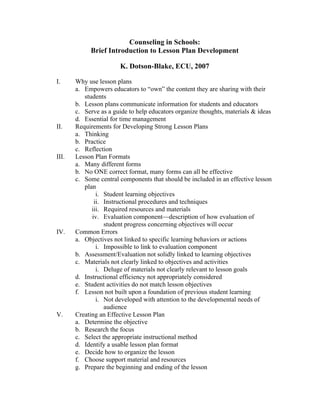
Counseling in Schools:
            Brief Introduction to Lesson Plan Development

                       K. Dotson-Blake, ECU, 2007

I.     Why use lesson plans
       a. Empowers educators to “own” the content they are sharing with their
          students
       b. Lesson plans communicate information for students and educators
       c. Serve as a guide to help educators organize thoughts, materials & ideas
       d. Essential for time management
II.    Requirements for Developing Strong Lesson Plans
       a. Thinking
       b. Practice
       c. Reflection
III.   Lesson Plan Formats
       a. Many different forms
       b. No ONE correct format, many forms can all be effective
       c. Some central components that should be included in an effective lesson
          plan
               i. Student learning objectives
              ii. Instructional procedures and techniques
             iii. Required resources and materials
             iv. Evaluation component—description of how evaluation of
                  student progress concerning objectives will occur
IV.    Common Errors
       a. Objectives not linked to specific learning behaviors or actions
               i. Impossible to link to evaluation component
       b. Assessment/Evaluation not solidly linked to learning objectives
       c. Materials not clearly linked to objectives and activities
               i. Deluge of materials not clearly relevant to lesson goals
       d. Instructional efficiency not appropriately considered
       e. Student activities do not match lesson objectives
       f. Lesson not built upon a foundation of previous student learning
               i. Not developed with attention to the developmental needs of
                  audience
V.     Creating an Effective Lesson Plan
       a. Determine the objective
       b. Research the focus
       c. Select the appropriate instructional method
       d. Identify a usable lesson plan format
       e. Decide how to organize the lesson
       f. Choose support material and resources
       g. Prepare the beginning and ending of the lesson
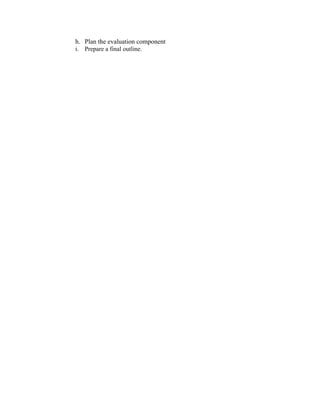
h. Plan the evaluation component
i. Prepare a final outline.

Lesson plan handout

  • 1.
    Counseling in Schools: Brief Introduction to Lesson Plan Development K. Dotson-Blake, ECU, 2007 I. Why use lesson plans a. Empowers educators to “own” the content they are sharing with their students b. Lesson plans communicate information for students and educators c. Serve as a guide to help educators organize thoughts, materials & ideas d. Essential for time management II. Requirements for Developing Strong Lesson Plans a. Thinking b. Practice c. Reflection III. Lesson Plan Formats a. Many different forms b. No ONE correct format, many forms can all be effective c. Some central components that should be included in an effective lesson plan i. Student learning objectives ii. Instructional procedures and techniques iii. Required resources and materials iv. Evaluation component—description of how evaluation of student progress concerning objectives will occur IV. Common Errors a. Objectives not linked to specific learning behaviors or actions i. Impossible to link to evaluation component b. Assessment/Evaluation not solidly linked to learning objectives c. Materials not clearly linked to objectives and activities i. Deluge of materials not clearly relevant to lesson goals d. Instructional efficiency not appropriately considered e. Student activities do not match lesson objectives f. Lesson not built upon a foundation of previous student learning i. Not developed with attention to the developmental needs of audience V. Creating an Effective Lesson Plan a. Determine the objective b. Research the focus c. Select the appropriate instructional method d. Identify a usable lesson plan format e. Decide how to organize the lesson f. Choose support material and resources g. Prepare the beginning and ending of the lesson
  • 2.
    h. Plan theevaluation component i. Prepare a final outline.