Presenter:
Dr	Muavia	Gallie	(PhD)
SchoolTurnaround
All	our	learners	can	and	should	
be	successful	in	our	schools.
STF-EMU
Excellent	Schools	
by	Design
www.slideshare.net
Register	to	download	– it	is	free
Search	– Excellent	Schools	brief
ZWELETHEMBA	HIGH	SCHOOL
TOPICS:
1. SUCCESS	FOR	ALL	LEARNERS	– 100%	PASS-RATE
2. LEARNER	DREAMS
3. TARGET	SETTING
4. RISK	ANALYSIS
5. 170	DAYS	OF	TEACHING	AND	LEARNING
6. TIMETABLE	TRANSITIONAL	TIME
7. DAILY	LESSON	PLANS
8. NO	HOMEWORK,	RATHER	CLASSWORK
9. INTERNAL	EXAMINATION	PAPERS
10. TEST	&	EXAM	PREPARATION
11. LEARNER	SELF-ASSESSMENT
12. DIGITAL	TEACHING	TIME
13. 3Lx4Mx3H	QUESTIONS
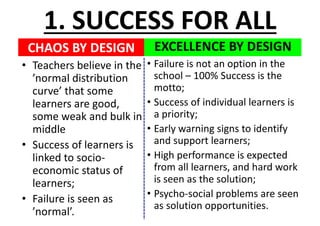
CHAOS	BY	DESIGN
• Teachers	believe	in	the	
’normal	distribution	
curve’	that	some	
learners	are	good,	
some	weak	and	bulk	in	
middle
• Success	of	learners	is	
linked	to	socio-
economic	status	of	
learners;
• Failure	is	seen	as	
’normal’.
EXCELLENCE	BY	DESIGN
1.	SUCCESS	FOR	ALL
• Failure	is	not	an	option	in	the	
school	– 100%	Success	is	the	
motto;
• Success	of	individual	learners	is	
a	priority;
• Early	warning	signs	to	identify	
and	support	learners;
• High	performance	is	expected	
from	all	learners,	and	hard	work	
is	seen	as	the	solution;
• Psycho-social	problems	are	seen	
as	solution	opportunities.
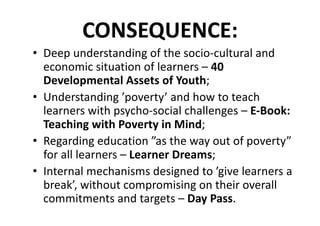
CONSEQUENCE:
• Deep	understanding	of	the	socio-cultural	and	
economic	situation	of	learners	– 40	
Developmental	Assets	of	Youth;
• Understanding	’poverty’	and	how	to	teach	
learners	with	psycho-social	challenges	– E-Book:	
Teaching	with	Poverty	in	Mind;
• Regarding	education	”as	the	way	out	of	poverty”	
for	all	learners	– Learner	Dreams;
• Internal	mechanisms	designed	to	’give	learners	a	
break’,	without	compromising	on	their	overall	
commitments	and	targets	– Day	Pass.
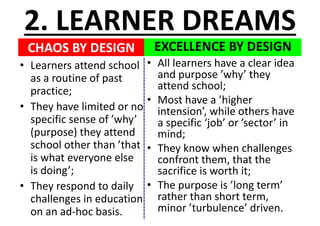
CHAOS	BY	DESIGN
• Learners	attend	school	
as	a	routine	of	past	
practice;
• They	have	limited	or	no	
specific	sense	of	’why’	
(purpose)	they	attend	
school	other	than	’that	
is	what	everyone	else	
is	doing’;
• They	respond	to	daily	
challenges	in	education	
on	an	ad-hoc	basis.
EXCELLENCE	BY	DESIGN
2.	LEARNER	DREAMS
• All	learners	have	a	clear	idea	
and	purpose	’why’	they	
attend	school;
• Most	have	a	’higher	
intension’,	while	others	have	
a	specific	‘job’	or	’sector’	in	
mind;
• They	know	when	challenges	
confront	them,	that	the	
sacrifice	is	worth	it;
• The	purpose	is	’long	term’	
rather	than	short	term,	
minor	’turbulence’	driven.
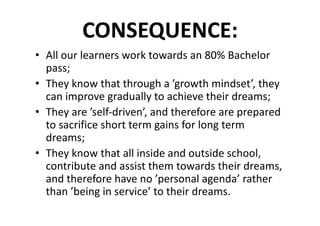
CONSEQUENCE:
• All	our	learners	work	towards	an	80%	Bachelor	
pass;
• They	know	that	through	a	’growth	mindset’,	they	
can	improve	gradually	to	achieve	their	dreams;
• They	are	’self-driven’,	and	therefore	are	prepared	
to	sacrifice	short	term	gains	for	long	term	
dreams;
• They	know	that	all	inside	and	outside	school,	
contribute	and	assist	them	towards	their	dreams,	
and	therefore	have	no	’personal	agenda’	rather	
than	’being	in	service’	to	their	dreams.
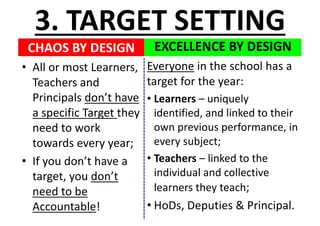
CHAOS	BY	DESIGN
• All	or	most	Learners,	
Teachers	and	
Principals	don’t	have	
a	specific	Target	they	
need	to	work	
towards	every	year;
• If	you	don’t	have	a	
target,	you	don’t	
need	to	be	
Accountable!
EXCELLENCE	BY	DESIGN
3.	TARGET	SETTING
Everyone in	the	school	has	a	
target	for	the	year:
• Learners – uniquely	
identified,	and	linked	to	their	
own	previous	performance,	in	
every	subject;
• Teachers – linked	to	the	
individual	and	collective	
learners	they	teach;
• HoDs,	Deputies	&	Principal.
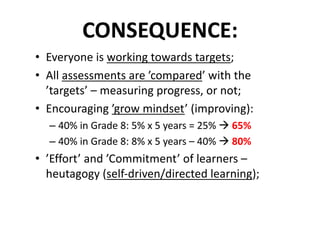
CONSEQUENCE:
• Everyone	is	working	towards	targets;
• All	assessments	are	’compared’	with	the	
’targets’	– measuring	progress,	or	not;
• Encouraging	’grow	mindset’	(improving):
– 40%	in	Grade	8:	5%	x	5	years	=	25%	à 65%
– 40%	in	Grade	8:	8%	x	5	years	– 40%	à 80%
• ’Effort’	and	’Commitment’	of	learners	–
heutagogy (self-driven/directed	learning);
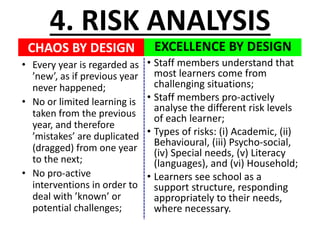
CHAOS	BY	DESIGN
• Every	year	is	regarded	as	
’new’,	as	if	previous	year	
never	happened;
• No	or	limited	learning	is	
taken	from	the	previous	
year,	and	therefore	
’mistakes’	are	duplicated	
(dragged)	from	one	year	
to	the	next;
• No	pro-active	
interventions	in	order	to	
deal	with	’known’	or	
potential	challenges;
EXCELLENCE	BY	DESIGN
4.	RISK	ANALYSIS
• Staff	members	understand	that	
most	learners	come	from	
challenging	situations;
• Staff	members	pro-actively	
analyse the	different	risk	levels	
of	each	learner;
• Types	of	risks:	(i)	Academic,	(ii)	
Behavioural,	(iii)	Psycho-social,	
(iv)	Special	needs,	(v)	Literacy	
(languages),	and	(vi)	Household;
• Learners	see	school	as	a	
support	structure,	responding	
appropriately	to	their	needs,	
where	necessary.
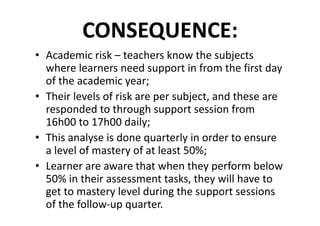
CONSEQUENCE:
• Academic	risk	– teachers	know	the	subjects	
where	learners	need	support	in	from	the	first	day	
of	the	academic	year;
• Their	levels	of	risk	are	per	subject,	and	these	are	
responded	to	through	support	session	from	
16h00	to	17h00	daily;
• This	analyse is	done	quarterly	in	order	to	ensure	
a	level	of	mastery	of	at	least	50%;
• Learner	are	aware	that	when	they	perform	below	
50%	in	their	assessment	tasks,	they	will	have	to	
get	to	mastery	level	during	the	support	sessions	
of	the	follow-up	quarter.
CHAOS	BY	DESIGN
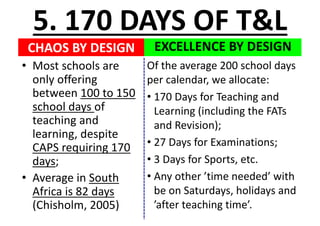
• Most	schools	are	
only	offering	
between	100	to	150	
school	days	of	
teaching	and	
learning,	despite	
CAPS	requiring	170	
days;
• Average	in	South	
Africa	is	82	days	
(Chisholm,	2005)
EXCELLENCE	BY	DESIGN
5.	170	DAYS	OF	T&L
Of	the	average	200	school	days	
per	calendar,	we	allocate:
• 170	Days	for	Teaching	and	
Learning	(including	the	FATs	
and	Revision);
• 27	Days	for	Examinations;
• 3	Days	for	Sports,	etc.
• Any	other	’time	needed’	with	
be	on	Saturdays,	holidays	and	
’after	teaching	time’.
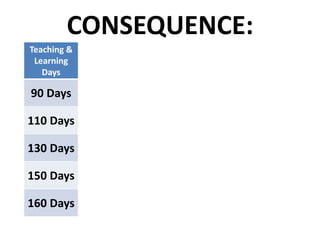
CONSEQUENCE:
Teaching	&	
Learning	
Days
Missing	
Days	per	
Year
Missing	
Days	per
Primary
Missing	
Days	per	
Schooling
Missing
Days	in	
Years	(12)
90	Days 80 560 960 5,64	yrs
110	Days 60 420 720 4,23	yrs
130	Days 40 280 480 2,82	yrs
150	Days 20 140 160 0,94	yrs
160	Days 10 70 80 0,47	yrs
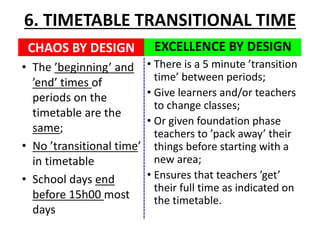
CHAOS	BY	DESIGN
• The	’beginning’	and	
’end’	times	of	
periods	on	the	
timetable	are	the	
same;
• No	’transitional	time’	
in	timetable
• School	days	end	
before	15h00	most	
days
EXCELLENCE	BY	DESIGN
6.	TIMETABLE	TRANSITIONAL	TIME
• There	is	a	5	minute	’transition	
time’	between	periods;
• Give	learners	and/or	teachers	
to	change	classes;
• Or	given	foundation	phase	
teachers	to	’pack	away’	their	
things	before	starting	with	a	
new	area;
• Ensures	that	teachers	’get’	
their	full	time	as	indicated	on	
the	timetable.
CONSEQUENCE:
• Additional	45	minutes	per	day	to	the	’closing	
time;
• Teachers	can	follow	their	50-60	minutes	daily	
lesson	plans,	per	minute;
• Learners	get	their	full	5,5	hours	per	day	or	
27,5	hours	per	week;
• The	potential	of	decent	CLASSWORK	can	be	
structured,	rather	than	giving	HOMEWORK,	
which	I	believe	should	be	banned	from	
schools.
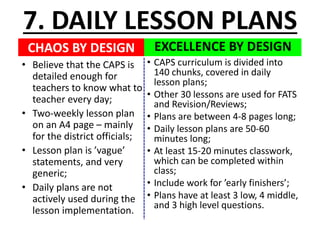
CHAOS	BY	DESIGN
• Believe	that	the	CAPS	is	
detailed	enough	for	
teachers	to	know	what	to	
teacher	every	day;
• Two-weekly	lesson	plan	
on	an	A4	page	– mainly	
for	the	district	officials;
• Lesson	plan	is	’vague’	
statements,	and	very	
generic;
• Daily	plans	are	not	
actively	used	during	the	
lesson	implementation.
EXCELLENCE	BY	DESIGN
7.	DAILY	LESSON	PLANS
• CAPS	curriculum	is	divided	into	
140	chunks,	covered	in	daily	
lesson	plans;
• Other	30	lessons	are	used	for	FATS	
and	Revision/Reviews;
• Plans	are	between	4-8	pages	long;
• Daily	lesson	plans	are	50-60	
minutes	long;
• At	least	15-20	minutes	classwork,	
which	can	be	completed	within	
class;
• Include	work	for	’early	finishers’;
• Plans	have	at	least	3	low,	4	middle,	
and	3	high	level	questions.
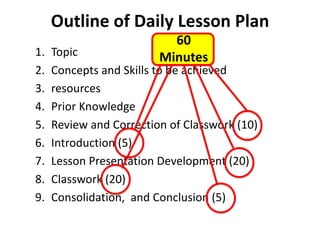
Outline	of	Daily	Lesson	Plan
1. Topic
2. Concepts	and	Skills	to	be	achieved
3. resources
4. Prior	Knowledge
5. Review	and	Correction	of	Classwork	(10)
6. Introduction	(5)
7. Lesson	Presentation	Development	(20)
8. Classwork	(20)
9. Consolidation,		and	Conclusion	(5)
60
Minutes
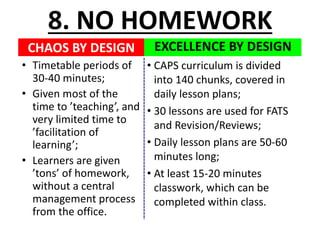
CHAOS	BY	DESIGN
• Timetable	periods	of	
30-40	minutes;
• Given	most	of	the	
time	to	’teaching’,	and	
very	limited	time	to	
’facilitation	of	
learning’;
• Learners	are	given	
’tons’	of	homework,	
without	a	central	
management	process	
from	the	office.
EXCELLENCE	BY	DESIGN
8.	NO	HOMEWORK
• CAPS	curriculum	is	divided	
into	140	chunks,	covered	in	
daily	lesson	plans;
• 30	lessons	are	used	for	FATS	
and	Revision/Reviews;
• Daily	lesson	plans	are	50-60	
minutes	long;
• At	least	15-20	minutes	
classwork,	which	can	be	
completed	within	class.
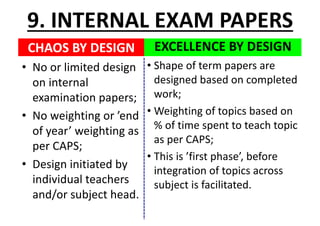
CHAOS	BY	DESIGN
• No	or	limited	design	
on	internal	
examination	papers;
• No	weighting	or	’end	
of	year’	weighting	as	
per	CAPS;
• Design	initiated	by	
individual	teachers	
and/or	subject	head.
EXCELLENCE	BY	DESIGN
9.	INTERNAL	EXAM	PAPERS
• Shape	of	term	papers	are	
designed	based	on	completed	
work;
• Weighting	of	topics	based	on	
%	of	time	spent	to	teach	topic	
as	per	CAPS;
• This	is	’first	phase’,	before	
integration	of	topics	across	
subject	is	facilitated.
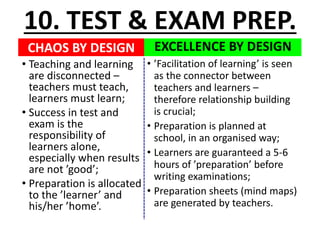
CHAOS	BY	DESIGN
• Teaching	and	learning	
are	disconnected	–
teachers	must	teach,	
learners	must	learn;
• Success	in	test	and	
exam	is	the	
responsibility	of	
learners	alone,	
especially	when	results	
are	not	’good’;
• Preparation	is	allocated	
to	the	’learner’	and	
his/her	’home’.
EXCELLENCE	BY	DESIGN
10.	TEST	&	EXAM	PREP.
• ’Facilitation	of	learning’	is	seen	
as	the	connector	between	
teachers	and	learners	–
therefore	relationship	building	
is	crucial;
• Preparation	is	planned	at	
school,	in	an	organised way;
• Learners	are	guaranteed	a	5-6	
hours	of	’preparation’	before	
writing	examinations;
• Preparation	sheets	(mind	maps)	
are	generated	by	teachers.
CHAOS	BY	DESIGN
• The	activity	of	
’assessment’	is	seen	as	
the	responsibility	of	
teachers	only;
• Learners	are	the	
recipients	of	’marks’	from	
teachers,	and	often	have	
not	clue	how	to	’judge’	
the	value	of	their	work;
• Learners	sometime	see	
teachers	as	people	who	
can	’give	them	any	marks’,	
disconnected	from	the	
value	of	the	work	
submitted.
EXCELLENCE	BY	DESIGN
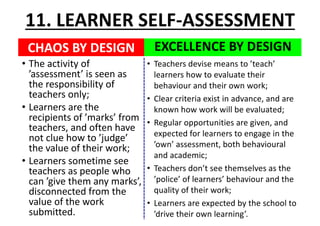
11.	LEARNER	SELF-ASSESSMENT
• Teachers	devise	means	to	’teach’	
learners	how	to	evaluate	their	
behaviour and	their	own	work;
• Clear	criteria	exist	in	advance,	and	are	
known	how	work	will	be	evaluated;
• Regular	opportunities	are	given,	and	
expected	for	learners	to	engage	in	the	
’own’	assessment,	both	behavioural
and	academic;
• Teachers	don’t	see	themselves	as	the	
’police’	of	learners’	behaviour and	the	
quality	of	their	work;
• Learners	are	expected	by	the	school	to	
’drive	their	own	learning’.
CHAOS	BY	DESIGN
• Teachers	see	themselves	as	the	
only	’source	of	information’	in	
the	learning	process;
• The	primary	resources	will	be	
teacher	and	the	textbook;
• Primarily	a	’manual’	process	of	
teaching	and	learning;
• Technology,	such	as	cellphones,	is	
not	allowed	(banned);
• Technology	is	seen	as	’threat’	and	
’distraction’	in	the	battle	for	the	
attention	of	learners;
• Teachers	suspect	that	presence	
of	technology	could	be	used	to	
’share’	digital	content.
EXCELLENCE	BY	DESIGN
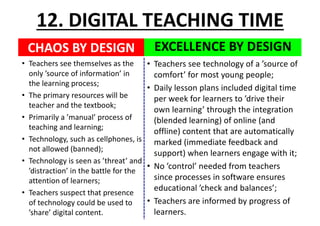
12.	DIGITAL	TEACHING	TIME
• Teachers	see	technology	of	a	’source	of	
comfort’	for	most	young	people;
• Daily	lesson	plans	included	digital	time	
per	week	for	learners	to	’drive	their	
own	learning’	through	the	integration	
(blended	learning)	of	online	(and	
offline)	content	that	are	automatically	
marked	(immediate	feedback	and	
support)	when	learners	engage	with	it;
• No	’control’	needed	from	teachers	
since	processes	in	software	ensures	
educational	’check	and	balances’;
• Teachers	are	informed	by	progress	of	
learners.
CHAOS	BY	DESIGN
• Teachers	don’t	have	prepared	
questions	they	want	to	engage	
with	learners,	before	they	deliver	
their	lessons;
• And	if	prepared,	the	majority	of	
questions	are	’low	level’	
questions	the	learners	have	to	
engaged	in	during	the	lesson;
• Teacher	will	give	’middle	and	high	
level’	questions	during	the	
homework	or	test	and	
examination	time;
• Learners	will	see	a	fair	amount	of	
middle	and	high	level	questions	
for	the	first	time	during	exams.
EXCELLENCE	BY	DESIGN
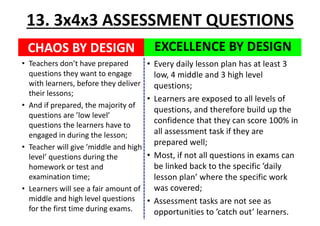
13.	3x4x3	ASSESSMENT	QUESTIONS
• Every	daily	lesson	plan	has	at	least	3	
low,	4	middle	and	3	high	level	
questions;
• Learners	are	exposed	to	all	levels	of	
questions,	and	therefore	build	up	the	
confidence	that	they	can	score	100%	in	
all	assessment	task	if	they	are	
prepared	well;
• Most,	if	not	all	questions	in	exams	can	
be	linked	back	to	the	specific	’daily	
lesson	plan’	where	the	specific	work	
was	covered;
• Assessment	tasks	are	not	see	as	
opportunities	to	’catch	out’	learners.
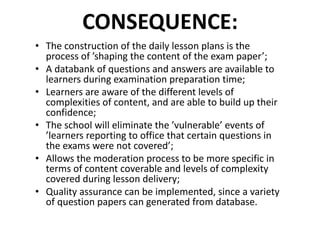
CONSEQUENCE:
• The	construction	of	the	daily	lesson	plans	is	the	
process	of	’shaping	the	content	of	the	exam	paper’;
• A	databank	of	questions	and	answers	are	available	to	
learners	during	examination	preparation	time;
• Learners	are	aware	of	the	different	levels	of	
complexities	of	content,	and	are	able	to	build	up	their	
confidence;
• The	school	will	eliminate	the	’vulnerable’	events	of	
’learners	reporting	to	office	that	certain	questions	in	
the	exams	were	not	covered’;
• Allows	the	moderation	process	to	be	more	specific	in	
terms	of	content	coverable	and	levels	of	complexity
covered	during	lesson	delivery;
• Quality	assurance	can	be	implemented,	since	a	variety	
of	question	papers	can	generated	from	database.
Thank	You!

STF EMU - Excellent Schools by Design - brief