Universal Design and the ICF


                       Edward Steinfeld, Arch.D.
                       Gary Scott Danford, Ph.D.
                  Center for Inclusive Design and
             Environmental Access (IDEA Center)
                School of Architecture and Planning
                               University at Buffalo
                  The State University of New York
R&D Activities


Related Activities of the Rehabilitation
Engineering Research Center on
Universal Design and the Built
Environment, 2005 – 2010
  Develop low cost methods for measuring universal
  design (UD) effectiveness
  Develop benchmarks for effectiveness
  Develop evidence based guidelines and tie them to
  the ICF
  Survey state of the art in selected areas
  Involve stakeholders in developing guidelines

                                                      UD & ICF
Outline


An introduction to UD
The relationship of the ICF to UD practice
A “crosswalk” between the ICF and UD
A method for developing that crosswalk
The need to build a community of practice


                                             UD & ICF
Key Points


UD is the new paradigm for environmental
facilitation of preferred outcomes related to
function, activity and participation
UD is highly compatible with the ICF model
A body of evidence for practicing UD needs to
be assembled
The ICF can be used to provide that body of
evidence and guide research
A crosswalk is needed to link the ICF and UD
Participation of all stakeholder groups is
desirable in developing the body of evidence


                                                UD & ICF
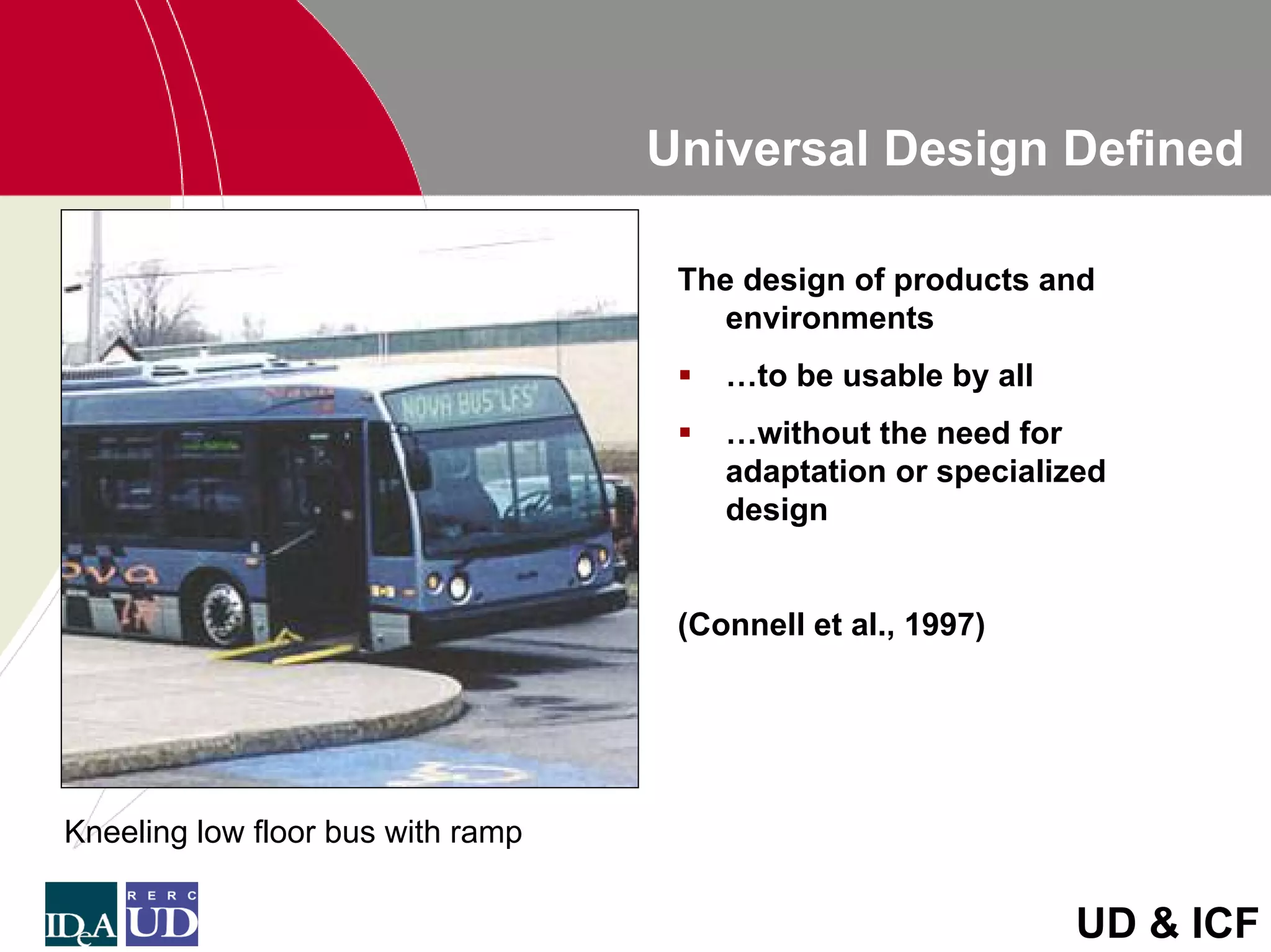
Universal Design Defined

                                    The design of products and
                                       environments
                                       …to be usable by all
                                       …without the need for
                                       adaptation or specialized
                                       design


                                    (Connell et al., 1997)


Kneeling low floor bus with ramp

                                                              UD & ICF
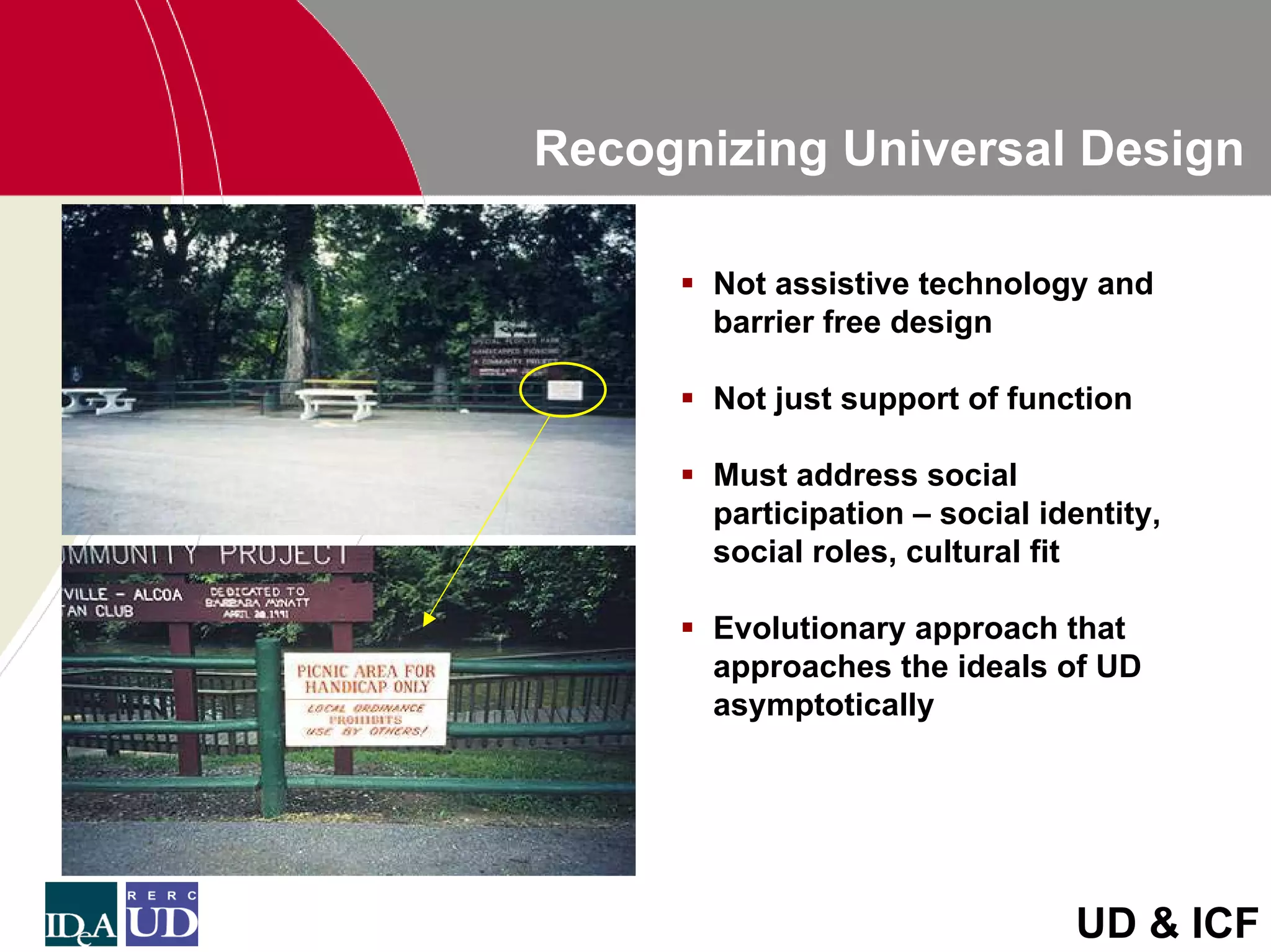
Recognizing Universal Design

       Not assistive technology and
       barrier free design

       Not just support of function

       Must address social
       participation – social identity,
       social roles, cultural fit

       Evolutionary approach that
       approaches the ideals of UD
       asymptotically


                                UD & ICF
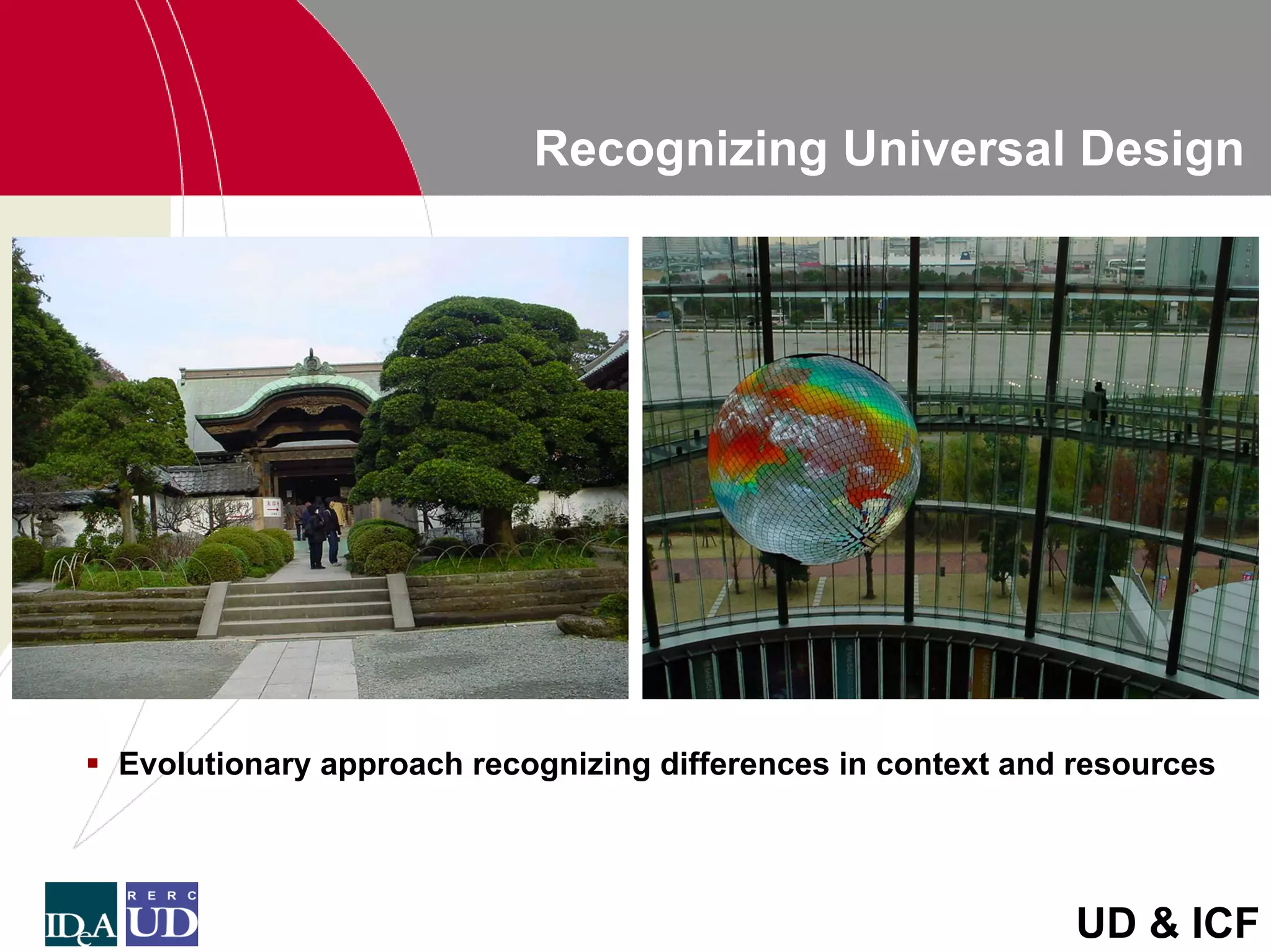
Recognizing Universal Design


Evolutionary approach recognizing differences in context and resources


                                                             UD & ICF
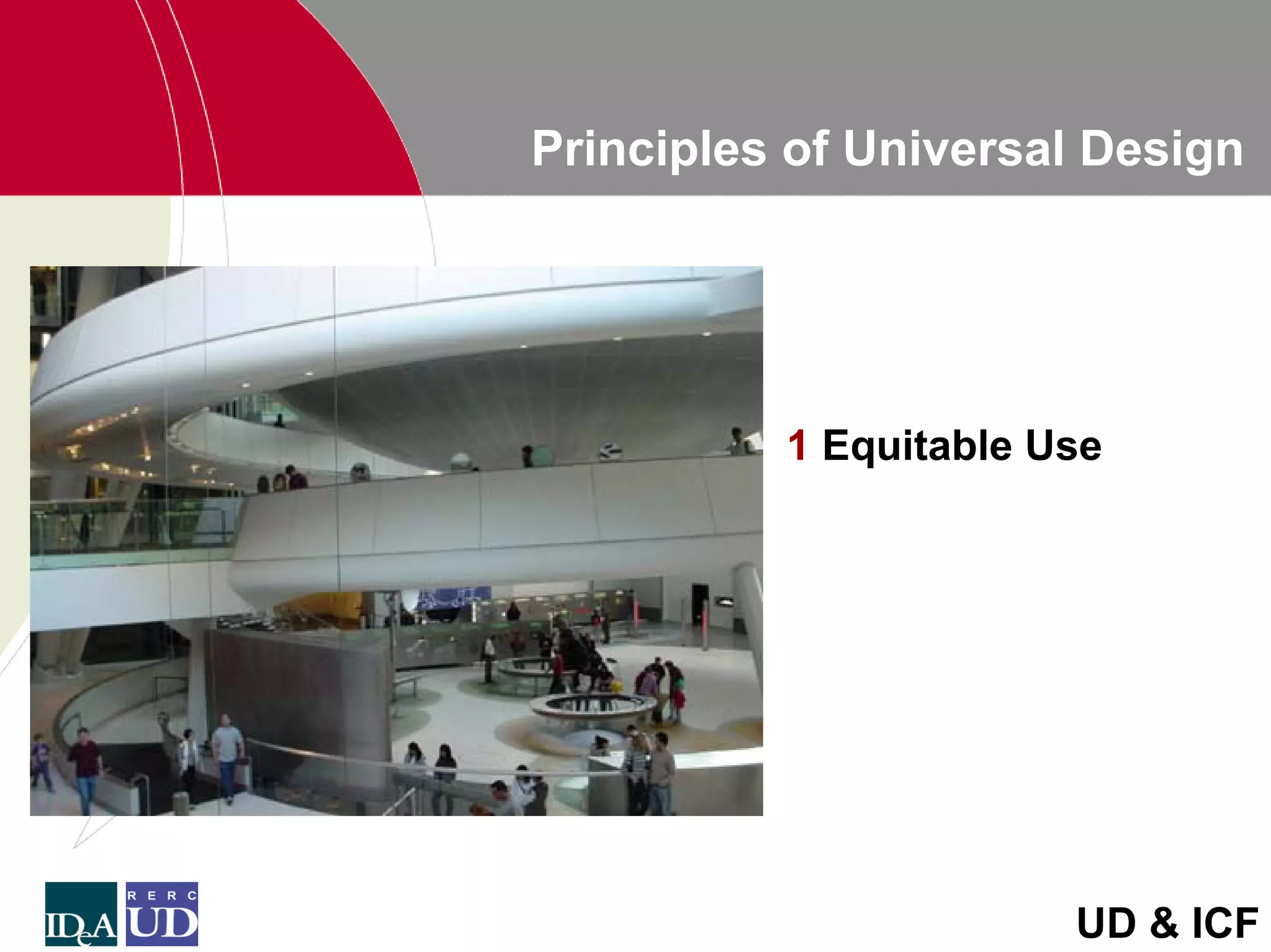
Principles of Universal Design


          1 Equitable Use


                       UD & ICF
Principles of Universal Design


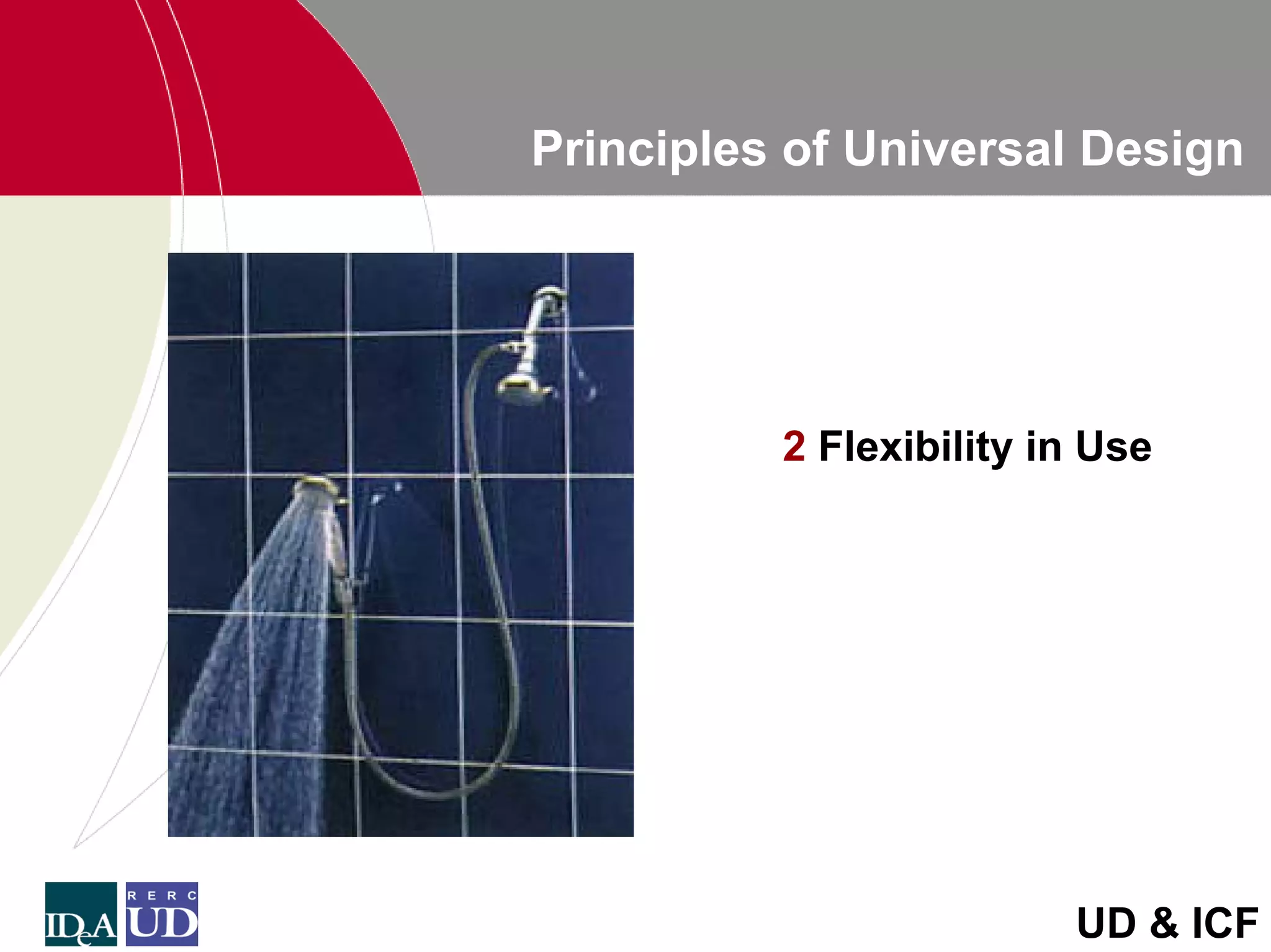
          2 Flexibility in Use


                         UD & ICF
Principles of Universal Design


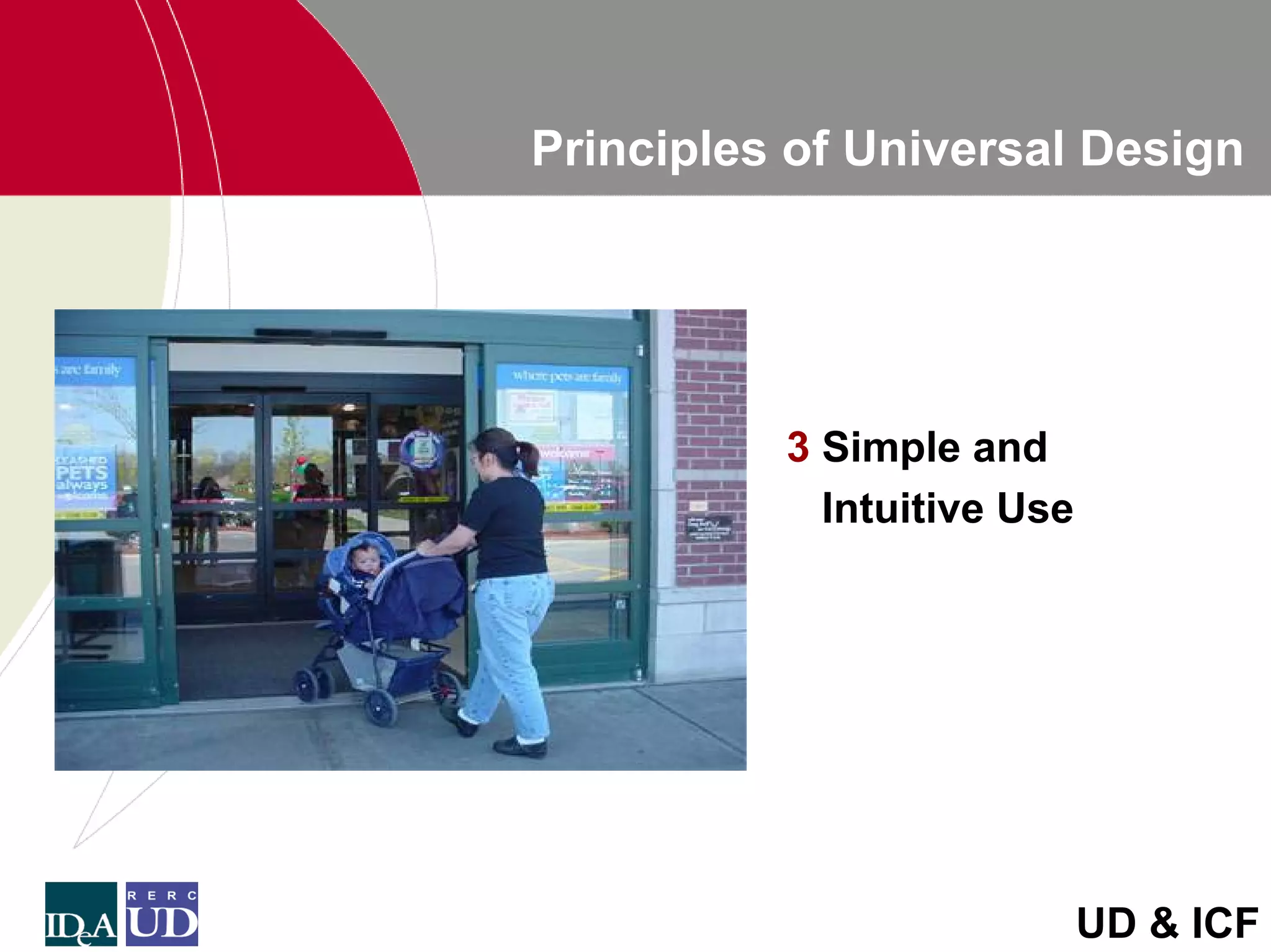
          3 Simple and
            Intuitive Use


                            UD & ICF
Principles of Universal Design


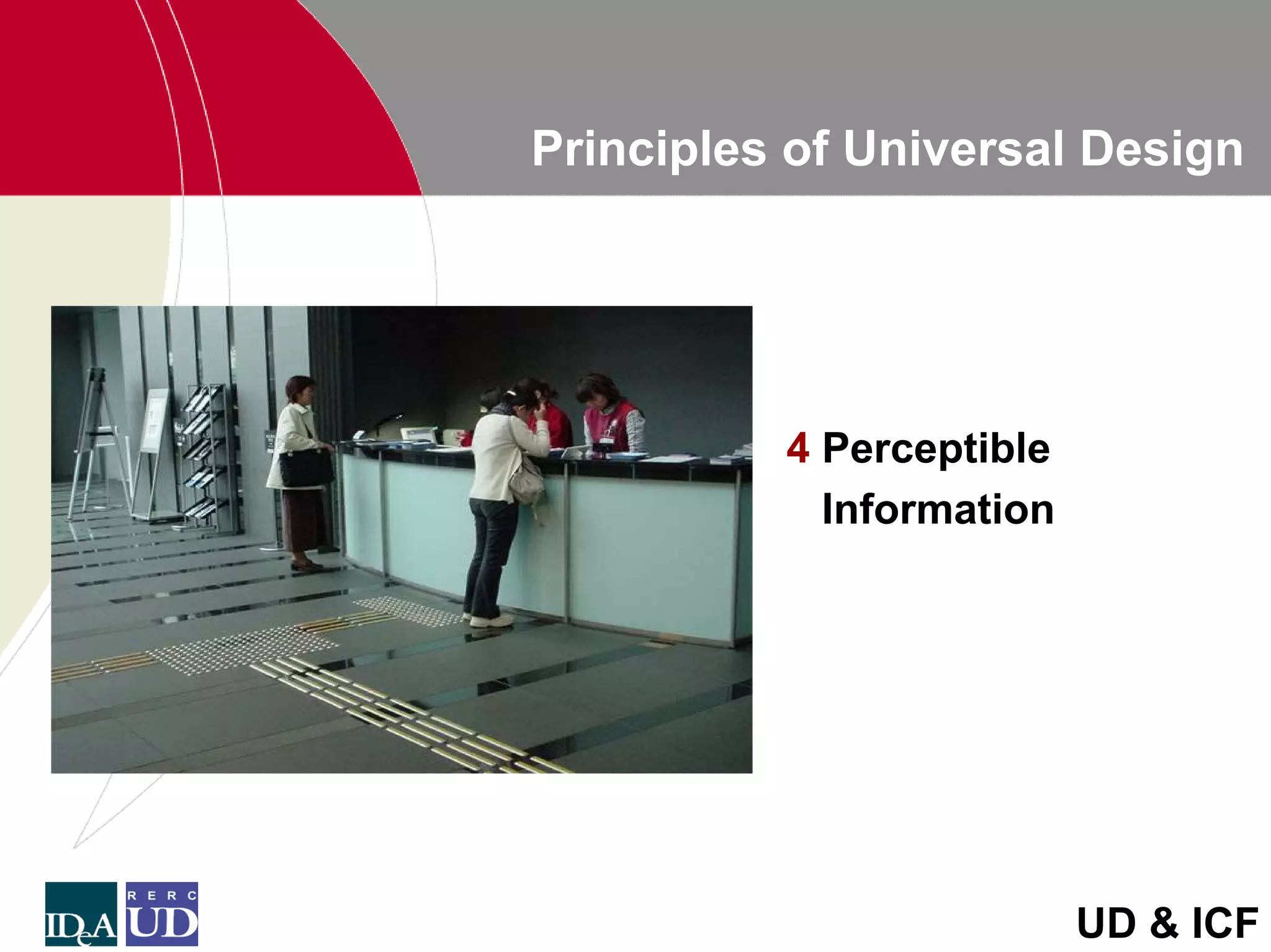
          4 Perceptible
            Information


                          UD & ICF
Principles of Universal Design


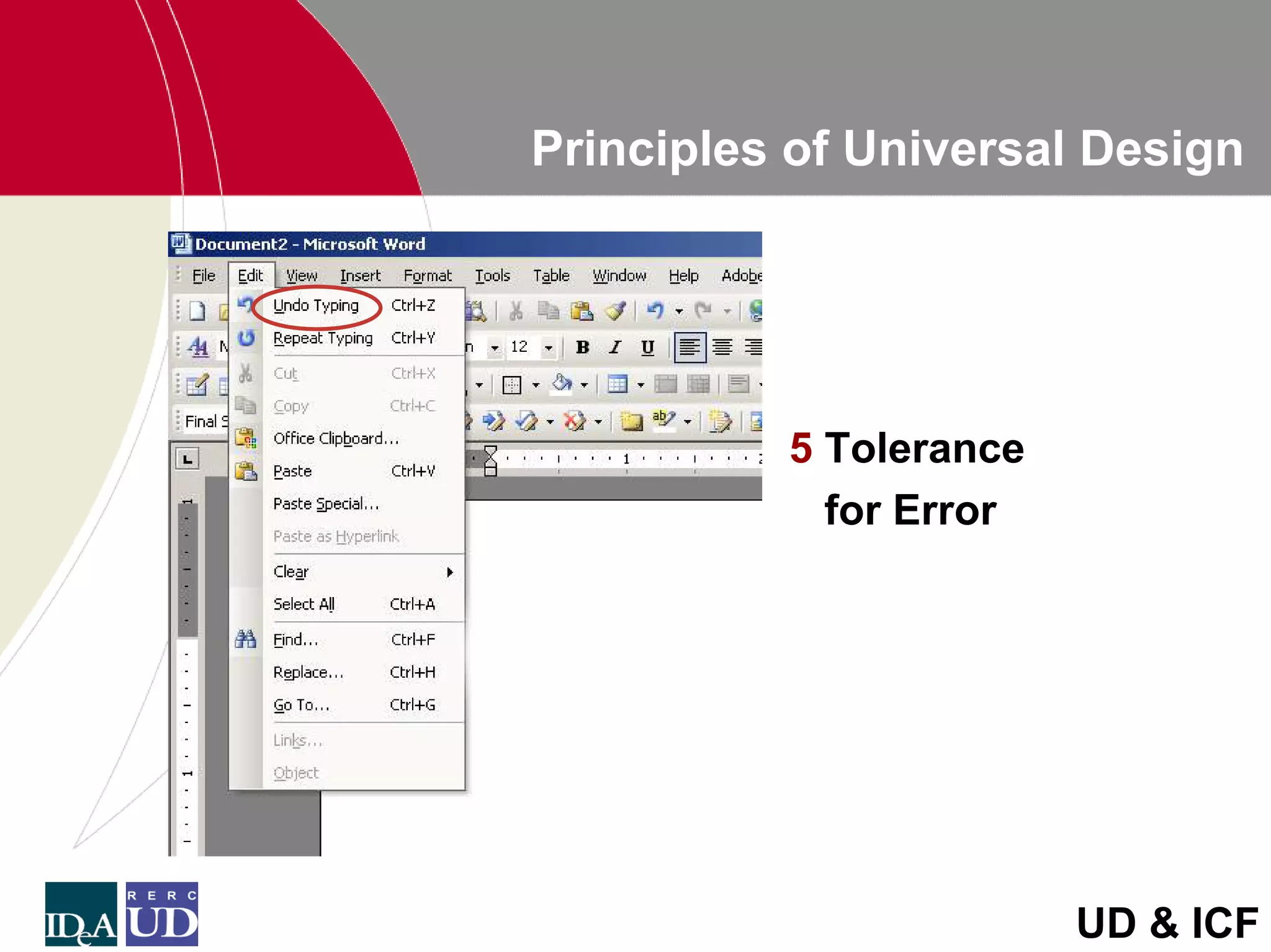
          5 Tolerance
            for Error


                        UD & ICF
Principles of Universal Design


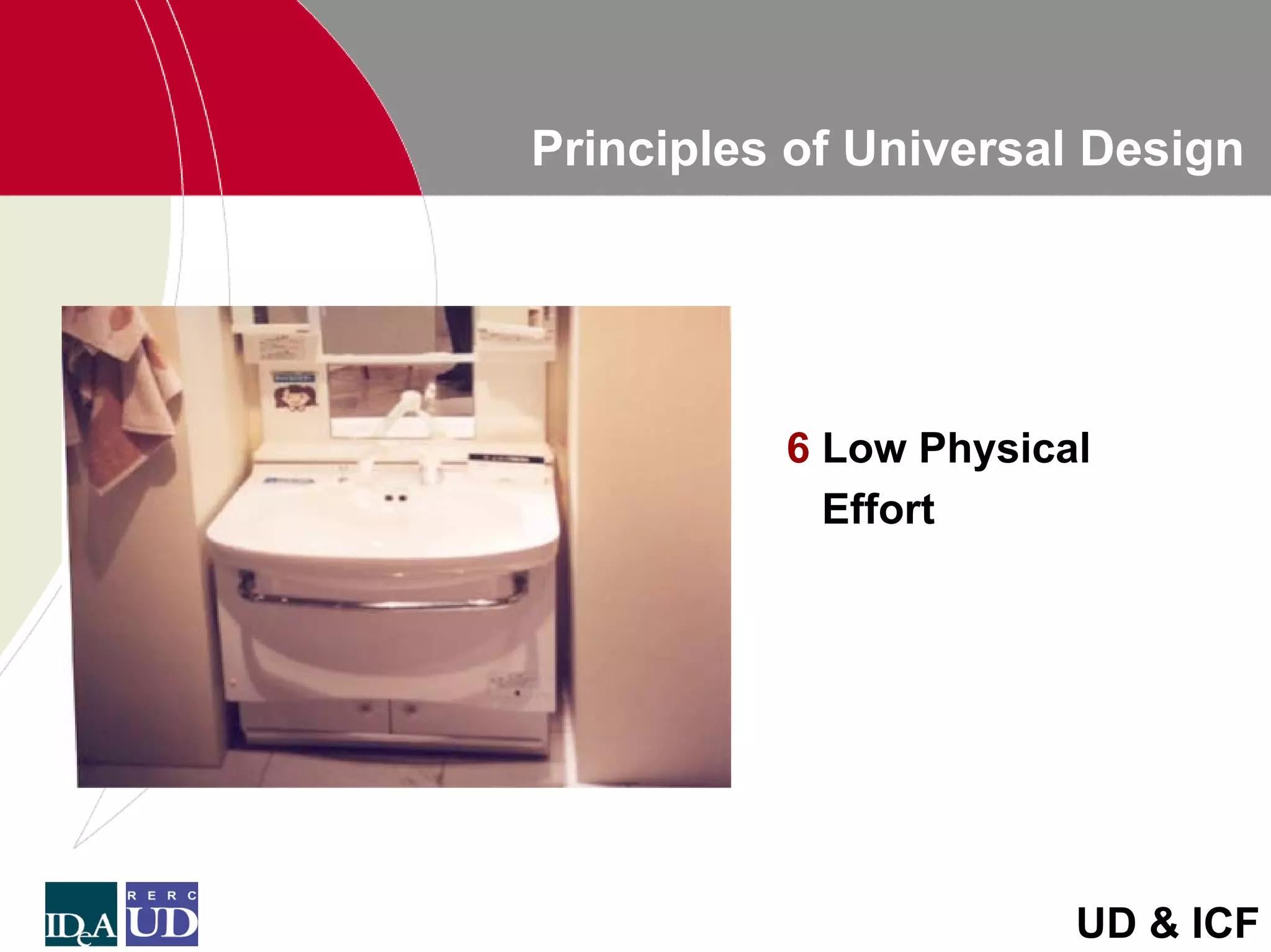
          6 Low Physical
            Effort


                       UD & ICF
Principles of Universal Design


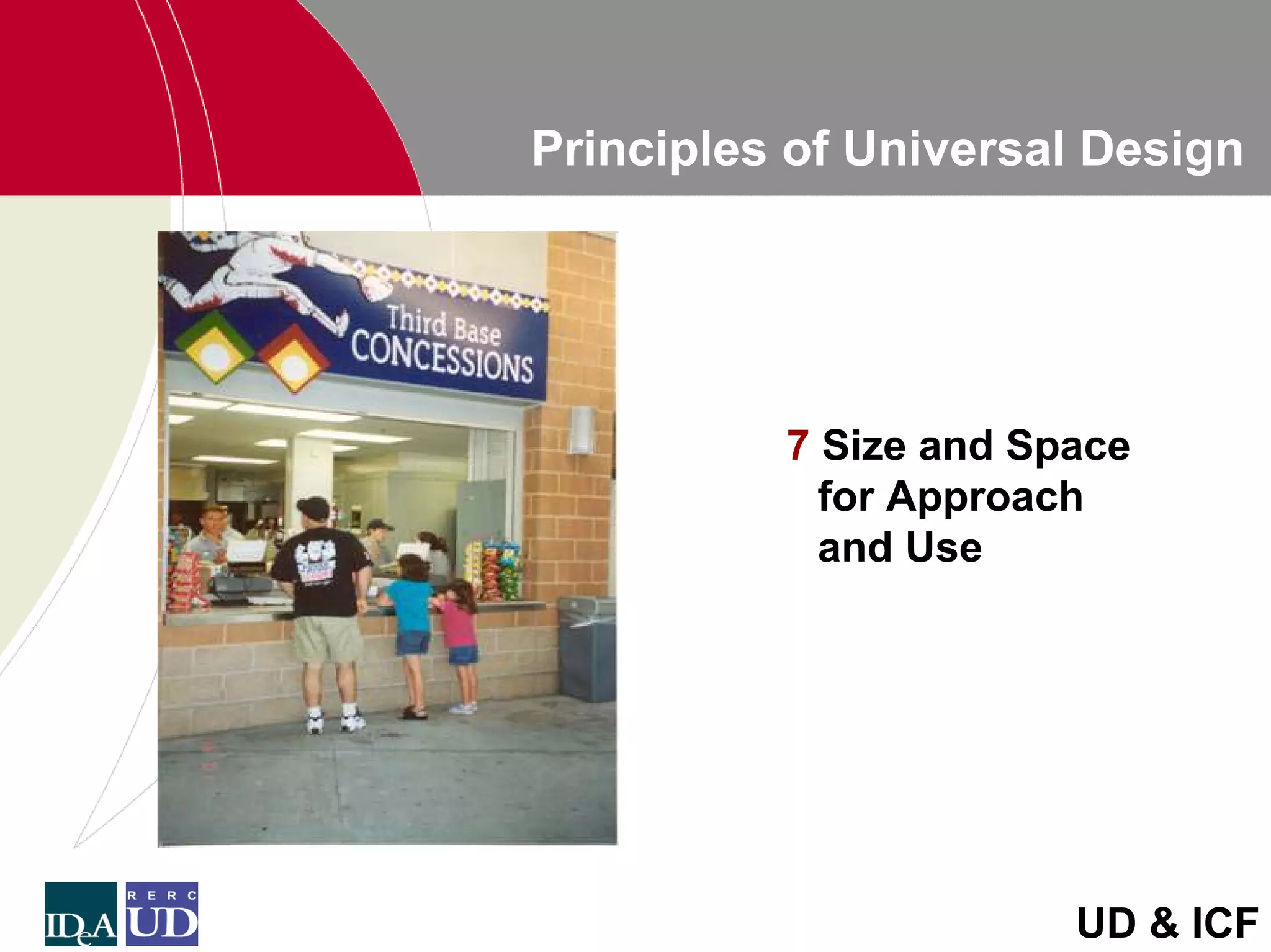
          7 Size and Space
            for Approach
            and Use


                       UD & ICF
Compatibility


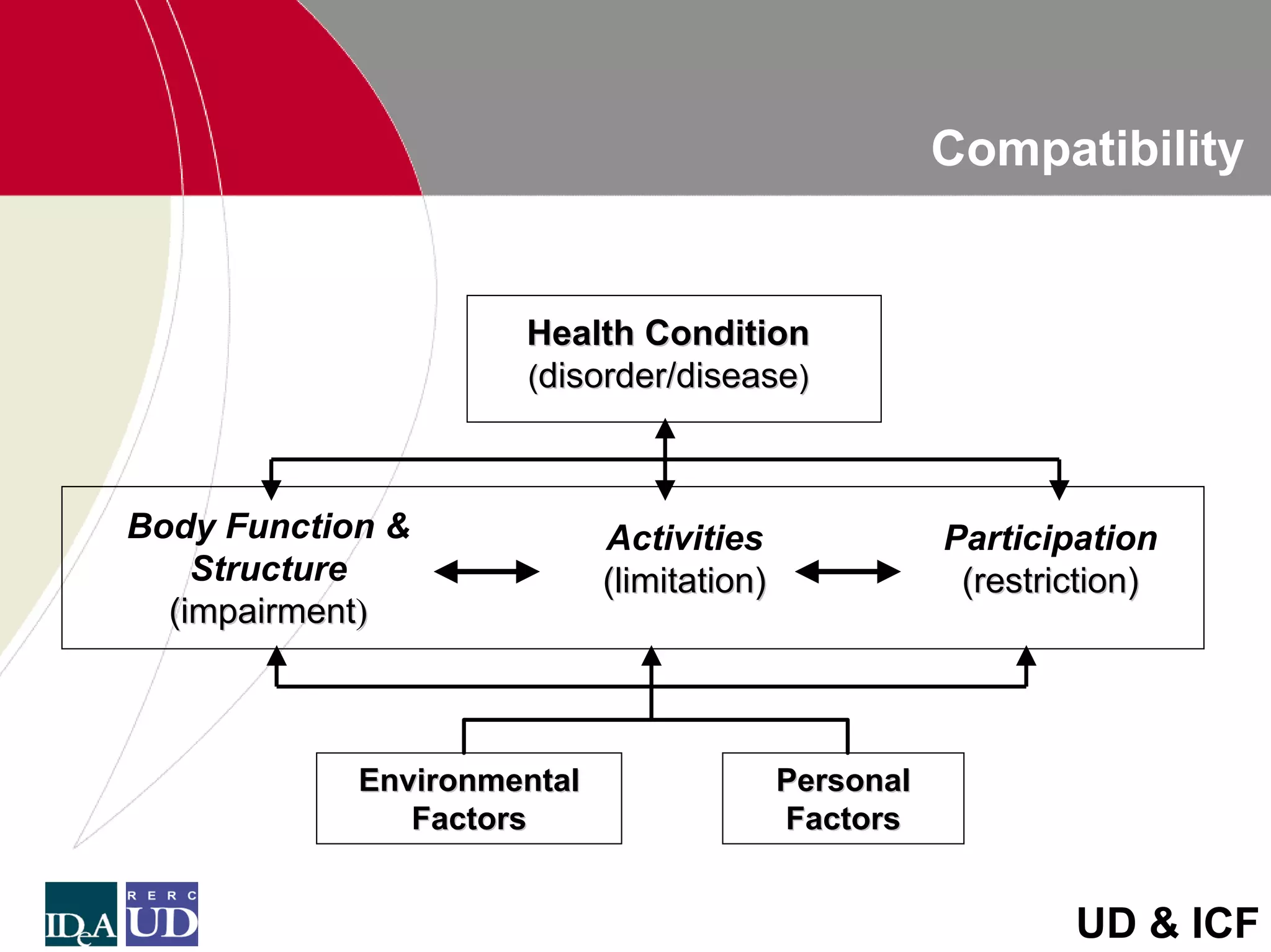
                     Health Condition
                     (disorder/disease)


Body Function &             Activities                Participation
    Structure               (limitation)               (restriction)
  (impairment)


            Environmental                  Personal
               Factors                     Factors


                                                              UD & ICF
Compatibility

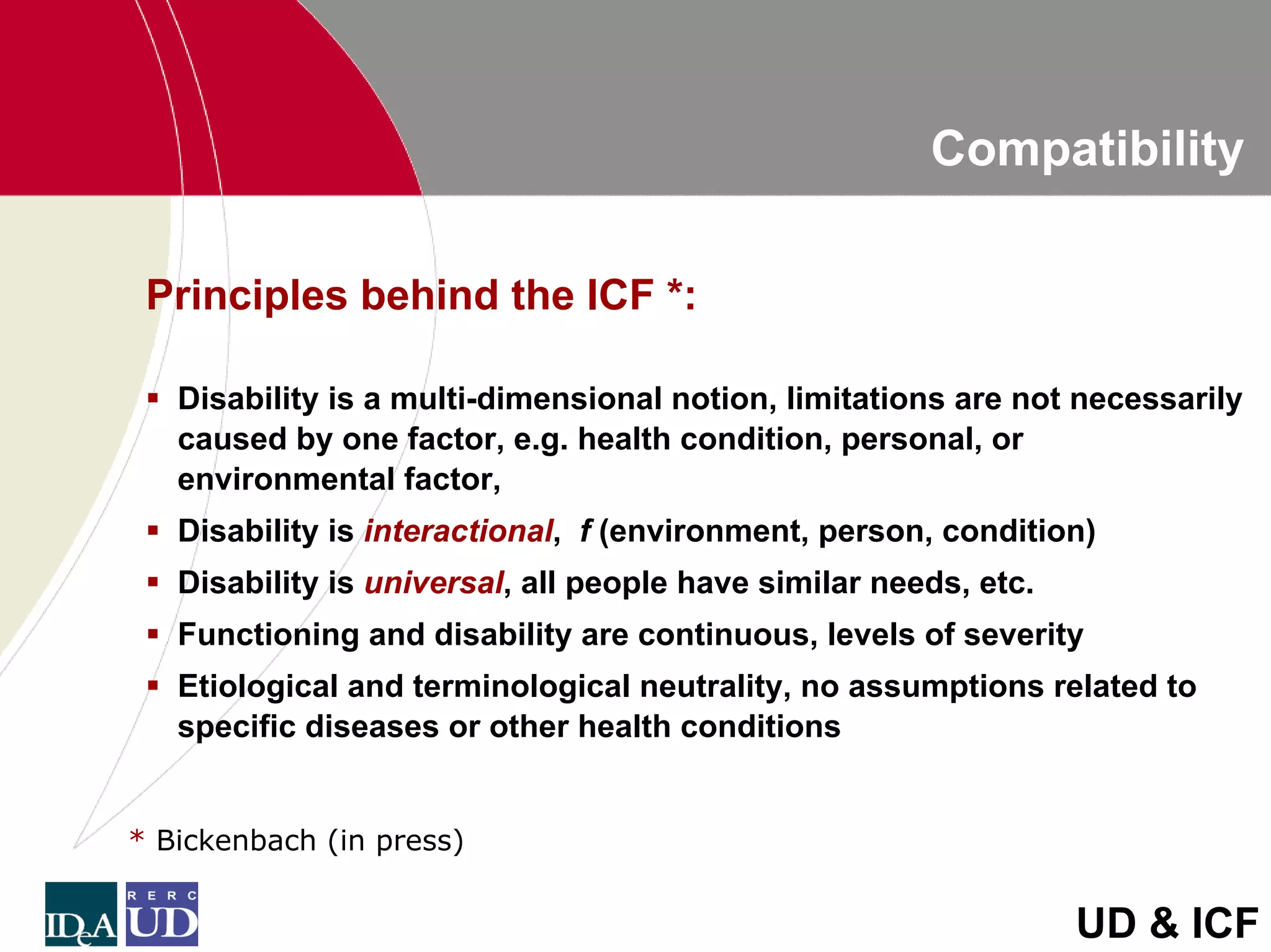
 Principles behind the ICF *:

   Disability is a multi-dimensional notion, limitations are not necessarily
   caused by one factor, e.g. health condition, personal, or
   environmental factor,
   Disability is interactional, f (environment, person, condition)
   Disability is universal, all people have similar needs, etc.
   Functioning and disability are continuous, levels of severity
   Etiological and terminological neutrality, no assumptions related to
   specific diseases or other health conditions


* Bickenbach (in press)


                                                                  UD & ICF
Compatibility

Needs in evidenced based practice:

  Identifying the environmental factors related to UD
  Identifying the questions the designer needs to ask
  Finding the information needed to answer the questions
  Finding examples of best practices


                                                           UD & ICF
Compatibility

Using the ICF to organize evidence for UD:

  ICF is the international language about function and
  disability
  It facilitates multi-disciplinary communication
  It can be used to clarify the relationship between
  environmental factors, personal factors and outcomes
  (function, activities, participation)
  It can help link research to practice
       For the practitioner - identify knowledge to apply to
       specific problems
       For the researcher - identify research needs


                                                               UD & ICF
Compatibility

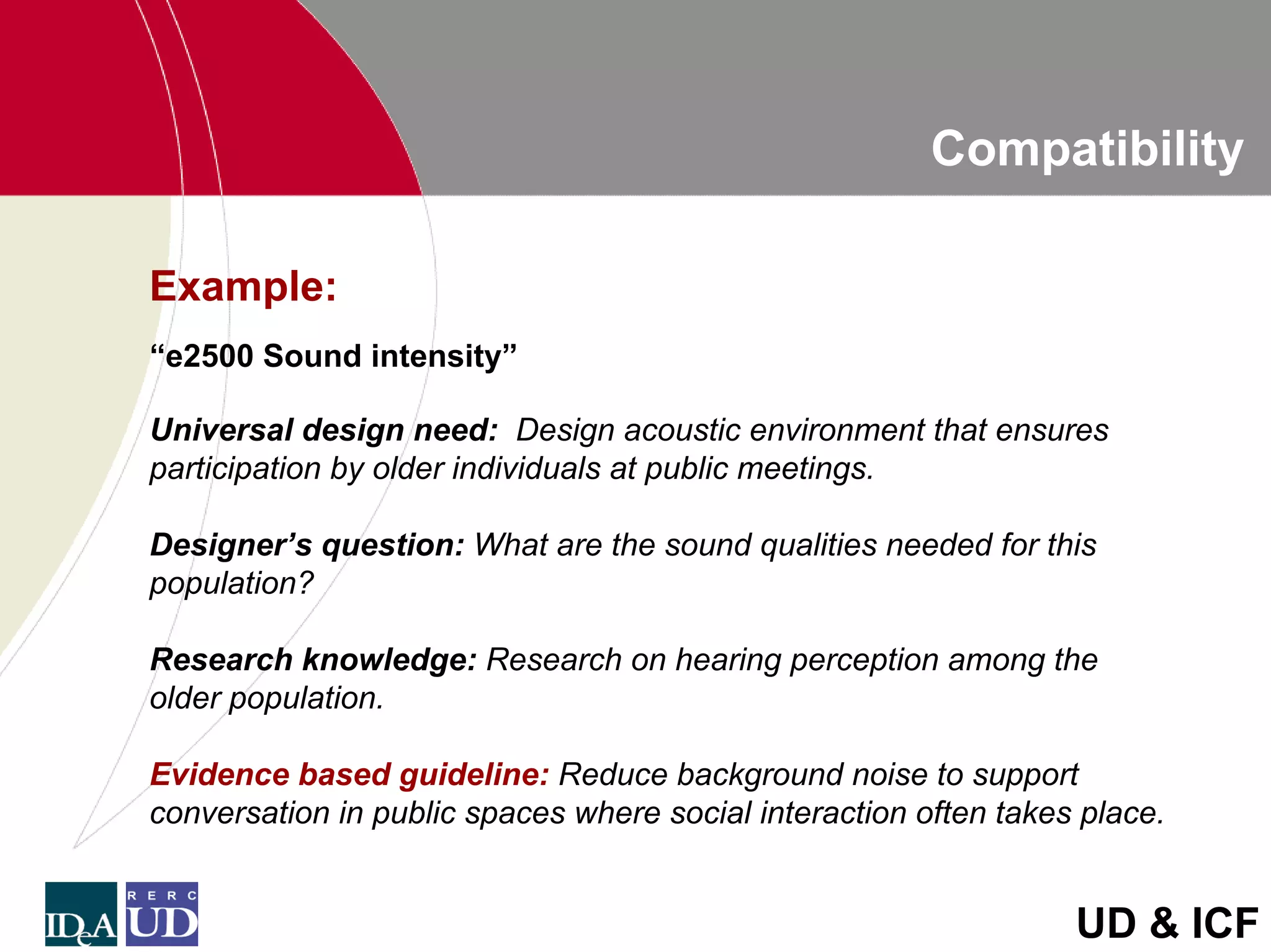
Example:
“e2500 Sound intensity”

Universal design need: Design acoustic environment that ensures
participation by older individuals at public meetings.

Designer’s question: What are the sound qualities needed for this
population?

Research knowledge: Research on hearing perception among the
older population.

Evidence based guideline: Reduce background noise to support
conversation in public spaces where social interaction often takes place.


                                                                  UD & ICF
Compatibility

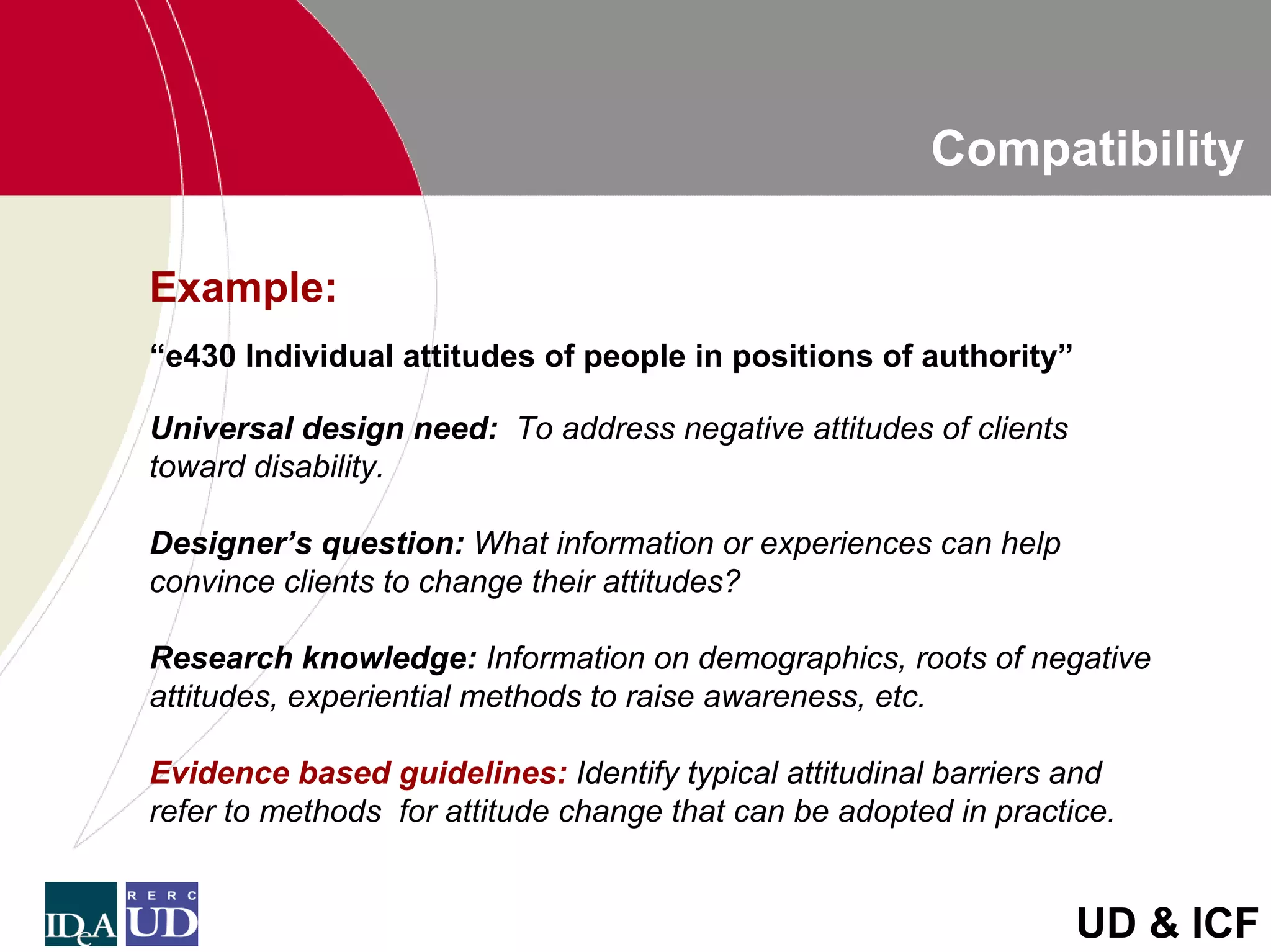
Example:
“e430 Individual attitudes of people in positions of authority”

Universal design need: To address negative attitudes of clients
toward disability.

Designer’s question: What information or experiences can help
convince clients to change their attitudes?

Research knowledge: Information on demographics, roots of negative
attitudes, experiential methods to raise awareness, etc.

Evidence based guidelines: Identify typical attitudinal barriers and
refer to methods for attitude change that can be adopted in practice.


                                                                  UD & ICF
Compatibility

Limitations to Overcome:

  Definition and principles of UD need to be reconciled with the ICF
  No method is available to search for answers to design questions
  and find best practices
  Some Environmental Factors are not well conceived for design
  practice, e.g. e2500 Sound Intensity is not sufficient to ensure an
  adequate acoustic environment
  Immediate needs: Revision of UD’s definition and principles;
  development of a crosswalk and an application method
  Future: Recommendations to improve the ICF’s Environmental
  Factors


                                                             UD & ICF
Redefining Universal Design

Definition:                        Principles:
  Incorporate function, activity     Focus goals on ICF outcomes –
  and social participation           functions, activities and
  Be explicit about the process      participation
  of continuous improvement          Develop guidelines for different
  Accommodate cost and social        domains
  difference                         Tie to a body of evidence –
                                     knowledge base of research
                                     Develop benchmarks to use as
                                     comparison - best practices


                                                               UD & ICF
Redefining Universal Design

Universal Design of products, environments
and systems is:

    a process of continual improvement
    to improve function, activity and participation for all users,
    and to extend those benefits to an ever broader population
    within the context of resources available.


                                                              UD & ICF
Redefining Universal Design

Principles of Universal Design (Steinfeld, 2006)
1.   Body fit: Accommodate people with the widest range of body sizes,
     postures and movement abilities
2.   Comfort: Ensure that the physical demands for safe and effective
     use are within the comfort range of the widest range of people
3.   Awareness: Make information needed for safe and effective use
     readily available in all necessary forms
4.   Understanding: Ensure that the methods of operation and use are
     easily understood by all users
5.   Identity: Support the construction of positive self image and social
     status for the end users
6.   Social integration: Support effective participation by all and reduce
     barriers between user groups
7.   Cultural appropriateness: Ensure that differences in cultural values
     and attitudes are respected
                                                                  UD & ICF
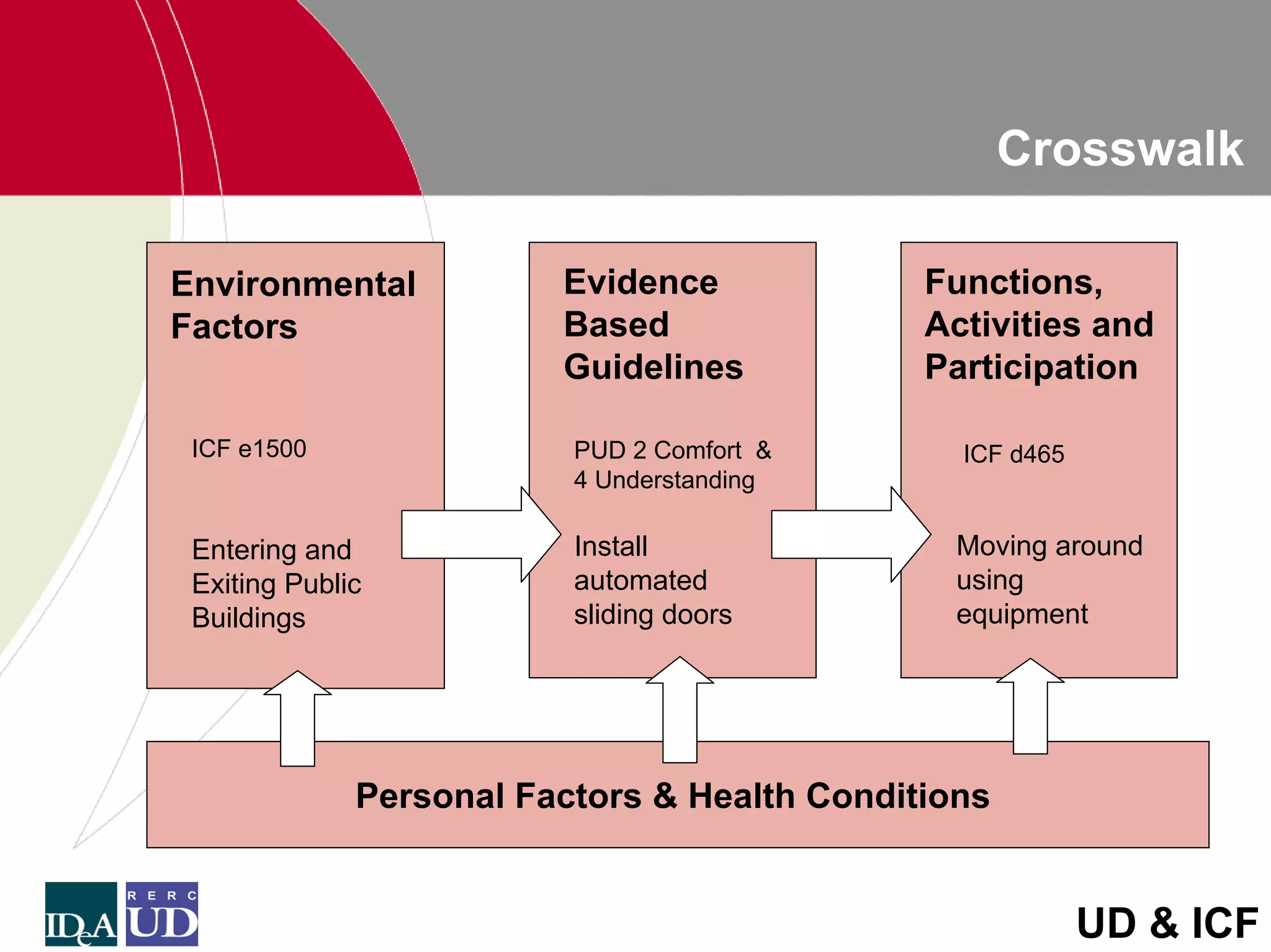
Crosswalk

Environmental            Evidence             Functions,
Factors                  Based                Activities and
                         Guidelines           Participation

 ICF e1500                PUD 2 Comfort &       ICF d465
                          4 Understanding

 Entering and             Install               Moving around
 Exiting Public           automated             using
 Buildings                sliding doors         equipment


              Personal Factors & Health Conditions


                                                           UD & ICF
Method


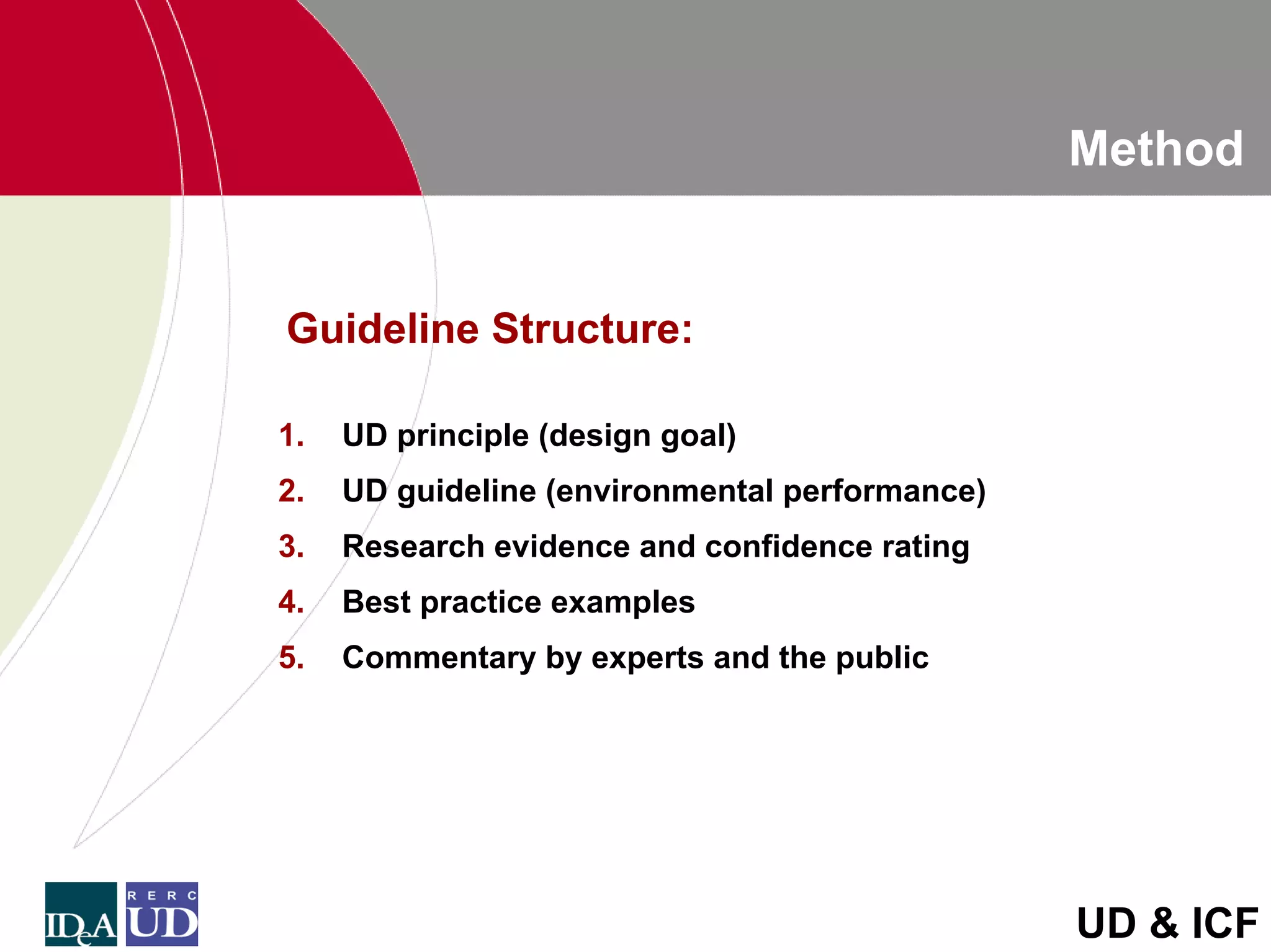
Guideline Structure:

1.   UD principle (design goal)
2.   UD guideline (environmental performance)
3.   Research evidence and confidence rating
4.   Best practice examples
5.   Commentary by experts and the public


                                                UD & ICF
Method

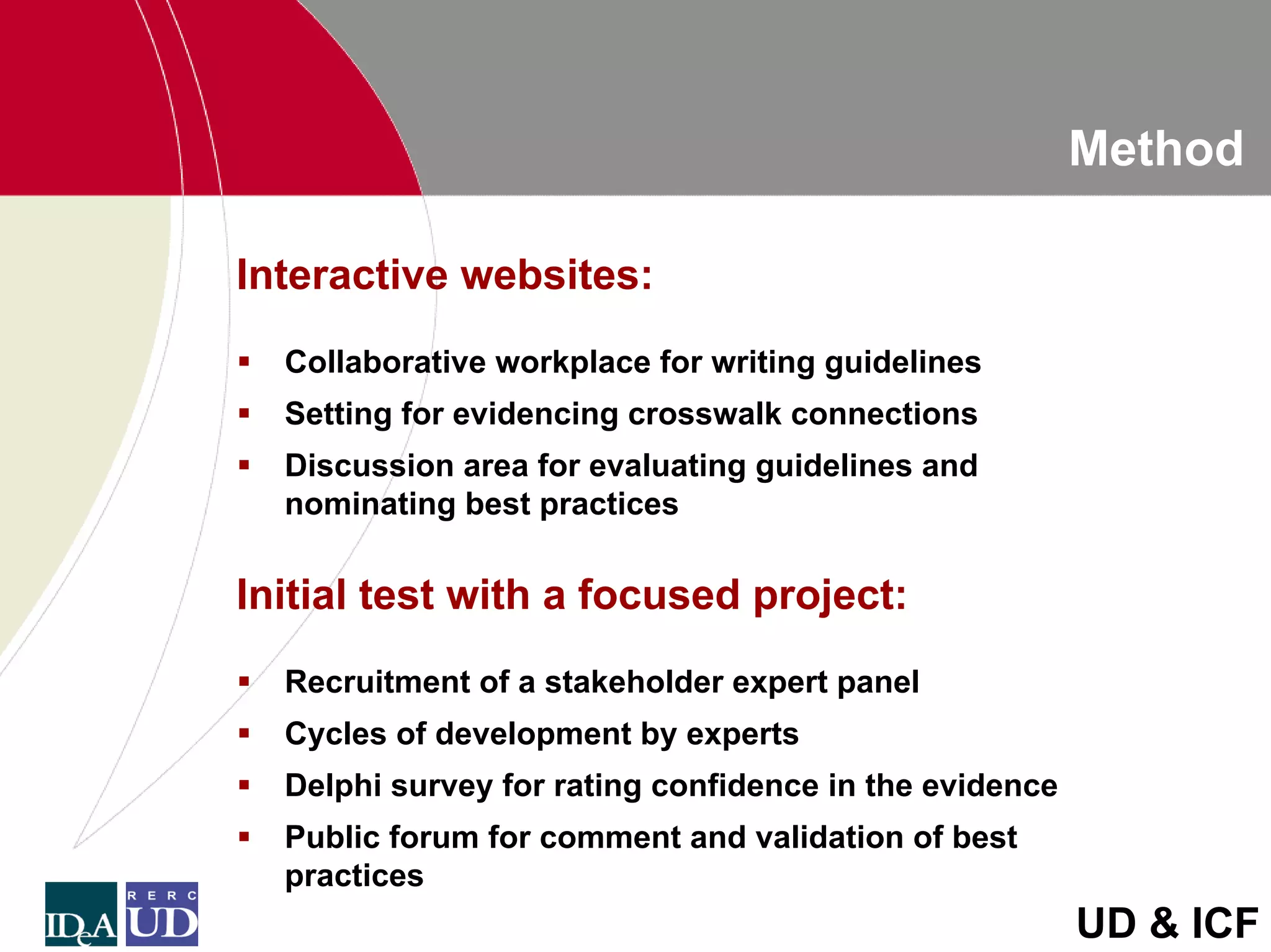
Interactive websites:
  Collaborative workplace for writing guidelines
  Setting for evidencing crosswalk connections
  Discussion area for evaluating guidelines and
  nominating best practices

Initial test with a focused project:
  Recruitment of a stakeholder expert panel
  Cycles of development by experts
  Delphi survey for rating confidence in the evidence
  Public forum for comment and validation of best
  practices
                                                        UD & ICF
Community of Practice

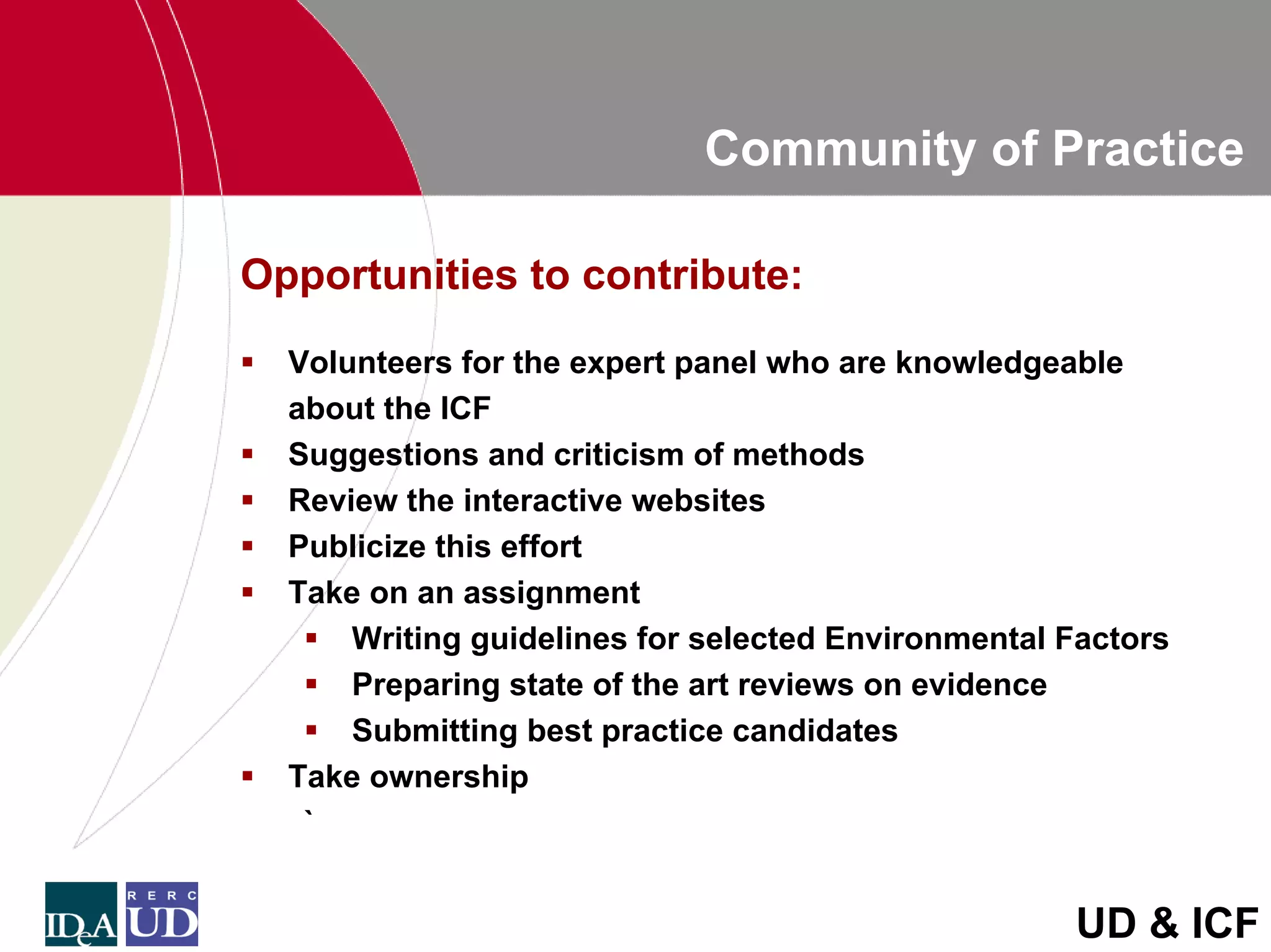
Opportunities to contribute:
  Volunteers for the expert panel who are knowledgeable
  about the ICF
  Suggestions and criticism of methods
  Review the interactive websites
  Publicize this effort
  Take on an assignment
      Writing guidelines for selected Environmental Factors
      Preparing state of the art reviews on evidence
      Submitting best practice candidates
  Take ownership
   `


                                                    UD & ICF
Contact


Center for Inclusive Design and        School of Architecture and
                                       Planning, University at Buffalo
Environmental Access (IDEA Center)
                                       3435 Main Street, 378 Hayes Hall
                                       Buffalo, NY 14214-3087
RERC on Universal Design and the
Built Environment *                    Tel:
                                       716-829-3485 ext. 329

                                       Fax:
                                       716-829-3861
* Funding provided by the
                                       Email:
U.S. Department of Education,
                                       arced@buffalo.edu
National Institute on Disability and
Rehabilitation Research                Website:
                                       http://www.ap.buffalo.edu/idea


                                                               UD & ICF

Universal Design and the ICF

  • 1.
    Universal Design andthe ICF Edward Steinfeld, Arch.D. Gary Scott Danford, Ph.D. Center for Inclusive Design and Environmental Access (IDEA Center) School of Architecture and Planning University at Buffalo The State University of New York
  • 2.
    R&D Activities Related Activitiesof the Rehabilitation Engineering Research Center on Universal Design and the Built Environment, 2005 – 2010 Develop low cost methods for measuring universal design (UD) effectiveness Develop benchmarks for effectiveness Develop evidence based guidelines and tie them to the ICF Survey state of the art in selected areas Involve stakeholders in developing guidelines UD & ICF
  • 3.
    Outline An introduction toUD The relationship of the ICF to UD practice A “crosswalk” between the ICF and UD A method for developing that crosswalk The need to build a community of practice UD & ICF
  • 4.
    Key Points UD isthe new paradigm for environmental facilitation of preferred outcomes related to function, activity and participation UD is highly compatible with the ICF model A body of evidence for practicing UD needs to be assembled The ICF can be used to provide that body of evidence and guide research A crosswalk is needed to link the ICF and UD Participation of all stakeholder groups is desirable in developing the body of evidence UD & ICF
  • 5.
    Universal Design Defined The design of products and environments …to be usable by all …without the need for adaptation or specialized design (Connell et al., 1997) Kneeling low floor bus with ramp UD & ICF
  • 6.
    Recognizing Universal Design Not assistive technology and barrier free design Not just support of function Must address social participation – social identity, social roles, cultural fit Evolutionary approach that approaches the ideals of UD asymptotically UD & ICF
  • 7.
    Recognizing Universal Design Evolutionaryapproach recognizing differences in context and resources UD & ICF
  • 8.
    Principles of UniversalDesign 1 Equitable Use UD & ICF
  • 9.
    Principles of UniversalDesign 2 Flexibility in Use UD & ICF
  • 10.
    Principles of UniversalDesign 3 Simple and Intuitive Use UD & ICF
  • 11.
    Principles of UniversalDesign 4 Perceptible Information UD & ICF
  • 12.
    Principles of UniversalDesign 5 Tolerance for Error UD & ICF
  • 13.
    Principles of UniversalDesign 6 Low Physical Effort UD & ICF
  • 14.
    Principles of UniversalDesign 7 Size and Space for Approach and Use UD & ICF
  • 15.
    Compatibility Health Condition (disorder/disease) Body Function & Activities Participation Structure (limitation) (restriction) (impairment) Environmental Personal Factors Factors UD & ICF
  • 16.
    Compatibility Principles behindthe ICF *: Disability is a multi-dimensional notion, limitations are not necessarily caused by one factor, e.g. health condition, personal, or environmental factor, Disability is interactional, f (environment, person, condition) Disability is universal, all people have similar needs, etc. Functioning and disability are continuous, levels of severity Etiological and terminological neutrality, no assumptions related to specific diseases or other health conditions * Bickenbach (in press) UD & ICF
  • 17.
    Compatibility Needs in evidencedbased practice: Identifying the environmental factors related to UD Identifying the questions the designer needs to ask Finding the information needed to answer the questions Finding examples of best practices UD & ICF
  • 18.
    Compatibility Using the ICFto organize evidence for UD: ICF is the international language about function and disability It facilitates multi-disciplinary communication It can be used to clarify the relationship between environmental factors, personal factors and outcomes (function, activities, participation) It can help link research to practice For the practitioner - identify knowledge to apply to specific problems For the researcher - identify research needs UD & ICF
  • 19.
    Compatibility Example: “e2500 Sound intensity” Universaldesign need: Design acoustic environment that ensures participation by older individuals at public meetings. Designer’s question: What are the sound qualities needed for this population? Research knowledge: Research on hearing perception among the older population. Evidence based guideline: Reduce background noise to support conversation in public spaces where social interaction often takes place. UD & ICF
  • 20.
    Compatibility Example: “e430 Individual attitudesof people in positions of authority” Universal design need: To address negative attitudes of clients toward disability. Designer’s question: What information or experiences can help convince clients to change their attitudes? Research knowledge: Information on demographics, roots of negative attitudes, experiential methods to raise awareness, etc. Evidence based guidelines: Identify typical attitudinal barriers and refer to methods for attitude change that can be adopted in practice. UD & ICF
  • 21.
    Compatibility Limitations to Overcome: Definition and principles of UD need to be reconciled with the ICF No method is available to search for answers to design questions and find best practices Some Environmental Factors are not well conceived for design practice, e.g. e2500 Sound Intensity is not sufficient to ensure an adequate acoustic environment Immediate needs: Revision of UD’s definition and principles; development of a crosswalk and an application method Future: Recommendations to improve the ICF’s Environmental Factors UD & ICF
  • 22.
    Redefining Universal Design Definition: Principles: Incorporate function, activity Focus goals on ICF outcomes – and social participation functions, activities and Be explicit about the process participation of continuous improvement Develop guidelines for different Accommodate cost and social domains difference Tie to a body of evidence – knowledge base of research Develop benchmarks to use as comparison - best practices UD & ICF
  • 23.
    Redefining Universal Design UniversalDesign of products, environments and systems is: a process of continual improvement to improve function, activity and participation for all users, and to extend those benefits to an ever broader population within the context of resources available. UD & ICF
  • 24.
    Redefining Universal Design Principlesof Universal Design (Steinfeld, 2006) 1. Body fit: Accommodate people with the widest range of body sizes, postures and movement abilities 2. Comfort: Ensure that the physical demands for safe and effective use are within the comfort range of the widest range of people 3. Awareness: Make information needed for safe and effective use readily available in all necessary forms 4. Understanding: Ensure that the methods of operation and use are easily understood by all users 5. Identity: Support the construction of positive self image and social status for the end users 6. Social integration: Support effective participation by all and reduce barriers between user groups 7. Cultural appropriateness: Ensure that differences in cultural values and attitudes are respected UD & ICF
  • 25.
    Crosswalk Environmental Evidence Functions, Factors Based Activities and Guidelines Participation ICF e1500 PUD 2 Comfort & ICF d465 4 Understanding Entering and Install Moving around Exiting Public automated using Buildings sliding doors equipment Personal Factors & Health Conditions UD & ICF
  • 26.
    Method Guideline Structure: 1. UD principle (design goal) 2. UD guideline (environmental performance) 3. Research evidence and confidence rating 4. Best practice examples 5. Commentary by experts and the public UD & ICF
  • 27.
    Method Interactive websites: Collaborative workplace for writing guidelines Setting for evidencing crosswalk connections Discussion area for evaluating guidelines and nominating best practices Initial test with a focused project: Recruitment of a stakeholder expert panel Cycles of development by experts Delphi survey for rating confidence in the evidence Public forum for comment and validation of best practices UD & ICF
  • 28.
    Community of Practice Opportunitiesto contribute: Volunteers for the expert panel who are knowledgeable about the ICF Suggestions and criticism of methods Review the interactive websites Publicize this effort Take on an assignment Writing guidelines for selected Environmental Factors Preparing state of the art reviews on evidence Submitting best practice candidates Take ownership ` UD & ICF
  • 29.
    Contact Center for InclusiveDesign and School of Architecture and Planning, University at Buffalo Environmental Access (IDEA Center) 3435 Main Street, 378 Hayes Hall Buffalo, NY 14214-3087 RERC on Universal Design and the Built Environment * Tel: 716-829-3485 ext. 329 Fax: 716-829-3861 * Funding provided by the Email: U.S. Department of Education, arced@buffalo.edu National Institute on Disability and Rehabilitation Research Website: http://www.ap.buffalo.edu/idea UD & ICF