UNIVERSAL DESIGN
    WHAT IS IT?!
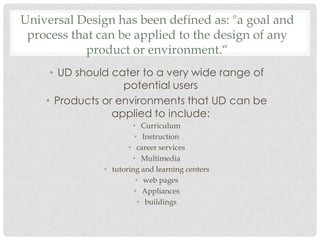
Universal Design has been defined as: "a goal and
 process that can be applied to the design of any
            product or environment.“
     • UD should cater to a very wide range of
                   potential users
    • Products or environments that UD can be
                 applied to include:
                       • Curriculum
                        • Instruction
                      • career services
                       • Multimedia
               • tutoring and learning centers
                        • web pages
                        • Appliances
                         • buildings
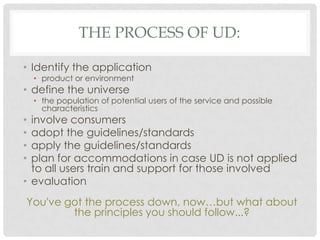
THE PROCESS OF UD:

• Identify the application
    • product or environment
• define the universe
    • the population of potential users of the service and possible
      characteristics
• involve consumers
• adopt the guidelines/standards
• apply the guidelines/standards
• plan for accommodations in case UD is not applied
  to all users train and support for those involved
• evaluation
You've got the process down, now…but what about
        the principles you should follow...?
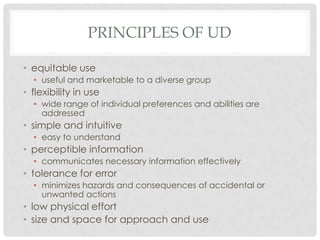
PRINCIPLES OF UD

• equitable use
  • useful and marketable to a diverse group
• flexibility in use
  • wide range of individual preferences and abilities are
    addressed
• simple and intuitive
  • easy to understand
• perceptible information
  • communicates necessary information effectively
• tolerance for error
  • minimizes hazards and consequences of accidental or
    unwanted actions
• low physical effort
• size and space for approach and use
WHAT ABOUT UD IN EDUCATION?!

• Universal Design in education ensures that the "non-
    average" students are not marginalized, forgotten
      or under-served by the mainstream guidelines,
        whether they be below or above average.
  • As teachers we must design learning experiences
       that, from the beginning, are universal in their
                   approach and flexible.
   • We must also make sure to not focus on just one
    kind of students and create lessons that appeal to
                 learners across the board.
THE UNIVERSAL DESIGN FOR
        LEARNERS GUIDELINES
  • The UDL guidelines focus on three main things:
         • Multiple means of representation
     • Multiple means of action and expression
                        And
          • Multiple means of engagement

It also looks at goals and standards that need to be met, the
materials that will be used, the methods by which the subjects
          will be taught and the means of assessment.


** The curriculum, not the students are the disability.
                 Use UDL to help! **
UDL GUIDELINES
• Multiple Means of Representation
 • Perception
 • language and symbols
 • comprehension
• Multiple Means of Action and Expression
 • Options for physical action
 • Options for expression and fluency
 • Options for executive decision
• Multiple Means of Engagement
 • Options for recruiting interests
 • Options for sustaining effort and persistence
 • Options for self-regulation
CONCLUSION

• By implementing and practicing UDL in the classroom,
  teachers and administrators are able to ensure that all
  students are being taught in a manner that best suites
                         them.

• They are also able to ensure that students below, at or
   above average are not overlooked or underserved
            because of their particular needs

• UDL looks at the current curriculum as the problem or
   disability rather than the children as the problem or
    disability. By doing so, teachers can work toward
    providing a better educational experience for all
                           children!
WORKS CITED

• http://www.youtube.com/watch?v=rfsx3DGpv5o&f
  eature=relmfu

• http://www.youtube.com/watch?feature=player_e
  mbedded&v=pGLTJw0GSxk

• http://www.youtube.com/watch?v=vr3ardmq0a0&
  feature=relmfu

• http://www.washington.edu/doit/Brochures/Progra
  ms/ud.html

Universal Design

  • 1.
    UNIVERSAL DESIGN WHAT IS IT?!
  • 2.
    Universal Design hasbeen defined as: "a goal and process that can be applied to the design of any product or environment.“ • UD should cater to a very wide range of potential users • Products or environments that UD can be applied to include: • Curriculum • Instruction • career services • Multimedia • tutoring and learning centers • web pages • Appliances • buildings
  • 3.
    THE PROCESS OFUD: • Identify the application • product or environment • define the universe • the population of potential users of the service and possible characteristics • involve consumers • adopt the guidelines/standards • apply the guidelines/standards • plan for accommodations in case UD is not applied to all users train and support for those involved • evaluation You've got the process down, now…but what about the principles you should follow...?
  • 4.
    PRINCIPLES OF UD •equitable use • useful and marketable to a diverse group • flexibility in use • wide range of individual preferences and abilities are addressed • simple and intuitive • easy to understand • perceptible information • communicates necessary information effectively • tolerance for error • minimizes hazards and consequences of accidental or unwanted actions • low physical effort • size and space for approach and use
  • 5.
    WHAT ABOUT UDIN EDUCATION?! • Universal Design in education ensures that the "non- average" students are not marginalized, forgotten or under-served by the mainstream guidelines, whether they be below or above average. • As teachers we must design learning experiences that, from the beginning, are universal in their approach and flexible. • We must also make sure to not focus on just one kind of students and create lessons that appeal to learners across the board.
  • 6.
    THE UNIVERSAL DESIGNFOR LEARNERS GUIDELINES • The UDL guidelines focus on three main things: • Multiple means of representation • Multiple means of action and expression And • Multiple means of engagement It also looks at goals and standards that need to be met, the materials that will be used, the methods by which the subjects will be taught and the means of assessment. ** The curriculum, not the students are the disability. Use UDL to help! **
  • 7.
    UDL GUIDELINES • MultipleMeans of Representation • Perception • language and symbols • comprehension • Multiple Means of Action and Expression • Options for physical action • Options for expression and fluency • Options for executive decision • Multiple Means of Engagement • Options for recruiting interests • Options for sustaining effort and persistence • Options for self-regulation
  • 8.
    CONCLUSION • By implementingand practicing UDL in the classroom, teachers and administrators are able to ensure that all students are being taught in a manner that best suites them. • They are also able to ensure that students below, at or above average are not overlooked or underserved because of their particular needs • UDL looks at the current curriculum as the problem or disability rather than the children as the problem or disability. By doing so, teachers can work toward providing a better educational experience for all children!
  • 9.
    WORKS CITED • http://www.youtube.com/watch?v=rfsx3DGpv5o&f eature=relmfu • http://www.youtube.com/watch?feature=player_e mbedded&v=pGLTJw0GSxk • http://www.youtube.com/watch?v=vr3ardmq0a0& feature=relmfu • http://www.washington.edu/doit/Brochures/Progra ms/ud.html