.
Submitted by:
Aasish Sapkota (075BAR001)
Abhishek Acharya (075BAR002)
Anita Kafle (075BAR006)
Ashesh Regmi (075BAR006)
Divya Adhikari (075BAR017)
Submitted to:
Lec. Ar. Milan Bhattarai
Lec. Ar. Dipendra S.
chongbong
LITERATURE REVIEW FORMAT:
• Introduction
• Types of school
• History
• Site selection criteria
• Zoning of spaces
• Anthropometric data of spaces
• 1. Academic
• 2.Administrative
• 3.Creative
• 4.others
• Matrix diagram
• Safety factor of building
• Conclusion
INTRODUCTION:
• A school is an educational institution designed to provide learning
spaces and learning environment for the students.
• Why is education so important:
1. "Education is the most Powerful
weapon which we can use
to change the world."
- Nelson Mandela
2. " Education is not about molding
Children the way you think they
Should be. It is about organizing the
natural longing in a human being
to know.“
- Sadhguru
BUDHANILKANTHA SCHOOL
TYPES OF SCHOOL:
• COMMUNITY SCHOOLS
• INSTITUTIONAL SCHOOLS
• RELIGIOUS SCHOOLS
COMMUNITY SCHOOL
• Community schools are the types of school that are supported
by the government and are similar to that of public school.
• Divided into three sub-categories:
1. Community-Aided school
school where the responsibility regarding paying salary and
other form of expenses is in the hand of government.
2. Community-Managed school
fully supported by the government but the community is
responsible for the management of schools.
3. Community-unaided School
that might get partial support or may not get any support
from the government.
. INSTITUTIONAL SCHOOLS
• That are supported by the parents and the trustees and
are similar to that of private schools.
RELIGIOUS SCHOOLS
• School that either has a religious component in its operations
or its curriculum.
• Divided into three sub-categories:
1. MADRASA- that are operating for the people of muslim
community.
2. ASHRAM-that are operating for the people of hindu
community.
3. GUMBA-that are operating for the people of buddhist
community.
ON THE BASIS OF FACULTIES
• SCIENCE SCHOOL: science lab, demonstration spaces
• ARTS SCHOOL: art galleries,
lighting, aesthetic elements.
• TECHNICAL SCHOOL: labs, medical
equipment, practical spaces
commerce school, humanities.
• MULTIFACULTY SCHOOL: including
two or more faculties.
HISTORY
• The concept of grouping students together in a centralized
location for learning had existed since classical antiquity,
formal schools have existed at least since ancient times.
1. WESTERN: Greece and
Rome are famous for
Starting education.
• In western Europe –
Cathedral school.
• In Islam-school system
Developed with mosque.
Continue…
2.EASTERN: Gurukul education
System was famous in India.
3.NEPAL: the first formal school
is Durbar high school.(1855)
• For the Eute, after democracy
More opportunities opened for
Diverse people.
DESIGN PRINCIPLE
ASPECT
• Classroom-well ventilated
• Sufficient light (without glare)-easy reading and writing.
• Entrance door-open to the stage
• Laboratories-bright light availibility
ROOMINESS- Width to length ratio (1:1.2 to 1:1.5)
PRIVACY
• Not more than 3 classes in a row.
• It is a good to have independent access to each class.
.
GROUPING
• Principal and staff room are grouped and located near
entrance.
• Girls waiting room and toilet need to be grouped.
CIRCULATION
• There should be only one entrance into the classroom.
• Horizontal circulation should be possibly utility should not be
more than 1:3.
SITE SELECTION AND GUIDELINE:
• Size: larger school site is always preferred since it allows more
environmental integration.
• Shape: Rectangular shape site
are always easier to plan.
and adequate plan can be
Achieved.
• Location: Site has to be safe
and rich with utilities and services but free from disturbing
elements such as noise pollution.
• Topography and drainage: The site should allow the flow of
sewage according to gravity, preferable without use of pumps.
Continue……
• Terraced land is unsuitable for construction of building.
• Construction site has to be safe
and stable to withstand total
building code.
• Poor sites are the site that are
vulnerable to landslides, soil
erosion, steep slopes.
• Building on sloped ground have
unequal height, columns along
the slope, which causes ill effects
like twisting and damage in shorter
columns
Continue….
• Should be gently sloping with an elevation and contour
which will ensure good drainage.
• Site should provide sufficient
space to sustain physical
education with a variety
of vegetation and plant life.
• Access and traffic: The site should be surrounded by
different means of transport that are useful to students and
staff. Avoid location near factories.
Continue……
• Security and safety: No roadways should be crossed by any
students to get to playground.
• Site should allow the construction
of building so as to allow the
adequate sunlight to hinder
any act of vandalism.
• Noise level school should be far enough from air terminals
and high speed vechicular traffic.
• Utilities water, drainage and electrical services including
telivision and telephones lines must be available.
Zoning of spaces
Main hall
Art
room
entrance
To playing fields
office
head
Staff room
cloakroom
Classroom
ACADEMIC SPACE
.
DIFFERENT TYPES OF
CLASSROOM
GENERAL PURPOSE CLASSROOM
SEMINAR CLASSROOM
ACTIVE LEARNING CLASSROOM
ADMINISTRATIVE SPACES
.
ADMINISTRATIVE
PRINCIPLE‘S ROOM
• It is the office for the person
Who is head of the organization.
• It should have access to clerk
and vice-principals room.
• Size of the room-(20-25)m²
• General furniture-
Working tables ,book
shelfs, closet, chair
VICE-PRINCIPLE‘S ROOM
• It is almost similar to
principal’s room.
• It should be link with
account section and have
access to record room.
• Size of the room-(15-20)M².
• Location-near to principal
office and clerk room.
.
TEACHER’S AND STAFF’S ROOM
• The room where the staff’s
of the school gather.
• Location-should be near
reception or clerk office.
• Public shouldn’t able to
gain direct access to this
room.
ACCOUNTANT ROOM
• It is the place where all
the financial transition of
the school is carried out.
• Dimension- varies as per
Teacher. Generally
1.2/2M².
CREATIVE SPACES
.
OPEN AMPHITHEATRE
• Open-air venue used for the performance entertainment
and sports.
• Circular, oval or raised seating.
• Slope of seating shouldn’t be
less than 12 degree for better
audibility and visibility.
• Noise level shouldn’t exceed
40 decible.
• It helps to connect indoor and
outdoor space.
ART GALLERY
INTRODUCTION
● exhibition space
for visual arts,
generally.
● space for collecting ,preserving,
interpreting and exhibiting art
materials.
● height less than 12
meters, or for
architectural elements,
upto 17 meters.
● circulation space must
me well lighted, clearly
defined and easy to
follow for wheelchair
users as well.(Wd= 1-
1.5m)
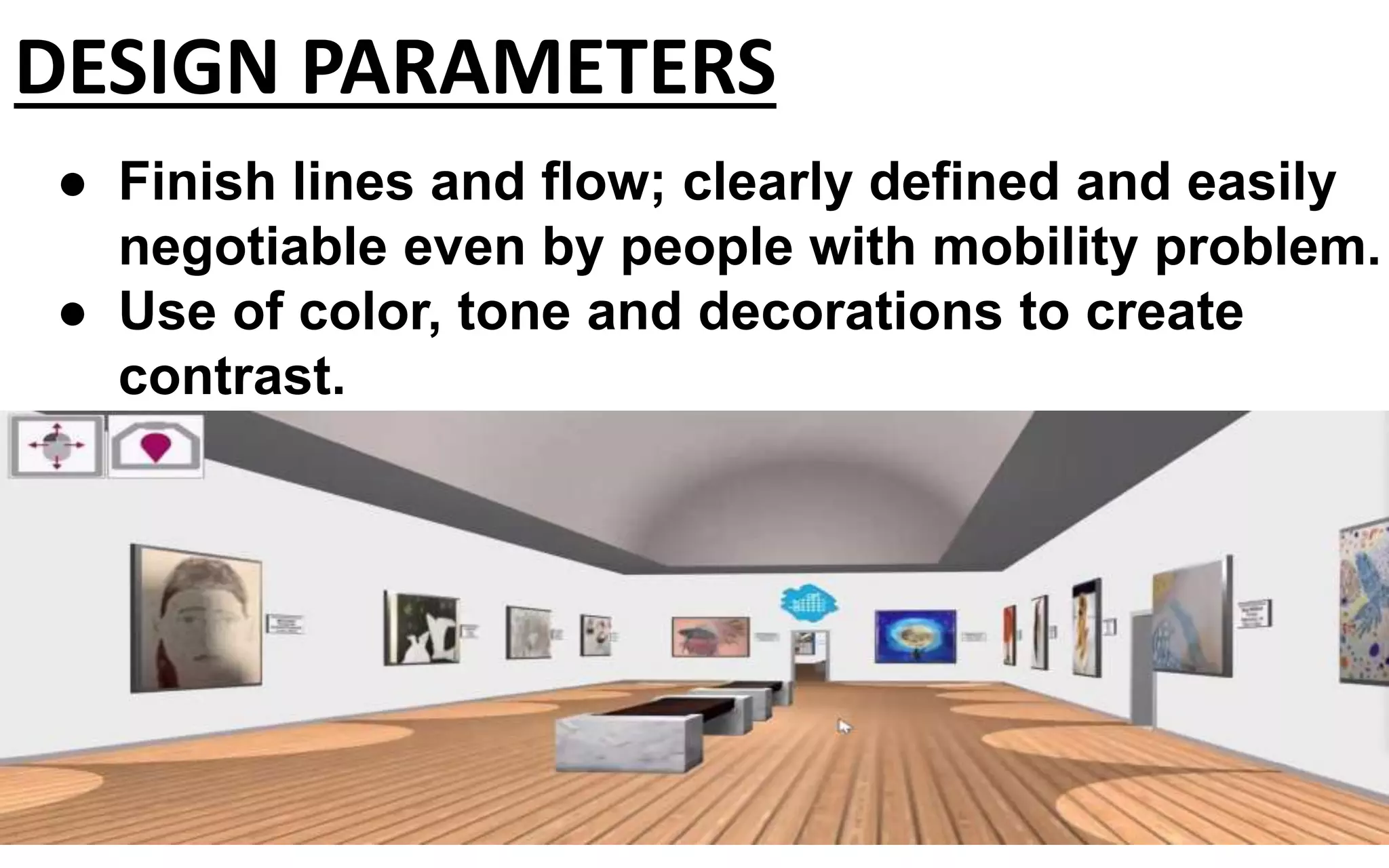
DESIGN PARAMETERS
DESIGN PARAMETERS
● Finish lines and flow; clearly defined and easily
negotiable even by people with mobility problem.
● Use of color, tone and decorations to create
contrast.
ANTHROPOMETRY
Lightings
● Floorceiling plans that
allow admitting natural
lights. Clarify pathways.
● Concious and creative
use of windows, glass
walls and artificial lights.
● Sufficient light on
objects and lables.
● Visual safety of visitors
must be considered.
SPACE DIVISION IDEAS
Orientation
● Regarding, safety of art peices, the gallery space be oriented
towards north or so as to avoid direct acess to sunrays.
● Windows facing north.
● Well lit space, easy access, proper circulationflow.
Creative learning space
.
OTHER CREATIVE SPACES
● LEARNING HUB: spaces for leisure
learning self studies, growing creativity.
● Enhanced with smart boards, digital
kiosks, lego kits, etc in semi-open
space/well lit space.
● MULTIPURPOSE HALL: To learn dance
drama, club gathering, and many more
● Well ventilated, in rather separated
space/building, soundproof walls.
DANCE STUDIO:
● 20-24 Sq.ft per student.
● Approx. 20 student at studio.
● Ceiling height 4.8m to 7.3m.
● Mirror section of 1.8m .2.4m
should attach to wall approx. 0.15m from floor.
● Maintain temp. around 24° and 21°c.
● Light source: windows in opaque glass above eye level.
AUDITORIUM
•An auditorium is a room built to enable an audience to
hear and watch performance at venue such as theatres.
Types of Auditorium
END STAGE THEATRE
Auditorium with audience
only on the front side
THRUST THEATRE
Auditorium with audience
surrounded on three sides
Continue…
ARENE THEATRE
• Having audience on all sides
• A theatre without a proscenium
FLEXIBLE THEATRE
•With flexible space and seating
arrangement
PLAN
BUBBLE DAIGRAM
AUDITORIUM
SEATING AREA
STAGE
INSTRUMENTAL
MUSIC
CLASSROOM
DRESSING
ROOM
DRESSIN
G ROOM
STORAGE
FOYER
LOBBY
WOMEN
W/C
MEN
W/C
SPACE REQUIREMENT
(0.65-0.84)SQ.M/SEAT
MAX. 16 SEATS PER AISLE
25 SEATS IF DOOR WIDTH IS 1M
STAGE:(0.46-0.65)M²/ PERSON
REHEARSAL ROOM:(35-50)% OF STAGE AREA
WORKSHOP:(50-70)% OF STAGE
CEILING HEIGHT:(6-7.5)M
DISTANCE BETWEEN STAGE AND FRONT ROW:
3.6-4.5)M
Continue….
CHANGING ROOM:(3.8-5)M²/PERSON
ORCHESTRA
2.5M BELOW STAGE
(1-1.5)M²/ MUSICIAN
In order to obtain clear and
Unobstructed sight line to the screen
Staggered seating planning is prefered.
• Staggering is accomplished by the
Non-uniform placement of seats.
DESIGN GUIDELINES
• The choice of site for an auditorium is governed by
several factors. The problem of noice is an important
consideration.
• In fact, the quietest possible condition should be
provided so that intelligibility of speech doesn’t suffer
and even soft messages of music are heard.
• Sound insulation like plantation should be provided.
• Echo should be avoided by covering a long distance walls
ceiling with suitable sound absorbing material.
ANTHROPOMETRY
Continue…
RAISED FLOOR
• For good visibility as also for
Good listening conditions, the
Successive rows of seats have to
Be raised.
•Concentric seating is found
to be more efficient than
straight linear seating.
•Multiple aisle system of
seating is found to be more
.
Maximum vertical cone of vision for man is 70° so the
seats should should be arranged not to be near more than
this.
Similarly maximum horizontal cone of vision is 150°
(60+90)
LIGHTING
• To concentrate attention upon the stage.
• Colour of light should be neutral.
• Should strike actor face at about 45° at
horizontal.
VENTILATION
• Stage ventilations needed
For stage greater than 50 ft.
Height.
SOUND INSULATION
• Use of acoustic panel for sound proofing of
auditorium.
• Acoustical panels Offer great results by
Observing the reflection and echoes within
the auditorium.
FIRE PROTECTION
 SPRINKLERS: under
Roof
 Use of fire curtain.
OTHERS
• .
HOSTEL
• It is a form of low-cost, short-term shared sociable lodging where
students can rent a bed, usually a bunk bed in a dormitory.
• A single person room should be of minimum of 8.5m² and increasing
to 12m² for 2 persons.
• Separate dormitories for men and women, with separate entrance.
• Supervision by a warden.
WATER SUPPLY AND DRAINAGE
It is the provision of water by public utilities, by a system of pumps
and pipes.
OVERHEAD TANKS:
concrete water tank , elevated
to create pressure for distribution
Without using booster pumps
• Minimum 500 litre tank for
every 100 children.
DRAINAGE: water should not discharge over side walls except by
sheet flow.
• Recreation and play area shall be properly drained at about 2%
slope.
Safety Includes two major aspects:
Physical Safety
Emotional and personal safety
• FIRE SAFETY MANAGEMENT
• NATURAL DISASTERS MANAGEMENT
• Sanitation and hygiene
• Trauma management
• Health safety
• Entrance as check point
,securing monitoring and
maximum visibility
• Two security guards for
managing the patrons
• Prefabricated guard house
which includes HVAC, wiring
and phone.
• Guard house dimensions
(8’*8’*8’)
• Ensuring and capturing the
activities through cctv
• Implement an ID badge policy.
• Set clear rules and limits for students on violence
• Bully proof class rooms
• Plan for severe weather
• Develop resources for depressed or stressed students
• Brainstorm solutions to the barriers
• Also and easy access to the class room for the disabled
students with appropriate safety .
• Analyze the overall state ,district and school crisis and
disasters plan.
• Help student learn, understand and practice the specific skills
they will need to develop to stay safe.
MATRIX DIAGRAM FOR SCHOOL
SAFETY FACTOR OF BUILDING:
• Ratio of length and breadth less than 1:3.
• Must be welled tie up of beam and column.
• Expansion joint at regular interval.
• Exterior wall should be of 9 inch.
• Structure with larger base is safer as compared
to structure with slender shape with lesser base
area.
• Building with U, V, H shaped plans have sustained
significant damages.
• In many cases the damage
could be avoided by making
building into two parts.
CONCLUSION:
• While learning about school literally we came to know that:
1. The required area for person in different places.
2. Standard dimension of room area, furniture, floor height, opening
area for different room.
3. Linkage between spaces
4. School has a lot beyond education spaces like art room ,playground
Dance hall, assembly etc
literature-review-on-school-1.pptx

literature-review-on-school-1.pptx

  • 1.
    . Submitted by: Aasish Sapkota(075BAR001) Abhishek Acharya (075BAR002) Anita Kafle (075BAR006) Ashesh Regmi (075BAR006) Divya Adhikari (075BAR017) Submitted to: Lec. Ar. Milan Bhattarai Lec. Ar. Dipendra S. chongbong
  • 2.
    LITERATURE REVIEW FORMAT: •Introduction • Types of school • History • Site selection criteria • Zoning of spaces • Anthropometric data of spaces • 1. Academic • 2.Administrative • 3.Creative • 4.others • Matrix diagram • Safety factor of building • Conclusion
  • 3.
    INTRODUCTION: • A schoolis an educational institution designed to provide learning spaces and learning environment for the students. • Why is education so important: 1. "Education is the most Powerful weapon which we can use to change the world." - Nelson Mandela 2. " Education is not about molding Children the way you think they Should be. It is about organizing the natural longing in a human being to know.“ - Sadhguru BUDHANILKANTHA SCHOOL
  • 4.
    TYPES OF SCHOOL: •COMMUNITY SCHOOLS • INSTITUTIONAL SCHOOLS • RELIGIOUS SCHOOLS
  • 5.
    COMMUNITY SCHOOL • Communityschools are the types of school that are supported by the government and are similar to that of public school. • Divided into three sub-categories: 1. Community-Aided school school where the responsibility regarding paying salary and other form of expenses is in the hand of government. 2. Community-Managed school fully supported by the government but the community is responsible for the management of schools. 3. Community-unaided School that might get partial support or may not get any support from the government.
  • 6.
    . INSTITUTIONAL SCHOOLS •That are supported by the parents and the trustees and are similar to that of private schools. RELIGIOUS SCHOOLS • School that either has a religious component in its operations or its curriculum. • Divided into three sub-categories: 1. MADRASA- that are operating for the people of muslim community. 2. ASHRAM-that are operating for the people of hindu community. 3. GUMBA-that are operating for the people of buddhist community.
  • 7.
    ON THE BASISOF FACULTIES • SCIENCE SCHOOL: science lab, demonstration spaces • ARTS SCHOOL: art galleries, lighting, aesthetic elements. • TECHNICAL SCHOOL: labs, medical equipment, practical spaces commerce school, humanities. • MULTIFACULTY SCHOOL: including two or more faculties.
  • 8.
    HISTORY • The conceptof grouping students together in a centralized location for learning had existed since classical antiquity, formal schools have existed at least since ancient times. 1. WESTERN: Greece and Rome are famous for Starting education. • In western Europe – Cathedral school. • In Islam-school system Developed with mosque.
  • 9.
    Continue… 2.EASTERN: Gurukul education Systemwas famous in India. 3.NEPAL: the first formal school is Durbar high school.(1855) • For the Eute, after democracy More opportunities opened for Diverse people.
  • 11.
    DESIGN PRINCIPLE ASPECT • Classroom-wellventilated • Sufficient light (without glare)-easy reading and writing. • Entrance door-open to the stage • Laboratories-bright light availibility ROOMINESS- Width to length ratio (1:1.2 to 1:1.5) PRIVACY • Not more than 3 classes in a row. • It is a good to have independent access to each class.
  • 12.
    . GROUPING • Principal andstaff room are grouped and located near entrance. • Girls waiting room and toilet need to be grouped. CIRCULATION • There should be only one entrance into the classroom. • Horizontal circulation should be possibly utility should not be more than 1:3.
  • 13.
    SITE SELECTION ANDGUIDELINE: • Size: larger school site is always preferred since it allows more environmental integration. • Shape: Rectangular shape site are always easier to plan. and adequate plan can be Achieved. • Location: Site has to be safe and rich with utilities and services but free from disturbing elements such as noise pollution. • Topography and drainage: The site should allow the flow of sewage according to gravity, preferable without use of pumps.
  • 14.
    Continue…… • Terraced landis unsuitable for construction of building. • Construction site has to be safe and stable to withstand total building code. • Poor sites are the site that are vulnerable to landslides, soil erosion, steep slopes. • Building on sloped ground have unequal height, columns along the slope, which causes ill effects like twisting and damage in shorter columns
  • 15.
    Continue…. • Should begently sloping with an elevation and contour which will ensure good drainage. • Site should provide sufficient space to sustain physical education with a variety of vegetation and plant life. • Access and traffic: The site should be surrounded by different means of transport that are useful to students and staff. Avoid location near factories.
  • 16.
    Continue…… • Security andsafety: No roadways should be crossed by any students to get to playground. • Site should allow the construction of building so as to allow the adequate sunlight to hinder any act of vandalism. • Noise level school should be far enough from air terminals and high speed vechicular traffic. • Utilities water, drainage and electrical services including telivision and telephones lines must be available.
  • 17.
    Zoning of spaces Mainhall Art room entrance To playing fields office head Staff room cloakroom Classroom
  • 19.
  • 24.
    DIFFERENT TYPES OF CLASSROOM GENERALPURPOSE CLASSROOM SEMINAR CLASSROOM ACTIVE LEARNING CLASSROOM
  • 34.
  • 36.
    ADMINISTRATIVE PRINCIPLE‘S ROOM • Itis the office for the person Who is head of the organization. • It should have access to clerk and vice-principals room. • Size of the room-(20-25)m² • General furniture- Working tables ,book shelfs, closet, chair VICE-PRINCIPLE‘S ROOM • It is almost similar to principal’s room. • It should be link with account section and have access to record room. • Size of the room-(15-20)M². • Location-near to principal office and clerk room.
  • 37.
    . TEACHER’S AND STAFF’SROOM • The room where the staff’s of the school gather. • Location-should be near reception or clerk office. • Public shouldn’t able to gain direct access to this room. ACCOUNTANT ROOM • It is the place where all the financial transition of the school is carried out. • Dimension- varies as per Teacher. Generally 1.2/2M².
  • 39.
  • 41.
    OPEN AMPHITHEATRE • Open-airvenue used for the performance entertainment and sports. • Circular, oval or raised seating. • Slope of seating shouldn’t be less than 12 degree for better audibility and visibility. • Noise level shouldn’t exceed 40 decible. • It helps to connect indoor and outdoor space.
  • 42.
    ART GALLERY INTRODUCTION ● exhibitionspace for visual arts, generally. ● space for collecting ,preserving, interpreting and exhibiting art materials.
  • 43.
    ● height lessthan 12 meters, or for architectural elements, upto 17 meters. ● circulation space must me well lighted, clearly defined and easy to follow for wheelchair users as well.(Wd= 1- 1.5m) DESIGN PARAMETERS
  • 44.
    DESIGN PARAMETERS ● Finishlines and flow; clearly defined and easily negotiable even by people with mobility problem. ● Use of color, tone and decorations to create contrast.
  • 45.
  • 46.
    Lightings ● Floorceiling plansthat allow admitting natural lights. Clarify pathways. ● Concious and creative use of windows, glass walls and artificial lights. ● Sufficient light on objects and lables. ● Visual safety of visitors must be considered.
  • 47.
  • 48.
    Orientation ● Regarding, safetyof art peices, the gallery space be oriented towards north or so as to avoid direct acess to sunrays. ● Windows facing north. ● Well lit space, easy access, proper circulationflow.
  • 50.
  • 51.
    OTHER CREATIVE SPACES ●LEARNING HUB: spaces for leisure learning self studies, growing creativity. ● Enhanced with smart boards, digital kiosks, lego kits, etc in semi-open space/well lit space. ● MULTIPURPOSE HALL: To learn dance drama, club gathering, and many more ● Well ventilated, in rather separated space/building, soundproof walls.
  • 52.
    DANCE STUDIO: ● 20-24Sq.ft per student. ● Approx. 20 student at studio. ● Ceiling height 4.8m to 7.3m. ● Mirror section of 1.8m .2.4m should attach to wall approx. 0.15m from floor. ● Maintain temp. around 24° and 21°c. ● Light source: windows in opaque glass above eye level.
  • 53.
    AUDITORIUM •An auditorium isa room built to enable an audience to hear and watch performance at venue such as theatres.
  • 54.
    Types of Auditorium ENDSTAGE THEATRE Auditorium with audience only on the front side THRUST THEATRE Auditorium with audience surrounded on three sides
  • 55.
    Continue… ARENE THEATRE • Havingaudience on all sides • A theatre without a proscenium FLEXIBLE THEATRE •With flexible space and seating arrangement
  • 56.
  • 57.
  • 58.
    SPACE REQUIREMENT (0.65-0.84)SQ.M/SEAT MAX. 16SEATS PER AISLE 25 SEATS IF DOOR WIDTH IS 1M STAGE:(0.46-0.65)M²/ PERSON REHEARSAL ROOM:(35-50)% OF STAGE AREA WORKSHOP:(50-70)% OF STAGE CEILING HEIGHT:(6-7.5)M DISTANCE BETWEEN STAGE AND FRONT ROW: 3.6-4.5)M
  • 59.
    Continue…. CHANGING ROOM:(3.8-5)M²/PERSON ORCHESTRA 2.5M BELOWSTAGE (1-1.5)M²/ MUSICIAN In order to obtain clear and Unobstructed sight line to the screen Staggered seating planning is prefered. • Staggering is accomplished by the Non-uniform placement of seats.
  • 60.
    DESIGN GUIDELINES • Thechoice of site for an auditorium is governed by several factors. The problem of noice is an important consideration. • In fact, the quietest possible condition should be provided so that intelligibility of speech doesn’t suffer and even soft messages of music are heard. • Sound insulation like plantation should be provided. • Echo should be avoided by covering a long distance walls ceiling with suitable sound absorbing material.
  • 61.
  • 62.
  • 63.
    RAISED FLOOR • Forgood visibility as also for Good listening conditions, the Successive rows of seats have to Be raised. •Concentric seating is found to be more efficient than straight linear seating. •Multiple aisle system of seating is found to be more
  • 64.
    . Maximum vertical coneof vision for man is 70° so the seats should should be arranged not to be near more than this. Similarly maximum horizontal cone of vision is 150° (60+90)
  • 65.
    LIGHTING • To concentrateattention upon the stage. • Colour of light should be neutral. • Should strike actor face at about 45° at horizontal. VENTILATION • Stage ventilations needed For stage greater than 50 ft. Height.
  • 66.
    SOUND INSULATION • Useof acoustic panel for sound proofing of auditorium. • Acoustical panels Offer great results by Observing the reflection and echoes within the auditorium. FIRE PROTECTION  SPRINKLERS: under Roof  Use of fire curtain.
  • 67.
  • 73.
    HOSTEL • It isa form of low-cost, short-term shared sociable lodging where students can rent a bed, usually a bunk bed in a dormitory. • A single person room should be of minimum of 8.5m² and increasing to 12m² for 2 persons. • Separate dormitories for men and women, with separate entrance. • Supervision by a warden.
  • 76.
    WATER SUPPLY ANDDRAINAGE It is the provision of water by public utilities, by a system of pumps and pipes. OVERHEAD TANKS: concrete water tank , elevated to create pressure for distribution Without using booster pumps • Minimum 500 litre tank for every 100 children. DRAINAGE: water should not discharge over side walls except by sheet flow. • Recreation and play area shall be properly drained at about 2% slope.
  • 78.
    Safety Includes twomajor aspects: Physical Safety Emotional and personal safety
  • 79.
    • FIRE SAFETYMANAGEMENT
  • 80.
  • 81.
    • Sanitation andhygiene • Trauma management • Health safety
  • 82.
    • Entrance ascheck point ,securing monitoring and maximum visibility • Two security guards for managing the patrons • Prefabricated guard house which includes HVAC, wiring and phone. • Guard house dimensions (8’*8’*8’) • Ensuring and capturing the activities through cctv
  • 83.
    • Implement anID badge policy. • Set clear rules and limits for students on violence • Bully proof class rooms • Plan for severe weather • Develop resources for depressed or stressed students • Brainstorm solutions to the barriers • Also and easy access to the class room for the disabled students with appropriate safety . • Analyze the overall state ,district and school crisis and disasters plan. • Help student learn, understand and practice the specific skills they will need to develop to stay safe.
  • 84.
  • 85.
    SAFETY FACTOR OFBUILDING: • Ratio of length and breadth less than 1:3. • Must be welled tie up of beam and column. • Expansion joint at regular interval. • Exterior wall should be of 9 inch. • Structure with larger base is safer as compared to structure with slender shape with lesser base area. • Building with U, V, H shaped plans have sustained significant damages. • In many cases the damage could be avoided by making building into two parts.
  • 86.
    CONCLUSION: • While learningabout school literally we came to know that: 1. The required area for person in different places. 2. Standard dimension of room area, furniture, floor height, opening area for different room. 3. Linkage between spaces 4. School has a lot beyond education spaces like art room ,playground Dance hall, assembly etc