
Incorporating Universal Design Principles in the Development, Delivery, and Assessment of Your InstructionSusan A. Aase, J.D., M.S.Ed., Outreach Coordinator, Disability ServicesIlene D. Alexander, PhD, Teaching Consultant, Center for Teaching and LearningTim Kamenar, M.S., Disability Specialist, Disability ServicesKate Martin, M.A., Teaching Consultant, Center for Teaching and Learning
ResourcesTo download slides and handouts from today’s session, go tohttp://slideshare.net/uminnteachlearnTo participate in Twitter idea sharing about August Teaching Enrichment Series:#atesCTL
LearningLearning refers only to significant changes in capability, understanding, knowledge, practices, attitudes or values by individuals, groups, organisations or society. Frank Coffield
LearningOne of the differences that has had the most influence on my own approach is that  Confucian philosophy encourages questioning and discussion but after the learner has focused on understanding and acquiring concepts  “Teaching and learning: the international higher education landscape”  Sheila Trahar
LearningSilence, rather than an indicator of a lack of engagement in the process of learning, or of passive learning, regarded pejoratively by many Western Academics is thus an active process, socially positive and beneficial to higher levels of thinking and to deepening understanding..
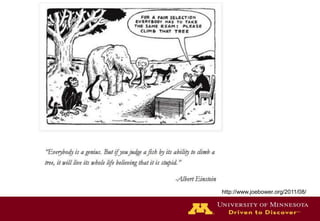
Centered Titlehttp://www.joebower.org/2011/08/
Universal Design: Key QuestionStudents want to learn and their instructors share this goal. How can instructors select their curriculum and instructional strategies to maximize the learning of all students?The Faculty Room, DoIt webpage:http://www.washington.edu/doit/Faculty/Strategies/Universal/
Universal Design – Core PracticeEmploying universal design principles in instruction does not eliminate the need for specific accommodations for students with disabilities. There will always be the need for some specific accommodations, such as sign language interpreters for students who are deaf.
Universal Design – Core PracticeHowever, applying universal design concepts in course planning will assure full access to the content for most students and minimize the need for specific accommodations.
Universal Design – Core PracticeFor example, designing web resources in accessible format as they are developed means that no re-development is necessary if a blind student enrolls in the class; planning ahead can be less time-consuming in the long run. Letting all students have access to your class notes and assignments on an accessible website can eliminate the need for providing materials in alternative formats.
Integrated and Aligned Design“Integrated and Aligned Design” incorporates the principles of Universal Design into well established tenants of good curricular design.
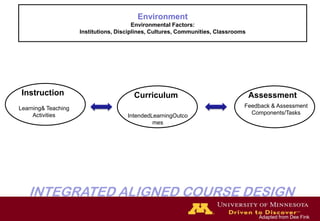
CurriculumAssessmentLearning& Teaching ActivitiesEnvironmentEnvironmental Factors:Institutions, Disciplines, Cultures, Communities, ClassroomsInstructionFeedback & Assessment Components/TasksIntendedLearningOutcomesINTEGRATED ALIGNED COURSE DESIGNAdapted from Dee Fink
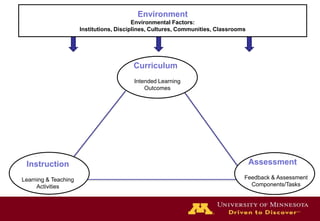
Intended Learning OutcomesAssessmentLearning & Teaching ActivitiesEnvironmentEnvironmental Factors:Institutions, Disciplines, Cultures, Communities, ClassroomsSituational ContextCurriculumInstructionFeedback & Assessment Components/Tasks
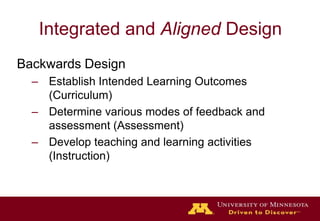
Integrated and Aligned DesignBackwards DesignEstablish Intended Learning Outcomes (Curriculum)Determine various modes of feedback and assessment (Assessment)Develop teaching and learning activities (Instruction)
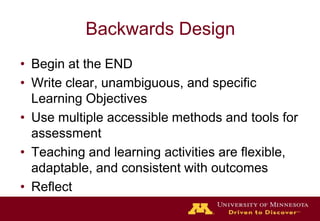
Backwards DesignBegin at the ENDWrite clear, unambiguous, and specific Learning ObjectivesUse multiple accessible methods and tools for assessmentTeaching and learning activities are flexible, adaptable, and consistent with outcomes Reflect
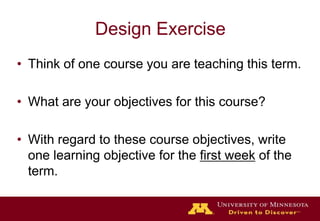
Design ExerciseThink of one course you are teaching this term.What are your objectives for this course? With regard to these course objectives, write one learning objective for the first week of the term.
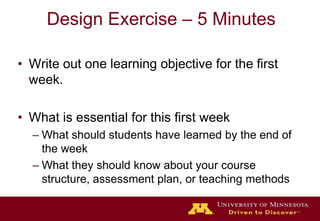
Design Exercise – 5 MinutesWrite out one learning objective for the first week.  What is essential for this first weekWhat should students have learned by the end of the weekWhat they should know about your course structure, assessment plan, or teaching methods
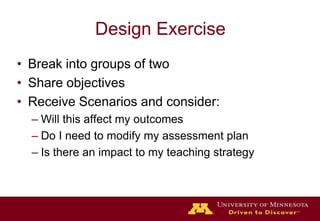
Design ExerciseBreak into groups of twoShare objectivesReceive Scenarios and consider:Will this affect my outcomesDo I need to modify my assessment planIs there an impact to my teaching strategy
What Can You Do NowSyllabusTechnologyNext Steps
SyllabusUniversally Designed Syllabus Tips:Present information in a least 2 formatsGive as many resources as possibleProvide background information, but be briefBuild in flexibilityGo digitalLess is more(Source:  Equity and Excellence in Higher Education:  Universal Course Designwww.eeonline.org)
TechnologyUniversal Course Design ToolsComputer-based presentation hardware and softwareVideos, pictures and graphicsAudio related hardwareSoftwareAccessible communication tools(Source:  Equity and Excellence in Higher Education:  Universal Course Designwww.eeonline.org)
Next StepsReview instruction beyond the first weekUse principles of Universal Design to rethink teaching/instructionMake the unexpected expected
Thank you for your participation.
Please complete the evaluation form.

Teaching Enrichment Series: Incorporating Universal Design

  • 1.
    Incorporating Universal DesignPrinciples in the Development, Delivery, and Assessment of Your InstructionSusan A. Aase, J.D., M.S.Ed., Outreach Coordinator, Disability ServicesIlene D. Alexander, PhD, Teaching Consultant, Center for Teaching and LearningTim Kamenar, M.S., Disability Specialist, Disability ServicesKate Martin, M.A., Teaching Consultant, Center for Teaching and Learning
  • 2.
    ResourcesTo download slidesand handouts from today’s session, go tohttp://slideshare.net/uminnteachlearnTo participate in Twitter idea sharing about August Teaching Enrichment Series:#atesCTL
  • 4.
    LearningLearning refers onlyto significant changes in capability, understanding, knowledge, practices, attitudes or values by individuals, groups, organisations or society. Frank Coffield
  • 5.
    LearningOne of thedifferences that has had the most influence on my own approach is that Confucian philosophy encourages questioning and discussion but after the learner has focused on understanding and acquiring concepts  “Teaching and learning: the international higher education landscape” Sheila Trahar
  • 6.
    LearningSilence, rather thanan indicator of a lack of engagement in the process of learning, or of passive learning, regarded pejoratively by many Western Academics is thus an active process, socially positive and beneficial to higher levels of thinking and to deepening understanding..
  • 7.
  • 8.
    Universal Design: KeyQuestionStudents want to learn and their instructors share this goal. How can instructors select their curriculum and instructional strategies to maximize the learning of all students?The Faculty Room, DoIt webpage:http://www.washington.edu/doit/Faculty/Strategies/Universal/
  • 9.
    Universal Design –Core PracticeEmploying universal design principles in instruction does not eliminate the need for specific accommodations for students with disabilities. There will always be the need for some specific accommodations, such as sign language interpreters for students who are deaf.
  • 10.
    Universal Design –Core PracticeHowever, applying universal design concepts in course planning will assure full access to the content for most students and minimize the need for specific accommodations.
  • 11.
    Universal Design –Core PracticeFor example, designing web resources in accessible format as they are developed means that no re-development is necessary if a blind student enrolls in the class; planning ahead can be less time-consuming in the long run. Letting all students have access to your class notes and assignments on an accessible website can eliminate the need for providing materials in alternative formats.
  • 12.
    Integrated and AlignedDesign“Integrated and Aligned Design” incorporates the principles of Universal Design into well established tenants of good curricular design.
  • 13.
    CurriculumAssessmentLearning& Teaching ActivitiesEnvironmentEnvironmentalFactors:Institutions, Disciplines, Cultures, Communities, ClassroomsInstructionFeedback & Assessment Components/TasksIntendedLearningOutcomesINTEGRATED ALIGNED COURSE DESIGNAdapted from Dee Fink
  • 14.
    Intended Learning OutcomesAssessmentLearning& Teaching ActivitiesEnvironmentEnvironmental Factors:Institutions, Disciplines, Cultures, Communities, ClassroomsSituational ContextCurriculumInstructionFeedback & Assessment Components/Tasks
  • 15.
    Integrated and AlignedDesignBackwards DesignEstablish Intended Learning Outcomes (Curriculum)Determine various modes of feedback and assessment (Assessment)Develop teaching and learning activities (Instruction)
  • 16.
    Backwards DesignBegin atthe ENDWrite clear, unambiguous, and specific Learning ObjectivesUse multiple accessible methods and tools for assessmentTeaching and learning activities are flexible, adaptable, and consistent with outcomes Reflect
  • 17.
    Design ExerciseThink ofone course you are teaching this term.What are your objectives for this course? With regard to these course objectives, write one learning objective for the first week of the term.
  • 18.
    Design Exercise –5 MinutesWrite out one learning objective for the first week. What is essential for this first weekWhat should students have learned by the end of the weekWhat they should know about your course structure, assessment plan, or teaching methods
  • 19.
    Design ExerciseBreak intogroups of twoShare objectivesReceive Scenarios and consider:Will this affect my outcomesDo I need to modify my assessment planIs there an impact to my teaching strategy
  • 20.
    What Can YouDo NowSyllabusTechnologyNext Steps
  • 21.
    SyllabusUniversally Designed SyllabusTips:Present information in a least 2 formatsGive as many resources as possibleProvide background information, but be briefBuild in flexibilityGo digitalLess is more(Source: Equity and Excellence in Higher Education: Universal Course Designwww.eeonline.org)
  • 22.
    TechnologyUniversal Course DesignToolsComputer-based presentation hardware and softwareVideos, pictures and graphicsAudio related hardwareSoftwareAccessible communication tools(Source: Equity and Excellence in Higher Education: Universal Course Designwww.eeonline.org)
  • 23.
    Next StepsReview instructionbeyond the first weekUse principles of Universal Design to rethink teaching/instructionMake the unexpected expected
  • 24.
    Thank you foryour participation.
  • 25.
    Please complete theevaluation form.

Editor's Notes

  • #4 While they’re writing
  • #5 For brief discussion about learning
  • #6 Prompt for specific example – asking for students to report on readings
  • #7 Prompt for specific example – designated listener(s) during a discussion of readings
  • #10 Build reading example – Ida note