The Universal
Design File

Designing for People
of All Ages and Abilities


© 1998 NC State University, The Center for Universal Design.
Revised Edition. Please contact the author for permission to make copies.
Credits


 Principal Investigators       Molly Follette Story, MS, IDSA
                               Ronald L. Mace, FAIA


               Authors         Molly Follette Story, MS, IDSA
                               James L. Mueller, MA, IDSA
                               Ronald L. Mace, FAIA


        Graphic Design         Jackie Gottlieb


               Funding         This publication was produced under Grant #H133A40006,
                               "Studies to Further the Development of Universal Design,"
                               from the National Institute on Disability and Rehabilitation
                               Research, U.S. Department of Education. The opinions
                               expressed in this publication are those of the grantee and do
                               not necessarily reflect those of the Department of Education.
                               The Center for Universal Design is part of the School of
                               Design at North Carolina State University.


                       The Universal Design File     THE CENTER FOR UNIVERSAL DESIGN
Acknowledgments


                  This book was produced as part of a Research and Demonstration
                  Project titled “Studies to Further the Development of Universal
                  Design,” funded by the United States Department of Education’s
                  National Institute on Disability and Rehabilitation Research from
                  1994 to 1997. We would like to thank our project officer,
                  Dr. Richard K. Johnson, for his support and assistance.

                  The project was conducted by staff of The Center for Universal
                  Design in the School of Design at NC State University. Contributing
                  staff were Michael L. Jones, Ronald L. Mace, Molly Follette Story,
                  Bettye Rose Connell, Jon A. Sanford, Kelly Houk, Sigrid Hall,
                  Jackie Gottlieb, and graduate research assistants Sherri Koester,
                  David Ringholz, Greg Lalier, Mark Olszowy, Leslie Frye, Kevin
                  Roughton, Kody Hargrave, Dorje Bellbrook, Tonie Cox, and Erin
                  Zitelli. The project, and particularly this document, received
                  substantial assistance from subcontractor James L. Mueller,
                  Principal of J.L. Mueller, Inc., in Chantilly, Virginia.

                  Assistance in developing “The Principles of Universal Design”
                  was provided by an advisory panel of experts in universal design
                  including Gregg Vanderheiden, PhD, Trace R&D Center at the
                  University of Wisconsin at Madison; Edward Steinfeld, ArchD, and
                  Abir Mullick, IDSA, IDEA Center at the State University of New
                  York at Buffalo; and Elaine Ostroff, MEd, Adaptive Environments
                  Center in Boston. We would like to express our appreciation to them
                  for generously sharing their time and expertise to further the goals of
                  the project.

                  The Principles of Universal Design were reviewed by a group of
                  professional colleagues with experience in the field of universal
                  design, including Meredith Davis, NC State University;


     The Universal Design File      THE CENTER FOR UNIVERSAL DESIGN
Acknowledgments


                     John P.S. Salmen, Universal Designers and Consultants, Inc.; Peter
                     Orleans (Architect), Denver, Colorado; Mary Jo Peterson, Mary Jo
                     Peterson, Inc.; Susan Goltsman, Moore Iacafano Goltsman, Inc.;
                     Paul J. Grayson, Environments for Living; Polly Welch, University of
                     Oregon; Allan Eckhaus, Consumers Union; Scott Sargent, Consumer
                     Testing Laboratories, Inc.; Margaret Wylde, ProMatura Group, LLC;
                     Gerald Weisman, University of Wisconsin at Milwaukee; and Roger
                     Whitehouse, Whitehouse & Company. We would like to thank them
                     for their contributions to the project.

                     We would also like to thank our academic colleagues in the Universal
                     Design Education Project (UDEP), an ongoing project of the Adaptive
                     Environments Center and The Center for Universal Design to introduce
                     the concept and Principles of Universal Design into design curricula
                     nationwide. UDEP faculty received a preliminary working draft of The
                     Principles of Universal Design in October 1995. They provided lively
                     feedback on the concept of principles, helped us know how our
                     Principles might be received, understood and applied, and used them
                     in their classrooms. Their feedback was invaluable.


           The Universal Design File    THE CENTER FOR UNIVERSAL DESIGN
Introduction


                             1
 The Universal Design File       THE CENTER FOR UNIVERSAL DESIGN
Introduction


               The designed world doesn’t suit anyone perfectly. At times, we all have
               problems with the spaces we live in and the products we use. Designers
               are trained to design for a mythical “average” group of people, but in fact
               this group does not exist. Every individual is unique and as a group, the
               human species is quite diverse.

               It is possible to design a product or an environment to suit a broad range
               of users, including children, older adults, people with disabilities, people
               of atypical size or shape, people who are ill or injured, and people
               inconvenienced by circumstance. This approach is known as universal
               design. Universal design can be defined as the design of products and
               environments to be usable to the greatest extent possible by people of all
               ages and abilities. Universal design respects human diversity and
               promotes inclusion of all people in all activities of life.

               It is unlikely that any product or environment could ever be used by
               everyone under all conditions. Because of this, it may be more
               appropriate to consider universal design a process, rather than
               an achievement.

               Disability is a common condition, and more pervasive than many people
               realize. Most likely, everyone will experience disability in his or her
               lifetime, even if only temporarily. According to 1994-95 data from the
               US Census Bureau’s Survey of Income and Program Participation (SIPP),
               1.8 million people ages 6 and over used a wheelchair that year, and 5.2
               million people used a cane, crutches, or a walker for six months or more.
               8.8 million people had difficulty seeing the words and letters in ordinary
               newsprint even when wearing corrective lenses, and 1.6 million could not
               see such words and letters at all. 10.1 million people ages 6 and over had


                                   2
       The Universal Design File       THE CENTER FOR UNIVERSAL DESIGN
Introduction


             difficulty hearing what was said in a normal conversation with
             another person, and 1.0 million were unable to hear at all
             (McNeil, 1997).

             Cognitive impairments are not visible but affect many people.
             It is estimated that at the end of 1994, among the population aged
             21 to 64 years, 6.0 million people in the United States had a mental
             disability. Of the 35.0 million children aged 6 to 14 years, 2.2
             million had difficulty doing regular homework, 1.5 million had a
             learning disability, and .5 million had a developmental disability
             (McNeil, 1997).

             Disability increases with age for natural reasons and as a result of
             external causes. Many people, especially older adults, deny having
             a disability because of the perceived social stigma identified with
             being disabled. Disability, however, is a common and normal part
             of life.

             While some individuals have chronic conditions, anyone may be
             temporarily disabled. For example, a broken leg, a sprained wrist,
             the flu, pupils dilated for an eye exam, or the lasting effects of a
             loud concert are temporarily disabling conditions. Also,
             circumstances such as poor lighting, high noise levels, adverse
             weather conditions, carrying packages, wearing bad shoes, or
             visiting a country where natives speak a different language affect
             people’s physical, sensory, and cognitive abilities. In addition,
             nearly everyone knows someone with a disability, and as a result,
             our lives are affected indirectly, as well, by products and
             environments that fail to accommodate limitations.

             Concern for usability may be the next frontier in design, one that
             will set apart competitors in upcoming decades. Longer lifespans
             and higher survival rates for people with severe injuries and
             illnesses mean more people are living with disabilities now than at
             any time in history, and the number is increasing. Universal design
             will become even more important as these trends persist and the
             average age of the world’s population continues to climb after the
             turn of the century. Fortunately, the practice of universal design is


                            3
The Universal Design File       THE CENTER FOR UNIVERSAL DESIGN
Introduction


                         becoming more sophisticated each year as understanding, guidelines,
                         examples, teaching strategies, design experience, and marketing
                         skills evolve.

                         This book presents an in-depth introduction to the concept of universal
                         design and serves as a guide for persons studying the field and for
                         individuals evaluating current designs or creating new ones. Chapter 1
                         offers a brief history of universal design and Chapter 2, an overview of
                         the diversity in human abilities. Chapter 3 introduces The Principles of
                         Universal Design (The Center for Universal Design, 1997) and offers
                         examples of each Principle in practice. Chapter 4 presents case studies
                         of successful universal design application.

                         The information contained in this book was gathered as part of a
                         research and demonstration project titled “Studies to Further the
                         Development of Universal Design.” The project, funded by the National
                         Institute on Disability and Rehabilitation Research of the U.S.
                         Department of Education, evaluated consumer products, architectural
                         spaces, and building elements to identify performance characteristics
                         and features that make products and environments usable by the
                         greatest variety of people. The project also developed a series of case
                         studies that document the process by which selected products and
                         environments were created, from preliminary design to execution.

                         The challenge inherent in the universal design approach should be
                         taken as an inspiration for good design and not an obstacle. The
                         examples and case studies included in this book serve as proof that
                         designing universally can be an achievable, worthwhile, and
                         rewarding enterprise.

          References
                         The Center for Universal Design. (1997). The Principles of Universal
                         Design (Version 2.0). Raleigh, NC: NC State University, Author.

                         McNeil, J.M. (1997). Americans with disabilities: 1994-95. US Bureau
                         of the Census Current Population Reports, P70-61. Washington, DC:
                         US Government Printing Office.


                                           4
               The Universal Design File       THE CENTER FOR UNIVERSAL DESIGN
1
Chapter
A Brief History of
Universal Design


                                 5
     The Universal Design File       THE CENTER FOR UNIVERSAL DESIGN
A Brief History of Universal Design


                  Like a bean sprout that emerges only after its root is deep and strong,
                  universal design has its beginnings in demographic, legislative,
                  economic, and social changes among older adults and people with
                  disabilities throughout the 20th century.

       Changing Demographics
                  At the beginning of the 20th century, older adults and people with
                  disabilities were true minorities. The average human lifespan was only
                  47 years, and people who received spinal cord injuries had only a 10%
                  chance of survival. Most people with chronic conditions lived in
                  nursing institutions.

                  People are living longer today. The average lifespan has increased to 76,
                  largely due to healthier living, better medicine, and vaccines and
                  sanitation that have virtually eliminated many killer infectious diseases
                  (The Denver Post, 1998). Nearly 80% of the population now lives past the
                  age of 65. Projections based on U.S. Census Bureau estimates indicate
                  that the number of persons ages 65 and over will grow to almost 40
                  million by the year 2010 (Jones and Sanford, 1996). Last year, 4 million
                  people in the United States were over the age of 85 and about 60,000
                  topped age 100. By 2020, the Census Bureau estimates that 7 million to
                  8 million people will be over age 85 and 214,000 will be over age 100.
                  By contrast, at the end of World War II, only 1 in 500 made it to age 100
                  (The Denver Post, 1998).

                  In addition, more people are now living with disability. Two world wars
                  created a huge population of veterans with disabilities, and antibiotics
                  and other medical advances enabled people to survive accidents and
                  illnesses which were previously fatal. At the end of 1994, 53.9 million
                  people in the United States (20.6% of the population) had some level of


                                      6
          The Universal Design File       THE CENTER FOR UNIVERSAL DESIGN
A Brief History of
               Universal Design


             disability (Figure 1), and 26.0 million (9.9%) had a severe
             disability. It is estimated that among the population 6 years and
             over, 8.6 million people had difficulty with one or more activities of
             daily living (ADLs) and 4.1 million needed personal assistance of
             some kind (McNeil, 1997).

             These demographic changes result in a population that is older and
             more disabled than many realize, and these trends continue. The
             limitations imposed by products and environments designed and
             built without regard to the needs and rights of all American citizens
             are significant but often unrecognized.

             Public acknowledgment of people with disabilities and progress
             toward universal design has developed in the last few decades along
             three parallel tracks of activities: legislation fueled by the disability
             rights movement, the barrier-free design to universal design
             movement, and advances in rehabilitation engineering and
             assistive technology.

Federal Legislation
             The Civil Rights Movement of the 1960s inspired the subsequent
             Disability Rights Movement that greatly influenced the legislation of
             the 1970s, 1980s, and 1990s. These new laws prohibited
             discrimination against people with disabilities and provided access
             to education, places of public accommodation, telecommunications,
             and transportation.

             The barrier-free movement in the 1950s began a process of
             change in public policies and design practices. The movement
             was established in response to demands by disabled veterans and
             advocates for people with disabilities to create opportunities in
             education and employment rather than institutionalized health
             care and maintenance. Physical barriers in the environment
             were recognized as a significant hindrance to people with
             mobility impairments.


                            7
The Universal Design File       THE CENTER FOR UNIVERSAL DESIGN
A Brief History of
Universal Design


                      Efforts of the Veterans Administration, The President’s Committee on
                      Employment of the Handicapped, and the National Easter Seals
                      Society, among others, resulted in development of national standards
                      for “barrier-free” buildings. In 1961, the American Standards
                      Association (later known as The American National Standards
                      Institute, or ANSI), published the first accessibility standard titled,
                      “A 117.1 – Making Buildings Accessible to and Usable by the
                      Physically Handicapped.” These standards were not enforceable,
                      however, until adopted by state or local legislative entities.

                      A number of states responded with their own accessibility standards,
                      and by 1966, 30 states had passed accessibility legislation; by 1973,
                      the number was up to 49 states. Individual federal agencies attempted
                      to provide minimum access through additional regulations and
                      standards. This resulted in numerous, often differing accessibility
                      guidelines. An attempt to “standardize” these federal guidelines
                      occurred in 1984 when the ANSI specifications were incorporated into
                      the Uniform Federal Accessibility Standard (UFAS).

                      Significant federal legislation began to be passed in the late 1960s,
                      including the following:

                           The Architectural Barriers Act of 1968 mandated the removal of
                           what was perceived to be the most significant obstacle to
                           employment for people with disabilities: the physical design of the
                           buildings and facilities they had to use on the job. The Act
                           required all buildings designed, constructed, altered, or leased
                           with federal funds to be made accessible.

                           Section 504 of the Rehabilitation Act of 1973 was the first civil
                           rights law for people with disabilities. This Act made it illegal to
                           discriminate on the basis of disability and applied to federal
                           agencies, public universities, federal contractors, and any other
                           institution or activity receiving federal funds. The promulgation of
                           regulations was initially stalled by the U.S. Department of Health,
                           Education and Welfare. In protest, disability rights advocates held
                           numerous demonstrations. As a result, regulations were finally
                           issued in 1977.


                                        8
            The Universal Design File       THE CENTER FOR UNIVERSAL DESIGN
A Brief History of
               Universal Design


                  The Education for Handicapped Children Act of 1975
                  (now called the Individuals with Disabilities Education Act,
                  or IDEA) guaranteed a free, appropriate education for all
                  children with disabilities. This Act had an effect on
                  educational programs as well as on the facilities in which
                  they were conducted.

                  The Fair Housing Amendments Act of 1988 expanded the
                  coverage of the Civil Rights Act of 1968 to include families
                  with children and people with disabilities. The Act required
                  accessible units be created in all new multi-family housing
                  with four or more units, both public and private, not just those
                  that received federal funds. Accessibility Guidelines were
                  issued by the U.S. Department of Housing and Urban
                  Development in 1991 to facilitate compliance.

                  The Americans with Disabilities Act of 1990 (ADA) awakened
                  widespread public awareness of the civil rights of people with
                  disabilities. Discrimination in employment, access to places of
                  public accommodation, services, programs, public
                  transportation, and telecommunications is prohibited by this
                  law. Physical barriers that impede access must be removed
                  wherever they exist. The ADA has a uniform nationwide
                  mandate that ensures accessibility regardless of local attitudes.
                  The Architectural and Transportation Barriers Compliance
                  Board (Access Board) issued Accessibility Guidelines for
                  accessible design in 1991. These guidelines were adopted with
                  modifications by the U.S. Department of Justice and became
                  the enforceable ADA Standards for Accessible Design.

                  The Telecommunications Act of 1996 mandates that
                  telecommunications services and equipment and customer
                  premises equipment be “designed, developed, and fabricated to
                  be accessible to and usable by individuals with disabilities, if
                  readily achievable.” It applies to all types of
                  telecommunications devices and services, from telephones
                  to television programming to computers.


                            9
The Universal Design File       THE CENTER FOR UNIVERSAL DESIGN
A Brief History of
Universal Design


                       Federal legislation began as requirements for minimum accessibility
                       to small percentages of facilities and features, which lawmakers felt
                       was sufficient. It has progressed to providing full access to public and
                       private programs and facilities and has begun to affect devices and
                       services in the home.


           Barrier-Free to Universal Design
                       Early on, advocates of barrier-free design and architectural
                       accessibility recognized the legal, economic, and social power of a
                       concept that addressed the common needs of people with and without
                       disabilities. As architects began to wrestle with the implementation of
                       standards, it became apparent that segregated accessible features were
                       “special,” more expensive, and usually ugly. It also became apparent
                       that many of the environmental changes needed to accommodate
                       people with disabilities actually benefited everyone. Recognition that
                       many such features could be commonly provided and thus less
                       expensive, unlabeled, attractive, and even marketable, laid the
                       foundation for the universal design movement.

           Rehabilitation Engineering and Assistive Technology
                       Rehabilitation engineering and assistive technology emerged in the
                       middle of the 20th century. Efforts to improve prosthetics and orthotics
                       intensified with the return of thousands of disabled veterans from
                       World War II in the 1940s. During the 1950s, engineering research
                       centers sponsored by the Veterans Administration and other federal
                       organizations were established to address other technological problems
                       of rehabilitation, including communication, mobility, and
                       transportation. Rehabilitation engineering centers expanded during the
                       1960s and 1970s.

                       Rehabilitation engineering became a specialty that applied scientific
                       principles and engineering methodologies to these problems. The label,
                       “assistive technology,” was applied to devices for personal use created
                       specifically to enhance the physical, sensory, and cognitive abilities of
                       people with disabilities and to help them function more independently
                       in environments oblivious to their needs.


                                         10
             The Universal Design File        THE CENTER FOR UNIVERSAL DESIGN
A Brief History of
               Universal Design


Intersecting Paths
             Though coming from quite different histories and directions, the
             purpose of universal design and assistive technology is the same: to
             reduce the physical and attitudinal barriers between people with and
             without disabilities.

             Universal design strives to integrate people with disabilities into the
             mainstream and assistive technology attempts to meet the specific
             needs of individuals, but the two fields meet in the middle. In fact, the
             point at which they intersect is a gray zone in which products and
             environments are not clearly “universal” or “assistive,” but have
             characteristics of each type of design. A number of products have
             enjoyed crossover success, often starting as assistive devices and
             becoming mainstream products, such as the kitchen utensils with
             thick grips popularized by Oxo International in their “Good Grips”
             line. A few products have moved the other way, typically conceived as
             high-tech devices for small markets that find new application in the
             rehabilitation arena, such as voice recognition software.

             The potential benefit of cooperation between professionals in both
             fields is exciting but mostly untapped. Commercial designers have
             much to learn from rehabilitation technologists familiar with the
             ergonomics of disability and aging. Rehabilitation technologists and
             their clients can benefit from designers’ expertise in creating products
             and environments that are functional, safe, attractive, and marketable
             for a wide diversity of users.


Changing Economics
             The economic downturn of the 1980s had a negative impact on
             funds for rehabilitation engineering research and the removal of
             environmental barriers. At the same time, product manufacturers
             were beginning to recognize the market-broadening potential of more
             accommodating products.


                            11
The Universal Design File        THE CENTER FOR UNIVERSAL DESIGN
A Brief History of
Universal Design


                       In 1988, New York City’s Museum of Modern Art exhibit, “Designs for
                       Independent Living,” featured products selected for their beauty as
                       well as their consideration of the needs of older adults and people with
                       disabilities. Selections included products from the United States,
                       Denmark, England, Italy, Netherlands, and New Zealand. It was clear
                       that the commercial world was beginning to acknowledge aging
                       individuals and people with disabilities as viable customers.

                       In 1990, Oxo International introduced its Good Grips kitchen utensils
                       for people who were limited by arthritis. These upscale products
                       immediately found an enthusiastic audience, even though their
                       advantages over utensils with oversized handles sold through assistive
                       technology suppliers were primarily aesthetic. Oxo International grew
                       at a 40% to 50% annual rate from 1990 to 1995, to $20 million a year.
                       Other companies quickly copied their approach.

                       Another emerging economic trend is the increasing “globalization” of
                       the marketplace. Consumer businesses hoping to remain successful in
                       the coming decades must recognize the opportunities and challenges
                       inherent in global competition. While the size of potential customer
                       markets is growing, the diversity of the consumer base is expanding at
                       the same time to include differences in language and culture, customs,
                       experiences, and historical design precedents. All of these increase the
                       need for design that is sensitive to individual abilities and preferences.

                       Because reasonable cost is a fundamental issue in any design and
                       production process, universal design has become a very marketable
                       approach, since it addresses the diverse needs of a majority
                       of consumers.

           Changing Social Climate
                       Throughout history, community attitudes and physical barriers in the
                       built environment have prevented people with disabilities from fully
                       participating in society. Access to education, employment, housing,
                       recreation, cultural events, and transportation has been denied many
                       people. Along with the growth in the disabled population, the quest for
                       independence and equal rights has grown, as well.


                                         12
             The Universal Design File        THE CENTER FOR UNIVERSAL DESIGN
A Brief History of
               Universal Design


             Buyers of assistive technology now demand that products be designed
             with concern for their impact on the image, as well as the function, of
             the user. Devices are expected to be appropriate for use at the office
             or school, at home, in the community, and on vacation.

             Similarly, aging members of the baby-boom generation (those born
             between the years 1946 and 1964) have begun to see the usefulness
             of products conceived for people with limitations. In a 1990 issue of
             Capturing Customers, Peter Francese noted, “As more Americans age,
             products that offer youthfulness without denigrating aging will do
             well. These consumers are not like their parents – they don’t feel that
             older is ugly” (American Association of Retired Persons, 1992).

The Future
             At the end of the 20th century, the world is very different than 100
             years ago. People are living longer and surviving better. Potential
             consumers of design who may be functionally limited by age or
             disability are increasing at a dramatic rate. These populations are no
             longer an insignificant or silent minority.

             The current generation of children, baby boomers entering middle
             age, older adults, people with disabilities, and individuals
             inconvenienced by circumstance, constitute a market majority.
             All of these constituencies and indeed, all consumers, deserve
             to be recognized and respected. Facilities, devices, services,
             and programs must be designed to serve an increasingly
             diverse clientele.

             The demographic, legislative, economic, and social changes that
             brought us to this point are increasing the momentum that will propel
             us into a 21st century that will need to be more accommodating of
             individual differences. Universal design provides a blueprint for
             maximum inclusion of all people.


                            13
The Universal Design File        THE CENTER FOR UNIVERSAL DESIGN
A Brief History of
Universal Design


           References
                       American Association of Retired Persons. (1992). Mature America in
                       the 1990s: A special report from Modern Maturity magazine and the
                       Roper Organization. New York, NY: The Roper Organization, 21.

                       Jones, M. and Sanford, J. (1996). People with mobility impairments in
                       the United States today and in 2010. Assistive Technology, 8.1, 43-53.

                       LaMendola, B. (1998, April 12). Age-old question: How long can we
                       live? The Denver Post, 1F.

                       McNeil, J.M. (1997). Americans with disabilities: 1994-95. US Bureau
                       of the Census Current Population Reports, P70-61. Washington, DC:
                       US Government Printing Office.

                       Shapiro, J.P. (1994). No pity: People with disabilities forging a new civil
                       rights movement. New York, NY: Times Books (Random House).

                       Welch, P. and Palames, C. (1995). A brief history of disability rights
                       legislation in the United States. In Welch, P. (Ed.), Strategies for
                       teaching universal design. Boston, MA: Adaptive Environments Center.


                                         14
             The Universal Design File        THE CENTER FOR UNIVERSAL DESIGN
2
Chapter
Understanding the
Spectrum of Human
Abilities


                                15
    The Universal Design File        THE CENTER FOR UNIVERSAL DESIGN
Understanding the Spectrum
of Human Abilities


                        Each of us is unique in age, size, abilities, talents, and preferences.
                        Any human characteristic that can be measured spans a broad range in
                        any population. An understanding of human diversity is critical to
                        designing effectively. Successful application of universal design
                        principles requires an understanding of how abilities vary with age,
                        disability, the environment, or the circumstances.

                        Human abilities can be grouped into the following categories: cognition,
                        vision, hearing and speech, body function, arm function, hand function,
                        and mobility. The following sections describe how variations in each of
                        these areas may affect design usability, the types of people who may use
                        a design, and ways to test a product or environment to assess its
                        broad usability.


 Universal Design and Cognition

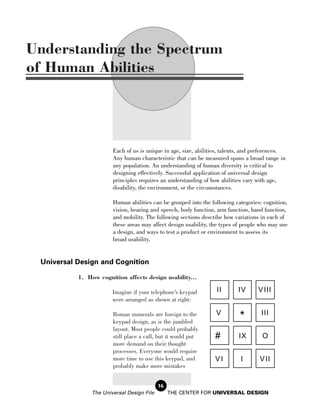
           1. How cognition affects design usability...

                        Imagine if your telephone’s keypad        II       IV      V III
                        were arranged as shown at right:

                                                                  V                  III
                        Roman numerals are foreign to the
                        keypad design, as is the jumbled
                                                                            *
                        layout. Most people could probably
                        still place a call, but it would put      #        IX        O
                        more demand on their thought
                        processes. Everyone would require
                        more time to use this keypad, and         VI        I       V II
                        probably make more mistakes


                                            16
                The Universal Design File        THE CENTER FOR UNIVERSAL DESIGN
Understanding the Spectrum
               of Human Abilities


             because of the cognitive “mapping” each of us has internalized from
             making countless phone calls with conventional keypads.

             Obviously, using this design is even more difficult for individuals who
             do not understand Roman numerals, or who have cognitive limitations
             and difficulty doing things in a non-standard way.

2. Universal design for cognition means considering the variety of human
   abilities in receiving, comprehending, interpreting, remembering, or
   acting on information. This includes:
             • self-starting; initiating tasks without prompting
             • reacting to stimuli; response time
             • paying attention; concentration
             • comprehending visual information
             • comprehending auditory information
             • understanding or expressing language
             • sequencing; doing things in proper order
             • keeping things organized
             • remembering things, either short- or long-term
             • problem-solving; decision-making
             • creative thinking; doing things in a new way
             • learning new things

3. Cognition can vary widely according to age, disability, the environment,
   or the particular situation. This variability should be considered when
   the design population may include:
             • very young children, with limited vocabulary, grammar,
               and reasoning skills
             • individuals with limited literacy
             • individuals using foreign languages or having different
               cultural backgrounds
             • older adults with diminished memory and reasoning skills
             • individuals who are fatigued or distracted


                            17
The Universal Design File        THE CENTER FOR UNIVERSAL DESIGN
Understanding the Spectrum
of Human Abilities


                          • individuals with limited comprehension, memory, concentration,
                            or reasoning due to:
                                •retardation
                                •Down’s syndrome
                                •learning disabilities
                                •head injuries
                                •stroke
                                •Alzheimer’s disease

             4. Assess the effectiveness of a design for cognition by answering the
                following questions. Is the design still as usable and safe if you...
                         •are using it for the first time without help or instructions?
                         •cannot read?
                         •perform steps out of order?
                         •try to use it much faster or slower than intended?
                         •make a mistake and want to correct it or start over?
                         •are distracted or interrupted while using it?


   Universal Design and Vision

             1. How vision affects design usability...

                           If you do not have a vision impairment, consider the following
                           circumstances.

                           Try reading a book at the beach without sunglasses, finding your way
                           after walking out of a movie theater into bright daylight, or driving
                           toward the sun. You will experience the limiting effects of glare.
                           Try getting a key into your front door in the dark, reading a detailed
                           road map in your car at night, or finding the light switch in a dark
                           room. You will appreciate the limitations caused by inadequate light.

                           When you’re lost and struggling to find a specific road sign, all signs
                           may seem small and hard to locate. How much more difficult would
                           this be if your glasses or windshield were badly smudged?


                                             18
                 The Universal Design File        THE CENTER FOR UNIVERSAL DESIGN
Understanding the Spectrum
                of Human Abilities


              How difficult would it be to find the sign if you could not move
              your neck, used only one eye, or viewed the world through a
              cardboard tube?

              The scenarios described above may cause anyone to make mistakes,
              slow down, get help, or avoid even simple tasks because the demand
              on visual capabilities is too great, whether temporarily or permanently.
2. Universal design for vision means considering the variety of human
   abilities in perceiving visual stimuli. This includes:
             •perceiving visual detail clearly
             •focusing on objects up close and far away
             •separating objects from a background
             •perceiving objects in the center, as well as at the edges
               of the field of vision
             •perceiving contrasts in color and brightness
             •adapting to high and low lighting levels
             •tracking moving objects
             •judging distances

3. Vision can vary widely according to age, disability, the environment,
   or the particular situation. This variability should be considered when
   the design population may include:
            •individuals distracted by a “busy” visual environment
            •individuals fatigued from excessive visual tasks
            •individuals functioning under colored lighting or very high
             or very low lighting conditions
            •individuals functioning in adverse weather conditions
            •older adults and others with:
                 •blindness
                 •hereditary loss of vision
                 •cataracts
                 •glaucoma
                 •retinitis
                 •presbyopia (farsightedness after middle age)
                 •macular degeneration
                 •eye injuries

                             19
 The Universal Design File        THE CENTER FOR UNIVERSAL DESIGN
Understanding the Spectrum
of Human Abilities


             4. Assess the effectiveness of a design for vision by answering the following
                questions. Is the design still as usable and safe if you...
                         •view it in very low light?
                         •view it in very bright light?
                         •view it much closer or further away than intended?
                         •could see it only in black and white?
                         •view it through a tube?
                         •view it with one eye closed?
                         •view it using only peripheral vision?


   Universal Design and Hearing and Speech

             1. How hearing and speech affect design usability...

                           If you do not have a hearing impairment, consider the
                           following circumstances.

                           Have you ever struggled to determine where a siren was coming from
                           while driving with the radio on? Has the congestion from a head cold,
                           especially if you did any airline traveling, ever left you temporarily
                           impaired in hearing, speech, or even balance?

                           Try giving directions to someone across a busy street. Try following
                           verbal instructions while listening to music through headphones. Much
                           of the message may get lost or confused in the ambient sound.

                           If you have ever used a cordless or cellular phone in a car, a shopping
                           mall, or the airport, you have had the experience of trying to hold a
                           conversation amid background noise and other distractions. In addition,
                           the variable quality of transmission often causes lapses in
                           communication or even interference from other conversations.

                           The situations described above can cause anyone to miss important
                           information, repeat messages, rely on other sensory input, or just give
                           up because the demands on auditory capabilities are too great, whether
                           temporarily or permanently.


                                             20
                 The Universal Design File        THE CENTER FOR UNIVERSAL DESIGN
Understanding the Spectrum
               of Human Abilities


2. Universal design for hearing and speech means considering the variety
   of human abilities in perceiving auditory stimuli. This includes:
           •localizing the source of sound
           •separating auditory information from background sound
           •perceiving both high- and low-pitched sounds
           •carrying on a conversation

3. Hearing and speech can vary widely according to age, disability, the
   environment, or the particular situation. This variability should be
   considered when the design population may include:
           •individuals whose attention is divided among several auditory sources
           •individuals functioning in very noisy environments
           •individuals using headphones
           •older adults and others with:
               •deafness
               •hereditary loss of hearing
               •blockages in the route to the inner ear
               •damage from prolonged exposure to excessive noise
               •diseases
               •presbycusis (reduction of hearing in older age)
               •head injuries or stroke

4. Assess the effectiveness of a design for hearing by answering the
   following questions. Is the design still as usable and safe if you...
            •use it in a noisy environment?
            •use it with one ear plugged?
            •use it with both ears plugged?
            •eliminate the sounds of the letters c, ch, s, sh, f, and z?


                            21
The Universal Design File        THE CENTER FOR UNIVERSAL DESIGN
Understanding the Spectrum
of Human Abilities


   Universal Design and Body Functions

             1. How body function affects design usability...

                         If your body is non-disabled, consider the following circumstances.

                         Imagine working in a chair with one missing caster. With every change
                         in posture, you might lose your balance. This would affect your
                         concentration and productivity and might cause you to avoid changing
                         body position.

                         Try doing your job from a straight-back chair with your spine firmly
                         against the seat back and your feet on the floor. Retain that position
                         without twisting or bending as you try to retrieve materials from your
                         desk, use the telephone, and perform other simple everyday tasks.
                         Limitations to your reach, field of vision, and mobility make simple
                         tasks more difficult and eventually cause fatigue and pain from the lack
                         of range of motion.

                         Perhaps you have carried a bulky object up or down a flight of stairs.
                         The added weight made balance more difficult and the object may have
                         prevented you from using the railings for support or even seeing the
                         steps in front of you.

                         Remember the last time you had the flu. Even the simplest tasks were
                         exhausting, and it was difficult to concentrate on anything for very long.
                         Getting up from the bed or a chair required a few extra seconds for you
                         to clear your head and keep your balance. If you took any medication,
                         these effects may have been more pronounced and prevented you from
                         even attempting other tasks, such as driving.

                         Consider the difficulty of strenuous exercise on a very hot summer day.

                         In each of the situations described above, the demands of the tasks may
                         exceed human capabilities to some extent, making the task
                         inconvenient, frustrating, exhausting, dangerous, or impossible.


                                           22
               The Universal Design File        THE CENTER FOR UNIVERSAL DESIGN
Understanding the Spectrum
               of Human Abilities


2. Universal design for body function means considering the variety of
   human abilities in performing common tasks. These tasks include
   cardiovascular, musculoskeletal, and central nervous system functions
   such as:
            •physical exertion
            •achieving, maintaining, and changing posture
            •maintaining equilibrium
            •breathing

3. Body function can vary widely according to age, disability, the
   environment, or the particular situation. This variability should be
   considered when the design population may include:
           •very young children, with limited physical development
           •older adults with diminished stamina, balance, or other body functions
           •individuals of extreme body size or weight
           •women in later stages of pregnancy, whose balance is affected by the
            weight of the baby
           •individuals with pain or limited range of motion due to temporary or
            minor injuries or illness
           •individuals under adverse environmental conditions (e.g., bad
            weather, extremes of temperature, poor air supply, unstable footing)
           •individuals who are fatigued or ill
           •individuals with chronic limitations due to:
               •epilepsy or other seizure disorders
               •allergies
               •multiple chemical sensitivities
               •asthma
               •diabetes
               •arthritis
               •musculoskeletal injuries or illness
               •hernia
               •stroke


                            23
The Universal Design File        THE CENTER FOR UNIVERSAL DESIGN
Understanding the Spectrum
of Human Abilities


             4. Assess the effectiveness of a design for body function by answering the
                following questions. Is the design still as usable and safe if you...
                         •have shortness of breath?
                         •stop frequently to rest?
                         •need to lean on something for support while using it?
                         •cannot bend, stoop, or twist at the waist?
                         •use it only in a seated position?
                         •cannot turn your head?
                         •are sensitive to dust, fumes, smoke, or chemicals?


   Universal Design and Arm Function

            1. How arm function affects design usability...

                         If your arms are unimpaired, consider the following circumstances.

                         Think of objects you regularly reach for, lift, and carry. Some ordinary
                         household products weigh more than you might guess. A six-pack of
                         12-oz. cans and a ream of paper each weigh over 5 lbs. One-gallon
                         containers of milk or juice weigh about 8 lbs. each, and cartons of
                         detergent up to 20 lbs. each. Could you move these products using only
                         one arm? How would you reach them if you could not straighten your
                         arms to reach forward, up, or down?

                         What about other ordinary tasks like driving, cooking, eating, drinking
                         a cup of coffee, or opening a window? Think about the last time you
                         experienced pain in a shoulder or elbow. How did it affect the way
                         you performed these everyday tasks? How would your strength and
                         movements be limited if you constantly wore a 3-lb. weight on
                         each wrist?

                         In each of the situations described above, the demands of the tasks may
                         exceed human capabilities to some extent, making the task
                         inconvenient, frustrating, exhausting, dangerous, or impossible.


                                           24
               The Universal Design File        THE CENTER FOR UNIVERSAL DESIGN
Understanding the Spectrum
               of Human Abilities


2. Universal design for arm function means considering the variety of
   human abilities in upper extremity range of motion, coordination,
   and strength. This includes:
           •reaching up, down, forward, or behind
           •pushing
           •pulling
           •lifting
           •lowering
           •carrying

3. Arm function can vary widely according to age, disability, the
   environment, or the particular situation. This variability should be
   considered when the design population may include:
           •very young children, with limited physical development
           •older adults with diminished joint range of motion or strength
           •individuals with pain or limited range of motion due to temporary
            or minor injuries or illness
           •individuals who are fatigued
           •individuals with only one free arm due to carrying things or
            performing another task
           •individuals wearing thick clothing
           •individuals with chronic limitations due to:
                 •congenital loss or deformation of an arm
                 •cerebral palsy
                 •post-poliomyelitis
                 •muscular dystrophy
                 •multiple sclerosis
                 •Lou Gehrig’s disease (amyotrophic lateral sclerosis, or ALS)
                 •Parkinson’s disease
                 •spinal cord injuries
                 •amputations
                 •arthritis
                 •bursitis
                 •tendonitis
                 •stroke


                            25
The Universal Design File        THE CENTER FOR UNIVERSAL DESIGN
Understanding the Spectrum
of Human Abilities


             4. Assess the effectiveness of a design for arm function by answering the
                following questions. Is the design as usable and safe if you...
                         •wear 3-lb. weights on each wrist?
                         •hold your elbows against your body?
                         •use only your non-dominant arm?


   Universal Design and Hand Function

             1. How hand function affects design usability...

                          If your hands are unimpaired, consider the following circumstances.

                          Consider how much you depend on use of both hands. Using only one
                          hand, try hammering a nail, tying a shoe, or placing a telephone call.
                          Try dialing a mobile phone while driving.

                          Try turning a door knob with oily or wet hands, or when
                          carrying packages.

                          Try using only your non-dominant hand for precision tasks such as
                          using scissors, cutting food, or shaving. Try doing these tasks while
                          wearing mittens.

                          Perhaps you have experienced a minor cut or burn that temporarily
                          limited your ability to open a jar, squeeze a tube of toothpaste, operate
                          a faucet, or hold a cup of coffee.

                          In each of these situations, the demands of the tasks may exceed
                          human capabilities to some extent, making the task inconvenient,
                          frustrating, exhausting, dangerous, or impossible.


                                            26
                The Universal Design File        THE CENTER FOR UNIVERSAL DESIGN
Understanding the Spectrum
               of Human Abilities


2. Universal design for hand function means considering the variety of
   human abilities required to perform common tasks.
   These tasks include:
           •grasping
           •squeezing
           •rotating
           •twisting
           •pinching
           •pulling
           •pushing

3. Abilities of hand function can vary widely according to age, disability,
   the environment, or the particular situation. This variability should be
   considered when the design population may include:
             •very young children, with small hands and weak fingers
             •older adults with diminished joint range of motion or strength
             •individuals with pain or limited range of motion due to temporary
              or minor injuries or illness
             •individuals whose hands are fatigued from repetitive tasks
             •individuals wearing gloves
             •individuals with wet or oily hands
             •individuals with only one free hand due to simultaneously performing
              another task
             •individuals with chronic limitations due to:
                   •congenital loss or deformation of a hand
                   •cerebral palsy
                   •post-poliomyelitis
                   •muscular dystrophy
                   •multiple sclerosis
                   •Lou Gehrig’s disease (amyotrophic lateral sclerosis, or ALS)
                   •Parkinson’s disease
                   •spinal cord injuries
                   •amputations
                   •carpal tunnel syndrome
                   •arthritis
                   •stroke


                            27
The Universal Design File        THE CENTER FOR UNIVERSAL DESIGN
Understanding the Spectrum
of Human Abilities


             4. Assess the effectiveness of a design for hand function by answering
                the following questions. Is the design as usable and safe if you...
                         •wear mittens?
                         •repeat no motion more than three times per minute?
                         •do not bend or rotate your wrists?
                         •use only one hand?
                         •use only the fist of your non-dominant hand?
                         •exert no more force than the strength in your little finger?


   Universal Design and Mobility

             1. How mobility affects design usability...

                          If your legs are unimpaired, consider the following circumstances.

                          Consider driving your car without using your legs. Without walking,
                          how could you get to work? Could you do your job without leaving a
                          seated position? What if there are stairs along the way?

                          Consider the difficulty of maintaining your balance while walking or
                          standing in an airplane, subway car, or bus. Imagine having this
                          difficulty even on stable ground.

                          Remember the last time you walked a long distance or ascended a long
                          flight of stairs and how the fatigue affected your stability. Did you tend
                          to use the railings more toward the end? Consider how carefully you use
                          stairs that are slippery with water or ice, and how dangerous it is when
                          you lose your balance on stairs.

                          Notice the different ways people walk on different surfaces. Grass,
                          sidewalks, loose gravel, carpeting, and tile floors each require a
                          different gait to maintain balance and avoid tripping or slipping.
                          When surfaces change unexpectedly, falls can result.

                          If you’ve ever injured a leg and used crutches, you realize the
                          additional time and effort required to cover distances, especially if
                          stairs, revolving doors, or slippery floors were in your way.


                                            28
                The Universal Design File        THE CENTER FOR UNIVERSAL DESIGN
Understanding the Spectrum
               of Human Abilities


             You may have also learned the importance of space to elevate or
             straighten your leg or maneuver a wheelchair. As you recovered, you
             learned the value of grab bars and sturdy surfaces to lean on.

             In each of the situations described above, the demands of the tasks
             may exceed human capabilities to some extent, making the task
             inconvenient, frustrating, exhausting, dangerous, or impossible.

2. Universal design for mobility means considering the variety of human
   abilities in performing common tasks. These tasks include:
             •rising from a seated position
             •standing upright
             •walking
             •running
             •jumping
             •climbing
             •kneeling
             •balancing on one foot
             •operating foot controls


3. Mobility can vary widely according to age, disability, the environment,
   or the particular situation. This variability should be considered when
   the design population may include:
             •very young children, with limited physical development
             •older adults with diminished strength, stamina, balance, range of
              motion in spine and lower extremities, or proprioception (sensing the
              positions of body parts and the motions of the muscles and joints)
             •individuals of extreme body size or weight
             •individuals with pain or limited range of motion due to temporary
              or minor injuries or illness
             •individuals who are fatigued
             •individuals under adverse environmental conditions (e.g., bad
              weather, uneven or unstable terrain)


                            29
The Universal Design File        THE CENTER FOR UNIVERSAL DESIGN
Understanding the Spectrum
of Human Abilities


                        •individuals with chronic limitations due to:
                              •congenital loss or deformity of a leg
                              •cerebral palsy
                              •post-poliomyelitis
                              •muscular dystrophy
                              •multiple sclerosis
                              •cerebral vascular disease
                              •diabetes
                              •Lou Gehrig’s disease (amyotrophic lateral sclerosis, or ALS)
                              •Parkinson’s disease
                              •amputations
                              •spinal cord injury
                              •arthritis
                              •stroke
                              •asthma, emphysema, or other respiratory complications

          4. Assess the effectiveness of a design for mobility by answering the
             following questions. Is the design as usable and safe if you...
                      •cannot see the floor surface?
                      •cannot lift either foot?
                      •wear two different shoes (different heel heights and sole friction)?
                      •use a cane?
                      •use crutches?
                      •use a wheelchair?
                      •cannot rise from a seated position?


                                         30
             The Universal Design File        THE CENTER FOR UNIVERSAL DESIGN
3
chapter
The Principles of
Universal Design
and Their Application


                                31
    The Universal Design File        THE CENTER FOR UNIVERSAL DESIGN
The Principles of Universal Design
and Their Application


                Universal design is simple in theory but more complicated in practice,
                and simply defining the term is not sufficient. Proponents of universal
                design have traditionally employed two strategies to communicate the
                approach. The first method has been through citation of good examples
                of aspects of the concept, such as lever door handles that require no
                grasping, remote controls to adjust devices from afar, and motion
                detecting room lights. The second strategy has been to offer time-
                proven tests for universal use, such as determining whether a device
                “can be used with a closed fist,” or “can be used in the dark,” or
                “requires 5 lbs. or less of force.” There were no definitive criteria
                covering all aspects of any design.

                Staff of The Center for Universal Design, as part of its project “Studies
                to Further the Development of Universal Design,” conducted a series
                of evaluations of consumer products, architectural spaces, and building
                elements. The purpose of the evaluations was to determine optimal
                performance characteristics and use features that make products and
                environments usable by the greatest diversity of people.

                The Center’s staff then convened a working group of architects,
                product designers, engineers, and environmental design researchers to
                assemble a set of principles of universal design that would encapsulate
                the existing knowledge base. These principles would apply to all design
                disciplines and all people. The principles could be applied to evaluate
                existing designs, guide the design process, and educate designers and
                consumers about the characteristics of more usableproducts and
                environments.


                                    32
        The Universal Design File        THE CENTER FOR UNIVERSAL DESIGN
T h e P r in c ip le s o f U n iv e r s a l D e s i g n
               a nd T h e ir A p p lic a t io n


             The Principles of Universal Design (The Center for Universal
             Design, 1997) developed by this group are presented here in the
             following format:
                  name of the principle, intended to be a concise and easily
                  remembered statement of the key concept embodied in
                  the principle;

                  definition of the principle, a brief description of the
                  principle’s primary directive for design; and

                  guidelines, a list of the key elements that should be present
                  in a design that adheres to the principle. (Note: all guidelines
                  may not be relevant to all designs.)

             Following each guideline are two to five photographs that
             demonstrate good applications of the guideline. The designs shown
             in the photos are not necessarily universal in every respect, but
             each is a good example of that specific guideline and helps
             illustrate its intent.


       References
             The Center for Universal Design. (1997). The Principles of Universal
             Design (Version 2.0). Raleigh, NC: NC State University, Author.


                            33
The Universal Design File        THE CENTER FOR UNIVERSAL DESIGN
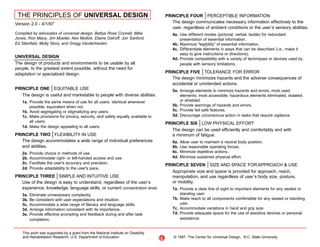
The Principles of Universal Design
by Bettye Rose Connell, Mike Jones, Ron Mace, Jim Mueller, Abir Mullick,
Elaine Ostroff, Jon Sanford, Ed Steinfeld, Molly Story & Gregg Vanderheiden

© 1997 NC State University, The Center for Universal Design


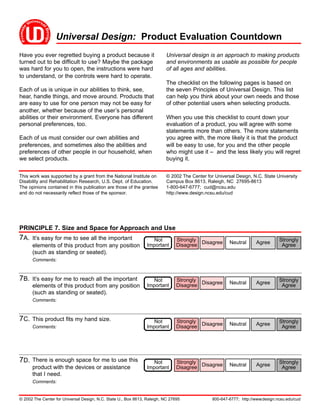
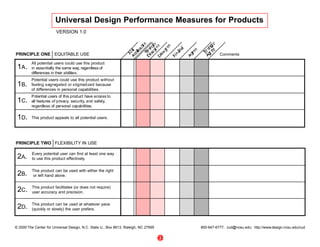
          PRINCIPLE ONE: Equitable Use
            The design is useful and marketable to people with diverse abilities.
          Guidelines:
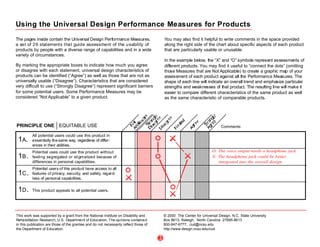
            1a. Provide the same means of use for all users: identical whenever possible; equivalent when not.
            1b. Avoid segregating or stigmatizing any users.
            1c. Make provisions for privacy, security, and safety equally available to all users.
            1d. Make the design appealing to all users.

          PRINCIPLE TWO: Flexibility in Use
            The design accommodates a wide range of individual preferences and abilities.
          Guidelines:
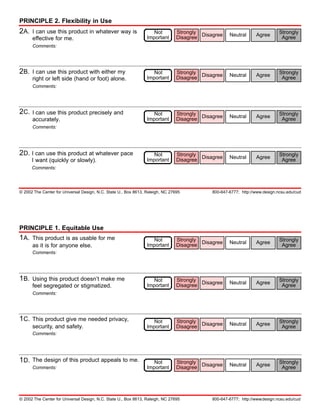
            2a. Provide choice in methods of use.
            2b. Accommodate right- or left-handed access and use.
            2c. Facilitate the user’s accuracy and precision.
            2d. Provide adaptability to the user’s pace.

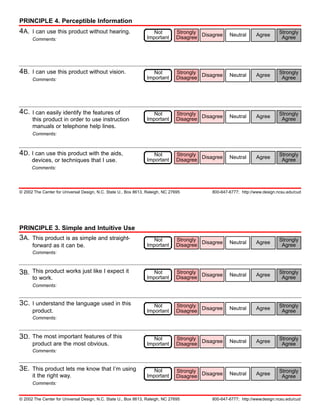
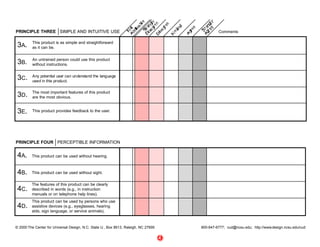
          PRINCIPLE THREE: Simple and Intuitive Use
            Use of the design is easy to understand, regardless of the user’s experience,
            knowledge, language skills, or current concentration level.
          Guidelines:
            3a. Eliminate unnecessary complexity.
            3b. Be consistent with user expectations and intuition.
            3c. Accommodate a wide range of literacy and language skills.
            3d. Arrange information consistent with its importance.
            3e. Provide effective prompting and feedback during and after task completion.

          PRINCIPLE FOUR: Perceptible Information
            The design communicates necessary information effectively to the user,
            regardless of ambient conditions or the user’s sensory abilities.
          Guidelines:
            4a. Use different modes (pictorial, verbal, tactile) for redundant presentation of
                essential information.
            4b. Maximize “legibility” of essential information.
            4c. Differentiate elements in ways that can be described (i.e., make it easy to give instructions
                or directions).
            4d. Provide compatibility with a variety of techniques or devices used by people with
                sensory limitations.

                                                              34
                                The Universal Design File          THE CENTER FOR UNIVERSAL DESIGN
The Principles of Universal Design
                               by Bettye Rose Connell, Mike Jones, Ron Mace, Jim Mueller, Abir Mullick,
                               Elaine Ostroff, Jon Sanford, Ed Steinfeld, Molly Story & Gregg Vanderheiden

                              © 1997 NC State University, The Center for Universal Design


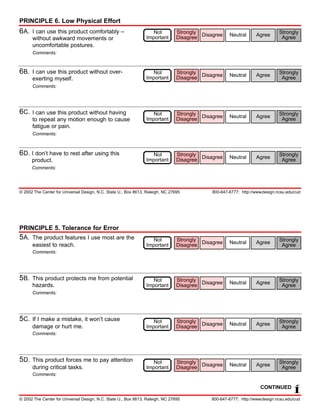
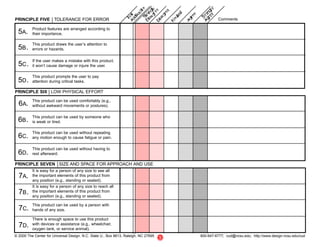
PRINCIPLE FIVE: Tolerance for Error
  The design minimizes hazards and the adverse consequences of accidental or
  unintended actions.
Guidelines:
  5a. Arrange elements to minimize hazards and errors: most used elements, most accessible;
      hazardous elements eliminated, isolated, or shielded.
  5b. Provide warnings of hazards and errors.
  5c. Provide fail safe features.
  5d. Discourage unconscious action in tasks that require vigilance.

PRINCIPLE SIX: Low Physical Effort
  The design can be used efficiently and comfortably and with a minimum of
  fatigue.
Guidelines:
  6a. Allow user to maintain a neutral body position.
  6b. Use reasonable operating forces.
  6c. Minimize repetitive actions.
  6d. Minimize sustained physical effort.

PRINCIPLE SEVEN: Size and Space for Approach and Use
  Appropriate size and space is provided for approach, reach, manipulation, and
  use regardless of user’s body size, posture, or mobility.
Guidelines:
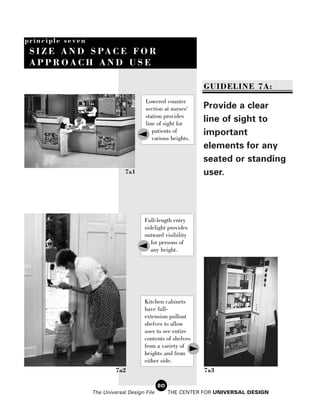
  7a. Provide a clear line of sight to important elements for any seated or standing user.
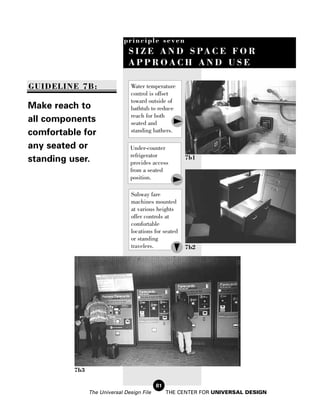
  7b. Make reach to all components comfortable for any seated or standing user.
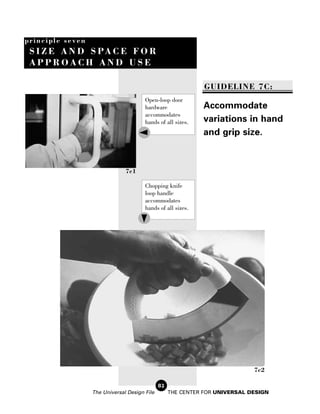
  7c. Accommodate variations in hand and grip size.
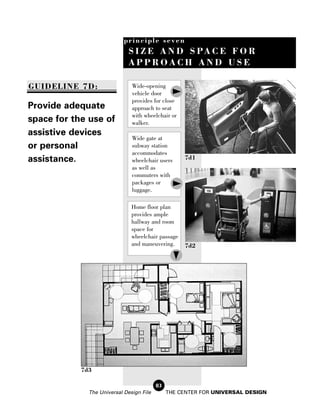
  7d. Provide adequate space for the use of assistive devices or personal assistance.


                                            35
                The Universal Design File        THE CENTER FOR UNIVERSAL DESIGN
36
The Universal Design File        THE CENTER FOR UNIVERSAL DESIGN
PRINCIPLE ONE:


                             1
 Equitable Use


                  The design is

                  useful and

                  marketable to

                  people with

                  diverse abilities.


                                 37
     The Universal Design File        THE CENTER FOR UNIVERSAL DESIGN
principle one

 E Q U I TA B L E U S E


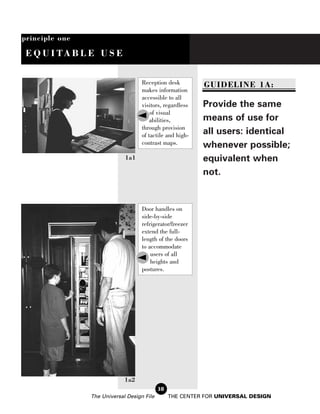
                                    Reception desk         GUIDELINE 1A:
                                    makes information
                                    accessible to all
                                    visitors, regardless   Provide the same
                                        of visual
                                       abilities,          means of use for
                                    through provision
                                    of tactile and high-   all users: identical
                                    contrast maps.         whenever possible;
                             1a1                           equivalent when
                                                           not.


                                    Door handles on
                                    side-by-side
                                    refrigerator/freezer
                                    extend the full-
                                    length of the doors
                                    to accommodate
                                        users of all
                                        heights and
                                    postures.


                             1a2
                                            38
                The Universal Design File        THE CENTER FOR UNIVERSAL DESIGN
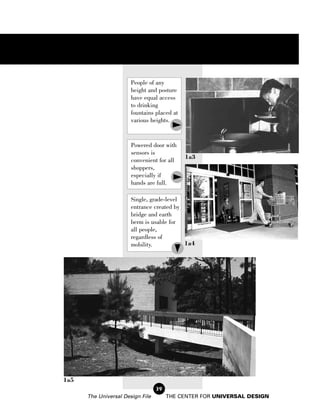
People of any
                       height and posture
                       have equal access
                       to drinking
                       fountains placed at
                       various heights.


                       Powered door with
                       sensors is
                                             1a3
                       convenient for all
                       shoppers,
                       especially if
                       hands are full.

                       Single, grade-level
                       entrance created by
                       bridge and earth
                       berm is usable for
                       all people,
                       regardless of
                       mobility.           1a4


1a5
                                  39
      The Universal Design File        THE CENTER FOR UNIVERSAL DESIGN
principle one

 E Q U I TA B L E U S E


                                                           GUIDELINE 1B:
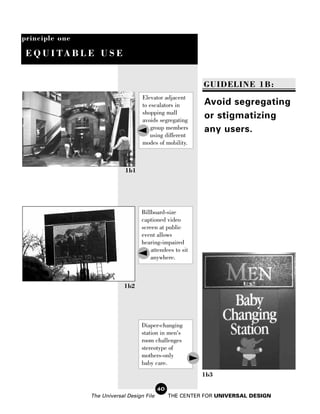
                                    Elevator adjacent
                                    to escalators in       Avoid segregating
                                    shopping mall
                                    avoids segregating
                                                           or stigmatizing
                                        group members      any users.
                                       using different
                                    modes of mobility.


                             1b1


                                    Billboard-size
                                    captioned video
                                    screen at public
                                    event allows
                                    hearing-impaired
                                        attendees to sit
                                        anywhere.


                            1b2


                                    Diaper-changing
                                    station in men's
                                    room challenges
                                    stereotype of
                                    mothers-only
                                    baby care.
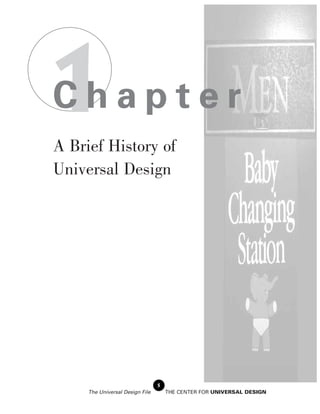
                                                           1b3

                                            40
                The Universal Design File        THE CENTER FOR UNIVERSAL DESIGN
principle one

                            E Q U I TA B L E U S E


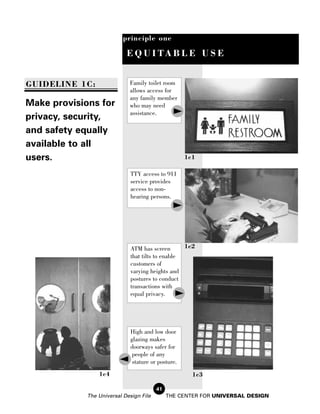
GUIDELINE 1C:                Family toilet room
                             allows access for
                             any family member
Make provisions for          who may need
                             assistance.
privacy, security,
and safety equally
available to all
users.                                               1c1

                              TTY access to 911
                              service provides
                              access to non-
                              hearing persons.


                              ATM has screen       1c2
                              that tilts to enable
                              customers of
                              varying heights and
                              postures to conduct
                              transactions with
                              equal privacy.


                              High and low door
                              glazing makes
                              doorways safer for
                               people of any
                               stature or posture.
                 1c4                                   1c3

                                         41
             The Universal Design File        THE CENTER FOR UNIVERSAL DESIGN
principle one

 E Q U I TA B L E U S E


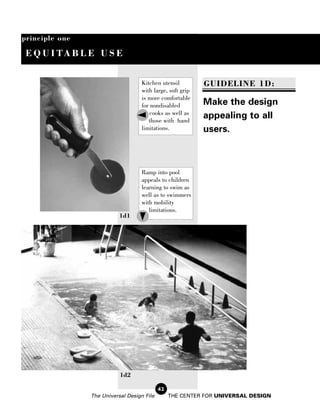
                                    Kitchen utensil         GUIDELINE 1D:
                                    with large, soft grip
                                    is more comfortable
                                    for nondisabled         Make the design
                                        cooks as well as
                                       those with hand
                                                            appealing to all
                                    limitations.            users.


                                    Ramp into pool
                                    appeals to children
                                    learning to swim as
                                    well as to swimmers
                                    with mobility
                                       limitations.
                           1d1


                           1d2

                                            42
                The Universal Design File        THE CENTER FOR UNIVERSAL DESIGN
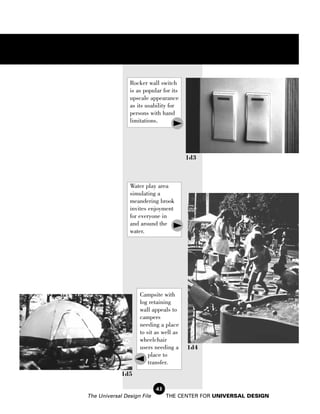
Rocker wall switch
                is as popular for its
                upscale appearance
                as its usability for
                persons with hand
                limitations.


                                        1d3


                Water play area
                simulating a
                meandering brook
                invites enjoyment
                for everyone in
                and around the
                water.


                    Campsite with
                    log retaining
                    wall appeals to
                    campers
                    needing a place
                    to sit as well as
                    wheelchair
                    users needing a     1d4
                        place to
                        transfer.
             1d5

                            43
The Universal Design File        THE CENTER FOR UNIVERSAL DESIGN
principle one

 E Q U I TA B L E U S E


            Photography Credits

                   1a1.   Whitehouse & Company, New York, New York
                   1a2.   J.L. Mueller, Inc., Chantilly, Virginia
                   1a3.   The Center for Universal Design, Raleigh, North Carolina
                   1a4.   The Center for Universal Design, Raleigh, North Carolina
                   1a5.   The Center for Universal Design, Raleigh, North Carolina

                   1b1.   The Center for Universal Design, Raleigh, North Carolina
                   1b2.   J.L. Mueller, Inc., Chantilly, Virginia
                   1b3.   The Center for Universal Design, Raleigh, North Carolina

                   1c1.   The Center for Universal Design, Raleigh, North Carolina
                   1c2.   The Center for Universal Design, Raleigh, North Carolina
                   1c3.   The Center for Universal Design, Raleigh, North Carolina
                   1c4.   Mitchell/Giurgola Architects, New York, New York

                   1d1.   Smart Design, Inc., New York, New York
                   1d2.   J.L. Mueller, Inc., Chantilly, Virginia
                   1d3.   Leviton Manufacturing Company, Little Neck, New York
                   1d4.   Carol R. Johnson Associates, Inc., Cambridge, Massachusetts
                   1d5.   U.S.D.A. Forest Service: Siskiyou National Forest, Grants Pass, Oregon


                                            44
                The Universal Design File        THE CENTER FOR UNIVERSAL DESIGN
PRINCIPLE TWO:


                             2
 Flexibility in Use


                   The design

                   accommodates

                   a wide range

                   of individual

                   preferences

                   and abilities.


                                  45
      The Universal Design File        THE CENTER FOR UNIVERSAL DESIGN
principle two

 FLEXIBILITY IN USE

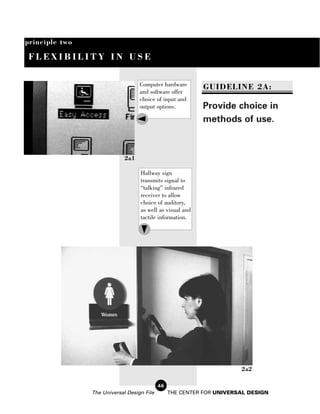
                                   Computer hardware       GUIDELINE 2A:
                                   and software offer
                                   choice of input and
                                   output options.         Provide choice in
                                                           methods of use.


                             2a1

                                   Hallway sign
                                   transmits signal to
                                   “talking” infrared
                                   receiver to allow
                                   choice of auditory,
                                   as well as visual and
                                   tactile information.


                                                                       2a2

                                            46
                The Universal Design File        THE CENTER FOR UNIVERSAL DESIGN
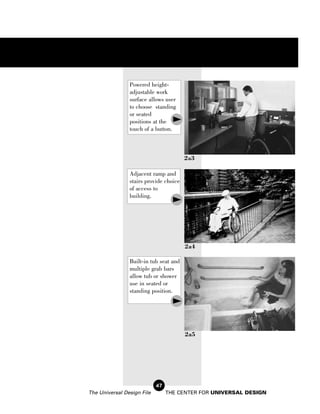
Powered height-
                adjustable work
                surface allows user
                to choose standing
                or seated
                positions at the
                touch of a button.


                                        2a3

                Adjacent ramp and
                stairs provide choice
                of access to
                building.


                                        2a4

                Built-in tub seat and
                multiple grab bars
                allow tub or shower
                use in seated or
                standing position.


                                        2a5


                            47
The Universal Design File        THE CENTER FOR UNIVERSAL DESIGN
principle two

 FLEXIBILITY IN USE


                                                             GUIDELINE 2B:
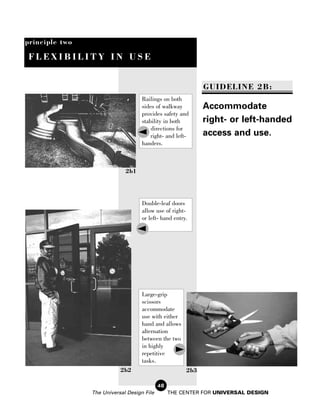
                                    Railings on both
                                    sides of walkway         Accommodate
                                    provides safety and
                                    stability in both        right- or left-handed
                                        directions for
                                        right- and left-     access and use.
                                    handers.


                             2b1


                                    Double-leaf doors
                                    allow use of right-
                                    or left- hand entry.


                                    Large-grip
                                    scissors
                                    accommodate
                                    use with either
                                    hand and allows
                                    alternation
                                    between the two
                                    in highly
                                    repetitive
                                    tasks.
                           2b2                         2b3

                                            48
                The Universal Design File        THE CENTER FOR UNIVERSAL DESIGN
principle two

                              FLEXIBILITY IN USE


GUIDELINE 2C:
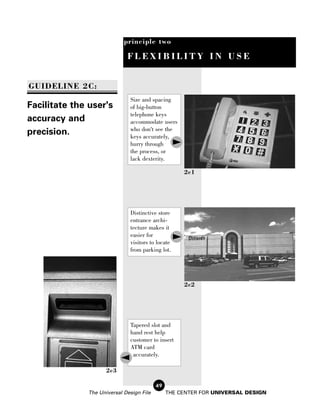
                               Size and spacing
Facilitate the user's          of big-button
                               telephone keys
accuracy and                   accommodate users
                               who don't see the
precision.                     keys accurately,
                               hurry through
                               the process, or
                               lack dexterity.

                                                     2c1


                               Distinctive store
                               entrance archi-
                               tecture makes it
                               easier for
                               visitors to locate
                               from parking lot.


                                                     2c2


                               Tapered slot and
                               hand rest help
                               customer to insert
                               ATM card
                                accurately.
                      2c3

                                           49
               The Universal Design File        THE CENTER FOR UNIVERSAL DESIGN
principle two

 FLEXIBILITY IN USE


                                                            GUIDELINE 2D:
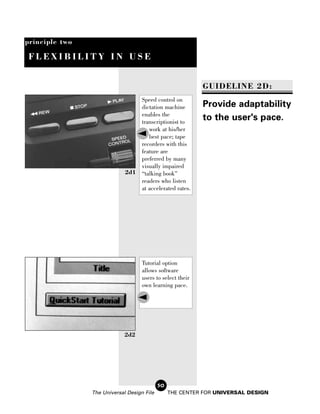
                                 Speed control on
                                 dictation machine          Provide adaptability
                                 enables the
                                 transcriptionist to
                                                            to the user's pace.
                                    work at his/her
                                    best pace; tape
                                 recorders with this
                                 feature are
                                 preferred by many
                                 visually impaired
                             2d1 “talking book”
                                 readers who listen
                                 at accelerated rates.


                                    Tutorial option
                                    allows software
                                    users to select their
                                    own learning pace.


                             2d2


                                            50
                The Universal Design File        THE CENTER FOR UNIVERSAL DESIGN
principle two

                   FLEXIBILITY IN USE


Photography Credits


          2a1.    The Center for Universal Design, Raleigh, North Carolina
          2a2.    Whitehouse & Company, New York, New York
          2a3.    Herman Miller, Inc., Zeeland, Michigan
          2a4.    The Center for Universal Design, Raleigh, North Carolina
          2a5.    The Center for Universal Design, Raleigh, North Carolina

          2b1.    Barba Architecture & Preservation, Portland, Maine
          2b2.    The Center for Universal Design, Raleigh, North Carolina
          2b3.    The Center for Universal Design, Raleigh, North Carolina

          2c1.    The Center for Universal Design, Raleigh, North Carolina
          2c2.    The Center for Universal Design, Raleigh, North Carolina
          2c3.    The Center for Universal Design, Raleigh, North Carolina

          2d1.    J.L. Mueller, Inc., Chantilly, Virginia
          2d2.    J.L. Mueller, Inc., Chantilly, Virginia


                                51
    The Universal Design File        THE CENTER FOR UNIVERSAL DESIGN
52
The Universal Design File        THE CENTER FOR UNIVERSAL DESIGN
PRINCIPLE THREE:


                            3
 Simple and Intuitive Use


                  Use of the design
                  is easy to
                  understand,
                  regardless of the
                  user's experience,
                  knowledge,
                  language skills,
                  or current
                  concentration
                  level.


                                 53
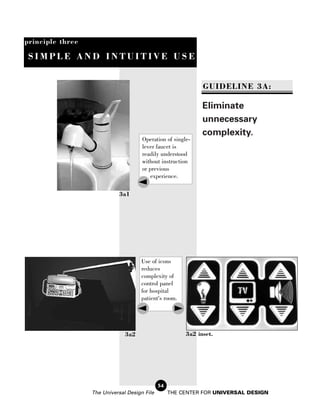
     The Universal Design File        THE CENTER FOR UNIVERSAL DESIGN
principle three

 SIMPLE AND INTUITIVE USE


                                                              GUIDELINE 3A:

                                                              Eliminate
                                                              unnecessary
                                                              complexity.
                                      Operation of single-
                                      lever faucet is
                                      readily understood
                                      without instruction
                                      or previous
                                          experience.

                             3a1


                                     Use of icons
                                     reduces
                                     complexity of
                                     control panel
                                     for hospital
                                     patient's room.


                               3a2                      3a2 inset.


                                              54
                  The Universal Design File        THE CENTER FOR UNIVERSAL DESIGN
principle three

                            SIMPLE AND INTUITIVE USE


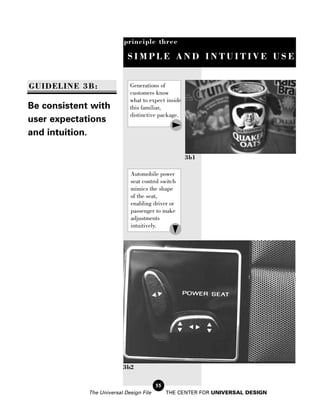
GUIDELINE 3B:                Generations of
                             customers know
                             what to expect inside
Be consistent with           this familiar,
                             distinctive package.
user expectations
and intuition.

                                                     3b1

                             Automobile power
                             seat control switch
                             mimics the shape
                             of the seat,
                             enabling driver or
                             passenger to make
                             adjustments
                             intuitively.


                          3b2

                                         55
             The Universal Design File        THE CENTER FOR UNIVERSAL DESIGN
principle three

 SIMPLE AND INTUITIVE USE


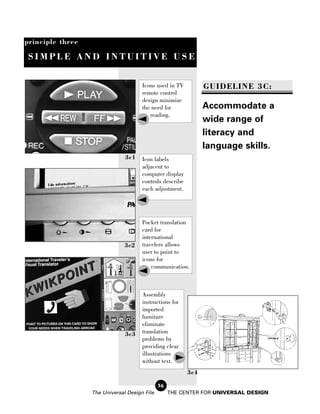
                                      Icons used in TV          GUIDELINE 3C:
                                      remote control
                                      design minimize
                                      the need for              Accommodate a
                                         reading.
                                                                wide range of
                                                                literacy and
                                                                language skills.
                               3c1    Icon labels
                                      adjacent to
                                      computer display
                                      controls describe
                                      each adjustment.


                                      Pocket translation
                                      card for
                                      international
                               3c2    travelers allows
                                      user to point to
                                      icons for
                                          communication.


                                      Assembly
                                      instructions for
                                      imported
                                      furniture
                                      eliminate
                               3c3    translation
                                      problems by
                                      providing clear
                                      illustrations
                                      without text.
                                                          3c4

                                              56
                  The Universal Design File        THE CENTER FOR UNIVERSAL DESIGN
principle three

                            SIMPLE AND INTUITIVE USE


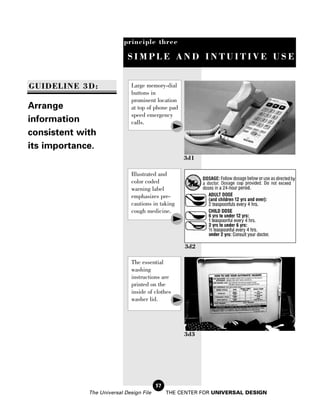
GUIDELINE 3D:                 Large memory-dial
                              buttons in
                              prominent location
Arrange                       at top of phone pad
                              speed emergency
information                   calls.
consistent with
its importance.
                                                    3d1

                              Illustrated and
                              color coded
                              warning label
                              emphasizes pre-
                              cautions in taking
                              cough medicine.


                                                    3d2

                              The essential
                              washing
                              instructions are
                              printed on the
                              inside of clothes
                              washer lid.


                                                    3d3


                                         57
             The Universal Design File        THE CENTER FOR UNIVERSAL DESIGN
principle three

SIMPLE AND INTUITIVE USE


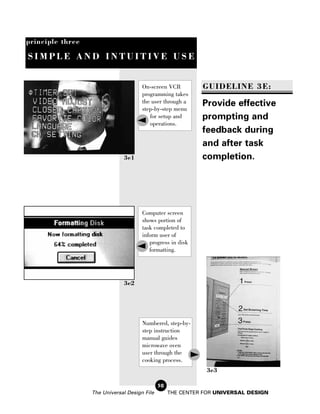
                                      On-screen VCR          GUIDELINE 3E:
                                      programming takes
                                      the user through a     Provide effective
                                      step-by-step menu
                                         for setup and       prompting and
                                         operations.
                                                             feedback during
                                                             and after task
                              3e1                            completion.


                                      Computer screen
                                      shows portion of
                                      task completed to
                                      inform user of
                                         progress in disk
                                         formatting.


                              3e2


                                      Numbered, step-by-
                                      step instruction
                                      manual guides
                                      microwave oven
                                      user through the
                                      cooking process.
                                                               3e3

                                              58
                  The Universal Design File        THE CENTER FOR UNIVERSAL DESIGN
principle three

                   SIMPLE AND INTUITIVE USE


Photography Credits

          3a1. The Center for Universal Design, Raleigh, North Carolina
          3a2. The Center for Universal Design, Raleigh, North Carolina
          3a2 inset. The Center for Universal Design, Raleigh, North Carolina

          3b1.   J.L. Mueller, Inc., Chantilly, Virginia
          3b2.   J.L. Mueller, Inc., Chantilly, Virginia

          3c1.   J.L. Mueller, Inc., Chantilly, Virginia
          3c2.   J.L. Mueller, Inc., Chantilly, Virginia
          3c3.   J.L. Mueller, Inc., Chantilly, Virginia
          3c4.   IKEA Svenska AB, Almhut, Sweden

          3d1.   The Center for Universal Design, Raleigh, North Carolina
          3d2.   J.L. Mueller, Inc., Chantilly, Virginia
          3d3.   J.L. Mueller, Inc., Chantilly, Virginia

          3e1.   J.L. Mueller, Inc., Chantilly, Virginia
          3e2.   J.L. Mueller, Inc., Chantilly, Virginia
          3e3.   The Center for Universal Design, Raleigh, North Carolina


                                59
    The Universal Design File        THE CENTER FOR UNIVERSAL DESIGN
60
The Universal Design File        THE CENTER FOR UNIVERSAL DESIGN
PRINCIPLE FOUR:


                            4
 Perceptible Information


                   The design
                   communicates
                   necessary infor-
                   mation effectively
                   t o t h e u s e r,
                   regardless of
                   ambient conditions
                   or the user's
                   sensory abilities.


                                 61
     The Universal Design File        THE CENTER FOR UNIVERSAL DESIGN
principle four

 P E R C E P T I B L E I N F O R M AT I O N


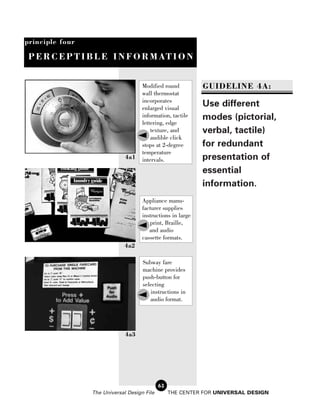
                                     Modified round          GUIDELINE 4A:
                                     wall thermostat
                                     incorporates
                                     enlarged visual
                                                             Use different
                                     information, tactile    modes (pictorial,
                                     lettering, edge
                                         texture, and        verbal, tactile)
                                         audible click
                                     stops at 2-degree       for redundant
                                     temperature
                              4a1    intervals.              presentation of
                                                             essential
                                                             information.
                                     Appliance manu-
                                     facturer supplies
                                     instructions in large
                                        print, Braille,
                                        and audio
                                     cassette formats.
                             4a2

                                     Subway fare
                                     machine provides
                                     push-button for
                                     selecting
                                        instructions in
                                        audio format.


                              4a3


                                             62
                 The Universal Design File        THE CENTER FOR UNIVERSAL DESIGN
principle four

                                 P E R C E P T I B L E I N F O R M AT I O N


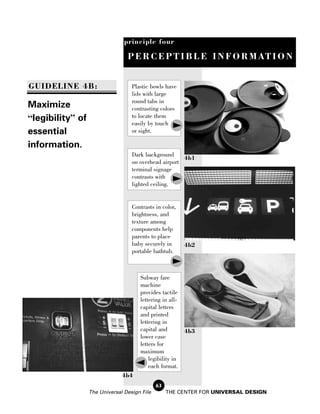
GUIDELINE 4B:                      Plastic bowls have
                                   lids with large
                                   round tabs in
Maximize                           contrasting colors
“legibility” of                    to locate them
                                   easily by touch
essential                          or sight.

information.
                                   Dark background
                                                       4b1
                                   on overhead airport
                                   terminal signage
                                   contrasts with
                                   lighted ceiling.


                                   Contrasts in color,
                                   brightness, and
                                   texture among
                                   components help
                                   parents to place
                                   baby securely in       4b2
                                   portable bathtub.


                                      Subway fare
                                      machine
                                      provides tactile
                                      lettering in all-
                                      capital letters
                                      and printed
                                      lettering in
                                      capital and         4b3
                                      lower case
                                      letters for
                                      maximum
                                          legibility in
                                          each format.
                               4b4
                                              63
                  The Universal Design File        THE CENTER FOR UNIVERSAL DESIGN
principle four

 P E R C E P T I B L E I N F O R M AT I O N


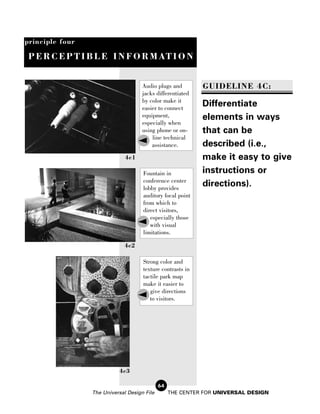
                                     Audio plugs and        GUIDELINE 4C:
                                     jacks differentiated
                                     by color make it
                                     easier to connect
                                                            Differentiate
                                     equipment,             elements in ways
                                     especially when
                                     using phone or on-     that can be
                                         line technical
                                         assistance.        described (i.e.,
                              4c1                           make it easy to give
                                     Fountain in            instructions or
                                     conference center
                                     lobby provides
                                                            directions).
                                     auditory focal point
                                     from which to
                                     direct visitors,
                                        especially those
                                        with visual
                                     limitations.

                             4c2

                                     Strong color and
                                     texture contrasts in
                                     tactile park map
                                     make it easier to
                                        give directions
                                        to visitors.


                           4c3

                                             64
                 The Universal Design File        THE CENTER FOR UNIVERSAL DESIGN
principle four

                             P E R C E P T I B L E I N F O R M AT I O N


GUIDELINE 4D:                  Color television
                               includes an
                               internal decoder
Provide                        chip for program
                               captioning.
compatibility with
a variety of
techniques or
devices used by                                       4d1

people with                    Public phone is
                               compatible with
sensory limitations.           hearing aids and
                               incorporates a
                               volume control
                               as well as a TTY.


                                                      4d2

                               Internet web
                               site includes
                               text-only option for
                               surfers using
                               screen-reader
                               software.


                                                      4d3


                                          65
              The Universal Design File        THE CENTER FOR UNIVERSAL DESIGN
principle four

 P E R C E P T I B L E I N F O R M AT I O N


          Photography Credits

                     4a1.   The Center for Universal Design, Raleigh, North Carolina
                     4a2.   Whirlpool Corporation, Benton Harbor, Michigan
                     4a3.   J.L. Mueller, Inc., Chantilly, Virginia

                     4b1.   J.L. Mueller, Inc., Chantilly, Virginia
                     4b2.   J.L. Mueller, Inc., Chantilly, Virginia
                     4b3.   Anderson Design Associates, Inc., Plainville, Connecticut
                     4b4.   J.L. Mueller, Inc., Chantilly, Virginia

                     4c1.   J.L. Mueller, Inc., Chantilly, Virginia
                     4c2.   J.L. Mueller, Inc., Chantilly, Virginia
                     4c3.   Moore Iacafano Goltsman, Inc., Berkeley, California

                     4d1.   J.L. Mueller, Inc., Chantilly, Virginia
                     4d2.   J.L. Mueller, Inc., Chantilly, Virginia
                     4d3.   J.L. Mueller, Inc., Chantilly, Virginia


                                             66
                 The Universal Design File        THE CENTER FOR UNIVERSAL DESIGN
PRINCIPLE FIVE:


                              5
 To l e r a n c e f o r E r r o r


                    The design

                    minimizes hazards

                    and the adverse

                    consequences of

                    accidental or

                    unintended

                    actions.


                                   67
       The Universal Design File        THE CENTER FOR UNIVERSAL DESIGN
principle five

 TOLERANCE FOR ERROR


                                    Shop machinery           GUIDELINE 5A:
                                    power control
                                    includes a ridge
                                    guard around the         Arrange elements
                                    “START” button,
                                      minimizing
                                                             to minimize
                                       accidental            hazards and errors:
                                       activation.
                                                             most used
                              5a1                            elements, most
                                    Lip or curb at           accessible;
                                    sides of ramp
                                    reduces risk of
                                                             hazardous
                                       slipping off.         elements
                                                             eliminated,
                                                             isolated, or
                                                             shielded.
                              5a2

                                    Bagel slicer shields
                                    hands from blade
                                    while holding bagel
                                       securely.


                        5a3

                                             68
                 The Universal Design File        THE CENTER FOR UNIVERSAL DESIGN
principle five

                           TOLERANCE FOR ERROR


GUIDELINE 5B:                 Computer disk
                              management
                              software warns user
Provide warnings              of consequences
                              prior to
of hazards and                formatting.
errors.

                              Prominent             5b1
                              escalator labeling
                              advises parents of
                              potential hazards
                              to children.


                              Strong graphic
                              message on sticker
                              augments package
                              warnings to           5b2
                              discourage
                              children from
                              accidental
                              ingestion of
                              household poisons.


                                Red tip on
                                contact lens
                                cleaner bottle
                                warns user not to
                                                  5b3
                                confuse with eye
                                drop bottle of
                                    identical
                                    shape.
                        5b4

                                        69
            The Universal Design File        THE CENTER FOR UNIVERSAL DESIGN
principle five

 TOLERANCE FOR ERROR


                                                                 GUIDELINE 5C:

                                     Double-cut auto             Provide fail safe
                                     key is always right
                                        side up.                 features.


                               5c1

                                     Clothing iron shuts
                                     off automatically
                                     after 5 minutes of
                                         non-use.


                               5c2   Ground-fault
                                     interrupter (GFI)
                                     electrical outlet
                                     reduces risk of
                                     shock in bathrooms
                                         and kitchens.


                                     “UNDO” option
                                     allows computer
                                     user to correct
                                     mistakes
                                     without
                                     penalty.
                         5c3                               5c4

                                             70
                 The Universal Design File        THE CENTER FOR UNIVERSAL DESIGN
principle five

                           TOLERANCE FOR ERROR


GUIDELINE 5D:                “Deadman” handle
                             on power
                             lawnmower
Discourage                   requires the user to
                             squeeze together
unconscious action           the lever and
in tasks that                handle to keep
                             engine running.
require vigilance.
                                                    5d1

                             Sodium content
                             critical to special
                             diets is marked
                             prominently on
                             soup can label.


                                                    5d2

                             Unique
                             configuration of
                             cable terminals
                             discourages
                             unconscious
                             accidents in
                             connecting
                             computer
                             components.
                                                    5d3


                                        71
            The Universal Design File        THE CENTER FOR UNIVERSAL DESIGN
principle five

 TOLERANCE FOR ERROR


           Photography Credits

                     5a1.   The Center for Universal Design, Raleigh, North Carolina
                     5a2.   The Center for Universal Design, Raleigh, North Carolina
                     5a3.   Larien Products, Northampton, Massachusetts

                     5b1.   J.L. Mueller, Inc., Chantilly, Virginia
                     5b2.   J.L. Mueller, Inc., Chantilly, Virginia
                     5b3.   J.L. Mueller, Inc., Chantilly, Virginia
                     5b4.   J.L. Mueller, Inc., Chantilly, Virginia

                     5c1.   The Center for Universal Design, Raleigh, North Carolina
                     5c2.   The Center for Universal Design, Raleigh, North Carolina
                     5c3.   The Center for Universal Design, Raleigh, North Carolina
                     5c4.   The Center for Universal Design, Raleigh, North Carolina

                     5d1.   J.L. Mueller, Inc., Chantilly, Virginia
                     5d2.   J.L. Mueller, Inc., Chantilly, Virginia
                     5d3.   The Center for Universal Design, Raleigh, North Carolina


                                             72
                 The Universal Design File        THE CENTER FOR UNIVERSAL DESIGN
PRINCIPLE SIX:


                            6
 Low Physical Effort


                  The design can be

                  used efficiently

                  and comfortably

                  and with a

                  minimum of

                  fatigue.


                                 73
     The Universal Design File        THE CENTER FOR UNIVERSAL DESIGN
principle six

 LOW PHYSICAL EFFORT


                                    Split, angled               GUIDELINE 6A:
                                    keyboard allows
                                    computer operator
                                    to maintain neutral         Allow user to
                                    position from
                                    elbow to fingers.
                                                                maintain a neutral
                                                                body position.

                             6a1

                                    Sign at subway
                                    station platform is
                                    located at eye
                                    level for
                                       passengers
                                       seated on train.


                             6a2    Lever-type window
                                    latch can be
                                    operated without
                                    grip or
                                        manipulation.


                                 Door lever can
                             6a3 be operated with
                                 closed fist or
                                 elbow, unlike
                                 door knobs.

                                                          6a4

                                            74
                The Universal Design File        THE CENTER FOR UNIVERSAL DESIGN
principle six

                            LOW PHYSICAL EFFORT


GUIDELINE 6B:                 Kitchen food
                              container with
                              snap-seal requires
Use reasonable                only a gentle
                              movement to
operating forces.             open or close.


                                                   6b1

                              Water flow control
                              in water park is
                              easy for children
                              to operate.


                              Electric power       6b2
                              eliminates
                              physical effort of
                              opening garage
                              door.


                                  Oversized latch
                                  for microwave    6b3
                                     door requires
                                     minimal
                                  operating force.

                          6b4

                                         75
             The Universal Design File        THE CENTER FOR UNIVERSAL DESIGN
principle six

 LOW PHYSICAL EFFORT


                                    Voice-recognition       GUIDELINE 6C:
                                    computer
                                    technology
                                    eliminates the         Minimize repetitive
                                        need for highly
                                       repetitive          actions.
                                    keystrokes.


                            6c1

                                    Troubleshooting
                                    hint card attached
                                    to equipment
                                    reduces repeated
                                    manipulation of
                                        instruction
                                        manuals.


                             6c2

                                    1/4-turn cap on
                                    pain reliever
                                    medication bottle
                                    minimizes repeated
                                       twisting.


                          6c3

                                            76
                The Universal Design File        THE CENTER FOR UNIVERSAL DESIGN
principle six

                           LOW PHYSICAL EFFORT


GUIDELINE 6D:                Free-rolling
                             casters greatly
                             reduce the
Minimize sustained           physical effort of
                             traveling with
physical effort.             carry-on
                             luggage.


                                                    6d1

                             Garden hose nozzle
                             with locking trigger
                             minimizes
                             sustained
                             squeezing.


                                                    6d2

                             Pedestrian malls
                             with places to rest
                             allow shoppers to
                             take a break
                                 whenever
                                needed.


                     6d3

                                        77
            The Universal Design File        THE CENTER FOR UNIVERSAL DESIGN
principle six

 LOW PHYSICAL EFFORT


           Photography Credits

                    6a1.   J.L. Mueller, Inc., Chantilly, Virginia
                    6a2.   J.L. Mueller, Inc., Chantilly, Virginia
                    6a3.   Design One, Lemont, Illinois
                    6a4.   The Center for Universal Design, Raleigh, North Carolina

                    6b1.   J.L. Mueller, Inc., Chantilly, Virginia
                    6b2.   Moore Iacafano Goltsman, Inc., Berkeley, California
                    6b3.   The Center for Universal Design, Raleigh, North Carolina
                    6b4.   The Center for Universal Design, Raleigh, North Carolina

                    6c1.   J.L. Mueller, Inc., Chantilly, Virginia
                    6c2.   The Center for Universal Design, Raleigh, North Carolina
                    6c3.   The Center for Universal Design, Raleigh, North Carolina

                    6d1.   J.L. Mueller, Inc., Chantilly, Virginia
                    6d2.   The Center for Universal Design, Raleigh, North Carolina
                    6d3.   The Center for Universal Design, Raleigh, North Carolina


                                            78
                The Universal Design File        THE CENTER FOR UNIVERSAL DESIGN
PRINCIPLE SEVEN:


                              7
 Size and Space for Approach and Use


                    Appropriate size

                    and space is

                    provided for

                    approach, reach,

                    manipulation, and

                    use regardless of

                    user's body size,

                    posture, or

                    m o b i l i t y.

                                   79
       The Universal Design File        THE CENTER FOR UNIVERSAL DESIGN
principle seven
 S I Z E A N D S PA C E F O R
 APPROACH AND USE

                                                              GUIDELINE 7A:
                                       Lowered counter
                                       section at nurses'    Provide a clear
                                       station provides
                                       line of sight for
                                                             line of sight to
                                          patients of        important
                                          various heights.
                                                             elements for any
                                                             seated or standing
                               7a1                           user.


                                       Full-length entry
                                       sidelight provides
                                       outward visibility
                                          for persons of
                                          any height.


                                       Kitchen cabinets
                                       have full-
                                       extension pullout
                                       shelves to allow
                                       user to see entire
                                       contents of shelves
                                       from a variety of
                                       heights and from
                                       either side.
                           7a2                                7a3

                                              80
                  The Universal Design File        THE CENTER FOR UNIVERSAL DESIGN
principle seven
                                S I Z E A N D S PA C E F O R
                                APPROACH AND USE

GUIDELINE 7B:                   Water temperature
                                control is offset
                                toward outside of
Make reach to                   bathtub to reduce
                                reach for both
all components                  seated and
comfortable for                 standing bathers.

any seated or                   Under-counter
                                refrigerator
standing user.                  provides access
                                                        7b1

                                from a seated
                                position.

                                 Subway fare
                                 machines mounted
                                 at various heights
                                 offer controls at
                                 comfortable
                                 locations for seated
                                 or standing
                                 travelers.             7b2


          7b3

                                            81
                The Universal Design File        THE CENTER FOR UNIVERSAL DESIGN
principle seven
 S I Z E A N D S PA C E F O R
 APPROACH AND USE

                                                              GUIDELINE 7C:
                                       Open-loop door
                                       hardware              Accommodate
                                       accommodates
                                       hands of all sizes.   variations in hand
                                                             and grip size.


                               7c1

                                       Chopping knife
                                       loop handle
                                       accommodates
                                       hands of all sizes.


                                                                             7c2

                                              82
                  The Universal Design File        THE CENTER FOR UNIVERSAL DESIGN
principle seven
                              S I Z E A N D S PA C E F O R
                              APPROACH AND USE

GUIDELINE 7D:                  Wide-opening
                               vehicle door
                               provides for close
Provide adequate               approach to seat
                               with wheelchair or
space for the use of           walker.
assistive devices
                               Wide gate at
or personal                    subway station
                               accommodates
assistance.                    wheelchair users     7d1
                               as well as
                               commuters with
                               packages or
                               luggage.

                               Home floor plan
                               provides ample
                               hallway and room
                               space for
                               wheelchair passage
                               and maneuvering.     7d2


            7d3

                                          83
              The Universal Design File        THE CENTER FOR UNIVERSAL DESIGN
principle seven
 S I Z E A N D S PA C E F O R
 APPROACH AND USE

         Photography Credits

                      7a1.   Herman Miller, Inc., Zeeland, Michigan
                      7a2.   The Center for Universal Design, Raleigh, North Carolina
                      7a3.   Stor Trac Company, Denver, Colorado

                      7b1.   The Center for Universal Design, Raleigh, North Carolina
                      7b2.   J.L. Mueller, Inc., Chantilly, Virginia
                      7b3.   J.L. Mueller, Inc., Chantilly, Virginia

                      7c1.   The Center for Universal Design, Raleigh, North Carolina
                      7c2.   J.L. Mueller, Inc., Chantilly, Virginia

                      7d1.   J.L. Mueller, Inc., Chantilly, Virginia
                      7d2.   J.L. Mueller, Inc., Chantilly, Virginia
                      7d3.   The Center for Universal Design, Raleigh, North Carolina


                                              84
                  The Universal Design File        THE CENTER FOR UNIVERSAL DESIGN
4
Chapter
Case Studies on
Universal Design


                                 85
     The Universal Design File        THE CENTER FOR UNIVERSAL DESIGN
Case Studies on Universal Design


                 The decision to adopt a universal design approach is ultimately based on
                 economics. Manufacturers are in business to generate revenue, and the
                 increased costs associated with the integration of more usable features in
                 products and environments, whether in materials or in the time
                 consumed by a more complicated design process, must be justified.
                 Cost control and final pricing are constant concerns. Just as customers
                 are concerned about value, manufacturers need reassurance that a larger
                 market share can be captured by products that are easier for more
                 people to use, especially if they cost more to produce.

                 Case studies of companies that have experienced success practicing
                 universal design can be illuminating for others considering the
                 approach. The Center for Universal Design, as part of its project,
                 “Studies to Further the Development of Universal Design,” compiled
                 a series of case studies that describe efforts to incorporate universal
                 design in products, spaces, and building elements (Mueller, 1998).
                 The following case studies document the process by which designed
                 solutions were created, from concept to execution, and the degree of
                 success in incorporating universal design features in the final designs.
                 In some instances, universal design was practiced in a limited way and
                 in others it began as a small project that had a large effect on an
                 organization. In some cases, universal design became absorbed into the
                 corporate culture.

                 Subjects for the case studies were selected from among a group of
                 candidates that included winners of design award programs, producers of
                 design recognized for universal design qualities in print media,
                 professional contacts among staff of The Center for Universal Design,
                 and companies recommended by the Center’s National Advisory Council.
                 Preliminary phone interviews were conducted to determine the
                 availability of information about the design’s development, the influence


                                     86
         The Universal Design File        THE CENTER FOR UNIVERSAL DESIGN
Case Studies on Universal Design

               Case Studies on Universal Design


             of universal design concepts on the process of its design, and the
             company’s willingness to share information.

             Seven case studies are presented here, each illustrating one of The
             Principles of Universal Design (The Center for Universal Design,
             1997). Information for the case studies was gathered through an
             interview process, either by phone or in person. Each case was unique
             and the interview structure was customized, using a general format as
             a model.

             The cases presented here are of two types: retrospective examinations
             of singular successful universal design efforts, and documentations of
             ongoing universal design programs. These case studies identify and
             describe the forces which influenced the development of universal
             design solutions and demonstrate successful introduction of universal
             design in the marketplace.


References
             The Center for Universal Design. (1997). The Principles of Universal
             Design (Version 2.0). Raleigh, NC: NC State University, Author.

             Mueller, J.L. (1998). Case studies on universal design. Raleigh, NC:
             NC State University, The Center for Universal Design.


                            87
The Universal Design File        THE CENTER FOR UNIVERSAL DESIGN
Case Studies on Universal Design
Case 1/Principle One
Equitable Use


   Promoting Equality While Preserving History
   At the University of Virginia
                      Academical Village
                      University of Virginia
                      Facilities Management
                      Charlottesville, VA
                      December 1994


        Jefferson’s Design
               “Making the Lawn accessible will be the biggest challenge,” architect James Murray
               Howard concluded as he contemplated how to accommodate students in wheelchairs on
               the University of Virginia campus. Known as “the quadrangle” on most university
               campuses, the vast, terraced
               “Lawn” was the centerpiece of
               the original campus designed
               by Thomas Jefferson. The
               Lawn had been the site of
               commencement exercises for
               such famous graduates as
               Woodrow Wilson, Edgar Allen
               Poe, and Robert Kennedy.         Jefferson’s terraced Lawn for the University of Virginia
                                                Benjamin Tanner engraving for the University of Virginia
                                                from the Boye map of Virginia, 1827, Special Collections
                                                Department, University of Virginia Library


                                                88
                    The Universal Design File        THE CENTER FOR UNIVERSAL DESIGN
Case Studies on Universal Design
                            Case 1/Principle One
                            Equitable Use

Background
     The University of Virginia (UVA) is located in Charlottesville, VA. Founded in 1819,
     UVA was originally surveyed and sited by Thomas Jefferson in 1815. Classes began in
     1825. By 1994, UVA had grown into a state-supported institution of 18,000 students
     and 1650 full-time faculty.


       Jefferson’s original Academical Village remained the focal point of the campus
       throughout its history, which included an 1895 fire in the Rotunda, during
       which students had saved the life-sized marble statue of Jefferson by carrying it
       out in a mattress.


       It was not until the 1980s that serious conservation of all of Jefferson’s buildings was
       undertaken. By this time, some of the deterioration required considerable investment.
       In the course of this construction, renovation, and conservation work, it also become
       necessary to consider the needs of students and visitors with disabilities.


       As a state-supported institution, UVA was prohibited by Title II of the Americans with
       Disabilities Act from discrimination on the basis of disability. As a result, architectural
       barriers were to be removed wherever readily achievable, especially when construction
       or renovation was undertaken.


An Architect’s Challenge
       Murray Howard was the curator and architect of what Jefferson had called Central
       College. Construction of Central College, which Jefferson later termed the Academical
       Village, was begun in 1817. Howard and a number of other architects contributed to the
       daunting task of designing modifications throughout the UVA campus to accommodate
       students and visitors with disabilities.


                                        89
            The Universal Design File        THE CENTER FOR UNIVERSAL DESIGN
Case Studies on Universal Design
Case 1/Principle One
Equitable Use

                Jefferson’s Academical Village was a historical landmark recognized on the World
                Heritage List, as well as the National Registry of Historic Places. The 5-terrace design
                for the University’s Academical Village Lawn was one of the few original landscape
                details remaining intact. Most of the architectural details had survived from the 1820s
                with little alteration.


                Bordering the sides of the Lawn were two parallel rows of five houses, the Pavilions, which
                were connected by walkways and student rooms. Faculty members lived in the Pavilion
                rooms, while fourth-year students selected according to academic and community service
                records, lived in the individual rooms between the Pavilions. Residence in a Pavilion
                room on the Lawn was an honor, even though bathrooms and showers were located
                separately in buildings behind the rooms, or in cellars below.

                At the north end was the Rotunda, the last building built by Jefferson. Bordering the
                Lawn to the south was Old Cabell Hall, designed by Stanford White at the turn of
                the century.


         An Equitable Balance Between Accessibility and History
              Preserving as much as possible of Jefferson’s design while allowing students with mobility
              limitations access to all levels of the terrace for ceremonies was a formidable design
                challenge to Howard and to the University of Virginia. Though not part of Jefferson’s
                original design, landscaping and buildings throughout the UVA campus had historical
                significance as well, such as Old Cabell Hall and Monroe Hill Home nearby. These
                presented additional challenges to accessibility.


                                                  90
                      The Universal Design File        THE CENTER FOR UNIVERSAL DESIGN
Case Studies on Universal Design
                            Case 1/Principle One
                            Equitable Use

Access to the Lawn
     As Howard had surmised, access to the Lawn was a complex problem defying a single
     solution. Therefore, grade-level access to each terrace of the Lawn was achieved
     through a variety of routes between the Pavilions. Where necessary, modern methods
     of ensuring access were designed and constructed so as not to disturb or attach to
       original details, including masonry and plantings which survived from the 1800s.
       The ramp shown here was entirely
       self-supporting and did not touch
       adjacent masonry or disturb
       adjacent greenery. Even the
       illumination was arranged so as
       not to intrude on the evening
       appearance of the Village.

       For more direct access during              Modern ramp built adjacent to
                                                  original shrubbery and stairs
       occasional ceremonies such as
       commencement, a removable ramp and platform system was constructed down the center
       of the lawn from the Rotunda at the north to Old Cabell Hall at the south.

       Some access to the Lawn and the surrounding landscape was integrated into existing
       structures, as in the case of access to the lowest level of the terrace through Old Cabell
       Hall opposite the Rotunda. In 1994, Old Cabell Hall was under renovation, and part of
       the work included incorporation of an access ramp from parking and walkways behind
       the hall up to the first level of the Lawn. The considerable level change required an
       elevator and very long ramps to achieve an acceptable grade. The large open space
       inside Old Cabell Hall made it possible to locate these ramps internally, making all-
       weather access much easier, as well as minimizing the impact on the exterior design of
       the Academical Village.


                                        91
            The Universal Design File        THE CENTER FOR UNIVERSAL DESIGN
Case Studies on Universal Design
Case 1/Principle One
Equitable Use

   Equitable Access Throughout the Campus
               Designing for the integration of historical details with modern accessibility technology
               resulted in more equitable use for all students. At the rear of Pavilion V, a modern
               electrically powered lift provided wheelchair access
               from grade level to the porch.


                  All the lift’s components, except the controls, were
                  installed entirely below ground in an 8-foot pit. The
                  photos below show that the floor of the lift is
                  covered in brick identical to the surrounding walk,
                  and the lift sides rise from the pit before the lift
                  begins to rise. When not in use, the lift is entirely
                  invisible.


                  Creating an accessible 15-foot level change just        A wheelchair lift integrated
                  west of the Academical Village between the grade into a brick walkway and porch
                  level at the 1920s Brown College dormitories and
                  the Monroe Hill House on the hill above presented site design as well as architectural
                  concerns. The solution was to install an elevator within a new outbuilding designed to
                  reflect the 1820s era architecture.

                  To minimize intrusion into the existing pathways, the
                  outbuilding was nestled into the hillside and the
                  surrounding trees. The upper elevator patio was
                  connected to the meeting building by a wooden ramp
                  which appeared to be a natural continuation of the
                  building’s original porch.
                                                                             Elevator concealed in new
                                                                          outbuilding at Monroe Hill House


                                                    92
                        The Universal Design File        THE CENTER FOR UNIVERSAL DESIGN
Case Studies on Universal Design
                           Case 1/Principle One
                           Equitable Use

Unobtrusive Access
     One measure of the success of the design solutions at the University of Virginia were
     their near-invisibility, as in the example here. But since accessible routes also needed
     also be easily located, campus guides were well-trained and maps were designed to
     illustrate access routes for self-guided visitors.


       As UVA continued its restoration and renovation, as well as new construction, the
       concept of Universal Design remained evident. Balance between the needs of a
       modern 18,000-student campus and historical preservation presented ongoing
       challenges to the architects who saw these challenges not as problems but as
       opportunities for creative work.


                                        93
            The Universal Design File        THE CENTER FOR UNIVERSAL DESIGN
Case Studies on Universal Design
Case 2/Principle Two
Flexibility in Use


   Fiskars Considers Variety of Customer Ages and Abilities
                      Fiskars, Inc.
                      7811 West Stewart Ave.
                      Wausau, WI 54401

                      Fiskars Oy Ab
                      Helsinki Finland
                      January 1995


        “Just Common Sense”
              “It just seems like common sense to me,” said Jim Boda, director of Research &
              Development for Fiskars, Inc. Fiskars’ senior industrial designer Doug Birkholz agreed.
               It was 1991, and Boda and Birkholz were evaluating a new scissors design begun
               18 months earlier.

               In 1989, a Fiskars vice president received a one-page study from the Arthritis
               Foundation citing arthritis as a major concern of aging baby-boomers. Struck by the
               size of this population and by their own personal experiences with aging family
               members, Fiskars’ designers began to consider how well their products were designed
               for this market.

               Beginning in 1989, Fiskars began to develop new products based on sensitivity to the
               aging consumer market, particularly those with arthritis that interfered with their ability
               to grasp and manipulate hand tools.


                                                 94
                     The Universal Design File        THE CENTER FOR UNIVERSAL DESIGN
Case Studies on Universal Design
                           C a s e 2 / P r i n c i p l e Tw o
                           Flexibility in Use

Company Background
    Fiskars, Inc., produced nearly half the scissors sold in the US. The quality of their
    scissors was among the top three manufacturers in the world, including Henckels and
    Gingher, whose products were more expensive.


       Based in Helsinki, Finland, Fiskars was one of the oldest companies in the western
       world, with roots dating back to the 17th century. By the 1990s, the company had
       organized around four business units:

           The Inha Works manufactured aluminum fishing and recreational boats, door and
           window hinges, rail fittings, and heat radiators, primarily for the Finnish and
           Swedish markets.

           The UPS Group manufactured uninterruptible power supplies (UPS) for
           the computer industry, financial institutions, and trade and industrial
           operations worldwide.

           The Real Estate Group managed the company’s real estate properties along the
           southwestern coast of Finland along with related services.

           The Consumer Products Group, the largest unit, was headquartered in Madison,
           Wisconsin, and managed the manufacture, sale, and worldwide distribution of three
           product families: scissors and other housewares products, outdoor recreation
           products, and lawn and garden products. The Consumer Products Group
           maintained offices in North America and Europe, as well as offices and
           manufacturing facilities in Fiskars, Finland. Their products were marketed under
           the Fiskars name as well as under the labels of some of its customers.


                                       95
           The Universal Design File        THE CENTER FOR UNIVERSAL DESIGN
Case Studies on Universal Design
C a s e 2 / P r i n c i p l e Tw o
Flexibility in Use

          Fiskars’ History
                The use of scissors predates written history, but the design was believed to have
                originated during the Bronze Age, which began about 3000 B.C. In the 18th century,
                steel replaced bronze and iron blades.


                 In 1649, a Dutch merchant and owner of an ironworks was chartered to establish a blast
                 furnace and forging operation in Fiskars, a small village in western Finland. The
                 country was under Swedish rule at the time, and much of the nails, wire, knives, and
                 hoes produced by the operation were sent on company ships to Stockholm.

                 Over the next 160 years, industrial and economic development accelerated in Europe.
                 During this time, Fiskars developed its skills and reputation as one of the finest copper
                 and ironworks in northern Europe. In the 1830s, the company expanded into the
                 manufacture of forks and scissors. In 1837, Fiskars established the first machine shop
                 in Finland and manufactured the first Finnish steamship engine the following year.
                 Fiskars continued to develop its reputation as a premier steel and ironworks company,
                 extending its production into architectural, industrial, agricultural, and home products.


          Throughout its history, Fiskars strove toward five principles:
                 • A sense of its identity and direction
                 • Commitment to quality
                 • Attention to details
                 • Understanding of each of its marketplaces
                 • Strong relationships with its customers


          Taking the “Common Sense” Approach
                Eighteen months after its vice president had first read about the effects of arthritis on
                the baby boomer generation, Fiskars had developed the “Golden Age Scissors” concept,
                 based on consideration for users with arthritis.


                                                   96
                       The Universal Design File        THE CENTER FOR UNIVERSAL DESIGN
Case Studies on Universal Design
                            C a s e 2 / P r i n c i p l e Tw o
                            Flexibility in Use

       The lightweight design accommodated both right- and left-handers equally well and
       offered a larger, softer grip to distribute pressure more evenly across the palm of the
       hand. The scissors also incorporated a lock closure and a spring assist to open the
       scissors, eliminating one of the tasks of cutting.


       No market surveys among older or disabled
       customers were conducted to justify the design.
       It just seemed like “common sense.” As it
       became obvious to Fiskars designers that the
       product had features useful to anyone, Fiskars
       changed the name to reflect a less age-related
       focus, and the “Golden Age Scissors” became
                                                                 Fiskars’ Softouch Scissors
       known as the “Softouch” scissors and went into
       production in 1991.


Positive Customer Feedback
       Elder Fiskars customers responded that until Softouch went on the market, they had
       given up sewing. Children found that Softouch gave them much greater cutting ability.
       Businesses began to use them in production jobs to minimize the risk of repetitive
       motion and cumulative trauma disorders.
       Both Softouch Scissors and Softouch Microtip
       Scissors, another soft-grip design, won awards
       from the American Society on Aging in 1993.

       Softouch scissors were sold through a wide
       variety of outlets, from kitchen supply retailers
       to New York’s Museum of Modern Art
                                                                 Fiskars’ Rotary Cutters
       Design Store.


                                        97
            The Universal Design File        THE CENTER FOR UNIVERSAL DESIGN
Case Studies on Universal Design
C a s e 2 / P r i n c i p l e Tw o
Flexibility in Use

          Spin-offs and Competition
                Focus groups of 40 to 70-year-old customers with limited hand function were conducted
                in the development of other Fiskars’ products, IDSA award-winning Rotary Cutters and
                Rotary Paper Trimmer. These products were conceived in reaction to competitive rolling-
                cutter products from Olo and Dritz. Fiskars’ advantage over these lay in superior
                 ergonomics. In citing the design for a 1994 Industrial Design Excellence Award, jurors
                 noted that the handle contours made it “comfortable for any size hand, allowing the user
                 to distribute downward pressure across the hand while maintaining neutral arm position.”


          New Market Concept, Not Market Niche
              Jim Boda and Doug Birkholz felt that the Universal Design approach had required a
              “paradigm shift” at Fiskars toward a broader definition of their market to include people
              with manual limitations, whether due to age or disability.


                 They noted that Fiskars
                 Research and
                 Development staff
                 integrated this shift
                 readily, but other
                 departments, such as
                 Lawn & Garden Products,
                 were more conservative
                 and resistant to redefining
                 fundamental marketing
                                                        Softouch Floral Shears, Power Lever Pro,
                 strategy. Nevertheless,                        and Softgrip Multi-Snip
                 the concept took hold,
                 and customers with limited hand function were eventually considered also in the design
                 of garden tools such as Softouch Floral Shears, Power Lever Pro, and Softgrip Multi-Snip
                 gardening tools. The approach was also integrated into designs for ax and shovel handles
                 marketed by Fiskars in Europe.


                                                   98
                       The Universal Design File        THE CENTER FOR UNIVERSAL DESIGN
Case Studies on Universal Design
                            C a s e 2 / P r i n c i p l e Tw o
                            Flexibility in Use

Applying the “Universal Design” Concept
      Fiskars designers agreed that introducing a new product such as Softouch or Rotary
      Cutter was somewhat easier than “displacing” an existing product, whether the
      company’s own or that of a competitor. They believed that market “space” was already
      available and waiting for a product that meets a significant need.


       This suggested that products reflecting Universal Design as a new paradigm were
       more likely to be successful than existing products facelifted or subtly altered to
       reflect this approach.

       For Fiskars, the key was to avoid designing for a specific market segment,
       e.g. “Golden Age Scissors,” in favor of integrating features that addressed the needs
       of these populations with those of the general market. This, in a nutshell, was the
       concept of Universal Design.


References

       Birkholz, D. (1994, Fall). Carving out a niche. Innovation, 13 (4), 22-23.

       Fiskars Worldwide History.(1996, June 16). [Online]. Available
       <http://www.fiskars.com/worldwide/things/history/history.html>

       Pierson, J. (1994, November 14). Form + function. The Wall Street Journal.

       Scissors and shears. (1992, October). Consumer Reports, 57 (10), 672-676.


                                        99
            The Universal Design File        THE CENTER FOR UNIVERSAL DESIGN
Case Studies on Universal Design
Case 3/Principle Three
Simple and Intuitive Use


    Worldwide Distribution Requires Simplicity in
    Product Assembly
                      IKEA, US, Inc.
                      IKEA Svenska AB
                      Almhut, Sweden
                      March 1995


        When in Doubt, Read the Instructions
             On the adjacent page is a portion of the 159-page manual for a Sony video camera sold
             in 1990. The illustration defines each of the 16 indicators that may light up in the
               viewfinder occasionally to inform the user of some vital bit of information.


               Even subtracting the pages printed in French and Spanish, this manual was 80 pages
               long. In fact, the manual weighed exactly 1/3 of the camera itself (including the
               battery). And the camera was smaller.

               Next to the Video Camera illustration is the Head-Up Display (HUD) illustration of an
               F-16 fighter simulator showing 13 indicators (3 fewer than the video camera viewfinder).


                                                 100
                     The Universal Design File         THE CENTER FOR UNIVERSAL DESIGN
Case Studies on Universal Design
                             Case 3/Principle Three
                             Simple and Intuitive Use


            Video Camera Viewfinder                          F-16 HUD display


       Video recording was not meant to be a more demanding task than flying a fighter jet.
       The user, far less skilled and practiced than a military fighter pilot, was probably more
       confused than aided by all this data. Moreover, the 80-page instruction book did little
       to clarify it and make it useful when Mom or Dad dusted off the camera for a Saturday
       afternoon trip to the zoo with the kids.


“Just Who Designed This, Anyway?”
      Product instructions seemed to be written by someone with thorough knowledge and
      understanding of how the product works. In fact, they were often written by the
       product’s design or engineering staff. Compounding these problems were illustrations
       which themselves were unclear and often related to a slightly (or very) different product
       offered by the manufacturer.

       Anyone who needed the help of a child to assemble a toy or to program a VCR knew
       the frustration of reading product instructions. Most instructions seemed to be a result
       of less-than-perfect translation from another language into English, and this, in fact,
       was often the case.


                                        101
            The Universal Design File         THE CENTER FOR UNIVERSAL DESIGN
Case Studies on Universal Design
Case 3/Principle Three
Simple and Intuitive Use

          IKEA Design for Worldwide Distribution
          Background
               IKEA was a Swedish furniture manufacturer hugely successful in marketing its home
               furnishing products worldwide. From 1987-1991, IKEA doubled in annual sales to
                 $3.2 billion. In 1995, US sales reached $511 million and $5 billion worldwide.
                 A subsidiary of Ingka Holdings AB in Amsterdam, Netherlands, IKEA Svenska AB
                 had 126 stores in 25 countries. The first of IKEA’s US stores opened in Philadelphia
                 in 1985.

                 IKEA derived its name from a brief history of the founder, Ingvar Kamprad, who grew
                 up in Sweden on a farm called Elmtaryd, in the parish of Agunnaryd. Under
                 Kamprad’s leadership, IKEA set international standards for functional design,
                 people-centered management, and creative marketing.

                 IKEA’s catalogs were not only a marketing tool for their range of home furnishings,
                 but also a vehicle for communicating the company’s concern for family values and
                 environmental issues.


                                               From the IKEA catalog


                                                   102
                       The Universal Design File         THE CENTER FOR UNIVERSAL DESIGN
Case Studies on Universal Design
                            Case 3/Principle Three
                            Simple and Intuitive Use

Designing for Assembly
      IKEA’s furniture products were shipped in disassembled form for economy of
      manufacture and transportation, resulting in price advantage in the marketplace.

       Economy and efficiency in
       manufacture was also extended to
       product assembly, with an added
       benefit. Not a word was included
       in these instructions, eliminating
       the cost and potential confusion
       in translation. Instead, simple
       illustrations detailed every step
       of assembly.

       Consumers Union compared
                                                  Portion of the assembly flyer for an IKEA home
       several brands of home furniture                  entertainment cabinet
       kits in a March, 1996 issue of
       Consumer Reports. While complaining that the lack of text made the instructions hard
       to follow, Consumer Reports still rated IKEA products the easiest to assemble of the
       bookcases and home entertainment centers tested.


       The clarity of the diagrams, with details of the proper location for each fastener,
       coupled with the simplicity of construction, made home assembly so simple that even
       an, um, adult could do it.


                                           103
            The Universal Design File            THE CENTER FOR UNIVERSAL DESIGN
Case Studies on Universal Design
Case 3/Principle Three
Simple and Intuitive Use

          Video Cameras, Fighter Jets, and Furniture
                The development of product assembly instructions and product use manuals often
                resulted in greater confusion than clarity, leaving the reader to find a child to figure it
                all out by simply picking up the pieces and fitting them together. Without the
                instructions, assembly became essentially a Tinker-Toy task, for which most adults had
                 long since lost their qualifications.

                 Surely furniture assembly was not nearly as technologically complicated as flying an
                 F-16 fighter, or even operating a video camera. But IKEA demonstrated the power of
                 well-designed product instructions. Noted in the business world for its success through
                 exemplary business practices, IKEA’s most basic tenet was to “sell the same product in
                 the same way in Houston as it could elsewhere in the world.”

                 Surely the ease of assembly supported this idea; one with wide applications to other
                 areas of product and environmental graphic design in the world marketplace.


          References
                Furniture from a kit. (1996, March). Consumer Reports, 61 (3), 38-41.


                 IKEA culture. (1996, March/April). I.D. Magazine, 43 (2), 70-75.


                                                   104
                       The Universal Design File         THE CENTER FOR UNIVERSAL DESIGN
Case Studies on Universal Design
Case 4/Principle Four
Perceptible Information


    Designing for the Senses at The Lighthouse
                       The Lighthouse, Inc.
                       111 E. 59th Street
                       New York, NY 10022


        A Living Laboratory of Accessibility
              “We must have a building that demonstrates what we advocate. The importance of
              light, of signage, all of the kinds of issues we stress, we are going to be living with, day
               in and day out...This will be a living laboratory,” said Dr. Barbara Silverstone,
               executive director of The Lighthouse, Inc., which had been known as The Lighthouse
               for the Blind since its creation in 1906. In 1990, both its name and its headquarters
               underwent fundamental changes.


        Background
             The Lighthouse had occupied its headquarters in Manhattan since 1906. In the past,
             people who were blind had engaged in self-segregated activities at the Lighthouse.
               By the 1970s, the philosophy had begun to shift toward greater integration in
               the community.


               In 1990, when The Lighthouse set out to modernize and expand its headquarters in
               Manhattan, a conscious effort was made to create a structure that would reflect the
               philosophy of function as independently as possible in the mainstream.


                                                 105
                     The Universal Design File         THE CENTER FOR UNIVERSAL DESIGN
Case Studies on Universal Design
Case 4/Principle Four
Perceptible Information

                This meant designing a model environment without creating an “accessibility oasis”
                that would teach little of how to cope with barriers in the community.
                The mixed-use building housed a performing arts and conference center, a child
                development center, a music school, and a library, as well as clinics, labs, training
                facilities, and administrative offices. These spaces needed to be designed with
                consideration for people with a wide variety of visual abilities, including people who
                were partially sighted or blind.


          The Graphic Design Challenge
               The Lighthouse’s building graphics were designed by Roger Whitehouse, a New York
                City graphic design consultant. Whitehouse wrote a white paper in 1993 for the
                Society for Environmental Graphic Design (SEGD) on the Americans with Disabilities
                Act signage requirements.


                In his paper, Whitehouse pointed out conflicts between tenets of graphic legibility and
                ADA requirements. For example, the ADA required all-capital lettering for tactile
                signage, while it was known that combined capitals and lowercase lettering provided a
                more distinctive visual pattern through the variety of letter heights and shapes. Caps
                with lowercase also took less space, allowing use of a larger type size in a given space
                if used in preference to all caps.


                                      Accessible
                 40-point caps with lower case are more readable than 30-point caps...

                                       ACCESSIBLE

                                                  106
                      The Universal Design File         THE CENTER FOR UNIVERSAL DESIGN
Case Studies on Universal Design
                             Case 4/Principle Four
                             Perceptible Information

       Whitehouse further pointed out SEGD’s interpretation of those ADA graphic
       requirements which might be unclear to graphic designers attempting to comply with
       this law. Specific acceptable uses of Braille, type styles and width-to-height ratios, as
       well as clarification of acceptable locations, finishes, contrasts, and illumination of
       signage were presented in the white paper.


Wayfinding at The Lighthouse
     Signage and maps were designed to meet the requirements of the ADA and be usable by
     people with a variety of visual as well as physical and cognitive abilities. Whitehouse
     addressed the caps only vs. caps with lowercase dilemma with redundant lettering.


       Room information was presented in white-on-black caps with lowercase lettering, in
       addition to tactile all-caps lettering and Grade 2 Braille. Talking signs were also
       incorporated into the room signage as another redundant system.


       Visual and tactile
       maps with specially
       designed symbols
       were located
       throughout the
       building. Layout
       was kept consistent
       among the floors to
       facilitate location of
       rest rooms, fire exits,
       and elevators.
                                        Whitehouse’s tactile map with Braille, symbols,
                                                and raised “Haptic” lettering


                                        107
            The Universal Design File         THE CENTER FOR UNIVERSAL DESIGN
Case Studies on Universal Design
Case 4/Principle Four
Perceptible Information


                 On these maps, Whitehouse’s own “Haptic” typeface was used, which incorporated
                 generous spacing for tactile reading, a slash inside the zero to prevent confusion with
                 the letter O, and an open-top numeral 4 to avoid confusion with the letter A.


          The Architecture
                At the Lighthouse, Mitchell/Giurgola Architects combined the principle of integration
                with an understanding of the navigational skills of people who are visually impaired.
                Before implementation, plans were reviewed by Lighthouse researchers, staff, and
                 people with visual impairments.

                 To increase visibility, contrast needed to be increased. But rather than simply
                 increasing the overall illumination within the building and with it, risk of glare,
                 contrasts of color were used to delineate borders, doorways, railings, and level changes.
                 Interestingly, doors and door frames to engineering spaces were “painted out”; painted
                 the same color as the walls, to avoid confusion with accessible areas. This simple and
                 effective strategy for simplifying the environment aided wayfinding for people with
                 cognitive as well as sensory limitations (Cohen, 1993).


                 Contrasts between carpeted and tiled floors separated work and public spaces.
                 Traditional lighting fixtures were adapted by H.M. Brandston & Partners to avoid glare
                 and sudden changes in brightness, which made it difficult to adapt for some people
                 who are visually impaired.

                 The needs of people with disabilities other than visual impairments were also
                 considered in the design of building features. For example, the auditorium
                 incorporated a variety of seating options for wheelchair users as well as an infrared
                 system for assistive listening and for descriptive audio for people with limited vision.


                 Originally both the “up” and “down” lights in the elevator lobbies were identical
                 circles, one above the other. It was pointed out that people with severe visual


                                                   108
                       The Universal Design File         THE CENTER FOR UNIVERSAL DESIGN
Case Studies on Universal Design
                            Case 4/Principle Four
                            Perceptible Information


       impairments might not perceive the unlighted circle, but only a single, ambiguous light.
       If the individual also had cognitive limitations, the problem would be compounded.
       Therefore, the indicator circles were changed to triangles, so that the lighted indicator
       would also show direction, making it necessary only to see the lighted indicator.


A Universal Design Laboratory
      Reopened on June 20, 1994, the Lighthouse’s headquarters offered people of all abilities
       an opportunity to experience and give feedback on the concept of increasing
       independence through a more universal approach to wayfinding and graphic design.
       Lighthouse staff took advantage of every opportunity for feedback from visitors to the
       building, whether they were nondisabled, visually-impaired, or cognitively or physically
       impaired. What they learned about signage, symbology, typefaces, and wayfinding
       became invaluable to graphic designers learning to deal with these issues not only in
       architectural graphics, but also in graphic user interfaces and other areas of graphic
       design. Upon completion of the project, Steven Goldberg of Mitchell/Giurgola
       Architects observed, “I don’t think any of us who worked on the project will ever look
       on architecture the same way again.”


References
      Cohen, U. & Day, K. (1993). Contemporary environments for people with dementia.
      Baltimore, MD: The Johns Hopkins University Press.

       Rumble, J. (1993, April). Lighting the way. Metropolis, 71-75.

       Schwartzkopf, E. (1994, November). Beyond the ADA. Sign Business, 40-52.

       Slatin, P. (1994, June 19). The Lighthouse gets bright, airy new headquarters.
       The New York Times.


                                        109
            The Universal Design File         THE CENTER FOR UNIVERSAL DESIGN
Case Studies on Universal Design
Case 5/Principle Five
Tolerance for Error


   The “Squeeze-Meter” Dispenser Eliminates
   Measuring Tasks
                     McKechne Plastics
                     Gilmont, NY
                     October 1994


       Background
            Industrial designer Bob Donoghue knew he had a useful idea. It was one of those
            simple solutions to a problem everyone has at one time or another. How can you easily
              and accurately measure a specified amount of liquid, say a teaspoon? It was a problem
              that had caused its share of spills and waste, as well as concern over accurate dosage of
              medicines. Labeling of many over-the-counter medicines had become so complicated
              and small as to be impossible to read for all but the best eyes under ideal lighting.


       A Simple but Effective Solution
            Donoghue had devised a reservoir which could be molded into the top of any flexible
            plastic container. When the container was squeezed, a siphon tube carried the liquid
            into the reservoir. When the reservoir was full and the container was released, any
            additional liquid squeezed up would siphon back down into the bottle. Then the
            container could simply be inverted, and only the measured amount would pour out.
            By sizing the reservoir appropriately, any amount of liquid could be precisely metered
            without manual or visual precision. In fact, the user would not even have to look at the


                                                110
                    The Universal Design File         THE CENTER FOR UNIVERSAL DESIGN
Case Studies on Universal Design
                             Case 5/Principle Five
                             To l e r a n c e f o r E r r o r
       container, meaning it could be used accurately in the dark. Donoghue envisioned use of
       his invention in containers for liquid medical products, where dangerous measuring
       mistakes are common, especially in times of crisis or in the middle of the night, when
       the user’s attention and vision are not at their best.


Getting the Idea into Production
      Donoghue realized the potential of his invention, and was granted a patent in 1985.
      He first approached Johnson & Johnson about the application of the device to their ACT
      Fluoride Anti-Cavity Treatment. This seemed an ideal product, since using the correct
      amount of fluoride treatment was important. The “Squeeze-Meter” dispenser became
       part of the ACT package. For
       the ACT application, the
       dispenser was sized to
       dispense the correct 10 ml.
       dose of
       fluoride treatment.

       In 1987, Weatherly
       Consumer Products of
       Lexington, Kentucky, adapted
       the Squeeze-Meter dispenser
       for use in its Jobe’s Liquid
       Fertilizer containers. This
       product was intended for
                                           Jobe’s Liquid Fertilizer and Johnson & Johnson’s
       quick, accurate feeding of
                                                           ACT Fluoride bottles
       houseplants, a chore often
       neglected by busy homeowners.
       The dispenser was sized to hold the correct amount of fertilizer for one quart of water,
       again requiring only a gentle squeeze, then a tip into the bucket of water.


                                        111
            The Universal Design File         THE CENTER FOR UNIVERSAL DESIGN
Case Studies on Universal Design
Case 5/Principle Five
To l e r a n c e f o r E r r o r

                 By 1992, Donoghue had sold the patent to McKechne Plastics of Gilmont, New York.
                 McKechne Plastics, the original developer of the Fuller Brush, designed and
                 manufactured plastic containers for producers of consumable home products, like
                 Weatherly and Johnson & Johnson.


                 McKechne proved to be innovative in manufacturing as well as marketing Donoghue’s
                 Squeeze-Meter dispenser. The company contracted the assembly of the dispensers to
                 a local organization which employed people with disabilities.


          Marketing Difficulties
               McKechne designers could add the Squeeze-Meter dispenser to a client’s design,
                 adding the popular feature for only pennies per container. But these pennies were
                 important, and large production runs were needed to amortize the considerable cost
                 of changes to container molds. Unless a product had the potential for large-scale
                 production, the additional cost per package could be prohibitive. McKechne’s sales
                 staff found it a challenge to sell addition of the Squeeze-Meter dispenser to the cost
                 of product packaging for other reasons, too.

                 Many potential manufacturers didn’t perceive a benefit to the feature. “They really
                 didn’t mind that their customers were spilling and wasting their product,” Donoghue
                 noted. They were selling only the liquid, and waste simply meant greater product
                 sales. Furthermore, McKechne sales representatives found it difficult to convince
                 clients of the benefits to elder users and those with visual or manual limitations that
                 made measurement such a difficult task.


          Ongoing Development
               The Squeeze-Meter dispenser was not a perfect solution to the need Donoghue had
               perceived. Some users found that it was still possible to spill liquid if the container
                 were squeezed too forcefully. Because the reservoir configuration and siphon tube


                                                   112
                       The Universal Design File         THE CENTER FOR UNIVERSAL DESIGN
Case Studies on Universal Design
                            Case 5/Principle Five
                            To l e r a n c e f o r E r r o r

       usually required that the outlet be positioned near the top of the opening of the reservoir
       itself, squeezing the container hard enough often made the package into a “squirt gun,”
       Donoghue realized.

       Donoghue set about redesigning the Squeeze-Meter dispenser to avoid this problem, and
       was granted a patent on the improved version which went into production in 1996. The
       new dispenser was fabricated by a new process that provided for the formation of the
       reservoir as a separate part that could be combined with the siphon tube and mounted
       within the confines of the squeezable container itself. The new dispenser prevented the
       “squirt-gun” effect as well as spilling if the container were squeezed too forcefully.


A Unique and Successful Example of Universal Design
      The Squeeze-Meter dispenser was an example of a product that incorporated the
      universal design principle of Tolerance for Error by eliminating the need for manual and
      visual precision in measuring liquids.


       It certainly had proven effective in marketing several products. Ten years after its
       introduction, Johnson & Johnson’s ACT Fluoride Treatment package still incorporated
       Donoghue’s dispenser design. Several new products were also under development,
       including an eye wash bottle and a separate screw-on measuring chamber which could
       be provided to consumers by manufacturers of large-quantity containers, such as
       detergents or commercial liquids.


                                        113
            The Universal Design File         THE CENTER FOR UNIVERSAL DESIGN
Case Studies on Universal Design
Case 6/Principle Six
Low Physical Effort


   Redesign of Classic Tupperware Incorporates
   Universal Design
                     Tupperware Worldwide
                     14901 S. Orange Blossom Trail
                     Orlando, FL 32837
                     February 1996


       Recreating a Classic
             It was 1990, and Morison Cousins, Director of Design for Tupperware Worldwide, faced
             a formidable challenge. Tupperware had decided that it needed to update its products
              to reach a new generation of homemakers. This would mean changing a design which
              had remained essentially unchanged since the 1950s while increasing in sales for
              three decades.

              Cousins remembered the 1950s fondly, and Tupperware had been among the more
              popular and exciting home products during these years. Born in Brooklyn in 1935,
              Cousins had studied industrial design at Pratt Institute and had later opened his own
              design office, also in New York, before joining Tupperware.


                                                114
                    The Universal Design File         THE CENTER FOR UNIVERSAL DESIGN
Case Studies on Universal Design
                           Case 6/Principle Six
                           Low Physical Effort

Background
     Tupperware had literally been a household word for generations. But long before
     Tupperware became an integral part of the classic suburban lifestyle in the 1950s,
     Earl Tupper was a self-educated engineer working for a duPont chemical plant. With
     the beginning of WWII, industrial materials for home products became scarce, and
       Tupper began to experiment with a refining process to make use of duPont’s leftover
       polyethylene plastic. When refined, this plastic became the basis for Tupper’s
       revolutionary kitchen product.

       In 1958, Tupper sold the company to Rexall Drug, which became Dart Industries in
       1969. Dart Industries spun off Tupperware in 1986, along with several other divisions,
       Hobart (commercial kitchen appliances), Ralph Wilson Plastics (plastic laminates for
       countertops), and West Bend (small appliances), to form Premark International, Inc.

       Tupperware Express, a direct merchandising effort, was canceled in 1992 due to high
       shipping costs. Instead, the company increased its sales force by 27% and increased
       use of promotions, and sales improved in 1993 and 1994. In 1995, Tupperware
       accounted for 56% of Premark’s profits.

       Overseas sales accounted for 80% of Tupperware sales, which were especially strong
       in Japan, Latin America, and Asia. Premark planned to introduce Tupperware to
       India in 1997.


An Innovative Marketing Idea
      Until Earl Tupper introduced his Tupper Plastic products in 1945, kitchen containers
      were either glass jars or ceramic crocks. Many homemakers were familiar with the use
      of Mason jars for preserving fruits and vegetables.


                                        115
            The Universal Design File         THE CENTER FOR UNIVERSAL DESIGN
Case Studies on Universal Design
Case 6/Principle Six
Low Physical Effort

                Tupper’s airtight seal made polyethylene Tupper containers functionally superior to
                conventional containers. But plastics had been seen very little outside of industrial
                applications. As a result, few homeowners knew the advantages of the material or even
                how to open the Tupper containers, and they sold poorly.


                Tupper realized that the product had to be brought directly into the homes of users
                 in order to convince the public. Tupper’s first direct sales person was Brownie Wise,
                who conceived the idea for the “Tupperware party” to do just that.

                Tupperware parties brought awareness of these new plastic products into suburban
                neighborhoods. Tupper product sales flourished, and Tupper instituted strict quality
                controls to back up the products’ lifetime warranties.


          Growing up with the Baby Boomers
                Unlike so many consumer products, Tupperware containers remained useful for
                decades after purchase. The same container that kept the baby’s food fresh was still
                used years later to save dinner leftovers for that same child when she came home late
                from high school cheerleading practice.

                In the ensuing years, young homemakers who purchased their first Tupperware in
                the 1940s reached middle age, while their children and their elderly parents used
                Tupperware products as well. Though life changed considerably for baby boomers
                and their families through the next 3 decades, Tupperware design remained essentially
                the same.


                                                  116
                      The Universal Design File         THE CENTER FOR UNIVERSAL DESIGN
Case Studies on Universal Design
                               Case 6/Principle Six
                               Low Physical Effort

Sealing Out Some Users
      For many children, elders, and people with disabilities, the same airtight seal that had
      been Tupperware’s trademark was a barrier, because the narrow lip was difficult to open.
      At the same time, many who had been young homemakers in 1945—and among
      Tupperware’s most faithful customers—had begun to experience arthritis and other
       natural effects of aging that made use of that classic seal difficult for them as well.

       One of those users was the mother of Morison Cousins, Director of Design for
       Tupperware Worldwide. Like many of her contemporaries, she had found that the
       narrow lip around the edge of the seal had become difficult to use.


Usability Meets Durability
      In 1990, Cousins undertook the redesign of Tupperware products. In developing his
      own One Touch Seal and the redesign of the classic Wonderlier bowls, Cousins had in
       mind users like his 87-year-old mother. He replaced the narrow lip seals with larger
       seal tabs and double-arc handles that were easier to grasp.

       Strong color contrast
       between the lids and
       bowls increased usability
       for people with limited
       vision. The very features
       appreciated by museum
       curators also had a
       straightforward usability,
       even for people limited by
       age or disability.
                                                   Tupperware’s Wonderlier Bowls


                                        117
            The Universal Design File         THE CENTER FOR UNIVERSAL DESIGN
Case Studies on Universal Design
Case 6/Principle Six
Low Physical Effort

          Products for the 1990s
               In 1994, Tupperware added about 100 new products to the line, which included
               Modular Mates stackable storage containers, Bell tumblers, Wonderlier and Sevalier
               bowls, One Touch containers, Tuppertoys, and Tupperware microwave cookware. In
               1995, 12 million Tupperware parties were held.


                 Cousins’ adherence to simple, elegant forms helped to preserve the utilitarian character
                 that had endeared Tupperware products to homemakers. His approach also earned
                 Tupperware products a place in six museums around the world, including New York’s
                 Museum of Modern Art.


                 With Cousins’ redesign of the classic Tupper seal, Tupperware products became not
                 only capable of enduring through the user’s lifespan, but remaining useful throughout
                 that lifespan as well.


          References
                The art of the seal. (1995, September). Metropolis, 47-53.

                 Hoover’s handbook of American companies. (1996). 706.

                 Pirkl, J. J. (1994). Transgenerational design. New York, NY:
                 Van Nostrand Reinhold, 146.


                                                   118
                       The Universal Design File         THE CENTER FOR UNIVERSAL DESIGN
Case Studies on Universal Design
Case 7/Principle Seven
Size and Space for Approach and Use


  Steelcase’s New Approach to Workplace Design
                      Steelcase, Inc.
                      901 44th Street, SE
                      Grand Rapids, MI 49508
                      February 1996


       Background
            Since 1968, Steelcase, Inc., was the world’s largest manufacturer of office furniture, with
            over 900 independent dealers worldwide and manufacturing plants in the US and ten
              foreign countries. About twice the size of its closest competitor, Herman Miller, Inc. in
              nearby Zeeland, Michigan, Steelcase’s roots reached back to early in the 20th century,
              when all office furniture was made of wood and offices were heated with wood and
              lighted with gas lamps. Because fire was a constant danger, sheet-metal designer Peter
              Wege decided to build steel furniture instead. With the help of $75,000 from investors,
              Wege founded the Metal Office Furniture Company in 1912.


              Despite its superior fire safety over wood, metal furniture was more expensive, and it
              wasn’t until Wege’s company won its first government contract in 1915 that architects
              began specifying metal furniture. In 1921, Wege hired a consultant to develop a
              trademark for his company that would promote the durability of his products.
              The trademark was Steelcase.


                                               119
                   The Universal Design File         THE CENTER FOR UNIVERSAL DESIGN
Case Studies on Universal Design
Case 7/Principle Seven
Size and Space for Approach and Use


                The Metal Office Furniture Company patented the suspension file cabinet in 1934 and
                created office furniture for the headquarters of Johnson Wax with Frank Lloyd Wright
                in 1937. The company was able to survive the shortage of steel for civilian use during
                WWII by producing steel furniture with interchangeable parts for US Navy warships.
                After the war, this work became the basis for the company’s modular office
                furniture products.

                The Metal Office Furniture Company’s trademark became its name in 1954, and five
                years later, Steelcase, Inc., introduced a system of cabinets, frames, and panels to
                customize work areas to workers’ individual needs.

                Overseas, Steelcase created Steelcase Japan as a joint marketing and sales venture
                with Kurogane Kosakusho in 1973 and Steelcase Strafor in France with Strafor Facom
                in 1974. In 1995, a joint office furniture manufacturing venture in India,
                Steelcase/Godrej & Boyce, was formed.


                Steelcase was able to triple its sales in the 1980s due to growth from several
                acquisitions begun in 1978. In 1987, the Steelcase Design Partnership was formed
                from seven companies in special market niches such as designer seating, desktop and
                computer accessories, textiles and wood office furniture.

                With the recession of the early 1990s, purchases of new office furniture slowed, and
                Steelcase began to diversify into such operations as construction products, consultant
                services, and products for the health care field. In 1993, Steelcase started two new
                companies: Turnstone to cater to small businesses and home office workers, and
                Continuum, Inc., which commissioned work from minority designers.


                                                  120
                      The Universal Design File         THE CENTER FOR UNIVERSAL DESIGN
Case Studies on Universal Design
                            Case 7/Principle Seven
                            Size and Space for Approach and Use


       In 1995, Marriott, AT&T, and Steelcase developed a collaborative project to enhance
       office services for traveling business people. Through this project, selected Marriott
       hotels offered a “Room That Works,” equipped with a large table, mobile writing desk,
       adjustable office chair, task lighting, power outlets, and PC modem jack.


A Departure from Conventional Office Design
     In 1991, Steelcase designers Mark Baloga, Paul Siebert, and Steve Eriksson began
       conceptual work on a new product that combined features of product design with those
       of interior and architectural design. The concept, which came to be known as the
       Personal Harbor® workspace, won a Gold Award in the 1995 Industrial Design
       Excellence Award (IDEA) competition and was featured in Business Week’s 1995 Best
       Product Designs of the Year.


       Personal Harbor® was a departure from conventional office design. In developing this
       new concept, Steelcase did not rely on interviews and other conventional customer
       research. Instead, Steelcase researchers did exhaustive videotape studies of how workers
       actually function in a variety of companies. The result was a design based not on how
       people say they work, but how they actually did work, particularly in their interactions
       with coworkers.


A Mix of Shared and Private Space
       The 6' x 8' work station was complete with walls, door, lighting, ventilation, power
       supply, worksurfaces, and storage systems. Even a partial ceiling was included. The
       walls and door of the Personal Harbor® reached 78" high and were raised 2 1/2" above
       the floor to provide for air circulation, even when fully closed.


                                        121
            The Universal Design File         THE CENTER FOR UNIVERSAL DESIGN
Case Studies on Universal Design
Case 7/Principle Seven
Size and Space for Approach and Use


                 To facilitate both collaborative and individual tasks, the Personal Harbor® offered the
                 user freedom in adjusting the privacy of the work space at will. A small clear-glazed
                 window was located on a side wall above the worksurface, and the door incorporated a
                 full-length frosted panel which could be special-ordered in clear glaze.


                 Although the private space
                 included within Personal
                 Harbor® was small by
                 conventional office design
                 standards, the 48" wide entrance
                 afforded a seamless transition
                 into common areas when needed,
                 complete privacy when desired,
                 or anything in between.        Personal Harbor® and Activity Products from Steelcase


                 Steelcase designers called the transition into common space the
                 Personal Harbor’s® “front porch.”


          Well-Integrated Accessibility
                As might be expected of such a self-contained work space, requirements of a number
                 of codes were incorporated, including the accessibility guidelines of Title III of the
                 Americans with Disabilities Act.

                 The sliding, curved door incorporated a full-length vertical bar handle on the outside
                 and 16" vertical bars on the inside, at both the inner and outer edges. The bars were
                 approx. 1 1/4" in diameter with 1 1/2" clearance between the bar and the door surface.
                 The force required for opening or closing was less than 5 lb. There was no latch or
                 lock mechanism on the Personal Harbor® door.


                                                   122
                       The Universal Design File         THE CENTER FOR UNIVERSAL DESIGN
Case Studies on Universal Design
                            Case 7/Principle Seven
                            Size and Space for Approach and Use


Integrated Storage and Worksurfaces
      In studying ADA guidelines for accessibility, Steelcase designers noted that reach
      ranges for wheelchair users were greater to the sides than straight ahead. Therefore,
      inside the Personal Harbor® was a wide column, nicknamed the “totem,” which
       protruded no more than 4" into the space and could be oriented to the user’s right or
       left. Stacked within the totem were shelves, drawers, and space for a telephone, a
       CD player, control panel for lighting and ventilation, and side-mounted power outlets,
       all between 15" and 54" above the floor.

       Fixed shelves were located behind the curved wall housing the door, and
       height-adjustable shelves were integrated with the worksurface, also adjustable in
       1" increments. The user had a choice of a convex worksurface for greater surface space,
       or a concave shape for greater maneuvering room. With the concave surface, there was
       60" of turning space to allow ample room for wheelchair maneuvers inside, even with
       the door closed. A mobile auxiliary worksurface could be nested beneath the fixed
       worksurface or parked behind the user as necessary.

       User-adjustable lighting was provided above as well as behind the worksurface,
       including a motion detector which turned on the lights when the threshold
       was approached.


A Usable Space for All
     The four-year development of the Personal Harbor® design obviously included
     consideration of the needs of workers with disabilities. However, these considerations
     were so well-integrated with other design parameters as to be invisible. The result was
     a work station with universally useful features, yet flexible enough to accommodate
       specific needs and preferences of individuals. Nothing in the design identified the user
       as old or young, disabled or able bodied.


                                        123
            The Universal Design File         THE CENTER FOR UNIVERSAL DESIGN
Case Studies on Universal Design
Case 7/Principle Seven
Size and Space for Approach and Use


                A unique hybrid of product, interior, and architectural design, the Personal Harbor®
                illustrated the consideration for space, equability, and flexibility characteristic of good
                examples of Universal Design.


          References
                Hoover’s company profile database. (1996). Austin, TX: the Reference Press, Inc.


                                                   124
                       The Universal Design File         THE CENTER FOR UNIVERSAL DESIGN
Conclusion


                             125
 The Universal Design File         THE CENTER FOR UNIVERSAL DESIGN
Conclusion


               Universal design can be subtle. At its best, products and environments
               have universally usable features that are so well integrated they
               become indistinguishable.

               The Principles of Universal Design (The Center for Universal Design,
               1997) are a breakthrough in specifying concretely all aspects of the
               concept for all design disciplines. They are useful for evaluating existing
               products and environments, guiding the design process, and educating
               designers and consumers about the characteristics of more usable
               designs.

               The examples in Chapter 3 illustrate the intent of each guideline that
               accompanies the Principles. While the examples serve this purpose well,
               it is the authors’ hope that these products, features, building elements,
               and spaces are only a beginning. Better examples should become
               increasingly easy to find as the concept of universal design gains broader
               acceptance and is adopted more widely.

               The Principles of Universal Design are a work in progress. The next
               phase of development is to generate two additional levels of information.
               The first level is a set of design strategies that suggest ways to satisfy
               each guideline. The second level is a set of performance measures, or
               tests, that can be applied to a product or environment to assess its
               universal usability. Both of these additional levels of information need to
               be design discipline-specific, since people interact with landscapes,
               interior spaces, products, and communications devices and services in
               such different ways.


                                   126
       The Universal Design File         THE CENTER FOR UNIVERSAL DESIGN
r
              v
              Conclusion


             The biggest challenge faced by universal design advocates is
             increasing awareness of the approach among design professionals,
             manufacturers and consumers. Designers can influence their clients
             to appreciate the relatively small cost and large benefit associated
             with improved usability for all users. Manufacturers can realize
             higher sales to a wider market and deeper customer loyalty through
             production of products that are easier for more people to use.
             Finally, consumers will benefit from environments and products that
             impose less demand on their physical, sensory and cognitive
             abilities. All three of these constituencies must be educated about
             the benefits of universal design to stimulate widespread demand
             that it be practiced.

             One of the best ways to influence the future of our designed world is
             to educate the next generation of practitioners. The Universal
             Design Education Project (UDEP), funded by several government
             and private entities, strives to integrate universal design issues into
             design curricula nationwide. While this effort has been beneficial,
             other academic disciplines should be introduced, as well. Students
             studying not only design, but also engineering, business, and public
             policy should be taught that access is a civil rights issue, and that
             maximum usability of all products and environments benefits
             everyone, both directly and indirectly. Universal design is the best
             way to integrate access for everyone into any effort to serve people
             well in any field. Although it will never be easy to design for diverse
             populations, concern for people should become an expected
             component of the process of designing any environment, product,
             service, or policy.

             The need for sensitivity to usability issues will only become more
             pressing in the coming decades as user populations become more
             diverse. One significant trend is the increasing longevity of the
             human race, worldwide. Another factor is improved medical
             technologies that allow more critically injured and seriously ill
             people to survive. At the same time, consumer markets are
             becoming more global, as information and goods travel the globe


                            127
The Universal Design File         THE CENTER FOR UNIVERSAL DESIGN
Conclusion


                     with increasing ease. These three trends combine to create markets that
                     are more diverse in age, ability, and experience. Recent federal
                     legislation and changing demographics have raised the visibility of the
                     issues of accessibility and greater usability. We must maintain and build
                     this momentum.

                     It is our hope that this book has increased your knowledge, stimulated
                     your creative energies, and galvanized your commitment to the successful
                     practice of universal design.


         References
                     The Center for Universal Design. (1997). The Principles of Universal
                     Design (Version 2.0). Raleigh, NC: NC State University, Author.


                                         128
             The Universal Design File         THE CENTER FOR UNIVERSAL DESIGN
A
Appendix


                             A-1
 The Universal Design File         THE CENTER FOR UNIVERSAL DESIGN
Appendix


Resource List
                       This list is a selected bibliography of books, pamphlets, reports, articles,
                       papers, and other media pertaining to universal design. It does not
                       constitute an exhaustive list of all available materials but is, rather, a
                       selection of works that represents the research, development, and
                       application of universal design in a variety of disciplines.


    Books, Pamphlets, Reports, Articles
         Universal Design, General

                       Access: Special universal design report. (1992, November).
                       Metropolis, 39-67.

                       Adaptive Environments Center. (1995). Universal design resource
                       notebook. Boston, MA: Author.

                       Calmenson, D.W. (1991). Accessible for all: Universal design by
                       Ron Mace. Interiors and Sources, 8(17), 28-31.

                       The Center for Accessible Housing. (1995). Accessibility and universal
                       design (Infopack). Raleigh, NC: NC State University, Author.

                       The Center for Accessible Housing. (1995). Accessible environments:
                       Toward universal design. Raleigh, NC: NC State University, Author.

                       The Center for Accessible Housing. (1991). Definitions: Accessible,
                       adaptable and universal design (Fact Sheet). Raleigh, NC:
                       NC State University, Author.


                                           A-2
               The Universal Design File         THE CENTER FOR UNIVERSAL DESIGN
Appendix
               Resource List


             The Center for Universal Design (1997). The Principles of Universal
             Design (Version 2.0). Raleigh, NC: NC State University, Author.

             Covington, G.A. (1994). The Trojan horse of design. Washington, DC:
             The Howard University Research and Training Center and the
             President’s Committee on Employment of People With Disabilities.

             Covington, G.A. & Hannah, B. (1997). Access by design. New York,
             NY: Van Nostrand Reinhold.

             Day, L. & Taylor, C. (1993, May). Ways and means: Universal design.
             Decorating/Remodeling, 108-118.

             Design in action. (1992, October). Success, 16-17.

             Dreyfuss, H. (1984). Symbol sourcebook: An authoritative guide to
             international graphic symbols. New York, NY: Van Nostrand Reinhold.

             Flanagan, B. (1995, May). A manifesto for change. Metropolis,
             108-111, 136-137, 167.

             Formosa, D. (1997, Spring). Think globally, act locally:
             Teriyaki burgers and Coca-Cola. Innovation, 36-39.

             Grayson, P.J. (1995, July). Universal design—Environments for
             everyone: Usable spaces, places, and products. Architecture and
             Society, 33-39.

             Grayson, P.J. (1990). Universal design and design performance criteria
             in falls in the home: A quiet epidemic. Proceedings of the National
             Safety Council and the American Association of Retired Persons
             Special Program.

             Herbst, L. (1997, January). Nobody’s perfect. Popular Science, 64-66.

             Johnson, M. (1994). Universal man: Architect Ron Mace leads the way
             to design that includes everybody. Mainstream, 18(10), 18-27.


                            A-3
The Universal Design File         THE CENTER FOR UNIVERSAL DESIGN
Appendix
Resource List


                      Kose, S. (1998). From barrier-free to universal design:
                      An international perspective. Assistive Technology, 10(1), 44-50.

                      Mace, R.L., Hardie, G.J., & Place, J.P. (1990). Accessible
                      environments: Toward universal design. In Preiser, W., Visher, J.,
                      and White, E. (Eds.), Design interventions: Toward a more human
                      architecture. New York, NY: Van Nostrand Reinhold.

                      Moore, R., Goltsman, S. & Iacofano, D. (Eds.). (1992). Play for all
                      guidelines: Planning, design and management of outdoor play settings
                      for all children. Berkeley, CA: MIG Communications.

                      Mueller, J.L. (1998). Case studies on universal design. Raleigh, NC:
                      NC State University, The Center for Universal Design.

                      Mueller, J.L. (1995). Designing for real people. Design Management
                      Journal, 6(4), 40-44.

                      Mueller, J.L. (1995). If you can’t use it, it’s just art: The case for
                      universal design. Ageing International, 22(1), 19-23.

                      Mueller, J.L. (1990, Spring). ‘Real’ consumers just aren’t normal.
                      Journal of Consumer Marketing, 7(1), 51-53.

                      Mueller, J.L. & Mace, R.L. (1997, Spring). The business stories
                      behind universal design winners: Silver and gold. Innovation, 40-43.

                      Mullick, A. & Steinfeld, E. (1997, Spring). Universal design: What it
                      is and isn’t. Innovation, 14-18.

                      Norman, D.A. (1988). The design of everyday things. New York:
                      Basic Books, Inc.

                      Norman, D.A. (1993). Things that make us smart: Defending human
                      attributes in the age of the machine. Reading, MA: Addison-Wesley
                      Publishing Co.

                      Null, R.L. & Cherry, K.F. (1996). Universal design: Creative solutions
                      for ADA compliance. Belmont, CA: Professional Publications.

                                        A-4
            The Universal Design File         THE CENTER FOR UNIVERSAL DESIGN
Appendix
               Resource List


             Peterson, W. (1998). Public policy affecting universal design. Assistive
             Technology, 10(1), 13-20.

             Plae, Inc., USDA Forest Service, Sea Ranch, Ltd. (1993). Universal
             access to outdoor recreation: A design guide. Berkeley, CA:
             MIG Communications.

             Preiser, W., Vischer, J. & White, E. (Eds.). (1990). Design intervention:
             Toward a more humane architecture. New York, NY:
             Van Nostrand Reinhold.

             Remich, N.C., Jr. (1992, July). Universal design. Appliance
             Manufacturer, 50-52.

             Robinette, G.O. (1985). Barrier-free exterior design: Anyone can
             go anywhere. New York, NY: Van Nostrand Reinhold.

             Scadden, L. (1994). Design for everyone. [A series of articles
             reprinted from CE Network News]. Washington, DC: Electronic
             Industries Association.

             Steinfeld, E. (1997, Spring). Innovation theory: How does an
             idea spread and grow? Innovation, 19-24.

             Steinfeld, E. et al. (1979). Barrier-free access to the man-made
             environment: A review of literature. Washington, DC: U.S. Department
             of Housing and Urban Development.

             Story, M.F. (1997, Spring). Is it universal? Seven defining criteria.
             Innovation, 29-32.

             Story, M.F. (1998). Maximizing usability: The Principles of Universal
             Design. Assistive Technology, 10(1), 4-12.

             Story, M.F., Jones, M.L., Mueller, J.L. & Mace, R.L. (1996).
             Development and validation of principles of universal design.
             In Exploring new horizons: Proceedings of the RESNA ‘95 Annual
             Conference, 435-437.


                            A-5
The Universal Design File         THE CENTER FOR UNIVERSAL DESIGN
Appendix
Resource List


                      Story, M.F. & Mace, R.L. (Eds.) Special feature: Universal design.
                      Assistive Technology (special issue), 10(1).

                      Universal design. (1994, November). American Homestyle, 84-95.

                      Universal design: Examining issues of accessible design.
                      (1995, June). Interiors and Sources, 49-71.

                      Universal design: Making interiors work for everyone. (1992).
                      Interior Design, 63(11).

                      Vanderheiden, G.C. (1990). Thirty-something million: Should they
                      be exceptions? The Human Factors, Inc. Journal, 32(4), 338-396.

                      What works for one works for all. (1992, April 20). Business Week, 112.

                      Wilkoff, W.L. & Abed, L.W. (1994). Practicing universal design:
                      An interpretation of the ADA. New York, NY: Van Nostrand Reinhold.


                Housing

                      The Adaptable Home. (1989, Summer). Woman’s Day Home Ideas,
                      84-91.

                      Adaptive Environments Center. (1995). A consumer’s guide to home
                      adaptation. Boston, MA: Author.

                      Bakker, R. (1997). Elder design: Designing and furnishing a home for
                      later years. New York, NY: Penguin Books.

                      Barrier Free Environments, Inc. (1991). The accessible housing design
                      file. New York, NY: Van Nostrand Reinhold.

                      Barrier Free Environments, Inc. (1987). Adaptable housing: Marketable
                      accessible housing for everyone. Washington, DC: U.S. Department of
                      Housing and Urban Development.


                                        A-6
            The Universal Design File         THE CENTER FOR UNIVERSAL DESIGN
Appendix
               Resource List


             Best, D. (1993). Creating homes to last a lifetime. Home Magazine,
             39 (1), 48-54.

             Boetticher-Raschko, B. (1982). Housing interiors for the disabled and
             elderly. New York, NY: Van Nostrand Reinhold.

             Branson, G.D. (1991). The complete guide to barrier free housing:
             Convenient living for the elderly and physically handicapped.
             Cincinnati, OH: Betterway Books.

             The Center for Accessible Housing. (1993). Financing home
             accessibility modifications. Raleigh, NC: NC State University, Author.

             The Center for Accessible Housing. (1993). Housing accessibility
             for individuals with visual impairment or blindness: Final report.
             Raleigh, NC: NC State University.

             The Center for Accessible Housing. (1993). Universal decks, porches,
             patios, and balconies. Raleigh, NC: NC State University, Author.

             The Center for Universal Design. (1998). Accessible housing designs
             and modifications (Infopack). Raleigh, NC: NC State University,
             Author.

             The Center for Universal Design. (1998). Housing designs and
             modifications for older people. (Infopack). Raleigh, NC: NC State
             University, Author.

             Cohen, E. L. (1992, August). Graceful living. Interior Design, 64-71.

             Dickman, I. R., (1983). Making life more livable: Simple adaptations
             for the homes of blind and visually impaired older people. Brooklyn,
             NY: American Foundation for the Blind, American Book Center.

             Donio, P.J. (1997, June). Tailor-fit kitchens: Some universal ways to
             make your kitchen suit you and the way you live. Today’s Homeowner,
             66-71.


                            A-7
The Universal Design File         THE CENTER FOR UNIVERSAL DESIGN
Appendix
Resource List


                      Franck, K. (1991). New households, new housing. New York, NY:
                      Van Nostrand Reinhold.

                      Frechette, L.A. (1996). Accessible housing. New York, NY:
                      McGraw-Hill Text.

                      Grayson, P. J. (1990). Applying innovative technology to create
                      enabling environments. In Chellis, R. & Grayson, P.J. (Eds.),
                      Life Care: A Long Term Solution? (pp. 131-171). New York, NY:
                      Lexington Press – DC Heath.

                      Grayson, P. J. (1989, January 9). Technology and aging – The newest
                      business: Home automation. Aging Network News.

                      Hertz, S. (1992, November). The user-friendly home.
                      House Beautiful, 90-92, 159.

                      Lanspery, S.C. & Hyde, J. (Eds.). (1996). Staying put: Adapting the
                      places instead of the people. Amityville, NY: Baywood Publishing Co.

                      Long, R. (1993). Housing accessibility for individuals with visual
                      impairment or blindness: Final report. Raleigh, NC: NC State University,
                      The Center for Accessible Housing.

                      Mace, R. (1988). Universal design: Housing for the lifespan of all people.
                      Rockville, MD: U.S. Department of Housing and Urban Development.

                      Mace, R.L. (1998). Universal design in housing. Assistive Technology,
                      10(1), 21-28.

                      Mann, W.C., Hurren, D., Tomita, M., Bengali, M. & Steinfeld, E.
                      (1994, Summer). Environmental problems in homes of elders with
                      disabilities. The Occupational Therapy Journal of Research, 14(3).

                      McCullough, M. (1993, January). No bars hold: Barrier free design
                      consultants’ building designs to accommodate the disabled.
                      BC Business, 15-17.


                                        A-8
            The Universal Design File         THE CENTER FOR UNIVERSAL DESIGN
Appendix
               Resource List


             National Association of Home Builders Research Center. (1997). The
             directory of accessible building products. Upper Marlboro, MD: Author.

             National Association of Home Builders Research Center. (1997).
             Residential remodeling and universal design: Making homes more
             comfortable and accessible. Washington, DC: U.S. Department of
             Housing and Urban Development.

             On the eve of universal design: Homes and products that meet
             everyone’s special needs. (1988, October). Home, 95-104.

             Oreskovich, M. (1997, Summer). Accessible products with universal
             appeal. Professional Builder, 68-69.

             Peterson, M.J. (1996). Universal bathroom planning: Design
             that adapts to people. Hackettstown, NJ: National Kitchen and
             Bath Association.

             Peterson, M.J. (1995). Universal kitchen planning: Design that adapts
             to people. Hackettstown, NJ: National Kitchen and Bath Association.

             Pynoos, J. & Cohen, E. (1992). The perfect fit: Creative ideas for
             a safe and livable home. Washington, DC: American Association
             of Retired Persons.

             Raisch, M.A. (1994, Fall). A kitchen for all seasons. Better Homes
             and Gardens Kitchen and Bath Ideas, 43-49.

             Reagan, J.D. & Mace, R.L. (1997, August). Bathing beauties:
             Creating safer and more usable bathrooms. Team Rehab Report, 24-29.

             REquest Rehabilitation Engineering Center. (1992).
             Independence in the bathroom. Washington, DC: The National
             Rehabilitation Hospital.

             Roper, J. (1995, February/March). Accessible and full of ideas.
             American Homestyle, 36-38.


                            A-9
The Universal Design File         THE CENTER FOR UNIVERSAL DESIGN
Appendix
Resource List


                      Salmen, J. (1988). The do-able renewable home. Washington, DC:
                      American Association of Retired Persons.

                      Schwarz, S.P. (1998, January/February). Creating an accessible home
                      with projects under $100. Enable, 52-53.

                      Spencer, P. (1997, November/December). Dream home.
                      Arthritis Today, 29-34.

                      Steinfeld, E. (1987). Adaptable housing for older people. In Regnier, V.
                      and Pynoos, J. (Eds.), Housing for the aged: Satisfactions and
                      preferences. New York, NY: Elsevier.

                      Steinfeld, E. (1981). The scope of residential repair and renovation
                      services and models of service delivery. In Lawton, M.P. (Ed.),
                      Community housing choices for the older American. New York, NY:
                      Springer.

                      Steinfeld, E. (1981). The place of old age: The meaning of housing
                      for older people. In Duncan, J. (Ed.), Housing and identity. London,
                      England: Croom-Helm.

                      Steinfeld, E. (1980). Designing adaptable housing to meet barrier-free
                      design goals. Architectural Record.

                      Steinfeld, E. (1993, Fall) (Ed.). Home modifications. Technology
                      and Disability.

                      Steinfeld, E. , Levine, D. & Shea, S. (1998, February). Home
                      modifications and the Fair Housing law. Technology and Disability,
                      8(1.2), 15-36.

                      Steinfeld, E. & Shea, S. (1995). Enabling home environments:
                      Strategies for aging in place. Proceedings of the annual meeting
                      of the Gerontological Society of America.

                      Steven Winter Associates. (1997). Accessible housing by design:
                      Universal design principles in practice. New York, NY: McGraw-Hill.


                                        A-10
            The Universal Design File          THE CENTER FOR UNIVERSAL DESIGN
Appendix
               Resource List


             Steven Winter Associates. (1996). Homes for everyone: Universal design
             principles in practice. Washington, DC: U.S. Department
             of Housing and Urban Development.

             Usher, B. (1998, January/February). Universal design: Home
             of the future. Enable, 44-51.

             Walsh, M. (1992, February 23). User friendly homes. Wisconsin State
             Journal, Section J.

             Wasch, W.K. (1996). Home planning for your later years. St. Louis, MO:
             Beverly Cracom Publications.

             Williams, C. (1992, September). A house without barriers.
             Fine Homebuilding, 54-59.

             Wylde, M., Baron-Robbins, A. & Clark, S. (1994). Building for
             a lifetime: The design and construction of fully accessible homes.
             Newtown, CT: The Taunton Press.


     Consumer Products

             Accessible products: Aids to universal design. (1992). Interior Design,
             63 (11), 28-31.

             Alguire, C. (1995). Outside watering products: A guide for buyers,
             manufacturers, and designers. Raleigh, NC: NC State University,
             The Center for Universal Design.

             Birkholz, D.(1994, Fall). Carving out a niche. Innovation, 22-23.

             Forsberg, M. (1998). One shape serves all. Modern Maturity, 28.

             GE Appliances. (1995). Real life design, by GE. Louisville, KY: Author.

             Grab hold of the future. (1992, Fall). Innovation, 20.


                            A-11
The Universal Design File          THE CENTER FOR UNIVERSAL DESIGN
Appendix
Resource List


                      Grayson, P. J. (1989, April 12). Universal design – Products to serve
                      all regardless of age. Aging Network News.

                      Herman Miller, Inc. (1994). Designing for accessibility applications
                      guide. Zeeland, MI: Author.

                      Kanis, H. (1993). Operation of controls on consumer products
                      by physically impaired users. Human Factors, 35 (2), 305-328.

                      Koester, S.M. and Story, M.F. (1998). Food storage containers: A guide for
                      buyers, manufacturers, and designers. Raleigh, NC: NC State University,
                      The Center for Universal Design.

                      Labuda, D. R. (Ed.) & the American Association of Retired Persons.
                      (1985). The gadget book: Ingenious devices for easier living. Glenview, IL:
                      Scott, Foresman and Company, Lifelong Learning Division.

                      Mueller, J.L. (1996). Universal design for products. In Null,
                      R.& Cherry, K., Universal Design (pp. 104-113). Belmont, CA:
                      Professional Publications.

                      Nutter, E. (1995). Household vacuum cleaners: A guide for buyers,
                      manufacturers, and designers. Raleigh, NC: NC State University,
                      The Center for Universal Design.

                      Pirkl, J.J. (1994). Transgenerational design: Products for an aging
                      population. New York, NY: Van Nostrand Reinhold.

                      Rahman, M.M. & Sprigle, S. (1997). Physical accessibility guidelines
                      of consumer product controls. Assistive Technology, 9 (1).

                      Scadden, J., CE Network News. (1994). Maximizing market share
                      through design. Washington, DC: Electronic Industries Association,
                      Consumer Electronics Group.

                      Stein, E. M. Application of consumer electronics and other gadgets
                      to the mental health and well-being of the elderly. International Journal
                      of Technology and Aging, (3)1, 63-68.


                                        A-12
            The Universal Design File          THE CENTER FOR UNIVERSAL DESIGN
Appendix
               Resource List


             Story, M.F. (1995). Microwave ovens: A guide for buyers, manufacturers,
             and designers. Raleigh, NC: NC State University, The Center for
             Universal Design.

             Story, M.F. & Koester, S.M. (1995). Door hardware: A guide for buyers,
             manufacturers, and designers. Raleigh, NC: NC State University, The
             Center for Universal Design.

             Story, M.F. & Koester, S.M. (1996). Fire extinguishers: A guide for
             buyers, manufacturers, and designers. Raleigh, NC: NC State
             University, The Center for Universal Design.

             Story, M.F. & Jones, M.L. (1995). Universal product design through
             consumer product evaluations. In Connecting Value, Symposium
             Proceedings of The Design Management Institute’s Seventh
             International Forum of Design Management Research and Education.

             Vanderheiden, G.C. & Vanderheiden, K.R. (1991). Accessible design
             of consumer products: Guidelines for the design of consumer products to
             increase their accessibility to people with disabilities or who are aging.
             Madison, WI: Trace Research and Development Center.

             Shaker (Furniture). (1994, May/June). Metropolitan Home, 106-109.

             Winters, M. (1998, January). Lazy susan spawns a kitchen genre.
             Woodshop News, T2.

             Wylde, M.A. (1994, June). Developing ageless appliances.
             Appliance, 131-133.


     Computer Usage

             The Alliance for Technology Access. (1994). Computer resources for
             people with disabilities: A guide to exploring today’s assistive
             technology. Alameda, CA: Hunter House, Inc.

             Apple Computer, Inc. (1987). Topics in disability access (Vol. 1).
             Cupertino, CA: Author.

                            A-13
The Universal Design File          THE CENTER FOR UNIVERSAL DESIGN
Appendix
Resource List


                      Apple Computer, Inc. (1990). Toward independence: The accessible
                      Macintosh. Cupertino, CA: Author.

                      Bailey, R.W. (1989). Human performance engineering: Using human
                      factors/ergonomics to achieve computer system usability. Englewood
                      Cliffs, NJ: Prentice-Hall.

                      Betts, M.& Bozman, J.S. (1991, November 25). Ready, willing and
                      able? Computerworld, 63-67.

                      Bridging a gap for blind PC users. (1991, February 16). The New York
                      Times, Business section.

                      Brown, C.B. (1988). Human-computer interface design guidelines.
                      Sunnyvale, CA: Ablex Publishing Corporation.

                      Chisholm, W.A., Ewers, N., & Vanderheiden, G.C. (1997). Design of
                      HTML pages to increase their accessibility to users with disabilities:
                      Strategies for today and tomorrow. [On-line]. Available
                      <http://trace.wisc.edu/text/guidelns/htmlgide/htmlgide.htm>

                      Cress, G.J., Goltz, C.C., Tew, J.P., & French, G.J. (1988-1994).
                      Cognitive access to computers: Selected research, design and application
                      papers. Madison, WI: Trace Research and Development Center.

                      Edwards, A. (Ed.). (1996). Extra-ordinary human computer interaction:
                      Interfaces for users with disabilities. Cambridge, UK: Cambridge
                      University Press.

                      Epstein, E. Virtual reality: Taking computers to a new plane.
                      (1991, March 30). Wisconsin State Journal, 1C.

                      General Services Administration, Information Resources Management
                      Service. (1991). Managing end user computing for users with
                      disabilities. Washington, DC: Author.

                      Green, P. & Brightman, A.J. (1990). Independence day: Designing
                      computer solutions for individuals with disability. Allen, TX: DLM.


                                        A-14
            The Universal Design File          THE CENTER FOR UNIVERSAL DESIGN
Appendix
               Resource List


             Griffith, D. (1990). Computer access for persons who are blind
             or visually impaired: Human factors issues. Human Factors,
             32 (4), 467-475.

             Helander, M. (Ed.). (1988). The handbook of human-computer
             interaction. New York: Elsevier Science Publishers, B.V.

             Microsoft Corporation. (1997). The Microsoft Windows guide
             to accessible software design. [Online] Available
             <http://www.microsoft.com/enable/download/winapp23.exe>

             Microsoft Corporation. (1997). The need for accessible design.
             [Online] Available
             <http://www.microsoft.com/enable/dev/reasons.htm>

             Ryba, K.A. & Nolan, C.J.P. (1985). Computer learning systems for
             mentally retarded persons: Interfacing theory with practice. In The
             Education & Training of the Mentally Retarded (pp. 245-277).
             London, England: Nicholas Publishing Company.

             Schneiderman, B. (1987). Designing the user interface: Strategies
              for effective human-computer interaction. Reading, MA:
             Addison-Wesley.

             Smith, S. & Mosier, J. (1986). Guidelines for designing user
             interface software (Report No. ESD-TR-86-278). Bedford, MA:
             MITRE Corporation.

             Vanderheiden, G.C. (1996). Interface techniques to allow nonvisual
             access to touchscreen appliances. Madison, WI: Trace Research and
             Development Center.

             Vanderheiden, G.C. (1992). Making software more accessible for
             people with disabilities: A white paper on the design of software
             programs to increase their accessibility for people with disabilities.
             Madison, WI: Trace Research and Development Center.


                            A-15
The Universal Design File          THE CENTER FOR UNIVERSAL DESIGN
Appendix
Resource List


                      Vanderheiden, G.C. (1998). Universal design and assistive technology
                      in communication and information technologies: Alternatives or
                      complements? Assistive Technology, 10(1), 29-36.

                      Vanderheiden, G.C. & Kaine-Krolak, M. (1995). Access to current
                      and next-generation information systems by people with disabilities.
                      Madison, WI: Trace Research and Development Center.

                      Vanderheiden, G.C. & Lee, C.C. (Coord.). (1996). Considerations in the
                      design of computers and operating systems to increase their accessibility to
                      persons with disabilities. (Version 4.2). Madison, WI: Trace Research and
                      Development Center.


                Telecommunications

                      Francik, E. (1996). Telephone interfaces: Universal design filters.
                      Berkeley, CA: Pacific Bell.

                      Frederiksen, J., Martin, M., Puig de la Bellacasa, R., & Von Tetzchner,
                      S. (1989). The use of telecommunication: The needs of people with
                      disabilities. Madrid, Spain: EEC, Fundesco, and Telefonica.

                      Gallaudet Research Institute (1987). Disabled consumers: An exploratory
                      opinion survey; Joint telecommunications project of the Consumer
                      Federation of American and the American Association of Retired Persons
                      and American Telephone and Telegraph, Inc. Washington, DC: Author.

                      Gibler, C., Kall, D., Kasday, L., & Gawley, D. (1994). The accessible
                      design process: An AT&T perspective. Technology and Disability
                      Journal, 3(3), 218-234.

                      Israelski, E. & Schoeffler, M. (Eds.). (1995, June). Telecommunications.
                      Human Factors (special issue), 37(2).

                      Kaplan, D. & Dewitt, J. (1993). Telecommunications and persons
                      with disabilities: Building the framework. (The second report of
                      the Blue Ribbon Panel on National Telecommunications Policy.)
                      Oakland, CA: World Institute on Disability.

                                        A-16
            The Universal Design File          THE CENTER FOR UNIVERSAL DESIGN
Appendix
               Resource List


             Kaplan, D., Dewitt, J., & Steyaert, M. (1992). Telecommunications
             and persons with disabilities: Laying the foundation. (The first report
             of the Blue Ribbon Panel on National Telecommunications Policy.)
             Oakland, CA: World Institute on Disability.

             Kumar, S. & Mital, A. (Eds.). (1994, October). Telecommunications.
             Ergonomics (special issue), 37(10).

             Pacific Bell’s Advisory Group for People With Disabilities. (1994).
             The Advisory Group’s recommendations and Pacific Bell’s response.
             Berkeley, CA: Pacific Bell.

             U.S. Architectural and Transportation Barriers Compliance Board.
             (1996). Telecommunications Access Advisory Committee –
             Final report. Washington, DC: Author.


      Employment

             International Center for the Disabled (ICD). (1987). The ICD survey
             II: Employing disabled Americans. New York, NY: Louis Harris and
             Associates, Inc.

             Making hearing loss an issue of national concern: How the ADA
             affects you in the workplace. (1990, October). Self Help for the Hard
             of Hearing Journal, 7-8.

             Mueller, J.L. (1998). Assistive technology and universal design
             in the workplace. Assistive Technology, 10(1), 37-43.

             Mueller, J.L. (1984). Human factors and worksite design. In Feffer
             & Wiesel, Low back pain and industry. Charlottesville, VA:
             Michie Company.

             Mueller, J.L. (1991, Spring). The universal workplace. Independent
             Living Forum, 8(1).


                            A-17
The Universal Design File          THE CENTER FOR UNIVERSAL DESIGN
Appendix
Resource List


                      Mueller, J.L. (1992). The workplace workbook 2.0: An illustrated guide
                      to workplace accommodation and technology. Amherst, MA: Human
                      Resource Development Press.

                      Osborne. (1987). Ergonomics at work. New York, NY:
                      John Wiley & Sons.

                      Steinfeld, E. & Angelo, J. (1992, Fall). Adaptive work placement:
                      A horizontal model. Technology and Disability, 1-10.


                Human Factors, Ergonomics, and Rehabilitation

                      Coleman, R. & Pullinger, D. (Eds.). (1993, February). Designing
                      for our future selves. Applied Ergonomics (special issue). 24(1).

                      Cushman, W.H. & Rosenberg, D.J. (1991). Human factors in
                      product design. New York, NY: Elsevier.

                      Czaja, S. (1983). Hand anthropometrics. Washington, DC: U.S.
                      Architectural and Transportation Barriers Compliance Board.

                      Czaja, S.J. (1990). Human factors research needs for an aging
                      population. Washington, DC: National Academy Press.

                      Diffrient, N., Tilley, A.R., & Bardagjy, J.C. (1974). Humanscale 1/2/3.
                      Cambridge, MA: The MIT Press.


                      Diffrient, N., Tilley, A.R., & Harmon, D. (1981). Humanscale 4/5/6.
                      Cambridge, MA: The MIT Press.

                      Diffrient, N., Tilley, A.R., & Harmon, D. (1981). Humanscale 7/8/9.
                      Cambridge, MA: The MIT Press.

                      Ergonomics for disabled people. (1981, November). Ergonomics
                      (special issue), 24(11).


                                        A-18
            The Universal Design File          THE CENTER FOR UNIVERSAL DESIGN
Appendix
               Resource List


             Fisk, A.D. & Rogers, W.A. (1997). Handbook of human factors
             for the older adult. San Diego, CA: Academic Press.

             Grandjean, E. (Ed.). (1987). Ergonomics in computerized offices.
             Philadelphia: Taylor & Francis.

             Haigh, R. (1993). The aging process: A challenge for design.
             Ergonomics, 24(1), 9-14.

             Henry Dreyfuss Associates. (1993). The measure of man and woman.
             New York, NY: The Whitney Library of Design.

             Honeywell, Inc. (May 1992). Human factors design guidelines for the
             elderly and people with disabilities (Revision 3, Draft). Minneapolis,
             MN: Honeywell Inc., Sensor and System Development Center.

             Kantowitz, B.H. & Sorkin, R.D. (1983). Human factors: Understanding
             people-system relationships. New York, NY: John Wiley & Sons.

             Kottke, F.J., Stillwell, G.K., & Lehmann, J.F. (Eds.). (1990).
             Krusen’s handbook of physical medicine and rehabilitation (4th ed.).
             Philadelphia, PA: W.B. Saunders.

             Kroemer, H., Kroemer, K., & Kroemer-Elbert, K. (1994). Ergonomics:
             How to design for ease and efficiency. Englewood Cliffs, NJ:
             Prentice-Hall.

             Marshall, C. (1991). Ergonomics is dead: Long live ergonomics
             (Parts 1 & 2). Human Factors Society Bulletin, 34(3), 4-6 & 34(4), 3-4.

             McCormick, E.J. & Sanders, M.S. (1987). Human factors
             and engineering design. New York, NY: McGraw-Hill.

             Milas, G. H. (1992, January). IE’s role in implementing the
             Americans With Disabilities Act. Industrial Engineering, 36-39.

             Mital, A. & Karwowski, W. (Eds.). (1988). Ergonomics in
             rehabilitation. Philadelphia, PA: Taylor & Francis.


                            A-19
The Universal Design File          THE CENTER FOR UNIVERSAL DESIGN
Appendix
Resource List


                      Mueller, J.L. (1990). Toward universal design: An ongoing project on
                      the ergonomics of disability. Silver Spring, MD: National Rehabilitation
                      Information Center.

                      Nielsen, J. (1993). Usability engineering. San Diego, CA:
                      Academic Press.

                      Nielsen, J. And Mack, R.L. (1993). Usability inspection methods.
                      New York, NY: John Wiley and Sons.

                      Ostroff, E. (1997, Spring). The user as expert: Mining our natural
                      resources. Innovation, 33-35.

                      Rogers, W. A. (1997). Designing for an aging population: Ten years of
                      human factors/ergonomics research. Santa Monica, CA: Human Factors
                      and Ergonomics Society.

                      Salvendy, G. (Ed.). (1997). Handbook of human factors and ergonomics.
                      New York, NY: John Wiley and Sons.

                      Sanders, M.S. & McCormick, E.J. (1987). Human factors in engineering
                      and design (6th ed.). New York, NY: McGraw-Hill.

                      Steinfeld, E. (1990). Hands-on architecture: Design guide. Washington,
                      DC: U.S. Architectural and Transportation Barriers Compliance Board.

                      Steinfeld, E. (1983). Technical paper: Multiple disabilities through
                      the lifespan. Washington, DC: U.S. Architectural and Transportation
                      Barriers Compliance Board.

                      Steinfeld, E. & Danford, G.S. (1997). Measuring fit between
                      individual and environment. Proceedings of the Human Factors
                      and Ergonomics Society Annual Conference, 485-489.

                      Steinfeld, E. & Mullick, A. (1990, Fall). Universal design: The
                      case of the hand. Innovation.

                      Vanderheiden, G.C. (1992). Design and human disability and
                      aging (Techspec Course Guide). Madison, WI: Trace R&D Center.

                                        A-20
            The Universal Design File          THE CENTER FOR UNIVERSAL DESIGN
Appendix
               Resource List


             Vanderheiden, G.C. (1997). Design for people with functional
             limitations resulting from disability, aging, or circumstance.
             In Salvendy, G. (Ed.), Handbook of human factors and ergonomics
             (pp. 2010-2052). New York, NY: John Wiley and Sons.

             Wilson, J.R. & Corlett, E.N. (Eds.). (1990). Evaluation of human work:
             A practical ergonomics methodology. London: Taylor & Francis.

             Woodson, W. (1981). Human factors design handbook. New York, NY:
             McGraw-Hill.

             Ziemke, M.C. & Spann, M. S. (1991, February). Warning: Don’t
             be half-hearted in your efforts to employ concurrent engineering.
             Industrial Engineering, 23(2), 45-49.


     Statistics on Disability and Aging

             Adams, P.F. & Marano, M.A. (1995). Current estimates for the National
             Health Interview Survey, 1994. National Center for Health Statistics.
             Vital Health Stat 10 (193).

             American Association of Retired Persons. (1990). A profile of older
             Americans. Washington, DC: Author.

             Collins, J.G. & Leclere, F.B. (1996). Health and selected socioeconomic
             characteristics of the family: United States, 1988-1990. Vital Health
             Stat 10 (195). Washington, DC: National Center for Health Statistics.

             Czajka, J.L. (1984). Digest of data on persons with disabilities.
             Washington, DC: Library of Congress, Congressional
             Research Service.

             Dychtwald, K. & Flower, J. (1990). Age wave: The challenges and
             opportunities of an aging America. New York, NY: Bantam Books.

             Ficke, R.C. (1991). Digest of data on persons with disabilities.
             Washington, DC: National Institute on Disability and
             Rehabilitation Research.

                            A-21
The Universal Design File          THE CENTER FOR UNIVERSAL DESIGN
Appendix
Resource List


                      Human Services Research Institute (1985). Summary of data on
                      handicapped children and youth. Washington, DC: National Institute
                      of Handicapped Research.

                      Laplante, M.P. (1988). Data on disability from the national health
                      interview survey, 1983-1985. Washington, DC: National Institute on
                      Disability and Rehabilitation Research.

                      Laplante, M.P. (1991). The demographics of disability. In West, J. (Ed.),
                      The Americans with Disabilities Act: From policy to practice. New York:
                      Milbank Memorial Fund.

                      Laplante, M.P. (1991). Disability in basic life activities across the
                      life span. (Disability Statistics Report 1). Washington, DC: U.S.
                      Department of Education, National Institute on Disability and
                      Rehabilitation Research.

                      Laplante, M. & Carlson, D. (1996). Disability in the United States:
                      Prevalence and causes, 1992. (Disability Statistics Report 7).
                      Washington, DC: U.S. Department of Education, National Institute
                      on Disability and Rehabilitation Research.

                      Laplante, M.P., Hendershot G.E., & Moss, A.J. (1992). Assistive
                      technology devices and home accessibility features: Prevalence, payment,
                      need, and trends. (Advance data from vital and health statistics, no.
                      217). Hyattsville, MD: National Center for Health Statistics.

                      Laplante, M., Kennedy, J., & Trupin, L. (1997). Income and program
                      participation of people with work disabilities. (Disability Statistics
                      Report 9). Washington, DC: U.S. Department of Education, National
                      Institute on Disability and Rehabilitation Research.

                      Manton, K., Corder, L. & Stallard, E. (1997). Chronic disability trends
                      in elderly United States populations: 1982-1994. Proceedings of the
                      National Academy of Sciences. 94, 2593-2598.


                                        A-22
            The Universal Design File          THE CENTER FOR UNIVERSAL DESIGN
Appendix
               Resource List


             Manton, K., Stallard, E., & Corder, L. (1997). The dynamics of
             dimensions of age-related disability in 1982 to 1994 in the US
             elderly population. Durham, NC: Duke University Center for
             Demographic Studies.

             McNeil, J.M. (1993). Americans with disabilities: 1991-92. U.S. Bureau
             of the Census Current Population Reports, P70-33. Washington, DC:
             U.S. Government Printing Office.

             McNeil, J.M. (1997). Americans with disabilities: 1994-95. U.S. Bureau
             of the Census Current Population Reports, P70-61. Washington, DC:
             U.S. Government Printing Office.

             McNeil, J.M. (1996). Disability. [Online]. Available
             <http://www.census.gov/population/www/pop-profile/disabil.html>.

             National Institute on Disability and Rehabilitation Research. (1989).
             Chartbook on disability in the United States. Washington, DC: Author.

             National Institute on Disability and Rehabilitation Research. (1988).
             Data on disability from the National Health Interview Survey,
             1983-1985. Washington, DC: Author.

             National Institute on Disability and Rehabilitation Research. (1992).
             Digest of data on persons with disabilities. Washington, DC: Author.

             National Institute on Disability and Rehabilitation Research. (1993).
             Disability statistics. Rehab Brief 14(8). Washington, DC: Author.

             National Organization on Disability/Harris Survey of Americans With
             disabilities. (1994). (Study No. 942003). New York, NY: Louis Harris
             and Associates, Inc.

             U.S. Bureau of the Census. (1996). 65+ in the United States. (Current
             Population Reports, Special Studies, P23-190). Washington, DC: U.S.
             Government Printing Office.

             Wenger, B. (1996). Trends in disability rates in the United States,
             1970-1994. Disability Statistics Abstracts, Number 17.

                            A-23
The Universal Design File          THE CENTER FOR UNIVERSAL DESIGN
Appendix
Resource List


                Accessible/Universal Design Education

                      Anders, R. (1997, Spring). Lessons from Pratt: An educational case.
                      Innovation, 25-28.

                      Anders, R. & Fechtner, D. (1991). Universal design: Curriculum.
                      Brooklyn, NY: Pratt Institute School of Art and Design, Department
                      of Industrial Design.

                      Anders, R. & Fechtner, D. (1992). Universal design primer.
                      Brooklyn, NY: Pratt Institute School of Art and Design, Department
                      of Industrial Design.

                      Lifchez, R. (1986). Rethinking architecture: Design students
                      and physically disabled people. Berkeley, CA: University of
                      California Press.

                      Mueller, J.L. (1997). Leviton Manufacturing Company, Inc.: Universal
                      design marketing strategy. Boston, MA: Design Management Institute
                      Press for Harvard Business School Publishing.

                      Ostroff, E. (1997). Universal design education, in response to
                      civil rights and demographics. In Kose, S. (Ed.), What is universal
                      design? Tokyo, Japan: Toshi Bunkasha.

                      Ostroff, E. & Iacofano, D. (1982). Teaching design for all people:
                      State of the art. Boston, MA: Adaptive Environments Center.

                      Pirkl, J.J. & Babic, A.L. (1988). Guidelines and strategies for designing
                      transgenerational products: An instructor’s manual. Syracuse, NY:
                      Center for Instructional Development, Syracuse University.

                      Steinfeld, E. (1991). Teaching accessibility design. Action on
                      accessibility. Raleigh, NC: Center for Accessible Housing.

                      Welch, P. (Ed.) (1995). Strategies for teaching universal design. Boston,
                      MA: Adaptive Environments Center.


                                        A-24
            The Universal Design File          THE CENTER FOR UNIVERSAL DESIGN
Appendix
               Resource List


      Accessibility

             Adaptive Environments Center. (1994, 1996). ADA core curriculum.
             Boston, MA: Author.

             Adaptive Environments Center. (1992). ADA Title II action guide.
             Horsham, PA: LRP Publications.

             Adaptive Environments Center. (1992). ADA Title II action guide
             and employment supplement. Boston, MA: Author.

             Adaptive Environments Center. (1991). Community monitoring
             workbook. Boston, MA: Author.

             Adaptive Environments Center. (1993). The readily achievable
             checklist: A survey for accessibility. Boston, MA: Author.

             Adaptive Environments Center, R.S. Means, & Barrier Free
             Environments. (1995). ADA cost catalog for access modifications.
             Horsham, PA: LRP Publications.

             Adaptive Environments Center, R.S. Means, & Barrier Free
             Environments. (1995). Means ADA compliance pricing guide: Cost
             data for 75 essential projects. Kingston, MA: R.S. Means Company.

             Barrier Free Environments, Inc. (1996). Fair Housing Act design
             manual. Washington, DC: U.S. Department of HUD.

             Barrier Free Environments, Inc. & Harold Russell Associates, Inc.
             (1980). The planner’s guide to barrier free meetings. Raleigh, NC:
             Author.

             Berliss, J.R. (1992). Checklists for making library automation
             accessibile to patrons with disabilities. (Version 1.0). Madison, WI:
             Trace Research and Development Center.

             Davies, T. & Beasley, K. (1988). Design for hospitality: Planning
             for accessible hotels and motels. New York, NY: Nichols Publishing.


                            A-25
The Universal Design File          THE CENTER FOR UNIVERSAL DESIGN
Appendix
Resource List


                      Duncan, J., Gish, C., Mulholland, M.E. & Townsend, A. (1977).
                      Environmental modifications for the visually impaired: A handbook.
                      New York, NY: American Foundation for the Blind.

                      Dunlap, D.W. (1997, June 1). Architecture in the age of accessibility.
                      New York Times, Real Estate, Section 9, 1, 4.

                      International Commission on Technology and Accessibility. (1983).
                      Guidelines for improving access for disabled people. Vallingby, Sweden:
                      ICTA Information Centre.

                      Kailes, J.I. and Jones, D. (1993). A guide to planning accessible
                      meetings. Houston, TX: ILRU Research and Training Center on
                      Independent Living.

                      Lebovitch, W. (1993). Design for dignity: Accessible environments
                      for people with disabilities. New York, NY: John Wiley & Sons.

                      Leibrock, C. & Behar, S. (1992). Beautiful barrier-free: A visual guide
                      to accessibility. New York, NY: Van Nostrand Reinhold.

                      Mace, R.L., Orleans, P. & Harber, L. (1991). UFAS retrofit manual.
                      Washington, DC: U.S. Architectural and Transportation Barriers
                      Compliance Board.

                      National Center for Access Unlimited. (1991). Achieving physical
                      and communication accessibility. Boston, MA: Adaptive
                      Environments Center.

                      National Endowment for the Arts. (1992). The arts and 504:
                      A 504 handbook. Washington, DC: Author.

                      National Endowment for the Arts & American Institute of Architects.
                      (1986). Design for aging: An architect’s guide. Washington, DC:
                      National Endowment for the Arts.


                                        A-26
            The Universal Design File          THE CENTER FOR UNIVERSAL DESIGN
Appendix
               Resource List


             National Endowment for the Arts and American Association of
             Museums. (1993). The accessible museum: Model programs of
             accessibility for disabled and older people. Washington, DC:
             National Endowment for the Arts.

             National Endowment for the Arts and Graphic Artists Guild
             Foundation. (1993). Disabilities access symbols project: Promoting
             accessible places and programs. New York, NY: Graphic Artists
             Guild Foundation.

             National Library Service for the Blind and Physically Handicapped.
             (1981). Planning barrier free libraries: A guide for renovation and
             construction of libraries serving blind and physically handicapped
             readers. Washington, DC: The Library of Congress.

             Quarve-Peterson, J. (1991). The accessibility book. Crystal, MN:
             JQP, Inc.

             Salmen, J.P.S. (1992). Accommodating all guests. Washington, DC:
             American Hotel and Motel Association.

             Salmen, J.P.S., Park, S.C., & Jester, T.C. (1992). Historic properties
             and the ADA. Building Renovation Magazine.

             Salmen, J.P.S. & Quarve-Peterson, J. (1995). The 1995 accessible
             building product guide. New York, NY: John Wiley & Sons.

             Steinfeld, E. (1995). A primer on accessible design. Buffalo, NY:
             IDEA Center, University at Buffalo.

             Steinfeld, E. (1987). Access to buildings by disabled people. In
             Cowan, H. (Ed.), The encyclopedia of building technology. Englewood
             Cliffs, NJ: Prentice-Hall.

             Steinfeld, E. (1995). Architectural accessibility. In Dell Orto, A.E. &
             Marinelli, R.P. (Eds.), Encyclopedia of Disability and Rehabilitation.
             New York, NY: Macmillan.


                            A-27
The Universal Design File          THE CENTER FOR UNIVERSAL DESIGN
Appendix
Resource List


                      Steinfeld, E. (1995). Technical report: Accessible cabinetry. Buffalo, NY:
                      IDEA Center, University at Buffalo.

                      Steinfeld, E. & Shea, S. (1995). Technical report: Accessible plumbing.
                      Buffalo, NY: IDEA Center, University at Buffalo.

                      Steinfeld, E. & Levine, D. (1998). Technical report: Changes to
                      the CABO/ANSI A117 Standard. Buffalo, NY: IDEA Center,
                      University at Buffalo.

                      U.S. Department of Justice. (1991). ADA handbook. Washington, DC:
                      Author.

                      U.S. Department of Justice. (1993+). ADA: Title II technical assistance
                      manual and annual supplements. Washington, DC: Author.

                      U.S. Department of Justice. (1993+). ADA: Title III technical
                      assistance manual and annual supplements. Washington, DC: Author.


                Accessibility Standards and Regulations

                      The American National Standards Institute. (1992). A117.1 – Making
                      buildings accessible to and usable by the physically handicapped.
                      New York, NY: Author.

                      U.S. Architectural and Transportation Barriers Compliance Board.
                      (1991). ADA Accessibility Guidelines. Washington, DC: Author.

                      U.S. Architectural and Transportation Barriers Compliance Board.
                      (1998). Americans with Disabilities Act (ADA) accessibility guidelines
                      for buildings and facilities: Building elements designed for children’s
                      use; Final rule. In Federal Register, January 13, 1998. (63FR2060-
                      2091; 36CFRPart 1191). Washington, DC: U.S. Government
                      Printing Office.


                                        A-28
            The Universal Design File          THE CENTER FOR UNIVERSAL DESIGN
Appendix
                    Resource List


                  U.S. Architectural and Transportation Barriers Compliance Board.
                  (1988). Uniform Federal Accessibility Standards. Washington, DC:
                  Author.

                  U.S. Department of Housing and Urban Development. (1994).
                  Fair Housing Accessibility Guidelines; Questions and answers;
                  Supplement to notice. In Federal Register, June 28, 1994.
                  (vol. 59, pp. 33362-33368). Washington, DC: U.S. Government
                  Printing Office.

                  U.S. Department of Housing and Urban Development. (1991). Final
                  Fair Housing Accessibility Guidelines. In Federal Register, March 6,
                  1991. (vol. 56, pp. 9472-9515; 24CFRChpt. 1). Washington, DC: U.S.
                  Government Printing Office.

                  U.S. Department of Justice. (1991). Nondiscrimination on the basis
                  of disability by public accommodations and in commercial facilities:
                  Final rule. In Federal Register, July 26, 1991. (56FR35544-35691;
                  28CFRPart 36). Washington, DC: U.S. Government Printing Office.

                  U.S. Department of Justice. (1994). Nondiscrimination on the basis
                  of disability by public accommodations and in commercial facilities:
                  Revision. (28CFRPart 36). Washington, DC: U.S. Government
                  Printing Office.


Videotapes and Slide Shows
                  Accessibility. (1993). [Videotape]. Jackson Heights, NY: Eastern
                  Paralyzed Veterans Association.

                  Building better neighborhoods. (1994). [Videotape]. Atlanta, GA:
                  Concrete Change.

                  The Center for Universal Design. Accessible home modifications
                  slide show. (1993). [Slide show and script]. Raleigh, NC:
                  NC State University, Author.


                                 A-29
     The Universal Design File          THE CENTER FOR UNIVERSAL DESIGN
Appendix
Resource List


                      The Center for Universal Design. ADA standards for accessible design:
                      A videotape series. (1997-1998). [Videotapes]. Raleigh, NC: NC State
                      University, Author.

                      The Center for Universal Design. Fair Housing Amendments Act
                      Accessibility Guidelines slide show. (1997). [Slide show and script].
                      Raleigh, NC: NC State University, Author.

                      Crosby, K. & Steinfeld, E. Test driving a building. (1993). [Videotape].
                      Buffalo, NY: Center on Assistive Technology, University at Buffalo.

                      Design for living. (1992). [Videotape]. Washington, DC:
                      NCOA Publications Department.

                      Designing for accessibility - beyond the ADA. (1993). [Videotape].
                      Benton Harber, MI: Herman Miller, Inc.

                      Barrier Free Resources. Designing schools with universal design.
                      (1992). [Videotape]. Iowa City, IA: Author.

                      Barrier Free Environments, Inc. The Guide: Facilities evaluation
                      and modification guide (1984). [Slide show and script]. Raleigh, NC:
                      Author.

                      Intermedia Design Systems, Inc. autoBOOK: ADA. (1993). [Software.]
                      Latham, NY: Author.

                      It’s all in the planning. (1990). [Videotape]. Upper Marlboro, MD:
                      National Association of Home Builders Research Center.

                      National Park Service. (1994). Accessibility and historic preservation
                      resource guide and videotape. [Videotape]. Windsor, VT: Historic
                      Windsor, Inc.

                      Nobody is burning wheelchairs. (1992). [Videotape]. Chicago, IL:
                      National Easter Seals Society.

                      Open for business. (1992). [Videotapes]. Ward & Associates for
                      The Institute for Law and Policy Planning.

                                        A-30
            The Universal Design File          THE CENTER FOR UNIVERSAL DESIGN
Appendix
               Resource List


             Steinfeld. E., Hagin, J., Shea, S. & Levine, J. Fair Housing means
             universal design II: With an emphasis on kitchens (1997). [Videotape
             and instructor’s handbook]. Buffalo, NY: Center on Assistive
             Technology, University at Buffalo.

             Steinfeld. E., Shea, S., Zannie, W. & Mullick, A. Fair Housing
             means universal design I: With an emphasis on bathrooms. (1996).
             [Videotape and instructor’s handbook]. Buffalo, NY: Center on
             Assistive Technology, University at Buffalo.

             Steinfeld. E. & Shea, S. Designing accessible environments. (1995).
             [Computer aided instruction course]. Buffalo, NY: Center on Assistive
             Technology, University at Buffalo.

             Toward universal design: Universal design initiative. (1993).
             [Videotape]. Chantilly, VA: National Rehabilitation Hospital,
             Assistive Technology Program Universal Design Initiative.

             Universal design programs: A two part program package for
             the design professions. (1994). [Videotape]. Washington, DC:
             American Society of Interior Designers.

             Universal Designers & Consultants, Inc. The accessible place
             of business. (1993). [Videotape]. Takoma Park, MD: Author.

             Universal Designers & Consultants, Inc. Images of excellence
             slide show. (1996). [Slide Show with written narrative]. Takoma Park,
             MD: Author.

             Universal Designers & Consultants, Inc. Universal design in Europe
             and the US. (1993). [Audio tapes]. Takoma Park, MD: Author.

             A vision of independence. (1991). [Videotape]. Atlanta, GA:
             Atlanta Research and Education Foundation.

             W.C. Duke Associates, Inc. Opening doors. (1994). [Videotape].
             Woodford, VA: Author.


                            A-31
The Universal Design File          THE CENTER FOR UNIVERSAL DESIGN
Appendix
Resource List


      Periodicals
                          Ergonomics in design. [Quarterly magazine]. Human Factors
                          and Ergonomics Society: Post Office Box 1369, Santa Monica, CA
                          90406-1369.

                          Mature market perspectives. [Quarterly newsletter]. ProMatura Group:
                          142 Highway 30, Oxford, MS 38655.

                          Universal design. [Quarterly magazine]. Universal Design Consortium,
                          GXK Co. Ltd.: Mitsuboshi 3rd Building 2-13-6, Iwamotocho,
                          Chiyoda-ku, Tokyo, 101-0032, Japan.

                          Universal design newsletter. [Quarterly newsletter]. Universal Designers
                          and Consultants: 6 Grant Avenue, Takoma Park, MD 20912-4324.

                          UD newsline. [Quarterly newsletter]. The Center for Universal Design:
                          North Carolina State University, Box 8613, Raleigh, NC 27695-8613.


      Universal Design Practitioners

                    Universal Design Research and Development Organizations

                          Adaptive Environments Center, Inc.
                          Valerie Fletcher, Executive Director
                          372 Congress Street, Suite 301
                          Boston, MA 02210
                          (617) 695-1225 (voice/TTY)
                          Internet: <http://www.adaptenv.org>
                          E-mail: adaptive@adaptenv.org

                          The Association for Safe and Accessible Products (ASAP)
                          1511 K Street, NW, Suite 600
                          Washington, DC 20005
                          (202) 347-8200


                                          A-32
              The Universal Design File          THE CENTER FOR UNIVERSAL DESIGN
Appendix
               Resource List


             Center for Housing Innovation
             Polly Welch, Director
             Department of Architecture
             University of Oregon
             210 Lawrence Hall
             Eugene, OR 97403
             (541) 346-1421

             Center for Inclusive Design and Environmental Access (IDEA)
             Edward Steinfeld, ArchD, Director
             School of Architecture and Planning
             State University of New York at Buffalo
             112 Hayes Hall
             Buffalo, NY 14214-3087
             (716) 829-3483, extension 327
             Internet: <http://www.arch.buffalo.edu/~idea>
             E-mail: idea@arch.buffalo.edu

             The Center for Universal Design
             Lawrence H. Trachtman, MS, Executive Director
             NC State University
             School of Design, Box 8613
             Raleigh, NC 27695-8613
             (800) 647-6777 (voice/TTY)
             Internet: <http://www.design.ncsu.edu/cud>
             E-mail: cud@ncsu.edu

             Trace Research and Development Center
             Gregg C. Vanderheiden, PhD, Director
             The University of Wisconsin-Madison
             5901 Research Park Boulevard
             Madison, WI 53719-1252
             (608) 262-6966 (voice)
             (608) 263-5406 (TTY)
             Internet: <http://www.trace.wisc.edu>
             E-mail: info@trace.wisc.edu

             Web Accessibility Initiative
             Internet: <http://www.w3.org/WAI/>

                            A-33
The Universal Design File          THE CENTER FOR UNIVERSAL DESIGN
Appendix
Resource List


                Universal Design Research and Development Consultants

                      Beneficial Designs, Inc.
                      Peter Axelson, MS, Principal
                      5858 Empire Grade Road
                      Santa Cruz, CA 95060-9603
                      (408) 429-8447
                      <http://www.beneficialdesigns.com>
                      E-mail: mail@beneficialdesigns.com

                      District Design
                      William L. Wilkoff, FASID
                      2828 Brandywine Street, NW
                      Washington, DC 20008
                      (202) 966-4482

                      Easy Access Barrier Free Design Consultants
                      Cynthia Leibrock, ASID, President
                      2172 South Victor Street, #D
                      Aurora, CO 80014
                      (303) 745-5810

                      Environments for Living
                      Paul Grayson, AIA, President
                      Post Office Box 698
                      8 Buckman Drive
                      Winchester, MA 01890
                      (617) 721-1920
                      E-mail: Pjgrayson@aol.com

                      Guynes Design, Inc.
                      Patricia A. Moore, President
                      1555 East Jackson Street
                      Phoenix, AZ 85034
                      (602) 254-6699


                                        A-34
            The Universal Design File          THE CENTER FOR UNIVERSAL DESIGN
Appendix
               Resource List


             J.L. Mueller, Inc.
             James L. Mueller, IDSA, President
             4717 Walney Knoll Court
             Chantilly, VA 20151
             (703) 222-5808
             Internet: <http://www.nicom.com/~jlminc>
             E-mail: jlminc@nicom.com

             Peter Orleans, Architect, PC
             Peter Orleans, AIA, Principal and Owner
             228 Dexter Street
             Denver, CO 80220
             (303) 321-1726
             E-mail: petermiriamorleans@worldnet.att.net

             Mary Jo Peterson, Inc.
             Mary Jo Peterson, CKD, CBD, Principal
             3 Sunset Cove Road
             Brookfield, CT 06804
             (203) 775-4763

             Moore, Iacafano, Goltsman, Inc.
             Robin Moore, Daniel Iacafano, Susan Goltsman, ASLA, Principals
             800 Hearst Avenue
             Berkeley, CA 94710
             (510) 845-7549

             ProMatura Group, LLC
             Margaret Wylde, Principal
             142 Highway 30
             Oxford, MS 38655
             (601) 234-0158
             Internet: <http://www.promatura.com>

             Susan Behar, ASID, Universal Design
             1732 Hickory Gate Drive
             North Dunedin, FL 34698


                            A-35
The Universal Design File          THE CENTER FOR UNIVERSAL DESIGN
Appendix
Resource List


                      Universal Designers and Consultants, Inc.
                      John P.S. Salmen, AIA, President
                      6 Grant Avenue
                      Takoma Park, MD 20912-4324
                      (301)270-2470 (voice/TTY)
                      Internet: <http://www.universaldesign.com>
                      E-mail: udandc@erols.com


                International Universal Design Resources On-Line:

                      Design for Ageing Network, European Union
                      <http://valley.interact.nl/dan/home.html>

                      E&C (Enjoyment & Creation) Project, Japan
                      <http://www.eandc.org>

                      European Institute for Design and Disability
                      <http://www.lboro.ac.uk/info/usabilitynet/eidd/EIDDHOME.htm>


                Universal Design Listservers:

                      The Universal Design Education Project (uDEP)
                      Universaldesign-l@adaptenv.org

                      Design For All
                      design-for-all@tudelft.nl

                      RESNA’s Universal Access Special Interest Group (SIG-19)
                      uasig19-l@trace.wisc.edu

                      Universal Access Project
                      uaccess-l@trace.wisc.edu

                      RESNA’s Universal Access Special Interest Group (SIG-19)
                      uasig19-l@trace.wisc.edu

                      Universal Access Project
                      uaccess-l@trace.wisc.edu

                                        A-36
            The Universal Design File          THE CENTER FOR UNIVERSAL DESIGN
A-37
The Universal Design File       THE CENTER FOR UNIVERSAL DESIGN
Universal Design: Product Evaluation Countdown
Have you ever regretted buying a product because it                        Universal design is an approach to making products
turned out to be difficult to use? Maybe the package                       and environments as usable as possible for people
was hard for you to open, the instructions were hard                       of all ages and abilities.
to understand, or the controls were hard to operate.
                                                                           The checklist on the following pages is based on
Each of us is unique in our abilities to think, see,                       the seven Principles of Universal Design. This list
hear, handle things, and move around. Products that                        can help you think about your own needs and those
are easy to use for one person may not be easy for                         of other potential users when selecting products.
another, whether because of the user’s personal
abilities or their environment. Everyone has different                     When you use this checklist to count down your
personal preferences, too.                                                 evaluation of a product, you will agree with some
                                                                           statements more than others. The more statements
Each of us must consider our own abilities and                             you agree with, the more likely it is that the product
preferences, and sometimes also the abilities and                          will be easy to use, for you and the other people
preferences of other people in our household, when                         who might use it – and the less likely you will regret
we select products.                                                        buying it.


This work was supported by a grant from the National Institute on          © 2002 The Center for Universal Design, N.C. State University
Disability and Rehabilitation Research, U.S. Dept. of Education.           Campus Box 8613, Raleigh, NC 27695-8613
The opinions contained in this publication are those of the grantee        1-800-647-6777; cud@ncsu.edu
and do not necessarily reflect those of the sponsor.                       http://www.design.ncsu.edu/cud


PRINCIPLE 7. Size and Space for Approach and Use
7A.   It’s easy for me to see all the important                     Not         Strongly                                         Strongly
                                                                                Disagree Disagree       Neutral      Agree
      elements of this product from any position                 Important                                                        Agree
      (such as standing or seated).
      Comments:


7B.   It’s easy for me to reach all the important                   Not         Strongly                                         Strongly
                                                                                Disagree Disagree       Neutral      Agree
      elements of this product from any position                 Important                                                        Agree
      (such as standing or seated).
      Comments:


7C.   This product fits my hand size.                               Not         Strongly                                         Strongly
                                                                                Disagree Disagree       Neutral      Agree
      Comments:                                                  Important                                                        Agree


7D.   There is enough space for me to use this                      Not         Strongly                                         Strongly
                                                                                Disagree Disagree       Neutral      Agree
      product with the devices or assistance                     Important                                                        Agree
      that I need.
      Comments:


© 2002 The Center for Universal Design, N.C. State U., Box 8613, Raleigh, NC 27695              800-647-6777; http://www.design.ncsu.edu/cud
PRINCIPLE 6. Low Physical Effort
6A.   I can use this product comfortably –                         Not          Strongly                                      Strongly
                                                                                Disagree Disagree    Neutral      Agree
      without awkward movements or                              Important                                                      Agree
      uncomfortable postures.
      Comments:


6B.   I can use this product without over-                         Not          Strongly                                      Strongly
                                                                                Disagree Disagree    Neutral      Agree
      exerting myself.                                          Important                                                      Agree
      Comments:


6C.   I can use this product without having                        Not          Strongly                                      Strongly
                                                                                Disagree Disagree    Neutral      Agree
      to repeat any motion enough to cause                      Important                                                      Agree
      fatigue or pain.
      Comments:


6D. I don’t have to rest after using this                          Not          Strongly                                      Strongly
                                                                                Disagree Disagree    Neutral      Agree
      product.                                                  Important                                                      Agree
      Comments:


© 2002 The Center for Universal Design, N.C. State U., Box 8613, Raleigh, NC 27695           800-647-6777; http://www.design.ncsu.edu/cud


PRINCIPLE 5. Tolerance for Error
5A. The product features I use most are the                        Not          Strongly                                      Strongly
                                                                                Disagree Disagree    Neutral      Agree
      easiest to reach.                                         Important                                                      Agree
      Comments:


5B.   This product protects me from potential                      Not          Strongly                                      Strongly
                                                                                Disagree Disagree    Neutral      Agree
      hazards.                                                  Important                                                      Agree
      Comments:


5C.   If I make a mistake, it won’t cause                          Not          Strongly                                      Strongly
                                                                                Disagree Disagree    Neutral      Agree
      damage or hurt me.                                        Important                                                      Agree
      Comments:


5D.   This product forces me to pay attention                      Not          Strongly                                      Strongly
                                                                                Disagree Disagree    Neutral      Agree
      during critical tasks.                                    Important                                                      Agree
      Comments:

                                                                                                                     CONTINUED
                                                                                                                                     Í
© 2002 The Center for Universal Design, N.C. State U., Box 8613, Raleigh, NC 27695          800-647-6777; http://www.design.ncsu.edu/cud
PRINCIPLE 4. Perceptible Information
4A.   I can use this product without hearing.                       Not         Strongly                                      Strongly
                                                                                Disagree Disagree    Neutral      Agree
      Comments:                                                  Important                                                     Agree


4B.   I can use this product without vision.                        Not         Strongly                                      Strongly
                                                                                Disagree Disagree    Neutral      Agree
      Comments:                                                  Important                                                     Agree


4C.   I can easily identify the features of                         Not         Strongly                                      Strongly
                                                                                Disagree Disagree    Neutral      Agree
      this product in order to use instruction                   Important                                                     Agree
      manuals or telephone help lines.
      Comments:


4D. I can use this product with the aids,                           Not         Strongly                                      Strongly
                                                                                Disagree Disagree    Neutral      Agree
      devices, or techniques that I use.                         Important                                                     Agree
      Comments:


© 2002 The Center for Universal Design, N.C. State U., Box 8613, Raleigh, NC 27695           800-647-6777; http://www.design.ncsu.edu/cud


PRINCIPLE 3. Simple and Intuitive Use
3A.   This product is as simple and straight-                       Not         Strongly                                      Strongly
                                                                                Disagree Disagree    Neutral      Agree
      forward as it can be.                                      Important                                                     Agree
      Comments:


3B.   This product works just like I expect it                      Not         Strongly                                      Strongly
                                                                                Disagree Disagree    Neutral      Agree
      to work.                                                   Important                                                     Agree
      Comments:


3C.   I understand the language used in this                        Not         Strongly                                      Strongly
                                                                                Disagree Disagree    Neutral      Agree
      product.                                                   Important                                                     Agree
      Comments:


3D.   The most important features of this                           Not         Strongly                                      Strongly
                                                                                Disagree Disagree    Neutral      Agree
      product are the most obvious.                              Important                                                     Agree
      Comments:


3E.   This product lets me know that I’m using                      Not         Strongly                                      Strongly
                                                                                Disagree Disagree
      it the right way.                                          Important                           Neutral      Agree        Agree
      Comments:


© 2002 The Center for Universal Design, N.C. State U., Box 8613, Raleigh, NC 27695           800-647-6777; http://www.design.ncsu.edu/cud
PRINCIPLE 2. Flexibility in Use
2A.   I can use this product in whatever way is                     Not         Strongly                                      Strongly
                                                                                Disagree Disagree    Neutral      Agree
      effective for me.                                          Important                                                     Agree
      Comments:


2B.   I can use this product with either my                         Not         Strongly                                      Strongly
                                                                                Disagree Disagree    Neutral      Agree
      right or left side (hand or foot) alone.                   Important                                                     Agree
      Comments:


2C.   I can use this product precisely and                          Not         Strongly                                      Strongly
                                                                                Disagree Disagree    Neutral      Agree
      accurately.                                                Important                                                     Agree
      Comments:


2D. I can use this product at whatever pace                         Not         Strongly                                      Strongly
                                                                                Disagree Disagree    Neutral      Agree
      I want (quickly or slowly).                                Important                                                     Agree
      Comments:


© 2002 The Center for Universal Design, N.C. State U., Box 8613, Raleigh, NC 27695           800-647-6777; http://www.design.ncsu.edu/cud


PRINCIPLE 1. Equitable Use
1A.   This product is as usable for me                              Not         Strongly                                      Strongly
                                                                                Disagree Disagree    Neutral      Agree
      as it is for anyone else.                                  Important                                                     Agree
      Comments:


1B.   Using this product doesn’t make me                            Not         Strongly                                      Strongly
                                                                                Disagree Disagree    Neutral      Agree
      feel segregated or stigmatized.                            Important                                                     Agree
      Comments:


1C.   This product give me needed privacy,                          Not         Strongly                                      Strongly
                                                                                Disagree Disagree    Neutral      Agree
      security, and safety.                                      Important                                                     Agree
      Comments:


1D.   The design of this product appeals to me.                     Not         Strongly                                      Strongly
                                                                                Disagree Disagree    Neutral      Agree
      Comments:                                                  Important                                                     Agree


© 2002 The Center for Universal Design, N.C. State U., Box 8613, Raleigh, NC 27695           800-647-6777; http://www.design.ncsu.edu/cud
A Guide to
Evaluating the Universal Design Performance of Products
Copyright 2003, The Center for Universal Design, N.C. State University

This document contains the designers’ version of the Universal Design Performance Measures
for Products. These Performance Measures are intended to guide the development of more
universally usable products.
The Performance Measures are based on the Principles of Universal Design (The Center for
Universal Design, 1997), beginning with the initial, overall concept of Equitable Use (Principle
One) and proceeding to the physical detail of Size and Space for Approach and Use (Principle
Seven). Depending on the nature of the product, some Principles may not apply, and it may
sometimes be more effective to apply them out of order.
The value of these Performance Measures lies in each data point, which identifies a specific
strength or weakness that is important for some portion of the user population. These
Measures are not intended to be used as a “score sheet” to calculate overall totals or averages
as a measure of a product’s usability. Such absolute values are meaningless in universal
design. Rather, this chart provides a type of graphic profile of usability features
The Universal Design Performance Measures for Products are useful for:
    Identifying potential areas for improvement for a product;
    Comparing relative strengths of similar products; and
    Identifying particular strengths of a product such as for marketing purposes.
Users of these Performance Measures should keep in mind:
    The wording in the Performance Measures is intentionally generic to apply to many
       types of products; not all Measures apply to all products and some interpretation may be
       required to apply some of the Performance Measures.
    The quality of the results achieved applying the measures may depend on the
       knowledge base of the respondent. Each measure represents the needs of some
       individuals and background knowledge of a diversity of human needs is useful when
       using these Performance Measures.
    It is important to apply the Performance Measures separately to each phase of use of
       the product, such as reading and opening the package, reading and understanding the
       instructions, using the product, maintaining the product, disposal, etc.
The Performance Measures are not intended to serve as a substitute for user testing or a
method of empathizing with users who have disabilities – closing your eyes is not the same as
being blind. However, this tool may help to identify needs for user testing and to develop
effective and appropriate testing procedures.
For more information, please contact:
      The Center for Universal Design, North Carolina State University
      Box 8613, Raleigh, NC 27695-8613 U.S.A.
      1-800-647-6777; cud@ncsu.edu; http://www.design.ncsu.edu/cud
The Center for Universal Design (1997). The Principles of Universal Design. Raleigh, NC: North
Carolina State University.
Evaluating the Universal Design Performance of Products
Universal Design                                                                             Evaluating Universal Design
Universal design is the design of all products and environments to be                        The purpose of the Universal Design Performance Measures in this
usable by everyone regardless of age, ability or situation. Achieving                        document is to provide a procedure for evaluating how well products
usability by people of all ages, abilities, and situations is very difficult,                satisfy the Principles of Universal Design and their guidelines. The
but it is a goal well worth striving for. As universal design performance                    Performance Measures were developed with the input of product
is increased, so are usability, safety and marketability for all users.                      designers, marketing professionals, and persons with disabilities. Five
                                                                                             different drafts were initially reviewed by a group of 28 consumers with
The Principles of Universal Design                                                           disabilities, 18 professional product designers, and 12 marketing
The Principles of Universal Design and their guidelines were                                 managers from across the U.S. A group of 78 families, diverse in age
developed by a working group* of architects, product designers,                              and abilities, geographic and socio-economic status, as well as in
engineers, and environmental design researchers as part of a                                 attitudes toward universal design, then tested the Performance
project coordinated by the Center for Universal Design at North                              Measures using an assortment of four commercially available
                                                                                             household products.
Carolina State University. The seven Principles that describe
characteristics that make designs universally usable are:
                                                                                             Using Universal Design Performance Measures
    1. Equitable Use                                                                         The Universal Design Performance Measures are not intended to be
    2. Flexibility in Use                                                                    used as a “scoring” device, nor as a substitute for real-world testing
                                                                                             by individuals with personal experience of aging or disability. Product
    3. Simple and Intuitive Use
                                                                                             developers with some knowledge of the issues involved in aging and
    4. Perceptible Information                                                               disability will find this tool helpful in:
    5. Tolerance for Error                                                                       • Evaluating product usability throughout its life cycle:
    6. Low Physical Effort                                                                         packaging, instructions, set-up, use, maintenance, and disposal;
    7. Size and Space for Approach and Use                                                       • Developing product testing and focus group methodologies
                                                                                                   for use with individuals of diverse ages and abilities;
The seven Principles of Universal Design and their 29 associated
guidelines are shown on page 6.                                                                  • Promoting the universal design features of products to
                                                                                                   potential customers;
* Bettye Rose Connell, Mike Jones, Ron Mace, Jim Mueller,
  Abir Mullick, Elaine Ostroff, Jon Sanford, Ed Steinfeld,                                       • Identifying universal design features of products for design
  Molly Story, Gregg Vanderheiden                                                                  competitions and award programs.


This work was su pported by a g rant from the National Institute on Disa bility and          © 2000 The Center for Universal Design, N.C. State University
Rehabilitation Research, U.S. Departme nt of Education . Th e opinions con taine d           Box 8613, Raleigh, North Carolina 27695-8613
in th is publication are those of the grantee and do not necessarily r eflect those of       800-647-6777; cud@ncsu.edu
the Department of Education.                                                                 http://www.design.ncsu.edu/cud

                                                                                         1
Using the Universal Design Performance Measures for Products
The pages inside contain the Universal Design Performance Measures,                        You may also find it helpful to write comments in the space provided
a set of 29 statements that guide assessment of the usability of                           along the right side of the chart about specific aspects of each product
products by people with a diverse range of capabilities and in a wide                      that are particularly usable or unusable.
variety of circumstances.
                                                                                           In the example below, the “X” and “O” symbols represent assessments of
By marking the appropriate boxes to indicate how much you agree                            different products. You may find it useful to “connect the dots” (omitting
or disagree with each statement, universal design characteristics of                       those Measures that are Not Applicable) to create a graphic map of your
products can be identified (“Agree”) as well as those that are not as                      assessment of each product against all the Performance Measures. The
universally usable (“Disagree”). Characteristics that are considered                       shape of each line will indicate an overall trend and emphasize particular
very difficult to use (“Strongly Disagree”) represent significant barriers                 strengths and weaknesses of that product. The resulting line will make it
for some potential users. Some Performance Measures may be                                 easier to compare different characteristics of the same product as well
considered “Not Applicable” to a given product.                                            as the same characteristic of comparable products.


PRINCIPLE ONE EQUITABLE USE                                                                                                  Comments

          All potential users could use this product in
 1A.      essentially the same way, regardless of differ-
          ences in their abilities.
          Potential uses could use this product without                                                                O: The voice output needs a headphone jack.
 1B .     feeling segregated or stigmatized because of                                                                 X: The headphone jack could be better
          differences in personal capabilities.                                                                           integrated into the overall design.
          Potential users of this product have access to all
 1C .     features of privacy, security, and safety, regard-
          less of personal capabilities.


 1D .     This product appeals to all potential users.


This work was supported by a grant from the National Institute on Disability and           © 2000 The Center for Universal Design, N.C. State University
Reha bilitation Research, U.S. Departme nt of Education. The op inions containe d          Box 8613, Raleigh, North Carolina 27695-8613
in this publication are those of the grantee and do not necessarily reflect those of       800-647-6777; cud@ncsu.edu
the Department of Education.                                                               http://www.design.ncsu.edu/cud

                                                                                       2
Universal Design Performance Measures for Products
                        VERSION 1.0


PRINCIPLE ONE EQUITABLE USE                                                                        Comments

         All potential users could use this product
 1A .    in essentially the same way, regardless of
         differences in their abilities.
         Potential users could use this product without
 1B.     feeling segregated or stigmatized because
         of differences in personal capabilities.
         Potential users of this product have access to
 1C.     all features of privacy, security, and safety,
         regardless of personal capabilities.


 1D.     This product appeals to all potential users.


PRINCIPLE TWO FLEXIBILITY IN USE

         Every potential user can find at least one way
 2A.     to use this product effectively.


         This product can be used with either the right
 2B.     or left hand alone.

         This product facilitates (or does not require)
 2C.     user accuracy and precision.


         This product can be used at whatever pace
 2D.     (quickly or slowly) the user prefers.


© 2000 The Center for Universal Design, N.C. State U., Box 8613, Raleigh, NC 27695       800-647-6777; cud@ncsu.edu; http://www.design.ncsu.edu/cud


                                                                                     3
PRINCIPLE THREE SIMPLE AND INTUITIVE USE                                                          Comments

         This product is as simple and straightforward
 3A.     as it can be.


         An untrained person could use this product
 3B.     without instructions.

         Any potential user can understand the language
 3C.     used in this product.

         The most important features of this product
 3D.     are the most obvious.


 3E.     This product provides feedback to the user.


PRINCIPLE FOUR PERCEPTIBLE INFORMATION


 4A.     This product can be used without hearing.


 4B.     This product can be used without sight.

         The features of this product can be clearly
 4C.     described in words (e.g., in instruction
         manuals or on telephone help lines).
         This product can be used by persons who use
 4D.     assistive devices (e.g., eyeglasses, hearing
         aids, sign language, or service animals).


© 2000 The Center for Universal Design, N.C. State U., Box 8613, Raleigh, NC 27695       800-647-6777; cud@ncsu.edu; http://www.design.ncsu.edu/cud


                                                                                     4
PRINCIPLE FIVE TOLERANCE FOR ERROR                                                                Comments

          Product features are arranged according to
  5A.     their importance.

          This product draws the user’s attention to
  5B .    errors or hazards.

          If the user makes a mistake with this product,
  5C .    it won’t cause damage or injure the user.

          This product prompts the user to pay
  5D .    attention during critical tasks.

PRINCIPLE SIX LOW PHYSICAL EFFORT

          This product can be used comfortably (e.g.,
  6A.     without awkward movements or postures).

          This product can be used by someone who
  6B .    is weak or tired.

          This product can be used without repeating
  6C.     any motion enough to cause fatigue or pain.

          This product can be used without having to
  6D.     rest afterward.

PRINCIPLE SEVEN SIZE AND SPACE FOR APPROACH AND USE
          It is easy for a person of any size to see all
  7A.     the important elements of this product from
          any position (e.g., standing or seated).
          It is easy for a person of any size to reach all
  7B .    the important elements of this product from
          any position (e.g., standing or seated).

          This product can be used by a person with
  7C.     hands of any size.

          There is enough space to use this product
  7D.     with devices or assistance (e.g., wheelchair,
          oxygen tank, or service animal).
© 2000 The Center for Universal Design, N.C. State U., Box 8613, Raleigh, NC 27695       800-647-6777; cud@ncsu.edu; http://www.design.ncsu.edu/cud
                                                                                     5
THE PRINCIPLES OF UNIVERSAL DESIGN                                                    PRINCIPLE FOUR PERCEPTIBLE INFORMATION
Version 2.0 - 4/1/97                                                                      The design communicates necessary information effectively to the
                                                                                          user, regardless of ambient conditions or the user’s sensory abilities.
Compiled by advocates of universal design: Bettye Rose Connell, Mike                      4a. Use different modes (pictorial, verbal, tactile) for redundant
Jones, Ron Mace, Jim Mueller, Abir Mullick, Elaine Ostroff, Jon Sanford,                      presentation of essential information.
Ed Steinfeld, Molly Story, and Gregg Vanderheiden                                         4b. Maximize "legibility" of essential information.
                                                                                          4c. Differentiate elements in ways that can be described (i.e., make it
                                                                                              easy to give instructions or directions).
UNIVERSAL DESIGN                                                                          4d. Provide compatibility with a variety of techniques or devices used by
The design of products and environments to be usable by all                                   people with sensory limitations.
people, to the greatest extent possible, without the need for
adaptation or specialized design.                                                      PRINCIPLE FIVE TOLERANCE FOR ERROR
                                                                                          The design minimizes hazards and the adverse consequences of
                                                                                          accidental or unintended actions.
PRINCIPLE ONE EQUITABLE USE                                                               5a. Arrange elements to minimize hazards and errors: most used
   The design is useful and marketable to people with diverse abilities.                      elements, most accessible; hazardous elements eliminated, isolated,
    1a. Provide the same means of use for all users: identical whenever                       or shielded.
        possible; equivalent when not.                                                    5b. Provide warnings of hazards and errors.
    1b. Avoid segregating or stigmatizing any users.                                      5c. Provide fail safe features.
    1c. Make provisions for privacy, security, and safety equally available to            5d. Discourage unconscious action in tasks that require vigilance.
        all users.                                                                     PRINCIPLE SIX LOW PHYSICAL EFFORT
    1d. Make the design appealing to all users.
                                                                                          The design can be used efficiently and comfortably and with
PRINCIPLE TWO FLEXIBILITY IN USE                                                          a minimum of fatigue.
   The design accommodates a wide range of individual preferences                         6a.   Allow user to maintain a neutral body position.
   and abilities.                                                                         6b.   Use reasonable operating forces.
    2a.   Provide choice in methods of use.                                               6c.   Minimize repetitive actions.
    2b.   Accommodate right- or left-handed access and use.                               6d.   Minimize sustained physical effort.
    2c.   Facilitate the user's accuracy and precision.                                PRINCIPLE SEVEN SIZE AND SPACE FOR APPROACH & USE
    2d.   Provide adaptability to the user's pace.
                                                                                          Appropriate size and space is provided for approach, reach,
PRINCIPLE THREE SIMPLE AND INTUITIVE USE                                                  manipulation, and use regardless of user’s body size, posture,
   Use of the design is easy to understand, regardless of the user’s                      or mobility.
   experience, knowledge, language skills, or current concentration level.                7a. Provide a clear line of sight to important elements for any seated or
    3a.   Eliminate unnecessary complexity.                                                   standing user.
    3b.   Be consistent with user expectations and intuition.                             7b. Make reach to all components comfortable for any seated or standing
    3c.   Accommodate a wide range of literacy and language skills.                           user.
    3d.   Arrange information consistent with its importance.                             7c. Accommodate variations in hand and grip size.
    3e.   Provide effective prompting and feedback during and after task                  7d. Provide adequate space for the use of assistive devices or personal
          completion.                                                                         assistance.


    This work was supported by a grant from the National Institute on Disability
    and Rehabilitation Research, U.S. Department of Education                      6       © 1997 The Center for Universal Design, N.C. State University
A Guide to
Evaluating the Universal Design Performance of Products
Copyright 2003, The Center for Universal Design, N.C. State University

This document contains the designers’ version of the Universal Design Performance Measures
for Products. These Performance Measures are intended to guide the development of more
universally usable products.
The Performance Measures are based on the Principles of Universal Design (The Center for
Universal Design, 1997), beginning with the initial, overall concept of Equitable Use (Principle
One) and proceeding to the physical detail of Size and Space for Approach and Use (Principle
Seven). Depending on the nature of the product, some Principles may not apply, and it may
sometimes be more effective to apply them out of order.
The value of these Performance Measures lies in each data point, which identifies a specific
strength or weakness that is important for some portion of the user population. These
Measures are not intended to be used as a “score sheet” to calculate overall totals or averages
as a measure of a product’s usability. Such absolute values are meaningless in universal
design. Rather, this chart provides a type of graphic profile of usability features
The Universal Design Performance Measures for Products are useful for:
    Identifying potential areas for improvement for a product;
    Comparing relative strengths of similar products; and
    Identifying particular strengths of a product such as for marketing purposes.
Users of these Performance Measures should keep in mind:
    The wording in the Performance Measures is intentionally generic to apply to many
       types of products; not all Measures apply to all products and some interpretation may be
       required to apply some of the Performance Measures.
    The quality of the results achieved applying the measures may depend on the
       knowledge base of the respondent. Each measure represents the needs of some
       individuals and background knowledge of a diversity of human needs is useful when
       using these Performance Measures.
    It is important to apply the Performance Measures separately to each phase of use of
       the product, such as reading and opening the package, reading and understanding the
       instructions, using the product, maintaining the product, disposal, etc.
The Performance Measures are not intended to serve as a substitute for user testing or a
method of empathizing with users who have disabilities – closing your eyes is not the same as
being blind. However, this tool may help to identify needs for user testing and to develop
effective and appropriate testing procedures.
For more information, please contact:
      The Center for Universal Design, North Carolina State University
      Box 8613, Raleigh, NC 27695-8613 U.S.A.
      1-800-647-6777; cud@ncsu.edu; http://www.design.ncsu.edu/cud
The Center for Universal Design (1997). The Principles of Universal Design. Raleigh, NC: North
Carolina State University.
COMPLETION OF
                   UNIVERSAL DESIGN PERFORMANCE MEASURES
           M.F. Story, MS, IDSA, J.L. Mueller, MA, IDSA, M. Montoya-Weiss, PhD
 The Center for Universal Design, School of Design, North Carolina State University, Raleigh NC

ABSTRACT
     The authors developed and tested two sets of Universal Design Performance Measures that
reflect the Principles of Universal Design. One version is useful for product designers developing
new products and the other version for individuals assessing products before purchase. The
Measures were tested by a diverse group of 60 consumer households and 18 professional product
designers using four common household products.

BACKGROUND
    The authors are conducting a three-year field initiated project, funded by the National Institute
on Disability and Rehabilitation Research (NIDRR), titled "Promoting the Practice of Universal
Design." The purpose of the project is to increase the acceptance and adoption of the universal
design approach by mainstream product industries. One project task is to develop a method of
evaluating products to determine their universal usability; another task is to develop an evaluation
service for industry based on this evaluation method. The project began in June 1998 and is
scheduled to run through May 2001.

STATEMENT OF THE PROBLEM
    This paper presents the results of the first two and a half years of project work regarding the
development of a set of Universal Design Performance Measures that are based on the Principles of
Universal Design (1) and are easier to apply. The Performance Measures are intended for use by
product designers to guide the development of more universally usable new products and by
consumers to assess products, either before purchase of already owned.

DESIGN
    The authors originally had hoped to develop a single set of Universal Design Performance
Measures that could be used by consumers as well as designers so both groups would be literally
working off the same page. This, however, proved to be inappropriate. Consumers are concerned
only with issues that relate to their personal needs, while designers should address the needs of the
widest diversity of users concurrently. Each of these constituencies requires its own document.
    For this reason, two versions of the Universal Design Performance Measures were developed.
The consumer and designer versions of the Survey each comprise a set of 29 statements that
correspond to the 29 guidelines associated with the Principles of Universal Design.

DEVELOPMENT
     The initial phases of the process of developing the Universal Design Performance Measures
were described in two earlier papers, published in the proceedings of the RESNA '99 and RESNA
'00 conferences (3) (4). Five distinct versions of the Performance Measures were drafted and
reviewed by 28 consumers with disabilities, 18 professional product designers, and 12 marketing
managers from across the United States. These were distilled into two working versions of the
Universal Design Performance Measures, one for consumers and one for designers. The two
documents were reviewed by five project advisors and pilot-tested by four colleague advisors who


                               RESNA 2001         June 22-26, 2001          109
U.D. PERFORMANCE MEASURES


suggested changes that were incorporated into the documents used in the testing phase. The final
versions of the Measures were reviewed by a professional survey designer for clarity of wording.

EVALUATION
     Testing of the Universal Design Performance Measures was conducted with consumer
households and professional product designers. Test participants were chosen to be as diverse a
group as possible in terms of age, abilities, race geographic location, and socioeconomic status. In
order to assess the true universal usability of the Performance Measures, the consumer group
included 60 households, 36 of which contained at least one member with an identifiable disability
and 24 of which contained no one with a disability. The designer group included 18 households,
some containing individuals with disabilities, representing a range of experience with and attitudes
toward universal design.
     Each household was sent four common home products: a cordless handheld vacuum cleaner,
and alarm clock, a plastic food storage container, and a set of single-serving cereals. Participants
were asked to have everyone in the household use each product, as appropriate, and keep a carefully
structured journal documenting everyone's use of and comments about the products. After using the
products for few weeks, the test participants were asked to complete four sets of Universal Design
Performance Measures, one for each product. (The consumer households received the consumer
version of the Measures and the designer households received the designer version.) Each
household was asked to provide some basic demographic information, to describe their past
experiences using these types of products, and to evaluate the Performance Measures themselves.
     The rate of participating households completing the testing was 79% overall: 83% (50 of 60)
for consumer households and 67% (12 of 18) for designers. In order to compare the discrete
responses on the Measures to the qualitative comments in the journal, both were converted into
numerical scores, as follows:

Measures Response                      Score         Journal Comments                     Score
“Strongly Disagree”                      1           Very Negative                          1
“Disagree”                               2           Negative                               2
“Neither Agree nor Disagree”             3           Neutral                                3
“Agree”                                  4           Positive                               4
“Strongly Agree”                         5           Very Positive                          5

     In general, the responses on the two documents tracked well. However, as a group, the product
designers who took part in the testing were more critical of each product than were the consumers.
This may be because the designers knew how the products could be changed to make them easier to
use. The designers may be more demanding of design and may have been less likely to blame
themselves for any problems experienced.
     During the recruiting phase of the project, staff asked the designer applicants about their
previous experience with and knowledge of universal design. This enabled a comparison between
designers with different levels of knowledge on their ratings of the usability and usefulness of the
Universal Design Performance Measures. While the size of the sample was quite small, the trends
were clear: the higher the level of knowledge of universal design, the more useful the designer
believed the Performance Measures to be. This finding implies that simply providing designers
with a paper tool like this one is not enough to support their effective practice of universal design.


                               RESNA 2001        June 22-26, 2001                                 110
U.D. PERFORMANCE MEASURES


The usability and disability issues imbedded in Performance Measures may not be obvious to the
novice user. Additional information may be needed to maximize the utility of the Measures.

DISCUSSION
     Developing a set of performance measures for assessing universal design was not simple but
the authors believe the Universal Design Performance Measures were proven to have value. The
Performance Measures are useful for identifying potential areas for improvement for a product; for
comparing relative strengths of similar products; and for identifying potential strengths of a product
such as for marketing purposes.
     The Universal Design Performance Measures are limited, however, in several aspects. First,
the wording in the Measures is so generic it is sometimes difficult for respondents to interpret the
statements. Second, it is important for the respondents to apply the Measures separately to each
phase of use of the product, such as reading and opening the package, reading and understanding
the instructions, using the product, maintaining the product, etc. Third, the results of this project
suggest that the quality of the results achieved applying the Measures may depend on the
knowledge base of the respondent. Finally, the Universal Design Performance Measures for
Designers require the assessor to guess how this might be used by diverse groups of people because,
for example, closing your eyes is not the same as being blind. One of the most important truths
reinforced by this project is that while suggestive, applying a paper tool such as the Performance
Measures is no substitute for consumer testing.
     The authors believe that the next generation of the Universal Design Performance Measures
should be electronic and multi-layered. While this would increase their complexity, it would also
increase their usability. An electronic tool would enable users to select the information they need
based on the type of product, the aspect of use under consideration, and their level of knowledge of
disability and universal design.

REFERENCES
1. Story, MF (1998). Assessing usability: The principles of universal design. Assistive
   technology, Volume 10.1, pp. 4-12.
2. Story, MF, Mueller, JL, Montoya-Weiss, M, & Ringholz D (1999). The development of
   universal design performance measures. Spotlight on technology: Proceedings of the RESNA
   '99 annual conference, pp.100-102.
3. Story, MF, Mueller, JL, Montoya-Weiss, M, & Ringholz D (2000). Progress in the
   development of universal design performance measures. Technology for the new millennium:
   Proceedings of the RESNA '00 annual conference, pp. 132-134.

ACKNOWLEDGMENTS
     This work was supported by National Institute on Disability and Rehabilitation Research, U.S.
Department of Education, under grant #H133G80060. The opinions contained in this manuscript
are those of the Dept. of Education.
Molly Follette Story, MS, IDSA, Principal Investigator
The Center for Universal Design, Box 8613, NC State University, Raleigh, NC 27695-8613
16438 East Dorado Avenue, Aurora, CO 80015-4061
Voice/TTY: (303) 699-8133 / Fax: (303) 699-4703 / E-mail: molly_story@ncsu.edu

Copyright © 2001 RESNA
Proceedings of the RESNA 2001 Annual Conference: The AT Odyssey Continues. Arlington: RESNA Press.


                                  RESNA 2001          June 22-26, 2001                               111

Universal design files

  • 1.
    The Universal Design File Designingfor People of All Ages and Abilities © 1998 NC State University, The Center for Universal Design. Revised Edition. Please contact the author for permission to make copies.
  • 2.
    Credits Principal Investigators Molly Follette Story, MS, IDSA Ronald L. Mace, FAIA Authors Molly Follette Story, MS, IDSA James L. Mueller, MA, IDSA Ronald L. Mace, FAIA Graphic Design Jackie Gottlieb Funding This publication was produced under Grant #H133A40006, "Studies to Further the Development of Universal Design," from the National Institute on Disability and Rehabilitation Research, U.S. Department of Education. The opinions expressed in this publication are those of the grantee and do not necessarily reflect those of the Department of Education. The Center for Universal Design is part of the School of Design at North Carolina State University. The Universal Design File THE CENTER FOR UNIVERSAL DESIGN
  • 3.
    Acknowledgments This book was produced as part of a Research and Demonstration Project titled “Studies to Further the Development of Universal Design,” funded by the United States Department of Education’s National Institute on Disability and Rehabilitation Research from 1994 to 1997. We would like to thank our project officer, Dr. Richard K. Johnson, for his support and assistance. The project was conducted by staff of The Center for Universal Design in the School of Design at NC State University. Contributing staff were Michael L. Jones, Ronald L. Mace, Molly Follette Story, Bettye Rose Connell, Jon A. Sanford, Kelly Houk, Sigrid Hall, Jackie Gottlieb, and graduate research assistants Sherri Koester, David Ringholz, Greg Lalier, Mark Olszowy, Leslie Frye, Kevin Roughton, Kody Hargrave, Dorje Bellbrook, Tonie Cox, and Erin Zitelli. The project, and particularly this document, received substantial assistance from subcontractor James L. Mueller, Principal of J.L. Mueller, Inc., in Chantilly, Virginia. Assistance in developing “The Principles of Universal Design” was provided by an advisory panel of experts in universal design including Gregg Vanderheiden, PhD, Trace R&D Center at the University of Wisconsin at Madison; Edward Steinfeld, ArchD, and Abir Mullick, IDSA, IDEA Center at the State University of New York at Buffalo; and Elaine Ostroff, MEd, Adaptive Environments Center in Boston. We would like to express our appreciation to them for generously sharing their time and expertise to further the goals of the project. The Principles of Universal Design were reviewed by a group of professional colleagues with experience in the field of universal design, including Meredith Davis, NC State University; The Universal Design File THE CENTER FOR UNIVERSAL DESIGN
  • 4.
    Acknowledgments John P.S. Salmen, Universal Designers and Consultants, Inc.; Peter Orleans (Architect), Denver, Colorado; Mary Jo Peterson, Mary Jo Peterson, Inc.; Susan Goltsman, Moore Iacafano Goltsman, Inc.; Paul J. Grayson, Environments for Living; Polly Welch, University of Oregon; Allan Eckhaus, Consumers Union; Scott Sargent, Consumer Testing Laboratories, Inc.; Margaret Wylde, ProMatura Group, LLC; Gerald Weisman, University of Wisconsin at Milwaukee; and Roger Whitehouse, Whitehouse & Company. We would like to thank them for their contributions to the project. We would also like to thank our academic colleagues in the Universal Design Education Project (UDEP), an ongoing project of the Adaptive Environments Center and The Center for Universal Design to introduce the concept and Principles of Universal Design into design curricula nationwide. UDEP faculty received a preliminary working draft of The Principles of Universal Design in October 1995. They provided lively feedback on the concept of principles, helped us know how our Principles might be received, understood and applied, and used them in their classrooms. Their feedback was invaluable. The Universal Design File THE CENTER FOR UNIVERSAL DESIGN
  • 5.
    Introduction 1 The Universal Design File THE CENTER FOR UNIVERSAL DESIGN
  • 6.
    Introduction The designed world doesn’t suit anyone perfectly. At times, we all have problems with the spaces we live in and the products we use. Designers are trained to design for a mythical “average” group of people, but in fact this group does not exist. Every individual is unique and as a group, the human species is quite diverse. It is possible to design a product or an environment to suit a broad range of users, including children, older adults, people with disabilities, people of atypical size or shape, people who are ill or injured, and people inconvenienced by circumstance. This approach is known as universal design. Universal design can be defined as the design of products and environments to be usable to the greatest extent possible by people of all ages and abilities. Universal design respects human diversity and promotes inclusion of all people in all activities of life. It is unlikely that any product or environment could ever be used by everyone under all conditions. Because of this, it may be more appropriate to consider universal design a process, rather than an achievement. Disability is a common condition, and more pervasive than many people realize. Most likely, everyone will experience disability in his or her lifetime, even if only temporarily. According to 1994-95 data from the US Census Bureau’s Survey of Income and Program Participation (SIPP), 1.8 million people ages 6 and over used a wheelchair that year, and 5.2 million people used a cane, crutches, or a walker for six months or more. 8.8 million people had difficulty seeing the words and letters in ordinary newsprint even when wearing corrective lenses, and 1.6 million could not see such words and letters at all. 10.1 million people ages 6 and over had 2 The Universal Design File THE CENTER FOR UNIVERSAL DESIGN
  • 7.
    Introduction difficulty hearing what was said in a normal conversation with another person, and 1.0 million were unable to hear at all (McNeil, 1997). Cognitive impairments are not visible but affect many people. It is estimated that at the end of 1994, among the population aged 21 to 64 years, 6.0 million people in the United States had a mental disability. Of the 35.0 million children aged 6 to 14 years, 2.2 million had difficulty doing regular homework, 1.5 million had a learning disability, and .5 million had a developmental disability (McNeil, 1997). Disability increases with age for natural reasons and as a result of external causes. Many people, especially older adults, deny having a disability because of the perceived social stigma identified with being disabled. Disability, however, is a common and normal part of life. While some individuals have chronic conditions, anyone may be temporarily disabled. For example, a broken leg, a sprained wrist, the flu, pupils dilated for an eye exam, or the lasting effects of a loud concert are temporarily disabling conditions. Also, circumstances such as poor lighting, high noise levels, adverse weather conditions, carrying packages, wearing bad shoes, or visiting a country where natives speak a different language affect people’s physical, sensory, and cognitive abilities. In addition, nearly everyone knows someone with a disability, and as a result, our lives are affected indirectly, as well, by products and environments that fail to accommodate limitations. Concern for usability may be the next frontier in design, one that will set apart competitors in upcoming decades. Longer lifespans and higher survival rates for people with severe injuries and illnesses mean more people are living with disabilities now than at any time in history, and the number is increasing. Universal design will become even more important as these trends persist and the average age of the world’s population continues to climb after the turn of the century. Fortunately, the practice of universal design is 3 The Universal Design File THE CENTER FOR UNIVERSAL DESIGN
  • 8.
    Introduction becoming more sophisticated each year as understanding, guidelines, examples, teaching strategies, design experience, and marketing skills evolve. This book presents an in-depth introduction to the concept of universal design and serves as a guide for persons studying the field and for individuals evaluating current designs or creating new ones. Chapter 1 offers a brief history of universal design and Chapter 2, an overview of the diversity in human abilities. Chapter 3 introduces The Principles of Universal Design (The Center for Universal Design, 1997) and offers examples of each Principle in practice. Chapter 4 presents case studies of successful universal design application. The information contained in this book was gathered as part of a research and demonstration project titled “Studies to Further the Development of Universal Design.” The project, funded by the National Institute on Disability and Rehabilitation Research of the U.S. Department of Education, evaluated consumer products, architectural spaces, and building elements to identify performance characteristics and features that make products and environments usable by the greatest variety of people. The project also developed a series of case studies that document the process by which selected products and environments were created, from preliminary design to execution. The challenge inherent in the universal design approach should be taken as an inspiration for good design and not an obstacle. The examples and case studies included in this book serve as proof that designing universally can be an achievable, worthwhile, and rewarding enterprise. References The Center for Universal Design. (1997). The Principles of Universal Design (Version 2.0). Raleigh, NC: NC State University, Author. McNeil, J.M. (1997). Americans with disabilities: 1994-95. US Bureau of the Census Current Population Reports, P70-61. Washington, DC: US Government Printing Office. 4 The Universal Design File THE CENTER FOR UNIVERSAL DESIGN
  • 9.
    1 Chapter A Brief Historyof Universal Design 5 The Universal Design File THE CENTER FOR UNIVERSAL DESIGN
  • 10.
    A Brief Historyof Universal Design Like a bean sprout that emerges only after its root is deep and strong, universal design has its beginnings in demographic, legislative, economic, and social changes among older adults and people with disabilities throughout the 20th century. Changing Demographics At the beginning of the 20th century, older adults and people with disabilities were true minorities. The average human lifespan was only 47 years, and people who received spinal cord injuries had only a 10% chance of survival. Most people with chronic conditions lived in nursing institutions. People are living longer today. The average lifespan has increased to 76, largely due to healthier living, better medicine, and vaccines and sanitation that have virtually eliminated many killer infectious diseases (The Denver Post, 1998). Nearly 80% of the population now lives past the age of 65. Projections based on U.S. Census Bureau estimates indicate that the number of persons ages 65 and over will grow to almost 40 million by the year 2010 (Jones and Sanford, 1996). Last year, 4 million people in the United States were over the age of 85 and about 60,000 topped age 100. By 2020, the Census Bureau estimates that 7 million to 8 million people will be over age 85 and 214,000 will be over age 100. By contrast, at the end of World War II, only 1 in 500 made it to age 100 (The Denver Post, 1998). In addition, more people are now living with disability. Two world wars created a huge population of veterans with disabilities, and antibiotics and other medical advances enabled people to survive accidents and illnesses which were previously fatal. At the end of 1994, 53.9 million people in the United States (20.6% of the population) had some level of 6 The Universal Design File THE CENTER FOR UNIVERSAL DESIGN
  • 11.
    A Brief Historyof Universal Design disability (Figure 1), and 26.0 million (9.9%) had a severe disability. It is estimated that among the population 6 years and over, 8.6 million people had difficulty with one or more activities of daily living (ADLs) and 4.1 million needed personal assistance of some kind (McNeil, 1997). These demographic changes result in a population that is older and more disabled than many realize, and these trends continue. The limitations imposed by products and environments designed and built without regard to the needs and rights of all American citizens are significant but often unrecognized. Public acknowledgment of people with disabilities and progress toward universal design has developed in the last few decades along three parallel tracks of activities: legislation fueled by the disability rights movement, the barrier-free design to universal design movement, and advances in rehabilitation engineering and assistive technology. Federal Legislation The Civil Rights Movement of the 1960s inspired the subsequent Disability Rights Movement that greatly influenced the legislation of the 1970s, 1980s, and 1990s. These new laws prohibited discrimination against people with disabilities and provided access to education, places of public accommodation, telecommunications, and transportation. The barrier-free movement in the 1950s began a process of change in public policies and design practices. The movement was established in response to demands by disabled veterans and advocates for people with disabilities to create opportunities in education and employment rather than institutionalized health care and maintenance. Physical barriers in the environment were recognized as a significant hindrance to people with mobility impairments. 7 The Universal Design File THE CENTER FOR UNIVERSAL DESIGN
  • 12.
    A Brief Historyof Universal Design Efforts of the Veterans Administration, The President’s Committee on Employment of the Handicapped, and the National Easter Seals Society, among others, resulted in development of national standards for “barrier-free” buildings. In 1961, the American Standards Association (later known as The American National Standards Institute, or ANSI), published the first accessibility standard titled, “A 117.1 – Making Buildings Accessible to and Usable by the Physically Handicapped.” These standards were not enforceable, however, until adopted by state or local legislative entities. A number of states responded with their own accessibility standards, and by 1966, 30 states had passed accessibility legislation; by 1973, the number was up to 49 states. Individual federal agencies attempted to provide minimum access through additional regulations and standards. This resulted in numerous, often differing accessibility guidelines. An attempt to “standardize” these federal guidelines occurred in 1984 when the ANSI specifications were incorporated into the Uniform Federal Accessibility Standard (UFAS). Significant federal legislation began to be passed in the late 1960s, including the following: The Architectural Barriers Act of 1968 mandated the removal of what was perceived to be the most significant obstacle to employment for people with disabilities: the physical design of the buildings and facilities they had to use on the job. The Act required all buildings designed, constructed, altered, or leased with federal funds to be made accessible. Section 504 of the Rehabilitation Act of 1973 was the first civil rights law for people with disabilities. This Act made it illegal to discriminate on the basis of disability and applied to federal agencies, public universities, federal contractors, and any other institution or activity receiving federal funds. The promulgation of regulations was initially stalled by the U.S. Department of Health, Education and Welfare. In protest, disability rights advocates held numerous demonstrations. As a result, regulations were finally issued in 1977. 8 The Universal Design File THE CENTER FOR UNIVERSAL DESIGN
  • 13.
    A Brief Historyof Universal Design The Education for Handicapped Children Act of 1975 (now called the Individuals with Disabilities Education Act, or IDEA) guaranteed a free, appropriate education for all children with disabilities. This Act had an effect on educational programs as well as on the facilities in which they were conducted. The Fair Housing Amendments Act of 1988 expanded the coverage of the Civil Rights Act of 1968 to include families with children and people with disabilities. The Act required accessible units be created in all new multi-family housing with four or more units, both public and private, not just those that received federal funds. Accessibility Guidelines were issued by the U.S. Department of Housing and Urban Development in 1991 to facilitate compliance. The Americans with Disabilities Act of 1990 (ADA) awakened widespread public awareness of the civil rights of people with disabilities. Discrimination in employment, access to places of public accommodation, services, programs, public transportation, and telecommunications is prohibited by this law. Physical barriers that impede access must be removed wherever they exist. The ADA has a uniform nationwide mandate that ensures accessibility regardless of local attitudes. The Architectural and Transportation Barriers Compliance Board (Access Board) issued Accessibility Guidelines for accessible design in 1991. These guidelines were adopted with modifications by the U.S. Department of Justice and became the enforceable ADA Standards for Accessible Design. The Telecommunications Act of 1996 mandates that telecommunications services and equipment and customer premises equipment be “designed, developed, and fabricated to be accessible to and usable by individuals with disabilities, if readily achievable.” It applies to all types of telecommunications devices and services, from telephones to television programming to computers. 9 The Universal Design File THE CENTER FOR UNIVERSAL DESIGN
  • 14.
    A Brief Historyof Universal Design Federal legislation began as requirements for minimum accessibility to small percentages of facilities and features, which lawmakers felt was sufficient. It has progressed to providing full access to public and private programs and facilities and has begun to affect devices and services in the home. Barrier-Free to Universal Design Early on, advocates of barrier-free design and architectural accessibility recognized the legal, economic, and social power of a concept that addressed the common needs of people with and without disabilities. As architects began to wrestle with the implementation of standards, it became apparent that segregated accessible features were “special,” more expensive, and usually ugly. It also became apparent that many of the environmental changes needed to accommodate people with disabilities actually benefited everyone. Recognition that many such features could be commonly provided and thus less expensive, unlabeled, attractive, and even marketable, laid the foundation for the universal design movement. Rehabilitation Engineering and Assistive Technology Rehabilitation engineering and assistive technology emerged in the middle of the 20th century. Efforts to improve prosthetics and orthotics intensified with the return of thousands of disabled veterans from World War II in the 1940s. During the 1950s, engineering research centers sponsored by the Veterans Administration and other federal organizations were established to address other technological problems of rehabilitation, including communication, mobility, and transportation. Rehabilitation engineering centers expanded during the 1960s and 1970s. Rehabilitation engineering became a specialty that applied scientific principles and engineering methodologies to these problems. The label, “assistive technology,” was applied to devices for personal use created specifically to enhance the physical, sensory, and cognitive abilities of people with disabilities and to help them function more independently in environments oblivious to their needs. 10 The Universal Design File THE CENTER FOR UNIVERSAL DESIGN
  • 15.
    A Brief Historyof Universal Design Intersecting Paths Though coming from quite different histories and directions, the purpose of universal design and assistive technology is the same: to reduce the physical and attitudinal barriers between people with and without disabilities. Universal design strives to integrate people with disabilities into the mainstream and assistive technology attempts to meet the specific needs of individuals, but the two fields meet in the middle. In fact, the point at which they intersect is a gray zone in which products and environments are not clearly “universal” or “assistive,” but have characteristics of each type of design. A number of products have enjoyed crossover success, often starting as assistive devices and becoming mainstream products, such as the kitchen utensils with thick grips popularized by Oxo International in their “Good Grips” line. A few products have moved the other way, typically conceived as high-tech devices for small markets that find new application in the rehabilitation arena, such as voice recognition software. The potential benefit of cooperation between professionals in both fields is exciting but mostly untapped. Commercial designers have much to learn from rehabilitation technologists familiar with the ergonomics of disability and aging. Rehabilitation technologists and their clients can benefit from designers’ expertise in creating products and environments that are functional, safe, attractive, and marketable for a wide diversity of users. Changing Economics The economic downturn of the 1980s had a negative impact on funds for rehabilitation engineering research and the removal of environmental barriers. At the same time, product manufacturers were beginning to recognize the market-broadening potential of more accommodating products. 11 The Universal Design File THE CENTER FOR UNIVERSAL DESIGN
  • 16.
    A Brief Historyof Universal Design In 1988, New York City’s Museum of Modern Art exhibit, “Designs for Independent Living,” featured products selected for their beauty as well as their consideration of the needs of older adults and people with disabilities. Selections included products from the United States, Denmark, England, Italy, Netherlands, and New Zealand. It was clear that the commercial world was beginning to acknowledge aging individuals and people with disabilities as viable customers. In 1990, Oxo International introduced its Good Grips kitchen utensils for people who were limited by arthritis. These upscale products immediately found an enthusiastic audience, even though their advantages over utensils with oversized handles sold through assistive technology suppliers were primarily aesthetic. Oxo International grew at a 40% to 50% annual rate from 1990 to 1995, to $20 million a year. Other companies quickly copied their approach. Another emerging economic trend is the increasing “globalization” of the marketplace. Consumer businesses hoping to remain successful in the coming decades must recognize the opportunities and challenges inherent in global competition. While the size of potential customer markets is growing, the diversity of the consumer base is expanding at the same time to include differences in language and culture, customs, experiences, and historical design precedents. All of these increase the need for design that is sensitive to individual abilities and preferences. Because reasonable cost is a fundamental issue in any design and production process, universal design has become a very marketable approach, since it addresses the diverse needs of a majority of consumers. Changing Social Climate Throughout history, community attitudes and physical barriers in the built environment have prevented people with disabilities from fully participating in society. Access to education, employment, housing, recreation, cultural events, and transportation has been denied many people. Along with the growth in the disabled population, the quest for independence and equal rights has grown, as well. 12 The Universal Design File THE CENTER FOR UNIVERSAL DESIGN
  • 17.
    A Brief Historyof Universal Design Buyers of assistive technology now demand that products be designed with concern for their impact on the image, as well as the function, of the user. Devices are expected to be appropriate for use at the office or school, at home, in the community, and on vacation. Similarly, aging members of the baby-boom generation (those born between the years 1946 and 1964) have begun to see the usefulness of products conceived for people with limitations. In a 1990 issue of Capturing Customers, Peter Francese noted, “As more Americans age, products that offer youthfulness without denigrating aging will do well. These consumers are not like their parents – they don’t feel that older is ugly” (American Association of Retired Persons, 1992). The Future At the end of the 20th century, the world is very different than 100 years ago. People are living longer and surviving better. Potential consumers of design who may be functionally limited by age or disability are increasing at a dramatic rate. These populations are no longer an insignificant or silent minority. The current generation of children, baby boomers entering middle age, older adults, people with disabilities, and individuals inconvenienced by circumstance, constitute a market majority. All of these constituencies and indeed, all consumers, deserve to be recognized and respected. Facilities, devices, services, and programs must be designed to serve an increasingly diverse clientele. The demographic, legislative, economic, and social changes that brought us to this point are increasing the momentum that will propel us into a 21st century that will need to be more accommodating of individual differences. Universal design provides a blueprint for maximum inclusion of all people. 13 The Universal Design File THE CENTER FOR UNIVERSAL DESIGN
  • 18.
    A Brief Historyof Universal Design References American Association of Retired Persons. (1992). Mature America in the 1990s: A special report from Modern Maturity magazine and the Roper Organization. New York, NY: The Roper Organization, 21. Jones, M. and Sanford, J. (1996). People with mobility impairments in the United States today and in 2010. Assistive Technology, 8.1, 43-53. LaMendola, B. (1998, April 12). Age-old question: How long can we live? The Denver Post, 1F. McNeil, J.M. (1997). Americans with disabilities: 1994-95. US Bureau of the Census Current Population Reports, P70-61. Washington, DC: US Government Printing Office. Shapiro, J.P. (1994). No pity: People with disabilities forging a new civil rights movement. New York, NY: Times Books (Random House). Welch, P. and Palames, C. (1995). A brief history of disability rights legislation in the United States. In Welch, P. (Ed.), Strategies for teaching universal design. Boston, MA: Adaptive Environments Center. 14 The Universal Design File THE CENTER FOR UNIVERSAL DESIGN
  • 19.
    2 Chapter Understanding the Spectrum ofHuman Abilities 15 The Universal Design File THE CENTER FOR UNIVERSAL DESIGN
  • 20.
    Understanding the Spectrum ofHuman Abilities Each of us is unique in age, size, abilities, talents, and preferences. Any human characteristic that can be measured spans a broad range in any population. An understanding of human diversity is critical to designing effectively. Successful application of universal design principles requires an understanding of how abilities vary with age, disability, the environment, or the circumstances. Human abilities can be grouped into the following categories: cognition, vision, hearing and speech, body function, arm function, hand function, and mobility. The following sections describe how variations in each of these areas may affect design usability, the types of people who may use a design, and ways to test a product or environment to assess its broad usability. Universal Design and Cognition 1. How cognition affects design usability... Imagine if your telephone’s keypad II IV V III were arranged as shown at right: V III Roman numerals are foreign to the keypad design, as is the jumbled * layout. Most people could probably still place a call, but it would put # IX O more demand on their thought processes. Everyone would require more time to use this keypad, and VI I V II probably make more mistakes 16 The Universal Design File THE CENTER FOR UNIVERSAL DESIGN
  • 21.
    Understanding the Spectrum of Human Abilities because of the cognitive “mapping” each of us has internalized from making countless phone calls with conventional keypads. Obviously, using this design is even more difficult for individuals who do not understand Roman numerals, or who have cognitive limitations and difficulty doing things in a non-standard way. 2. Universal design for cognition means considering the variety of human abilities in receiving, comprehending, interpreting, remembering, or acting on information. This includes: • self-starting; initiating tasks without prompting • reacting to stimuli; response time • paying attention; concentration • comprehending visual information • comprehending auditory information • understanding or expressing language • sequencing; doing things in proper order • keeping things organized • remembering things, either short- or long-term • problem-solving; decision-making • creative thinking; doing things in a new way • learning new things 3. Cognition can vary widely according to age, disability, the environment, or the particular situation. This variability should be considered when the design population may include: • very young children, with limited vocabulary, grammar, and reasoning skills • individuals with limited literacy • individuals using foreign languages or having different cultural backgrounds • older adults with diminished memory and reasoning skills • individuals who are fatigued or distracted 17 The Universal Design File THE CENTER FOR UNIVERSAL DESIGN
  • 22.
    Understanding the Spectrum ofHuman Abilities • individuals with limited comprehension, memory, concentration, or reasoning due to: •retardation •Down’s syndrome •learning disabilities •head injuries •stroke •Alzheimer’s disease 4. Assess the effectiveness of a design for cognition by answering the following questions. Is the design still as usable and safe if you... •are using it for the first time without help or instructions? •cannot read? •perform steps out of order? •try to use it much faster or slower than intended? •make a mistake and want to correct it or start over? •are distracted or interrupted while using it? Universal Design and Vision 1. How vision affects design usability... If you do not have a vision impairment, consider the following circumstances. Try reading a book at the beach without sunglasses, finding your way after walking out of a movie theater into bright daylight, or driving toward the sun. You will experience the limiting effects of glare. Try getting a key into your front door in the dark, reading a detailed road map in your car at night, or finding the light switch in a dark room. You will appreciate the limitations caused by inadequate light. When you’re lost and struggling to find a specific road sign, all signs may seem small and hard to locate. How much more difficult would this be if your glasses or windshield were badly smudged? 18 The Universal Design File THE CENTER FOR UNIVERSAL DESIGN
  • 23.
    Understanding the Spectrum of Human Abilities How difficult would it be to find the sign if you could not move your neck, used only one eye, or viewed the world through a cardboard tube? The scenarios described above may cause anyone to make mistakes, slow down, get help, or avoid even simple tasks because the demand on visual capabilities is too great, whether temporarily or permanently. 2. Universal design for vision means considering the variety of human abilities in perceiving visual stimuli. This includes: •perceiving visual detail clearly •focusing on objects up close and far away •separating objects from a background •perceiving objects in the center, as well as at the edges of the field of vision •perceiving contrasts in color and brightness •adapting to high and low lighting levels •tracking moving objects •judging distances 3. Vision can vary widely according to age, disability, the environment, or the particular situation. This variability should be considered when the design population may include: •individuals distracted by a “busy” visual environment •individuals fatigued from excessive visual tasks •individuals functioning under colored lighting or very high or very low lighting conditions •individuals functioning in adverse weather conditions •older adults and others with: •blindness •hereditary loss of vision •cataracts •glaucoma •retinitis •presbyopia (farsightedness after middle age) •macular degeneration •eye injuries 19 The Universal Design File THE CENTER FOR UNIVERSAL DESIGN
  • 24.
    Understanding the Spectrum ofHuman Abilities 4. Assess the effectiveness of a design for vision by answering the following questions. Is the design still as usable and safe if you... •view it in very low light? •view it in very bright light? •view it much closer or further away than intended? •could see it only in black and white? •view it through a tube? •view it with one eye closed? •view it using only peripheral vision? Universal Design and Hearing and Speech 1. How hearing and speech affect design usability... If you do not have a hearing impairment, consider the following circumstances. Have you ever struggled to determine where a siren was coming from while driving with the radio on? Has the congestion from a head cold, especially if you did any airline traveling, ever left you temporarily impaired in hearing, speech, or even balance? Try giving directions to someone across a busy street. Try following verbal instructions while listening to music through headphones. Much of the message may get lost or confused in the ambient sound. If you have ever used a cordless or cellular phone in a car, a shopping mall, or the airport, you have had the experience of trying to hold a conversation amid background noise and other distractions. In addition, the variable quality of transmission often causes lapses in communication or even interference from other conversations. The situations described above can cause anyone to miss important information, repeat messages, rely on other sensory input, or just give up because the demands on auditory capabilities are too great, whether temporarily or permanently. 20 The Universal Design File THE CENTER FOR UNIVERSAL DESIGN
  • 25.
    Understanding the Spectrum of Human Abilities 2. Universal design for hearing and speech means considering the variety of human abilities in perceiving auditory stimuli. This includes: •localizing the source of sound •separating auditory information from background sound •perceiving both high- and low-pitched sounds •carrying on a conversation 3. Hearing and speech can vary widely according to age, disability, the environment, or the particular situation. This variability should be considered when the design population may include: •individuals whose attention is divided among several auditory sources •individuals functioning in very noisy environments •individuals using headphones •older adults and others with: •deafness •hereditary loss of hearing •blockages in the route to the inner ear •damage from prolonged exposure to excessive noise •diseases •presbycusis (reduction of hearing in older age) •head injuries or stroke 4. Assess the effectiveness of a design for hearing by answering the following questions. Is the design still as usable and safe if you... •use it in a noisy environment? •use it with one ear plugged? •use it with both ears plugged? •eliminate the sounds of the letters c, ch, s, sh, f, and z? 21 The Universal Design File THE CENTER FOR UNIVERSAL DESIGN
  • 26.
    Understanding the Spectrum ofHuman Abilities Universal Design and Body Functions 1. How body function affects design usability... If your body is non-disabled, consider the following circumstances. Imagine working in a chair with one missing caster. With every change in posture, you might lose your balance. This would affect your concentration and productivity and might cause you to avoid changing body position. Try doing your job from a straight-back chair with your spine firmly against the seat back and your feet on the floor. Retain that position without twisting or bending as you try to retrieve materials from your desk, use the telephone, and perform other simple everyday tasks. Limitations to your reach, field of vision, and mobility make simple tasks more difficult and eventually cause fatigue and pain from the lack of range of motion. Perhaps you have carried a bulky object up or down a flight of stairs. The added weight made balance more difficult and the object may have prevented you from using the railings for support or even seeing the steps in front of you. Remember the last time you had the flu. Even the simplest tasks were exhausting, and it was difficult to concentrate on anything for very long. Getting up from the bed or a chair required a few extra seconds for you to clear your head and keep your balance. If you took any medication, these effects may have been more pronounced and prevented you from even attempting other tasks, such as driving. Consider the difficulty of strenuous exercise on a very hot summer day. In each of the situations described above, the demands of the tasks may exceed human capabilities to some extent, making the task inconvenient, frustrating, exhausting, dangerous, or impossible. 22 The Universal Design File THE CENTER FOR UNIVERSAL DESIGN
  • 27.
    Understanding the Spectrum of Human Abilities 2. Universal design for body function means considering the variety of human abilities in performing common tasks. These tasks include cardiovascular, musculoskeletal, and central nervous system functions such as: •physical exertion •achieving, maintaining, and changing posture •maintaining equilibrium •breathing 3. Body function can vary widely according to age, disability, the environment, or the particular situation. This variability should be considered when the design population may include: •very young children, with limited physical development •older adults with diminished stamina, balance, or other body functions •individuals of extreme body size or weight •women in later stages of pregnancy, whose balance is affected by the weight of the baby •individuals with pain or limited range of motion due to temporary or minor injuries or illness •individuals under adverse environmental conditions (e.g., bad weather, extremes of temperature, poor air supply, unstable footing) •individuals who are fatigued or ill •individuals with chronic limitations due to: •epilepsy or other seizure disorders •allergies •multiple chemical sensitivities •asthma •diabetes •arthritis •musculoskeletal injuries or illness •hernia •stroke 23 The Universal Design File THE CENTER FOR UNIVERSAL DESIGN
  • 28.
    Understanding the Spectrum ofHuman Abilities 4. Assess the effectiveness of a design for body function by answering the following questions. Is the design still as usable and safe if you... •have shortness of breath? •stop frequently to rest? •need to lean on something for support while using it? •cannot bend, stoop, or twist at the waist? •use it only in a seated position? •cannot turn your head? •are sensitive to dust, fumes, smoke, or chemicals? Universal Design and Arm Function 1. How arm function affects design usability... If your arms are unimpaired, consider the following circumstances. Think of objects you regularly reach for, lift, and carry. Some ordinary household products weigh more than you might guess. A six-pack of 12-oz. cans and a ream of paper each weigh over 5 lbs. One-gallon containers of milk or juice weigh about 8 lbs. each, and cartons of detergent up to 20 lbs. each. Could you move these products using only one arm? How would you reach them if you could not straighten your arms to reach forward, up, or down? What about other ordinary tasks like driving, cooking, eating, drinking a cup of coffee, or opening a window? Think about the last time you experienced pain in a shoulder or elbow. How did it affect the way you performed these everyday tasks? How would your strength and movements be limited if you constantly wore a 3-lb. weight on each wrist? In each of the situations described above, the demands of the tasks may exceed human capabilities to some extent, making the task inconvenient, frustrating, exhausting, dangerous, or impossible. 24 The Universal Design File THE CENTER FOR UNIVERSAL DESIGN
  • 29.
    Understanding the Spectrum of Human Abilities 2. Universal design for arm function means considering the variety of human abilities in upper extremity range of motion, coordination, and strength. This includes: •reaching up, down, forward, or behind •pushing •pulling •lifting •lowering •carrying 3. Arm function can vary widely according to age, disability, the environment, or the particular situation. This variability should be considered when the design population may include: •very young children, with limited physical development •older adults with diminished joint range of motion or strength •individuals with pain or limited range of motion due to temporary or minor injuries or illness •individuals who are fatigued •individuals with only one free arm due to carrying things or performing another task •individuals wearing thick clothing •individuals with chronic limitations due to: •congenital loss or deformation of an arm •cerebral palsy •post-poliomyelitis •muscular dystrophy •multiple sclerosis •Lou Gehrig’s disease (amyotrophic lateral sclerosis, or ALS) •Parkinson’s disease •spinal cord injuries •amputations •arthritis •bursitis •tendonitis •stroke 25 The Universal Design File THE CENTER FOR UNIVERSAL DESIGN
  • 30.
    Understanding the Spectrum ofHuman Abilities 4. Assess the effectiveness of a design for arm function by answering the following questions. Is the design as usable and safe if you... •wear 3-lb. weights on each wrist? •hold your elbows against your body? •use only your non-dominant arm? Universal Design and Hand Function 1. How hand function affects design usability... If your hands are unimpaired, consider the following circumstances. Consider how much you depend on use of both hands. Using only one hand, try hammering a nail, tying a shoe, or placing a telephone call. Try dialing a mobile phone while driving. Try turning a door knob with oily or wet hands, or when carrying packages. Try using only your non-dominant hand for precision tasks such as using scissors, cutting food, or shaving. Try doing these tasks while wearing mittens. Perhaps you have experienced a minor cut or burn that temporarily limited your ability to open a jar, squeeze a tube of toothpaste, operate a faucet, or hold a cup of coffee. In each of these situations, the demands of the tasks may exceed human capabilities to some extent, making the task inconvenient, frustrating, exhausting, dangerous, or impossible. 26 The Universal Design File THE CENTER FOR UNIVERSAL DESIGN
  • 31.
    Understanding the Spectrum of Human Abilities 2. Universal design for hand function means considering the variety of human abilities required to perform common tasks. These tasks include: •grasping •squeezing •rotating •twisting •pinching •pulling •pushing 3. Abilities of hand function can vary widely according to age, disability, the environment, or the particular situation. This variability should be considered when the design population may include: •very young children, with small hands and weak fingers •older adults with diminished joint range of motion or strength •individuals with pain or limited range of motion due to temporary or minor injuries or illness •individuals whose hands are fatigued from repetitive tasks •individuals wearing gloves •individuals with wet or oily hands •individuals with only one free hand due to simultaneously performing another task •individuals with chronic limitations due to: •congenital loss or deformation of a hand •cerebral palsy •post-poliomyelitis •muscular dystrophy •multiple sclerosis •Lou Gehrig’s disease (amyotrophic lateral sclerosis, or ALS) •Parkinson’s disease •spinal cord injuries •amputations •carpal tunnel syndrome •arthritis •stroke 27 The Universal Design File THE CENTER FOR UNIVERSAL DESIGN
  • 32.
    Understanding the Spectrum ofHuman Abilities 4. Assess the effectiveness of a design for hand function by answering the following questions. Is the design as usable and safe if you... •wear mittens? •repeat no motion more than three times per minute? •do not bend or rotate your wrists? •use only one hand? •use only the fist of your non-dominant hand? •exert no more force than the strength in your little finger? Universal Design and Mobility 1. How mobility affects design usability... If your legs are unimpaired, consider the following circumstances. Consider driving your car without using your legs. Without walking, how could you get to work? Could you do your job without leaving a seated position? What if there are stairs along the way? Consider the difficulty of maintaining your balance while walking or standing in an airplane, subway car, or bus. Imagine having this difficulty even on stable ground. Remember the last time you walked a long distance or ascended a long flight of stairs and how the fatigue affected your stability. Did you tend to use the railings more toward the end? Consider how carefully you use stairs that are slippery with water or ice, and how dangerous it is when you lose your balance on stairs. Notice the different ways people walk on different surfaces. Grass, sidewalks, loose gravel, carpeting, and tile floors each require a different gait to maintain balance and avoid tripping or slipping. When surfaces change unexpectedly, falls can result. If you’ve ever injured a leg and used crutches, you realize the additional time and effort required to cover distances, especially if stairs, revolving doors, or slippery floors were in your way. 28 The Universal Design File THE CENTER FOR UNIVERSAL DESIGN
  • 33.
    Understanding the Spectrum of Human Abilities You may have also learned the importance of space to elevate or straighten your leg or maneuver a wheelchair. As you recovered, you learned the value of grab bars and sturdy surfaces to lean on. In each of the situations described above, the demands of the tasks may exceed human capabilities to some extent, making the task inconvenient, frustrating, exhausting, dangerous, or impossible. 2. Universal design for mobility means considering the variety of human abilities in performing common tasks. These tasks include: •rising from a seated position •standing upright •walking •running •jumping •climbing •kneeling •balancing on one foot •operating foot controls 3. Mobility can vary widely according to age, disability, the environment, or the particular situation. This variability should be considered when the design population may include: •very young children, with limited physical development •older adults with diminished strength, stamina, balance, range of motion in spine and lower extremities, or proprioception (sensing the positions of body parts and the motions of the muscles and joints) •individuals of extreme body size or weight •individuals with pain or limited range of motion due to temporary or minor injuries or illness •individuals who are fatigued •individuals under adverse environmental conditions (e.g., bad weather, uneven or unstable terrain) 29 The Universal Design File THE CENTER FOR UNIVERSAL DESIGN
  • 34.
    Understanding the Spectrum ofHuman Abilities •individuals with chronic limitations due to: •congenital loss or deformity of a leg •cerebral palsy •post-poliomyelitis •muscular dystrophy •multiple sclerosis •cerebral vascular disease •diabetes •Lou Gehrig’s disease (amyotrophic lateral sclerosis, or ALS) •Parkinson’s disease •amputations •spinal cord injury •arthritis •stroke •asthma, emphysema, or other respiratory complications 4. Assess the effectiveness of a design for mobility by answering the following questions. Is the design as usable and safe if you... •cannot see the floor surface? •cannot lift either foot? •wear two different shoes (different heel heights and sole friction)? •use a cane? •use crutches? •use a wheelchair? •cannot rise from a seated position? 30 The Universal Design File THE CENTER FOR UNIVERSAL DESIGN
  • 35.
    3 chapter The Principles of UniversalDesign and Their Application 31 The Universal Design File THE CENTER FOR UNIVERSAL DESIGN
  • 36.
    The Principles ofUniversal Design and Their Application Universal design is simple in theory but more complicated in practice, and simply defining the term is not sufficient. Proponents of universal design have traditionally employed two strategies to communicate the approach. The first method has been through citation of good examples of aspects of the concept, such as lever door handles that require no grasping, remote controls to adjust devices from afar, and motion detecting room lights. The second strategy has been to offer time- proven tests for universal use, such as determining whether a device “can be used with a closed fist,” or “can be used in the dark,” or “requires 5 lbs. or less of force.” There were no definitive criteria covering all aspects of any design. Staff of The Center for Universal Design, as part of its project “Studies to Further the Development of Universal Design,” conducted a series of evaluations of consumer products, architectural spaces, and building elements. The purpose of the evaluations was to determine optimal performance characteristics and use features that make products and environments usable by the greatest diversity of people. The Center’s staff then convened a working group of architects, product designers, engineers, and environmental design researchers to assemble a set of principles of universal design that would encapsulate the existing knowledge base. These principles would apply to all design disciplines and all people. The principles could be applied to evaluate existing designs, guide the design process, and educate designers and consumers about the characteristics of more usableproducts and environments. 32 The Universal Design File THE CENTER FOR UNIVERSAL DESIGN
  • 37.
    T h eP r in c ip le s o f U n iv e r s a l D e s i g n a nd T h e ir A p p lic a t io n The Principles of Universal Design (The Center for Universal Design, 1997) developed by this group are presented here in the following format: name of the principle, intended to be a concise and easily remembered statement of the key concept embodied in the principle; definition of the principle, a brief description of the principle’s primary directive for design; and guidelines, a list of the key elements that should be present in a design that adheres to the principle. (Note: all guidelines may not be relevant to all designs.) Following each guideline are two to five photographs that demonstrate good applications of the guideline. The designs shown in the photos are not necessarily universal in every respect, but each is a good example of that specific guideline and helps illustrate its intent. References The Center for Universal Design. (1997). The Principles of Universal Design (Version 2.0). Raleigh, NC: NC State University, Author. 33 The Universal Design File THE CENTER FOR UNIVERSAL DESIGN
  • 38.
    The Principles ofUniversal Design by Bettye Rose Connell, Mike Jones, Ron Mace, Jim Mueller, Abir Mullick, Elaine Ostroff, Jon Sanford, Ed Steinfeld, Molly Story & Gregg Vanderheiden © 1997 NC State University, The Center for Universal Design PRINCIPLE ONE: Equitable Use The design is useful and marketable to people with diverse abilities. Guidelines: 1a. Provide the same means of use for all users: identical whenever possible; equivalent when not. 1b. Avoid segregating or stigmatizing any users. 1c. Make provisions for privacy, security, and safety equally available to all users. 1d. Make the design appealing to all users. PRINCIPLE TWO: Flexibility in Use The design accommodates a wide range of individual preferences and abilities. Guidelines: 2a. Provide choice in methods of use. 2b. Accommodate right- or left-handed access and use. 2c. Facilitate the user’s accuracy and precision. 2d. Provide adaptability to the user’s pace. PRINCIPLE THREE: Simple and Intuitive Use Use of the design is easy to understand, regardless of the user’s experience, knowledge, language skills, or current concentration level. Guidelines: 3a. Eliminate unnecessary complexity. 3b. Be consistent with user expectations and intuition. 3c. Accommodate a wide range of literacy and language skills. 3d. Arrange information consistent with its importance. 3e. Provide effective prompting and feedback during and after task completion. PRINCIPLE FOUR: Perceptible Information The design communicates necessary information effectively to the user, regardless of ambient conditions or the user’s sensory abilities. Guidelines: 4a. Use different modes (pictorial, verbal, tactile) for redundant presentation of essential information. 4b. Maximize “legibility” of essential information. 4c. Differentiate elements in ways that can be described (i.e., make it easy to give instructions or directions). 4d. Provide compatibility with a variety of techniques or devices used by people with sensory limitations. 34 The Universal Design File THE CENTER FOR UNIVERSAL DESIGN
  • 39.
    The Principles ofUniversal Design by Bettye Rose Connell, Mike Jones, Ron Mace, Jim Mueller, Abir Mullick, Elaine Ostroff, Jon Sanford, Ed Steinfeld, Molly Story & Gregg Vanderheiden © 1997 NC State University, The Center for Universal Design PRINCIPLE FIVE: Tolerance for Error The design minimizes hazards and the adverse consequences of accidental or unintended actions. Guidelines: 5a. Arrange elements to minimize hazards and errors: most used elements, most accessible; hazardous elements eliminated, isolated, or shielded. 5b. Provide warnings of hazards and errors. 5c. Provide fail safe features. 5d. Discourage unconscious action in tasks that require vigilance. PRINCIPLE SIX: Low Physical Effort The design can be used efficiently and comfortably and with a minimum of fatigue. Guidelines: 6a. Allow user to maintain a neutral body position. 6b. Use reasonable operating forces. 6c. Minimize repetitive actions. 6d. Minimize sustained physical effort. PRINCIPLE SEVEN: Size and Space for Approach and Use Appropriate size and space is provided for approach, reach, manipulation, and use regardless of user’s body size, posture, or mobility. Guidelines: 7a. Provide a clear line of sight to important elements for any seated or standing user. 7b. Make reach to all components comfortable for any seated or standing user. 7c. Accommodate variations in hand and grip size. 7d. Provide adequate space for the use of assistive devices or personal assistance. 35 The Universal Design File THE CENTER FOR UNIVERSAL DESIGN
  • 40.
    36 The Universal DesignFile THE CENTER FOR UNIVERSAL DESIGN
  • 41.
    PRINCIPLE ONE: 1 Equitable Use The design is useful and marketable to people with diverse abilities. 37 The Universal Design File THE CENTER FOR UNIVERSAL DESIGN
  • 42.
    principle one EQ U I TA B L E U S E Reception desk GUIDELINE 1A: makes information accessible to all visitors, regardless Provide the same of visual abilities, means of use for through provision of tactile and high- all users: identical contrast maps. whenever possible; 1a1 equivalent when not. Door handles on side-by-side refrigerator/freezer extend the full- length of the doors to accommodate users of all heights and postures. 1a2 38 The Universal Design File THE CENTER FOR UNIVERSAL DESIGN
  • 43.
    People of any height and posture have equal access to drinking fountains placed at various heights. Powered door with sensors is 1a3 convenient for all shoppers, especially if hands are full. Single, grade-level entrance created by bridge and earth berm is usable for all people, regardless of mobility. 1a4 1a5 39 The Universal Design File THE CENTER FOR UNIVERSAL DESIGN
  • 44.
    principle one EQ U I TA B L E U S E GUIDELINE 1B: Elevator adjacent to escalators in Avoid segregating shopping mall avoids segregating or stigmatizing group members any users. using different modes of mobility. 1b1 Billboard-size captioned video screen at public event allows hearing-impaired attendees to sit anywhere. 1b2 Diaper-changing station in men's room challenges stereotype of mothers-only baby care. 1b3 40 The Universal Design File THE CENTER FOR UNIVERSAL DESIGN
  • 45.
    principle one E Q U I TA B L E U S E GUIDELINE 1C: Family toilet room allows access for any family member Make provisions for who may need assistance. privacy, security, and safety equally available to all users. 1c1 TTY access to 911 service provides access to non- hearing persons. ATM has screen 1c2 that tilts to enable customers of varying heights and postures to conduct transactions with equal privacy. High and low door glazing makes doorways safer for people of any stature or posture. 1c4 1c3 41 The Universal Design File THE CENTER FOR UNIVERSAL DESIGN
  • 46.
    principle one EQ U I TA B L E U S E Kitchen utensil GUIDELINE 1D: with large, soft grip is more comfortable for nondisabled Make the design cooks as well as those with hand appealing to all limitations. users. Ramp into pool appeals to children learning to swim as well as to swimmers with mobility limitations. 1d1 1d2 42 The Universal Design File THE CENTER FOR UNIVERSAL DESIGN
  • 47.
    Rocker wall switch is as popular for its upscale appearance as its usability for persons with hand limitations. 1d3 Water play area simulating a meandering brook invites enjoyment for everyone in and around the water. Campsite with log retaining wall appeals to campers needing a place to sit as well as wheelchair users needing a 1d4 place to transfer. 1d5 43 The Universal Design File THE CENTER FOR UNIVERSAL DESIGN
  • 48.
    principle one EQ U I TA B L E U S E Photography Credits 1a1. Whitehouse & Company, New York, New York 1a2. J.L. Mueller, Inc., Chantilly, Virginia 1a3. The Center for Universal Design, Raleigh, North Carolina 1a4. The Center for Universal Design, Raleigh, North Carolina 1a5. The Center for Universal Design, Raleigh, North Carolina 1b1. The Center for Universal Design, Raleigh, North Carolina 1b2. J.L. Mueller, Inc., Chantilly, Virginia 1b3. The Center for Universal Design, Raleigh, North Carolina 1c1. The Center for Universal Design, Raleigh, North Carolina 1c2. The Center for Universal Design, Raleigh, North Carolina 1c3. The Center for Universal Design, Raleigh, North Carolina 1c4. Mitchell/Giurgola Architects, New York, New York 1d1. Smart Design, Inc., New York, New York 1d2. J.L. Mueller, Inc., Chantilly, Virginia 1d3. Leviton Manufacturing Company, Little Neck, New York 1d4. Carol R. Johnson Associates, Inc., Cambridge, Massachusetts 1d5. U.S.D.A. Forest Service: Siskiyou National Forest, Grants Pass, Oregon 44 The Universal Design File THE CENTER FOR UNIVERSAL DESIGN
  • 49.
    PRINCIPLE TWO: 2 Flexibility in Use The design accommodates a wide range of individual preferences and abilities. 45 The Universal Design File THE CENTER FOR UNIVERSAL DESIGN
  • 50.
    principle two FLEXIBILITYIN USE Computer hardware GUIDELINE 2A: and software offer choice of input and output options. Provide choice in methods of use. 2a1 Hallway sign transmits signal to “talking” infrared receiver to allow choice of auditory, as well as visual and tactile information. 2a2 46 The Universal Design File THE CENTER FOR UNIVERSAL DESIGN
  • 51.
    Powered height- adjustable work surface allows user to choose standing or seated positions at the touch of a button. 2a3 Adjacent ramp and stairs provide choice of access to building. 2a4 Built-in tub seat and multiple grab bars allow tub or shower use in seated or standing position. 2a5 47 The Universal Design File THE CENTER FOR UNIVERSAL DESIGN
  • 52.
    principle two FLEXIBILITYIN USE GUIDELINE 2B: Railings on both sides of walkway Accommodate provides safety and stability in both right- or left-handed directions for right- and left- access and use. handers. 2b1 Double-leaf doors allow use of right- or left- hand entry. Large-grip scissors accommodate use with either hand and allows alternation between the two in highly repetitive tasks. 2b2 2b3 48 The Universal Design File THE CENTER FOR UNIVERSAL DESIGN
  • 53.
    principle two FLEXIBILITY IN USE GUIDELINE 2C: Size and spacing Facilitate the user's of big-button telephone keys accuracy and accommodate users who don't see the precision. keys accurately, hurry through the process, or lack dexterity. 2c1 Distinctive store entrance archi- tecture makes it easier for visitors to locate from parking lot. 2c2 Tapered slot and hand rest help customer to insert ATM card accurately. 2c3 49 The Universal Design File THE CENTER FOR UNIVERSAL DESIGN
  • 54.
    principle two FLEXIBILITYIN USE GUIDELINE 2D: Speed control on dictation machine Provide adaptability enables the transcriptionist to to the user's pace. work at his/her best pace; tape recorders with this feature are preferred by many visually impaired 2d1 “talking book” readers who listen at accelerated rates. Tutorial option allows software users to select their own learning pace. 2d2 50 The Universal Design File THE CENTER FOR UNIVERSAL DESIGN
  • 55.
    principle two FLEXIBILITY IN USE Photography Credits 2a1. The Center for Universal Design, Raleigh, North Carolina 2a2. Whitehouse & Company, New York, New York 2a3. Herman Miller, Inc., Zeeland, Michigan 2a4. The Center for Universal Design, Raleigh, North Carolina 2a5. The Center for Universal Design, Raleigh, North Carolina 2b1. Barba Architecture & Preservation, Portland, Maine 2b2. The Center for Universal Design, Raleigh, North Carolina 2b3. The Center for Universal Design, Raleigh, North Carolina 2c1. The Center for Universal Design, Raleigh, North Carolina 2c2. The Center for Universal Design, Raleigh, North Carolina 2c3. The Center for Universal Design, Raleigh, North Carolina 2d1. J.L. Mueller, Inc., Chantilly, Virginia 2d2. J.L. Mueller, Inc., Chantilly, Virginia 51 The Universal Design File THE CENTER FOR UNIVERSAL DESIGN
  • 56.
    52 The Universal DesignFile THE CENTER FOR UNIVERSAL DESIGN
  • 57.
    PRINCIPLE THREE: 3 Simple and Intuitive Use Use of the design is easy to understand, regardless of the user's experience, knowledge, language skills, or current concentration level. 53 The Universal Design File THE CENTER FOR UNIVERSAL DESIGN
  • 58.
    principle three SIMPLEAND INTUITIVE USE GUIDELINE 3A: Eliminate unnecessary complexity. Operation of single- lever faucet is readily understood without instruction or previous experience. 3a1 Use of icons reduces complexity of control panel for hospital patient's room. 3a2 3a2 inset. 54 The Universal Design File THE CENTER FOR UNIVERSAL DESIGN
  • 59.
    principle three SIMPLE AND INTUITIVE USE GUIDELINE 3B: Generations of customers know what to expect inside Be consistent with this familiar, distinctive package. user expectations and intuition. 3b1 Automobile power seat control switch mimics the shape of the seat, enabling driver or passenger to make adjustments intuitively. 3b2 55 The Universal Design File THE CENTER FOR UNIVERSAL DESIGN
  • 60.
    principle three SIMPLEAND INTUITIVE USE Icons used in TV GUIDELINE 3C: remote control design minimize the need for Accommodate a reading. wide range of literacy and language skills. 3c1 Icon labels adjacent to computer display controls describe each adjustment. Pocket translation card for international 3c2 travelers allows user to point to icons for communication. Assembly instructions for imported furniture eliminate 3c3 translation problems by providing clear illustrations without text. 3c4 56 The Universal Design File THE CENTER FOR UNIVERSAL DESIGN
  • 61.
    principle three SIMPLE AND INTUITIVE USE GUIDELINE 3D: Large memory-dial buttons in prominent location Arrange at top of phone pad speed emergency information calls. consistent with its importance. 3d1 Illustrated and color coded warning label emphasizes pre- cautions in taking cough medicine. 3d2 The essential washing instructions are printed on the inside of clothes washer lid. 3d3 57 The Universal Design File THE CENTER FOR UNIVERSAL DESIGN
  • 62.
    principle three SIMPLE ANDINTUITIVE USE On-screen VCR GUIDELINE 3E: programming takes the user through a Provide effective step-by-step menu for setup and prompting and operations. feedback during and after task 3e1 completion. Computer screen shows portion of task completed to inform user of progress in disk formatting. 3e2 Numbered, step-by- step instruction manual guides microwave oven user through the cooking process. 3e3 58 The Universal Design File THE CENTER FOR UNIVERSAL DESIGN
  • 63.
    principle three SIMPLE AND INTUITIVE USE Photography Credits 3a1. The Center for Universal Design, Raleigh, North Carolina 3a2. The Center for Universal Design, Raleigh, North Carolina 3a2 inset. The Center for Universal Design, Raleigh, North Carolina 3b1. J.L. Mueller, Inc., Chantilly, Virginia 3b2. J.L. Mueller, Inc., Chantilly, Virginia 3c1. J.L. Mueller, Inc., Chantilly, Virginia 3c2. J.L. Mueller, Inc., Chantilly, Virginia 3c3. J.L. Mueller, Inc., Chantilly, Virginia 3c4. IKEA Svenska AB, Almhut, Sweden 3d1. The Center for Universal Design, Raleigh, North Carolina 3d2. J.L. Mueller, Inc., Chantilly, Virginia 3d3. J.L. Mueller, Inc., Chantilly, Virginia 3e1. J.L. Mueller, Inc., Chantilly, Virginia 3e2. J.L. Mueller, Inc., Chantilly, Virginia 3e3. The Center for Universal Design, Raleigh, North Carolina 59 The Universal Design File THE CENTER FOR UNIVERSAL DESIGN
  • 64.
    60 The Universal DesignFile THE CENTER FOR UNIVERSAL DESIGN
  • 65.
    PRINCIPLE FOUR: 4 Perceptible Information The design communicates necessary infor- mation effectively t o t h e u s e r, regardless of ambient conditions or the user's sensory abilities. 61 The Universal Design File THE CENTER FOR UNIVERSAL DESIGN
  • 66.
    principle four PE R C E P T I B L E I N F O R M AT I O N Modified round GUIDELINE 4A: wall thermostat incorporates enlarged visual Use different information, tactile modes (pictorial, lettering, edge texture, and verbal, tactile) audible click stops at 2-degree for redundant temperature 4a1 intervals. presentation of essential information. Appliance manu- facturer supplies instructions in large print, Braille, and audio cassette formats. 4a2 Subway fare machine provides push-button for selecting instructions in audio format. 4a3 62 The Universal Design File THE CENTER FOR UNIVERSAL DESIGN
  • 67.
    principle four P E R C E P T I B L E I N F O R M AT I O N GUIDELINE 4B: Plastic bowls have lids with large round tabs in Maximize contrasting colors “legibility” of to locate them easily by touch essential or sight. information. Dark background 4b1 on overhead airport terminal signage contrasts with lighted ceiling. Contrasts in color, brightness, and texture among components help parents to place baby securely in 4b2 portable bathtub. Subway fare machine provides tactile lettering in all- capital letters and printed lettering in capital and 4b3 lower case letters for maximum legibility in each format. 4b4 63 The Universal Design File THE CENTER FOR UNIVERSAL DESIGN
  • 68.
    principle four PE R C E P T I B L E I N F O R M AT I O N Audio plugs and GUIDELINE 4C: jacks differentiated by color make it easier to connect Differentiate equipment, elements in ways especially when using phone or on- that can be line technical assistance. described (i.e., 4c1 make it easy to give Fountain in instructions or conference center lobby provides directions). auditory focal point from which to direct visitors, especially those with visual limitations. 4c2 Strong color and texture contrasts in tactile park map make it easier to give directions to visitors. 4c3 64 The Universal Design File THE CENTER FOR UNIVERSAL DESIGN
  • 69.
    principle four P E R C E P T I B L E I N F O R M AT I O N GUIDELINE 4D: Color television includes an internal decoder Provide chip for program captioning. compatibility with a variety of techniques or devices used by 4d1 people with Public phone is compatible with sensory limitations. hearing aids and incorporates a volume control as well as a TTY. 4d2 Internet web site includes text-only option for surfers using screen-reader software. 4d3 65 The Universal Design File THE CENTER FOR UNIVERSAL DESIGN
  • 70.
    principle four PE R C E P T I B L E I N F O R M AT I O N Photography Credits 4a1. The Center for Universal Design, Raleigh, North Carolina 4a2. Whirlpool Corporation, Benton Harbor, Michigan 4a3. J.L. Mueller, Inc., Chantilly, Virginia 4b1. J.L. Mueller, Inc., Chantilly, Virginia 4b2. J.L. Mueller, Inc., Chantilly, Virginia 4b3. Anderson Design Associates, Inc., Plainville, Connecticut 4b4. J.L. Mueller, Inc., Chantilly, Virginia 4c1. J.L. Mueller, Inc., Chantilly, Virginia 4c2. J.L. Mueller, Inc., Chantilly, Virginia 4c3. Moore Iacafano Goltsman, Inc., Berkeley, California 4d1. J.L. Mueller, Inc., Chantilly, Virginia 4d2. J.L. Mueller, Inc., Chantilly, Virginia 4d3. J.L. Mueller, Inc., Chantilly, Virginia 66 The Universal Design File THE CENTER FOR UNIVERSAL DESIGN
  • 71.
    PRINCIPLE FIVE: 5 To l e r a n c e f o r E r r o r The design minimizes hazards and the adverse consequences of accidental or unintended actions. 67 The Universal Design File THE CENTER FOR UNIVERSAL DESIGN
  • 72.
    principle five TOLERANCEFOR ERROR Shop machinery GUIDELINE 5A: power control includes a ridge guard around the Arrange elements “START” button, minimizing to minimize accidental hazards and errors: activation. most used 5a1 elements, most Lip or curb at accessible; sides of ramp reduces risk of hazardous slipping off. elements eliminated, isolated, or shielded. 5a2 Bagel slicer shields hands from blade while holding bagel securely. 5a3 68 The Universal Design File THE CENTER FOR UNIVERSAL DESIGN
  • 73.
    principle five TOLERANCE FOR ERROR GUIDELINE 5B: Computer disk management software warns user Provide warnings of consequences prior to of hazards and formatting. errors. Prominent 5b1 escalator labeling advises parents of potential hazards to children. Strong graphic message on sticker augments package warnings to 5b2 discourage children from accidental ingestion of household poisons. Red tip on contact lens cleaner bottle warns user not to 5b3 confuse with eye drop bottle of identical shape. 5b4 69 The Universal Design File THE CENTER FOR UNIVERSAL DESIGN
  • 74.
    principle five TOLERANCEFOR ERROR GUIDELINE 5C: Double-cut auto Provide fail safe key is always right side up. features. 5c1 Clothing iron shuts off automatically after 5 minutes of non-use. 5c2 Ground-fault interrupter (GFI) electrical outlet reduces risk of shock in bathrooms and kitchens. “UNDO” option allows computer user to correct mistakes without penalty. 5c3 5c4 70 The Universal Design File THE CENTER FOR UNIVERSAL DESIGN
  • 75.
    principle five TOLERANCE FOR ERROR GUIDELINE 5D: “Deadman” handle on power lawnmower Discourage requires the user to squeeze together unconscious action the lever and in tasks that handle to keep engine running. require vigilance. 5d1 Sodium content critical to special diets is marked prominently on soup can label. 5d2 Unique configuration of cable terminals discourages unconscious accidents in connecting computer components. 5d3 71 The Universal Design File THE CENTER FOR UNIVERSAL DESIGN
  • 76.
    principle five TOLERANCEFOR ERROR Photography Credits 5a1. The Center for Universal Design, Raleigh, North Carolina 5a2. The Center for Universal Design, Raleigh, North Carolina 5a3. Larien Products, Northampton, Massachusetts 5b1. J.L. Mueller, Inc., Chantilly, Virginia 5b2. J.L. Mueller, Inc., Chantilly, Virginia 5b3. J.L. Mueller, Inc., Chantilly, Virginia 5b4. J.L. Mueller, Inc., Chantilly, Virginia 5c1. The Center for Universal Design, Raleigh, North Carolina 5c2. The Center for Universal Design, Raleigh, North Carolina 5c3. The Center for Universal Design, Raleigh, North Carolina 5c4. The Center for Universal Design, Raleigh, North Carolina 5d1. J.L. Mueller, Inc., Chantilly, Virginia 5d2. J.L. Mueller, Inc., Chantilly, Virginia 5d3. The Center for Universal Design, Raleigh, North Carolina 72 The Universal Design File THE CENTER FOR UNIVERSAL DESIGN
  • 77.
    PRINCIPLE SIX: 6 Low Physical Effort The design can be used efficiently and comfortably and with a minimum of fatigue. 73 The Universal Design File THE CENTER FOR UNIVERSAL DESIGN
  • 78.
    principle six LOWPHYSICAL EFFORT Split, angled GUIDELINE 6A: keyboard allows computer operator to maintain neutral Allow user to position from elbow to fingers. maintain a neutral body position. 6a1 Sign at subway station platform is located at eye level for passengers seated on train. 6a2 Lever-type window latch can be operated without grip or manipulation. Door lever can 6a3 be operated with closed fist or elbow, unlike door knobs. 6a4 74 The Universal Design File THE CENTER FOR UNIVERSAL DESIGN
  • 79.
    principle six LOW PHYSICAL EFFORT GUIDELINE 6B: Kitchen food container with snap-seal requires Use reasonable only a gentle movement to operating forces. open or close. 6b1 Water flow control in water park is easy for children to operate. Electric power 6b2 eliminates physical effort of opening garage door. Oversized latch for microwave 6b3 door requires minimal operating force. 6b4 75 The Universal Design File THE CENTER FOR UNIVERSAL DESIGN
  • 80.
    principle six LOWPHYSICAL EFFORT Voice-recognition GUIDELINE 6C: computer technology eliminates the Minimize repetitive need for highly repetitive actions. keystrokes. 6c1 Troubleshooting hint card attached to equipment reduces repeated manipulation of instruction manuals. 6c2 1/4-turn cap on pain reliever medication bottle minimizes repeated twisting. 6c3 76 The Universal Design File THE CENTER FOR UNIVERSAL DESIGN
  • 81.
    principle six LOW PHYSICAL EFFORT GUIDELINE 6D: Free-rolling casters greatly reduce the Minimize sustained physical effort of traveling with physical effort. carry-on luggage. 6d1 Garden hose nozzle with locking trigger minimizes sustained squeezing. 6d2 Pedestrian malls with places to rest allow shoppers to take a break whenever needed. 6d3 77 The Universal Design File THE CENTER FOR UNIVERSAL DESIGN
  • 82.
    principle six LOWPHYSICAL EFFORT Photography Credits 6a1. J.L. Mueller, Inc., Chantilly, Virginia 6a2. J.L. Mueller, Inc., Chantilly, Virginia 6a3. Design One, Lemont, Illinois 6a4. The Center for Universal Design, Raleigh, North Carolina 6b1. J.L. Mueller, Inc., Chantilly, Virginia 6b2. Moore Iacafano Goltsman, Inc., Berkeley, California 6b3. The Center for Universal Design, Raleigh, North Carolina 6b4. The Center for Universal Design, Raleigh, North Carolina 6c1. J.L. Mueller, Inc., Chantilly, Virginia 6c2. The Center for Universal Design, Raleigh, North Carolina 6c3. The Center for Universal Design, Raleigh, North Carolina 6d1. J.L. Mueller, Inc., Chantilly, Virginia 6d2. The Center for Universal Design, Raleigh, North Carolina 6d3. The Center for Universal Design, Raleigh, North Carolina 78 The Universal Design File THE CENTER FOR UNIVERSAL DESIGN
  • 83.
    PRINCIPLE SEVEN: 7 Size and Space for Approach and Use Appropriate size and space is provided for approach, reach, manipulation, and use regardless of user's body size, posture, or m o b i l i t y. 79 The Universal Design File THE CENTER FOR UNIVERSAL DESIGN
  • 84.
    principle seven SI Z E A N D S PA C E F O R APPROACH AND USE GUIDELINE 7A: Lowered counter section at nurses' Provide a clear station provides line of sight for line of sight to patients of important various heights. elements for any seated or standing 7a1 user. Full-length entry sidelight provides outward visibility for persons of any height. Kitchen cabinets have full- extension pullout shelves to allow user to see entire contents of shelves from a variety of heights and from either side. 7a2 7a3 80 The Universal Design File THE CENTER FOR UNIVERSAL DESIGN
  • 85.
    principle seven S I Z E A N D S PA C E F O R APPROACH AND USE GUIDELINE 7B: Water temperature control is offset toward outside of Make reach to bathtub to reduce reach for both all components seated and comfortable for standing bathers. any seated or Under-counter refrigerator standing user. provides access 7b1 from a seated position. Subway fare machines mounted at various heights offer controls at comfortable locations for seated or standing travelers. 7b2 7b3 81 The Universal Design File THE CENTER FOR UNIVERSAL DESIGN
  • 86.
    principle seven SI Z E A N D S PA C E F O R APPROACH AND USE GUIDELINE 7C: Open-loop door hardware Accommodate accommodates hands of all sizes. variations in hand and grip size. 7c1 Chopping knife loop handle accommodates hands of all sizes. 7c2 82 The Universal Design File THE CENTER FOR UNIVERSAL DESIGN
  • 87.
    principle seven S I Z E A N D S PA C E F O R APPROACH AND USE GUIDELINE 7D: Wide-opening vehicle door provides for close Provide adequate approach to seat with wheelchair or space for the use of walker. assistive devices Wide gate at or personal subway station accommodates assistance. wheelchair users 7d1 as well as commuters with packages or luggage. Home floor plan provides ample hallway and room space for wheelchair passage and maneuvering. 7d2 7d3 83 The Universal Design File THE CENTER FOR UNIVERSAL DESIGN
  • 88.
    principle seven SI Z E A N D S PA C E F O R APPROACH AND USE Photography Credits 7a1. Herman Miller, Inc., Zeeland, Michigan 7a2. The Center for Universal Design, Raleigh, North Carolina 7a3. Stor Trac Company, Denver, Colorado 7b1. The Center for Universal Design, Raleigh, North Carolina 7b2. J.L. Mueller, Inc., Chantilly, Virginia 7b3. J.L. Mueller, Inc., Chantilly, Virginia 7c1. The Center for Universal Design, Raleigh, North Carolina 7c2. J.L. Mueller, Inc., Chantilly, Virginia 7d1. J.L. Mueller, Inc., Chantilly, Virginia 7d2. J.L. Mueller, Inc., Chantilly, Virginia 7d3. The Center for Universal Design, Raleigh, North Carolina 84 The Universal Design File THE CENTER FOR UNIVERSAL DESIGN
  • 89.
    4 Chapter Case Studies on UniversalDesign 85 The Universal Design File THE CENTER FOR UNIVERSAL DESIGN
  • 90.
    Case Studies onUniversal Design The decision to adopt a universal design approach is ultimately based on economics. Manufacturers are in business to generate revenue, and the increased costs associated with the integration of more usable features in products and environments, whether in materials or in the time consumed by a more complicated design process, must be justified. Cost control and final pricing are constant concerns. Just as customers are concerned about value, manufacturers need reassurance that a larger market share can be captured by products that are easier for more people to use, especially if they cost more to produce. Case studies of companies that have experienced success practicing universal design can be illuminating for others considering the approach. The Center for Universal Design, as part of its project, “Studies to Further the Development of Universal Design,” compiled a series of case studies that describe efforts to incorporate universal design in products, spaces, and building elements (Mueller, 1998). The following case studies document the process by which designed solutions were created, from concept to execution, and the degree of success in incorporating universal design features in the final designs. In some instances, universal design was practiced in a limited way and in others it began as a small project that had a large effect on an organization. In some cases, universal design became absorbed into the corporate culture. Subjects for the case studies were selected from among a group of candidates that included winners of design award programs, producers of design recognized for universal design qualities in print media, professional contacts among staff of The Center for Universal Design, and companies recommended by the Center’s National Advisory Council. Preliminary phone interviews were conducted to determine the availability of information about the design’s development, the influence 86 The Universal Design File THE CENTER FOR UNIVERSAL DESIGN
  • 91.
    Case Studies onUniversal Design Case Studies on Universal Design of universal design concepts on the process of its design, and the company’s willingness to share information. Seven case studies are presented here, each illustrating one of The Principles of Universal Design (The Center for Universal Design, 1997). Information for the case studies was gathered through an interview process, either by phone or in person. Each case was unique and the interview structure was customized, using a general format as a model. The cases presented here are of two types: retrospective examinations of singular successful universal design efforts, and documentations of ongoing universal design programs. These case studies identify and describe the forces which influenced the development of universal design solutions and demonstrate successful introduction of universal design in the marketplace. References The Center for Universal Design. (1997). The Principles of Universal Design (Version 2.0). Raleigh, NC: NC State University, Author. Mueller, J.L. (1998). Case studies on universal design. Raleigh, NC: NC State University, The Center for Universal Design. 87 The Universal Design File THE CENTER FOR UNIVERSAL DESIGN
  • 92.
    Case Studies onUniversal Design Case 1/Principle One Equitable Use Promoting Equality While Preserving History At the University of Virginia Academical Village University of Virginia Facilities Management Charlottesville, VA December 1994 Jefferson’s Design “Making the Lawn accessible will be the biggest challenge,” architect James Murray Howard concluded as he contemplated how to accommodate students in wheelchairs on the University of Virginia campus. Known as “the quadrangle” on most university campuses, the vast, terraced “Lawn” was the centerpiece of the original campus designed by Thomas Jefferson. The Lawn had been the site of commencement exercises for such famous graduates as Woodrow Wilson, Edgar Allen Poe, and Robert Kennedy. Jefferson’s terraced Lawn for the University of Virginia Benjamin Tanner engraving for the University of Virginia from the Boye map of Virginia, 1827, Special Collections Department, University of Virginia Library 88 The Universal Design File THE CENTER FOR UNIVERSAL DESIGN
  • 93.
    Case Studies onUniversal Design Case 1/Principle One Equitable Use Background The University of Virginia (UVA) is located in Charlottesville, VA. Founded in 1819, UVA was originally surveyed and sited by Thomas Jefferson in 1815. Classes began in 1825. By 1994, UVA had grown into a state-supported institution of 18,000 students and 1650 full-time faculty. Jefferson’s original Academical Village remained the focal point of the campus throughout its history, which included an 1895 fire in the Rotunda, during which students had saved the life-sized marble statue of Jefferson by carrying it out in a mattress. It was not until the 1980s that serious conservation of all of Jefferson’s buildings was undertaken. By this time, some of the deterioration required considerable investment. In the course of this construction, renovation, and conservation work, it also become necessary to consider the needs of students and visitors with disabilities. As a state-supported institution, UVA was prohibited by Title II of the Americans with Disabilities Act from discrimination on the basis of disability. As a result, architectural barriers were to be removed wherever readily achievable, especially when construction or renovation was undertaken. An Architect’s Challenge Murray Howard was the curator and architect of what Jefferson had called Central College. Construction of Central College, which Jefferson later termed the Academical Village, was begun in 1817. Howard and a number of other architects contributed to the daunting task of designing modifications throughout the UVA campus to accommodate students and visitors with disabilities. 89 The Universal Design File THE CENTER FOR UNIVERSAL DESIGN
  • 94.
    Case Studies onUniversal Design Case 1/Principle One Equitable Use Jefferson’s Academical Village was a historical landmark recognized on the World Heritage List, as well as the National Registry of Historic Places. The 5-terrace design for the University’s Academical Village Lawn was one of the few original landscape details remaining intact. Most of the architectural details had survived from the 1820s with little alteration. Bordering the sides of the Lawn were two parallel rows of five houses, the Pavilions, which were connected by walkways and student rooms. Faculty members lived in the Pavilion rooms, while fourth-year students selected according to academic and community service records, lived in the individual rooms between the Pavilions. Residence in a Pavilion room on the Lawn was an honor, even though bathrooms and showers were located separately in buildings behind the rooms, or in cellars below. At the north end was the Rotunda, the last building built by Jefferson. Bordering the Lawn to the south was Old Cabell Hall, designed by Stanford White at the turn of the century. An Equitable Balance Between Accessibility and History Preserving as much as possible of Jefferson’s design while allowing students with mobility limitations access to all levels of the terrace for ceremonies was a formidable design challenge to Howard and to the University of Virginia. Though not part of Jefferson’s original design, landscaping and buildings throughout the UVA campus had historical significance as well, such as Old Cabell Hall and Monroe Hill Home nearby. These presented additional challenges to accessibility. 90 The Universal Design File THE CENTER FOR UNIVERSAL DESIGN
  • 95.
    Case Studies onUniversal Design Case 1/Principle One Equitable Use Access to the Lawn As Howard had surmised, access to the Lawn was a complex problem defying a single solution. Therefore, grade-level access to each terrace of the Lawn was achieved through a variety of routes between the Pavilions. Where necessary, modern methods of ensuring access were designed and constructed so as not to disturb or attach to original details, including masonry and plantings which survived from the 1800s. The ramp shown here was entirely self-supporting and did not touch adjacent masonry or disturb adjacent greenery. Even the illumination was arranged so as not to intrude on the evening appearance of the Village. For more direct access during Modern ramp built adjacent to original shrubbery and stairs occasional ceremonies such as commencement, a removable ramp and platform system was constructed down the center of the lawn from the Rotunda at the north to Old Cabell Hall at the south. Some access to the Lawn and the surrounding landscape was integrated into existing structures, as in the case of access to the lowest level of the terrace through Old Cabell Hall opposite the Rotunda. In 1994, Old Cabell Hall was under renovation, and part of the work included incorporation of an access ramp from parking and walkways behind the hall up to the first level of the Lawn. The considerable level change required an elevator and very long ramps to achieve an acceptable grade. The large open space inside Old Cabell Hall made it possible to locate these ramps internally, making all- weather access much easier, as well as minimizing the impact on the exterior design of the Academical Village. 91 The Universal Design File THE CENTER FOR UNIVERSAL DESIGN
  • 96.
    Case Studies onUniversal Design Case 1/Principle One Equitable Use Equitable Access Throughout the Campus Designing for the integration of historical details with modern accessibility technology resulted in more equitable use for all students. At the rear of Pavilion V, a modern electrically powered lift provided wheelchair access from grade level to the porch. All the lift’s components, except the controls, were installed entirely below ground in an 8-foot pit. The photos below show that the floor of the lift is covered in brick identical to the surrounding walk, and the lift sides rise from the pit before the lift begins to rise. When not in use, the lift is entirely invisible. Creating an accessible 15-foot level change just A wheelchair lift integrated west of the Academical Village between the grade into a brick walkway and porch level at the 1920s Brown College dormitories and the Monroe Hill House on the hill above presented site design as well as architectural concerns. The solution was to install an elevator within a new outbuilding designed to reflect the 1820s era architecture. To minimize intrusion into the existing pathways, the outbuilding was nestled into the hillside and the surrounding trees. The upper elevator patio was connected to the meeting building by a wooden ramp which appeared to be a natural continuation of the building’s original porch. Elevator concealed in new outbuilding at Monroe Hill House 92 The Universal Design File THE CENTER FOR UNIVERSAL DESIGN
  • 97.
    Case Studies onUniversal Design Case 1/Principle One Equitable Use Unobtrusive Access One measure of the success of the design solutions at the University of Virginia were their near-invisibility, as in the example here. But since accessible routes also needed also be easily located, campus guides were well-trained and maps were designed to illustrate access routes for self-guided visitors. As UVA continued its restoration and renovation, as well as new construction, the concept of Universal Design remained evident. Balance between the needs of a modern 18,000-student campus and historical preservation presented ongoing challenges to the architects who saw these challenges not as problems but as opportunities for creative work. 93 The Universal Design File THE CENTER FOR UNIVERSAL DESIGN
  • 98.
    Case Studies onUniversal Design Case 2/Principle Two Flexibility in Use Fiskars Considers Variety of Customer Ages and Abilities Fiskars, Inc. 7811 West Stewart Ave. Wausau, WI 54401 Fiskars Oy Ab Helsinki Finland January 1995 “Just Common Sense” “It just seems like common sense to me,” said Jim Boda, director of Research & Development for Fiskars, Inc. Fiskars’ senior industrial designer Doug Birkholz agreed. It was 1991, and Boda and Birkholz were evaluating a new scissors design begun 18 months earlier. In 1989, a Fiskars vice president received a one-page study from the Arthritis Foundation citing arthritis as a major concern of aging baby-boomers. Struck by the size of this population and by their own personal experiences with aging family members, Fiskars’ designers began to consider how well their products were designed for this market. Beginning in 1989, Fiskars began to develop new products based on sensitivity to the aging consumer market, particularly those with arthritis that interfered with their ability to grasp and manipulate hand tools. 94 The Universal Design File THE CENTER FOR UNIVERSAL DESIGN
  • 99.
    Case Studies onUniversal Design C a s e 2 / P r i n c i p l e Tw o Flexibility in Use Company Background Fiskars, Inc., produced nearly half the scissors sold in the US. The quality of their scissors was among the top three manufacturers in the world, including Henckels and Gingher, whose products were more expensive. Based in Helsinki, Finland, Fiskars was one of the oldest companies in the western world, with roots dating back to the 17th century. By the 1990s, the company had organized around four business units: The Inha Works manufactured aluminum fishing and recreational boats, door and window hinges, rail fittings, and heat radiators, primarily for the Finnish and Swedish markets. The UPS Group manufactured uninterruptible power supplies (UPS) for the computer industry, financial institutions, and trade and industrial operations worldwide. The Real Estate Group managed the company’s real estate properties along the southwestern coast of Finland along with related services. The Consumer Products Group, the largest unit, was headquartered in Madison, Wisconsin, and managed the manufacture, sale, and worldwide distribution of three product families: scissors and other housewares products, outdoor recreation products, and lawn and garden products. The Consumer Products Group maintained offices in North America and Europe, as well as offices and manufacturing facilities in Fiskars, Finland. Their products were marketed under the Fiskars name as well as under the labels of some of its customers. 95 The Universal Design File THE CENTER FOR UNIVERSAL DESIGN
  • 100.
    Case Studies onUniversal Design C a s e 2 / P r i n c i p l e Tw o Flexibility in Use Fiskars’ History The use of scissors predates written history, but the design was believed to have originated during the Bronze Age, which began about 3000 B.C. In the 18th century, steel replaced bronze and iron blades. In 1649, a Dutch merchant and owner of an ironworks was chartered to establish a blast furnace and forging operation in Fiskars, a small village in western Finland. The country was under Swedish rule at the time, and much of the nails, wire, knives, and hoes produced by the operation were sent on company ships to Stockholm. Over the next 160 years, industrial and economic development accelerated in Europe. During this time, Fiskars developed its skills and reputation as one of the finest copper and ironworks in northern Europe. In the 1830s, the company expanded into the manufacture of forks and scissors. In 1837, Fiskars established the first machine shop in Finland and manufactured the first Finnish steamship engine the following year. Fiskars continued to develop its reputation as a premier steel and ironworks company, extending its production into architectural, industrial, agricultural, and home products. Throughout its history, Fiskars strove toward five principles: • A sense of its identity and direction • Commitment to quality • Attention to details • Understanding of each of its marketplaces • Strong relationships with its customers Taking the “Common Sense” Approach Eighteen months after its vice president had first read about the effects of arthritis on the baby boomer generation, Fiskars had developed the “Golden Age Scissors” concept, based on consideration for users with arthritis. 96 The Universal Design File THE CENTER FOR UNIVERSAL DESIGN
  • 101.
    Case Studies onUniversal Design C a s e 2 / P r i n c i p l e Tw o Flexibility in Use The lightweight design accommodated both right- and left-handers equally well and offered a larger, softer grip to distribute pressure more evenly across the palm of the hand. The scissors also incorporated a lock closure and a spring assist to open the scissors, eliminating one of the tasks of cutting. No market surveys among older or disabled customers were conducted to justify the design. It just seemed like “common sense.” As it became obvious to Fiskars designers that the product had features useful to anyone, Fiskars changed the name to reflect a less age-related focus, and the “Golden Age Scissors” became Fiskars’ Softouch Scissors known as the “Softouch” scissors and went into production in 1991. Positive Customer Feedback Elder Fiskars customers responded that until Softouch went on the market, they had given up sewing. Children found that Softouch gave them much greater cutting ability. Businesses began to use them in production jobs to minimize the risk of repetitive motion and cumulative trauma disorders. Both Softouch Scissors and Softouch Microtip Scissors, another soft-grip design, won awards from the American Society on Aging in 1993. Softouch scissors were sold through a wide variety of outlets, from kitchen supply retailers to New York’s Museum of Modern Art Fiskars’ Rotary Cutters Design Store. 97 The Universal Design File THE CENTER FOR UNIVERSAL DESIGN
  • 102.
    Case Studies onUniversal Design C a s e 2 / P r i n c i p l e Tw o Flexibility in Use Spin-offs and Competition Focus groups of 40 to 70-year-old customers with limited hand function were conducted in the development of other Fiskars’ products, IDSA award-winning Rotary Cutters and Rotary Paper Trimmer. These products were conceived in reaction to competitive rolling- cutter products from Olo and Dritz. Fiskars’ advantage over these lay in superior ergonomics. In citing the design for a 1994 Industrial Design Excellence Award, jurors noted that the handle contours made it “comfortable for any size hand, allowing the user to distribute downward pressure across the hand while maintaining neutral arm position.” New Market Concept, Not Market Niche Jim Boda and Doug Birkholz felt that the Universal Design approach had required a “paradigm shift” at Fiskars toward a broader definition of their market to include people with manual limitations, whether due to age or disability. They noted that Fiskars Research and Development staff integrated this shift readily, but other departments, such as Lawn & Garden Products, were more conservative and resistant to redefining fundamental marketing Softouch Floral Shears, Power Lever Pro, strategy. Nevertheless, and Softgrip Multi-Snip the concept took hold, and customers with limited hand function were eventually considered also in the design of garden tools such as Softouch Floral Shears, Power Lever Pro, and Softgrip Multi-Snip gardening tools. The approach was also integrated into designs for ax and shovel handles marketed by Fiskars in Europe. 98 The Universal Design File THE CENTER FOR UNIVERSAL DESIGN
  • 103.
    Case Studies onUniversal Design C a s e 2 / P r i n c i p l e Tw o Flexibility in Use Applying the “Universal Design” Concept Fiskars designers agreed that introducing a new product such as Softouch or Rotary Cutter was somewhat easier than “displacing” an existing product, whether the company’s own or that of a competitor. They believed that market “space” was already available and waiting for a product that meets a significant need. This suggested that products reflecting Universal Design as a new paradigm were more likely to be successful than existing products facelifted or subtly altered to reflect this approach. For Fiskars, the key was to avoid designing for a specific market segment, e.g. “Golden Age Scissors,” in favor of integrating features that addressed the needs of these populations with those of the general market. This, in a nutshell, was the concept of Universal Design. References Birkholz, D. (1994, Fall). Carving out a niche. Innovation, 13 (4), 22-23. Fiskars Worldwide History.(1996, June 16). [Online]. Available <http://www.fiskars.com/worldwide/things/history/history.html> Pierson, J. (1994, November 14). Form + function. The Wall Street Journal. Scissors and shears. (1992, October). Consumer Reports, 57 (10), 672-676. 99 The Universal Design File THE CENTER FOR UNIVERSAL DESIGN
  • 104.
    Case Studies onUniversal Design Case 3/Principle Three Simple and Intuitive Use Worldwide Distribution Requires Simplicity in Product Assembly IKEA, US, Inc. IKEA Svenska AB Almhut, Sweden March 1995 When in Doubt, Read the Instructions On the adjacent page is a portion of the 159-page manual for a Sony video camera sold in 1990. The illustration defines each of the 16 indicators that may light up in the viewfinder occasionally to inform the user of some vital bit of information. Even subtracting the pages printed in French and Spanish, this manual was 80 pages long. In fact, the manual weighed exactly 1/3 of the camera itself (including the battery). And the camera was smaller. Next to the Video Camera illustration is the Head-Up Display (HUD) illustration of an F-16 fighter simulator showing 13 indicators (3 fewer than the video camera viewfinder). 100 The Universal Design File THE CENTER FOR UNIVERSAL DESIGN
  • 105.
    Case Studies onUniversal Design Case 3/Principle Three Simple and Intuitive Use Video Camera Viewfinder F-16 HUD display Video recording was not meant to be a more demanding task than flying a fighter jet. The user, far less skilled and practiced than a military fighter pilot, was probably more confused than aided by all this data. Moreover, the 80-page instruction book did little to clarify it and make it useful when Mom or Dad dusted off the camera for a Saturday afternoon trip to the zoo with the kids. “Just Who Designed This, Anyway?” Product instructions seemed to be written by someone with thorough knowledge and understanding of how the product works. In fact, they were often written by the product’s design or engineering staff. Compounding these problems were illustrations which themselves were unclear and often related to a slightly (or very) different product offered by the manufacturer. Anyone who needed the help of a child to assemble a toy or to program a VCR knew the frustration of reading product instructions. Most instructions seemed to be a result of less-than-perfect translation from another language into English, and this, in fact, was often the case. 101 The Universal Design File THE CENTER FOR UNIVERSAL DESIGN
  • 106.
    Case Studies onUniversal Design Case 3/Principle Three Simple and Intuitive Use IKEA Design for Worldwide Distribution Background IKEA was a Swedish furniture manufacturer hugely successful in marketing its home furnishing products worldwide. From 1987-1991, IKEA doubled in annual sales to $3.2 billion. In 1995, US sales reached $511 million and $5 billion worldwide. A subsidiary of Ingka Holdings AB in Amsterdam, Netherlands, IKEA Svenska AB had 126 stores in 25 countries. The first of IKEA’s US stores opened in Philadelphia in 1985. IKEA derived its name from a brief history of the founder, Ingvar Kamprad, who grew up in Sweden on a farm called Elmtaryd, in the parish of Agunnaryd. Under Kamprad’s leadership, IKEA set international standards for functional design, people-centered management, and creative marketing. IKEA’s catalogs were not only a marketing tool for their range of home furnishings, but also a vehicle for communicating the company’s concern for family values and environmental issues. From the IKEA catalog 102 The Universal Design File THE CENTER FOR UNIVERSAL DESIGN
  • 107.
    Case Studies onUniversal Design Case 3/Principle Three Simple and Intuitive Use Designing for Assembly IKEA’s furniture products were shipped in disassembled form for economy of manufacture and transportation, resulting in price advantage in the marketplace. Economy and efficiency in manufacture was also extended to product assembly, with an added benefit. Not a word was included in these instructions, eliminating the cost and potential confusion in translation. Instead, simple illustrations detailed every step of assembly. Consumers Union compared Portion of the assembly flyer for an IKEA home several brands of home furniture entertainment cabinet kits in a March, 1996 issue of Consumer Reports. While complaining that the lack of text made the instructions hard to follow, Consumer Reports still rated IKEA products the easiest to assemble of the bookcases and home entertainment centers tested. The clarity of the diagrams, with details of the proper location for each fastener, coupled with the simplicity of construction, made home assembly so simple that even an, um, adult could do it. 103 The Universal Design File THE CENTER FOR UNIVERSAL DESIGN
  • 108.
    Case Studies onUniversal Design Case 3/Principle Three Simple and Intuitive Use Video Cameras, Fighter Jets, and Furniture The development of product assembly instructions and product use manuals often resulted in greater confusion than clarity, leaving the reader to find a child to figure it all out by simply picking up the pieces and fitting them together. Without the instructions, assembly became essentially a Tinker-Toy task, for which most adults had long since lost their qualifications. Surely furniture assembly was not nearly as technologically complicated as flying an F-16 fighter, or even operating a video camera. But IKEA demonstrated the power of well-designed product instructions. Noted in the business world for its success through exemplary business practices, IKEA’s most basic tenet was to “sell the same product in the same way in Houston as it could elsewhere in the world.” Surely the ease of assembly supported this idea; one with wide applications to other areas of product and environmental graphic design in the world marketplace. References Furniture from a kit. (1996, March). Consumer Reports, 61 (3), 38-41. IKEA culture. (1996, March/April). I.D. Magazine, 43 (2), 70-75. 104 The Universal Design File THE CENTER FOR UNIVERSAL DESIGN
  • 109.
    Case Studies onUniversal Design Case 4/Principle Four Perceptible Information Designing for the Senses at The Lighthouse The Lighthouse, Inc. 111 E. 59th Street New York, NY 10022 A Living Laboratory of Accessibility “We must have a building that demonstrates what we advocate. The importance of light, of signage, all of the kinds of issues we stress, we are going to be living with, day in and day out...This will be a living laboratory,” said Dr. Barbara Silverstone, executive director of The Lighthouse, Inc., which had been known as The Lighthouse for the Blind since its creation in 1906. In 1990, both its name and its headquarters underwent fundamental changes. Background The Lighthouse had occupied its headquarters in Manhattan since 1906. In the past, people who were blind had engaged in self-segregated activities at the Lighthouse. By the 1970s, the philosophy had begun to shift toward greater integration in the community. In 1990, when The Lighthouse set out to modernize and expand its headquarters in Manhattan, a conscious effort was made to create a structure that would reflect the philosophy of function as independently as possible in the mainstream. 105 The Universal Design File THE CENTER FOR UNIVERSAL DESIGN
  • 110.
    Case Studies onUniversal Design Case 4/Principle Four Perceptible Information This meant designing a model environment without creating an “accessibility oasis” that would teach little of how to cope with barriers in the community. The mixed-use building housed a performing arts and conference center, a child development center, a music school, and a library, as well as clinics, labs, training facilities, and administrative offices. These spaces needed to be designed with consideration for people with a wide variety of visual abilities, including people who were partially sighted or blind. The Graphic Design Challenge The Lighthouse’s building graphics were designed by Roger Whitehouse, a New York City graphic design consultant. Whitehouse wrote a white paper in 1993 for the Society for Environmental Graphic Design (SEGD) on the Americans with Disabilities Act signage requirements. In his paper, Whitehouse pointed out conflicts between tenets of graphic legibility and ADA requirements. For example, the ADA required all-capital lettering for tactile signage, while it was known that combined capitals and lowercase lettering provided a more distinctive visual pattern through the variety of letter heights and shapes. Caps with lowercase also took less space, allowing use of a larger type size in a given space if used in preference to all caps. Accessible 40-point caps with lower case are more readable than 30-point caps... ACCESSIBLE 106 The Universal Design File THE CENTER FOR UNIVERSAL DESIGN
  • 111.
    Case Studies onUniversal Design Case 4/Principle Four Perceptible Information Whitehouse further pointed out SEGD’s interpretation of those ADA graphic requirements which might be unclear to graphic designers attempting to comply with this law. Specific acceptable uses of Braille, type styles and width-to-height ratios, as well as clarification of acceptable locations, finishes, contrasts, and illumination of signage were presented in the white paper. Wayfinding at The Lighthouse Signage and maps were designed to meet the requirements of the ADA and be usable by people with a variety of visual as well as physical and cognitive abilities. Whitehouse addressed the caps only vs. caps with lowercase dilemma with redundant lettering. Room information was presented in white-on-black caps with lowercase lettering, in addition to tactile all-caps lettering and Grade 2 Braille. Talking signs were also incorporated into the room signage as another redundant system. Visual and tactile maps with specially designed symbols were located throughout the building. Layout was kept consistent among the floors to facilitate location of rest rooms, fire exits, and elevators. Whitehouse’s tactile map with Braille, symbols, and raised “Haptic” lettering 107 The Universal Design File THE CENTER FOR UNIVERSAL DESIGN
  • 112.
    Case Studies onUniversal Design Case 4/Principle Four Perceptible Information On these maps, Whitehouse’s own “Haptic” typeface was used, which incorporated generous spacing for tactile reading, a slash inside the zero to prevent confusion with the letter O, and an open-top numeral 4 to avoid confusion with the letter A. The Architecture At the Lighthouse, Mitchell/Giurgola Architects combined the principle of integration with an understanding of the navigational skills of people who are visually impaired. Before implementation, plans were reviewed by Lighthouse researchers, staff, and people with visual impairments. To increase visibility, contrast needed to be increased. But rather than simply increasing the overall illumination within the building and with it, risk of glare, contrasts of color were used to delineate borders, doorways, railings, and level changes. Interestingly, doors and door frames to engineering spaces were “painted out”; painted the same color as the walls, to avoid confusion with accessible areas. This simple and effective strategy for simplifying the environment aided wayfinding for people with cognitive as well as sensory limitations (Cohen, 1993). Contrasts between carpeted and tiled floors separated work and public spaces. Traditional lighting fixtures were adapted by H.M. Brandston & Partners to avoid glare and sudden changes in brightness, which made it difficult to adapt for some people who are visually impaired. The needs of people with disabilities other than visual impairments were also considered in the design of building features. For example, the auditorium incorporated a variety of seating options for wheelchair users as well as an infrared system for assistive listening and for descriptive audio for people with limited vision. Originally both the “up” and “down” lights in the elevator lobbies were identical circles, one above the other. It was pointed out that people with severe visual 108 The Universal Design File THE CENTER FOR UNIVERSAL DESIGN
  • 113.
    Case Studies onUniversal Design Case 4/Principle Four Perceptible Information impairments might not perceive the unlighted circle, but only a single, ambiguous light. If the individual also had cognitive limitations, the problem would be compounded. Therefore, the indicator circles were changed to triangles, so that the lighted indicator would also show direction, making it necessary only to see the lighted indicator. A Universal Design Laboratory Reopened on June 20, 1994, the Lighthouse’s headquarters offered people of all abilities an opportunity to experience and give feedback on the concept of increasing independence through a more universal approach to wayfinding and graphic design. Lighthouse staff took advantage of every opportunity for feedback from visitors to the building, whether they were nondisabled, visually-impaired, or cognitively or physically impaired. What they learned about signage, symbology, typefaces, and wayfinding became invaluable to graphic designers learning to deal with these issues not only in architectural graphics, but also in graphic user interfaces and other areas of graphic design. Upon completion of the project, Steven Goldberg of Mitchell/Giurgola Architects observed, “I don’t think any of us who worked on the project will ever look on architecture the same way again.” References Cohen, U. & Day, K. (1993). Contemporary environments for people with dementia. Baltimore, MD: The Johns Hopkins University Press. Rumble, J. (1993, April). Lighting the way. Metropolis, 71-75. Schwartzkopf, E. (1994, November). Beyond the ADA. Sign Business, 40-52. Slatin, P. (1994, June 19). The Lighthouse gets bright, airy new headquarters. The New York Times. 109 The Universal Design File THE CENTER FOR UNIVERSAL DESIGN
  • 114.
    Case Studies onUniversal Design Case 5/Principle Five Tolerance for Error The “Squeeze-Meter” Dispenser Eliminates Measuring Tasks McKechne Plastics Gilmont, NY October 1994 Background Industrial designer Bob Donoghue knew he had a useful idea. It was one of those simple solutions to a problem everyone has at one time or another. How can you easily and accurately measure a specified amount of liquid, say a teaspoon? It was a problem that had caused its share of spills and waste, as well as concern over accurate dosage of medicines. Labeling of many over-the-counter medicines had become so complicated and small as to be impossible to read for all but the best eyes under ideal lighting. A Simple but Effective Solution Donoghue had devised a reservoir which could be molded into the top of any flexible plastic container. When the container was squeezed, a siphon tube carried the liquid into the reservoir. When the reservoir was full and the container was released, any additional liquid squeezed up would siphon back down into the bottle. Then the container could simply be inverted, and only the measured amount would pour out. By sizing the reservoir appropriately, any amount of liquid could be precisely metered without manual or visual precision. In fact, the user would not even have to look at the 110 The Universal Design File THE CENTER FOR UNIVERSAL DESIGN
  • 115.
    Case Studies onUniversal Design Case 5/Principle Five To l e r a n c e f o r E r r o r container, meaning it could be used accurately in the dark. Donoghue envisioned use of his invention in containers for liquid medical products, where dangerous measuring mistakes are common, especially in times of crisis or in the middle of the night, when the user’s attention and vision are not at their best. Getting the Idea into Production Donoghue realized the potential of his invention, and was granted a patent in 1985. He first approached Johnson & Johnson about the application of the device to their ACT Fluoride Anti-Cavity Treatment. This seemed an ideal product, since using the correct amount of fluoride treatment was important. The “Squeeze-Meter” dispenser became part of the ACT package. For the ACT application, the dispenser was sized to dispense the correct 10 ml. dose of fluoride treatment. In 1987, Weatherly Consumer Products of Lexington, Kentucky, adapted the Squeeze-Meter dispenser for use in its Jobe’s Liquid Fertilizer containers. This product was intended for Jobe’s Liquid Fertilizer and Johnson & Johnson’s quick, accurate feeding of ACT Fluoride bottles houseplants, a chore often neglected by busy homeowners. The dispenser was sized to hold the correct amount of fertilizer for one quart of water, again requiring only a gentle squeeze, then a tip into the bucket of water. 111 The Universal Design File THE CENTER FOR UNIVERSAL DESIGN
  • 116.
    Case Studies onUniversal Design Case 5/Principle Five To l e r a n c e f o r E r r o r By 1992, Donoghue had sold the patent to McKechne Plastics of Gilmont, New York. McKechne Plastics, the original developer of the Fuller Brush, designed and manufactured plastic containers for producers of consumable home products, like Weatherly and Johnson & Johnson. McKechne proved to be innovative in manufacturing as well as marketing Donoghue’s Squeeze-Meter dispenser. The company contracted the assembly of the dispensers to a local organization which employed people with disabilities. Marketing Difficulties McKechne designers could add the Squeeze-Meter dispenser to a client’s design, adding the popular feature for only pennies per container. But these pennies were important, and large production runs were needed to amortize the considerable cost of changes to container molds. Unless a product had the potential for large-scale production, the additional cost per package could be prohibitive. McKechne’s sales staff found it a challenge to sell addition of the Squeeze-Meter dispenser to the cost of product packaging for other reasons, too. Many potential manufacturers didn’t perceive a benefit to the feature. “They really didn’t mind that their customers were spilling and wasting their product,” Donoghue noted. They were selling only the liquid, and waste simply meant greater product sales. Furthermore, McKechne sales representatives found it difficult to convince clients of the benefits to elder users and those with visual or manual limitations that made measurement such a difficult task. Ongoing Development The Squeeze-Meter dispenser was not a perfect solution to the need Donoghue had perceived. Some users found that it was still possible to spill liquid if the container were squeezed too forcefully. Because the reservoir configuration and siphon tube 112 The Universal Design File THE CENTER FOR UNIVERSAL DESIGN
  • 117.
    Case Studies onUniversal Design Case 5/Principle Five To l e r a n c e f o r E r r o r usually required that the outlet be positioned near the top of the opening of the reservoir itself, squeezing the container hard enough often made the package into a “squirt gun,” Donoghue realized. Donoghue set about redesigning the Squeeze-Meter dispenser to avoid this problem, and was granted a patent on the improved version which went into production in 1996. The new dispenser was fabricated by a new process that provided for the formation of the reservoir as a separate part that could be combined with the siphon tube and mounted within the confines of the squeezable container itself. The new dispenser prevented the “squirt-gun” effect as well as spilling if the container were squeezed too forcefully. A Unique and Successful Example of Universal Design The Squeeze-Meter dispenser was an example of a product that incorporated the universal design principle of Tolerance for Error by eliminating the need for manual and visual precision in measuring liquids. It certainly had proven effective in marketing several products. Ten years after its introduction, Johnson & Johnson’s ACT Fluoride Treatment package still incorporated Donoghue’s dispenser design. Several new products were also under development, including an eye wash bottle and a separate screw-on measuring chamber which could be provided to consumers by manufacturers of large-quantity containers, such as detergents or commercial liquids. 113 The Universal Design File THE CENTER FOR UNIVERSAL DESIGN
  • 118.
    Case Studies onUniversal Design Case 6/Principle Six Low Physical Effort Redesign of Classic Tupperware Incorporates Universal Design Tupperware Worldwide 14901 S. Orange Blossom Trail Orlando, FL 32837 February 1996 Recreating a Classic It was 1990, and Morison Cousins, Director of Design for Tupperware Worldwide, faced a formidable challenge. Tupperware had decided that it needed to update its products to reach a new generation of homemakers. This would mean changing a design which had remained essentially unchanged since the 1950s while increasing in sales for three decades. Cousins remembered the 1950s fondly, and Tupperware had been among the more popular and exciting home products during these years. Born in Brooklyn in 1935, Cousins had studied industrial design at Pratt Institute and had later opened his own design office, also in New York, before joining Tupperware. 114 The Universal Design File THE CENTER FOR UNIVERSAL DESIGN
  • 119.
    Case Studies onUniversal Design Case 6/Principle Six Low Physical Effort Background Tupperware had literally been a household word for generations. But long before Tupperware became an integral part of the classic suburban lifestyle in the 1950s, Earl Tupper was a self-educated engineer working for a duPont chemical plant. With the beginning of WWII, industrial materials for home products became scarce, and Tupper began to experiment with a refining process to make use of duPont’s leftover polyethylene plastic. When refined, this plastic became the basis for Tupper’s revolutionary kitchen product. In 1958, Tupper sold the company to Rexall Drug, which became Dart Industries in 1969. Dart Industries spun off Tupperware in 1986, along with several other divisions, Hobart (commercial kitchen appliances), Ralph Wilson Plastics (plastic laminates for countertops), and West Bend (small appliances), to form Premark International, Inc. Tupperware Express, a direct merchandising effort, was canceled in 1992 due to high shipping costs. Instead, the company increased its sales force by 27% and increased use of promotions, and sales improved in 1993 and 1994. In 1995, Tupperware accounted for 56% of Premark’s profits. Overseas sales accounted for 80% of Tupperware sales, which were especially strong in Japan, Latin America, and Asia. Premark planned to introduce Tupperware to India in 1997. An Innovative Marketing Idea Until Earl Tupper introduced his Tupper Plastic products in 1945, kitchen containers were either glass jars or ceramic crocks. Many homemakers were familiar with the use of Mason jars for preserving fruits and vegetables. 115 The Universal Design File THE CENTER FOR UNIVERSAL DESIGN
  • 120.
    Case Studies onUniversal Design Case 6/Principle Six Low Physical Effort Tupper’s airtight seal made polyethylene Tupper containers functionally superior to conventional containers. But plastics had been seen very little outside of industrial applications. As a result, few homeowners knew the advantages of the material or even how to open the Tupper containers, and they sold poorly. Tupper realized that the product had to be brought directly into the homes of users in order to convince the public. Tupper’s first direct sales person was Brownie Wise, who conceived the idea for the “Tupperware party” to do just that. Tupperware parties brought awareness of these new plastic products into suburban neighborhoods. Tupper product sales flourished, and Tupper instituted strict quality controls to back up the products’ lifetime warranties. Growing up with the Baby Boomers Unlike so many consumer products, Tupperware containers remained useful for decades after purchase. The same container that kept the baby’s food fresh was still used years later to save dinner leftovers for that same child when she came home late from high school cheerleading practice. In the ensuing years, young homemakers who purchased their first Tupperware in the 1940s reached middle age, while their children and their elderly parents used Tupperware products as well. Though life changed considerably for baby boomers and their families through the next 3 decades, Tupperware design remained essentially the same. 116 The Universal Design File THE CENTER FOR UNIVERSAL DESIGN
  • 121.
    Case Studies onUniversal Design Case 6/Principle Six Low Physical Effort Sealing Out Some Users For many children, elders, and people with disabilities, the same airtight seal that had been Tupperware’s trademark was a barrier, because the narrow lip was difficult to open. At the same time, many who had been young homemakers in 1945—and among Tupperware’s most faithful customers—had begun to experience arthritis and other natural effects of aging that made use of that classic seal difficult for them as well. One of those users was the mother of Morison Cousins, Director of Design for Tupperware Worldwide. Like many of her contemporaries, she had found that the narrow lip around the edge of the seal had become difficult to use. Usability Meets Durability In 1990, Cousins undertook the redesign of Tupperware products. In developing his own One Touch Seal and the redesign of the classic Wonderlier bowls, Cousins had in mind users like his 87-year-old mother. He replaced the narrow lip seals with larger seal tabs and double-arc handles that were easier to grasp. Strong color contrast between the lids and bowls increased usability for people with limited vision. The very features appreciated by museum curators also had a straightforward usability, even for people limited by age or disability. Tupperware’s Wonderlier Bowls 117 The Universal Design File THE CENTER FOR UNIVERSAL DESIGN
  • 122.
    Case Studies onUniversal Design Case 6/Principle Six Low Physical Effort Products for the 1990s In 1994, Tupperware added about 100 new products to the line, which included Modular Mates stackable storage containers, Bell tumblers, Wonderlier and Sevalier bowls, One Touch containers, Tuppertoys, and Tupperware microwave cookware. In 1995, 12 million Tupperware parties were held. Cousins’ adherence to simple, elegant forms helped to preserve the utilitarian character that had endeared Tupperware products to homemakers. His approach also earned Tupperware products a place in six museums around the world, including New York’s Museum of Modern Art. With Cousins’ redesign of the classic Tupper seal, Tupperware products became not only capable of enduring through the user’s lifespan, but remaining useful throughout that lifespan as well. References The art of the seal. (1995, September). Metropolis, 47-53. Hoover’s handbook of American companies. (1996). 706. Pirkl, J. J. (1994). Transgenerational design. New York, NY: Van Nostrand Reinhold, 146. 118 The Universal Design File THE CENTER FOR UNIVERSAL DESIGN
  • 123.
    Case Studies onUniversal Design Case 7/Principle Seven Size and Space for Approach and Use Steelcase’s New Approach to Workplace Design Steelcase, Inc. 901 44th Street, SE Grand Rapids, MI 49508 February 1996 Background Since 1968, Steelcase, Inc., was the world’s largest manufacturer of office furniture, with over 900 independent dealers worldwide and manufacturing plants in the US and ten foreign countries. About twice the size of its closest competitor, Herman Miller, Inc. in nearby Zeeland, Michigan, Steelcase’s roots reached back to early in the 20th century, when all office furniture was made of wood and offices were heated with wood and lighted with gas lamps. Because fire was a constant danger, sheet-metal designer Peter Wege decided to build steel furniture instead. With the help of $75,000 from investors, Wege founded the Metal Office Furniture Company in 1912. Despite its superior fire safety over wood, metal furniture was more expensive, and it wasn’t until Wege’s company won its first government contract in 1915 that architects began specifying metal furniture. In 1921, Wege hired a consultant to develop a trademark for his company that would promote the durability of his products. The trademark was Steelcase. 119 The Universal Design File THE CENTER FOR UNIVERSAL DESIGN
  • 124.
    Case Studies onUniversal Design Case 7/Principle Seven Size and Space for Approach and Use The Metal Office Furniture Company patented the suspension file cabinet in 1934 and created office furniture for the headquarters of Johnson Wax with Frank Lloyd Wright in 1937. The company was able to survive the shortage of steel for civilian use during WWII by producing steel furniture with interchangeable parts for US Navy warships. After the war, this work became the basis for the company’s modular office furniture products. The Metal Office Furniture Company’s trademark became its name in 1954, and five years later, Steelcase, Inc., introduced a system of cabinets, frames, and panels to customize work areas to workers’ individual needs. Overseas, Steelcase created Steelcase Japan as a joint marketing and sales venture with Kurogane Kosakusho in 1973 and Steelcase Strafor in France with Strafor Facom in 1974. In 1995, a joint office furniture manufacturing venture in India, Steelcase/Godrej & Boyce, was formed. Steelcase was able to triple its sales in the 1980s due to growth from several acquisitions begun in 1978. In 1987, the Steelcase Design Partnership was formed from seven companies in special market niches such as designer seating, desktop and computer accessories, textiles and wood office furniture. With the recession of the early 1990s, purchases of new office furniture slowed, and Steelcase began to diversify into such operations as construction products, consultant services, and products for the health care field. In 1993, Steelcase started two new companies: Turnstone to cater to small businesses and home office workers, and Continuum, Inc., which commissioned work from minority designers. 120 The Universal Design File THE CENTER FOR UNIVERSAL DESIGN
  • 125.
    Case Studies onUniversal Design Case 7/Principle Seven Size and Space for Approach and Use In 1995, Marriott, AT&T, and Steelcase developed a collaborative project to enhance office services for traveling business people. Through this project, selected Marriott hotels offered a “Room That Works,” equipped with a large table, mobile writing desk, adjustable office chair, task lighting, power outlets, and PC modem jack. A Departure from Conventional Office Design In 1991, Steelcase designers Mark Baloga, Paul Siebert, and Steve Eriksson began conceptual work on a new product that combined features of product design with those of interior and architectural design. The concept, which came to be known as the Personal Harbor® workspace, won a Gold Award in the 1995 Industrial Design Excellence Award (IDEA) competition and was featured in Business Week’s 1995 Best Product Designs of the Year. Personal Harbor® was a departure from conventional office design. In developing this new concept, Steelcase did not rely on interviews and other conventional customer research. Instead, Steelcase researchers did exhaustive videotape studies of how workers actually function in a variety of companies. The result was a design based not on how people say they work, but how they actually did work, particularly in their interactions with coworkers. A Mix of Shared and Private Space The 6' x 8' work station was complete with walls, door, lighting, ventilation, power supply, worksurfaces, and storage systems. Even a partial ceiling was included. The walls and door of the Personal Harbor® reached 78" high and were raised 2 1/2" above the floor to provide for air circulation, even when fully closed. 121 The Universal Design File THE CENTER FOR UNIVERSAL DESIGN
  • 126.
    Case Studies onUniversal Design Case 7/Principle Seven Size and Space for Approach and Use To facilitate both collaborative and individual tasks, the Personal Harbor® offered the user freedom in adjusting the privacy of the work space at will. A small clear-glazed window was located on a side wall above the worksurface, and the door incorporated a full-length frosted panel which could be special-ordered in clear glaze. Although the private space included within Personal Harbor® was small by conventional office design standards, the 48" wide entrance afforded a seamless transition into common areas when needed, complete privacy when desired, or anything in between. Personal Harbor® and Activity Products from Steelcase Steelcase designers called the transition into common space the Personal Harbor’s® “front porch.” Well-Integrated Accessibility As might be expected of such a self-contained work space, requirements of a number of codes were incorporated, including the accessibility guidelines of Title III of the Americans with Disabilities Act. The sliding, curved door incorporated a full-length vertical bar handle on the outside and 16" vertical bars on the inside, at both the inner and outer edges. The bars were approx. 1 1/4" in diameter with 1 1/2" clearance between the bar and the door surface. The force required for opening or closing was less than 5 lb. There was no latch or lock mechanism on the Personal Harbor® door. 122 The Universal Design File THE CENTER FOR UNIVERSAL DESIGN
  • 127.
    Case Studies onUniversal Design Case 7/Principle Seven Size and Space for Approach and Use Integrated Storage and Worksurfaces In studying ADA guidelines for accessibility, Steelcase designers noted that reach ranges for wheelchair users were greater to the sides than straight ahead. Therefore, inside the Personal Harbor® was a wide column, nicknamed the “totem,” which protruded no more than 4" into the space and could be oriented to the user’s right or left. Stacked within the totem were shelves, drawers, and space for a telephone, a CD player, control panel for lighting and ventilation, and side-mounted power outlets, all between 15" and 54" above the floor. Fixed shelves were located behind the curved wall housing the door, and height-adjustable shelves were integrated with the worksurface, also adjustable in 1" increments. The user had a choice of a convex worksurface for greater surface space, or a concave shape for greater maneuvering room. With the concave surface, there was 60" of turning space to allow ample room for wheelchair maneuvers inside, even with the door closed. A mobile auxiliary worksurface could be nested beneath the fixed worksurface or parked behind the user as necessary. User-adjustable lighting was provided above as well as behind the worksurface, including a motion detector which turned on the lights when the threshold was approached. A Usable Space for All The four-year development of the Personal Harbor® design obviously included consideration of the needs of workers with disabilities. However, these considerations were so well-integrated with other design parameters as to be invisible. The result was a work station with universally useful features, yet flexible enough to accommodate specific needs and preferences of individuals. Nothing in the design identified the user as old or young, disabled or able bodied. 123 The Universal Design File THE CENTER FOR UNIVERSAL DESIGN
  • 128.
    Case Studies onUniversal Design Case 7/Principle Seven Size and Space for Approach and Use A unique hybrid of product, interior, and architectural design, the Personal Harbor® illustrated the consideration for space, equability, and flexibility characteristic of good examples of Universal Design. References Hoover’s company profile database. (1996). Austin, TX: the Reference Press, Inc. 124 The Universal Design File THE CENTER FOR UNIVERSAL DESIGN
  • 129.
    Conclusion 125 The Universal Design File THE CENTER FOR UNIVERSAL DESIGN
  • 130.
    Conclusion Universal design can be subtle. At its best, products and environments have universally usable features that are so well integrated they become indistinguishable. The Principles of Universal Design (The Center for Universal Design, 1997) are a breakthrough in specifying concretely all aspects of the concept for all design disciplines. They are useful for evaluating existing products and environments, guiding the design process, and educating designers and consumers about the characteristics of more usable designs. The examples in Chapter 3 illustrate the intent of each guideline that accompanies the Principles. While the examples serve this purpose well, it is the authors’ hope that these products, features, building elements, and spaces are only a beginning. Better examples should become increasingly easy to find as the concept of universal design gains broader acceptance and is adopted more widely. The Principles of Universal Design are a work in progress. The next phase of development is to generate two additional levels of information. The first level is a set of design strategies that suggest ways to satisfy each guideline. The second level is a set of performance measures, or tests, that can be applied to a product or environment to assess its universal usability. Both of these additional levels of information need to be design discipline-specific, since people interact with landscapes, interior spaces, products, and communications devices and services in such different ways. 126 The Universal Design File THE CENTER FOR UNIVERSAL DESIGN
  • 131.
    r v Conclusion The biggest challenge faced by universal design advocates is increasing awareness of the approach among design professionals, manufacturers and consumers. Designers can influence their clients to appreciate the relatively small cost and large benefit associated with improved usability for all users. Manufacturers can realize higher sales to a wider market and deeper customer loyalty through production of products that are easier for more people to use. Finally, consumers will benefit from environments and products that impose less demand on their physical, sensory and cognitive abilities. All three of these constituencies must be educated about the benefits of universal design to stimulate widespread demand that it be practiced. One of the best ways to influence the future of our designed world is to educate the next generation of practitioners. The Universal Design Education Project (UDEP), funded by several government and private entities, strives to integrate universal design issues into design curricula nationwide. While this effort has been beneficial, other academic disciplines should be introduced, as well. Students studying not only design, but also engineering, business, and public policy should be taught that access is a civil rights issue, and that maximum usability of all products and environments benefits everyone, both directly and indirectly. Universal design is the best way to integrate access for everyone into any effort to serve people well in any field. Although it will never be easy to design for diverse populations, concern for people should become an expected component of the process of designing any environment, product, service, or policy. The need for sensitivity to usability issues will only become more pressing in the coming decades as user populations become more diverse. One significant trend is the increasing longevity of the human race, worldwide. Another factor is improved medical technologies that allow more critically injured and seriously ill people to survive. At the same time, consumer markets are becoming more global, as information and goods travel the globe 127 The Universal Design File THE CENTER FOR UNIVERSAL DESIGN
  • 132.
    Conclusion with increasing ease. These three trends combine to create markets that are more diverse in age, ability, and experience. Recent federal legislation and changing demographics have raised the visibility of the issues of accessibility and greater usability. We must maintain and build this momentum. It is our hope that this book has increased your knowledge, stimulated your creative energies, and galvanized your commitment to the successful practice of universal design. References The Center for Universal Design. (1997). The Principles of Universal Design (Version 2.0). Raleigh, NC: NC State University, Author. 128 The Universal Design File THE CENTER FOR UNIVERSAL DESIGN
  • 133.
    A Appendix A-1 The Universal Design File THE CENTER FOR UNIVERSAL DESIGN
  • 134.
    Appendix Resource List This list is a selected bibliography of books, pamphlets, reports, articles, papers, and other media pertaining to universal design. It does not constitute an exhaustive list of all available materials but is, rather, a selection of works that represents the research, development, and application of universal design in a variety of disciplines. Books, Pamphlets, Reports, Articles Universal Design, General Access: Special universal design report. (1992, November). Metropolis, 39-67. Adaptive Environments Center. (1995). Universal design resource notebook. Boston, MA: Author. Calmenson, D.W. (1991). Accessible for all: Universal design by Ron Mace. Interiors and Sources, 8(17), 28-31. The Center for Accessible Housing. (1995). Accessibility and universal design (Infopack). Raleigh, NC: NC State University, Author. The Center for Accessible Housing. (1995). Accessible environments: Toward universal design. Raleigh, NC: NC State University, Author. The Center for Accessible Housing. (1991). Definitions: Accessible, adaptable and universal design (Fact Sheet). Raleigh, NC: NC State University, Author. A-2 The Universal Design File THE CENTER FOR UNIVERSAL DESIGN
  • 135.
    Appendix Resource List The Center for Universal Design (1997). The Principles of Universal Design (Version 2.0). Raleigh, NC: NC State University, Author. Covington, G.A. (1994). The Trojan horse of design. Washington, DC: The Howard University Research and Training Center and the President’s Committee on Employment of People With Disabilities. Covington, G.A. & Hannah, B. (1997). Access by design. New York, NY: Van Nostrand Reinhold. Day, L. & Taylor, C. (1993, May). Ways and means: Universal design. Decorating/Remodeling, 108-118. Design in action. (1992, October). Success, 16-17. Dreyfuss, H. (1984). Symbol sourcebook: An authoritative guide to international graphic symbols. New York, NY: Van Nostrand Reinhold. Flanagan, B. (1995, May). A manifesto for change. Metropolis, 108-111, 136-137, 167. Formosa, D. (1997, Spring). Think globally, act locally: Teriyaki burgers and Coca-Cola. Innovation, 36-39. Grayson, P.J. (1995, July). Universal design—Environments for everyone: Usable spaces, places, and products. Architecture and Society, 33-39. Grayson, P.J. (1990). Universal design and design performance criteria in falls in the home: A quiet epidemic. Proceedings of the National Safety Council and the American Association of Retired Persons Special Program. Herbst, L. (1997, January). Nobody’s perfect. Popular Science, 64-66. Johnson, M. (1994). Universal man: Architect Ron Mace leads the way to design that includes everybody. Mainstream, 18(10), 18-27. A-3 The Universal Design File THE CENTER FOR UNIVERSAL DESIGN
  • 136.
    Appendix Resource List Kose, S. (1998). From barrier-free to universal design: An international perspective. Assistive Technology, 10(1), 44-50. Mace, R.L., Hardie, G.J., & Place, J.P. (1990). Accessible environments: Toward universal design. In Preiser, W., Visher, J., and White, E. (Eds.), Design interventions: Toward a more human architecture. New York, NY: Van Nostrand Reinhold. Moore, R., Goltsman, S. & Iacofano, D. (Eds.). (1992). Play for all guidelines: Planning, design and management of outdoor play settings for all children. Berkeley, CA: MIG Communications. Mueller, J.L. (1998). Case studies on universal design. Raleigh, NC: NC State University, The Center for Universal Design. Mueller, J.L. (1995). Designing for real people. Design Management Journal, 6(4), 40-44. Mueller, J.L. (1995). If you can’t use it, it’s just art: The case for universal design. Ageing International, 22(1), 19-23. Mueller, J.L. (1990, Spring). ‘Real’ consumers just aren’t normal. Journal of Consumer Marketing, 7(1), 51-53. Mueller, J.L. & Mace, R.L. (1997, Spring). The business stories behind universal design winners: Silver and gold. Innovation, 40-43. Mullick, A. & Steinfeld, E. (1997, Spring). Universal design: What it is and isn’t. Innovation, 14-18. Norman, D.A. (1988). The design of everyday things. New York: Basic Books, Inc. Norman, D.A. (1993). Things that make us smart: Defending human attributes in the age of the machine. Reading, MA: Addison-Wesley Publishing Co. Null, R.L. & Cherry, K.F. (1996). Universal design: Creative solutions for ADA compliance. Belmont, CA: Professional Publications. A-4 The Universal Design File THE CENTER FOR UNIVERSAL DESIGN
  • 137.
    Appendix Resource List Peterson, W. (1998). Public policy affecting universal design. Assistive Technology, 10(1), 13-20. Plae, Inc., USDA Forest Service, Sea Ranch, Ltd. (1993). Universal access to outdoor recreation: A design guide. Berkeley, CA: MIG Communications. Preiser, W., Vischer, J. & White, E. (Eds.). (1990). Design intervention: Toward a more humane architecture. New York, NY: Van Nostrand Reinhold. Remich, N.C., Jr. (1992, July). Universal design. Appliance Manufacturer, 50-52. Robinette, G.O. (1985). Barrier-free exterior design: Anyone can go anywhere. New York, NY: Van Nostrand Reinhold. Scadden, L. (1994). Design for everyone. [A series of articles reprinted from CE Network News]. Washington, DC: Electronic Industries Association. Steinfeld, E. (1997, Spring). Innovation theory: How does an idea spread and grow? Innovation, 19-24. Steinfeld, E. et al. (1979). Barrier-free access to the man-made environment: A review of literature. Washington, DC: U.S. Department of Housing and Urban Development. Story, M.F. (1997, Spring). Is it universal? Seven defining criteria. Innovation, 29-32. Story, M.F. (1998). Maximizing usability: The Principles of Universal Design. Assistive Technology, 10(1), 4-12. Story, M.F., Jones, M.L., Mueller, J.L. & Mace, R.L. (1996). Development and validation of principles of universal design. In Exploring new horizons: Proceedings of the RESNA ‘95 Annual Conference, 435-437. A-5 The Universal Design File THE CENTER FOR UNIVERSAL DESIGN
  • 138.
    Appendix Resource List Story, M.F. & Mace, R.L. (Eds.) Special feature: Universal design. Assistive Technology (special issue), 10(1). Universal design. (1994, November). American Homestyle, 84-95. Universal design: Examining issues of accessible design. (1995, June). Interiors and Sources, 49-71. Universal design: Making interiors work for everyone. (1992). Interior Design, 63(11). Vanderheiden, G.C. (1990). Thirty-something million: Should they be exceptions? The Human Factors, Inc. Journal, 32(4), 338-396. What works for one works for all. (1992, April 20). Business Week, 112. Wilkoff, W.L. & Abed, L.W. (1994). Practicing universal design: An interpretation of the ADA. New York, NY: Van Nostrand Reinhold. Housing The Adaptable Home. (1989, Summer). Woman’s Day Home Ideas, 84-91. Adaptive Environments Center. (1995). A consumer’s guide to home adaptation. Boston, MA: Author. Bakker, R. (1997). Elder design: Designing and furnishing a home for later years. New York, NY: Penguin Books. Barrier Free Environments, Inc. (1991). The accessible housing design file. New York, NY: Van Nostrand Reinhold. Barrier Free Environments, Inc. (1987). Adaptable housing: Marketable accessible housing for everyone. Washington, DC: U.S. Department of Housing and Urban Development. A-6 The Universal Design File THE CENTER FOR UNIVERSAL DESIGN
  • 139.
    Appendix Resource List Best, D. (1993). Creating homes to last a lifetime. Home Magazine, 39 (1), 48-54. Boetticher-Raschko, B. (1982). Housing interiors for the disabled and elderly. New York, NY: Van Nostrand Reinhold. Branson, G.D. (1991). The complete guide to barrier free housing: Convenient living for the elderly and physically handicapped. Cincinnati, OH: Betterway Books. The Center for Accessible Housing. (1993). Financing home accessibility modifications. Raleigh, NC: NC State University, Author. The Center for Accessible Housing. (1993). Housing accessibility for individuals with visual impairment or blindness: Final report. Raleigh, NC: NC State University. The Center for Accessible Housing. (1993). Universal decks, porches, patios, and balconies. Raleigh, NC: NC State University, Author. The Center for Universal Design. (1998). Accessible housing designs and modifications (Infopack). Raleigh, NC: NC State University, Author. The Center for Universal Design. (1998). Housing designs and modifications for older people. (Infopack). Raleigh, NC: NC State University, Author. Cohen, E. L. (1992, August). Graceful living. Interior Design, 64-71. Dickman, I. R., (1983). Making life more livable: Simple adaptations for the homes of blind and visually impaired older people. Brooklyn, NY: American Foundation for the Blind, American Book Center. Donio, P.J. (1997, June). Tailor-fit kitchens: Some universal ways to make your kitchen suit you and the way you live. Today’s Homeowner, 66-71. A-7 The Universal Design File THE CENTER FOR UNIVERSAL DESIGN
  • 140.
    Appendix Resource List Franck, K. (1991). New households, new housing. New York, NY: Van Nostrand Reinhold. Frechette, L.A. (1996). Accessible housing. New York, NY: McGraw-Hill Text. Grayson, P. J. (1990). Applying innovative technology to create enabling environments. In Chellis, R. & Grayson, P.J. (Eds.), Life Care: A Long Term Solution? (pp. 131-171). New York, NY: Lexington Press – DC Heath. Grayson, P. J. (1989, January 9). Technology and aging – The newest business: Home automation. Aging Network News. Hertz, S. (1992, November). The user-friendly home. House Beautiful, 90-92, 159. Lanspery, S.C. & Hyde, J. (Eds.). (1996). Staying put: Adapting the places instead of the people. Amityville, NY: Baywood Publishing Co. Long, R. (1993). Housing accessibility for individuals with visual impairment or blindness: Final report. Raleigh, NC: NC State University, The Center for Accessible Housing. Mace, R. (1988). Universal design: Housing for the lifespan of all people. Rockville, MD: U.S. Department of Housing and Urban Development. Mace, R.L. (1998). Universal design in housing. Assistive Technology, 10(1), 21-28. Mann, W.C., Hurren, D., Tomita, M., Bengali, M. & Steinfeld, E. (1994, Summer). Environmental problems in homes of elders with disabilities. The Occupational Therapy Journal of Research, 14(3). McCullough, M. (1993, January). No bars hold: Barrier free design consultants’ building designs to accommodate the disabled. BC Business, 15-17. A-8 The Universal Design File THE CENTER FOR UNIVERSAL DESIGN
  • 141.
    Appendix Resource List National Association of Home Builders Research Center. (1997). The directory of accessible building products. Upper Marlboro, MD: Author. National Association of Home Builders Research Center. (1997). Residential remodeling and universal design: Making homes more comfortable and accessible. Washington, DC: U.S. Department of Housing and Urban Development. On the eve of universal design: Homes and products that meet everyone’s special needs. (1988, October). Home, 95-104. Oreskovich, M. (1997, Summer). Accessible products with universal appeal. Professional Builder, 68-69. Peterson, M.J. (1996). Universal bathroom planning: Design that adapts to people. Hackettstown, NJ: National Kitchen and Bath Association. Peterson, M.J. (1995). Universal kitchen planning: Design that adapts to people. Hackettstown, NJ: National Kitchen and Bath Association. Pynoos, J. & Cohen, E. (1992). The perfect fit: Creative ideas for a safe and livable home. Washington, DC: American Association of Retired Persons. Raisch, M.A. (1994, Fall). A kitchen for all seasons. Better Homes and Gardens Kitchen and Bath Ideas, 43-49. Reagan, J.D. & Mace, R.L. (1997, August). Bathing beauties: Creating safer and more usable bathrooms. Team Rehab Report, 24-29. REquest Rehabilitation Engineering Center. (1992). Independence in the bathroom. Washington, DC: The National Rehabilitation Hospital. Roper, J. (1995, February/March). Accessible and full of ideas. American Homestyle, 36-38. A-9 The Universal Design File THE CENTER FOR UNIVERSAL DESIGN
  • 142.
    Appendix Resource List Salmen, J. (1988). The do-able renewable home. Washington, DC: American Association of Retired Persons. Schwarz, S.P. (1998, January/February). Creating an accessible home with projects under $100. Enable, 52-53. Spencer, P. (1997, November/December). Dream home. Arthritis Today, 29-34. Steinfeld, E. (1987). Adaptable housing for older people. In Regnier, V. and Pynoos, J. (Eds.), Housing for the aged: Satisfactions and preferences. New York, NY: Elsevier. Steinfeld, E. (1981). The scope of residential repair and renovation services and models of service delivery. In Lawton, M.P. (Ed.), Community housing choices for the older American. New York, NY: Springer. Steinfeld, E. (1981). The place of old age: The meaning of housing for older people. In Duncan, J. (Ed.), Housing and identity. London, England: Croom-Helm. Steinfeld, E. (1980). Designing adaptable housing to meet barrier-free design goals. Architectural Record. Steinfeld, E. (1993, Fall) (Ed.). Home modifications. Technology and Disability. Steinfeld, E. , Levine, D. & Shea, S. (1998, February). Home modifications and the Fair Housing law. Technology and Disability, 8(1.2), 15-36. Steinfeld, E. & Shea, S. (1995). Enabling home environments: Strategies for aging in place. Proceedings of the annual meeting of the Gerontological Society of America. Steven Winter Associates. (1997). Accessible housing by design: Universal design principles in practice. New York, NY: McGraw-Hill. A-10 The Universal Design File THE CENTER FOR UNIVERSAL DESIGN
  • 143.
    Appendix Resource List Steven Winter Associates. (1996). Homes for everyone: Universal design principles in practice. Washington, DC: U.S. Department of Housing and Urban Development. Usher, B. (1998, January/February). Universal design: Home of the future. Enable, 44-51. Walsh, M. (1992, February 23). User friendly homes. Wisconsin State Journal, Section J. Wasch, W.K. (1996). Home planning for your later years. St. Louis, MO: Beverly Cracom Publications. Williams, C. (1992, September). A house without barriers. Fine Homebuilding, 54-59. Wylde, M., Baron-Robbins, A. & Clark, S. (1994). Building for a lifetime: The design and construction of fully accessible homes. Newtown, CT: The Taunton Press. Consumer Products Accessible products: Aids to universal design. (1992). Interior Design, 63 (11), 28-31. Alguire, C. (1995). Outside watering products: A guide for buyers, manufacturers, and designers. Raleigh, NC: NC State University, The Center for Universal Design. Birkholz, D.(1994, Fall). Carving out a niche. Innovation, 22-23. Forsberg, M. (1998). One shape serves all. Modern Maturity, 28. GE Appliances. (1995). Real life design, by GE. Louisville, KY: Author. Grab hold of the future. (1992, Fall). Innovation, 20. A-11 The Universal Design File THE CENTER FOR UNIVERSAL DESIGN
  • 144.
    Appendix Resource List Grayson, P. J. (1989, April 12). Universal design – Products to serve all regardless of age. Aging Network News. Herman Miller, Inc. (1994). Designing for accessibility applications guide. Zeeland, MI: Author. Kanis, H. (1993). Operation of controls on consumer products by physically impaired users. Human Factors, 35 (2), 305-328. Koester, S.M. and Story, M.F. (1998). Food storage containers: A guide for buyers, manufacturers, and designers. Raleigh, NC: NC State University, The Center for Universal Design. Labuda, D. R. (Ed.) & the American Association of Retired Persons. (1985). The gadget book: Ingenious devices for easier living. Glenview, IL: Scott, Foresman and Company, Lifelong Learning Division. Mueller, J.L. (1996). Universal design for products. In Null, R.& Cherry, K., Universal Design (pp. 104-113). Belmont, CA: Professional Publications. Nutter, E. (1995). Household vacuum cleaners: A guide for buyers, manufacturers, and designers. Raleigh, NC: NC State University, The Center for Universal Design. Pirkl, J.J. (1994). Transgenerational design: Products for an aging population. New York, NY: Van Nostrand Reinhold. Rahman, M.M. & Sprigle, S. (1997). Physical accessibility guidelines of consumer product controls. Assistive Technology, 9 (1). Scadden, J., CE Network News. (1994). Maximizing market share through design. Washington, DC: Electronic Industries Association, Consumer Electronics Group. Stein, E. M. Application of consumer electronics and other gadgets to the mental health and well-being of the elderly. International Journal of Technology and Aging, (3)1, 63-68. A-12 The Universal Design File THE CENTER FOR UNIVERSAL DESIGN
  • 145.
    Appendix Resource List Story, M.F. (1995). Microwave ovens: A guide for buyers, manufacturers, and designers. Raleigh, NC: NC State University, The Center for Universal Design. Story, M.F. & Koester, S.M. (1995). Door hardware: A guide for buyers, manufacturers, and designers. Raleigh, NC: NC State University, The Center for Universal Design. Story, M.F. & Koester, S.M. (1996). Fire extinguishers: A guide for buyers, manufacturers, and designers. Raleigh, NC: NC State University, The Center for Universal Design. Story, M.F. & Jones, M.L. (1995). Universal product design through consumer product evaluations. In Connecting Value, Symposium Proceedings of The Design Management Institute’s Seventh International Forum of Design Management Research and Education. Vanderheiden, G.C. & Vanderheiden, K.R. (1991). Accessible design of consumer products: Guidelines for the design of consumer products to increase their accessibility to people with disabilities or who are aging. Madison, WI: Trace Research and Development Center. Shaker (Furniture). (1994, May/June). Metropolitan Home, 106-109. Winters, M. (1998, January). Lazy susan spawns a kitchen genre. Woodshop News, T2. Wylde, M.A. (1994, June). Developing ageless appliances. Appliance, 131-133. Computer Usage The Alliance for Technology Access. (1994). Computer resources for people with disabilities: A guide to exploring today’s assistive technology. Alameda, CA: Hunter House, Inc. Apple Computer, Inc. (1987). Topics in disability access (Vol. 1). Cupertino, CA: Author. A-13 The Universal Design File THE CENTER FOR UNIVERSAL DESIGN
  • 146.
    Appendix Resource List Apple Computer, Inc. (1990). Toward independence: The accessible Macintosh. Cupertino, CA: Author. Bailey, R.W. (1989). Human performance engineering: Using human factors/ergonomics to achieve computer system usability. Englewood Cliffs, NJ: Prentice-Hall. Betts, M.& Bozman, J.S. (1991, November 25). Ready, willing and able? Computerworld, 63-67. Bridging a gap for blind PC users. (1991, February 16). The New York Times, Business section. Brown, C.B. (1988). Human-computer interface design guidelines. Sunnyvale, CA: Ablex Publishing Corporation. Chisholm, W.A., Ewers, N., & Vanderheiden, G.C. (1997). Design of HTML pages to increase their accessibility to users with disabilities: Strategies for today and tomorrow. [On-line]. Available <http://trace.wisc.edu/text/guidelns/htmlgide/htmlgide.htm> Cress, G.J., Goltz, C.C., Tew, J.P., & French, G.J. (1988-1994). Cognitive access to computers: Selected research, design and application papers. Madison, WI: Trace Research and Development Center. Edwards, A. (Ed.). (1996). Extra-ordinary human computer interaction: Interfaces for users with disabilities. Cambridge, UK: Cambridge University Press. Epstein, E. Virtual reality: Taking computers to a new plane. (1991, March 30). Wisconsin State Journal, 1C. General Services Administration, Information Resources Management Service. (1991). Managing end user computing for users with disabilities. Washington, DC: Author. Green, P. & Brightman, A.J. (1990). Independence day: Designing computer solutions for individuals with disability. Allen, TX: DLM. A-14 The Universal Design File THE CENTER FOR UNIVERSAL DESIGN
  • 147.
    Appendix Resource List Griffith, D. (1990). Computer access for persons who are blind or visually impaired: Human factors issues. Human Factors, 32 (4), 467-475. Helander, M. (Ed.). (1988). The handbook of human-computer interaction. New York: Elsevier Science Publishers, B.V. Microsoft Corporation. (1997). The Microsoft Windows guide to accessible software design. [Online] Available <http://www.microsoft.com/enable/download/winapp23.exe> Microsoft Corporation. (1997). The need for accessible design. [Online] Available <http://www.microsoft.com/enable/dev/reasons.htm> Ryba, K.A. & Nolan, C.J.P. (1985). Computer learning systems for mentally retarded persons: Interfacing theory with practice. In The Education & Training of the Mentally Retarded (pp. 245-277). London, England: Nicholas Publishing Company. Schneiderman, B. (1987). Designing the user interface: Strategies for effective human-computer interaction. Reading, MA: Addison-Wesley. Smith, S. & Mosier, J. (1986). Guidelines for designing user interface software (Report No. ESD-TR-86-278). Bedford, MA: MITRE Corporation. Vanderheiden, G.C. (1996). Interface techniques to allow nonvisual access to touchscreen appliances. Madison, WI: Trace Research and Development Center. Vanderheiden, G.C. (1992). Making software more accessible for people with disabilities: A white paper on the design of software programs to increase their accessibility for people with disabilities. Madison, WI: Trace Research and Development Center. A-15 The Universal Design File THE CENTER FOR UNIVERSAL DESIGN
  • 148.
    Appendix Resource List Vanderheiden, G.C. (1998). Universal design and assistive technology in communication and information technologies: Alternatives or complements? Assistive Technology, 10(1), 29-36. Vanderheiden, G.C. & Kaine-Krolak, M. (1995). Access to current and next-generation information systems by people with disabilities. Madison, WI: Trace Research and Development Center. Vanderheiden, G.C. & Lee, C.C. (Coord.). (1996). Considerations in the design of computers and operating systems to increase their accessibility to persons with disabilities. (Version 4.2). Madison, WI: Trace Research and Development Center. Telecommunications Francik, E. (1996). Telephone interfaces: Universal design filters. Berkeley, CA: Pacific Bell. Frederiksen, J., Martin, M., Puig de la Bellacasa, R., & Von Tetzchner, S. (1989). The use of telecommunication: The needs of people with disabilities. Madrid, Spain: EEC, Fundesco, and Telefonica. Gallaudet Research Institute (1987). Disabled consumers: An exploratory opinion survey; Joint telecommunications project of the Consumer Federation of American and the American Association of Retired Persons and American Telephone and Telegraph, Inc. Washington, DC: Author. Gibler, C., Kall, D., Kasday, L., & Gawley, D. (1994). The accessible design process: An AT&T perspective. Technology and Disability Journal, 3(3), 218-234. Israelski, E. & Schoeffler, M. (Eds.). (1995, June). Telecommunications. Human Factors (special issue), 37(2). Kaplan, D. & Dewitt, J. (1993). Telecommunications and persons with disabilities: Building the framework. (The second report of the Blue Ribbon Panel on National Telecommunications Policy.) Oakland, CA: World Institute on Disability. A-16 The Universal Design File THE CENTER FOR UNIVERSAL DESIGN
  • 149.
    Appendix Resource List Kaplan, D., Dewitt, J., & Steyaert, M. (1992). Telecommunications and persons with disabilities: Laying the foundation. (The first report of the Blue Ribbon Panel on National Telecommunications Policy.) Oakland, CA: World Institute on Disability. Kumar, S. & Mital, A. (Eds.). (1994, October). Telecommunications. Ergonomics (special issue), 37(10). Pacific Bell’s Advisory Group for People With Disabilities. (1994). The Advisory Group’s recommendations and Pacific Bell’s response. Berkeley, CA: Pacific Bell. U.S. Architectural and Transportation Barriers Compliance Board. (1996). Telecommunications Access Advisory Committee – Final report. Washington, DC: Author. Employment International Center for the Disabled (ICD). (1987). The ICD survey II: Employing disabled Americans. New York, NY: Louis Harris and Associates, Inc. Making hearing loss an issue of national concern: How the ADA affects you in the workplace. (1990, October). Self Help for the Hard of Hearing Journal, 7-8. Mueller, J.L. (1998). Assistive technology and universal design in the workplace. Assistive Technology, 10(1), 37-43. Mueller, J.L. (1984). Human factors and worksite design. In Feffer & Wiesel, Low back pain and industry. Charlottesville, VA: Michie Company. Mueller, J.L. (1991, Spring). The universal workplace. Independent Living Forum, 8(1). A-17 The Universal Design File THE CENTER FOR UNIVERSAL DESIGN
  • 150.
    Appendix Resource List Mueller, J.L. (1992). The workplace workbook 2.0: An illustrated guide to workplace accommodation and technology. Amherst, MA: Human Resource Development Press. Osborne. (1987). Ergonomics at work. New York, NY: John Wiley & Sons. Steinfeld, E. & Angelo, J. (1992, Fall). Adaptive work placement: A horizontal model. Technology and Disability, 1-10. Human Factors, Ergonomics, and Rehabilitation Coleman, R. & Pullinger, D. (Eds.). (1993, February). Designing for our future selves. Applied Ergonomics (special issue). 24(1). Cushman, W.H. & Rosenberg, D.J. (1991). Human factors in product design. New York, NY: Elsevier. Czaja, S. (1983). Hand anthropometrics. Washington, DC: U.S. Architectural and Transportation Barriers Compliance Board. Czaja, S.J. (1990). Human factors research needs for an aging population. Washington, DC: National Academy Press. Diffrient, N., Tilley, A.R., & Bardagjy, J.C. (1974). Humanscale 1/2/3. Cambridge, MA: The MIT Press. Diffrient, N., Tilley, A.R., & Harmon, D. (1981). Humanscale 4/5/6. Cambridge, MA: The MIT Press. Diffrient, N., Tilley, A.R., & Harmon, D. (1981). Humanscale 7/8/9. Cambridge, MA: The MIT Press. Ergonomics for disabled people. (1981, November). Ergonomics (special issue), 24(11). A-18 The Universal Design File THE CENTER FOR UNIVERSAL DESIGN
  • 151.
    Appendix Resource List Fisk, A.D. & Rogers, W.A. (1997). Handbook of human factors for the older adult. San Diego, CA: Academic Press. Grandjean, E. (Ed.). (1987). Ergonomics in computerized offices. Philadelphia: Taylor & Francis. Haigh, R. (1993). The aging process: A challenge for design. Ergonomics, 24(1), 9-14. Henry Dreyfuss Associates. (1993). The measure of man and woman. New York, NY: The Whitney Library of Design. Honeywell, Inc. (May 1992). Human factors design guidelines for the elderly and people with disabilities (Revision 3, Draft). Minneapolis, MN: Honeywell Inc., Sensor and System Development Center. Kantowitz, B.H. & Sorkin, R.D. (1983). Human factors: Understanding people-system relationships. New York, NY: John Wiley & Sons. Kottke, F.J., Stillwell, G.K., & Lehmann, J.F. (Eds.). (1990). Krusen’s handbook of physical medicine and rehabilitation (4th ed.). Philadelphia, PA: W.B. Saunders. Kroemer, H., Kroemer, K., & Kroemer-Elbert, K. (1994). Ergonomics: How to design for ease and efficiency. Englewood Cliffs, NJ: Prentice-Hall. Marshall, C. (1991). Ergonomics is dead: Long live ergonomics (Parts 1 & 2). Human Factors Society Bulletin, 34(3), 4-6 & 34(4), 3-4. McCormick, E.J. & Sanders, M.S. (1987). Human factors and engineering design. New York, NY: McGraw-Hill. Milas, G. H. (1992, January). IE’s role in implementing the Americans With Disabilities Act. Industrial Engineering, 36-39. Mital, A. & Karwowski, W. (Eds.). (1988). Ergonomics in rehabilitation. Philadelphia, PA: Taylor & Francis. A-19 The Universal Design File THE CENTER FOR UNIVERSAL DESIGN
  • 152.
    Appendix Resource List Mueller, J.L. (1990). Toward universal design: An ongoing project on the ergonomics of disability. Silver Spring, MD: National Rehabilitation Information Center. Nielsen, J. (1993). Usability engineering. San Diego, CA: Academic Press. Nielsen, J. And Mack, R.L. (1993). Usability inspection methods. New York, NY: John Wiley and Sons. Ostroff, E. (1997, Spring). The user as expert: Mining our natural resources. Innovation, 33-35. Rogers, W. A. (1997). Designing for an aging population: Ten years of human factors/ergonomics research. Santa Monica, CA: Human Factors and Ergonomics Society. Salvendy, G. (Ed.). (1997). Handbook of human factors and ergonomics. New York, NY: John Wiley and Sons. Sanders, M.S. & McCormick, E.J. (1987). Human factors in engineering and design (6th ed.). New York, NY: McGraw-Hill. Steinfeld, E. (1990). Hands-on architecture: Design guide. Washington, DC: U.S. Architectural and Transportation Barriers Compliance Board. Steinfeld, E. (1983). Technical paper: Multiple disabilities through the lifespan. Washington, DC: U.S. Architectural and Transportation Barriers Compliance Board. Steinfeld, E. & Danford, G.S. (1997). Measuring fit between individual and environment. Proceedings of the Human Factors and Ergonomics Society Annual Conference, 485-489. Steinfeld, E. & Mullick, A. (1990, Fall). Universal design: The case of the hand. Innovation. Vanderheiden, G.C. (1992). Design and human disability and aging (Techspec Course Guide). Madison, WI: Trace R&D Center. A-20 The Universal Design File THE CENTER FOR UNIVERSAL DESIGN
  • 153.
    Appendix Resource List Vanderheiden, G.C. (1997). Design for people with functional limitations resulting from disability, aging, or circumstance. In Salvendy, G. (Ed.), Handbook of human factors and ergonomics (pp. 2010-2052). New York, NY: John Wiley and Sons. Wilson, J.R. & Corlett, E.N. (Eds.). (1990). Evaluation of human work: A practical ergonomics methodology. London: Taylor & Francis. Woodson, W. (1981). Human factors design handbook. New York, NY: McGraw-Hill. Ziemke, M.C. & Spann, M. S. (1991, February). Warning: Don’t be half-hearted in your efforts to employ concurrent engineering. Industrial Engineering, 23(2), 45-49. Statistics on Disability and Aging Adams, P.F. & Marano, M.A. (1995). Current estimates for the National Health Interview Survey, 1994. National Center for Health Statistics. Vital Health Stat 10 (193). American Association of Retired Persons. (1990). A profile of older Americans. Washington, DC: Author. Collins, J.G. & Leclere, F.B. (1996). Health and selected socioeconomic characteristics of the family: United States, 1988-1990. Vital Health Stat 10 (195). Washington, DC: National Center for Health Statistics. Czajka, J.L. (1984). Digest of data on persons with disabilities. Washington, DC: Library of Congress, Congressional Research Service. Dychtwald, K. & Flower, J. (1990). Age wave: The challenges and opportunities of an aging America. New York, NY: Bantam Books. Ficke, R.C. (1991). Digest of data on persons with disabilities. Washington, DC: National Institute on Disability and Rehabilitation Research. A-21 The Universal Design File THE CENTER FOR UNIVERSAL DESIGN
  • 154.
    Appendix Resource List Human Services Research Institute (1985). Summary of data on handicapped children and youth. Washington, DC: National Institute of Handicapped Research. Laplante, M.P. (1988). Data on disability from the national health interview survey, 1983-1985. Washington, DC: National Institute on Disability and Rehabilitation Research. Laplante, M.P. (1991). The demographics of disability. In West, J. (Ed.), The Americans with Disabilities Act: From policy to practice. New York: Milbank Memorial Fund. Laplante, M.P. (1991). Disability in basic life activities across the life span. (Disability Statistics Report 1). Washington, DC: U.S. Department of Education, National Institute on Disability and Rehabilitation Research. Laplante, M. & Carlson, D. (1996). Disability in the United States: Prevalence and causes, 1992. (Disability Statistics Report 7). Washington, DC: U.S. Department of Education, National Institute on Disability and Rehabilitation Research. Laplante, M.P., Hendershot G.E., & Moss, A.J. (1992). Assistive technology devices and home accessibility features: Prevalence, payment, need, and trends. (Advance data from vital and health statistics, no. 217). Hyattsville, MD: National Center for Health Statistics. Laplante, M., Kennedy, J., & Trupin, L. (1997). Income and program participation of people with work disabilities. (Disability Statistics Report 9). Washington, DC: U.S. Department of Education, National Institute on Disability and Rehabilitation Research. Manton, K., Corder, L. & Stallard, E. (1997). Chronic disability trends in elderly United States populations: 1982-1994. Proceedings of the National Academy of Sciences. 94, 2593-2598. A-22 The Universal Design File THE CENTER FOR UNIVERSAL DESIGN
  • 155.
    Appendix Resource List Manton, K., Stallard, E., & Corder, L. (1997). The dynamics of dimensions of age-related disability in 1982 to 1994 in the US elderly population. Durham, NC: Duke University Center for Demographic Studies. McNeil, J.M. (1993). Americans with disabilities: 1991-92. U.S. Bureau of the Census Current Population Reports, P70-33. Washington, DC: U.S. Government Printing Office. McNeil, J.M. (1997). Americans with disabilities: 1994-95. U.S. Bureau of the Census Current Population Reports, P70-61. Washington, DC: U.S. Government Printing Office. McNeil, J.M. (1996). Disability. [Online]. Available <http://www.census.gov/population/www/pop-profile/disabil.html>. National Institute on Disability and Rehabilitation Research. (1989). Chartbook on disability in the United States. Washington, DC: Author. National Institute on Disability and Rehabilitation Research. (1988). Data on disability from the National Health Interview Survey, 1983-1985. Washington, DC: Author. National Institute on Disability and Rehabilitation Research. (1992). Digest of data on persons with disabilities. Washington, DC: Author. National Institute on Disability and Rehabilitation Research. (1993). Disability statistics. Rehab Brief 14(8). Washington, DC: Author. National Organization on Disability/Harris Survey of Americans With disabilities. (1994). (Study No. 942003). New York, NY: Louis Harris and Associates, Inc. U.S. Bureau of the Census. (1996). 65+ in the United States. (Current Population Reports, Special Studies, P23-190). Washington, DC: U.S. Government Printing Office. Wenger, B. (1996). Trends in disability rates in the United States, 1970-1994. Disability Statistics Abstracts, Number 17. A-23 The Universal Design File THE CENTER FOR UNIVERSAL DESIGN
  • 156.
    Appendix Resource List Accessible/Universal Design Education Anders, R. (1997, Spring). Lessons from Pratt: An educational case. Innovation, 25-28. Anders, R. & Fechtner, D. (1991). Universal design: Curriculum. Brooklyn, NY: Pratt Institute School of Art and Design, Department of Industrial Design. Anders, R. & Fechtner, D. (1992). Universal design primer. Brooklyn, NY: Pratt Institute School of Art and Design, Department of Industrial Design. Lifchez, R. (1986). Rethinking architecture: Design students and physically disabled people. Berkeley, CA: University of California Press. Mueller, J.L. (1997). Leviton Manufacturing Company, Inc.: Universal design marketing strategy. Boston, MA: Design Management Institute Press for Harvard Business School Publishing. Ostroff, E. (1997). Universal design education, in response to civil rights and demographics. In Kose, S. (Ed.), What is universal design? Tokyo, Japan: Toshi Bunkasha. Ostroff, E. & Iacofano, D. (1982). Teaching design for all people: State of the art. Boston, MA: Adaptive Environments Center. Pirkl, J.J. & Babic, A.L. (1988). Guidelines and strategies for designing transgenerational products: An instructor’s manual. Syracuse, NY: Center for Instructional Development, Syracuse University. Steinfeld, E. (1991). Teaching accessibility design. Action on accessibility. Raleigh, NC: Center for Accessible Housing. Welch, P. (Ed.) (1995). Strategies for teaching universal design. Boston, MA: Adaptive Environments Center. A-24 The Universal Design File THE CENTER FOR UNIVERSAL DESIGN
  • 157.
    Appendix Resource List Accessibility Adaptive Environments Center. (1994, 1996). ADA core curriculum. Boston, MA: Author. Adaptive Environments Center. (1992). ADA Title II action guide. Horsham, PA: LRP Publications. Adaptive Environments Center. (1992). ADA Title II action guide and employment supplement. Boston, MA: Author. Adaptive Environments Center. (1991). Community monitoring workbook. Boston, MA: Author. Adaptive Environments Center. (1993). The readily achievable checklist: A survey for accessibility. Boston, MA: Author. Adaptive Environments Center, R.S. Means, & Barrier Free Environments. (1995). ADA cost catalog for access modifications. Horsham, PA: LRP Publications. Adaptive Environments Center, R.S. Means, & Barrier Free Environments. (1995). Means ADA compliance pricing guide: Cost data for 75 essential projects. Kingston, MA: R.S. Means Company. Barrier Free Environments, Inc. (1996). Fair Housing Act design manual. Washington, DC: U.S. Department of HUD. Barrier Free Environments, Inc. & Harold Russell Associates, Inc. (1980). The planner’s guide to barrier free meetings. Raleigh, NC: Author. Berliss, J.R. (1992). Checklists for making library automation accessibile to patrons with disabilities. (Version 1.0). Madison, WI: Trace Research and Development Center. Davies, T. & Beasley, K. (1988). Design for hospitality: Planning for accessible hotels and motels. New York, NY: Nichols Publishing. A-25 The Universal Design File THE CENTER FOR UNIVERSAL DESIGN
  • 158.
    Appendix Resource List Duncan, J., Gish, C., Mulholland, M.E. & Townsend, A. (1977). Environmental modifications for the visually impaired: A handbook. New York, NY: American Foundation for the Blind. Dunlap, D.W. (1997, June 1). Architecture in the age of accessibility. New York Times, Real Estate, Section 9, 1, 4. International Commission on Technology and Accessibility. (1983). Guidelines for improving access for disabled people. Vallingby, Sweden: ICTA Information Centre. Kailes, J.I. and Jones, D. (1993). A guide to planning accessible meetings. Houston, TX: ILRU Research and Training Center on Independent Living. Lebovitch, W. (1993). Design for dignity: Accessible environments for people with disabilities. New York, NY: John Wiley & Sons. Leibrock, C. & Behar, S. (1992). Beautiful barrier-free: A visual guide to accessibility. New York, NY: Van Nostrand Reinhold. Mace, R.L., Orleans, P. & Harber, L. (1991). UFAS retrofit manual. Washington, DC: U.S. Architectural and Transportation Barriers Compliance Board. National Center for Access Unlimited. (1991). Achieving physical and communication accessibility. Boston, MA: Adaptive Environments Center. National Endowment for the Arts. (1992). The arts and 504: A 504 handbook. Washington, DC: Author. National Endowment for the Arts & American Institute of Architects. (1986). Design for aging: An architect’s guide. Washington, DC: National Endowment for the Arts. A-26 The Universal Design File THE CENTER FOR UNIVERSAL DESIGN
  • 159.
    Appendix Resource List National Endowment for the Arts and American Association of Museums. (1993). The accessible museum: Model programs of accessibility for disabled and older people. Washington, DC: National Endowment for the Arts. National Endowment for the Arts and Graphic Artists Guild Foundation. (1993). Disabilities access symbols project: Promoting accessible places and programs. New York, NY: Graphic Artists Guild Foundation. National Library Service for the Blind and Physically Handicapped. (1981). Planning barrier free libraries: A guide for renovation and construction of libraries serving blind and physically handicapped readers. Washington, DC: The Library of Congress. Quarve-Peterson, J. (1991). The accessibility book. Crystal, MN: JQP, Inc. Salmen, J.P.S. (1992). Accommodating all guests. Washington, DC: American Hotel and Motel Association. Salmen, J.P.S., Park, S.C., & Jester, T.C. (1992). Historic properties and the ADA. Building Renovation Magazine. Salmen, J.P.S. & Quarve-Peterson, J. (1995). The 1995 accessible building product guide. New York, NY: John Wiley & Sons. Steinfeld, E. (1995). A primer on accessible design. Buffalo, NY: IDEA Center, University at Buffalo. Steinfeld, E. (1987). Access to buildings by disabled people. In Cowan, H. (Ed.), The encyclopedia of building technology. Englewood Cliffs, NJ: Prentice-Hall. Steinfeld, E. (1995). Architectural accessibility. In Dell Orto, A.E. & Marinelli, R.P. (Eds.), Encyclopedia of Disability and Rehabilitation. New York, NY: Macmillan. A-27 The Universal Design File THE CENTER FOR UNIVERSAL DESIGN
  • 160.
    Appendix Resource List Steinfeld, E. (1995). Technical report: Accessible cabinetry. Buffalo, NY: IDEA Center, University at Buffalo. Steinfeld, E. & Shea, S. (1995). Technical report: Accessible plumbing. Buffalo, NY: IDEA Center, University at Buffalo. Steinfeld, E. & Levine, D. (1998). Technical report: Changes to the CABO/ANSI A117 Standard. Buffalo, NY: IDEA Center, University at Buffalo. U.S. Department of Justice. (1991). ADA handbook. Washington, DC: Author. U.S. Department of Justice. (1993+). ADA: Title II technical assistance manual and annual supplements. Washington, DC: Author. U.S. Department of Justice. (1993+). ADA: Title III technical assistance manual and annual supplements. Washington, DC: Author. Accessibility Standards and Regulations The American National Standards Institute. (1992). A117.1 – Making buildings accessible to and usable by the physically handicapped. New York, NY: Author. U.S. Architectural and Transportation Barriers Compliance Board. (1991). ADA Accessibility Guidelines. Washington, DC: Author. U.S. Architectural and Transportation Barriers Compliance Board. (1998). Americans with Disabilities Act (ADA) accessibility guidelines for buildings and facilities: Building elements designed for children’s use; Final rule. In Federal Register, January 13, 1998. (63FR2060- 2091; 36CFRPart 1191). Washington, DC: U.S. Government Printing Office. A-28 The Universal Design File THE CENTER FOR UNIVERSAL DESIGN
  • 161.
    Appendix Resource List U.S. Architectural and Transportation Barriers Compliance Board. (1988). Uniform Federal Accessibility Standards. Washington, DC: Author. U.S. Department of Housing and Urban Development. (1994). Fair Housing Accessibility Guidelines; Questions and answers; Supplement to notice. In Federal Register, June 28, 1994. (vol. 59, pp. 33362-33368). Washington, DC: U.S. Government Printing Office. U.S. Department of Housing and Urban Development. (1991). Final Fair Housing Accessibility Guidelines. In Federal Register, March 6, 1991. (vol. 56, pp. 9472-9515; 24CFRChpt. 1). Washington, DC: U.S. Government Printing Office. U.S. Department of Justice. (1991). Nondiscrimination on the basis of disability by public accommodations and in commercial facilities: Final rule. In Federal Register, July 26, 1991. (56FR35544-35691; 28CFRPart 36). Washington, DC: U.S. Government Printing Office. U.S. Department of Justice. (1994). Nondiscrimination on the basis of disability by public accommodations and in commercial facilities: Revision. (28CFRPart 36). Washington, DC: U.S. Government Printing Office. Videotapes and Slide Shows Accessibility. (1993). [Videotape]. Jackson Heights, NY: Eastern Paralyzed Veterans Association. Building better neighborhoods. (1994). [Videotape]. Atlanta, GA: Concrete Change. The Center for Universal Design. Accessible home modifications slide show. (1993). [Slide show and script]. Raleigh, NC: NC State University, Author. A-29 The Universal Design File THE CENTER FOR UNIVERSAL DESIGN
  • 162.
    Appendix Resource List The Center for Universal Design. ADA standards for accessible design: A videotape series. (1997-1998). [Videotapes]. Raleigh, NC: NC State University, Author. The Center for Universal Design. Fair Housing Amendments Act Accessibility Guidelines slide show. (1997). [Slide show and script]. Raleigh, NC: NC State University, Author. Crosby, K. & Steinfeld, E. Test driving a building. (1993). [Videotape]. Buffalo, NY: Center on Assistive Technology, University at Buffalo. Design for living. (1992). [Videotape]. Washington, DC: NCOA Publications Department. Designing for accessibility - beyond the ADA. (1993). [Videotape]. Benton Harber, MI: Herman Miller, Inc. Barrier Free Resources. Designing schools with universal design. (1992). [Videotape]. Iowa City, IA: Author. Barrier Free Environments, Inc. The Guide: Facilities evaluation and modification guide (1984). [Slide show and script]. Raleigh, NC: Author. Intermedia Design Systems, Inc. autoBOOK: ADA. (1993). [Software.] Latham, NY: Author. It’s all in the planning. (1990). [Videotape]. Upper Marlboro, MD: National Association of Home Builders Research Center. National Park Service. (1994). Accessibility and historic preservation resource guide and videotape. [Videotape]. Windsor, VT: Historic Windsor, Inc. Nobody is burning wheelchairs. (1992). [Videotape]. Chicago, IL: National Easter Seals Society. Open for business. (1992). [Videotapes]. Ward & Associates for The Institute for Law and Policy Planning. A-30 The Universal Design File THE CENTER FOR UNIVERSAL DESIGN
  • 163.
    Appendix Resource List Steinfeld. E., Hagin, J., Shea, S. & Levine, J. Fair Housing means universal design II: With an emphasis on kitchens (1997). [Videotape and instructor’s handbook]. Buffalo, NY: Center on Assistive Technology, University at Buffalo. Steinfeld. E., Shea, S., Zannie, W. & Mullick, A. Fair Housing means universal design I: With an emphasis on bathrooms. (1996). [Videotape and instructor’s handbook]. Buffalo, NY: Center on Assistive Technology, University at Buffalo. Steinfeld. E. & Shea, S. Designing accessible environments. (1995). [Computer aided instruction course]. Buffalo, NY: Center on Assistive Technology, University at Buffalo. Toward universal design: Universal design initiative. (1993). [Videotape]. Chantilly, VA: National Rehabilitation Hospital, Assistive Technology Program Universal Design Initiative. Universal design programs: A two part program package for the design professions. (1994). [Videotape]. Washington, DC: American Society of Interior Designers. Universal Designers & Consultants, Inc. The accessible place of business. (1993). [Videotape]. Takoma Park, MD: Author. Universal Designers & Consultants, Inc. Images of excellence slide show. (1996). [Slide Show with written narrative]. Takoma Park, MD: Author. Universal Designers & Consultants, Inc. Universal design in Europe and the US. (1993). [Audio tapes]. Takoma Park, MD: Author. A vision of independence. (1991). [Videotape]. Atlanta, GA: Atlanta Research and Education Foundation. W.C. Duke Associates, Inc. Opening doors. (1994). [Videotape]. Woodford, VA: Author. A-31 The Universal Design File THE CENTER FOR UNIVERSAL DESIGN
  • 164.
    Appendix Resource List Periodicals Ergonomics in design. [Quarterly magazine]. Human Factors and Ergonomics Society: Post Office Box 1369, Santa Monica, CA 90406-1369. Mature market perspectives. [Quarterly newsletter]. ProMatura Group: 142 Highway 30, Oxford, MS 38655. Universal design. [Quarterly magazine]. Universal Design Consortium, GXK Co. Ltd.: Mitsuboshi 3rd Building 2-13-6, Iwamotocho, Chiyoda-ku, Tokyo, 101-0032, Japan. Universal design newsletter. [Quarterly newsletter]. Universal Designers and Consultants: 6 Grant Avenue, Takoma Park, MD 20912-4324. UD newsline. [Quarterly newsletter]. The Center for Universal Design: North Carolina State University, Box 8613, Raleigh, NC 27695-8613. Universal Design Practitioners Universal Design Research and Development Organizations Adaptive Environments Center, Inc. Valerie Fletcher, Executive Director 372 Congress Street, Suite 301 Boston, MA 02210 (617) 695-1225 (voice/TTY) Internet: <http://www.adaptenv.org> E-mail: adaptive@adaptenv.org The Association for Safe and Accessible Products (ASAP) 1511 K Street, NW, Suite 600 Washington, DC 20005 (202) 347-8200 A-32 The Universal Design File THE CENTER FOR UNIVERSAL DESIGN
  • 165.
    Appendix Resource List Center for Housing Innovation Polly Welch, Director Department of Architecture University of Oregon 210 Lawrence Hall Eugene, OR 97403 (541) 346-1421 Center for Inclusive Design and Environmental Access (IDEA) Edward Steinfeld, ArchD, Director School of Architecture and Planning State University of New York at Buffalo 112 Hayes Hall Buffalo, NY 14214-3087 (716) 829-3483, extension 327 Internet: <http://www.arch.buffalo.edu/~idea> E-mail: idea@arch.buffalo.edu The Center for Universal Design Lawrence H. Trachtman, MS, Executive Director NC State University School of Design, Box 8613 Raleigh, NC 27695-8613 (800) 647-6777 (voice/TTY) Internet: <http://www.design.ncsu.edu/cud> E-mail: cud@ncsu.edu Trace Research and Development Center Gregg C. Vanderheiden, PhD, Director The University of Wisconsin-Madison 5901 Research Park Boulevard Madison, WI 53719-1252 (608) 262-6966 (voice) (608) 263-5406 (TTY) Internet: <http://www.trace.wisc.edu> E-mail: info@trace.wisc.edu Web Accessibility Initiative Internet: <http://www.w3.org/WAI/> A-33 The Universal Design File THE CENTER FOR UNIVERSAL DESIGN
  • 166.
    Appendix Resource List Universal Design Research and Development Consultants Beneficial Designs, Inc. Peter Axelson, MS, Principal 5858 Empire Grade Road Santa Cruz, CA 95060-9603 (408) 429-8447 <http://www.beneficialdesigns.com> E-mail: mail@beneficialdesigns.com District Design William L. Wilkoff, FASID 2828 Brandywine Street, NW Washington, DC 20008 (202) 966-4482 Easy Access Barrier Free Design Consultants Cynthia Leibrock, ASID, President 2172 South Victor Street, #D Aurora, CO 80014 (303) 745-5810 Environments for Living Paul Grayson, AIA, President Post Office Box 698 8 Buckman Drive Winchester, MA 01890 (617) 721-1920 E-mail: Pjgrayson@aol.com Guynes Design, Inc. Patricia A. Moore, President 1555 East Jackson Street Phoenix, AZ 85034 (602) 254-6699 A-34 The Universal Design File THE CENTER FOR UNIVERSAL DESIGN
  • 167.
    Appendix Resource List J.L. Mueller, Inc. James L. Mueller, IDSA, President 4717 Walney Knoll Court Chantilly, VA 20151 (703) 222-5808 Internet: <http://www.nicom.com/~jlminc> E-mail: jlminc@nicom.com Peter Orleans, Architect, PC Peter Orleans, AIA, Principal and Owner 228 Dexter Street Denver, CO 80220 (303) 321-1726 E-mail: petermiriamorleans@worldnet.att.net Mary Jo Peterson, Inc. Mary Jo Peterson, CKD, CBD, Principal 3 Sunset Cove Road Brookfield, CT 06804 (203) 775-4763 Moore, Iacafano, Goltsman, Inc. Robin Moore, Daniel Iacafano, Susan Goltsman, ASLA, Principals 800 Hearst Avenue Berkeley, CA 94710 (510) 845-7549 ProMatura Group, LLC Margaret Wylde, Principal 142 Highway 30 Oxford, MS 38655 (601) 234-0158 Internet: <http://www.promatura.com> Susan Behar, ASID, Universal Design 1732 Hickory Gate Drive North Dunedin, FL 34698 A-35 The Universal Design File THE CENTER FOR UNIVERSAL DESIGN
  • 168.
    Appendix Resource List Universal Designers and Consultants, Inc. John P.S. Salmen, AIA, President 6 Grant Avenue Takoma Park, MD 20912-4324 (301)270-2470 (voice/TTY) Internet: <http://www.universaldesign.com> E-mail: udandc@erols.com International Universal Design Resources On-Line: Design for Ageing Network, European Union <http://valley.interact.nl/dan/home.html> E&C (Enjoyment & Creation) Project, Japan <http://www.eandc.org> European Institute for Design and Disability <http://www.lboro.ac.uk/info/usabilitynet/eidd/EIDDHOME.htm> Universal Design Listservers: The Universal Design Education Project (uDEP) Universaldesign-l@adaptenv.org Design For All design-for-all@tudelft.nl RESNA’s Universal Access Special Interest Group (SIG-19) uasig19-l@trace.wisc.edu Universal Access Project uaccess-l@trace.wisc.edu RESNA’s Universal Access Special Interest Group (SIG-19) uasig19-l@trace.wisc.edu Universal Access Project uaccess-l@trace.wisc.edu A-36 The Universal Design File THE CENTER FOR UNIVERSAL DESIGN
  • 169.
    A-37 The Universal DesignFile THE CENTER FOR UNIVERSAL DESIGN
  • 170.
    Universal Design: ProductEvaluation Countdown Have you ever regretted buying a product because it Universal design is an approach to making products turned out to be difficult to use? Maybe the package and environments as usable as possible for people was hard for you to open, the instructions were hard of all ages and abilities. to understand, or the controls were hard to operate. The checklist on the following pages is based on Each of us is unique in our abilities to think, see, the seven Principles of Universal Design. This list hear, handle things, and move around. Products that can help you think about your own needs and those are easy to use for one person may not be easy for of other potential users when selecting products. another, whether because of the user’s personal abilities or their environment. Everyone has different When you use this checklist to count down your personal preferences, too. evaluation of a product, you will agree with some statements more than others. The more statements Each of us must consider our own abilities and you agree with, the more likely it is that the product preferences, and sometimes also the abilities and will be easy to use, for you and the other people preferences of other people in our household, when who might use it – and the less likely you will regret we select products. buying it. This work was supported by a grant from the National Institute on © 2002 The Center for Universal Design, N.C. State University Disability and Rehabilitation Research, U.S. Dept. of Education. Campus Box 8613, Raleigh, NC 27695-8613 The opinions contained in this publication are those of the grantee 1-800-647-6777; cud@ncsu.edu and do not necessarily reflect those of the sponsor. http://www.design.ncsu.edu/cud PRINCIPLE 7. Size and Space for Approach and Use 7A. It’s easy for me to see all the important Not Strongly Strongly Disagree Disagree Neutral Agree elements of this product from any position Important Agree (such as standing or seated). Comments: 7B. It’s easy for me to reach all the important Not Strongly Strongly Disagree Disagree Neutral Agree elements of this product from any position Important Agree (such as standing or seated). Comments: 7C. This product fits my hand size. Not Strongly Strongly Disagree Disagree Neutral Agree Comments: Important Agree 7D. There is enough space for me to use this Not Strongly Strongly Disagree Disagree Neutral Agree product with the devices or assistance Important Agree that I need. Comments: © 2002 The Center for Universal Design, N.C. State U., Box 8613, Raleigh, NC 27695 800-647-6777; http://www.design.ncsu.edu/cud
  • 171.
    PRINCIPLE 6. LowPhysical Effort 6A. I can use this product comfortably – Not Strongly Strongly Disagree Disagree Neutral Agree without awkward movements or Important Agree uncomfortable postures. Comments: 6B. I can use this product without over- Not Strongly Strongly Disagree Disagree Neutral Agree exerting myself. Important Agree Comments: 6C. I can use this product without having Not Strongly Strongly Disagree Disagree Neutral Agree to repeat any motion enough to cause Important Agree fatigue or pain. Comments: 6D. I don’t have to rest after using this Not Strongly Strongly Disagree Disagree Neutral Agree product. Important Agree Comments: © 2002 The Center for Universal Design, N.C. State U., Box 8613, Raleigh, NC 27695 800-647-6777; http://www.design.ncsu.edu/cud PRINCIPLE 5. Tolerance for Error 5A. The product features I use most are the Not Strongly Strongly Disagree Disagree Neutral Agree easiest to reach. Important Agree Comments: 5B. This product protects me from potential Not Strongly Strongly Disagree Disagree Neutral Agree hazards. Important Agree Comments: 5C. If I make a mistake, it won’t cause Not Strongly Strongly Disagree Disagree Neutral Agree damage or hurt me. Important Agree Comments: 5D. This product forces me to pay attention Not Strongly Strongly Disagree Disagree Neutral Agree during critical tasks. Important Agree Comments: CONTINUED Í © 2002 The Center for Universal Design, N.C. State U., Box 8613, Raleigh, NC 27695 800-647-6777; http://www.design.ncsu.edu/cud
  • 172.
    PRINCIPLE 4. PerceptibleInformation 4A. I can use this product without hearing. Not Strongly Strongly Disagree Disagree Neutral Agree Comments: Important Agree 4B. I can use this product without vision. Not Strongly Strongly Disagree Disagree Neutral Agree Comments: Important Agree 4C. I can easily identify the features of Not Strongly Strongly Disagree Disagree Neutral Agree this product in order to use instruction Important Agree manuals or telephone help lines. Comments: 4D. I can use this product with the aids, Not Strongly Strongly Disagree Disagree Neutral Agree devices, or techniques that I use. Important Agree Comments: © 2002 The Center for Universal Design, N.C. State U., Box 8613, Raleigh, NC 27695 800-647-6777; http://www.design.ncsu.edu/cud PRINCIPLE 3. Simple and Intuitive Use 3A. This product is as simple and straight- Not Strongly Strongly Disagree Disagree Neutral Agree forward as it can be. Important Agree Comments: 3B. This product works just like I expect it Not Strongly Strongly Disagree Disagree Neutral Agree to work. Important Agree Comments: 3C. I understand the language used in this Not Strongly Strongly Disagree Disagree Neutral Agree product. Important Agree Comments: 3D. The most important features of this Not Strongly Strongly Disagree Disagree Neutral Agree product are the most obvious. Important Agree Comments: 3E. This product lets me know that I’m using Not Strongly Strongly Disagree Disagree it the right way. Important Neutral Agree Agree Comments: © 2002 The Center for Universal Design, N.C. State U., Box 8613, Raleigh, NC 27695 800-647-6777; http://www.design.ncsu.edu/cud
  • 173.
    PRINCIPLE 2. Flexibilityin Use 2A. I can use this product in whatever way is Not Strongly Strongly Disagree Disagree Neutral Agree effective for me. Important Agree Comments: 2B. I can use this product with either my Not Strongly Strongly Disagree Disagree Neutral Agree right or left side (hand or foot) alone. Important Agree Comments: 2C. I can use this product precisely and Not Strongly Strongly Disagree Disagree Neutral Agree accurately. Important Agree Comments: 2D. I can use this product at whatever pace Not Strongly Strongly Disagree Disagree Neutral Agree I want (quickly or slowly). Important Agree Comments: © 2002 The Center for Universal Design, N.C. State U., Box 8613, Raleigh, NC 27695 800-647-6777; http://www.design.ncsu.edu/cud PRINCIPLE 1. Equitable Use 1A. This product is as usable for me Not Strongly Strongly Disagree Disagree Neutral Agree as it is for anyone else. Important Agree Comments: 1B. Using this product doesn’t make me Not Strongly Strongly Disagree Disagree Neutral Agree feel segregated or stigmatized. Important Agree Comments: 1C. This product give me needed privacy, Not Strongly Strongly Disagree Disagree Neutral Agree security, and safety. Important Agree Comments: 1D. The design of this product appeals to me. Not Strongly Strongly Disagree Disagree Neutral Agree Comments: Important Agree © 2002 The Center for Universal Design, N.C. State U., Box 8613, Raleigh, NC 27695 800-647-6777; http://www.design.ncsu.edu/cud
  • 174.
    A Guide to Evaluatingthe Universal Design Performance of Products Copyright 2003, The Center for Universal Design, N.C. State University This document contains the designers’ version of the Universal Design Performance Measures for Products. These Performance Measures are intended to guide the development of more universally usable products. The Performance Measures are based on the Principles of Universal Design (The Center for Universal Design, 1997), beginning with the initial, overall concept of Equitable Use (Principle One) and proceeding to the physical detail of Size and Space for Approach and Use (Principle Seven). Depending on the nature of the product, some Principles may not apply, and it may sometimes be more effective to apply them out of order. The value of these Performance Measures lies in each data point, which identifies a specific strength or weakness that is important for some portion of the user population. These Measures are not intended to be used as a “score sheet” to calculate overall totals or averages as a measure of a product’s usability. Such absolute values are meaningless in universal design. Rather, this chart provides a type of graphic profile of usability features The Universal Design Performance Measures for Products are useful for:  Identifying potential areas for improvement for a product;  Comparing relative strengths of similar products; and  Identifying particular strengths of a product such as for marketing purposes. Users of these Performance Measures should keep in mind:  The wording in the Performance Measures is intentionally generic to apply to many types of products; not all Measures apply to all products and some interpretation may be required to apply some of the Performance Measures.  The quality of the results achieved applying the measures may depend on the knowledge base of the respondent. Each measure represents the needs of some individuals and background knowledge of a diversity of human needs is useful when using these Performance Measures.  It is important to apply the Performance Measures separately to each phase of use of the product, such as reading and opening the package, reading and understanding the instructions, using the product, maintaining the product, disposal, etc. The Performance Measures are not intended to serve as a substitute for user testing or a method of empathizing with users who have disabilities – closing your eyes is not the same as being blind. However, this tool may help to identify needs for user testing and to develop effective and appropriate testing procedures. For more information, please contact: The Center for Universal Design, North Carolina State University Box 8613, Raleigh, NC 27695-8613 U.S.A. 1-800-647-6777; cud@ncsu.edu; http://www.design.ncsu.edu/cud The Center for Universal Design (1997). The Principles of Universal Design. Raleigh, NC: North Carolina State University.
  • 175.
    Evaluating the UniversalDesign Performance of Products Universal Design Evaluating Universal Design Universal design is the design of all products and environments to be The purpose of the Universal Design Performance Measures in this usable by everyone regardless of age, ability or situation. Achieving document is to provide a procedure for evaluating how well products usability by people of all ages, abilities, and situations is very difficult, satisfy the Principles of Universal Design and their guidelines. The but it is a goal well worth striving for. As universal design performance Performance Measures were developed with the input of product is increased, so are usability, safety and marketability for all users. designers, marketing professionals, and persons with disabilities. Five different drafts were initially reviewed by a group of 28 consumers with The Principles of Universal Design disabilities, 18 professional product designers, and 12 marketing The Principles of Universal Design and their guidelines were managers from across the U.S. A group of 78 families, diverse in age developed by a working group* of architects, product designers, and abilities, geographic and socio-economic status, as well as in engineers, and environmental design researchers as part of a attitudes toward universal design, then tested the Performance project coordinated by the Center for Universal Design at North Measures using an assortment of four commercially available household products. Carolina State University. The seven Principles that describe characteristics that make designs universally usable are: Using Universal Design Performance Measures 1. Equitable Use The Universal Design Performance Measures are not intended to be 2. Flexibility in Use used as a “scoring” device, nor as a substitute for real-world testing by individuals with personal experience of aging or disability. Product 3. Simple and Intuitive Use developers with some knowledge of the issues involved in aging and 4. Perceptible Information disability will find this tool helpful in: 5. Tolerance for Error • Evaluating product usability throughout its life cycle: 6. Low Physical Effort packaging, instructions, set-up, use, maintenance, and disposal; 7. Size and Space for Approach and Use • Developing product testing and focus group methodologies for use with individuals of diverse ages and abilities; The seven Principles of Universal Design and their 29 associated guidelines are shown on page 6. • Promoting the universal design features of products to potential customers; * Bettye Rose Connell, Mike Jones, Ron Mace, Jim Mueller, Abir Mullick, Elaine Ostroff, Jon Sanford, Ed Steinfeld, • Identifying universal design features of products for design Molly Story, Gregg Vanderheiden competitions and award programs. This work was su pported by a g rant from the National Institute on Disa bility and © 2000 The Center for Universal Design, N.C. State University Rehabilitation Research, U.S. Departme nt of Education . Th e opinions con taine d Box 8613, Raleigh, North Carolina 27695-8613 in th is publication are those of the grantee and do not necessarily r eflect those of 800-647-6777; cud@ncsu.edu the Department of Education. http://www.design.ncsu.edu/cud 1
  • 176.
    Using the UniversalDesign Performance Measures for Products The pages inside contain the Universal Design Performance Measures, You may also find it helpful to write comments in the space provided a set of 29 statements that guide assessment of the usability of along the right side of the chart about specific aspects of each product products by people with a diverse range of capabilities and in a wide that are particularly usable or unusable. variety of circumstances. In the example below, the “X” and “O” symbols represent assessments of By marking the appropriate boxes to indicate how much you agree different products. You may find it useful to “connect the dots” (omitting or disagree with each statement, universal design characteristics of those Measures that are Not Applicable) to create a graphic map of your products can be identified (“Agree”) as well as those that are not as assessment of each product against all the Performance Measures. The universally usable (“Disagree”). Characteristics that are considered shape of each line will indicate an overall trend and emphasize particular very difficult to use (“Strongly Disagree”) represent significant barriers strengths and weaknesses of that product. The resulting line will make it for some potential users. Some Performance Measures may be easier to compare different characteristics of the same product as well considered “Not Applicable” to a given product. as the same characteristic of comparable products. PRINCIPLE ONE EQUITABLE USE Comments All potential users could use this product in 1A. essentially the same way, regardless of differ- ences in their abilities. Potential uses could use this product without O: The voice output needs a headphone jack. 1B . feeling segregated or stigmatized because of X: The headphone jack could be better differences in personal capabilities. integrated into the overall design. Potential users of this product have access to all 1C . features of privacy, security, and safety, regard- less of personal capabilities. 1D . This product appeals to all potential users. This work was supported by a grant from the National Institute on Disability and © 2000 The Center for Universal Design, N.C. State University Reha bilitation Research, U.S. Departme nt of Education. The op inions containe d Box 8613, Raleigh, North Carolina 27695-8613 in this publication are those of the grantee and do not necessarily reflect those of 800-647-6777; cud@ncsu.edu the Department of Education. http://www.design.ncsu.edu/cud 2
  • 177.
    Universal Design PerformanceMeasures for Products VERSION 1.0 PRINCIPLE ONE EQUITABLE USE Comments All potential users could use this product 1A . in essentially the same way, regardless of differences in their abilities. Potential users could use this product without 1B. feeling segregated or stigmatized because of differences in personal capabilities. Potential users of this product have access to 1C. all features of privacy, security, and safety, regardless of personal capabilities. 1D. This product appeals to all potential users. PRINCIPLE TWO FLEXIBILITY IN USE Every potential user can find at least one way 2A. to use this product effectively. This product can be used with either the right 2B. or left hand alone. This product facilitates (or does not require) 2C. user accuracy and precision. This product can be used at whatever pace 2D. (quickly or slowly) the user prefers. © 2000 The Center for Universal Design, N.C. State U., Box 8613, Raleigh, NC 27695 800-647-6777; cud@ncsu.edu; http://www.design.ncsu.edu/cud 3
  • 178.
    PRINCIPLE THREE SIMPLEAND INTUITIVE USE Comments This product is as simple and straightforward 3A. as it can be. An untrained person could use this product 3B. without instructions. Any potential user can understand the language 3C. used in this product. The most important features of this product 3D. are the most obvious. 3E. This product provides feedback to the user. PRINCIPLE FOUR PERCEPTIBLE INFORMATION 4A. This product can be used without hearing. 4B. This product can be used without sight. The features of this product can be clearly 4C. described in words (e.g., in instruction manuals or on telephone help lines). This product can be used by persons who use 4D. assistive devices (e.g., eyeglasses, hearing aids, sign language, or service animals). © 2000 The Center for Universal Design, N.C. State U., Box 8613, Raleigh, NC 27695 800-647-6777; cud@ncsu.edu; http://www.design.ncsu.edu/cud 4
  • 179.
    PRINCIPLE FIVE TOLERANCEFOR ERROR Comments Product features are arranged according to 5A. their importance. This product draws the user’s attention to 5B . errors or hazards. If the user makes a mistake with this product, 5C . it won’t cause damage or injure the user. This product prompts the user to pay 5D . attention during critical tasks. PRINCIPLE SIX LOW PHYSICAL EFFORT This product can be used comfortably (e.g., 6A. without awkward movements or postures). This product can be used by someone who 6B . is weak or tired. This product can be used without repeating 6C. any motion enough to cause fatigue or pain. This product can be used without having to 6D. rest afterward. PRINCIPLE SEVEN SIZE AND SPACE FOR APPROACH AND USE It is easy for a person of any size to see all 7A. the important elements of this product from any position (e.g., standing or seated). It is easy for a person of any size to reach all 7B . the important elements of this product from any position (e.g., standing or seated). This product can be used by a person with 7C. hands of any size. There is enough space to use this product 7D. with devices or assistance (e.g., wheelchair, oxygen tank, or service animal). © 2000 The Center for Universal Design, N.C. State U., Box 8613, Raleigh, NC 27695 800-647-6777; cud@ncsu.edu; http://www.design.ncsu.edu/cud 5
  • 180.
    THE PRINCIPLES OFUNIVERSAL DESIGN PRINCIPLE FOUR PERCEPTIBLE INFORMATION Version 2.0 - 4/1/97 The design communicates necessary information effectively to the user, regardless of ambient conditions or the user’s sensory abilities. Compiled by advocates of universal design: Bettye Rose Connell, Mike 4a. Use different modes (pictorial, verbal, tactile) for redundant Jones, Ron Mace, Jim Mueller, Abir Mullick, Elaine Ostroff, Jon Sanford, presentation of essential information. Ed Steinfeld, Molly Story, and Gregg Vanderheiden 4b. Maximize "legibility" of essential information. 4c. Differentiate elements in ways that can be described (i.e., make it easy to give instructions or directions). UNIVERSAL DESIGN 4d. Provide compatibility with a variety of techniques or devices used by The design of products and environments to be usable by all people with sensory limitations. people, to the greatest extent possible, without the need for adaptation or specialized design. PRINCIPLE FIVE TOLERANCE FOR ERROR The design minimizes hazards and the adverse consequences of accidental or unintended actions. PRINCIPLE ONE EQUITABLE USE 5a. Arrange elements to minimize hazards and errors: most used The design is useful and marketable to people with diverse abilities. elements, most accessible; hazardous elements eliminated, isolated, 1a. Provide the same means of use for all users: identical whenever or shielded. possible; equivalent when not. 5b. Provide warnings of hazards and errors. 1b. Avoid segregating or stigmatizing any users. 5c. Provide fail safe features. 1c. Make provisions for privacy, security, and safety equally available to 5d. Discourage unconscious action in tasks that require vigilance. all users. PRINCIPLE SIX LOW PHYSICAL EFFORT 1d. Make the design appealing to all users. The design can be used efficiently and comfortably and with PRINCIPLE TWO FLEXIBILITY IN USE a minimum of fatigue. The design accommodates a wide range of individual preferences 6a. Allow user to maintain a neutral body position. and abilities. 6b. Use reasonable operating forces. 2a. Provide choice in methods of use. 6c. Minimize repetitive actions. 2b. Accommodate right- or left-handed access and use. 6d. Minimize sustained physical effort. 2c. Facilitate the user's accuracy and precision. PRINCIPLE SEVEN SIZE AND SPACE FOR APPROACH & USE 2d. Provide adaptability to the user's pace. Appropriate size and space is provided for approach, reach, PRINCIPLE THREE SIMPLE AND INTUITIVE USE manipulation, and use regardless of user’s body size, posture, Use of the design is easy to understand, regardless of the user’s or mobility. experience, knowledge, language skills, or current concentration level. 7a. Provide a clear line of sight to important elements for any seated or 3a. Eliminate unnecessary complexity. standing user. 3b. Be consistent with user expectations and intuition. 7b. Make reach to all components comfortable for any seated or standing 3c. Accommodate a wide range of literacy and language skills. user. 3d. Arrange information consistent with its importance. 7c. Accommodate variations in hand and grip size. 3e. Provide effective prompting and feedback during and after task 7d. Provide adequate space for the use of assistive devices or personal completion. assistance. This work was supported by a grant from the National Institute on Disability and Rehabilitation Research, U.S. Department of Education 6 © 1997 The Center for Universal Design, N.C. State University
  • 181.
    A Guide to Evaluatingthe Universal Design Performance of Products Copyright 2003, The Center for Universal Design, N.C. State University This document contains the designers’ version of the Universal Design Performance Measures for Products. These Performance Measures are intended to guide the development of more universally usable products. The Performance Measures are based on the Principles of Universal Design (The Center for Universal Design, 1997), beginning with the initial, overall concept of Equitable Use (Principle One) and proceeding to the physical detail of Size and Space for Approach and Use (Principle Seven). Depending on the nature of the product, some Principles may not apply, and it may sometimes be more effective to apply them out of order. The value of these Performance Measures lies in each data point, which identifies a specific strength or weakness that is important for some portion of the user population. These Measures are not intended to be used as a “score sheet” to calculate overall totals or averages as a measure of a product’s usability. Such absolute values are meaningless in universal design. Rather, this chart provides a type of graphic profile of usability features The Universal Design Performance Measures for Products are useful for:  Identifying potential areas for improvement for a product;  Comparing relative strengths of similar products; and  Identifying particular strengths of a product such as for marketing purposes. Users of these Performance Measures should keep in mind:  The wording in the Performance Measures is intentionally generic to apply to many types of products; not all Measures apply to all products and some interpretation may be required to apply some of the Performance Measures.  The quality of the results achieved applying the measures may depend on the knowledge base of the respondent. Each measure represents the needs of some individuals and background knowledge of a diversity of human needs is useful when using these Performance Measures.  It is important to apply the Performance Measures separately to each phase of use of the product, such as reading and opening the package, reading and understanding the instructions, using the product, maintaining the product, disposal, etc. The Performance Measures are not intended to serve as a substitute for user testing or a method of empathizing with users who have disabilities – closing your eyes is not the same as being blind. However, this tool may help to identify needs for user testing and to develop effective and appropriate testing procedures. For more information, please contact: The Center for Universal Design, North Carolina State University Box 8613, Raleigh, NC 27695-8613 U.S.A. 1-800-647-6777; cud@ncsu.edu; http://www.design.ncsu.edu/cud The Center for Universal Design (1997). The Principles of Universal Design. Raleigh, NC: North Carolina State University.
  • 182.
    COMPLETION OF UNIVERSAL DESIGN PERFORMANCE MEASURES M.F. Story, MS, IDSA, J.L. Mueller, MA, IDSA, M. Montoya-Weiss, PhD The Center for Universal Design, School of Design, North Carolina State University, Raleigh NC ABSTRACT The authors developed and tested two sets of Universal Design Performance Measures that reflect the Principles of Universal Design. One version is useful for product designers developing new products and the other version for individuals assessing products before purchase. The Measures were tested by a diverse group of 60 consumer households and 18 professional product designers using four common household products. BACKGROUND The authors are conducting a three-year field initiated project, funded by the National Institute on Disability and Rehabilitation Research (NIDRR), titled "Promoting the Practice of Universal Design." The purpose of the project is to increase the acceptance and adoption of the universal design approach by mainstream product industries. One project task is to develop a method of evaluating products to determine their universal usability; another task is to develop an evaluation service for industry based on this evaluation method. The project began in June 1998 and is scheduled to run through May 2001. STATEMENT OF THE PROBLEM This paper presents the results of the first two and a half years of project work regarding the development of a set of Universal Design Performance Measures that are based on the Principles of Universal Design (1) and are easier to apply. The Performance Measures are intended for use by product designers to guide the development of more universally usable new products and by consumers to assess products, either before purchase of already owned. DESIGN The authors originally had hoped to develop a single set of Universal Design Performance Measures that could be used by consumers as well as designers so both groups would be literally working off the same page. This, however, proved to be inappropriate. Consumers are concerned only with issues that relate to their personal needs, while designers should address the needs of the widest diversity of users concurrently. Each of these constituencies requires its own document. For this reason, two versions of the Universal Design Performance Measures were developed. The consumer and designer versions of the Survey each comprise a set of 29 statements that correspond to the 29 guidelines associated with the Principles of Universal Design. DEVELOPMENT The initial phases of the process of developing the Universal Design Performance Measures were described in two earlier papers, published in the proceedings of the RESNA '99 and RESNA '00 conferences (3) (4). Five distinct versions of the Performance Measures were drafted and reviewed by 28 consumers with disabilities, 18 professional product designers, and 12 marketing managers from across the United States. These were distilled into two working versions of the Universal Design Performance Measures, one for consumers and one for designers. The two documents were reviewed by five project advisors and pilot-tested by four colleague advisors who RESNA 2001 June 22-26, 2001 109
  • 183.
    U.D. PERFORMANCE MEASURES suggestedchanges that were incorporated into the documents used in the testing phase. The final versions of the Measures were reviewed by a professional survey designer for clarity of wording. EVALUATION Testing of the Universal Design Performance Measures was conducted with consumer households and professional product designers. Test participants were chosen to be as diverse a group as possible in terms of age, abilities, race geographic location, and socioeconomic status. In order to assess the true universal usability of the Performance Measures, the consumer group included 60 households, 36 of which contained at least one member with an identifiable disability and 24 of which contained no one with a disability. The designer group included 18 households, some containing individuals with disabilities, representing a range of experience with and attitudes toward universal design. Each household was sent four common home products: a cordless handheld vacuum cleaner, and alarm clock, a plastic food storage container, and a set of single-serving cereals. Participants were asked to have everyone in the household use each product, as appropriate, and keep a carefully structured journal documenting everyone's use of and comments about the products. After using the products for few weeks, the test participants were asked to complete four sets of Universal Design Performance Measures, one for each product. (The consumer households received the consumer version of the Measures and the designer households received the designer version.) Each household was asked to provide some basic demographic information, to describe their past experiences using these types of products, and to evaluate the Performance Measures themselves. The rate of participating households completing the testing was 79% overall: 83% (50 of 60) for consumer households and 67% (12 of 18) for designers. In order to compare the discrete responses on the Measures to the qualitative comments in the journal, both were converted into numerical scores, as follows: Measures Response Score Journal Comments Score “Strongly Disagree” 1 Very Negative 1 “Disagree” 2 Negative 2 “Neither Agree nor Disagree” 3 Neutral 3 “Agree” 4 Positive 4 “Strongly Agree” 5 Very Positive 5 In general, the responses on the two documents tracked well. However, as a group, the product designers who took part in the testing were more critical of each product than were the consumers. This may be because the designers knew how the products could be changed to make them easier to use. The designers may be more demanding of design and may have been less likely to blame themselves for any problems experienced. During the recruiting phase of the project, staff asked the designer applicants about their previous experience with and knowledge of universal design. This enabled a comparison between designers with different levels of knowledge on their ratings of the usability and usefulness of the Universal Design Performance Measures. While the size of the sample was quite small, the trends were clear: the higher the level of knowledge of universal design, the more useful the designer believed the Performance Measures to be. This finding implies that simply providing designers with a paper tool like this one is not enough to support their effective practice of universal design. RESNA 2001 June 22-26, 2001 110
  • 184.
    U.D. PERFORMANCE MEASURES Theusability and disability issues imbedded in Performance Measures may not be obvious to the novice user. Additional information may be needed to maximize the utility of the Measures. DISCUSSION Developing a set of performance measures for assessing universal design was not simple but the authors believe the Universal Design Performance Measures were proven to have value. The Performance Measures are useful for identifying potential areas for improvement for a product; for comparing relative strengths of similar products; and for identifying potential strengths of a product such as for marketing purposes. The Universal Design Performance Measures are limited, however, in several aspects. First, the wording in the Measures is so generic it is sometimes difficult for respondents to interpret the statements. Second, it is important for the respondents to apply the Measures separately to each phase of use of the product, such as reading and opening the package, reading and understanding the instructions, using the product, maintaining the product, etc. Third, the results of this project suggest that the quality of the results achieved applying the Measures may depend on the knowledge base of the respondent. Finally, the Universal Design Performance Measures for Designers require the assessor to guess how this might be used by diverse groups of people because, for example, closing your eyes is not the same as being blind. One of the most important truths reinforced by this project is that while suggestive, applying a paper tool such as the Performance Measures is no substitute for consumer testing. The authors believe that the next generation of the Universal Design Performance Measures should be electronic and multi-layered. While this would increase their complexity, it would also increase their usability. An electronic tool would enable users to select the information they need based on the type of product, the aspect of use under consideration, and their level of knowledge of disability and universal design. REFERENCES 1. Story, MF (1998). Assessing usability: The principles of universal design. Assistive technology, Volume 10.1, pp. 4-12. 2. Story, MF, Mueller, JL, Montoya-Weiss, M, & Ringholz D (1999). The development of universal design performance measures. Spotlight on technology: Proceedings of the RESNA '99 annual conference, pp.100-102. 3. Story, MF, Mueller, JL, Montoya-Weiss, M, & Ringholz D (2000). Progress in the development of universal design performance measures. Technology for the new millennium: Proceedings of the RESNA '00 annual conference, pp. 132-134. ACKNOWLEDGMENTS This work was supported by National Institute on Disability and Rehabilitation Research, U.S. Department of Education, under grant #H133G80060. The opinions contained in this manuscript are those of the Dept. of Education. Molly Follette Story, MS, IDSA, Principal Investigator The Center for Universal Design, Box 8613, NC State University, Raleigh, NC 27695-8613 16438 East Dorado Avenue, Aurora, CO 80015-4061 Voice/TTY: (303) 699-8133 / Fax: (303) 699-4703 / E-mail: molly_story@ncsu.edu Copyright © 2001 RESNA Proceedings of the RESNA 2001 Annual Conference: The AT Odyssey Continues. Arlington: RESNA Press. RESNA 2001 June 22-26, 2001 111