Universal Design for Learning  … in a Nutshell Rechelle Mojica
Universal design is the design of products and environments to be usable by all people, to the greatest extent possible, without the need for adaptation or specialized design. –Ron Mace. What is Universal Design?
Universal Design for Learning (UDL) applies the concept used in the architectural field to the area of learning—creating curriculum that meets the learning needs of a wide range of students.
Universal Design vs.  Universal Design for Learning
Is our physical environment welcoming to ALL students?
Design with All Users in Mind
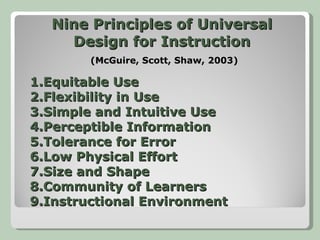
Nine Principles of Universal Design for Instruction   (McGuire, Scott, Shaw, 2003) Equitable Use Flexibility in Use Simple and Intuitive Use Perceptible Information Tolerance for Error Low Physical Effort Size and Shape Community of Learners Instructional Environment
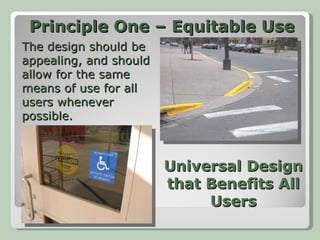
Principle One – Equitable Use Universal Design that Benefits All Users The design should be appealing, and should allow for the same means of use for all users whenever possible.
Principle Two – Flexibility in Use The design should provide choice in method of use. Consider the distribution of lecture notes or handouts to students through Blackboard.
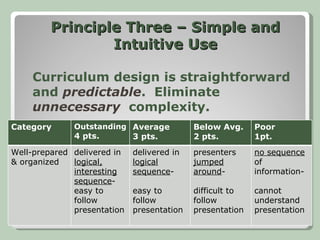
Principle Three – Simple and Intuitive Use Curriculum design is straightforward and  predictable .  Eliminate  unnecessary   complexity. Category Outstanding 4 pts. Average 3 pts. Below Avg. 2 pts. Poor 1pt. Well-prepared & organized delivered in  logical, interesting sequence -easy to follow presentation delivered in  logical sequence - easy to follow presentation presenters  jumped around - difficult to follow presentation no sequence  of information- cannot understand presentation
Principle Four – Perceptible Information Curriculum design communicates  necessary information  effectively to the student regardless of student’s  sensory  abilities .  Including captions for video presentations not only benefits students who are Deaf or Hard of Hearing but so will those who are English as a second language learners.
Principle   Five: Tolerance for Error The design minimizes hazards and the adverse consequences of accidental or unintended actions. An example is educational software that provides guidance and background information when the student makes an inappropriate selection .
Principle Six: Low Physical Effort Curriculum design minimizes  nonessential  physical effort in order to allow maximum  attention to learning . Example: Doors to a lecture hall open automatically for people with a wide variety of physical characteristics.
Principle Seven: Size & Space  for Use Curriculum design takes into consideration appropriate size and space for approach,  reach , manipulations, and  use  regardless  of student’s body size, posture, mobility, and communication needs .  Example: A flexible work area designed for use by students who are left or right handed and with diverse physical characteristics and abilities.
Principle Eight: A Community of Learners Curriculum design promotes  interaction   &  communication  among students and between students and faculty.  Example: Include study groups and/or learning communities
Principle Nine: Instructional Climate Curriculum design is welcoming and  inclusive .  High expectations  are espoused for all students. Example: Include a statement in your syllabus that encourages students to respect diversity, and encouraging students to discuss any special learning needs and information on the Disability Services office.
Is our teaching environment welcoming to ALL students? Just as physical barriers exist in our physical environment, curricular barriers exist in our instructional environment.
Overview of Scholar Program  The overall goal of the Scholar Program is to build capacity of colleges and universities to meet the diverse needs of students through the applications of UDL principles.   The Scholars demonstrate curriculum design and instruction that makes learning accessible for all students . http://highered.sdsu.edu/
Does One Size Really Fit All?
The “universal” in universal design  does not  imply that one size fits all; instead, it stresses the need for flexible, customizable content, assignments and activities. CAST (Center for Applied Special Technology)
A Universal Model for Success in  Higher Education San Diego State University  -  Interwork Institute Funded in part by a grant from  Dept. of Education – Office of Postsecondary Education,  Grant #P333A080039

Intro to Principles of Universal Design for Learning

  • 1.
    Universal Design forLearning … in a Nutshell Rechelle Mojica
  • 2.
    Universal design isthe design of products and environments to be usable by all people, to the greatest extent possible, without the need for adaptation or specialized design. –Ron Mace. What is Universal Design?
  • 3.
    Universal Design forLearning (UDL) applies the concept used in the architectural field to the area of learning—creating curriculum that meets the learning needs of a wide range of students.
  • 4.
    Universal Design vs. Universal Design for Learning
  • 5.
    Is our physicalenvironment welcoming to ALL students?
  • 6.
    Design with AllUsers in Mind
  • 7.
    Nine Principles ofUniversal Design for Instruction (McGuire, Scott, Shaw, 2003) Equitable Use Flexibility in Use Simple and Intuitive Use Perceptible Information Tolerance for Error Low Physical Effort Size and Shape Community of Learners Instructional Environment
  • 8.
    Principle One –Equitable Use Universal Design that Benefits All Users The design should be appealing, and should allow for the same means of use for all users whenever possible.
  • 9.
    Principle Two –Flexibility in Use The design should provide choice in method of use. Consider the distribution of lecture notes or handouts to students through Blackboard.
  • 10.
    Principle Three –Simple and Intuitive Use Curriculum design is straightforward and predictable . Eliminate unnecessary complexity. Category Outstanding 4 pts. Average 3 pts. Below Avg. 2 pts. Poor 1pt. Well-prepared & organized delivered in logical, interesting sequence -easy to follow presentation delivered in logical sequence - easy to follow presentation presenters jumped around - difficult to follow presentation no sequence of information- cannot understand presentation
  • 11.
    Principle Four –Perceptible Information Curriculum design communicates necessary information effectively to the student regardless of student’s sensory abilities . Including captions for video presentations not only benefits students who are Deaf or Hard of Hearing but so will those who are English as a second language learners.
  • 12.
    Principle Five: Tolerance for Error The design minimizes hazards and the adverse consequences of accidental or unintended actions. An example is educational software that provides guidance and background information when the student makes an inappropriate selection .
  • 13.
    Principle Six: LowPhysical Effort Curriculum design minimizes nonessential physical effort in order to allow maximum attention to learning . Example: Doors to a lecture hall open automatically for people with a wide variety of physical characteristics.
  • 14.
    Principle Seven: Size& Space for Use Curriculum design takes into consideration appropriate size and space for approach, reach , manipulations, and use regardless of student’s body size, posture, mobility, and communication needs . Example: A flexible work area designed for use by students who are left or right handed and with diverse physical characteristics and abilities.
  • 15.
    Principle Eight: ACommunity of Learners Curriculum design promotes interaction & communication among students and between students and faculty. Example: Include study groups and/or learning communities
  • 16.
    Principle Nine: InstructionalClimate Curriculum design is welcoming and inclusive . High expectations are espoused for all students. Example: Include a statement in your syllabus that encourages students to respect diversity, and encouraging students to discuss any special learning needs and information on the Disability Services office.
  • 17.
    Is our teachingenvironment welcoming to ALL students? Just as physical barriers exist in our physical environment, curricular barriers exist in our instructional environment.
  • 18.
    Overview of ScholarProgram The overall goal of the Scholar Program is to build capacity of colleges and universities to meet the diverse needs of students through the applications of UDL principles.  The Scholars demonstrate curriculum design and instruction that makes learning accessible for all students . http://highered.sdsu.edu/
  • 19.
    Does One SizeReally Fit All?
  • 20.
    The “universal” inuniversal design does not imply that one size fits all; instead, it stresses the need for flexible, customizable content, assignments and activities. CAST (Center for Applied Special Technology)
  • 21.
    A Universal Modelfor Success in Higher Education San Diego State University - Interwork Institute Funded in part by a grant from Dept. of Education – Office of Postsecondary Education, Grant #P333A080039

Editor's Notes

  • #4 The term “universal design” is borrowed from the architectural field curb cuts, automatic doors and other architectural features to be built into the design to avoid costly after-the-fact adaptations for individuals with disabilities. But, in reality, these features benefit many other people, including cyclists and parents with strollers.