Ms. Nilofar Loladiya
NILOFAR LOLADIYA: UNIT IV Research Types 1
Define different types of research
Enlist different types of research
 Identify quantitative and qualitative research
 Explain quantitative and qualitative research
Differentiate between quantitative and qualitative
research
UNIT-IV OBJECTIVES
NILOFAR LOLADIYA: UNIT IV Research Types 2
BASED ON APPROACH BASED ON PURPOSE
BASIC APPLIED
MIXED
METHOD
QUALITATIVE
QUANTITATIVE
CONVERGENT
EXPLANATORY
SEQUENTIAL
EXPLORATORY
SEQUENTIAL
EMBEDDED
PHENOMENOLOGY
ETHNOGRAPHY
GROUNDED
THEORY
CASE STUDY
HISTORICAL
RCT/ TRUE
EXPERIMENTAL
QUASI
EXPERIMENTAL
NON
EXPERIMENTAL
DESCRIPTIVE
EXPLORATORY
CO-RELATIONAL
NILOFAR LOLADIYA: UNIT IV Research Types 4
BASIC RESEARCH
Basic research is driven by a
scientist's curiosity or interest in a scientific
question.
- Fundamental research
Purpose:
- The main motivation is to expand man's
knowledge: Generates new knowledge without
particular reference to its immediate or practical
use
-Generate theories
NILOFAR LOLADIYA: UNIT IV Research Types 5
BASIC RESEARCH
-Eg: The researcher is observing that the workers
performance has improved in those organizations
which have participatory culture. Thus the theory “
workers participation in management increases
workers performance
-Studying grieving process
-Needs and functioning of persons with
schizophrenia( Cadena 2006)
NILOFAR LOLADIYA: UNIT IV Research Types 6
APPLIED RESEARCH
Applied research refers to scientific study and research
that seeks to solve practical problems.
- Applied research is used to find solutions to everyday
problems, cure illness, and develop innovative
technologies, rather than to acquire knowledge
- A problem is investigated and some resolution is
sought by way of research findings
- ( Polit and Hungler, 1995)
NILOFAR LOLADIYA: UNIT IV Research Types 7
APPLIED RESEARCH
Purposes:
-Solves problems of clinical, administrative and
education fields
-Evaluates practices
-Identifies needs of patients
-Make decisions
-Tends to be of greater utility for EBP
-Eg: measures taken to prevent hospital patient falls
NILOFAR LOLADIYA: UNIT IV Research Types 8
NILOFAR LOLADIYA: UNIT IV Research Types 9
PARAMETER QUANTITATIVE QUALITATIVE
GENERAL
NATURE
Objective approach to
seek precise
measurements in
numerical form
subjective approach to
seek in depth description
in narrative form
KNOWLEDGE OF
STUDY
VARIABLES
Variables are clearly
understood and defined
in advance
Only rough idea
AIMS
To identify and count the
variables to test or refine
the theories and
hypothesis
To develop theories and
assumptions
RESEARCH
PROBLEM
Is deductively reasoned
and does not change
Is inductively reasoned
and is constantly
reformulated during the
course
NILOFAR LOLADIYA: UNIT IV Research Types 10
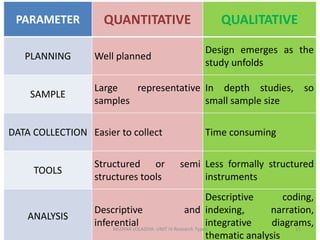
PARAMETER QUANTITATIVE QUALITATIVE
PLANNING Well planned
Design emerges as the
study unfolds
SAMPLE
Large representative
samples
In depth studies, so
small sample size
DATA COLLECTION Easier to collect Time consuming
TOOLS
Structured or semi
structures tools
Less formally structured
instruments
ANALYSIS
Descriptive and
inferential
Descriptive coding,
indexing, narration,
integrative diagrams,
thematic analysis
NILOFAR LOLADIYA: UNIT IV Research Types 11
NILOFAR LOLADIYA: UNIT IV Research Types 12
Qualitative Research
 It is concerned with the subjective meaning of an
experience to an individual
 Acc to Denzin and Lincoln(1994)
“Qualitative researcher study things in their natural
settings, attempting to make sense of or interpret
phenomenon in terms of meanings people bring to
them”
NILOFAR LOLADIYA: UNIT IV Research Types 13
• These methods permit broader understanding
and deeper insight into complex human behavior
• It is based on gaining insight and understanding
about individuals experience and sense of reality.
• Data is collected in descriptive form rather than
numerical form
• Involves analysis of data such as words, pictures
or objects
Qualitative Research
NILOFAR LOLADIYA: UNIT IV Research Types 14
• Concerned with opinions, experiences and
feelings of individuals
• Subjective data
• Describes social phenomena as they occur
naturally
• Understanding of a situation is gained
gradually through a holistic perspective
• Data is collected through direct interaction
with individuals thr one – to- one or group
interviews or by observation
Qualitative Research
NILOFAR LOLADIYA: UNIT IV Research Types 15
Examples:
Mothers sufferings after the children death
Mental trauma experienced by infertile couple
Stigma experienced by HIV positive patients
Stigma experienced by children born to CSW
Experiences of orphans in an orphanage
Feeling of elderly people in the family
Psycho- social experiences of couples of LBW
Subjective description of pain
Qualitative Research
NILOFAR LOLADIYA: UNIT IV Research Types 16
IDENTIFYING
RESEARCH
PROBLEM AREA
FORMULATING
STUDY
OBJECTIVES
REVIEW OF
LITERATURE
SELECTING
RESEARCH
APPROACH/ DESIGN
SELECT A
SMALL
SAMPLE
ETHICAL
CONSIDERATIONS
PLANNING TOOL FOR
DATA COLLECTION
DATA ANALYSIS
AND
INTERPRETATION
ORGANIZING
DATA FOR
ANALYSIS
DISSEMINATE THE
RESEARCH
FINDINGS
QUALITATIVE
RESEARCH
PROCESS
NILOFAR LOLADIYA: UNIT IV Research Types 17
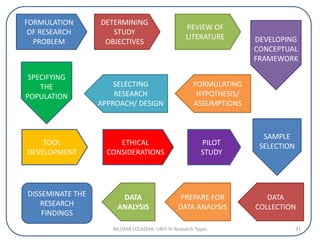
FORMULATION
OF RESEARCH
PROBLEM
DETERMINING
STUDY
OBJECTIVES
REVIEW OF
LITERATURE DEVELOPING
CONCEPTUAL
FRAMEWORK
FORMULATING
HYPOTHESIS/
ASSUMPTIONS
SELECTING
RESEARCH
APPROACH/ DESIGN
SPECIFYING
THE
POPULATION
TOOL
DEVELOPMENT
ETHICAL
CONSIDERATIONS
SAMPLE
SELECTION
DATA
COLLECTION
DATA
ANALYSIS
PREPARE FOR
DATA ANALYSIS
PILOT
STUDY
DISSEMINATE THE
RESEARCH
FINDINGS
NILOFAR LOLADIYA: UNIT IV Research Types 18
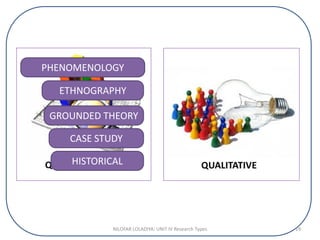
PHENOMENOLOGY
ETHNOGRAPHY
GROUNDED THEORY
CASE STUDY
HISTORICAL
NILOFAR LOLADIYA: UNIT IV Research Types 19
PHENOMENLOGICAL RESEARCH
Phenomenological research a descriptive research
approach developed from phenomenological
philosophy; its aim is to describe an experience as it is
actually lived by the person.
• Phenomenology is concerned with the study of experience
from the perspective of the individual. (person & society)
• They are based in a paradigm of personal knowledge and
subjectivity, and emphasise the importance of personal
perspective and interpretation.
• As such they are powerful for understanding subjective
experience, gaining insights into people’s motivations and
actions
NILOFAR LOLADIYA: UNIT IV Research Types 20
ETHNOGRAPHIC RESEARCH
Ethnographic research refer to the investigation of a
culture through an in-depth study of the members of
the culture; it involves the systematic collection,
description, and analysis of data for development of
theories of cultural behaviour.
• Anthropology.
• Macro and Micro
• Ethno-nursing NILOFAR LOLADIYA: UNIT IV Research Types 21
GROUNDED-THEORY RESEARCH
• This approach may be used by researchers to collect
data in inductive way
• Sociology branch
• Interview, Observation, Journals, Self-reports, Diaries,
AV
E.g. Response and Adaptation process of patients diagnosed
with Cancer
Adaptation level of people with post injury permanent physical
disabilities
NILOFAR LOLADIYA: UNIT IV Research Types 22
CASE STUDY RESEARCH
Case studies are in-depth examination of
people, objects, or institutions;
for example,
case study on emergency services in Civil
Hospital of Ludhiana, Punjab.
NILOFAR LOLADIYA: UNIT IV Research Types 23
HISTORICAL RESEARCH
Historical research is research involving analysis of
events that occurred in the remote or recent past
PURPOSE
• Historical research can show patterns that occurred in
the past and over time which can help us to see where
we came from and what kinds of solutions we have
used in the past.
• Understanding this can add perspective on how we
examine current events and educational practices.
NILOFAR LOLADIYA: UNIT IV Research Types 24
ACTION RESEARCH
• This design may be used if researcher wants to empower
people through constructing and using the knowledge.
• Collaborate with several disciplines
• Solution to problems by finding the causes and ways
• E.g. Problems in nursing education
NILOFAR LOLADIYA: UNIT IV Research Types 25
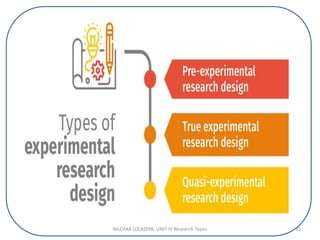
RCT/ TRUE
EXPERIMENTAL
QUASI
EXPERIMENTAL
PRE
EXPERIMENTAL
DESCRIPTIVE
EXPLORATORY
CROSS SECTIONAL
LONGITUDINAL
NILOFAR LOLADIYA: UNIT IV Research Types 26
COMPARATIVE
QUANTITATIVE RESEARCH
Quantitative research refers to the systematic
empirical investigation of any phenomena via
statistical, mathematical or computational
techniques.
The objective of quantitative research is to develop
and employ mathematical
Models, theories and/or hypotheses pertaining to
phenomena
NILOFAR LOLADIYA: UNIT IV Research Types 27
QUANTITATIVE RESEARCH
Quantitative research is generally made using scientific
methods, which can include:
• The generation of models, theories and hypotheses
• The development of instruments and methods for
measurement
• Experimental control and manipulation of variables
• Collection of empirical data
• Modelling and analysis of data
• Evaluation of results
NILOFAR LOLADIYA: UNIT IV Research Types 28
 Difference between the temperature controls
among newborns with and without vernix caseosa
 An educational program on hypertension and
patient compliance with medication schedules
 Effectiveness of infra-red therapy on healing of
cesarean suture site.
QUANTITATIVE RESEARCH
NILOFAR LOLADIYA: UNIT IV Research Types 29
FORMULATION
OF RESEARCH
PROBLEM
DETERMINING
STUDY
OBJECTIVES
REVIEW OF
LITERATURE DEVELOPING
CONCEPTUAL
FRAMEWORK
FORMULATING
HYPOTHESIS/
ASSUMPTIONS
SELECTING
RESEARCH
APPROACH/ DESIGN
SPECIFYING
THE
POPULATION
TOOL
DEVELOPMENT
ETHICAL
CONSIDERATIONS
SAMPLE
SELECTION
DATA
COLLECTION
DATA
ANALYSIS
PREPARE FOR
DATA ANALYSIS
PILOT
STUDY
DISSEMINATE THE
RESEARCH
FINDINGS
QUANTITATIVE
RESEARCH
PROCESS
NILOFAR LOLADIYA: UNIT IV Research Types 30
FORMULATION
OF RESEARCH
PROBLEM
DETERMINING
STUDY
OBJECTIVES
REVIEW OF
LITERATURE DEVELOPING
CONCEPTUAL
FRAMEWORK
FORMULATING
HYPOTHESIS/
ASSUMPTIONS
SELECTING
RESEARCH
APPROACH/ DESIGN
SPECIFYING
THE
POPULATION
TOOL
DEVELOPMENT
ETHICAL
CONSIDERATIONS
SAMPLE
SELECTION
DATA
COLLECTION
DATA
ANALYSIS
PREPARE FOR
DATA ANALYSIS
PILOT
STUDY
DISSEMINATE THE
RESEARCH
FINDINGS
NILOFAR LOLADIYA: UNIT IV Research Types 31
NILOFAR LOLADIYA: UNIT IV Research Types 32
THREE COMPONENTS
OF EXPERIMENTAL RESEARCH
NILOFAR LOLADIYA: UNIT IV Research Types 33
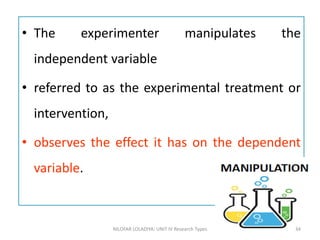
• The experimenter manipulates the
independent variable
• referred to as the experimental treatment or
intervention,
• observes the effect it has on the dependent
variable.
NILOFAR LOLADIYA: UNIT IV Research Types 34
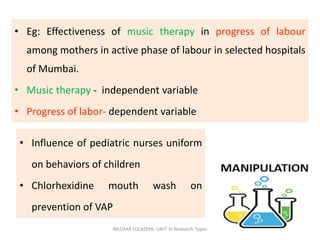
• Eg: Effectiveness of music therapy in progress of labour
among mothers in active phase of labour in selected hospitals
of Mumbai.
• Music therapy - independent variable
• Progress of labor- dependent variable
NILOFAR LOLADIYA: UNIT IV Research Types 35
• Influence of pediatric nurses uniform
on behaviors of children
• Chlorhexidine mouth wash on
prevention of VAP
The experiment must be organized so that the extraneous
factors are prevented from operating and confusing the
outcome which is to be appraised.
NILOFAR LOLADIYA: UNIT IV Research Types 36
• Controlling extraneous variables
• Careful preparation of
experimental protocols and by
using control groups (placebo)
• If a researcher wanted to supplement diet of the
low birth baby with a particular nutrient for 2
weeks, the weight gain at the end of 2 weeks
would tell us nothing about the treatment
effectiveness
NILOFAR LOLADIYA: UNIT IV Research Types 37
Suppose an average 1 kg. weight
gain is noted.
does this gain support the
conclusion that nutrition
supplement (IV) caused the weight
gain (DV)?
The answer will be NO? because babies normally gain
weight as they mature. It is impossible to separate the effects
of maturation from those treatment.
NILOFAR LOLADIYA: UNIT IV Research Types 38
It is a group of subjects whose
performance on a dependent variable is
used to evaluate the performance of the
experimental group.
control group- a group that does not
receive the nutritional supplements.
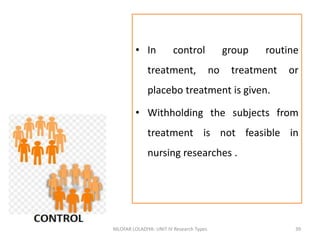
• In control group routine
treatment, no treatment or
placebo treatment is given.
• Withholding the subjects from
treatment is not feasible in
nursing researches .
NILOFAR LOLADIYA: UNIT IV Research Types 39
Random means every subject has an
equal and fair chance of being
assigned to any group.
Trustworthy and acceptable method
of equalizing groups.
NILOFAR LOLADIYA: UNIT IV Research Types 40
Allotting the subjects randomly to the
control and experimental group
Flipping a coin, Table of random numbers,
drawing the names from the hat,
EXAMPLE:
The effectiveness of a
contraceptive health
education programme for
multiparous women. Two
groups of subjects were
included
NILOFAR LOLADIYA: UNIT IV Research Types 41
. The women in the sample are likely to differ in age, education,
and attitude. This would affect the woman's diligence in
practicing contraception
One group was given intervention and other was not.
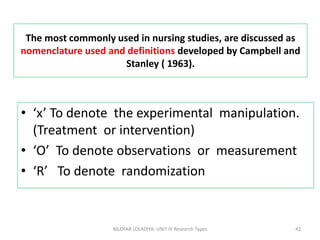
The most commonly used in nursing studies, are discussed as
nomenclature used and definitions developed by Campbell and
Stanley ( 1963).
• ‘x’ To denote the experimental manipulation.
(Treatment or intervention)
• ‘O’ To denote observations or measurement
• ‘R’ To denote randomization
NILOFAR LOLADIYA: UNIT IV Research Types 42
“A research design is the arrangement of conditions
for collection and analysis of data in a manner that
aims to combine relevance to the research purpose
with economy in procedure.”
- Johoda, Deutsch, & Cook
Definition OF RESEARCH DESIGN
NILOFAR LOLADIYA: UNIT IV Research Types 43
Research design can be defined as a blue print to
conduct a research study, which involves the
description of research approach, study setting,
sampling size, sampling technique, tools and methods
of data collection and analysis to answer a specific
research question or for testing research hypothesis.
– Suresh Sharma
Definition
NILOFAR LOLADIYA: UNIT IV Research Types 44
Purposes of Research Design
 It provides the scheme for answering research question.
 It maintains control to avoid bias that may affect the
outcomes.
 It organizes the study in a certain way defending the
advantages of doing while being aware and cautious
about potential disadvantages .
NILOFAR LOLADIYA: UNIT IV Research Types 45
Experimental Design
True experimental
Pre test/ post test
control groups
Post test
Only control group
Solomon four group design
Factorial Design
Crossover design
Quasi experimental
Non equivalent
control group
Time series
Pre experimental
One shot case
study
One group
Pre test/ post test
Study
Randomised Block Design
NILOFAR LOLADIYA: UNIT IV Research Types 46
Definition
Experimental method is defined as an empirical
research method used to examine a hypothesized
causal relationship between independent and
dependent variables.
NILOFAR LOLADIYA: UNIT IV Research Types 47
Experimental Design
• Permits the researcher to establish cause
effect relationship
• accurately predict and explain phenomena.
• The investigator attempts to ensure that the
results of the study can be attributed to
manipulation of variable under examination
NILOFAR LOLADIYA: UNIT IV Research Types 48
Experimental Design
• True experimental designs are that in which
the researcher has great deal of control over
research situation
• Are characterized by 3 fundamental
properties:
• Manipulation
• Control
• Randomization
NILOFAR LOLADIYA: UNIT IV Research Types 49
TRUE EXPERIMENTAL
NILOFAR LOLADIYA: UNIT IV Research Types 50
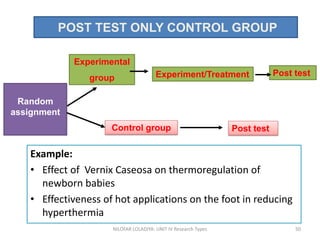
Experiment/Treatment
Control group
Post test
Experimental
group
Random
assignment
Post test
POST TEST ONLY CONTROL GROUP
Example:
• Effect of Vernix Caseosa on thermoregulation of
newborn babies
• Effectiveness of hot applications on the foot in reducing
hyperthermia
Pretest
Experiment
/Treatment
Control group
Post test
Experimental
group
Random
assignment
Pretest Post test
 Group I: R O1 X O2
 Group II: RO1 O2
NILOFAR LOLADIYA: UNIT IV Research Types 51
PRE TEST/ POST TEST CONTROL GROUP
 Eg: Effectiveness of music therapy in progress of labor
among mothers in active phase of labor in selected
hospitals of Mumbai.
 Effectiveness of health education
 Effectiveness of thirst bundle among preoperative
patients in reducing the thirst
NILOFAR LOLADIYA: UNIT IV Research Types 52
PRE TEST/ POST TEST CONTROL GROUP
NILOFAR LOLADIYA: UNIT IV Research Types 53
Experiment/Treatment
Control group- 2
Post test
Experimental
Group-2
Random
assignment
Post test
Pretest
Experiment
/Treatment
Control group-1
Post test
Experimental
Group-1
Pretest Post test
SOLOMON FOUR GROUP
It is a prestigious experimental design:
- Controls all threats of internal and external validity
- Can separate out the reactive effects of pre test
- LIMITATIONS:
- Large sample size is required
- Complex statistical analysis
NILOFAR LOLADIYA: UNIT IV Research Types 54
SOLOMON FOUR GROUP
FACTORIAL DESIGN
• Researcher manipulates 2 or more independent variable
simultaneously to observe their effects on the dependent
variable.
• Helps in testing multiple hypothesis
NILOFAR LOLADIYA: UNIT IV Research Types 55
EXAMPLE:
• “Experimental study to find out the efficacy of 2 different dressing
materials banana leaves and paraffin gauze on donor site wounds of
patients with burns”
• Effectiveness of chlorhexidine and saline wash protocols in
prevention of VAP
EXAMPLE
AUDITORY
A1
TACTILE
A2
15 Min
B1
A1 B1 A2 B1
30 Min.
B2
A1 B2 A2 B2
45 Min.
B3
A1 B3 A2 B3
Type of stimulation
Daily
Exposure
FACTORIAL DESIGN
e.g. Effect of Tactile vs Auditory stimulation of preterm
Repeated Measure Design
(Cross over design)
• Involves the exposure of the same subjects to more
than one experimental treatment
• Limitation: carry over effect
NILOFAR LOLADIYA: UNIT IV Research Types 57
E.g. Effectiveness of two alternative back rest position
(flat/horizontal vs 30o elevation) on intracranial and
cerebral perfusion pressures in brain injured adults
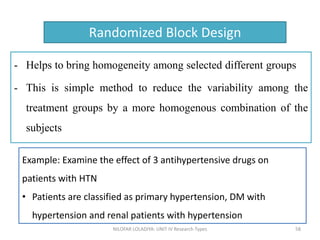
- Helps to bring homogeneity among selected different groups
- This is simple method to reduce the variability among the
treatment groups by a more homogenous combination of the
subjects
NILOFAR LOLADIYA: UNIT IV Research Types 58
Randomized Block Design
Example: Examine the effect of 3 antihypertensive drugs on
patients with HTN
• Patients are classified as primary hypertension, DM with
hypertension and renal patients with hypertension
- Primarily used in agricultural field
- Number of rows and columns must be equal
- 4 X 4 = 16 Experimental units
- ( Maximum 10) Complex analysis
- Take first four patients as rows and treatment as column
- Then repeat same with next four patients
- Every patient receives all the treatments
NILOFAR LOLADIYA: UNIT IV Research Types 59
Latin Square Design
NILOFAR LOLADIYA: UNIT IV Research Types 60
Latin Square Design
Example:
Examine the effect of 4 different creams on patients with dermatitis.
PATIENTS
T
R
E
A
T
M
E
N
T
Cream-1 Cream-2 Cream-3
Cream-4
Cream-2
Cream-3 Cream-4 Cream-1
Cream-3 Cream-4 Cream-1 Cream-2
Cream-4
Cream-1
Cream-2 Cream-3
PARALLEL DESIGN
• Researcher manipulates 2 or more independent variable
simultaneously to observe their effects on the dependent
variable.
• Results are compared in both the groups
NILOFAR LOLADIYA: UNIT IV Research Types 61
Random
assignment
Pretest
Experiment
I
Post test
Experimental
Group-I
Pretest
Experiment
II
Post test
Experimental
Group-II
PARALLEL DESIGN
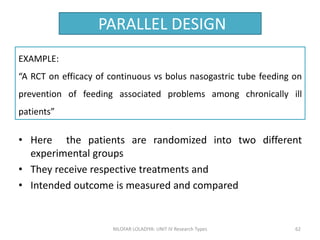
• Here the patients are randomized into two different
experimental groups
• They receive respective treatments and
• Intended outcome is measured and compared
NILOFAR LOLADIYA: UNIT IV Research Types 62
EXAMPLE:
“A RCT on efficacy of continuous vs bolus nasogastric tube feeding on
prevention of feeding associated problems among chronically ill
patients”
SPLIT BODY DESIGN
• Researcher divides the body into left and right half
• One half serves as an experimental and other as control
• Most Robust design as the sample is very homogenous
NILOFAR LOLADIYA: UNIT IV Research Types 63
SPLIT BODY DESIGN
NILOFAR LOLADIYA: UNIT IV Research Types 64
EXAMPLE:
• “RCT on efficacy of cold application in prevention and
reduction of pain, bruise and hematoma at subcutaneous
LMWH injection site”
• Patients right arm serves as an experimental arm and left
as control
• Cold application will be given only at the right side before
injections
Advantages of experimental designs
• Most powerful method of testing hypothesis of cause
and effect relationship between variables
• Has precision and control properties
• Beneficial: helps in predication and explanation
• Generalization
NILOFAR LOLADIYA: UNIT IV Research Types 65
• Based on artificial set up: randomization, lab
• Hawthorne effect : altering the behavior for a favorable
result
• Ethical issues: eg assessing effectiveness of some treatment
on pregnant women may affect the fetus
• Feasibility
• Expensive
• Risks
NILOFAR LOLADIYA: UNIT IV Research Types 66
Limitations of experimental designs
QUASI EXPERIMENTAL RESEARCH
• Quasi experiments are like true experiments, involve the
manipulation of an independent variable, that is an
intervention
• but lacks at least one of the other 2 properties ie,
randomization or control group features that strengthens
the ability to make causal inferences . (Polit 2004)
• They lack equivalent groups created by random assignment
NILOFAR LOLADIYA: UNIT IV Research Types 67
PURPOSES
PURPOSES:
• To provide alternative means of examining causality
in situations not conducive to experimental group.
• To facilitate the search for knowledge and
examination in situations when complete control is
not possible.
NILOFAR LOLADIYA: UNIT IV Research Types 68
QUASI EXPERIMENTAL RESEARCH
Advantages
ADVANTAGES
• Practical, feasible, generalizable
• Useful in cases where
randomization and control is
impossible due to health risks
• More adaptable to the real world
practice
• Reduces time and utilization of
resources
NILOFAR LOLADIYA: UNIT IV Research Types 69
QUASI EXPERIMENTAL RESEARCH
LIMITATIONS
• Clear cause and effect
relationship can not be
obtained
• Difficult to generalize
Non Randomized control group design:
Non equivalent control group PRE test POST test design:
Similar to pre test post test Design, but no random assignment of
subjects to experimental and control groups.
e.g. Health and Social Initiatives among old age citizen
NILOFAR LOLADIYA: UNIT IV Research Types 70
QUASI EXPERIMENTAL DESIGN
Pretest
Experiment
/Treatment
Control group
Post test
Experimental
Group
Pretest Post test
Non equivalent control group Post-test Only design:
e.g. Educational intervention related to self care abilities
among diabetic patients residing in rural areas.
One village as experimental group another as control.
NILOFAR LOLADIYA: UNIT IV Research Types 71
QUASI EXPERIMENTAL DESIGN
Experiment
/Treatment
Control group
Post test
Experimental
group
Post test
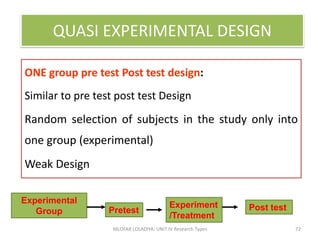
ONE group pre test Post test design:
Similar to pre test post test Design
Random selection of subjects in the study only into
one group (experimental)
Weak Design
NILOFAR LOLADIYA: UNIT IV Research Types 72
QUASI EXPERIMENTAL DESIGN
Pretest
Experiment
/Treatment
Post test
Experimental
Group
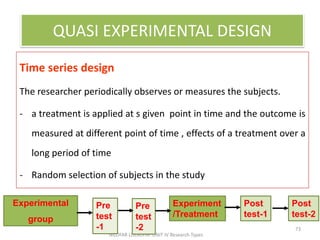
Time series design
The researcher periodically observes or measures the subjects.
- a treatment is applied at s given point in time and the outcome is
measured at different point of time , effects of a treatment over a
long period of time
- Random selection of subjects in the study
NILOFAR LOLADIYA: UNIT IV Research Types
73
QUASI EXPERIMENTAL DESIGN
Experiment
/Treatment
Post
test-2
Experimental
group
Post
test-1
Pre
test
-2
Pre
test
-1
Time series design (EXAMPLE)
1.observation of subjects before announcing a rule in the
hospital and after announcing the rule
2. Effect of aerobic exercises on fatigue and fitness among
people with rheumatoid arthritis
3. Nausea in HIV patients after ART
4. Effectiveness of selected nutritional interventions on
growth and development pattern of children attending
under fives clinic at Omayal Achi community health
centre at Tiruvalluvar district 2006- 2008
NILOFAR LOLADIYA: UNIT IV Research Types 74
QUASI EXPERIMENTAL DESIGN
Time Series Non equivalent control group design:
Similar to pre test post test Design, but no random
assignment of subjects to experimental and control groups.
e.g. VAP prevention bundle on VAP related events in ICUs
NILOFAR LOLADIYA: UNIT IV Research Types 75
QUASI EXPERIMENTAL DESIGN
(ICU-2)
(ICU-1) Experiment
/Treatment
Post
test-2
Experimental
group
Post
test-1
Pre
test
-2
Pre
test
-1
Experiment
/Treatment
Post
test-2
Control group
Post
test-1
Pre
test
-2
Pre
test
-1
(ICU-1)
PRE EXPERIMENTAL DESIGN
• One shot case study:
No pretesting, No randomization, ONE group only
subjects are given the treatment and observed.
Adv: simple and quick, minimizes the threat of testing
• Eg: vernix caseosa effect on thermoregulation
• Effect of demonstration of breast feeding techniques
• Effect of positioning of post operative hip fractured
patients as related to comfort
• Effectiveness pelvic floor muscles exercises in control
of incontinence of urine.
NILOFAR LOLADIYA: UNIT IV Research Types 76
NILOFAR LOLADIYA: UNIT IV Research Types 77

UNIT-IV RESEARCH TYPES.pdf

  • 1.
    Ms. Nilofar Loladiya NILOFARLOLADIYA: UNIT IV Research Types 1
  • 2.
    Define different typesof research Enlist different types of research  Identify quantitative and qualitative research  Explain quantitative and qualitative research Differentiate between quantitative and qualitative research UNIT-IV OBJECTIVES NILOFAR LOLADIYA: UNIT IV Research Types 2
  • 4.
    BASED ON APPROACHBASED ON PURPOSE BASIC APPLIED MIXED METHOD QUALITATIVE QUANTITATIVE CONVERGENT EXPLANATORY SEQUENTIAL EXPLORATORY SEQUENTIAL EMBEDDED PHENOMENOLOGY ETHNOGRAPHY GROUNDED THEORY CASE STUDY HISTORICAL RCT/ TRUE EXPERIMENTAL QUASI EXPERIMENTAL NON EXPERIMENTAL DESCRIPTIVE EXPLORATORY CO-RELATIONAL NILOFAR LOLADIYA: UNIT IV Research Types 4
  • 5.
    BASIC RESEARCH Basic researchis driven by a scientist's curiosity or interest in a scientific question. - Fundamental research Purpose: - The main motivation is to expand man's knowledge: Generates new knowledge without particular reference to its immediate or practical use -Generate theories NILOFAR LOLADIYA: UNIT IV Research Types 5
  • 6.
    BASIC RESEARCH -Eg: Theresearcher is observing that the workers performance has improved in those organizations which have participatory culture. Thus the theory “ workers participation in management increases workers performance -Studying grieving process -Needs and functioning of persons with schizophrenia( Cadena 2006) NILOFAR LOLADIYA: UNIT IV Research Types 6
  • 7.
    APPLIED RESEARCH Applied researchrefers to scientific study and research that seeks to solve practical problems. - Applied research is used to find solutions to everyday problems, cure illness, and develop innovative technologies, rather than to acquire knowledge - A problem is investigated and some resolution is sought by way of research findings - ( Polit and Hungler, 1995) NILOFAR LOLADIYA: UNIT IV Research Types 7
  • 8.
    APPLIED RESEARCH Purposes: -Solves problemsof clinical, administrative and education fields -Evaluates practices -Identifies needs of patients -Make decisions -Tends to be of greater utility for EBP -Eg: measures taken to prevent hospital patient falls NILOFAR LOLADIYA: UNIT IV Research Types 8
  • 9.
    NILOFAR LOLADIYA: UNITIV Research Types 9
  • 10.
    PARAMETER QUANTITATIVE QUALITATIVE GENERAL NATURE Objectiveapproach to seek precise measurements in numerical form subjective approach to seek in depth description in narrative form KNOWLEDGE OF STUDY VARIABLES Variables are clearly understood and defined in advance Only rough idea AIMS To identify and count the variables to test or refine the theories and hypothesis To develop theories and assumptions RESEARCH PROBLEM Is deductively reasoned and does not change Is inductively reasoned and is constantly reformulated during the course NILOFAR LOLADIYA: UNIT IV Research Types 10
  • 11.
    PARAMETER QUANTITATIVE QUALITATIVE PLANNINGWell planned Design emerges as the study unfolds SAMPLE Large representative samples In depth studies, so small sample size DATA COLLECTION Easier to collect Time consuming TOOLS Structured or semi structures tools Less formally structured instruments ANALYSIS Descriptive and inferential Descriptive coding, indexing, narration, integrative diagrams, thematic analysis NILOFAR LOLADIYA: UNIT IV Research Types 11
  • 12.
    NILOFAR LOLADIYA: UNITIV Research Types 12
  • 13.
    Qualitative Research  Itis concerned with the subjective meaning of an experience to an individual  Acc to Denzin and Lincoln(1994) “Qualitative researcher study things in their natural settings, attempting to make sense of or interpret phenomenon in terms of meanings people bring to them” NILOFAR LOLADIYA: UNIT IV Research Types 13
  • 14.
    • These methodspermit broader understanding and deeper insight into complex human behavior • It is based on gaining insight and understanding about individuals experience and sense of reality. • Data is collected in descriptive form rather than numerical form • Involves analysis of data such as words, pictures or objects Qualitative Research NILOFAR LOLADIYA: UNIT IV Research Types 14
  • 15.
    • Concerned withopinions, experiences and feelings of individuals • Subjective data • Describes social phenomena as they occur naturally • Understanding of a situation is gained gradually through a holistic perspective • Data is collected through direct interaction with individuals thr one – to- one or group interviews or by observation Qualitative Research NILOFAR LOLADIYA: UNIT IV Research Types 15
  • 16.
    Examples: Mothers sufferings afterthe children death Mental trauma experienced by infertile couple Stigma experienced by HIV positive patients Stigma experienced by children born to CSW Experiences of orphans in an orphanage Feeling of elderly people in the family Psycho- social experiences of couples of LBW Subjective description of pain Qualitative Research NILOFAR LOLADIYA: UNIT IV Research Types 16
  • 17.
    IDENTIFYING RESEARCH PROBLEM AREA FORMULATING STUDY OBJECTIVES REVIEW OF LITERATURE SELECTING RESEARCH APPROACH/DESIGN SELECT A SMALL SAMPLE ETHICAL CONSIDERATIONS PLANNING TOOL FOR DATA COLLECTION DATA ANALYSIS AND INTERPRETATION ORGANIZING DATA FOR ANALYSIS DISSEMINATE THE RESEARCH FINDINGS QUALITATIVE RESEARCH PROCESS NILOFAR LOLADIYA: UNIT IV Research Types 17
  • 18.
    FORMULATION OF RESEARCH PROBLEM DETERMINING STUDY OBJECTIVES REVIEW OF LITERATUREDEVELOPING CONCEPTUAL FRAMEWORK FORMULATING HYPOTHESIS/ ASSUMPTIONS SELECTING RESEARCH APPROACH/ DESIGN SPECIFYING THE POPULATION TOOL DEVELOPMENT ETHICAL CONSIDERATIONS SAMPLE SELECTION DATA COLLECTION DATA ANALYSIS PREPARE FOR DATA ANALYSIS PILOT STUDY DISSEMINATE THE RESEARCH FINDINGS NILOFAR LOLADIYA: UNIT IV Research Types 18
  • 19.
  • 20.
    PHENOMENLOGICAL RESEARCH Phenomenological researcha descriptive research approach developed from phenomenological philosophy; its aim is to describe an experience as it is actually lived by the person. • Phenomenology is concerned with the study of experience from the perspective of the individual. (person & society) • They are based in a paradigm of personal knowledge and subjectivity, and emphasise the importance of personal perspective and interpretation. • As such they are powerful for understanding subjective experience, gaining insights into people’s motivations and actions NILOFAR LOLADIYA: UNIT IV Research Types 20
  • 21.
    ETHNOGRAPHIC RESEARCH Ethnographic researchrefer to the investigation of a culture through an in-depth study of the members of the culture; it involves the systematic collection, description, and analysis of data for development of theories of cultural behaviour. • Anthropology. • Macro and Micro • Ethno-nursing NILOFAR LOLADIYA: UNIT IV Research Types 21
  • 22.
    GROUNDED-THEORY RESEARCH • Thisapproach may be used by researchers to collect data in inductive way • Sociology branch • Interview, Observation, Journals, Self-reports, Diaries, AV E.g. Response and Adaptation process of patients diagnosed with Cancer Adaptation level of people with post injury permanent physical disabilities NILOFAR LOLADIYA: UNIT IV Research Types 22
  • 23.
    CASE STUDY RESEARCH Casestudies are in-depth examination of people, objects, or institutions; for example, case study on emergency services in Civil Hospital of Ludhiana, Punjab. NILOFAR LOLADIYA: UNIT IV Research Types 23
  • 24.
    HISTORICAL RESEARCH Historical researchis research involving analysis of events that occurred in the remote or recent past PURPOSE • Historical research can show patterns that occurred in the past and over time which can help us to see where we came from and what kinds of solutions we have used in the past. • Understanding this can add perspective on how we examine current events and educational practices. NILOFAR LOLADIYA: UNIT IV Research Types 24
  • 25.
    ACTION RESEARCH • Thisdesign may be used if researcher wants to empower people through constructing and using the knowledge. • Collaborate with several disciplines • Solution to problems by finding the causes and ways • E.g. Problems in nursing education NILOFAR LOLADIYA: UNIT IV Research Types 25
  • 26.
  • 27.
    QUANTITATIVE RESEARCH Quantitative researchrefers to the systematic empirical investigation of any phenomena via statistical, mathematical or computational techniques. The objective of quantitative research is to develop and employ mathematical Models, theories and/or hypotheses pertaining to phenomena NILOFAR LOLADIYA: UNIT IV Research Types 27
  • 28.
    QUANTITATIVE RESEARCH Quantitative researchis generally made using scientific methods, which can include: • The generation of models, theories and hypotheses • The development of instruments and methods for measurement • Experimental control and manipulation of variables • Collection of empirical data • Modelling and analysis of data • Evaluation of results NILOFAR LOLADIYA: UNIT IV Research Types 28
  • 29.
     Difference betweenthe temperature controls among newborns with and without vernix caseosa  An educational program on hypertension and patient compliance with medication schedules  Effectiveness of infra-red therapy on healing of cesarean suture site. QUANTITATIVE RESEARCH NILOFAR LOLADIYA: UNIT IV Research Types 29
  • 30.
    FORMULATION OF RESEARCH PROBLEM DETERMINING STUDY OBJECTIVES REVIEW OF LITERATUREDEVELOPING CONCEPTUAL FRAMEWORK FORMULATING HYPOTHESIS/ ASSUMPTIONS SELECTING RESEARCH APPROACH/ DESIGN SPECIFYING THE POPULATION TOOL DEVELOPMENT ETHICAL CONSIDERATIONS SAMPLE SELECTION DATA COLLECTION DATA ANALYSIS PREPARE FOR DATA ANALYSIS PILOT STUDY DISSEMINATE THE RESEARCH FINDINGS QUANTITATIVE RESEARCH PROCESS NILOFAR LOLADIYA: UNIT IV Research Types 30
  • 31.
    FORMULATION OF RESEARCH PROBLEM DETERMINING STUDY OBJECTIVES REVIEW OF LITERATUREDEVELOPING CONCEPTUAL FRAMEWORK FORMULATING HYPOTHESIS/ ASSUMPTIONS SELECTING RESEARCH APPROACH/ DESIGN SPECIFYING THE POPULATION TOOL DEVELOPMENT ETHICAL CONSIDERATIONS SAMPLE SELECTION DATA COLLECTION DATA ANALYSIS PREPARE FOR DATA ANALYSIS PILOT STUDY DISSEMINATE THE RESEARCH FINDINGS NILOFAR LOLADIYA: UNIT IV Research Types 31
  • 32.
    NILOFAR LOLADIYA: UNITIV Research Types 32
  • 33.
    THREE COMPONENTS OF EXPERIMENTALRESEARCH NILOFAR LOLADIYA: UNIT IV Research Types 33
  • 34.
    • The experimentermanipulates the independent variable • referred to as the experimental treatment or intervention, • observes the effect it has on the dependent variable. NILOFAR LOLADIYA: UNIT IV Research Types 34
  • 35.
    • Eg: Effectivenessof music therapy in progress of labour among mothers in active phase of labour in selected hospitals of Mumbai. • Music therapy - independent variable • Progress of labor- dependent variable NILOFAR LOLADIYA: UNIT IV Research Types 35 • Influence of pediatric nurses uniform on behaviors of children • Chlorhexidine mouth wash on prevention of VAP
  • 36.
    The experiment mustbe organized so that the extraneous factors are prevented from operating and confusing the outcome which is to be appraised. NILOFAR LOLADIYA: UNIT IV Research Types 36 • Controlling extraneous variables • Careful preparation of experimental protocols and by using control groups (placebo)
  • 37.
    • If aresearcher wanted to supplement diet of the low birth baby with a particular nutrient for 2 weeks, the weight gain at the end of 2 weeks would tell us nothing about the treatment effectiveness NILOFAR LOLADIYA: UNIT IV Research Types 37 Suppose an average 1 kg. weight gain is noted. does this gain support the conclusion that nutrition supplement (IV) caused the weight gain (DV)?
  • 38.
    The answer willbe NO? because babies normally gain weight as they mature. It is impossible to separate the effects of maturation from those treatment. NILOFAR LOLADIYA: UNIT IV Research Types 38 It is a group of subjects whose performance on a dependent variable is used to evaluate the performance of the experimental group. control group- a group that does not receive the nutritional supplements.
  • 39.
    • In controlgroup routine treatment, no treatment or placebo treatment is given. • Withholding the subjects from treatment is not feasible in nursing researches . NILOFAR LOLADIYA: UNIT IV Research Types 39
  • 40.
    Random means everysubject has an equal and fair chance of being assigned to any group. Trustworthy and acceptable method of equalizing groups. NILOFAR LOLADIYA: UNIT IV Research Types 40 Allotting the subjects randomly to the control and experimental group Flipping a coin, Table of random numbers, drawing the names from the hat,
  • 41.
    EXAMPLE: The effectiveness ofa contraceptive health education programme for multiparous women. Two groups of subjects were included NILOFAR LOLADIYA: UNIT IV Research Types 41 . The women in the sample are likely to differ in age, education, and attitude. This would affect the woman's diligence in practicing contraception One group was given intervention and other was not.
  • 42.
    The most commonlyused in nursing studies, are discussed as nomenclature used and definitions developed by Campbell and Stanley ( 1963). • ‘x’ To denote the experimental manipulation. (Treatment or intervention) • ‘O’ To denote observations or measurement • ‘R’ To denote randomization NILOFAR LOLADIYA: UNIT IV Research Types 42
  • 43.
    “A research designis the arrangement of conditions for collection and analysis of data in a manner that aims to combine relevance to the research purpose with economy in procedure.” - Johoda, Deutsch, & Cook Definition OF RESEARCH DESIGN NILOFAR LOLADIYA: UNIT IV Research Types 43
  • 44.
    Research design canbe defined as a blue print to conduct a research study, which involves the description of research approach, study setting, sampling size, sampling technique, tools and methods of data collection and analysis to answer a specific research question or for testing research hypothesis. – Suresh Sharma Definition NILOFAR LOLADIYA: UNIT IV Research Types 44
  • 45.
    Purposes of ResearchDesign  It provides the scheme for answering research question.  It maintains control to avoid bias that may affect the outcomes.  It organizes the study in a certain way defending the advantages of doing while being aware and cautious about potential disadvantages . NILOFAR LOLADIYA: UNIT IV Research Types 45
  • 46.
    Experimental Design True experimental Pretest/ post test control groups Post test Only control group Solomon four group design Factorial Design Crossover design Quasi experimental Non equivalent control group Time series Pre experimental One shot case study One group Pre test/ post test Study Randomised Block Design NILOFAR LOLADIYA: UNIT IV Research Types 46
  • 47.
    Definition Experimental method isdefined as an empirical research method used to examine a hypothesized causal relationship between independent and dependent variables. NILOFAR LOLADIYA: UNIT IV Research Types 47 Experimental Design
  • 48.
    • Permits theresearcher to establish cause effect relationship • accurately predict and explain phenomena. • The investigator attempts to ensure that the results of the study can be attributed to manipulation of variable under examination NILOFAR LOLADIYA: UNIT IV Research Types 48 Experimental Design
  • 49.
    • True experimentaldesigns are that in which the researcher has great deal of control over research situation • Are characterized by 3 fundamental properties: • Manipulation • Control • Randomization NILOFAR LOLADIYA: UNIT IV Research Types 49 TRUE EXPERIMENTAL
  • 50.
    NILOFAR LOLADIYA: UNITIV Research Types 50 Experiment/Treatment Control group Post test Experimental group Random assignment Post test POST TEST ONLY CONTROL GROUP Example: • Effect of Vernix Caseosa on thermoregulation of newborn babies • Effectiveness of hot applications on the foot in reducing hyperthermia
  • 51.
    Pretest Experiment /Treatment Control group Post test Experimental group Random assignment PretestPost test  Group I: R O1 X O2  Group II: RO1 O2 NILOFAR LOLADIYA: UNIT IV Research Types 51 PRE TEST/ POST TEST CONTROL GROUP
  • 52.
     Eg: Effectivenessof music therapy in progress of labor among mothers in active phase of labor in selected hospitals of Mumbai.  Effectiveness of health education  Effectiveness of thirst bundle among preoperative patients in reducing the thirst NILOFAR LOLADIYA: UNIT IV Research Types 52 PRE TEST/ POST TEST CONTROL GROUP
  • 53.
    NILOFAR LOLADIYA: UNITIV Research Types 53 Experiment/Treatment Control group- 2 Post test Experimental Group-2 Random assignment Post test Pretest Experiment /Treatment Control group-1 Post test Experimental Group-1 Pretest Post test SOLOMON FOUR GROUP
  • 54.
    It is aprestigious experimental design: - Controls all threats of internal and external validity - Can separate out the reactive effects of pre test - LIMITATIONS: - Large sample size is required - Complex statistical analysis NILOFAR LOLADIYA: UNIT IV Research Types 54 SOLOMON FOUR GROUP
  • 55.
    FACTORIAL DESIGN • Researchermanipulates 2 or more independent variable simultaneously to observe their effects on the dependent variable. • Helps in testing multiple hypothesis NILOFAR LOLADIYA: UNIT IV Research Types 55 EXAMPLE: • “Experimental study to find out the efficacy of 2 different dressing materials banana leaves and paraffin gauze on donor site wounds of patients with burns” • Effectiveness of chlorhexidine and saline wash protocols in prevention of VAP
  • 56.
    EXAMPLE AUDITORY A1 TACTILE A2 15 Min B1 A1 B1A2 B1 30 Min. B2 A1 B2 A2 B2 45 Min. B3 A1 B3 A2 B3 Type of stimulation Daily Exposure FACTORIAL DESIGN e.g. Effect of Tactile vs Auditory stimulation of preterm
  • 57.
    Repeated Measure Design (Crossover design) • Involves the exposure of the same subjects to more than one experimental treatment • Limitation: carry over effect NILOFAR LOLADIYA: UNIT IV Research Types 57 E.g. Effectiveness of two alternative back rest position (flat/horizontal vs 30o elevation) on intracranial and cerebral perfusion pressures in brain injured adults
  • 58.
    - Helps tobring homogeneity among selected different groups - This is simple method to reduce the variability among the treatment groups by a more homogenous combination of the subjects NILOFAR LOLADIYA: UNIT IV Research Types 58 Randomized Block Design Example: Examine the effect of 3 antihypertensive drugs on patients with HTN • Patients are classified as primary hypertension, DM with hypertension and renal patients with hypertension
  • 59.
    - Primarily usedin agricultural field - Number of rows and columns must be equal - 4 X 4 = 16 Experimental units - ( Maximum 10) Complex analysis - Take first four patients as rows and treatment as column - Then repeat same with next four patients - Every patient receives all the treatments NILOFAR LOLADIYA: UNIT IV Research Types 59 Latin Square Design
  • 60.
    NILOFAR LOLADIYA: UNITIV Research Types 60 Latin Square Design Example: Examine the effect of 4 different creams on patients with dermatitis. PATIENTS T R E A T M E N T Cream-1 Cream-2 Cream-3 Cream-4 Cream-2 Cream-3 Cream-4 Cream-1 Cream-3 Cream-4 Cream-1 Cream-2 Cream-4 Cream-1 Cream-2 Cream-3

  • 61.
    PARALLEL DESIGN • Researchermanipulates 2 or more independent variable simultaneously to observe their effects on the dependent variable. • Results are compared in both the groups NILOFAR LOLADIYA: UNIT IV Research Types 61 Random assignment Pretest Experiment I Post test Experimental Group-I Pretest Experiment II Post test Experimental Group-II
  • 62.
    PARALLEL DESIGN • Herethe patients are randomized into two different experimental groups • They receive respective treatments and • Intended outcome is measured and compared NILOFAR LOLADIYA: UNIT IV Research Types 62 EXAMPLE: “A RCT on efficacy of continuous vs bolus nasogastric tube feeding on prevention of feeding associated problems among chronically ill patients”
  • 63.
    SPLIT BODY DESIGN •Researcher divides the body into left and right half • One half serves as an experimental and other as control • Most Robust design as the sample is very homogenous NILOFAR LOLADIYA: UNIT IV Research Types 63
  • 64.
    SPLIT BODY DESIGN NILOFARLOLADIYA: UNIT IV Research Types 64 EXAMPLE: • “RCT on efficacy of cold application in prevention and reduction of pain, bruise and hematoma at subcutaneous LMWH injection site” • Patients right arm serves as an experimental arm and left as control • Cold application will be given only at the right side before injections
  • 65.
    Advantages of experimentaldesigns • Most powerful method of testing hypothesis of cause and effect relationship between variables • Has precision and control properties • Beneficial: helps in predication and explanation • Generalization NILOFAR LOLADIYA: UNIT IV Research Types 65
  • 66.
    • Based onartificial set up: randomization, lab • Hawthorne effect : altering the behavior for a favorable result • Ethical issues: eg assessing effectiveness of some treatment on pregnant women may affect the fetus • Feasibility • Expensive • Risks NILOFAR LOLADIYA: UNIT IV Research Types 66 Limitations of experimental designs
  • 67.
    QUASI EXPERIMENTAL RESEARCH •Quasi experiments are like true experiments, involve the manipulation of an independent variable, that is an intervention • but lacks at least one of the other 2 properties ie, randomization or control group features that strengthens the ability to make causal inferences . (Polit 2004) • They lack equivalent groups created by random assignment NILOFAR LOLADIYA: UNIT IV Research Types 67
  • 68.
    PURPOSES PURPOSES: • To providealternative means of examining causality in situations not conducive to experimental group. • To facilitate the search for knowledge and examination in situations when complete control is not possible. NILOFAR LOLADIYA: UNIT IV Research Types 68 QUASI EXPERIMENTAL RESEARCH
  • 69.
    Advantages ADVANTAGES • Practical, feasible,generalizable • Useful in cases where randomization and control is impossible due to health risks • More adaptable to the real world practice • Reduces time and utilization of resources NILOFAR LOLADIYA: UNIT IV Research Types 69 QUASI EXPERIMENTAL RESEARCH LIMITATIONS • Clear cause and effect relationship can not be obtained • Difficult to generalize
  • 70.
    Non Randomized controlgroup design: Non equivalent control group PRE test POST test design: Similar to pre test post test Design, but no random assignment of subjects to experimental and control groups. e.g. Health and Social Initiatives among old age citizen NILOFAR LOLADIYA: UNIT IV Research Types 70 QUASI EXPERIMENTAL DESIGN Pretest Experiment /Treatment Control group Post test Experimental Group Pretest Post test
  • 71.
    Non equivalent controlgroup Post-test Only design: e.g. Educational intervention related to self care abilities among diabetic patients residing in rural areas. One village as experimental group another as control. NILOFAR LOLADIYA: UNIT IV Research Types 71 QUASI EXPERIMENTAL DESIGN Experiment /Treatment Control group Post test Experimental group Post test
  • 72.
    ONE group pretest Post test design: Similar to pre test post test Design Random selection of subjects in the study only into one group (experimental) Weak Design NILOFAR LOLADIYA: UNIT IV Research Types 72 QUASI EXPERIMENTAL DESIGN Pretest Experiment /Treatment Post test Experimental Group
  • 73.
    Time series design Theresearcher periodically observes or measures the subjects. - a treatment is applied at s given point in time and the outcome is measured at different point of time , effects of a treatment over a long period of time - Random selection of subjects in the study NILOFAR LOLADIYA: UNIT IV Research Types 73 QUASI EXPERIMENTAL DESIGN Experiment /Treatment Post test-2 Experimental group Post test-1 Pre test -2 Pre test -1
  • 74.
    Time series design(EXAMPLE) 1.observation of subjects before announcing a rule in the hospital and after announcing the rule 2. Effect of aerobic exercises on fatigue and fitness among people with rheumatoid arthritis 3. Nausea in HIV patients after ART 4. Effectiveness of selected nutritional interventions on growth and development pattern of children attending under fives clinic at Omayal Achi community health centre at Tiruvalluvar district 2006- 2008 NILOFAR LOLADIYA: UNIT IV Research Types 74 QUASI EXPERIMENTAL DESIGN
  • 75.
    Time Series Nonequivalent control group design: Similar to pre test post test Design, but no random assignment of subjects to experimental and control groups. e.g. VAP prevention bundle on VAP related events in ICUs NILOFAR LOLADIYA: UNIT IV Research Types 75 QUASI EXPERIMENTAL DESIGN (ICU-2) (ICU-1) Experiment /Treatment Post test-2 Experimental group Post test-1 Pre test -2 Pre test -1 Experiment /Treatment Post test-2 Control group Post test-1 Pre test -2 Pre test -1 (ICU-1)
  • 76.
    PRE EXPERIMENTAL DESIGN •One shot case study: No pretesting, No randomization, ONE group only subjects are given the treatment and observed. Adv: simple and quick, minimizes the threat of testing • Eg: vernix caseosa effect on thermoregulation • Effect of demonstration of breast feeding techniques • Effect of positioning of post operative hip fractured patients as related to comfort • Effectiveness pelvic floor muscles exercises in control of incontinence of urine. NILOFAR LOLADIYA: UNIT IV Research Types 76
  • 77.
    NILOFAR LOLADIYA: UNITIV Research Types 77