FRACTURE
Fracture is a break or disruption in the
continuity of bone.
• A bone gets fracture when the force
applied to it exceeds the amount, the bone
can absorb.
• In children: due to fall or direct trauma.
• Pathological cause or due to severe
muscular contraction.
• Child abuse may result bony injury in
children
In children, bones
are having thick
periosteum. Long
bones are more
resilient than those
of adults, so they are
able to withstand
greater deflection
without fracturing.
• Damage of growth plate may result in
cessation of or disturbance in bone
growth
• There is often acceleration in bone growth
after fracture in the long bones in
children.
• Fracture bone heals more rapidly in young
children and remodel more completely
and actively with less disability and
deformity
Common Sites of Fracture
1. Forearm fractures 50%: 3/4th of forearm
fractures involve distal third of radius and
ulna.
2. Epiphyseal fractures involve the physis
(growth plate) and accounts for about 15 to 30
percent of all fracture cases in children.
The mechanism of injury is usually fall on an
outstretched hand involving physeal injury of the
distal radius and ulna.
3. Fracture humerus:
It occurs due to fall onto an
out stretched arm or hand
involving proximal part of
the shaft of the humerus.
Direct trauma.
Supracondylar fracture: 60%
Lateral condylar 2nd most
common in distal humeral
injuries.
Medial epicondylar 3rd most
common
4. Femur fractures:
It is common in children involving mid shaft
of the femur.
motor vehicle accidents.
5. Tibial fracture and ankle fracture:
Most common lower extremity fracture in
children occurs in the tibial and fibular shaft
due to motor vehicle accidents and sports
injury.
Ankle fracture in adolescents: direct trauma.
Common types of fractures
A. Open/Compound fracture:
The wound through the adjacent or overlaying
soft tissues communicates with the site of the
break.
B. Closed:
Does not produce on open wounds.
3. Plastic deformation (bending):
A bending of the bone occurs in such a manner as
to cause a microscope fracture line that does not
cross the bone.
It is unique to children and commonly found in the
ulna.
4. Buckle (torus) fracture: A
fracture occurring on the
tension side of the bone
near the softer
metaphyseal bone.
crosses the bone and
buckles the harder
diaphyseal bone on the
opposite site causing a
bulge. The bone cortex not
broken but is buckled.
5. Greenstick fracture:
A fracture in which the bone partially bent and
partially broken, as a green stick breaks.
The bone is bent and the fracture begins but does
not entirely cross through the bone.
Other types of fractures which may found in
children are pathological fracture due to
weakening of the bone structure by
pathological processes such as neoplasm,
osteomyelitis, etc
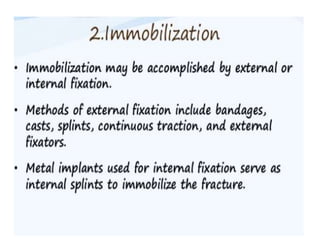
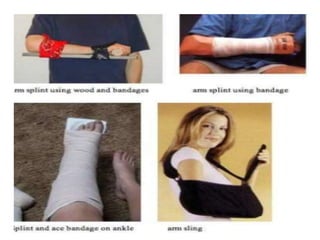
A. IMMOBILIZATION
B. CLOSED REDUCTION: f/b immobilization in
cast or splint
C. CLOSED REDUCTION and PERCUTANEOUS
PINNING:
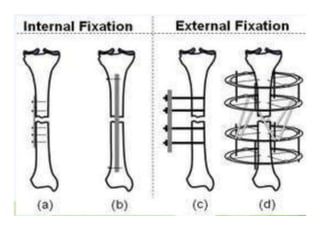
D. CLOSED OR OPEN REDUCTION and
application of external fixators
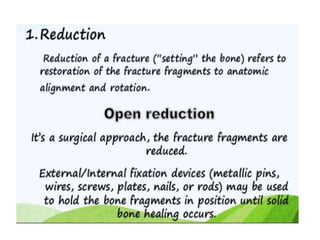
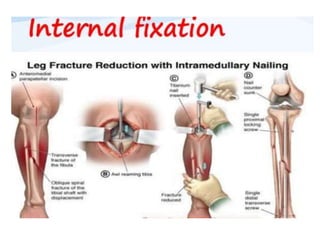
E. OPEN REDUCTION with or w/o internal
fixation f/b immobilization in cast or splint
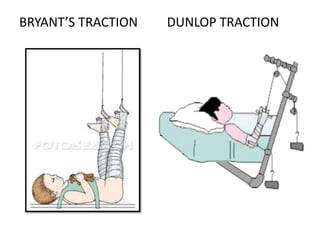
F. TRACTION
• RUSSELL’S TRACTION
BRYANT’S TRACTION DUNLOP TRACTION
90 degree-90 degree
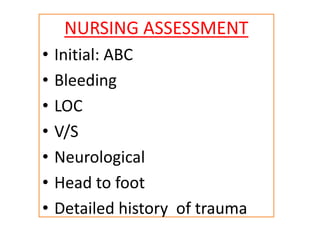
NURSING ASSESSMENT
• Initial: ABC
• Bleeding
• LOC
• V/S
• Neurological
• Head to foot
• Detailed history of trauma
When assessing for neurovascular integrity,
remember the five Ps:
NURSING INTERVENTION
PAIN
• ANTIBIOTIC THERAPY
• FREQUENT POSITION CHANGE
MOBILITY
• Exercise of uninvolved limbs
• Progressive ambulation
• Ambulatory aid
• WOUND CARE
Fracture

Fracture

  • 1.
  • 2.
    Fracture is abreak or disruption in the continuity of bone. • A bone gets fracture when the force applied to it exceeds the amount, the bone can absorb. • In children: due to fall or direct trauma. • Pathological cause or due to severe muscular contraction. • Child abuse may result bony injury in children
  • 3.
    In children, bones arehaving thick periosteum. Long bones are more resilient than those of adults, so they are able to withstand greater deflection without fracturing.
  • 4.
    • Damage ofgrowth plate may result in cessation of or disturbance in bone growth • There is often acceleration in bone growth after fracture in the long bones in children. • Fracture bone heals more rapidly in young children and remodel more completely and actively with less disability and deformity
  • 5.
    Common Sites ofFracture 1. Forearm fractures 50%: 3/4th of forearm fractures involve distal third of radius and ulna. 2. Epiphyseal fractures involve the physis (growth plate) and accounts for about 15 to 30 percent of all fracture cases in children. The mechanism of injury is usually fall on an outstretched hand involving physeal injury of the distal radius and ulna.
  • 6.
    3. Fracture humerus: Itoccurs due to fall onto an out stretched arm or hand involving proximal part of the shaft of the humerus. Direct trauma. Supracondylar fracture: 60% Lateral condylar 2nd most common in distal humeral injuries. Medial epicondylar 3rd most common
  • 7.
    4. Femur fractures: Itis common in children involving mid shaft of the femur. motor vehicle accidents. 5. Tibial fracture and ankle fracture: Most common lower extremity fracture in children occurs in the tibial and fibular shaft due to motor vehicle accidents and sports injury. Ankle fracture in adolescents: direct trauma.
  • 10.
    Common types offractures A. Open/Compound fracture: The wound through the adjacent or overlaying soft tissues communicates with the site of the break. B. Closed: Does not produce on open wounds.
  • 11.
    3. Plastic deformation(bending): A bending of the bone occurs in such a manner as to cause a microscope fracture line that does not cross the bone. It is unique to children and commonly found in the ulna.
  • 12.
    4. Buckle (torus)fracture: A fracture occurring on the tension side of the bone near the softer metaphyseal bone. crosses the bone and buckles the harder diaphyseal bone on the opposite site causing a bulge. The bone cortex not broken but is buckled.
  • 13.
    5. Greenstick fracture: Afracture in which the bone partially bent and partially broken, as a green stick breaks. The bone is bent and the fracture begins but does not entirely cross through the bone. Other types of fractures which may found in children are pathological fracture due to weakening of the bone structure by pathological processes such as neoplasm, osteomyelitis, etc
  • 18.
    A. IMMOBILIZATION B. CLOSEDREDUCTION: f/b immobilization in cast or splint C. CLOSED REDUCTION and PERCUTANEOUS PINNING: D. CLOSED OR OPEN REDUCTION and application of external fixators E. OPEN REDUCTION with or w/o internal fixation f/b immobilization in cast or splint F. TRACTION
  • 26.
  • 29.
  • 30.
  • 42.
    NURSING ASSESSMENT • Initial:ABC • Bleeding • LOC • V/S • Neurological • Head to foot • Detailed history of trauma
  • 43.
    When assessing forneurovascular integrity, remember the five Ps:
  • 45.
  • 46.
  • 49.
  • 50.
    MOBILITY • Exercise ofuninvolved limbs • Progressive ambulation • Ambulatory aid
  • 51.