SAJJAD KHUDHUR ABBAS
Chemical Engineering , Al-Muthanna University, Iraq
Oil & Gas Safety and Health Professional – OSHACADEMY
Trainer of Trainers (TOT) - Canadian Center of Human
Development
Episode 14 : Research
Methodology ( Part 4 )
Reference
• Research Methodology: A Step-by-Step Guide for Beginners
by Ranjith Kumar
• The Research Methods Knowledge Base by William Trochim
UNIT 1:
• [1] Overview of Research Methodologies
• 1.1: Need for research
• 1.2: Concepts of research and its methodologies
• 1.3: Classifications of research
• 1.4: Sequences in conducting research
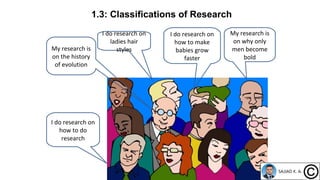
1.3: Classifications of Research
I do research on
how to make
babies grow
faster
I do research on
ladies hair
stylesMy research is
on the history
of evolution
My research is
on why only
men become
bold
I do research on
how to do
research
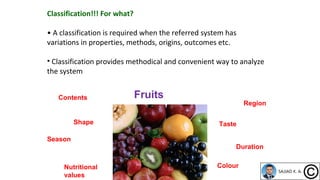
Classification!!! For what?
• A classification is required when the referred system has
variations in properties, methods, origins, outcomes etc.
• Classification provides methodical and convenient way to analyze
the system
Fruits
Shape Taste
Colour
Region
Nutritional
values
Contents
Season
Duration
• It is beneficial if we can classify a research under
a specific category as each category or type of
research uses a specific set of procedures.
RESEARCH CAN BE CLASSIFIEDRESEARCH CAN BE CLASSIFIED
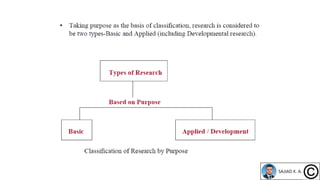
• Under Purpose of the Research
• Under Method of the Research
Purpose: To what degree the research findings are
applicable in a scientific setting and to what degree
the findings can be generalized
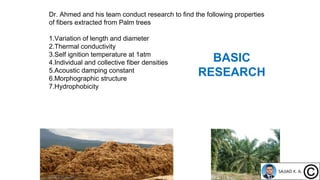
Dr. Ahmed and his team conduct research to find the following properties
of fibers extracted from Palm trees
1.Variation of length and diameter
2.Thermal conductivity
3.Self ignition temperature at 1atm
4.Individual and collective fiber densities
5.Acoustic damping constant
6.Morphographic structure
7.Hydrophobicity
BASIC
RESEARCH
There is no well-defined distinction between basic and
applied research.
• The most basic distinction is that basic research is research that
has no immediate application, whereas applied research is
research that does.
•However basic research eventually results in some worthwhile
applications in the long run. Sometimes, even in the short run
As per some researchers; Basic research is the backbone
of New Technologies
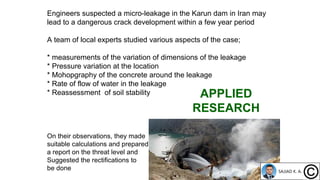
Engineers suspected a micro-leakage in the Karun dam in Iran may
lead to a dangerous crack development within a few year period
A team of local experts studied various aspects of the case;
* measurements of the variation of dimensions of the leakage
* Pressure variation at the location
* Mohopgraphy of the concrete around the leakage
* Rate of flow of water in the leakage
* Reassessment of soil stability
On their observations, they made
suitable calculations and prepared
a report on the threat level and
Suggested the rectifications to
be done
APPLIED
RESEARCH
• The other basis for classifying research, is by the
method it employs.
• Research method is characterized by the techniques
employed in collecting and analyzing data.
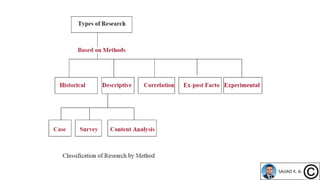
• On the basis of method, research can be classified as
historical, descriptive, correlational, ex-post facto and
experimental.
CLASSIFYING RESEARCH BY METHODS
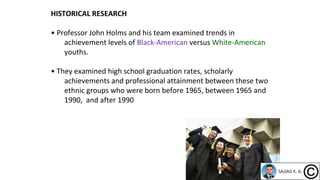
HISTORICAL RESEARCH
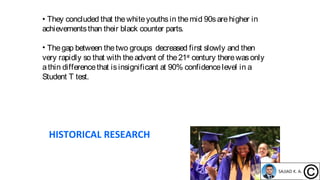
• Professor John Holms and his team examined trends in
achievement levels of Black-American versus White-American
youths.
• They examined high school graduation rates, scholarly
achievements and professional attainment between these two
ethnic groups who were born before 1965, between 1965 and
1990, and after 1990
• They concluded that thewhiteyouthsin themid 90sarehigher in
achievementsthan their black counter parts.
• Thegap between thetwo groups decreased first slowly and then
very rapidly so that with theadvent of the21st
century therewasonly
athin differencethat isinsignificant at 90% confidencelevel in a
Student T test.
HISTORICAL RESEARCH
HISTORICAL RESEARCH
• The purpose of historical research is to arrive at
conclusions concerning trends, causes or effects of
past occurrences.
• This may help in explaining present events and
anticipating future events.
• The data are not gathered by administering
instruments to individuals ,but …
HISTORICAL RESEARCH Cont.
• Rather, they are collected from original documents
or by interviewing the eye-witnesses (primary source of
information).
• In case primary sources are not available, data are
collected from those other than eye-witnesses
(secondary sources).
• The data thus collected are subjected to scientific
analysis to assess its authenticity and accuracy.
HISTORICAL RESEARCH are very significant in
Engineering business in anticipating future trends
DESCRIPTIVE RESEARCH
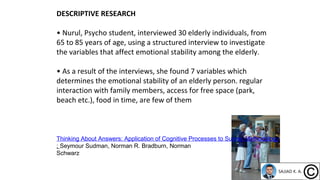
• Nurul, Psycho student, interviewed 30 elderly individuals, from
65 to 85 years of age, using a structured interview to investigate
the variables that affect emotional stability among the elderly.
• As a result of the interviews, she found 7 variables which
determines the emotional stability of an elderly person. regular
interaction with family members, access for free space (park,
beach etc.), food in time, are few of them
Thinking About Answers: Application of Cognitive Processes to Survey Methodology
; Seymour Sudman, Norman R. Bradburn, Norman
Schwarz
2. DESCRIPTIVE RESEARCH
• Descriptive research deals with collecting data and testing
hypotheses or answering questions concerning the current status
of the subject of study.
• It deals with the question “WHAT IS” of a situation.
• It concerns with determining the current practices, status or
features of situations.
• Another aspect of descriptive research is that data collection is
either done through asking questions from individuals in the
situation (through questionnaires or interviews) or by observation.
** Descriptive research helps a lot in understanding the needs of
society based on which applied engineering research can be planed
Descriptive and historical research provide a picture of
events that are currently happening or have occurred in
the past.
• Researchers often want to go beyond mere description
and begin discussing the relationship that certain events
might have to one another.
• The most likely type of research to answer the
relationship among variables or events is called
correlational research.
CORRELATIONAL RESEARCH
CORRELATIONAL STUDIES
• A correlation study aims at determining the degree of
relationship between two or more quantifiable variables.
• Secondly, the relationship thus determined could be
used for making predictions.
CORRELATIONAL STUDIES
• Correlational research are studies that are often conducted
to test the reliability and predictive validity of instruments
used for division making concerning selection of individuals for the
likely success in a course of study or a specific job.
• Some authors consider this research as a type of descriptive
research, since it describes the current conditions in a situation.
• However, the difference lies in the nature of conditions studied.
• A correlational study describes in quantitative terms the
degree to which the variables are related.
An Example of Correlational research
• In a study (by Vaughn et.al., 1989) of the relationship
between temperament and attachment behavior in infants, the
correlation among different types of attachment behaviors, how
securely attached the infants were to their mothers, and the
infant’s general temperament were examined.
• The researchers found that an infant’s temperament does
not predict how securely attached the child is to his or
her mother.
4. EX-POST FACTO STUDIES
• There is some research where both the effect and the alleged cause
have already occurred and are studied by the researcher in
retrospect.
• Such research is referred to as EX-POST FACTO (after the fact).
• Kerlinger (1973) defines Ex-post Facto research as : “Systematic
empirical inquiry in which the scientist does not have direct control of
independent variables because their manifestations have already
occurred or because they are inherently not manipulatable”.
• Thus, in ex-post facto research or causal-comparative research the
researcher has no control on the variables or he cannot manipulate
the variables (independent variables) which cause a certain effect
(dependent variables) being measured.
• Since this type of a study lacks manipulation of variables, the
cause-effect relationship measured are only tentative.
• Some authors categorize Ex-post facto studies into the category
of descriptive research.
• Though it too describes conditions that exist in a situation, it
attempts to determine reasons or causes for the current status of
the phenomena under study.
• The procedures involved in this study are quite different than
those in descriptive research.
EX-POST FACTO STUDIES
EXPERIMENTAL RESEARCH
• We already know that correlational research can help establish
the presence of a relationship among variables but not give us
any reason to believe that variables are causally related to one
another.
• How does one find out if the characteristics or behaviors or
events are related in such a way that the relationship is a causal
one?
• Two types of research can answer this: (1) quasi-experimental
research and (2) experimental research.
EXPERIMENTAL RESEARCH
• Experimental research is where participants are assigned to
groups based on some selected criterion often called
treatment variable.
• Quasi-experimental research is where participants are
Pre-assigned to groups based on some characteristic or
quality such as differences in sex, race, age, neighborhood, etc.
• These group assignments have already taken place before
the experiment begins, and the researcher has no control as
to what the people will belong to each group.
EXPERIMENTAL RESEARCH
• The primary characteristic of experimental research is
manipulation of at least one variables and control over
the other relevant variables so as to measure its effect
on one or more dependent variables.
• The variables (s) which is manipulated is also called an
independent variables, a treatment, an experimental
variables or the cause.
• Some of the examples of an independent variables
could be: temperature, pressure, chemical
concentration, type of material and conductivity.
An Example of Experimental Research
• Experimental research will always have two or more groups for
comparison on the dependent variables.
• It is the only type of research which can establish truly the
cause and effect relations.
• Consider an Example
– A researcher in technician education is interested in studying the
effects of two methods of instruction structured lecture method
and programmed instruction on the achievement of students in a
course of one semester in Applied Mechanics.
– Sixty students in the class are divided randomly into
two groups of thirty each.
– The groups receive the specified treatment for an equal
amount of time during the semester.
– The participants are measured for their performance on
the achievement test before and after the programme so
as to measure the gain.
– In this experiment, the experimental or independent
variables is the method of instruction and the dependent
variable, is the achievement of students.
– The difference in the gain on achievement between the
two groups will show the effect of the methods of
instruction.
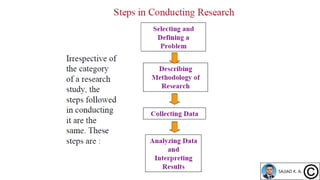
Steps in Conducting Research
1.Selecting and Defining a Problem
This marks the beginning of a research study and is the most difficult and
important step. This involves :
(1). identifying and stating the problem in specific terms;
(2). identifying the variables in the problem situation and defining them
adequately;
(3). generating tentative guesses (hypotheses) about the relation of the
variables or in other words the solution of the problem, or writing explicitly the
questions (research questions) for which answers are sought; and
(4). evaluating the problem for its research ability.
• To achieve this, we review the literature related to
the problem to know what other researchers have
done and discovered and to identify the possible
methodology for conducting the research.
Selecting and Defining a Problem
3. Collecting Data
• This step involves conducting the study as per the designed
procedure (manipulating the experimental variables in the case of an
experimental method), administering instruments for measuring
variables and/or gathering information through observation.
• It also involves tabulating the data thus collected for the
purpose of analysis.
Steps In Conducting Research
4. Analysing and Interpreting Results
• The results of the study are generated at this stage.
• The data are summarized, in other words analysed to provide
information for testing the hypotheses.
• Appropriate statistical methods of analysis are used to test the
hypotheses.
• You can perform the analysis manually, by using a hand calculator or
a computer as per the demands of the problem, and the available
facilities.
• After completing the analysis results are tied together or
summarized.
Steps In Conducting Research
2. Describing Methodology of Research You need to state the
purpose of the study and to define the problem clearly. This guides
you in deciding the methodology of research which involves :
a.identifying the method of research;
b. specifying the subjects of study (e.g. heat flow problem, etc.);
c. selecting an adequate representative sample of subjects;
d. selecting/constructing valid and reliable instruments for
measuring the variables in the problem;
e. selecting a research design and describing the procedure to be
employed for conducting the research study.
• The results are interpreted in the light of the hypotheses
and/or the research problem.
• These are then discussed in relation to : the existing body of
knowledge, consistencies and inconsistencies with the results of
other research studies, and then the conclusions are drawn.
• This is followed by writing the research report.
Summary of Unit-1
In this module, we have studied the following:
* Overview and Concepts of research
* The need for research
* Types of research
* Steps in conducting research
Thanks for Watching
Please follow me / SAJJAD KHUDHUR
ABBAS

Episode 14 : Research Methodology ( Part 4 )

  • 1.
    SAJJAD KHUDHUR ABBAS ChemicalEngineering , Al-Muthanna University, Iraq Oil & Gas Safety and Health Professional – OSHACADEMY Trainer of Trainers (TOT) - Canadian Center of Human Development Episode 14 : Research Methodology ( Part 4 )
  • 2.
    Reference • Research Methodology:A Step-by-Step Guide for Beginners by Ranjith Kumar • The Research Methods Knowledge Base by William Trochim
  • 3.
    UNIT 1: • [1]Overview of Research Methodologies • 1.1: Need for research • 1.2: Concepts of research and its methodologies • 1.3: Classifications of research • 1.4: Sequences in conducting research
  • 4.
    1.3: Classifications ofResearch I do research on how to make babies grow faster I do research on ladies hair stylesMy research is on the history of evolution My research is on why only men become bold I do research on how to do research
  • 5.
    Classification!!! For what? •A classification is required when the referred system has variations in properties, methods, origins, outcomes etc. • Classification provides methodical and convenient way to analyze the system Fruits Shape Taste Colour Region Nutritional values Contents Season Duration
  • 6.
    • It isbeneficial if we can classify a research under a specific category as each category or type of research uses a specific set of procedures.
  • 7.
    RESEARCH CAN BECLASSIFIEDRESEARCH CAN BE CLASSIFIED • Under Purpose of the Research • Under Method of the Research
  • 8.
    Purpose: To whatdegree the research findings are applicable in a scientific setting and to what degree the findings can be generalized
  • 10.
    Dr. Ahmed andhis team conduct research to find the following properties of fibers extracted from Palm trees 1.Variation of length and diameter 2.Thermal conductivity 3.Self ignition temperature at 1atm 4.Individual and collective fiber densities 5.Acoustic damping constant 6.Morphographic structure 7.Hydrophobicity BASIC RESEARCH
  • 11.
    There is nowell-defined distinction between basic and applied research. • The most basic distinction is that basic research is research that has no immediate application, whereas applied research is research that does. •However basic research eventually results in some worthwhile applications in the long run. Sometimes, even in the short run As per some researchers; Basic research is the backbone of New Technologies
  • 12.
    Engineers suspected amicro-leakage in the Karun dam in Iran may lead to a dangerous crack development within a few year period A team of local experts studied various aspects of the case; * measurements of the variation of dimensions of the leakage * Pressure variation at the location * Mohopgraphy of the concrete around the leakage * Rate of flow of water in the leakage * Reassessment of soil stability On their observations, they made suitable calculations and prepared a report on the threat level and Suggested the rectifications to be done APPLIED RESEARCH
  • 13.
    • The otherbasis for classifying research, is by the method it employs. • Research method is characterized by the techniques employed in collecting and analyzing data. • On the basis of method, research can be classified as historical, descriptive, correlational, ex-post facto and experimental. CLASSIFYING RESEARCH BY METHODS
  • 15.
    HISTORICAL RESEARCH • ProfessorJohn Holms and his team examined trends in achievement levels of Black-American versus White-American youths. • They examined high school graduation rates, scholarly achievements and professional attainment between these two ethnic groups who were born before 1965, between 1965 and 1990, and after 1990
  • 16.
    • They concludedthat thewhiteyouthsin themid 90sarehigher in achievementsthan their black counter parts. • Thegap between thetwo groups decreased first slowly and then very rapidly so that with theadvent of the21st century therewasonly athin differencethat isinsignificant at 90% confidencelevel in a Student T test. HISTORICAL RESEARCH
  • 17.
    HISTORICAL RESEARCH • Thepurpose of historical research is to arrive at conclusions concerning trends, causes or effects of past occurrences. • This may help in explaining present events and anticipating future events. • The data are not gathered by administering instruments to individuals ,but …
  • 18.
    HISTORICAL RESEARCH Cont. •Rather, they are collected from original documents or by interviewing the eye-witnesses (primary source of information). • In case primary sources are not available, data are collected from those other than eye-witnesses (secondary sources). • The data thus collected are subjected to scientific analysis to assess its authenticity and accuracy.
  • 19.
    HISTORICAL RESEARCH arevery significant in Engineering business in anticipating future trends
  • 20.
    DESCRIPTIVE RESEARCH • Nurul,Psycho student, interviewed 30 elderly individuals, from 65 to 85 years of age, using a structured interview to investigate the variables that affect emotional stability among the elderly. • As a result of the interviews, she found 7 variables which determines the emotional stability of an elderly person. regular interaction with family members, access for free space (park, beach etc.), food in time, are few of them Thinking About Answers: Application of Cognitive Processes to Survey Methodology ; Seymour Sudman, Norman R. Bradburn, Norman Schwarz
  • 21.
    2. DESCRIPTIVE RESEARCH •Descriptive research deals with collecting data and testing hypotheses or answering questions concerning the current status of the subject of study. • It deals with the question “WHAT IS” of a situation. • It concerns with determining the current practices, status or features of situations. • Another aspect of descriptive research is that data collection is either done through asking questions from individuals in the situation (through questionnaires or interviews) or by observation. ** Descriptive research helps a lot in understanding the needs of society based on which applied engineering research can be planed
  • 22.
    Descriptive and historicalresearch provide a picture of events that are currently happening or have occurred in the past. • Researchers often want to go beyond mere description and begin discussing the relationship that certain events might have to one another. • The most likely type of research to answer the relationship among variables or events is called correlational research. CORRELATIONAL RESEARCH
  • 23.
    CORRELATIONAL STUDIES • Acorrelation study aims at determining the degree of relationship between two or more quantifiable variables. • Secondly, the relationship thus determined could be used for making predictions.
  • 24.
    CORRELATIONAL STUDIES • Correlationalresearch are studies that are often conducted to test the reliability and predictive validity of instruments used for division making concerning selection of individuals for the likely success in a course of study or a specific job. • Some authors consider this research as a type of descriptive research, since it describes the current conditions in a situation. • However, the difference lies in the nature of conditions studied. • A correlational study describes in quantitative terms the degree to which the variables are related.
  • 25.
    An Example ofCorrelational research • In a study (by Vaughn et.al., 1989) of the relationship between temperament and attachment behavior in infants, the correlation among different types of attachment behaviors, how securely attached the infants were to their mothers, and the infant’s general temperament were examined. • The researchers found that an infant’s temperament does not predict how securely attached the child is to his or her mother.
  • 26.
    4. EX-POST FACTOSTUDIES • There is some research where both the effect and the alleged cause have already occurred and are studied by the researcher in retrospect. • Such research is referred to as EX-POST FACTO (after the fact). • Kerlinger (1973) defines Ex-post Facto research as : “Systematic empirical inquiry in which the scientist does not have direct control of independent variables because their manifestations have already occurred or because they are inherently not manipulatable”. • Thus, in ex-post facto research or causal-comparative research the researcher has no control on the variables or he cannot manipulate the variables (independent variables) which cause a certain effect (dependent variables) being measured.
  • 27.
    • Since thistype of a study lacks manipulation of variables, the cause-effect relationship measured are only tentative. • Some authors categorize Ex-post facto studies into the category of descriptive research. • Though it too describes conditions that exist in a situation, it attempts to determine reasons or causes for the current status of the phenomena under study. • The procedures involved in this study are quite different than those in descriptive research. EX-POST FACTO STUDIES
  • 28.
    EXPERIMENTAL RESEARCH • Wealready know that correlational research can help establish the presence of a relationship among variables but not give us any reason to believe that variables are causally related to one another. • How does one find out if the characteristics or behaviors or events are related in such a way that the relationship is a causal one? • Two types of research can answer this: (1) quasi-experimental research and (2) experimental research.
  • 29.
    EXPERIMENTAL RESEARCH • Experimentalresearch is where participants are assigned to groups based on some selected criterion often called treatment variable. • Quasi-experimental research is where participants are Pre-assigned to groups based on some characteristic or quality such as differences in sex, race, age, neighborhood, etc. • These group assignments have already taken place before the experiment begins, and the researcher has no control as to what the people will belong to each group.
  • 30.
    EXPERIMENTAL RESEARCH • Theprimary characteristic of experimental research is manipulation of at least one variables and control over the other relevant variables so as to measure its effect on one or more dependent variables. • The variables (s) which is manipulated is also called an independent variables, a treatment, an experimental variables or the cause. • Some of the examples of an independent variables could be: temperature, pressure, chemical concentration, type of material and conductivity.
  • 31.
    An Example ofExperimental Research • Experimental research will always have two or more groups for comparison on the dependent variables. • It is the only type of research which can establish truly the cause and effect relations. • Consider an Example – A researcher in technician education is interested in studying the effects of two methods of instruction structured lecture method and programmed instruction on the achievement of students in a course of one semester in Applied Mechanics. – Sixty students in the class are divided randomly into two groups of thirty each.
  • 32.
    – The groupsreceive the specified treatment for an equal amount of time during the semester. – The participants are measured for their performance on the achievement test before and after the programme so as to measure the gain. – In this experiment, the experimental or independent variables is the method of instruction and the dependent variable, is the achievement of students. – The difference in the gain on achievement between the two groups will show the effect of the methods of instruction.
  • 34.
    Steps in ConductingResearch 1.Selecting and Defining a Problem This marks the beginning of a research study and is the most difficult and important step. This involves : (1). identifying and stating the problem in specific terms; (2). identifying the variables in the problem situation and defining them adequately; (3). generating tentative guesses (hypotheses) about the relation of the variables or in other words the solution of the problem, or writing explicitly the questions (research questions) for which answers are sought; and (4). evaluating the problem for its research ability.
  • 35.
    • To achievethis, we review the literature related to the problem to know what other researchers have done and discovered and to identify the possible methodology for conducting the research. Selecting and Defining a Problem
  • 36.
    3. Collecting Data •This step involves conducting the study as per the designed procedure (manipulating the experimental variables in the case of an experimental method), administering instruments for measuring variables and/or gathering information through observation. • It also involves tabulating the data thus collected for the purpose of analysis. Steps In Conducting Research
  • 37.
    4. Analysing andInterpreting Results • The results of the study are generated at this stage. • The data are summarized, in other words analysed to provide information for testing the hypotheses. • Appropriate statistical methods of analysis are used to test the hypotheses. • You can perform the analysis manually, by using a hand calculator or a computer as per the demands of the problem, and the available facilities. • After completing the analysis results are tied together or summarized. Steps In Conducting Research
  • 38.
    Steps In ConductingResearch 2. Describing Methodology of Research You need to state the purpose of the study and to define the problem clearly. This guides you in deciding the methodology of research which involves : a.identifying the method of research; b. specifying the subjects of study (e.g. heat flow problem, etc.); c. selecting an adequate representative sample of subjects; d. selecting/constructing valid and reliable instruments for measuring the variables in the problem; e. selecting a research design and describing the procedure to be employed for conducting the research study.
  • 39.
    • The resultsare interpreted in the light of the hypotheses and/or the research problem. • These are then discussed in relation to : the existing body of knowledge, consistencies and inconsistencies with the results of other research studies, and then the conclusions are drawn. • This is followed by writing the research report.
  • 40.
    Summary of Unit-1 Inthis module, we have studied the following: * Overview and Concepts of research * The need for research * Types of research * Steps in conducting research
  • 41.
    Thanks for Watching Pleasefollow me / SAJJAD KHUDHUR ABBAS