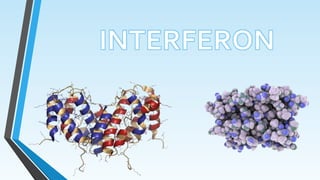
What is INTERFERON?
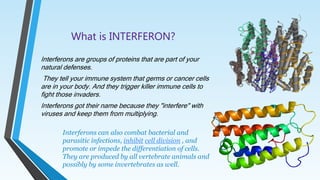
Interferons are groups of proteins that are part of your
natural defenses.
They tell your immune system that germs or cancer cells
are in your body. And they trigger killer immune cells to
fight those invaders.
Interferons got their name because they "interfere" with
viruses and keep them from multiplying.
Interferons can also combat bacterial and
parasitic infections, inhibit cell division , and
promote or impede the differentiation of cells.
They are produced by all vertebrate animals and
possibly by some invertebrates as well.
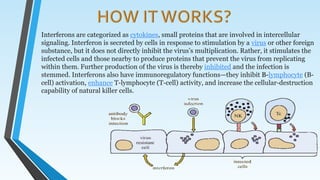
Interferons are categorized as cytokines, small proteins that are involved in intercellular
signaling. Interferon is secreted by cells in response to stimulation by a virus or other foreign
substance, but it does not directly inhibit the virus’s multiplication. Rather, it stimulates the
infected cells and those nearby to produce proteins that prevent the virus from replicating
within them. Further production of the virus is thereby inhibited and the infection is
stemmed. Interferons also have immunoregulatory functions—they inhibit B-lymphocyte (B-
cell) activation, enhance T-lymphocyte (T-cell) activity, and increase the cellular-destruction
capability of natural killer cells.
Interferons were discovered in 1957 by British bacteriologist Alick
Isaacs and Swiss microbiologist Jean Lindenmann. Research
conducted in the 1970s revealed that these substances could not only
prevent viral infection but also suppress the growth of cancers in some
laboratory animals. Hopes were raised that interferon might prove to
be a wonder drug able to cure a wide variety of diseases, but its serious
side effects, which include flulike symptoms of fever and fatigue as well
as a decrease in the production of blood cells by the bone marrow,
deflated expectations for its use against less serious diseases.
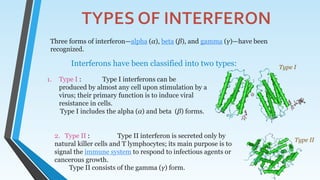
Interferons have been classified into two types:
1. Type I : Type I interferons can be
produced by almost any cell upon stimulation by a
virus; their primary function is to induce viral
resistance in cells.
Type I includes the alpha (α) and beta (β) forms.
2. Type II : Type II interferon is secreted only by
natural killer cells and T lymphocytes; its main purpose is to
signal the immune system to respond to infectious agents or
cancerous growth.
Type II consists of the gamma (γ) form.
Three forms of interferon—alpha (α), beta (β), and gamma (γ)—have been
recognized.
Type I
Type II
Cells that have been infected with viruses or other germs give off
interferon-alpha and interferon-beta as a warning signal to your
immune system. That triggers immune cells called white blood
cells to release interferon-gamma to fight the germs.
Interferons work in a few different ways. They:
•Alert your immune system so it can go after the virus or cancer
•Help your immune system recognize the virus or cancer
•Tell immune cells to attack
•Stop virus and cancer cells from growing and dividing
•Help healthy cells fight infection
The Overview of Interferon
Both Type I and Type II interferons are short glyco-proteins
Both possess indirect antiviral properties.
The production of both types of interferons is triggered by viral infections
Both types operate through receptors present on the plasma membrane.
Both can trigger the production of antiviral proteins.
Similarities between Type I and Type II Interferons
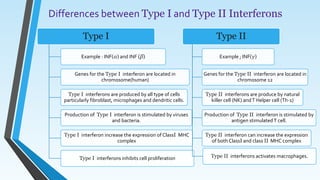
Type I
Example : INF(α) and INF (β)
Genes for the Type I interferon are located in
chromosome(human)
Type I interferons are produced by all type of cells
particularly fibroblast, microphages and dendritic cells.
Production of Type I interferon is stimulated by viruses
and bacteria.
Type I interferon increase the expression of ClassI MHC
complex
Type I interferons inhibits cell proliferation
Type II
Example ; INF(γ)
Genes for the Type II interferon are located in
chromosome 12
Type II interferons are produce by natural
killer cell (NK) andT Helper cell (Th-1)
Production of Type II interferon is stimulated by
antigen stimulatedT cell.
Type II interferon can increase the expression
of both ClassI and class II MHC complex
Type II interferons activates macrophages.
Differences between Type I and Type II Interferons
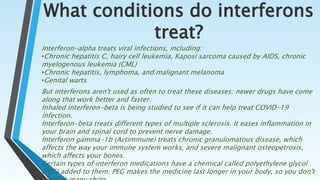
What conditions do interferons
treat?
Interferon-alpha treats viral infections, including:
•Chronic hepatitis C, hairy cell leukemia, Kaposi sarcoma caused by AIDS, chronic
myelogenous leukemia (CML)
•Chronic hepatitis, lymphoma, and malignant melanoma
•Genital warts
But interferons aren't used as often to treat these diseases; newer drugs have come
along that work better and faster.
Inhaled interferon-beta is being studied to see if it can help treat COVID-19
infection.
Interferon-beta treats different types of multiple sclerosis. It eases inflammation in
your brain and spinal cord to prevent nerve damage.
Interferon gamma-1b (Actimmune) treats chronic granulomatous disease, which
affects the way your immune system works, and severe malignant osteopetrosis,
which affects your bones.
Certain types of interferon medications have a chemical called polyethylene glycol
(PEG) added to them. PEG makes the medicine last longer in your body, so you don't
How do you take interferons?
You get interferon as a shot under your skin or
into a muscle. A doctor can give you the shot or
teach you how to give it to yourself at home.
Interferon is also sometimes given through a
vein in your arm (infusion).
The number of shots or infusions you need
depends on the condition you have. Shots are
often given three times a week, but to treat
cancer, you may get an infusion 5 days a week
for several weeks or months.
What are the
benefits?
Interferons are man-made versions of proteins your
body makes. These drugs work with your immune
system to help it find and attack viruses and cancer.
They can stop virus and cancer cells from growing
and spreading , and prevent other cells from getting
infected.
If you have MS, they can make you less likely to have
a flare-up and slow damage to your brain and spinal
cord.
What are the risks?
Interferons can cause some health issues,
including:
Heart problems:
A small number of people who are treated with interferons can have a fast or irregular
heartbeat or low blood pressure.
Mental health conditions:
Some people have said they feel depressed or think about suicide while taking
interferon. If you have depression or another mental health disorder, your doctor
might need to watch you more closely while you take one of these drugs.
Eye disease:
Interferons could make some eye diseases worse. Everyone should have a vision check before starting on
these drugs. People with diseases like diabetic retinopathy will need to have regular eye exams while
they're being treated with interferons.
Thyroid disease:
In rare cases, interferons can make the thyroid gland overactive (hyperthyroidism) or
(hypothyroidism). If you have thyroid disease that's not well controlled with medicine,
be able to take interferon. Before you start treatment, your doctor will check your
levels.
Lung disease:
Interferons can sometimes make lung problems like shortness of breath, pneumonia,
and bronchitis worse. People with lung disease should be watched closely by a doctor
while taking these drugs. If you have symptoms like a cough or shortness of breath,
you might need to stop taking this medicine.
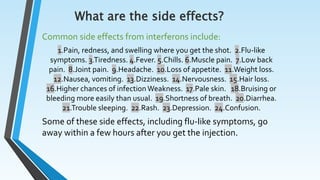
What are the side effects?
Common side effects from interferons include:
1.Pain, redness, and swelling where you get the shot. 2.Flu-like
symptoms. 3.Tiredness. 4.Fever. 5.Chills. 6.Muscle pain. 7.Low back
pain. 8.Joint pain. 9.Headache. 10.Loss of appetite. 11.Weight loss.
12.Nausea, vomiting. 13.Dizziness. 14.Nervousness. 15.Hair loss.
16.Higher chances of infection Weakness. 17.Pale skin. 18.Bruising or
bleeding more easily than usual. 19.Shortness of breath. 20.Diarrhea.
21.Trouble sleeping. 22.Rash. 23.Depression. 24.Confusion.
Some of these side effects, including flu-like symptoms, go
away within a few hours after you get the injection.
These side effects are less common:
•Chest pain
•Rash
•Liver problems
•Change in taste
•Belly pain
•Trouble getting pregnant
•Loss of sex drive
•Lack of periods
•Thirst
•Dry mouth
•Constipation
•Swollen glands
•Flushed skin
•Sweating
These side effects are rare:
•Shaking
•A feeling like pins and needles
Who shouldn't take them?
Interferons may not be safe for certain groups of people.
Pregnant and breastfeeding women:
Interferons can harm an unborn baby. It's important that you don't
while taking this drug and for at least 6 months after you finish
doctor may recommend that you have a pregnancy test before you
interferons and use protection -- like condoms -- for as long as you
Interferon can get into your breast milk, so don’t breastfeed while
Men who are trying to get their partner pregnant:
These drugs can cause birth defects if the father is taking it when
gets pregnant. You shouldn't father a child for at least 6 months
treatment.
interferon

interferon

  • 3.
    What is INTERFERON? Interferonsare groups of proteins that are part of your natural defenses. They tell your immune system that germs or cancer cells are in your body. And they trigger killer immune cells to fight those invaders. Interferons got their name because they "interfere" with viruses and keep them from multiplying. Interferons can also combat bacterial and parasitic infections, inhibit cell division , and promote or impede the differentiation of cells. They are produced by all vertebrate animals and possibly by some invertebrates as well.
  • 4.
    Interferons are categorizedas cytokines, small proteins that are involved in intercellular signaling. Interferon is secreted by cells in response to stimulation by a virus or other foreign substance, but it does not directly inhibit the virus’s multiplication. Rather, it stimulates the infected cells and those nearby to produce proteins that prevent the virus from replicating within them. Further production of the virus is thereby inhibited and the infection is stemmed. Interferons also have immunoregulatory functions—they inhibit B-lymphocyte (B- cell) activation, enhance T-lymphocyte (T-cell) activity, and increase the cellular-destruction capability of natural killer cells.
  • 5.
    Interferons were discoveredin 1957 by British bacteriologist Alick Isaacs and Swiss microbiologist Jean Lindenmann. Research conducted in the 1970s revealed that these substances could not only prevent viral infection but also suppress the growth of cancers in some laboratory animals. Hopes were raised that interferon might prove to be a wonder drug able to cure a wide variety of diseases, but its serious side effects, which include flulike symptoms of fever and fatigue as well as a decrease in the production of blood cells by the bone marrow, deflated expectations for its use against less serious diseases.
  • 6.
    Interferons have beenclassified into two types: 1. Type I : Type I interferons can be produced by almost any cell upon stimulation by a virus; their primary function is to induce viral resistance in cells. Type I includes the alpha (α) and beta (β) forms. 2. Type II : Type II interferon is secreted only by natural killer cells and T lymphocytes; its main purpose is to signal the immune system to respond to infectious agents or cancerous growth. Type II consists of the gamma (γ) form. Three forms of interferon—alpha (α), beta (β), and gamma (γ)—have been recognized. Type I Type II
  • 7.
    Cells that havebeen infected with viruses or other germs give off interferon-alpha and interferon-beta as a warning signal to your immune system. That triggers immune cells called white blood cells to release interferon-gamma to fight the germs. Interferons work in a few different ways. They: •Alert your immune system so it can go after the virus or cancer •Help your immune system recognize the virus or cancer •Tell immune cells to attack •Stop virus and cancer cells from growing and dividing •Help healthy cells fight infection
  • 8.
    The Overview ofInterferon
  • 9.
    Both Type Iand Type II interferons are short glyco-proteins Both possess indirect antiviral properties. The production of both types of interferons is triggered by viral infections Both types operate through receptors present on the plasma membrane. Both can trigger the production of antiviral proteins. Similarities between Type I and Type II Interferons
  • 10.
    Type I Example :INF(α) and INF (β) Genes for the Type I interferon are located in chromosome(human) Type I interferons are produced by all type of cells particularly fibroblast, microphages and dendritic cells. Production of Type I interferon is stimulated by viruses and bacteria. Type I interferon increase the expression of ClassI MHC complex Type I interferons inhibits cell proliferation Type II Example ; INF(γ) Genes for the Type II interferon are located in chromosome 12 Type II interferons are produce by natural killer cell (NK) andT Helper cell (Th-1) Production of Type II interferon is stimulated by antigen stimulatedT cell. Type II interferon can increase the expression of both ClassI and class II MHC complex Type II interferons activates macrophages. Differences between Type I and Type II Interferons
  • 12.
    What conditions dointerferons treat? Interferon-alpha treats viral infections, including: •Chronic hepatitis C, hairy cell leukemia, Kaposi sarcoma caused by AIDS, chronic myelogenous leukemia (CML) •Chronic hepatitis, lymphoma, and malignant melanoma •Genital warts But interferons aren't used as often to treat these diseases; newer drugs have come along that work better and faster. Inhaled interferon-beta is being studied to see if it can help treat COVID-19 infection. Interferon-beta treats different types of multiple sclerosis. It eases inflammation in your brain and spinal cord to prevent nerve damage. Interferon gamma-1b (Actimmune) treats chronic granulomatous disease, which affects the way your immune system works, and severe malignant osteopetrosis, which affects your bones. Certain types of interferon medications have a chemical called polyethylene glycol (PEG) added to them. PEG makes the medicine last longer in your body, so you don't
  • 13.
    How do youtake interferons? You get interferon as a shot under your skin or into a muscle. A doctor can give you the shot or teach you how to give it to yourself at home. Interferon is also sometimes given through a vein in your arm (infusion). The number of shots or infusions you need depends on the condition you have. Shots are often given three times a week, but to treat cancer, you may get an infusion 5 days a week for several weeks or months.
  • 14.
    What are the benefits? Interferonsare man-made versions of proteins your body makes. These drugs work with your immune system to help it find and attack viruses and cancer. They can stop virus and cancer cells from growing and spreading , and prevent other cells from getting infected. If you have MS, they can make you less likely to have a flare-up and slow damage to your brain and spinal cord.
  • 15.
    What are therisks? Interferons can cause some health issues, including: Heart problems: A small number of people who are treated with interferons can have a fast or irregular heartbeat or low blood pressure. Mental health conditions: Some people have said they feel depressed or think about suicide while taking interferon. If you have depression or another mental health disorder, your doctor might need to watch you more closely while you take one of these drugs. Eye disease: Interferons could make some eye diseases worse. Everyone should have a vision check before starting on these drugs. People with diseases like diabetic retinopathy will need to have regular eye exams while they're being treated with interferons.
  • 16.
    Thyroid disease: In rarecases, interferons can make the thyroid gland overactive (hyperthyroidism) or (hypothyroidism). If you have thyroid disease that's not well controlled with medicine, be able to take interferon. Before you start treatment, your doctor will check your levels. Lung disease: Interferons can sometimes make lung problems like shortness of breath, pneumonia, and bronchitis worse. People with lung disease should be watched closely by a doctor while taking these drugs. If you have symptoms like a cough or shortness of breath, you might need to stop taking this medicine.
  • 17.
    What are theside effects? Common side effects from interferons include: 1.Pain, redness, and swelling where you get the shot. 2.Flu-like symptoms. 3.Tiredness. 4.Fever. 5.Chills. 6.Muscle pain. 7.Low back pain. 8.Joint pain. 9.Headache. 10.Loss of appetite. 11.Weight loss. 12.Nausea, vomiting. 13.Dizziness. 14.Nervousness. 15.Hair loss. 16.Higher chances of infection Weakness. 17.Pale skin. 18.Bruising or bleeding more easily than usual. 19.Shortness of breath. 20.Diarrhea. 21.Trouble sleeping. 22.Rash. 23.Depression. 24.Confusion. Some of these side effects, including flu-like symptoms, go away within a few hours after you get the injection.
  • 18.
    These side effectsare less common: •Chest pain •Rash •Liver problems •Change in taste •Belly pain •Trouble getting pregnant •Loss of sex drive •Lack of periods •Thirst •Dry mouth •Constipation •Swollen glands •Flushed skin •Sweating These side effects are rare: •Shaking •A feeling like pins and needles
  • 19.
    Who shouldn't takethem? Interferons may not be safe for certain groups of people. Pregnant and breastfeeding women: Interferons can harm an unborn baby. It's important that you don't while taking this drug and for at least 6 months after you finish doctor may recommend that you have a pregnancy test before you interferons and use protection -- like condoms -- for as long as you Interferon can get into your breast milk, so don’t breastfeed while Men who are trying to get their partner pregnant: These drugs can cause birth defects if the father is taking it when gets pregnant. You shouldn't father a child for at least 6 months treatment.