Unit04:
Protocol Stacks
Overview
• Protocol
• TCP/IP
• IPX/SPX
• Appletalk
• NetBEUI
Protocol
• Standards define how devices communicate with each
other and access media
• Once a standard is implemented in software it becomes
a protocol
• Protocols define how devices and applications
communicate
• The protocols on a network affects the way in which it
functions and its ability to interface with other networks
Protocol Suite
• Transmission Control Protocol/Internet Protocol (TCP/IP)
– the most common of all network protocol suites, is the
‘standard’ in modern networks, used for
communication on the Internet
• Internet Packet eXchange/Sequence Packet eXchange
(IPX/SPX)
– developed by Novell, ensures communication
between Netware operating systems, provides similar
functionality to TCP/IP, can be routed but only to
communicate with other Netware networks
• AppleTalk
– popular networking protocol in American educational
establishments, used for communicating between
devices using the Mac OS
TCP/IP
• Developed for use on the Internet for the American
Department of Defence
• Two Parts:
– TCP – responsible for connection oriented
communication using error checking
– IP – implemented in the addressing system used to
identify devices
• Although designed for the Internet it is used to build
LANs, WANs and MANs
• Most widely used protocol suite, used within Unix,
Windows and Macintosh platforms
Features of TCP/IP
• Interoperability – has become the industry ‘standard’,
Netware have replaced two of its proprietary protocols
(IPX and SPX) with TCP and IP
• Flexibility – the multiple protocols within the suite allow a
variety of implementations, eg the use of either TCP
(reliable but slow) or UDP (fast and efficient, but not as
reliable)
• Multivendor Support – almost all network software
supports it, eg Apple, DEC, IBM, Novell, Microsoft and
Sun
TCP
• Designed to guarantee delivery of data from the sending
device to the receiving device
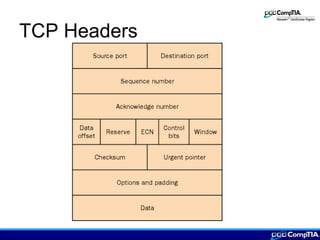
• Requires additional control information in the header
• Each data packet is placed in the correct sequence order
when it is received
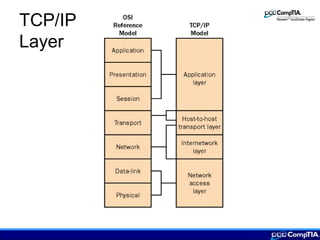
TCP/IP
Layer
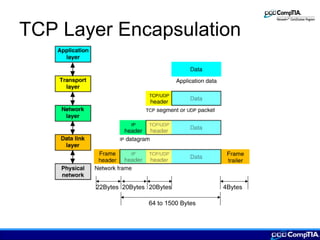
TCP Layer Encapsulation
22Bytes 20Bytes 20Bytes 4Bytes
64 to 1500 Bytes
TCP Headers
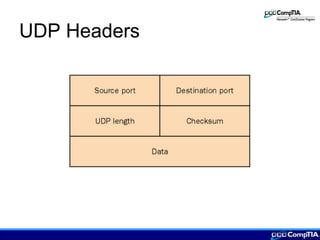
UDP
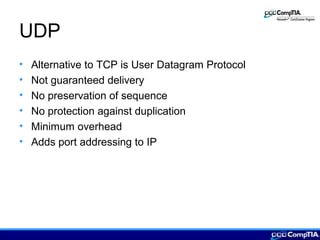
• Alternative to TCP is User Datagram Protocol
• Not guaranteed delivery
• No preservation of sequence
• No protection against duplication
• Minimum overhead
• Adds port addressing to IP
UDP Headers
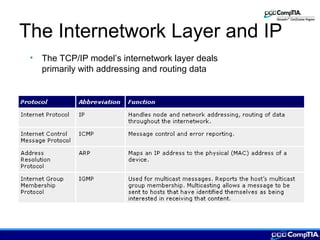
The Internetwork Layer and IP
• The TCP/IP model’s internetwork layer deals
primarily with addressing and routing data
IP
• One of the most important protocols
• Developed to function within a UNIX environment in the
days of ARPAnet
• Uses connectionless delivery – it does not guarantee
delivery
• Main purpose is to provide logical addressing through
the use of an IP address
• Uses IP address to route information between networks,
therefore every device requires a unique address
Understanding IP Addressing
• Address consists of 4 bytes = 32 bits
• Address is quoted as four dotted decimal numbers such
as 134.220.198.170 =
10000110.11011100.11000110.10101010
• IP address consists of two parts the network portion, and
the host portion
• The network portion is used to route packets between
networks
• The host portion identifies the particular device on the
host network
• (continued in next chapter)
IPX/SPX
• Novell first developed its Internetwork Packet
Exchange/Sequenced Packet Exchange (IPX/SPX)
protocol suite for use with its NetWare operating system
in the 1980s
• SPX is similar to TCP in that it functions at the transport
layer and provides a connection-oriented service to
upper-layer applications
IPX(Internetwork Packet Exchange) and Addressing
• IPX/SPX-based networks require that each node on a
network be assigned a unique address to avoid
communication conflicts
• IPX is the component of the protocol that handles
addressing, addresses on an IPX/SPX network are
called IPX addresses
• IPX addresses contain two parts: the network address
and the node address
NetBEUI
• NetBIOS (Network Basic Input Output System) is a
protocol originally designed for IBM to provide Transport
and Session layer services for applications running on
small, homogenous networks
• NetBEUI can support only 254 connections, however,
and does not allow for good security
• Because NetBEUI frames include only Data Link layer
(or MAC) addresses and not Network layer addresses, it
is not routable
NetBEUI
• Windows Internet Naming Service (WINS) - Provides a
means of resolving NetBIOS names to IP addresses
• A computer’s NetBIOS name and its TCP/IP host name
are different entities, though you can have the same
name for both
• WINS has the same relationship to NetBIOS as DNS has
to TCP/IP
• WINS does not assign names or IP addresses, but
merely keeps track of which NetBIOS names are linked
to which IP addresses
Appletalk
• The protocol suite originally designed to interconnect
Macintosh computers
• An AppleTalk network is separated into logical groups of
computers called AppleTalk zones
• An AppleTalk node ID is a unique 8-bit or 16-bit number
that identifies a computer on an AppleTalk network
• An AppleTalk network number is a unique 16-bit number
that identifies the network to which a node is connected

Unit04

  • 1.
  • 2.
    Overview • Protocol • TCP/IP •IPX/SPX • Appletalk • NetBEUI
  • 3.
    Protocol • Standards definehow devices communicate with each other and access media • Once a standard is implemented in software it becomes a protocol • Protocols define how devices and applications communicate • The protocols on a network affects the way in which it functions and its ability to interface with other networks
  • 4.
    Protocol Suite • TransmissionControl Protocol/Internet Protocol (TCP/IP) – the most common of all network protocol suites, is the ‘standard’ in modern networks, used for communication on the Internet • Internet Packet eXchange/Sequence Packet eXchange (IPX/SPX) – developed by Novell, ensures communication between Netware operating systems, provides similar functionality to TCP/IP, can be routed but only to communicate with other Netware networks • AppleTalk – popular networking protocol in American educational establishments, used for communicating between devices using the Mac OS
  • 5.
    TCP/IP • Developed foruse on the Internet for the American Department of Defence • Two Parts: – TCP – responsible for connection oriented communication using error checking – IP – implemented in the addressing system used to identify devices • Although designed for the Internet it is used to build LANs, WANs and MANs • Most widely used protocol suite, used within Unix, Windows and Macintosh platforms
  • 6.
    Features of TCP/IP •Interoperability – has become the industry ‘standard’, Netware have replaced two of its proprietary protocols (IPX and SPX) with TCP and IP • Flexibility – the multiple protocols within the suite allow a variety of implementations, eg the use of either TCP (reliable but slow) or UDP (fast and efficient, but not as reliable) • Multivendor Support – almost all network software supports it, eg Apple, DEC, IBM, Novell, Microsoft and Sun
  • 7.
    TCP • Designed toguarantee delivery of data from the sending device to the receiving device • Requires additional control information in the header • Each data packet is placed in the correct sequence order when it is received
  • 8.
  • 9.
    TCP Layer Encapsulation 22Bytes20Bytes 20Bytes 4Bytes 64 to 1500 Bytes
  • 10.
  • 11.
    UDP • Alternative toTCP is User Datagram Protocol • Not guaranteed delivery • No preservation of sequence • No protection against duplication • Minimum overhead • Adds port addressing to IP
  • 12.
  • 13.
    The Internetwork Layerand IP • The TCP/IP model’s internetwork layer deals primarily with addressing and routing data
  • 14.
    IP • One ofthe most important protocols • Developed to function within a UNIX environment in the days of ARPAnet • Uses connectionless delivery – it does not guarantee delivery • Main purpose is to provide logical addressing through the use of an IP address • Uses IP address to route information between networks, therefore every device requires a unique address
  • 15.
    Understanding IP Addressing •Address consists of 4 bytes = 32 bits • Address is quoted as four dotted decimal numbers such as 134.220.198.170 = 10000110.11011100.11000110.10101010 • IP address consists of two parts the network portion, and the host portion • The network portion is used to route packets between networks • The host portion identifies the particular device on the host network • (continued in next chapter)
  • 16.
    IPX/SPX • Novell firstdeveloped its Internetwork Packet Exchange/Sequenced Packet Exchange (IPX/SPX) protocol suite for use with its NetWare operating system in the 1980s • SPX is similar to TCP in that it functions at the transport layer and provides a connection-oriented service to upper-layer applications
  • 17.
    IPX(Internetwork Packet Exchange)and Addressing • IPX/SPX-based networks require that each node on a network be assigned a unique address to avoid communication conflicts • IPX is the component of the protocol that handles addressing, addresses on an IPX/SPX network are called IPX addresses • IPX addresses contain two parts: the network address and the node address
  • 18.
    NetBEUI • NetBIOS (NetworkBasic Input Output System) is a protocol originally designed for IBM to provide Transport and Session layer services for applications running on small, homogenous networks • NetBEUI can support only 254 connections, however, and does not allow for good security • Because NetBEUI frames include only Data Link layer (or MAC) addresses and not Network layer addresses, it is not routable
  • 19.
    NetBEUI • Windows InternetNaming Service (WINS) - Provides a means of resolving NetBIOS names to IP addresses • A computer’s NetBIOS name and its TCP/IP host name are different entities, though you can have the same name for both • WINS has the same relationship to NetBIOS as DNS has to TCP/IP • WINS does not assign names or IP addresses, but merely keeps track of which NetBIOS names are linked to which IP addresses
  • 20.
    Appletalk • The protocolsuite originally designed to interconnect Macintosh computers • An AppleTalk network is separated into logical groups of computers called AppleTalk zones • An AppleTalk node ID is a unique 8-bit or 16-bit number that identifies a computer on an AppleTalk network • An AppleTalk network number is a unique 16-bit number that identifies the network to which a node is connected