

Chapter
Subnets in TCP/IP Networks
© N. Ganesan, Ph.D.
© N. Ganesan, All
rights reserved.
Chapter Objectives
Module
Introduction to Subnetting
© N. Ganesan, All
rights reserved.
Subnetting
• Division of a network into subnets
– For example, division of a Class B address
into several Class C addresses
• Some of the host IDs are used for
creating subnet IDs
© N. Ganesan, All
rights reserved.
Need for Subnetting
• Classes A and B have a large number of hosts
corresponding to each network ID
• It may be desirable to subdivide the hosts in
Class C subnets
• Often, there is a limitation on the number of
hosts that could be hosted on a single
network segment
– The limitation may be imposed by concerns
related to the management of hardware
• Smaller broadcast domains are more efficient
and easy to manage
© N. Ganesan, All
rights reserved.
Subnetting Principle
• Use parts of the host IDs for subnetting
purpose
• A subnet mask is used to facilitate the
flow of traffic between the different
subnets and the outside network (hops)
– A hop is the distance a data packet travels
form one node to the other
© N. Ganesan, All
rights reserved.
Using Host IDs to Subnet
140 15 0 0
Class B Network
140 15 1 0
140 15 2 0
Subnet 1
Subnet 2
Third octet is now used for subnet IDs
140 15 3 0
Subnet 3
© N. Ganesan, All
rights reserved.
Subnet Configuration
140 15 1 0
140 15 1 1
Subnet ID
First Host ID
140 15 1 254…..
Last Host ID
© N. Ganesan, All
rights reserved.
Routing of Traffic
140.15.0.0
140.15.2.0
140.15.1.0
140.15.3.0
Routing
Subnets
1
2
3
Outside world
© N. Ganesan, All
rights reserved.
End of Module
Module
Subnetting Example
© N. Ganesan, All
rights reserved.
Subnetting Example
• Consider the case of a class C address
195. 175.25.0 assigned to an
organization
• Subnets can be constructed by
allocating part of the higher-order bits
of the host ID
• Assume that three of the higher-order
bits of the host ID are to be reserved for
that purpose
© N. Ganesan, All
rights reserved.
Subnetting Structure
195 175 25 0
11100000
Subnet Mask
© N. Ganesan, All
rights reserved.
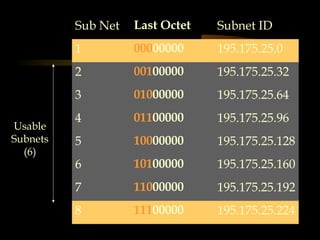
Sub Net Last Octet Subnet ID
1 00000000 195.175.25.0
2 00100000 195.175.25.32
3 01000000 195.175.25.64
4 01100000 195.175.25.96
5 10000000 195.175.25.128
6 10100000 195.175.25.160
7 11000000 195.175.25.192
8 11100000 195.175.25.224
Usable
Subnets
(6)
© N. Ganesan, All
rights reserved.
Sample Subnet Division
Router
195.175.25.32 195.175.25.64
195.175.25.33
.
.
.
195.175.25.62
195.175.25.65
.
.
.
195.175.25.94
30 hosts per subnet.
Subnet 2Subnet 1
© N. Ganesan, All
rights reserved.
Total Number of Subnets and
Hosts
• All zeros and ones are not used
– This has been overcome in the new RFC
• Total number of subnets is 6
• Number of hosts per subnet is 30
• Subnet mask is 255.255.255.224
– 255.255.255.11100000
© N. Ganesan, All
rights reserved.
End of Module
Module
The Routing Process
© N. Ganesan, All
rights reserved.
Overview of the Masking Process
• IP address and subnet masks are used
for the masking operation
• The purpose of masking is to identify
whether an IP address corresponds to a
local host or a remote host
• The mathematical technique used is
known as the ANDing process
© N. Ganesan, All
rights reserved.
ANDing Process
• Similar to the AND Boolean operator
• Consider A = B and C
– A is true only when B and C are true
– Otherwise, A is false for all other scenarios
© N. Ganesan, All
rights reserved.
ANDing Table
B C B AND C
0 0 0
0 1 0
1 0 0
1 1 1
© N. Ganesan, All
rights reserved.
Subnet Masking
• AND host IP and subnet mask value at
startup to identify network ID
• AND destination IP address and subnet
mask value determine either of the
following:
– IP represents local host
– IP represents remote host
© N. Ganesan, All
rights reserved.
Subnet Masking Example
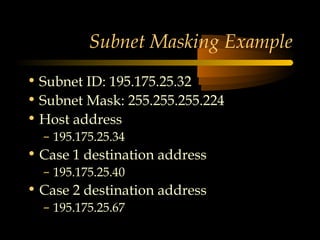
• Subnet ID: 195.175.25.32
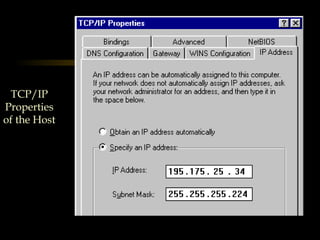
• Subnet Mask: 255.255.255.224
• Host address
– 195.175.25.34
• Case 1 destination address
– 195.175.25.40
• Case 2 destination address
– 195.175.25.67
© N. Ganesan, All
rights reserved.
Network Scenario
Router Subnet Mask: 255.255.255.224
Host
195.175.25.34
Local Host
195.175.25.40
Outside
World
195.175.25.40
195.175.25.67
© N. Ganesan, All
rights reserved.
Computing Subnet ID at Startup
Host ID 195 175 25 34
11000011 10101111 00011001 00100010
Subnet
Mask
255 255 255 224
11111111 11111111 11111111 11100000
ANDing
Result
195 175 25 32
11000011 10101111 00011001 00100000
Yields subnet ID.
© N. Ganesan, All
rights reserved.
TCP/IP
Properties
of the Host
© N. Ganesan, All
rights reserved.
Masking of Destination
Address:Case 1
Destinati-
nation IP
195 175 25 40
11000011 10101111 00011001 00101000
Subnet
Mask
255 255 255 224
11111111 11111111 11111111 11100000
ANDing
Result
195 175 25 32
11000011 10101111 00011001 00100000
Yields subnet ID to be that of the local subnet.
© N. Ganesan, All
rights reserved.
Case 1 Forwarding of Data
Packets
• The destination host is local
• Broadcast for the hardware address of
the local host at IP 195.175.25.40
• Send information to the local host
© N. Ganesan, All
rights reserved.
Masking of Destination
Address:Case 2
Destinati-
nation IP
195 175 25 67
11000011 10101111 00011001 01000011
Subnet
Mask
255 255 255 224
11111111 11111111 11111111 11100000
ANDing
Result
195 175 25 64
11000011 10101111 00011001 01000000
Yields subnet ID to be that of different subnet.
© N. Ganesan, All
rights reserved.
Case 2 Forwarding of Data
Packets
• The destination host is remote
• Send information to the gateway
• The router at the gateway will route the
data packet to the appropriate subnet
© N. Ganesan, All
rights reserved.
Gateway IP
address
specified
In TCP/IP
properties.
© N. Ganesan, All
rights reserved.
Summary of Transmission and
Routing of Data Packets
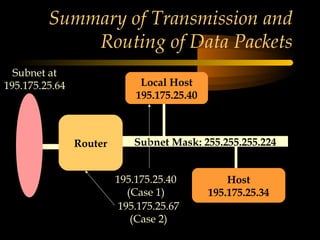
Router Subnet Mask: 255.255.255.224
Host
195.175.25.34
Local Host
195.175.25.40
Subnet at
195.175.25.64
195.175.25.40
(Case 1)
195.175.25.67
(Case 2)
© N. Ganesan, All
rights reserved.
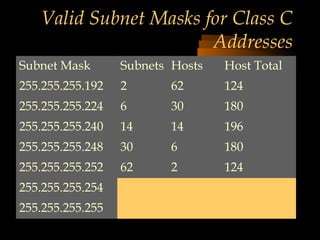
Valid Subnet Masks for Class C
Addresses
Subnet Mask Subnets Hosts Host Total
255.255.255.192 2 62 124
255.255.255.224 6 30 180
255.255.255.240 14 14 196
255.255.255.248 30 6 180
255.255.255.252 62 2 124
255.255.255.254
255.255.255.255
© N. Ganesan, All
rights reserved.
End of Module
Module
Subnetting Convention
© N. Ganesan, All
rights reserved.
Subnet Convention
• Consider the following Class C example
– 195.175.25.0/27
• In the above case, the first three octets
and the first three higher-order bits of
the fourth octet are used in subnet
masking
– 3*8+3 = 27 bits from the beginning of the 32
bit IP address
© N. Ganesan, All
rights reserved.
Subnet Convention Illustrated
11111111 11111111 11111111 11100000
8 Bits 8 Bits 8 Bits 3 Bits
Total number of masking bits = 27
195.175.25.0/27
Network ID
© N. Ganesan, All
rights reserved.
Variable Length Subnets
Source:
Microsoft White
Paper
135.41.0.0/16
135.41.0.0/17 135.41.128.0.0/17
135.41.128.0/21
135.41.128.0./17
135.41.248.0/21
135.41.248.0/24
1 Network, 32,766 hosts
15 Networks, 2046 hosts per network
135.41.255.0/21
Subnet
Subnet
8 Networks, 254 hosts per network
© N. Ganesan, All
rights reserved.
End of Module
Module
Classless Inter-Domain Routing
(CIDR)
© N. Ganesan, All
rights reserved.
Classless Inter-Domain Routing
(CIDR)
• To avoid the depletion of the class B
addresses, it is subnetted and assigned
as class C addresses
• To avoid the proliferation of network
IDs that would complicate entries in the
routing tables, they were folded for
easing the routing process
• The above is known as CIDR
© N. Ganesan, All
rights reserved.
Subnetting of Class B Example
• Consider the requirement of 2000 hosts by a
company
• Allocation of one class B network ID would
yield 65,534 hosts
– Far more than required
• The solution is to subnet a B class address
– 8 C class network IDs with each network being
able to support 254 hosts
– The total number of hosts supported is 2,032
© N. Ganesan, All
rights reserved.
CIDR
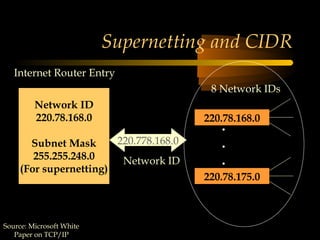
• CIDR enables the folding of network IDs
• The Internet router tables will need one entry
for network ID with the use of a subnet mask
for supernetting
– Otherwise, the table need to carry 8 entries in the
previous example
• RIP for IP version 2, OSPF and BGPv2 are
protocols that support CIDR
© N. Ganesan, All
rights reserved.
Classless Addressing
Fixed Variable
Fixed + Zeros
Fixed + Variables
Network ID
Host IDs
© N. Ganesan, All
rights reserved.
End of Module
Module
Supernetting
© N. Ganesan, All
rights reserved.
Supernetting and CIDR
220.78.168.0
Source: Microsoft White
Paper on TCP/IP
Network ID
220.78.168.0
Subnet Mask
255.255.248.0
(For supernetting)
220.78.175.0
220.778.168.0
Internet Router Entry
Network ID
.
.
.
8 Network IDs
End of Module
End of Chapter

Subnets

  • 1.
    Chapter Subnets in TCP/IPNetworks © N. Ganesan, Ph.D.
  • 2.
    © N. Ganesan,All rights reserved. Chapter Objectives
  • 3.
  • 4.
    © N. Ganesan,All rights reserved. Subnetting • Division of a network into subnets – For example, division of a Class B address into several Class C addresses • Some of the host IDs are used for creating subnet IDs
  • 5.
    © N. Ganesan,All rights reserved. Need for Subnetting • Classes A and B have a large number of hosts corresponding to each network ID • It may be desirable to subdivide the hosts in Class C subnets • Often, there is a limitation on the number of hosts that could be hosted on a single network segment – The limitation may be imposed by concerns related to the management of hardware • Smaller broadcast domains are more efficient and easy to manage
  • 6.
    © N. Ganesan,All rights reserved. Subnetting Principle • Use parts of the host IDs for subnetting purpose • A subnet mask is used to facilitate the flow of traffic between the different subnets and the outside network (hops) – A hop is the distance a data packet travels form one node to the other
  • 7.
    © N. Ganesan,All rights reserved. Using Host IDs to Subnet 140 15 0 0 Class B Network 140 15 1 0 140 15 2 0 Subnet 1 Subnet 2 Third octet is now used for subnet IDs 140 15 3 0 Subnet 3
  • 8.
    © N. Ganesan,All rights reserved. Subnet Configuration 140 15 1 0 140 15 1 1 Subnet ID First Host ID 140 15 1 254….. Last Host ID
  • 9.
    © N. Ganesan,All rights reserved. Routing of Traffic 140.15.0.0 140.15.2.0 140.15.1.0 140.15.3.0 Routing Subnets 1 2 3 Outside world
  • 10.
    © N. Ganesan,All rights reserved. End of Module
  • 11.
  • 12.
    © N. Ganesan,All rights reserved. Subnetting Example • Consider the case of a class C address 195. 175.25.0 assigned to an organization • Subnets can be constructed by allocating part of the higher-order bits of the host ID • Assume that three of the higher-order bits of the host ID are to be reserved for that purpose
  • 13.
    © N. Ganesan,All rights reserved. Subnetting Structure 195 175 25 0 11100000 Subnet Mask
  • 14.
    © N. Ganesan,All rights reserved. Sub Net Last Octet Subnet ID 1 00000000 195.175.25.0 2 00100000 195.175.25.32 3 01000000 195.175.25.64 4 01100000 195.175.25.96 5 10000000 195.175.25.128 6 10100000 195.175.25.160 7 11000000 195.175.25.192 8 11100000 195.175.25.224 Usable Subnets (6)
  • 15.
    © N. Ganesan,All rights reserved. Sample Subnet Division Router 195.175.25.32 195.175.25.64 195.175.25.33 . . . 195.175.25.62 195.175.25.65 . . . 195.175.25.94 30 hosts per subnet. Subnet 2Subnet 1
  • 16.
    © N. Ganesan,All rights reserved. Total Number of Subnets and Hosts • All zeros and ones are not used – This has been overcome in the new RFC • Total number of subnets is 6 • Number of hosts per subnet is 30 • Subnet mask is 255.255.255.224 – 255.255.255.11100000
  • 17.
    © N. Ganesan,All rights reserved. End of Module
  • 18.
  • 19.
    © N. Ganesan,All rights reserved. Overview of the Masking Process • IP address and subnet masks are used for the masking operation • The purpose of masking is to identify whether an IP address corresponds to a local host or a remote host • The mathematical technique used is known as the ANDing process
  • 20.
    © N. Ganesan,All rights reserved. ANDing Process • Similar to the AND Boolean operator • Consider A = B and C – A is true only when B and C are true – Otherwise, A is false for all other scenarios
  • 21.
    © N. Ganesan,All rights reserved. ANDing Table B C B AND C 0 0 0 0 1 0 1 0 0 1 1 1
  • 22.
    © N. Ganesan,All rights reserved. Subnet Masking • AND host IP and subnet mask value at startup to identify network ID • AND destination IP address and subnet mask value determine either of the following: – IP represents local host – IP represents remote host
  • 23.
    © N. Ganesan,All rights reserved. Subnet Masking Example • Subnet ID: 195.175.25.32 • Subnet Mask: 255.255.255.224 • Host address – 195.175.25.34 • Case 1 destination address – 195.175.25.40 • Case 2 destination address – 195.175.25.67
  • 24.
    © N. Ganesan,All rights reserved. Network Scenario Router Subnet Mask: 255.255.255.224 Host 195.175.25.34 Local Host 195.175.25.40 Outside World 195.175.25.40 195.175.25.67
  • 25.
    © N. Ganesan,All rights reserved. Computing Subnet ID at Startup Host ID 195 175 25 34 11000011 10101111 00011001 00100010 Subnet Mask 255 255 255 224 11111111 11111111 11111111 11100000 ANDing Result 195 175 25 32 11000011 10101111 00011001 00100000 Yields subnet ID.
  • 26.
    © N. Ganesan,All rights reserved. TCP/IP Properties of the Host
  • 27.
    © N. Ganesan,All rights reserved. Masking of Destination Address:Case 1 Destinati- nation IP 195 175 25 40 11000011 10101111 00011001 00101000 Subnet Mask 255 255 255 224 11111111 11111111 11111111 11100000 ANDing Result 195 175 25 32 11000011 10101111 00011001 00100000 Yields subnet ID to be that of the local subnet.
  • 28.
    © N. Ganesan,All rights reserved. Case 1 Forwarding of Data Packets • The destination host is local • Broadcast for the hardware address of the local host at IP 195.175.25.40 • Send information to the local host
  • 29.
    © N. Ganesan,All rights reserved. Masking of Destination Address:Case 2 Destinati- nation IP 195 175 25 67 11000011 10101111 00011001 01000011 Subnet Mask 255 255 255 224 11111111 11111111 11111111 11100000 ANDing Result 195 175 25 64 11000011 10101111 00011001 01000000 Yields subnet ID to be that of different subnet.
  • 30.
    © N. Ganesan,All rights reserved. Case 2 Forwarding of Data Packets • The destination host is remote • Send information to the gateway • The router at the gateway will route the data packet to the appropriate subnet
  • 31.
    © N. Ganesan,All rights reserved. Gateway IP address specified In TCP/IP properties.
  • 32.
    © N. Ganesan,All rights reserved. Summary of Transmission and Routing of Data Packets Router Subnet Mask: 255.255.255.224 Host 195.175.25.34 Local Host 195.175.25.40 Subnet at 195.175.25.64 195.175.25.40 (Case 1) 195.175.25.67 (Case 2)
  • 33.
    © N. Ganesan,All rights reserved. Valid Subnet Masks for Class C Addresses Subnet Mask Subnets Hosts Host Total 255.255.255.192 2 62 124 255.255.255.224 6 30 180 255.255.255.240 14 14 196 255.255.255.248 30 6 180 255.255.255.252 62 2 124 255.255.255.254 255.255.255.255
  • 34.
    © N. Ganesan,All rights reserved. End of Module
  • 35.
  • 36.
    © N. Ganesan,All rights reserved. Subnet Convention • Consider the following Class C example – 195.175.25.0/27 • In the above case, the first three octets and the first three higher-order bits of the fourth octet are used in subnet masking – 3*8+3 = 27 bits from the beginning of the 32 bit IP address
  • 37.
    © N. Ganesan,All rights reserved. Subnet Convention Illustrated 11111111 11111111 11111111 11100000 8 Bits 8 Bits 8 Bits 3 Bits Total number of masking bits = 27 195.175.25.0/27 Network ID
  • 38.
    © N. Ganesan,All rights reserved. Variable Length Subnets Source: Microsoft White Paper 135.41.0.0/16 135.41.0.0/17 135.41.128.0.0/17 135.41.128.0/21 135.41.128.0./17 135.41.248.0/21 135.41.248.0/24 1 Network, 32,766 hosts 15 Networks, 2046 hosts per network 135.41.255.0/21 Subnet Subnet 8 Networks, 254 hosts per network
  • 39.
    © N. Ganesan,All rights reserved. End of Module
  • 40.
  • 41.
    © N. Ganesan,All rights reserved. Classless Inter-Domain Routing (CIDR) • To avoid the depletion of the class B addresses, it is subnetted and assigned as class C addresses • To avoid the proliferation of network IDs that would complicate entries in the routing tables, they were folded for easing the routing process • The above is known as CIDR
  • 42.
    © N. Ganesan,All rights reserved. Subnetting of Class B Example • Consider the requirement of 2000 hosts by a company • Allocation of one class B network ID would yield 65,534 hosts – Far more than required • The solution is to subnet a B class address – 8 C class network IDs with each network being able to support 254 hosts – The total number of hosts supported is 2,032
  • 43.
    © N. Ganesan,All rights reserved. CIDR • CIDR enables the folding of network IDs • The Internet router tables will need one entry for network ID with the use of a subnet mask for supernetting – Otherwise, the table need to carry 8 entries in the previous example • RIP for IP version 2, OSPF and BGPv2 are protocols that support CIDR
  • 44.
    © N. Ganesan,All rights reserved. Classless Addressing Fixed Variable Fixed + Zeros Fixed + Variables Network ID Host IDs
  • 45.
    © N. Ganesan,All rights reserved. End of Module
  • 46.
  • 47.
    © N. Ganesan,All rights reserved. Supernetting and CIDR 220.78.168.0 Source: Microsoft White Paper on TCP/IP Network ID 220.78.168.0 Subnet Mask 255.255.248.0 (For supernetting) 220.78.175.0 220.778.168.0 Internet Router Entry Network ID . . . 8 Network IDs
  • 48.