TCP/IP
A highly standardized protocol used
widely on the Internet
Standards area available in the form
of RFC documents
Request For Comments (RFC)
Standards are overseen by the
Internet Engineering Task Force (IETF)
• There are four layers of the TCP/IP
reference model (DARPA model as named
by the US Government Agency)
– The ISO-OSI reference model is composed of
seven layers
• The next slide shows the mapping of the
ISO/OSI model to the TCP/IP model
• Note that the ISO/OSI model is more
widely used and accepted but the TCP/IP
model is easy to comprehend
Comparison of ISO-OSI Model
and the DOD (TCP/IP) Model
Application
Application layer
Presentation
Session
Transport Transport layer
Network Internet layer
Data Link
Host to the network
Physical
Application
Application layer FTP, Telnet, SMTP, HTTP..
Presentation
Session
Transport Transport layer TCP, UDP
Network Internet layer IP, ICMP, IGMP
Data Link Host to the
network
Ethernet, Token-Ring ...
Physical
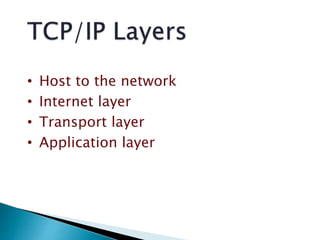
• Host to the network
• Internet layer
• Transport layer
• Application layer
• Responsible for sending and receiving
TCP/IP packets on the network medium
(physical/Data Link)
• Applicable LAN technologies
– Ethernet, Token Ring, FDDI etc.
• Applicable WAN technologies
– X.25 (old), Frame Relay, ATM etc.
• Note that some technologies such as
ATM and FDDI may be used at both the
WAN and the LAN levels
• IEEE 802.3, IEEE 802.5 and IEEE
802.11 series of protocols
Data Link Layer
Physical Layer
Network Interface
Layer
• Packaging
• Addressing
• Routing
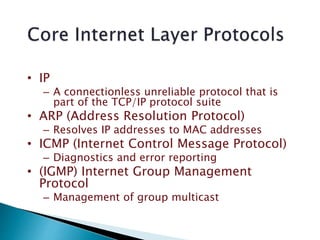
• IP
– A connectionless unreliable protocol that is
part of the TCP/IP protocol suite
• ARP (Address Resolution Protocol)
– Resolves IP addresses to MAC addresses
• ICMP (Internet Control Message Protocol)
– Diagnostics and error reporting
• (IGMP) Internet Group Management
Protocol
– Management of group multicast
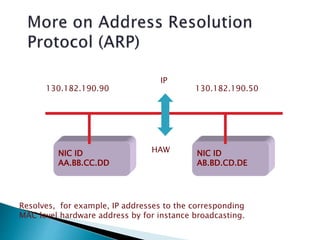
NIC ID
AA.BB.CC.DD
NIC ID
AB.BD.CD.DE
130.182.190.90 130.182.190.50
Resolves, for example, IP addresses to the corresponding
MAC level hardware address by for instance broadcasting.
IP
HAW
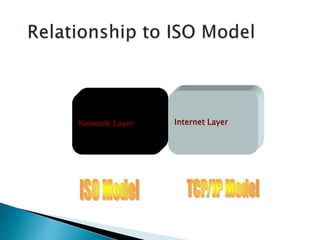
Network Layer Internet Layer
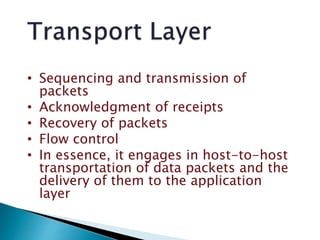
• Sequencing and transmission of
packets
• Acknowledgment of receipts
• Recovery of packets
• Flow control
• In essence, it engages in host-to-host
transportation of data packets and the
delivery of them to the application
layer
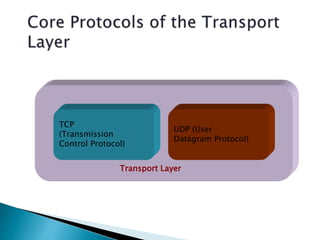
TCP
(Transmission
Control Protocol)
UDP (User
Datagram Protocol)
Transport Layer
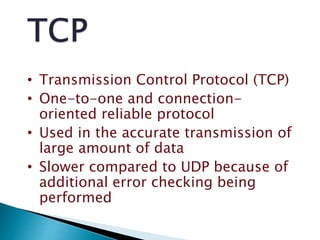
• Transmission Control Protocol (TCP)
• One-to-one and connection-
oriented reliable protocol
• Used in the accurate transmission of
large amount of data
• Slower compared to UDP because of
additional error checking being
performed
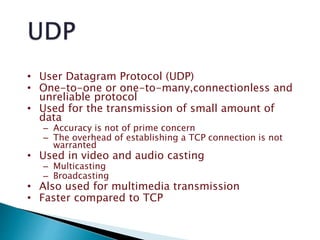
• User Datagram Protocol (UDP)
• One-to-one or one-to-many,connectionless and
unreliable protocol
• Used for the transmission of small amount of
data
– Accuracy is not of prime concern
– The overhead of establishing a TCP connection is not
warranted
• Used in video and audio casting
– Multicasting
– Broadcasting
• Also used for multimedia transmission
• Faster compared to TCP
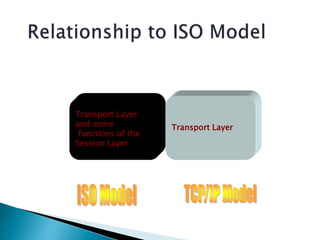
Transport Layer
and some
functions of the
Session Layer
Transport Layer
• Provides applications with the ability
to access the services of the other
layers
• New protocols and services are
always being developed in this
category
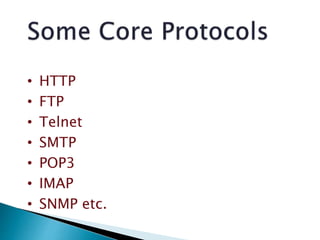
• HTTP
• FTP
• Telnet
• SMTP
• POP3
• IMAP
• SNMP etc.
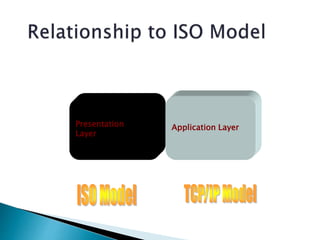
Presentation
Layer
Application Layer
Tcp model by ananya shukla

Tcp model by ananya shukla

  • 2.
    TCP/IP A highly standardizedprotocol used widely on the Internet Standards area available in the form of RFC documents Request For Comments (RFC) Standards are overseen by the Internet Engineering Task Force (IETF)
  • 3.
    • There arefour layers of the TCP/IP reference model (DARPA model as named by the US Government Agency) – The ISO-OSI reference model is composed of seven layers • The next slide shows the mapping of the ISO/OSI model to the TCP/IP model • Note that the ISO/OSI model is more widely used and accepted but the TCP/IP model is easy to comprehend
  • 4.
    Comparison of ISO-OSIModel and the DOD (TCP/IP) Model Application Application layer Presentation Session Transport Transport layer Network Internet layer Data Link Host to the network Physical
  • 5.
    Application Application layer FTP,Telnet, SMTP, HTTP.. Presentation Session Transport Transport layer TCP, UDP Network Internet layer IP, ICMP, IGMP Data Link Host to the network Ethernet, Token-Ring ... Physical
  • 6.
    • Host tothe network • Internet layer • Transport layer • Application layer
  • 7.
    • Responsible forsending and receiving TCP/IP packets on the network medium (physical/Data Link) • Applicable LAN technologies – Ethernet, Token Ring, FDDI etc. • Applicable WAN technologies – X.25 (old), Frame Relay, ATM etc. • Note that some technologies such as ATM and FDDI may be used at both the WAN and the LAN levels
  • 8.
    • IEEE 802.3,IEEE 802.5 and IEEE 802.11 series of protocols
  • 9.
    Data Link Layer PhysicalLayer Network Interface Layer
  • 10.
  • 11.
    • IP – Aconnectionless unreliable protocol that is part of the TCP/IP protocol suite • ARP (Address Resolution Protocol) – Resolves IP addresses to MAC addresses • ICMP (Internet Control Message Protocol) – Diagnostics and error reporting • (IGMP) Internet Group Management Protocol – Management of group multicast
  • 12.
    NIC ID AA.BB.CC.DD NIC ID AB.BD.CD.DE 130.182.190.90130.182.190.50 Resolves, for example, IP addresses to the corresponding MAC level hardware address by for instance broadcasting. IP HAW
  • 13.
  • 14.
    • Sequencing andtransmission of packets • Acknowledgment of receipts • Recovery of packets • Flow control • In essence, it engages in host-to-host transportation of data packets and the delivery of them to the application layer
  • 15.
  • 16.
    • Transmission ControlProtocol (TCP) • One-to-one and connection- oriented reliable protocol • Used in the accurate transmission of large amount of data • Slower compared to UDP because of additional error checking being performed
  • 17.
    • User DatagramProtocol (UDP) • One-to-one or one-to-many,connectionless and unreliable protocol • Used for the transmission of small amount of data – Accuracy is not of prime concern – The overhead of establishing a TCP connection is not warranted • Used in video and audio casting – Multicasting – Broadcasting • Also used for multimedia transmission • Faster compared to TCP
  • 18.
    Transport Layer and some functionsof the Session Layer Transport Layer
  • 19.
    • Provides applicationswith the ability to access the services of the other layers • New protocols and services are always being developed in this category
  • 20.
    • HTTP • FTP •Telnet • SMTP • POP3 • IMAP • SNMP etc.
  • 21.