IE 20303
What is a Protocol?Allows entities (i.e. application programs)  from different systems to communicateShared conventions for communicating information are called protocolsDefines a set of rules that govern the exchange of dataIncludes syntax, semantics, and timing
Why Use Protocol Architecture?Data communications requires complex proceduresSender identifies data path/receiverSystems negotiate preparednessApplications negotiate preparednessTranslation of file formatsFor all tasks to occur, high level of cooperation is required
Modular ApproachBreaks complex tasks into subtasksEach module handles specific subset of tasksCommunication occursbetween different modules on the same systembetween similar modules on different systems
Advantages of ModularityEasier application developmentNetwork can change without all programs being modified
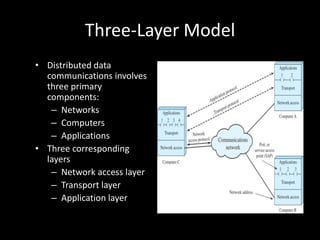
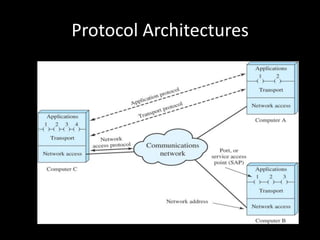
Three-Layer ModelDistributed data communications involves three primary components:NetworksComputersApplicationsThree corresponding layersNetwork access layerTransport layerApplication layer
Network Access LayerConcerned with exchange of data between computer and networkIncludes addressing, routing, prioritizing, etcDifferent networks require different software at this layerExample: X.25 standard for network access procedures on packet-switching networks
Transport LayerConcerned with reliable transfer of information between applicationsIndependent of the nature of the applicationIncludes aspects like flow control and error checking
Application LayerLogic needed to support various applicationsEach type of application (file transfer, remote access) requires different software on this layer
AddressingEach computer on a network requires a unique address on that networkEach application requires a unique address within the computer to allow support for multiple applications (service access points, or SAP)
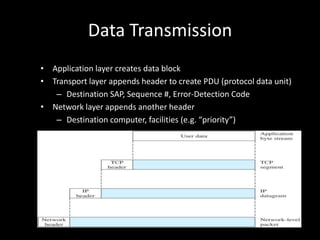
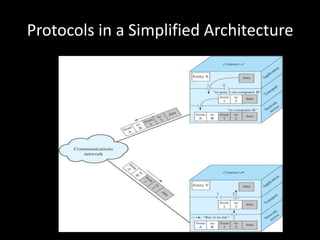
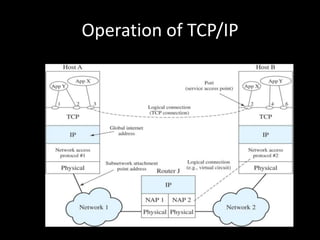
Data TransmissionApplication layer creates data blockTransport layer appends header to create PDU (protocol data unit)Destination SAP, Sequence #, Error-Detection CodeNetwork layer appends another headerDestination computer, facilities (e.g. “priority”)
Protocol Architectures
Protocols in a Simplified Architecture
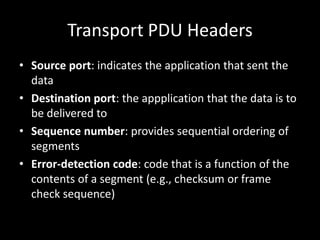
Transport PDU HeadersSource port: indicates the application that sent the dataDestination port: the appplication that the data is to be delivered toSequence number: provides sequential ordering of segments Error-detection code: code that is a function of the contents of a segment (e.g., checksum or frame check sequence)
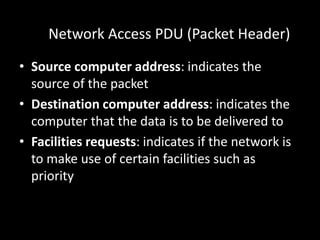
Network Access PDU (Packet Header)Source computer address: indicates the source of the packetDestination computer address: indicates the computer that the data is to be delivered toFacilities requests: indicates if the network is to make use of certain facilities such as priority
Standardized Protocol ArchitecturesVendors like standards because they make their products more marketableCustomers like standards because they enable products from different vendors to interoperateTwo protocol standards are well-known:TCP/IP: widely implementedOSI: less used, but widely known and still useful for modeling/conceptualizing
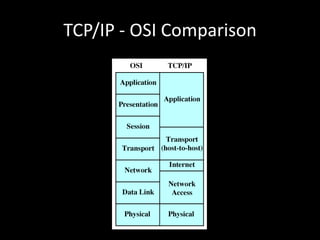
TCP/IPTransmission Control Protocol/Internet ProtocolDeveloped by DARPANo official protocol standardIdentifies 5 LayersApplicationHost-to-Host (transport)InternetNetwork AccessPhysical
TCP/IP Physical LayerPhysical interface between a DTE (e.g. computer or terminal) and a transmission medium Specifies:Characteristics of mediumNature of signalsData rate
TCP/IP Network Access LayerExchange of data between systems on a shared networkUtilizes address of host and destinationCan also prioritize  transmissionSoftware at this layer depends on network (e.g. X.25 vs. Ethernet)Segregation means that no other software needs to be concerned about net specifics
TCP/IP Internet LayerAn Internet is an interconnection of two or more networksInternet layer handles tasks similar to network access layer, but between networks rather than between nodes on a networkUses IP for addressing and routing across networksImplemented in workstations and routers
TCP/IP Transport LayerAlso called host-to-host layerReliable exchange of data between applicationsUses TCP protocols for transmission
TCP/IP Application LayerLogic needed to support variety of applicationsSeparate module supports each type of application (e.g. file transfer)
Operation of TCP/IP
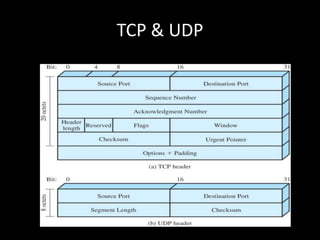
TCP & UDPMost TCP/IP applications use TCP for transport layerTCP provides a connection (logical association) between two entities to regulate flow check errorsUDP (User Datagram Protocol) does not maintain a connection, and therefore does not guarantee delivery, preserve sequences, or protect against duplication
TCP & UDP
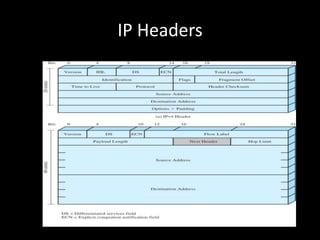
IP and IPv6IP provides for 32-bit source and destination addressesIPv6 (1996 standard) provides for 128-bit addressesMigraqtion to IPv6 will be a very slow process
IP Headers
TCP/IP ApplicationsSMTP (Simple Mail Transfer Protocol)Basic e-mail facility, transferring messages among hostsFTP (File Transfer Protocol)Sends files from one system to another on user commandSSH (Secure Shell)Secure remote login capability, allowing a user to remotely logon to a computer
InternetworkingInterconnected networks, usually implies TCP/IPCan appear to users as a single large networkThe global Internet is the largest example, but intranets and extranets are also examples
RoutersEquipment used to interconnect independent networksSeveral essential functionsProvide a link between networksProvide routing and delivery of data between processes on systems from different networksProvide these functions without requiring modification of networking architecture
Router IssuesAddressing schemesMaximum packet sizeInterfacesReliability
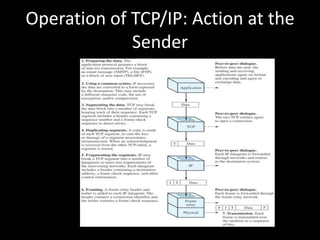
Operation of TCP/IP: Action at the Sender
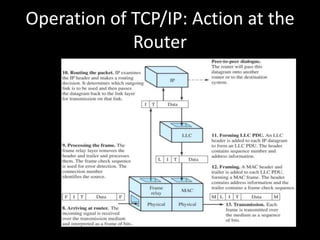
Operation of TCP/IP: Action at the Router
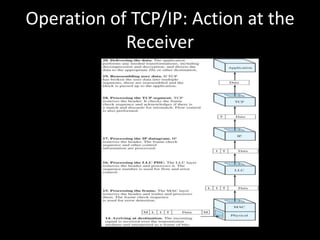
Operation of TCP/IP: Action at the Receiver
Why Study OSI?Still an excellent model for conceptualizing and understanding protocol architecturesKey points:ModularHierarchicalBoundaries between layers=interfaces
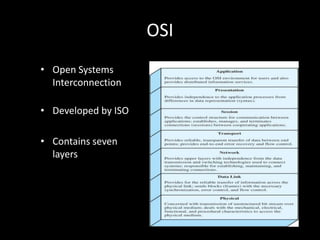
OSIOpen Systems InterconnectionDeveloped by ISOContains seven layers
OSI Lower LayersPhysicalData LinkNetwork
OSI Physical LayerResponsible for transmission of bitsAlways implemented through hardwareEncompasses mechanical, electrical, and functional interfacese.g. RS-232
OSI Data Link LayerResponsible for error-free, reliable transmission of dataFlow control, error correctione.g. HDLC
OSI Network LayerResponsible for routing of messages through networkConcerned with type of switching used (circuit v. packet)Handles routing between networks, as well as through packet-switching networks
OSI Upper LayersTransportSessionPresentationApplication
OSI Transport LayerIsolates messages from lower and upper layersBreaks down message sizeMonitors quality of communications channelSelects most efficient communication service necessary for a given transmission
OSI Session LayerEstablishes logical connections between systemsManages log-ons, password exchange, log-offsTerminates connection at end of session
OSI Presentation LayerProvides format and code conversion servicesExamples File conversion from ASCII to EBDICInvoking character sequences to generate bold, italics, etc on a printer
OSI Application LayerProvides access to network for end-userUser’s capabilities are determined by what items are available on this layer
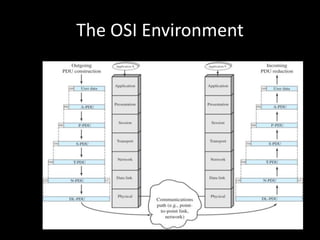
The OSI Environment
TCP/IP - OSI Comparison
IPSecDeveloped by the Internet Architecture Board in 1994 (RFC 1636)Examples of Applications include:-Secure branch office connectivity over the Internet-Secure remote access over the Internet-Establishing extranet and intranet connectivity with partners-Enhancing electronic security
Benefits of IPSecProvides stronger secuirty to routers and firewallsIs resistant to bypass within a firewallIs transparent to applications Is transparent to end usersCan provide security to end-users

Presentation5

  • 1.
  • 2.
    What is aProtocol?Allows entities (i.e. application programs) from different systems to communicateShared conventions for communicating information are called protocolsDefines a set of rules that govern the exchange of dataIncludes syntax, semantics, and timing
  • 3.
    Why Use ProtocolArchitecture?Data communications requires complex proceduresSender identifies data path/receiverSystems negotiate preparednessApplications negotiate preparednessTranslation of file formatsFor all tasks to occur, high level of cooperation is required
  • 4.
    Modular ApproachBreaks complextasks into subtasksEach module handles specific subset of tasksCommunication occursbetween different modules on the same systembetween similar modules on different systems
  • 5.
    Advantages of ModularityEasierapplication developmentNetwork can change without all programs being modified
  • 6.
    Three-Layer ModelDistributed datacommunications involves three primary components:NetworksComputersApplicationsThree corresponding layersNetwork access layerTransport layerApplication layer
  • 7.
    Network Access LayerConcernedwith exchange of data between computer and networkIncludes addressing, routing, prioritizing, etcDifferent networks require different software at this layerExample: X.25 standard for network access procedures on packet-switching networks
  • 8.
    Transport LayerConcerned withreliable transfer of information between applicationsIndependent of the nature of the applicationIncludes aspects like flow control and error checking
  • 9.
    Application LayerLogic neededto support various applicationsEach type of application (file transfer, remote access) requires different software on this layer
  • 10.
    AddressingEach computer ona network requires a unique address on that networkEach application requires a unique address within the computer to allow support for multiple applications (service access points, or SAP)
  • 11.
    Data TransmissionApplication layercreates data blockTransport layer appends header to create PDU (protocol data unit)Destination SAP, Sequence #, Error-Detection CodeNetwork layer appends another headerDestination computer, facilities (e.g. “priority”)
  • 12.
  • 13.
    Protocols in aSimplified Architecture
  • 14.
    Transport PDU HeadersSourceport: indicates the application that sent the dataDestination port: the appplication that the data is to be delivered toSequence number: provides sequential ordering of segments Error-detection code: code that is a function of the contents of a segment (e.g., checksum or frame check sequence)
  • 15.
    Network Access PDU(Packet Header)Source computer address: indicates the source of the packetDestination computer address: indicates the computer that the data is to be delivered toFacilities requests: indicates if the network is to make use of certain facilities such as priority
  • 16.
    Standardized Protocol ArchitecturesVendorslike standards because they make their products more marketableCustomers like standards because they enable products from different vendors to interoperateTwo protocol standards are well-known:TCP/IP: widely implementedOSI: less used, but widely known and still useful for modeling/conceptualizing
  • 17.
    TCP/IPTransmission Control Protocol/InternetProtocolDeveloped by DARPANo official protocol standardIdentifies 5 LayersApplicationHost-to-Host (transport)InternetNetwork AccessPhysical
  • 18.
    TCP/IP Physical LayerPhysicalinterface between a DTE (e.g. computer or terminal) and a transmission medium Specifies:Characteristics of mediumNature of signalsData rate
  • 19.
    TCP/IP Network AccessLayerExchange of data between systems on a shared networkUtilizes address of host and destinationCan also prioritize transmissionSoftware at this layer depends on network (e.g. X.25 vs. Ethernet)Segregation means that no other software needs to be concerned about net specifics
  • 20.
    TCP/IP Internet LayerAnInternet is an interconnection of two or more networksInternet layer handles tasks similar to network access layer, but between networks rather than between nodes on a networkUses IP for addressing and routing across networksImplemented in workstations and routers
  • 21.
    TCP/IP Transport LayerAlsocalled host-to-host layerReliable exchange of data between applicationsUses TCP protocols for transmission
  • 22.
    TCP/IP Application LayerLogicneeded to support variety of applicationsSeparate module supports each type of application (e.g. file transfer)
  • 23.
  • 24.
    TCP & UDPMostTCP/IP applications use TCP for transport layerTCP provides a connection (logical association) between two entities to regulate flow check errorsUDP (User Datagram Protocol) does not maintain a connection, and therefore does not guarantee delivery, preserve sequences, or protect against duplication
  • 25.
  • 26.
    IP and IPv6IPprovides for 32-bit source and destination addressesIPv6 (1996 standard) provides for 128-bit addressesMigraqtion to IPv6 will be a very slow process
  • 27.
  • 28.
    TCP/IP ApplicationsSMTP (SimpleMail Transfer Protocol)Basic e-mail facility, transferring messages among hostsFTP (File Transfer Protocol)Sends files from one system to another on user commandSSH (Secure Shell)Secure remote login capability, allowing a user to remotely logon to a computer
  • 29.
    InternetworkingInterconnected networks, usuallyimplies TCP/IPCan appear to users as a single large networkThe global Internet is the largest example, but intranets and extranets are also examples
  • 30.
    RoutersEquipment used tointerconnect independent networksSeveral essential functionsProvide a link between networksProvide routing and delivery of data between processes on systems from different networksProvide these functions without requiring modification of networking architecture
  • 31.
    Router IssuesAddressing schemesMaximumpacket sizeInterfacesReliability
  • 32.
    Operation of TCP/IP:Action at the Sender
  • 33.
    Operation of TCP/IP:Action at the Router
  • 34.
    Operation of TCP/IP:Action at the Receiver
  • 35.
    Why Study OSI?Stillan excellent model for conceptualizing and understanding protocol architecturesKey points:ModularHierarchicalBoundaries between layers=interfaces
  • 36.
    OSIOpen Systems InterconnectionDevelopedby ISOContains seven layers
  • 37.
  • 38.
    OSI Physical LayerResponsiblefor transmission of bitsAlways implemented through hardwareEncompasses mechanical, electrical, and functional interfacese.g. RS-232
  • 39.
    OSI Data LinkLayerResponsible for error-free, reliable transmission of dataFlow control, error correctione.g. HDLC
  • 40.
    OSI Network LayerResponsiblefor routing of messages through networkConcerned with type of switching used (circuit v. packet)Handles routing between networks, as well as through packet-switching networks
  • 41.
  • 42.
    OSI Transport LayerIsolatesmessages from lower and upper layersBreaks down message sizeMonitors quality of communications channelSelects most efficient communication service necessary for a given transmission
  • 43.
    OSI Session LayerEstablisheslogical connections between systemsManages log-ons, password exchange, log-offsTerminates connection at end of session
  • 44.
    OSI Presentation LayerProvidesformat and code conversion servicesExamples File conversion from ASCII to EBDICInvoking character sequences to generate bold, italics, etc on a printer
  • 45.
    OSI Application LayerProvidesaccess to network for end-userUser’s capabilities are determined by what items are available on this layer
  • 46.
  • 47.
    TCP/IP - OSIComparison
  • 48.
    IPSecDeveloped by theInternet Architecture Board in 1994 (RFC 1636)Examples of Applications include:-Secure branch office connectivity over the Internet-Secure remote access over the Internet-Establishing extranet and intranet connectivity with partners-Enhancing electronic security
  • 49.
    Benefits of IPSecProvidesstronger secuirty to routers and firewallsIs resistant to bypass within a firewallIs transparent to applications Is transparent to end usersCan provide security to end-users