POWER SYSTEM OPERATION AND CONTROL
TOPIC: Overview of POWER SYSTEM operation AND
CONTROL
Dr.G.Kannayeram
ASSOCIATE PROFESSOR/EEE Department,
SRIT
POWER SYSTEM OPERATIONS & CONTROL
Power System Operations:
•To ensure the supply of good quality of
power whenever the customer demands.
•Power System should able to supply the ever changing load demand.
•Power delivered should be economical & reliable.
•Power System can be operated at the desired
operating level by maintaining frequency voltage & load flow
configurations.
Control:
•The Problems of dynamic & transient stability, steady state stability
voltage and frequency regulation, power optimization need to be
properly analysed.
•A methodology of overall system control is to be devised.
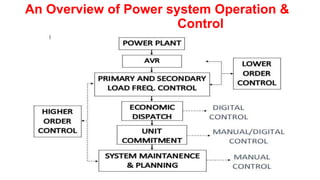
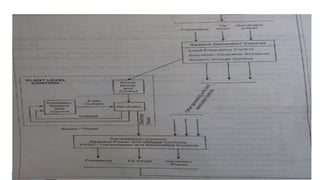
An Overview of Power system Operation &
Control
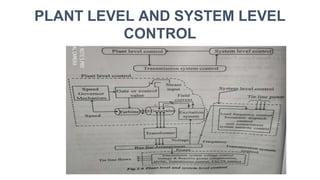
PLANT LEVEL AND SYSTEM LEVEL
CONTROL
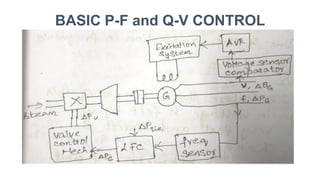
BASIC P-F and Q-V CONTROL
LOOPS
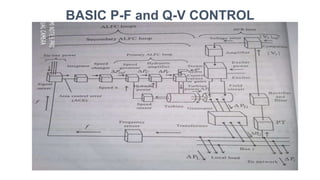
BASIC P-F and Q-V CONTROL
LOOPS
POWER SYSTEM OPERATION
(i)Load Forecasting,
(ii)Unit Commitment and
(iii)Load Scheduling.
Load forecasting
The load on their systems should be estimated in advance. This
estimation in advance is known as load forecasting. Load
forecasting based on the previous experience without any
historical data.
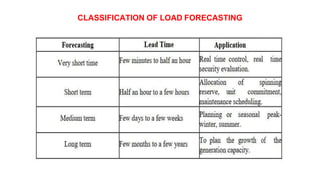
CLASSIFICATION OF LOAD FORECASTING
Need for load forecasting
• To meet out the future demand.
• Long term forecasting is required for preparing maintenance schedule of
the generating units, planning future expansion of the system.
• For day to day operation, short term load forecasting
demand and for maintaining the required spinning reserve.
• Very short term load forecasting is used for generation and distribution.
That is, economic generation scheduling and load dispatching.
• Medium term load forecasting is needed for predicted monsoon acting
and hydro availability and allocating.
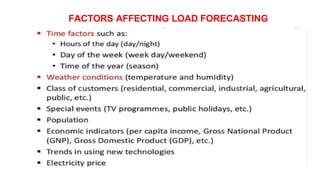
FACTORS AFFECTING LOAD FORECASTING
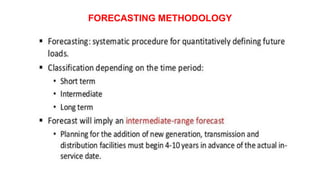
FORECASTING METHODOLOGY
Governor Control
Governor is a device used to control the speed of a prime mover.
A governor protects the prime mover from overspeed and keeps
the prime mover speed at or near the desired revolutions per minute.
When a prime mover drives an alternator supplying electrical power
at a given frequency, a governor must be used to hold the prime
mover at a speed that will yield this frequency.
An unloaded diesel engine will fly to pieces unless it is under
governor control.
Economic dispatch control
1. When load distribution between a number of generator units considered
optimum schedule affected when increase at one replaces a decreases at
other.
2. Optimum use of generators at each station at various load is known as
economic dispatch control.
System voltage control
Control the voltage within the tolerable limits. Devices used are.
1. Static VAR compensator
2. Synchronous condenser
3. Tap changing transformer
4. Switches
5. Capacitor
6. Reactor
Automatic voltage regulator
1. Regulate generator voltage and output power
2. Terminal voltage & reactive power is also met
Load frequency control
1. Sense the bus bar frequency &power frequency
2. Difference fed to the integrator & to speed changer
3. Tie line frequency maintained constant
Security control
1. Monitoring & decision
2. Control
Monitoring & decision:
1. Condition of the system continuously observed in the control cente
rs by relays.
2. If any continuous severe problem occurs system is in abnormal con
dition.
Security control
1. Control:
1. Proper commands are generated for correcting the abnormality in protecti
ng the system
2. If no abnormality is observed, then the normal operation proceeds for nex
t interval.
3. Central controls are used to monitor the interconnected areas
Security control
1. Control:
4. Inter connected areas can be tolerate larger load changes with smaller fre
quency deviations
5. Central control centre monitors information about frequency, generating
unit outputs and tie line power flows to interconnected areas.
6. This information is used by automation load frequency control in order to
maintain area frequency at its scheduled value.
THANK YOU

CO1 Power System Operation and Control BASICS .ppt

  • 1.
    POWER SYSTEM OPERATIONAND CONTROL TOPIC: Overview of POWER SYSTEM operation AND CONTROL Dr.G.Kannayeram ASSOCIATE PROFESSOR/EEE Department, SRIT
  • 2.
    POWER SYSTEM OPERATIONS& CONTROL Power System Operations: •To ensure the supply of good quality of power whenever the customer demands. •Power System should able to supply the ever changing load demand. •Power delivered should be economical & reliable. •Power System can be operated at the desired operating level by maintaining frequency voltage & load flow configurations. Control: •The Problems of dynamic & transient stability, steady state stability voltage and frequency regulation, power optimization need to be properly analysed. •A methodology of overall system control is to be devised.
  • 3.
    An Overview ofPower system Operation & Control
  • 5.
    PLANT LEVEL ANDSYSTEM LEVEL CONTROL
  • 6.
    BASIC P-F andQ-V CONTROL LOOPS
  • 7.
    BASIC P-F andQ-V CONTROL LOOPS
  • 8.
    POWER SYSTEM OPERATION POWERSYSTEM OPERATION (i)Load Forecasting, (ii)Unit Commitment and (iii)Load Scheduling. Load forecasting The load on their systems should be estimated in advance. This estimation in advance is known as load forecasting. Load forecasting based on the previous experience without any historical data.
  • 9.
  • 10.
    Need for loadforecasting • To meet out the future demand. • Long term forecasting is required for preparing maintenance schedule of the generating units, planning future expansion of the system. • For day to day operation, short term load forecasting demand and for maintaining the required spinning reserve. • Very short term load forecasting is used for generation and distribution. That is, economic generation scheduling and load dispatching. • Medium term load forecasting is needed for predicted monsoon acting and hydro availability and allocating.
  • 11.
  • 12.
  • 13.
    Governor Control Governor isa device used to control the speed of a prime mover. A governor protects the prime mover from overspeed and keeps the prime mover speed at or near the desired revolutions per minute. When a prime mover drives an alternator supplying electrical power at a given frequency, a governor must be used to hold the prime mover at a speed that will yield this frequency. An unloaded diesel engine will fly to pieces unless it is under governor control.
  • 14.
    Economic dispatch control 1.When load distribution between a number of generator units considered optimum schedule affected when increase at one replaces a decreases at other. 2. Optimum use of generators at each station at various load is known as economic dispatch control.
  • 15.
    System voltage control Controlthe voltage within the tolerable limits. Devices used are. 1. Static VAR compensator 2. Synchronous condenser 3. Tap changing transformer 4. Switches 5. Capacitor 6. Reactor
  • 16.
    Automatic voltage regulator 1.Regulate generator voltage and output power 2. Terminal voltage & reactive power is also met
  • 17.
    Load frequency control 1.Sense the bus bar frequency &power frequency 2. Difference fed to the integrator & to speed changer 3. Tie line frequency maintained constant
  • 18.
    Security control 1. Monitoring& decision 2. Control Monitoring & decision: 1. Condition of the system continuously observed in the control cente rs by relays. 2. If any continuous severe problem occurs system is in abnormal con dition.
  • 19.
    Security control 1. Control: 1.Proper commands are generated for correcting the abnormality in protecti ng the system 2. If no abnormality is observed, then the normal operation proceeds for nex t interval. 3. Central controls are used to monitor the interconnected areas
  • 20.
    Security control 1. Control: 4.Inter connected areas can be tolerate larger load changes with smaller fre quency deviations 5. Central control centre monitors information about frequency, generating unit outputs and tie line power flows to interconnected areas. 6. This information is used by automation load frequency control in order to maintain area frequency at its scheduled value.
  • 21.