By
Lect. Ebtihal Abdul Kadhim
Assist. Lect. Zahraa Amer
Suppositories
SUPPOSITORIES
 Are solid dosage forms intended for insertion into body
orifices (such as vaginal or rectal cavity) where they melt,
soften or dissolve and exert localized or systemic effects.
 The shape and size of a suppository must be such that it is
capable of being easily inserted into the intended body orifice
without causing undue distention, and once inserted, it must
be retained for appropriate period .
Advantages of Suppository
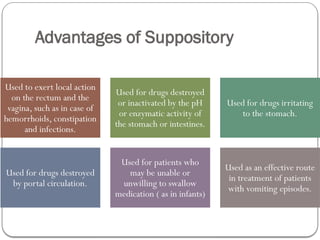
Used to exert local action
on the rectum and the
vagina, such as in case of
hemorrhoids, constipation
and infections.
Used for drugs destroyed
or inactivated by the pH
or enzymatic activity of
the stomach or intestines.
Used for drugs irritating
to the stomach.
Used for drugs destroyed
by portal circulation.
Used for patients who
may be unable or
unwilling to swallow
medication ( as in infants)
Used as an effective route
in treatment of patients
with vomiting episodes.
Types of Suppository Base
:
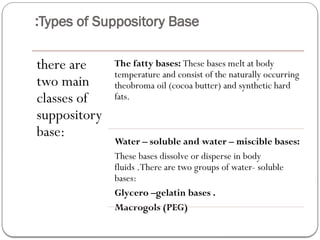
there are
two main
classes of
suppository
base:
The fatty bases: These bases melt at body
temperature and consist of the naturally occurring
theobroma oil (cocoa butter) and synthetic hard
fats.
Water – soluble and water – miscible bases:
These bases dissolve or disperse in body
fluids .There are two groups of water- soluble
bases:
Glycero –gelatin bases .
Macrogols (PEG)
Preparation of Suppository
:
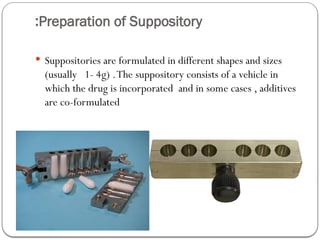
 Suppositories are formulated in different shapes and sizes
(usually 1- 4g) .The suppository consists of a vehicle in
which the drug is incorporated and in some cases , additives
are co-formulated
Suppositories are manufactured by two
general methods
:
• The drug is added to the melted
base and the mixtureis allowed to
cool after pouring into molds.
Fusion
method (hot
process)
:
• The drug is incorporated with the
unmelted base and the resulting
massis shaped either by hand or
by compression forced in metallic
mold.
Compression
method
(
Cold
process
:)
Calibration of the Mold
:
 Molds in common use today are made from stainless steel,
aluminium , brass or plastic.The molds, which separate into
sections,generally longitudinally.
 The capacity of the mold is confirmed by filling the mold
with the chosen base.The weight of the perfect products is
taken and the mean weight is calculated .This value is the
calibration value of the mold for that particular base.
Displacement Value (DVs)
:
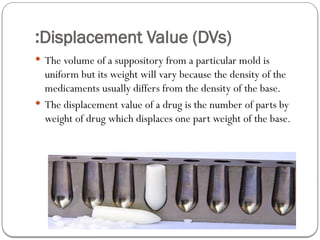
 The volume of a suppository from a particular mold is
uniform but its weight will vary because the density of the
medicaments usually differs from the density of the base.
 The displacement value of a drug is the number of parts by
weight of drug which displaces one part weight of the base.
Drug
5 gm
BASE
10 gm
1 gm of base
Therefore DV is (5)
As the displacement equal in volume not the mass !
Example Rx1
:
 Bismuth subgallate 300 mg
 Cocoa butter q.s.
 Ft. supp.
 M.ft. 6 supp. using 1 g mold
 Calculations :
 To allow for unavoidable wastage , we calculate for eight suppositories.
 DV of bismuth subgalallate = 2.7 (i.e. 2.7 g )
 bismuth subgallate = 8*300 mg = 2.4 g
 2.4/2.7 = 0.89 g displaced base
 The weight of base required to prepare eight unmedicated suppositories= 1*8 =
8 g
 Therefore , the weight of base required for medicated suppositories = 8 –
0.89 = 7.21 g
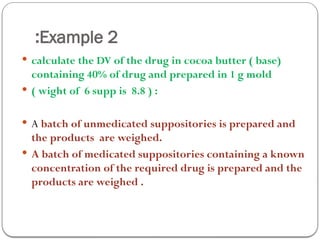
Example 2
:
 calculate the DV of the drug in cocoa butter ( base)
containing 40% of drug and prepared in 1 g mold
 ( wight of 6 supp is 8.8 ) :
 A batch of unmedicated suppositories is prepared and
the products are weighed.
 A batch of medicated suppositories containing a known
concentration of the required drug is prepared and the
products are weighed .
Answer
 Weight of six unmedicated suppositories = 6 g ( since the mould is fixed
(1gm each )
 Weight of six medicated suppositories containing 40% drug = 8.8 g
( from the question)
 Weight of the base in the suppositories = 60%
(60/100)*8.8 = 5.28 g
 Weight of the drug in the suppositories = 40 %
(40/100)*8.8 = 3.52 g
 Weight of the base displaced by the drug = 6 -5.28 = 0.72 g
 If the 0.72 g of the base is displaced by 3.52g of the drug then 1 g of the
base is displaced by 3.52/0.72 = 4.88 g
 Therefore displacement value of the drug is 4.9
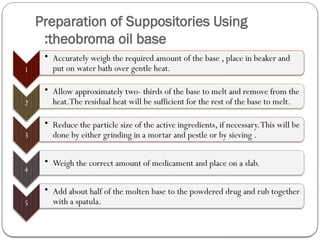
Preparation of Suppositories Using
theobroma oil base
:
1
• Accurately weigh the required amount of the base , place in beaker and
put on water bath over gentle heat.
2
• Allow approximately two- thirds of the base to melt and remove from the
heat.The residual heat will be sufficient for the rest of the base to melt.
3
• Reduce the particle size of the active ingredients, if necessary.This will be
done by either grinding in a mortar and pestle or by sieving .
4
• Weigh the correct amount of medicament and place on a slab.
5
• Add about half of the molten base to the powdered drug and rub together
with a spatula.
Preparation of Suppositories (continued )
:
6
• Scrap this mixture off the slab, using the spatula and place back into the beaker.
7
• If necessary, put the beaker back over the water bath to re-melt the ingredients
8
• Remove from the heat and stir constantly until almost on the point of setting
9
• Quickly pour into the mold, slightly overfill each cavity.This is done to allow for
contraction on cooling.
10
• Leave the mold and its contents to cool for about 5 minutes and then, using a
spatula, trim the tops of the suppositories.
11
• Allow to cool for another 10-15 minutes until the suppositories are firm and set.
Experimental Work
:
 Rx 1 DV
 Tannic acid gr v 0.9
 Oil of theobroma q.s.
 Ft. sup.
 M. ft. iii supp. using 2 g mold
 Sig. insert one as directed
 Calculations:
 5 gr= 5* 0.065g =0.325 g
 Let no. of supp. formulated = 3+2= 5
 0.325 *5 = 1.65 g of tannic acid
 The weight of base required to prepare five unmedicated suppositories= 5*2 = 10 g
 1.65 g/ 0.9 = 1.83g the base displaced by tannic acid .
 Therefore the weight of the base required to prepare the medicated suppositories = 10 g –
1.83 g = 8.17g
 The total weight = 8.17g + 1.65 g = 9.82 g
 The weight of each supp. = 9.82g /5 = 1.96 g
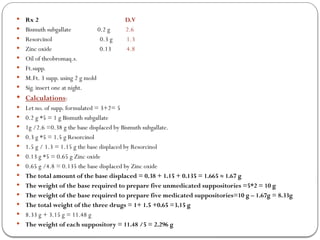
 Rx 2 D.V
 Bismuth subgallate 0.2 g 2.6
 Resorcinol 0.3 g 1.3
 Zinc oxide 0.13 4.8
 Oil of theobromaq.s.
 Ft.supp.
 M.Ft. 3 supp. using 2 g mold
 Sig. insert one at night.
 Calculations:
 Let no. of supp. formulated = 3+2= 5
 0.2 g *5 = 1 g Bismuth subgallate
 1g /2.6 =0.38 g the base displaced by Bismuth subgallate.
 0.3 g *5 = 1.5 g Resorcinol
 1.5 g / 1.3 = 1.15 g the base displaced by Resorcinol
 0.13 g *5 = 0.65 g Zinc oxide
 0.65 g /4.8 = 0.135 the base displaced by Zinc oxide
 The total amount of the base displaced = 0.38 + 1.15 + 0.135 = 1.665 ≈ 1.67 g
 The weight of the base required to prepare five unmedicated suppositories =5*2 = 10 g
 The weight of the base required to prepare five medicated suppositories=10 g – 1.67g = 8.33g
 The total weight of the three drugs = 1+ 1.5 +0.65 =3.15 g
 8.33 g + 3.15 g = 11.48 g
 The weight of each suppository = 11.48 /5 = 2.296 g
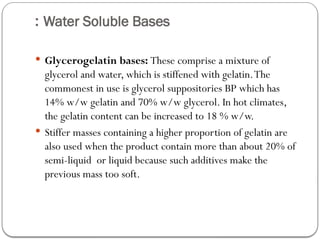
Water Soluble Bases
:
 Glycerogelatin bases: These comprise a mixture of
glycerol and water, which is stiffened with gelatin.The
commonest in use is glycerol suppositories BP which has
14% w/w gelatin and 70% w/w glycerol. In hot climates,
the gelatin content can be increased to 18 % w/w.
 Stiffer masses containing a higher proportion of gelatin are
also used when the product contain more than about 20% of
semi-liquid or liquid because such additives make the
previous mass too soft.
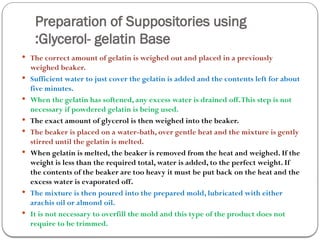
Preparation of Suppositories using
Glycerol- gelatin Base
:
 The correct amount of gelatin is weighed out and placed in a previously
weighed beaker.
 Sufficient water to just cover the gelatin is added and the contents left for about
five minutes.
 When the gelatin has softened, any excess water is drained off.This step is not
necessary if powdered gelatin is being used.
 The exact amount of glycerol is then weighed into the beaker.
 The beaker is placed on a water-bath, over gentle heat and the mixture is gently
stirred until the gelatin is melted.
 When gelatin is melted, the beaker is removed from the heat and weighed. If the
weight is less than the required total, water is added, to the perfect weight. If
the contents of the beaker are too heavy it must be put back on the heat and the
excess water is evaporated off.
 The mixture is then poured into the prepared mold, lubricated with either
arachis oil or almond oil.
 It is not necessary to overfill the mold and this type of the product does not
require to be trimmed.
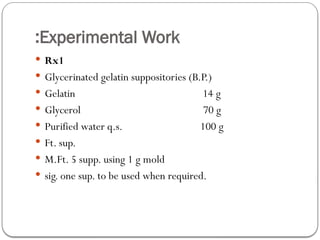
Experimental Work
:
 Rx1
 Glycerinated gelatin suppositories (B.P.)
 Gelatin 14 g
 Glycerol 70 g
 Purified water q.s. 100 g
 Ft. sup.
 M.Ft. 5 supp. using 1 g mold
 sig. one sup. to be used when required.
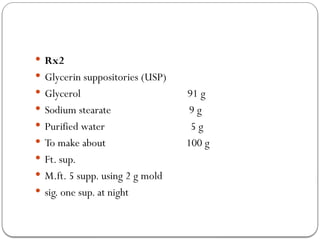
 Rx2
 Glycerin suppositories (USP)
 Glycerol 91 g
 Sodium stearate 9 g
 Purified water 5 g
 To make about 100 g
 Ft. sup.
 M.ft. 5 supp. using 2 g mold
 sig. one sup. at night
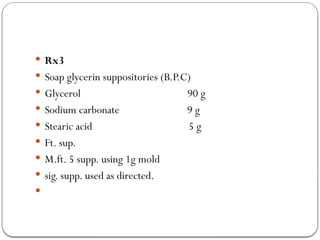
 Rx3
 Soap glycerin suppositories (B.P.C)
 Glycerol 90 g
 Sodium carbonate 9 g
 Stearic acid 5 g
 Ft. sup.
 M.ft. 5 supp. using 1g mold
 sig. supp. used as directed.

Macrogols (PEG)
 These polyethylene glycols can be blended together to produce
suppository bases with varying: melting points, dissolution
rates and physical characteristics.
 Drug release depends on the base dissolving rather than
melting.The melting point is often around 50°C.
 Higher proportions of high molecular weight polymers
produce Preparations which release the drug slowly and are
also brittle.
 less brittle products which release the drug more readily can
be prepared by mixing high polymers with medium and low
polymers.
Experimental Work
 Rx 1
 PEG 1000 35%
 PEG 400 40%
 PEG 4000 25%
 Ft. supp.
 M.Ft. 5 supp. using 2 g mold
 Rx2
 PEG 400 20%
 PEG 6000 33%
 PEG 600 47%
 Ft.supp.
 M.Ft. 5 supp. using 2 g mold
 Rx3
 PEG 4000 20%
 PEG 1540 33%
 Water 47%
 Ft. supp.
 M.ft. 5 supp. using 1 g mold

Suppositories and suppository base PM.pptx

  • 1.
    By Lect. Ebtihal AbdulKadhim Assist. Lect. Zahraa Amer Suppositories
  • 2.
    SUPPOSITORIES  Are soliddosage forms intended for insertion into body orifices (such as vaginal or rectal cavity) where they melt, soften or dissolve and exert localized or systemic effects.  The shape and size of a suppository must be such that it is capable of being easily inserted into the intended body orifice without causing undue distention, and once inserted, it must be retained for appropriate period .
  • 3.
    Advantages of Suppository Usedto exert local action on the rectum and the vagina, such as in case of hemorrhoids, constipation and infections. Used for drugs destroyed or inactivated by the pH or enzymatic activity of the stomach or intestines. Used for drugs irritating to the stomach. Used for drugs destroyed by portal circulation. Used for patients who may be unable or unwilling to swallow medication ( as in infants) Used as an effective route in treatment of patients with vomiting episodes.
  • 4.
    Types of SuppositoryBase : there are two main classes of suppository base: The fatty bases: These bases melt at body temperature and consist of the naturally occurring theobroma oil (cocoa butter) and synthetic hard fats. Water – soluble and water – miscible bases: These bases dissolve or disperse in body fluids .There are two groups of water- soluble bases: Glycero –gelatin bases . Macrogols (PEG)
  • 5.
    Preparation of Suppository : Suppositories are formulated in different shapes and sizes (usually 1- 4g) .The suppository consists of a vehicle in which the drug is incorporated and in some cases , additives are co-formulated
  • 6.
    Suppositories are manufacturedby two general methods : • The drug is added to the melted base and the mixtureis allowed to cool after pouring into molds. Fusion method (hot process) : • The drug is incorporated with the unmelted base and the resulting massis shaped either by hand or by compression forced in metallic mold. Compression method ( Cold process :)
  • 7.
    Calibration of theMold :  Molds in common use today are made from stainless steel, aluminium , brass or plastic.The molds, which separate into sections,generally longitudinally.  The capacity of the mold is confirmed by filling the mold with the chosen base.The weight of the perfect products is taken and the mean weight is calculated .This value is the calibration value of the mold for that particular base.
  • 8.
    Displacement Value (DVs) : The volume of a suppository from a particular mold is uniform but its weight will vary because the density of the medicaments usually differs from the density of the base.  The displacement value of a drug is the number of parts by weight of drug which displaces one part weight of the base.
  • 9.
    Drug 5 gm BASE 10 gm 1gm of base Therefore DV is (5) As the displacement equal in volume not the mass !
  • 10.
    Example Rx1 :  Bismuthsubgallate 300 mg  Cocoa butter q.s.  Ft. supp.  M.ft. 6 supp. using 1 g mold  Calculations :  To allow for unavoidable wastage , we calculate for eight suppositories.  DV of bismuth subgalallate = 2.7 (i.e. 2.7 g )  bismuth subgallate = 8*300 mg = 2.4 g  2.4/2.7 = 0.89 g displaced base  The weight of base required to prepare eight unmedicated suppositories= 1*8 = 8 g  Therefore , the weight of base required for medicated suppositories = 8 – 0.89 = 7.21 g
  • 11.
    Example 2 :  calculatethe DV of the drug in cocoa butter ( base) containing 40% of drug and prepared in 1 g mold  ( wight of 6 supp is 8.8 ) :  A batch of unmedicated suppositories is prepared and the products are weighed.  A batch of medicated suppositories containing a known concentration of the required drug is prepared and the products are weighed .
  • 12.
    Answer  Weight ofsix unmedicated suppositories = 6 g ( since the mould is fixed (1gm each )  Weight of six medicated suppositories containing 40% drug = 8.8 g ( from the question)  Weight of the base in the suppositories = 60% (60/100)*8.8 = 5.28 g  Weight of the drug in the suppositories = 40 % (40/100)*8.8 = 3.52 g  Weight of the base displaced by the drug = 6 -5.28 = 0.72 g  If the 0.72 g of the base is displaced by 3.52g of the drug then 1 g of the base is displaced by 3.52/0.72 = 4.88 g  Therefore displacement value of the drug is 4.9
  • 13.
    Preparation of SuppositoriesUsing theobroma oil base : 1 • Accurately weigh the required amount of the base , place in beaker and put on water bath over gentle heat. 2 • Allow approximately two- thirds of the base to melt and remove from the heat.The residual heat will be sufficient for the rest of the base to melt. 3 • Reduce the particle size of the active ingredients, if necessary.This will be done by either grinding in a mortar and pestle or by sieving . 4 • Weigh the correct amount of medicament and place on a slab. 5 • Add about half of the molten base to the powdered drug and rub together with a spatula.
  • 14.
    Preparation of Suppositories(continued ) : 6 • Scrap this mixture off the slab, using the spatula and place back into the beaker. 7 • If necessary, put the beaker back over the water bath to re-melt the ingredients 8 • Remove from the heat and stir constantly until almost on the point of setting 9 • Quickly pour into the mold, slightly overfill each cavity.This is done to allow for contraction on cooling. 10 • Leave the mold and its contents to cool for about 5 minutes and then, using a spatula, trim the tops of the suppositories. 11 • Allow to cool for another 10-15 minutes until the suppositories are firm and set.
  • 15.
    Experimental Work :  Rx1 DV  Tannic acid gr v 0.9  Oil of theobroma q.s.  Ft. sup.  M. ft. iii supp. using 2 g mold  Sig. insert one as directed  Calculations:  5 gr= 5* 0.065g =0.325 g  Let no. of supp. formulated = 3+2= 5  0.325 *5 = 1.65 g of tannic acid  The weight of base required to prepare five unmedicated suppositories= 5*2 = 10 g  1.65 g/ 0.9 = 1.83g the base displaced by tannic acid .  Therefore the weight of the base required to prepare the medicated suppositories = 10 g – 1.83 g = 8.17g  The total weight = 8.17g + 1.65 g = 9.82 g  The weight of each supp. = 9.82g /5 = 1.96 g
  • 16.
     Rx 2D.V  Bismuth subgallate 0.2 g 2.6  Resorcinol 0.3 g 1.3  Zinc oxide 0.13 4.8  Oil of theobromaq.s.  Ft.supp.  M.Ft. 3 supp. using 2 g mold  Sig. insert one at night.  Calculations:  Let no. of supp. formulated = 3+2= 5  0.2 g *5 = 1 g Bismuth subgallate  1g /2.6 =0.38 g the base displaced by Bismuth subgallate.  0.3 g *5 = 1.5 g Resorcinol  1.5 g / 1.3 = 1.15 g the base displaced by Resorcinol  0.13 g *5 = 0.65 g Zinc oxide  0.65 g /4.8 = 0.135 the base displaced by Zinc oxide  The total amount of the base displaced = 0.38 + 1.15 + 0.135 = 1.665 ≈ 1.67 g  The weight of the base required to prepare five unmedicated suppositories =5*2 = 10 g  The weight of the base required to prepare five medicated suppositories=10 g – 1.67g = 8.33g  The total weight of the three drugs = 1+ 1.5 +0.65 =3.15 g  8.33 g + 3.15 g = 11.48 g  The weight of each suppository = 11.48 /5 = 2.296 g
  • 17.
    Water Soluble Bases : Glycerogelatin bases: These comprise a mixture of glycerol and water, which is stiffened with gelatin.The commonest in use is glycerol suppositories BP which has 14% w/w gelatin and 70% w/w glycerol. In hot climates, the gelatin content can be increased to 18 % w/w.  Stiffer masses containing a higher proportion of gelatin are also used when the product contain more than about 20% of semi-liquid or liquid because such additives make the previous mass too soft.
  • 18.
    Preparation of Suppositoriesusing Glycerol- gelatin Base :  The correct amount of gelatin is weighed out and placed in a previously weighed beaker.  Sufficient water to just cover the gelatin is added and the contents left for about five minutes.  When the gelatin has softened, any excess water is drained off.This step is not necessary if powdered gelatin is being used.  The exact amount of glycerol is then weighed into the beaker.  The beaker is placed on a water-bath, over gentle heat and the mixture is gently stirred until the gelatin is melted.  When gelatin is melted, the beaker is removed from the heat and weighed. If the weight is less than the required total, water is added, to the perfect weight. If the contents of the beaker are too heavy it must be put back on the heat and the excess water is evaporated off.  The mixture is then poured into the prepared mold, lubricated with either arachis oil or almond oil.  It is not necessary to overfill the mold and this type of the product does not require to be trimmed.
  • 19.
    Experimental Work :  Rx1 Glycerinated gelatin suppositories (B.P.)  Gelatin 14 g  Glycerol 70 g  Purified water q.s. 100 g  Ft. sup.  M.Ft. 5 supp. using 1 g mold  sig. one sup. to be used when required.
  • 20.
     Rx2  Glycerinsuppositories (USP)  Glycerol 91 g  Sodium stearate 9 g  Purified water 5 g  To make about 100 g  Ft. sup.  M.ft. 5 supp. using 2 g mold  sig. one sup. at night
  • 21.
     Rx3  Soapglycerin suppositories (B.P.C)  Glycerol 90 g  Sodium carbonate 9 g  Stearic acid 5 g  Ft. sup.  M.ft. 5 supp. using 1g mold  sig. supp. used as directed. 
  • 22.
    Macrogols (PEG)  Thesepolyethylene glycols can be blended together to produce suppository bases with varying: melting points, dissolution rates and physical characteristics.  Drug release depends on the base dissolving rather than melting.The melting point is often around 50°C.  Higher proportions of high molecular weight polymers produce Preparations which release the drug slowly and are also brittle.  less brittle products which release the drug more readily can be prepared by mixing high polymers with medium and low polymers.
  • 23.
    Experimental Work  Rx1  PEG 1000 35%  PEG 400 40%  PEG 4000 25%  Ft. supp.  M.Ft. 5 supp. using 2 g mold
  • 24.
     Rx2  PEG400 20%  PEG 6000 33%  PEG 600 47%  Ft.supp.  M.Ft. 5 supp. using 2 g mold
  • 25.
     Rx3  PEG4000 20%  PEG 1540 33%  Water 47%  Ft. supp.  M.ft. 5 supp. using 1 g mold