ST. VINCENT PALLOTTI COLLEGE OF ENGINEERING & TECHNOLOGY, NAGPUR
DEPARTMENT OF ELECTRONICS & TELECOMMUNICATION ENGINEERING
BEETE701T: DSP PROCESSOR & ARCHITECTURE
Instructor :M N Kapse
Email: mkapse@stvincentngp.edu.in
O
b
j
e
c
t
i
v
e
s
2
To study Programmable DSP Processors.
To provide an understanding of the fundamentals of DSP
techniques.
To study implementation & applications of DSP
techniques.
To study multi-rate filters.
To understand architecture of DSP processor.
M N KAPSE, SVPCET, NAGPUR
Outcome:
By the end of this course, the students shall be able to ,
3
to describe the detailed architecture, addressing mode,
instruction sets of TMS320C5X
to write program of DSP processor.
to design & implement DSP algorithm using code composer
studio
to design decimation filter and interpolation filter.
M N KAPSE, SVPCET, NAGPUR
UNIT 1 : FUNDAMENTALS OF PROGRAMMABLE DSPs
Multiplier and Multiplier accumulator
Modified Bus Structures and Memory access in P-DSPs
Multiple access memory
Multi-ported memory.
VLIW architecture, Pipelining, Special Addressing modes in PDSPs
On chip Peripherals
Von Neumann and Harvard Architecture, MAC
Computational accuracy in DSP processor
M N KAPSE, SVPCET, NAGPUR 5
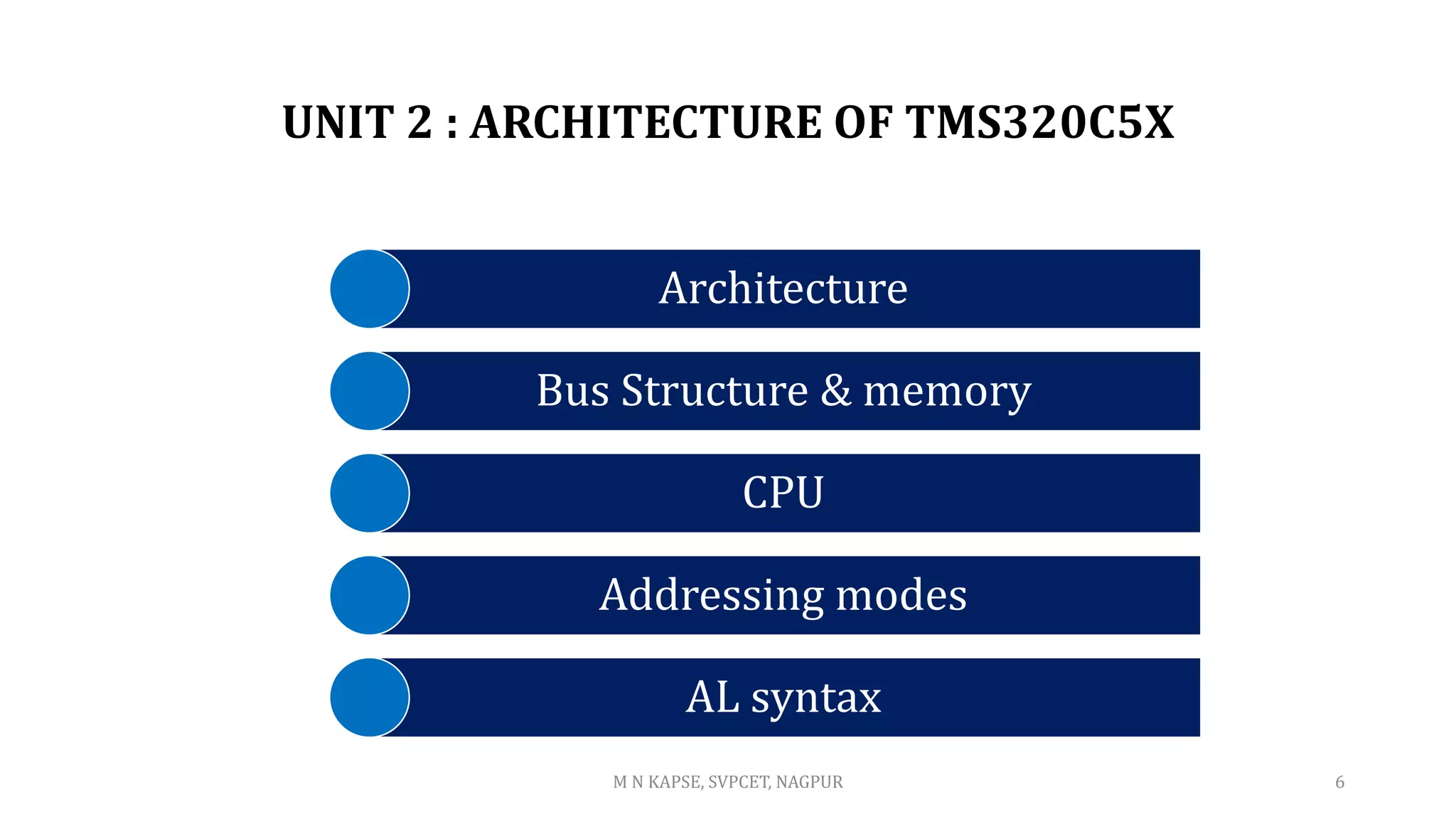
UNIT 2 : ARCHITECTURE OF TMS320C5X
Architecture
Bus Structure & memory
CPU
Addressing modes
AL syntax
M N KAPSE, SVPCET, NAGPUR 6
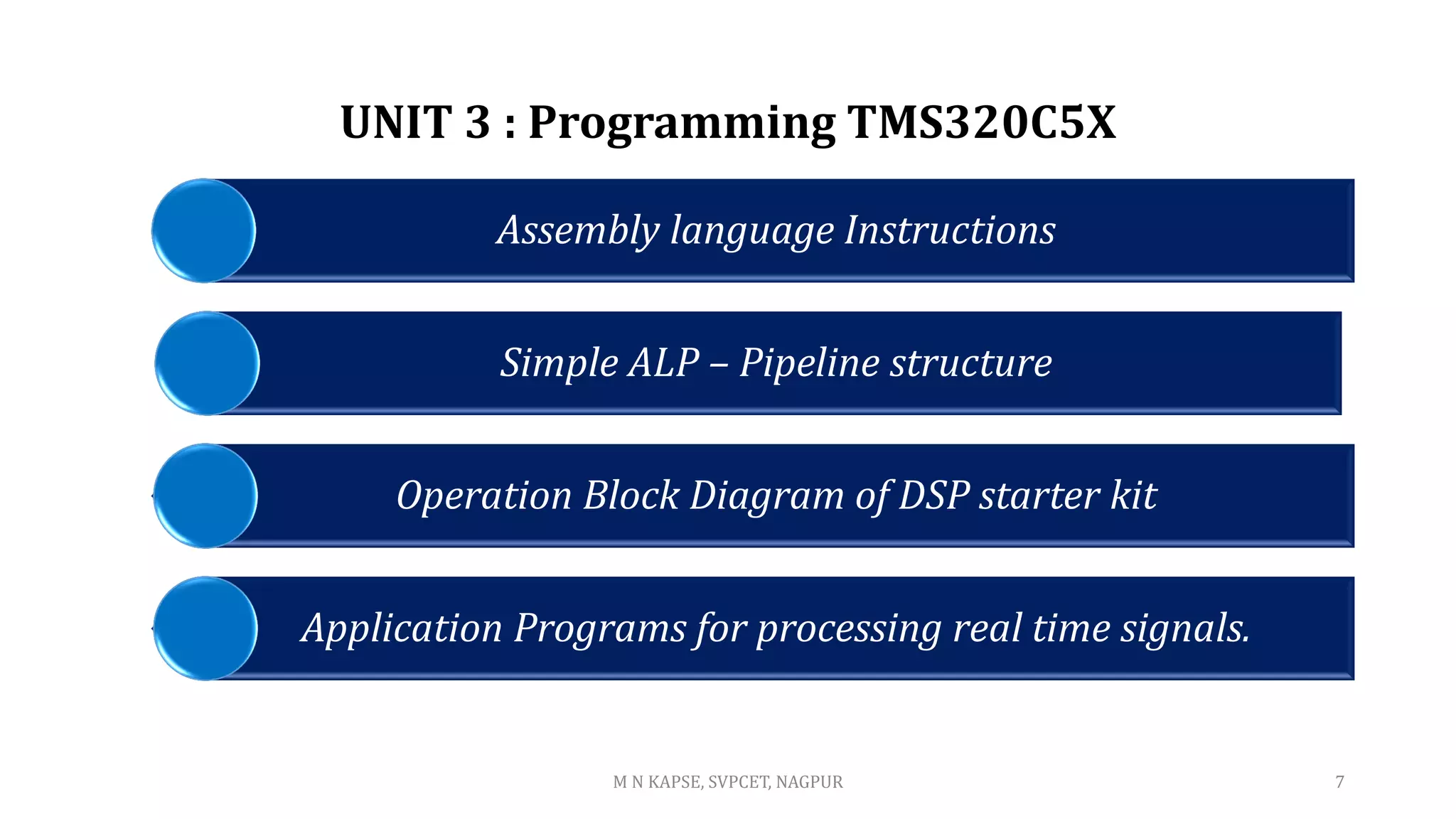
UNIT 3 : Programming TMS320C5X
Assembly language Instructions
Simple ALP – Pipeline structure
Operation Block Diagram of DSP starter kit
Application Programs for processing real time signals.
M N KAPSE, SVPCET, NAGPUR 7
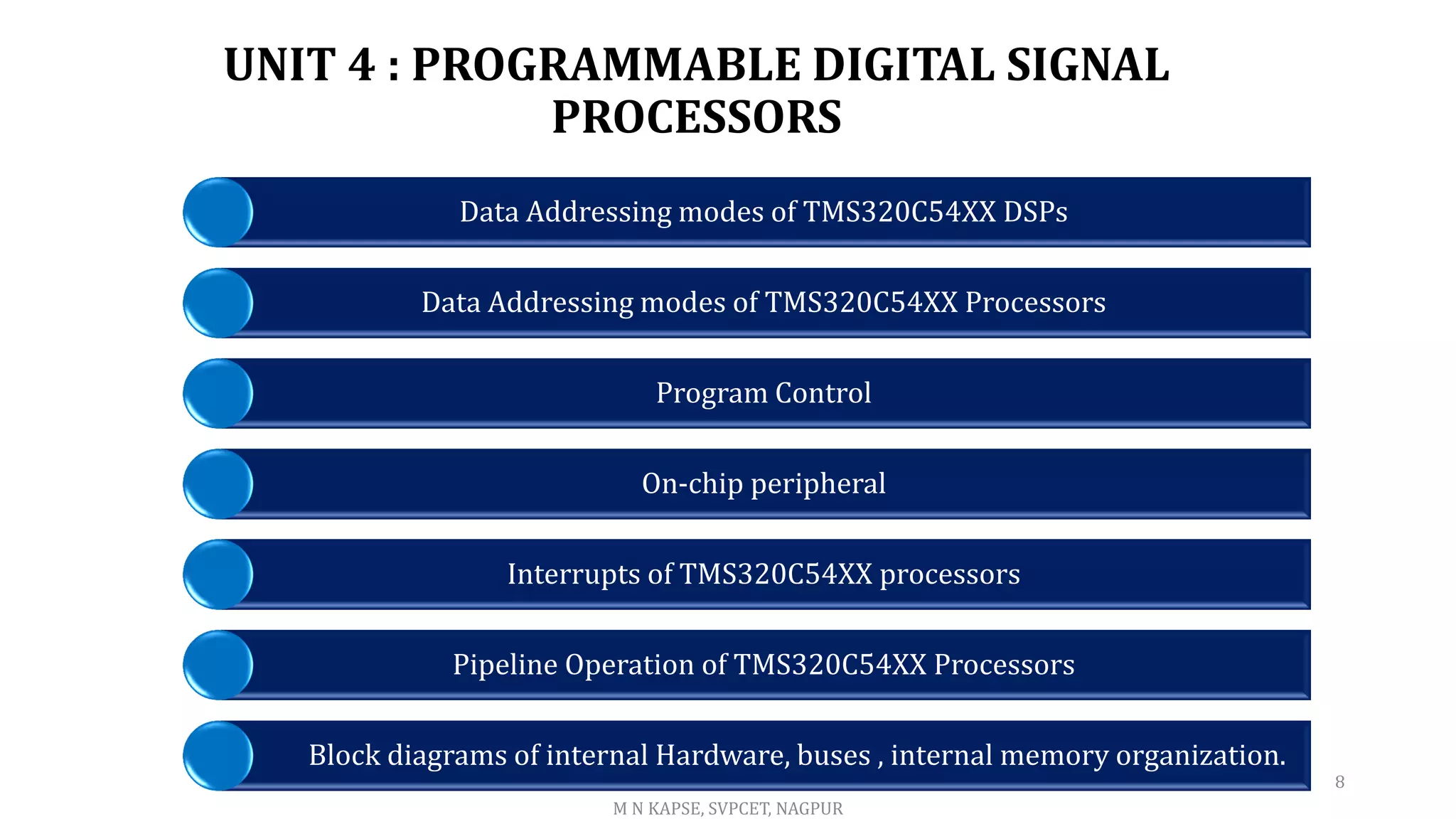
UNIT 4 : PROGRAMMABLE DIGITAL SIGNAL
PROCESSORS
Data Addressing modes of TMS320C54XX DSPs
Data Addressing modes of TMS320C54XX Processors
Program Control
On-chip peripheral
Interrupts of TMS320C54XX processors
Pipeline Operation of TMS320C54XX Processors
Block diagrams of internal Hardware, buses , internal memory organization.
M N KAPSE, SVPCET, NAGPUR
8
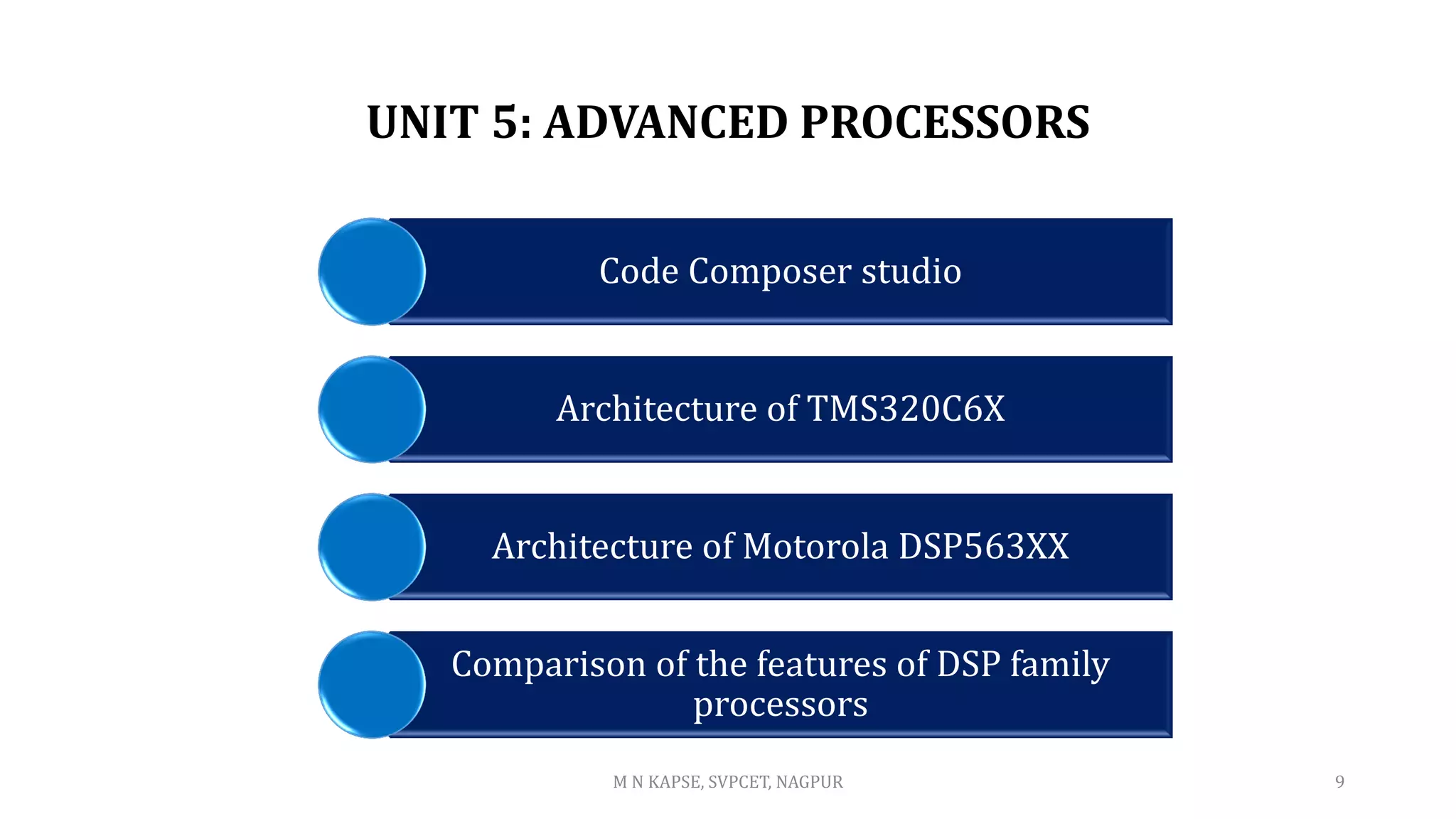
UNIT 5: ADVANCED PROCESSORS
Code Composer studio
Architecture of TMS320C6X
Architecture of Motorola DSP563XX
Comparison of the features of DSP family
processors
M N KAPSE, SVPCET, NAGPUR 9
UNIT 6: IMPLEMENTATION OF BASIC DSP ALGORITHMS
Study of time complexity of DFT and FFT algorithm
Use of FFT for filtering long data sequence
Interpolation filter
Decimation filter
Wavelet filter
M N KAPSE, SVPCET, NAGPUR
10
T
e
x
t
B
o
o
k
s
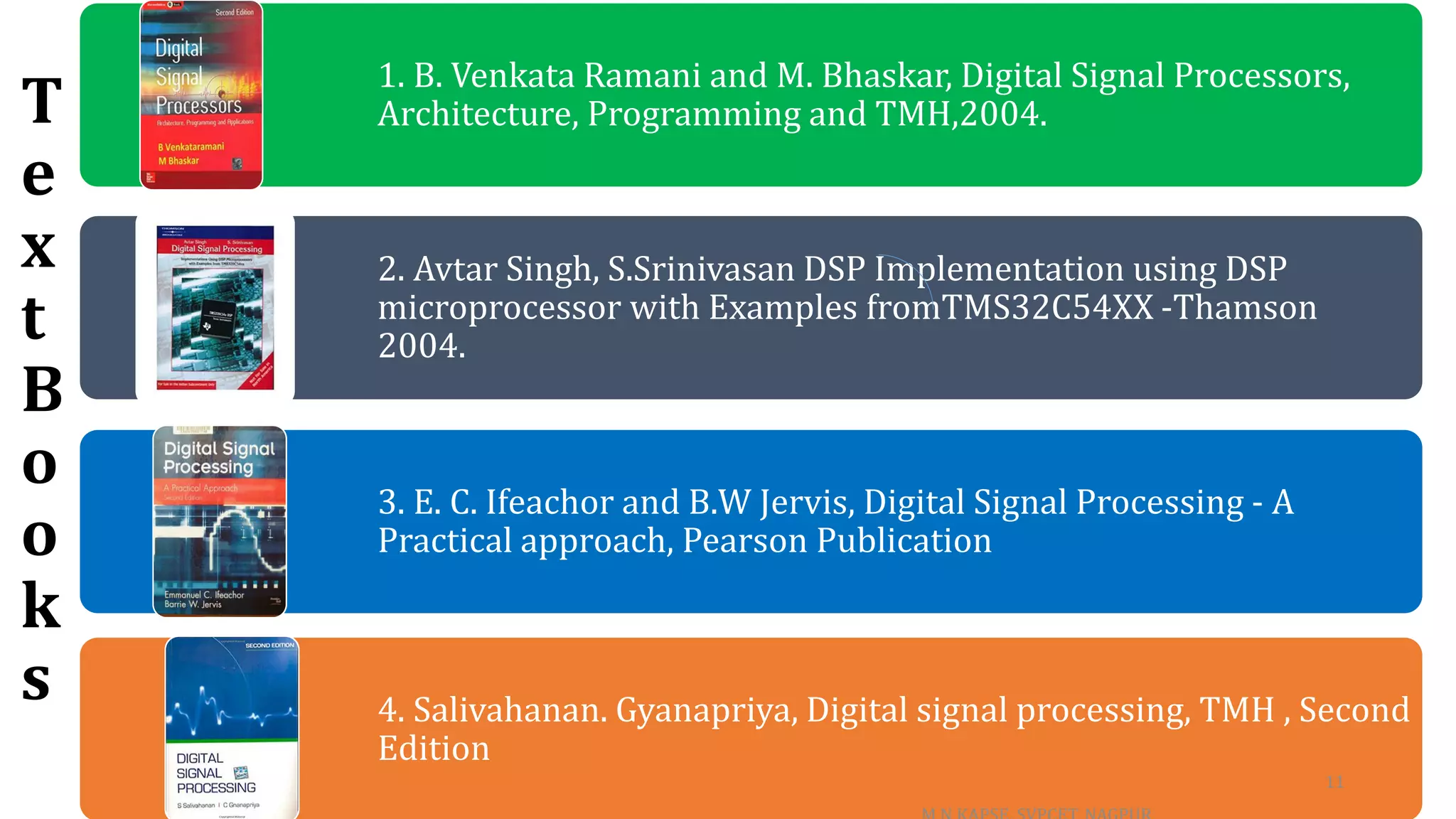
1. B. Venkata Ramani and M. Bhaskar, Digital Signal Processors,
Architecture, Programming and TMH,2004.
2. Avtar Singh, S.Srinivasan DSP Implementation using DSP
microprocessor with Examples fromTMS32C54XX -Thamson
2004.
3. E. C. Ifeachor and B.W Jervis, Digital Signal Processing - A
Practical approach, Pearson Publication
4. Salivahanan. Gyanapriya, Digital signal processing, TMH , Second
Edition
11
R
e
f
e
r
e
n
c
e
B
o
o
k
s
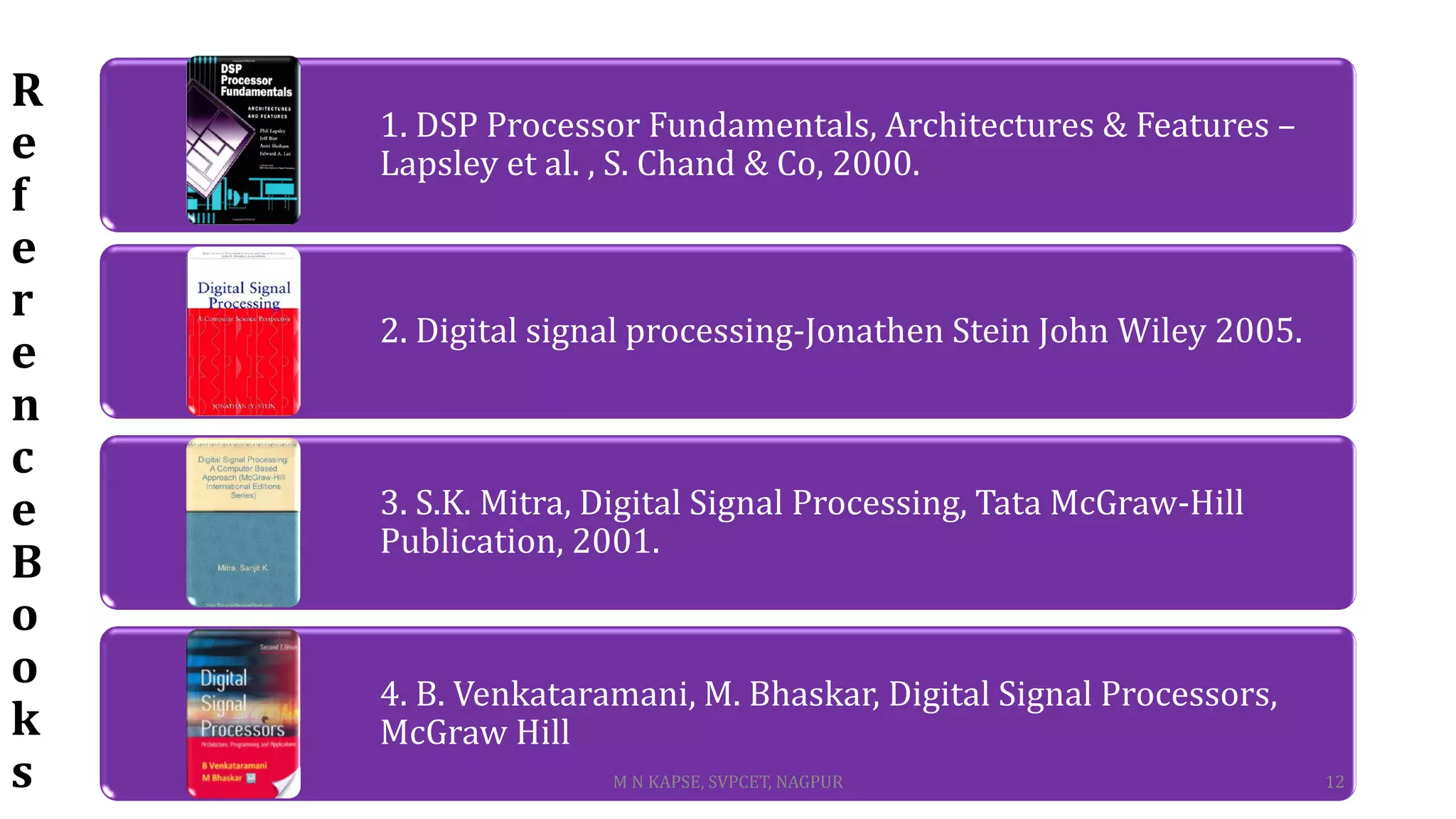
1. DSP Processor Fundamentals, Architectures & Features –
Lapsley et al. , S. Chand & Co, 2000.
2. Digital signal processing-Jonathen Stein John Wiley 2005.
3. S.K. Mitra, Digital Signal Processing, Tata McGraw-Hill
Publication, 2001.
4. B. Venkataramani, M. Bhaskar, Digital Signal Processors,
McGraw Hill
M N KAPSE, SVPCET, NAGPUR 12
Online References
https://www.ti.com/
…………..lit/ug/spru056d/spru056d.pdf
https://www.bdti.com/Resources/Comp.DSP.FAQ/Part3
………….Comp.DSP FAQ: Berkeley Design Technology, Inc
http://users.ece.utexas.edu/~bevans/courses/realtime/index.html
………………..EE445S Real-Time Digital Signal Processing Laboratory
http://dspfirst.gatech.edu/matlab/
………………Educational Matlab GUIs
http://dspfirst.gatech.edu/
M N KAPSE, SVPCET, NAGPUR
13
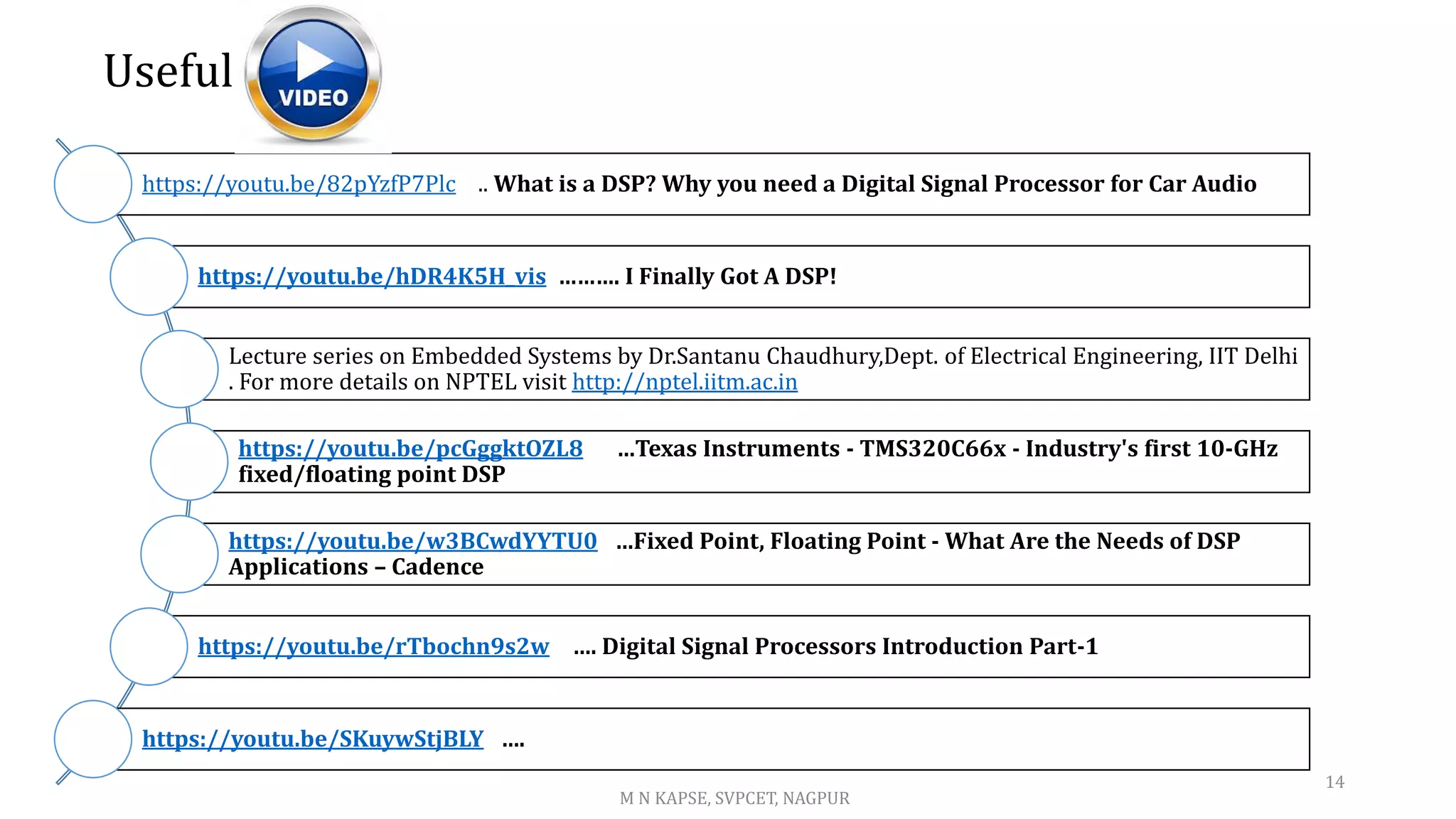
Useful
14
https://youtu.be/82pYzfP7Plc .. What is a DSP? Why you need a Digital Signal Processor for Car Audio
https://youtu.be/hDR4K5H_vis ………. I Finally Got A DSP!
Lecture series on Embedded Systems by Dr.Santanu Chaudhury,Dept. of Electrical Engineering, IIT Delhi
. For more details on NPTEL visit http://nptel.iitm.ac.in
https://youtu.be/pcGggktOZL8 …Texas Instruments - TMS320C66x - Industry's first 10-GHz
fixed/floating point DSP
https://youtu.be/w3BCwdYYTU0 …Fixed Point, Floating Point - What Are the Needs of DSP
Applications – Cadence
https://youtu.be/rTbochn9s2w …. Digital Signal Processors Introduction Part-1
https://youtu.be/SKuywStjBLY ….
M N KAPSE, SVPCET, NAGPUR
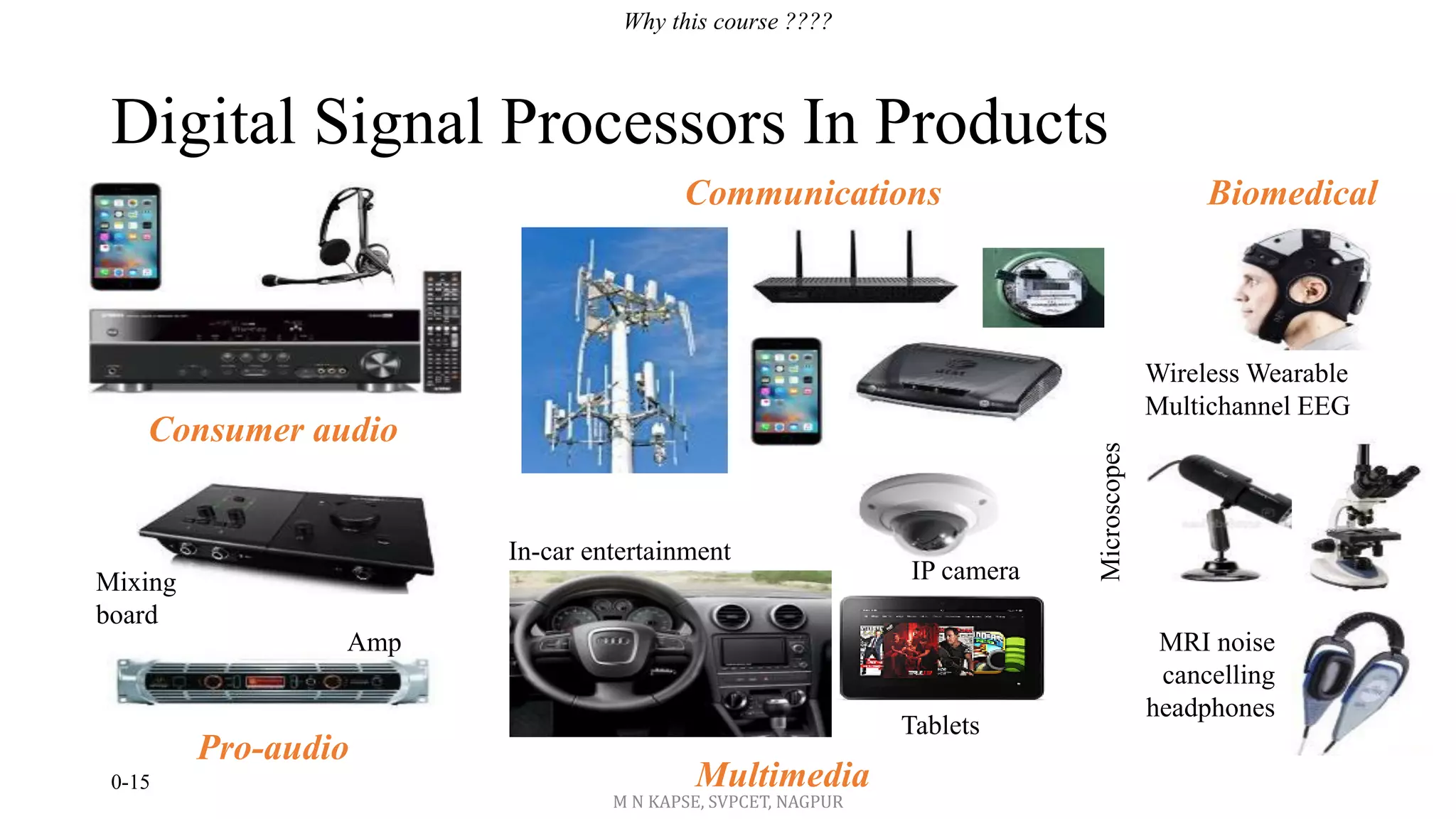
Digital Signal Processors In Products
0-15
Pro-audio
Amp
Mixing
board
IP camera
Multimedia
In-car entertainment
Tablets
Why this course ????
Consumer audio
Biomedical
Wireless Wearable
Multichannel EEG
Microscopes
MRI noise
cancelling
headphones
Communications
M N KAPSE, SVPCET, NAGPUR
16
M N KAPSE, SVPCET, NAGPUR
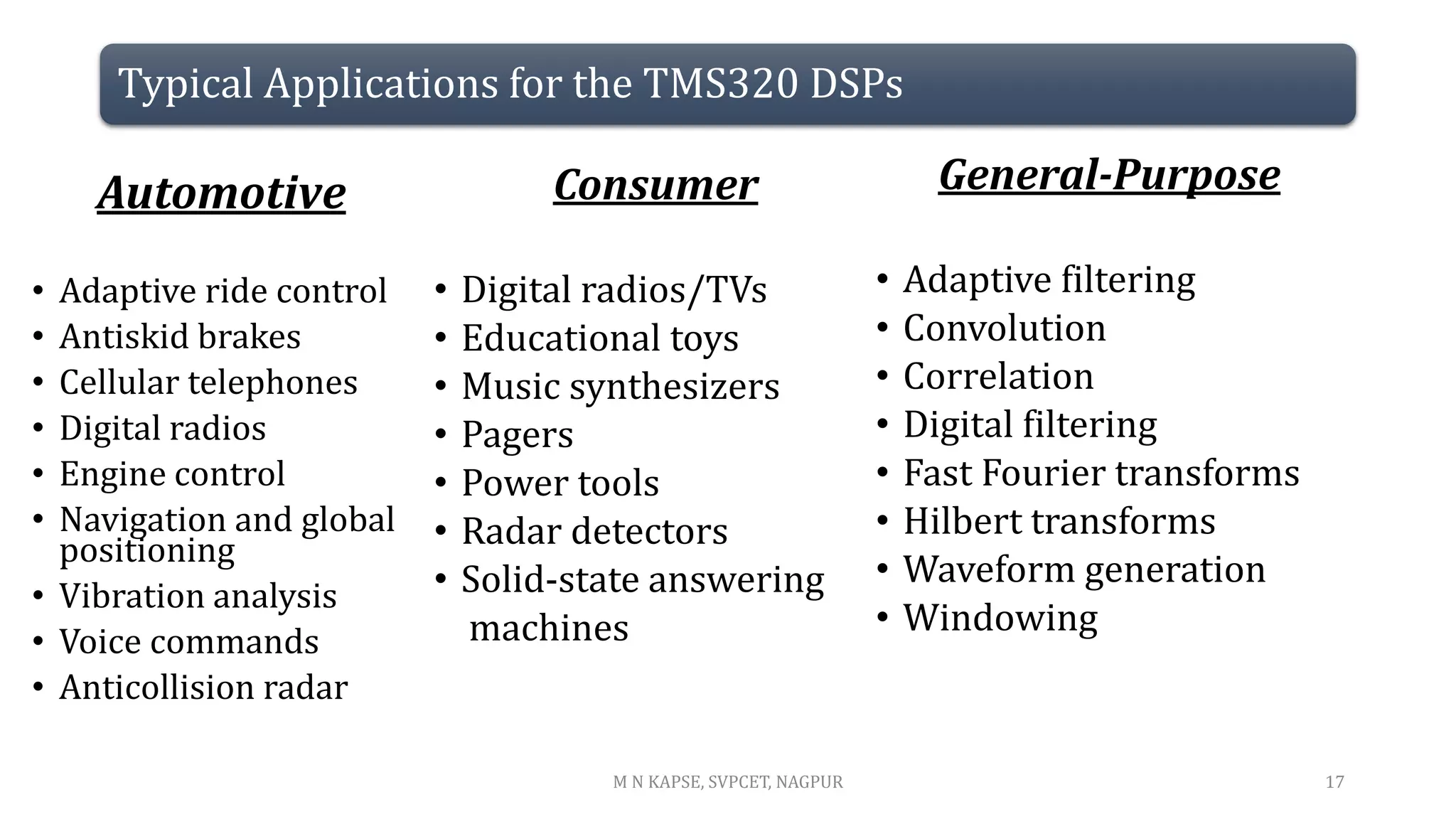
Typical Applications for the TMS320 DSPs
Automotive
• Adaptive ride control
• Antiskid brakes
• Cellular telephones
• Digital radios
• Engine control
• Navigation and global
positioning
• Vibration analysis
• Voice commands
• Anticollision radar
17
M N KAPSE, SVPCET, NAGPUR
Consumer
• Digital radios/TVs
• Educational toys
• Music synthesizers
• Pagers
• Power tools
• Radar detectors
• Solid-state answering
machines
General-Purpose
• Adaptive filtering
• Convolution
• Correlation
• Digital filtering
• Fast Fourier transforms
• Hilbert transforms
• Waveform generation
• Windowing
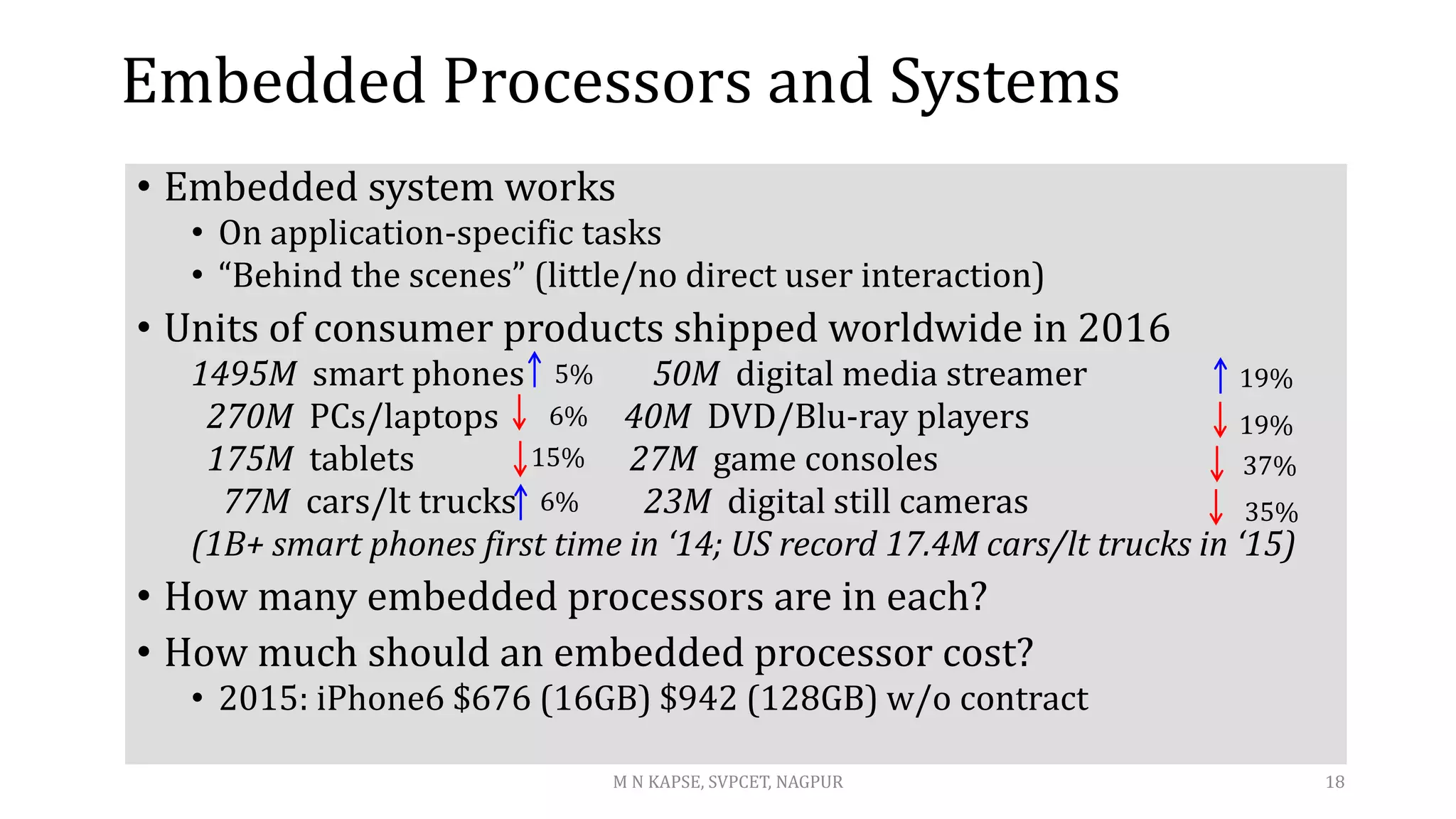
Embedded Processors and Systems
• Embedded system works
• On application-specific tasks
• “Behind the scenes” (little/no direct user interaction)
• Units of consumer products shipped worldwide in 2016
1495M smart phones 50M digital media streamer
270M PCs/laptops 40M DVD/Blu-ray players
175M tablets 27M game consoles
77M cars/lt trucks 23M digital still cameras
(1B+ smart phones first time in ‘14; US record 17.4M cars/lt trucks in ‘15)
• How many embedded processors are in each?
• How much should an embedded processor cost?
• 2015: iPhone6 $676 (16GB) $942 (128GB) w/o contract
19%
19%
37%
35%
6%
5%
15%
6%
M N KAPSE, SVPCET, NAGPUR 18
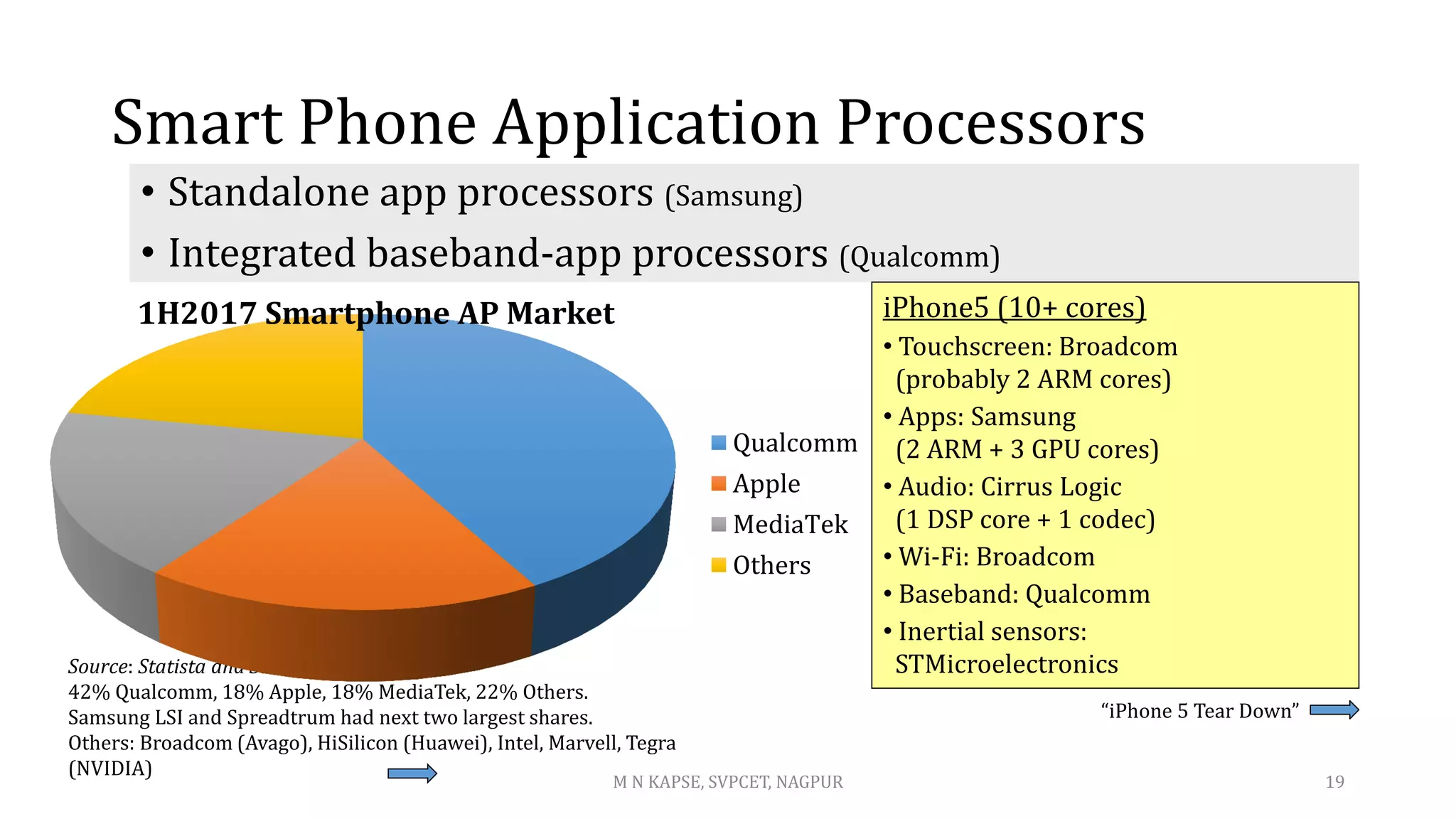
Smart Phone Application Processors
• Standalone app processors (Samsung)
• Integrated baseband-app processors (Qualcomm)
iPhone5 (10+ cores)
• Touchscreen: Broadcom
(probably 2 ARM cores)
• Apps: Samsung
(2 ARM + 3 GPU cores)
• Audio: Cirrus Logic
(1 DSP core + 1 codec)
• Wi-Fi: Broadcom
• Baseband: Qualcomm
• Inertial sensors:
STMicroelectronics
Source: Statista and Strategy Analytics
42% Qualcomm, 18% Apple, 18% MediaTek, 22% Others.
Samsung LSI and Spreadtrum had next two largest shares.
Others: Broadcom (Avago), HiSilicon (Huawei), Intel, Marvell, Tegra
(NVIDIA)
“iPhone 5 Tear Down”
1H2017 Smartphone AP Market
Qualcomm
Apple
MediaTek
Others
M N KAPSE, SVPCET, NAGPUR 19
Market for Application Processors
 Tablets $ 3.6B ‘13, $ 4.2B ‘14, $ 2.7B ’15, $ 2.1B ‘16
 Phones $18.0B ‘13, $20.9B ‘14, $20.1B ’15, $21.5B ’16
 32% revenue of all microprocessors in 2013 (est.)
[“Tablet and Cellphone Processors Offset PC MPU Weakness,” Aug 2013]
Tablet App Processor Market
Statista and Strategy Analytics
(1) Apple 37%, (2) Intel 18%,
(3) Qualcomm 16%, (4) Others 29%.
MediaTek and Samsung LSI had next two largest marker
shares.
HiSilicon (Huawei) performed well.
Decline in 2015 and 2016 due to strong competition from large screen smartphones
1H2017 Tablet AP Market
Apple
Intel
Qualcomm
Others
M N KAPSE, SVPCET, NAGPUR
20
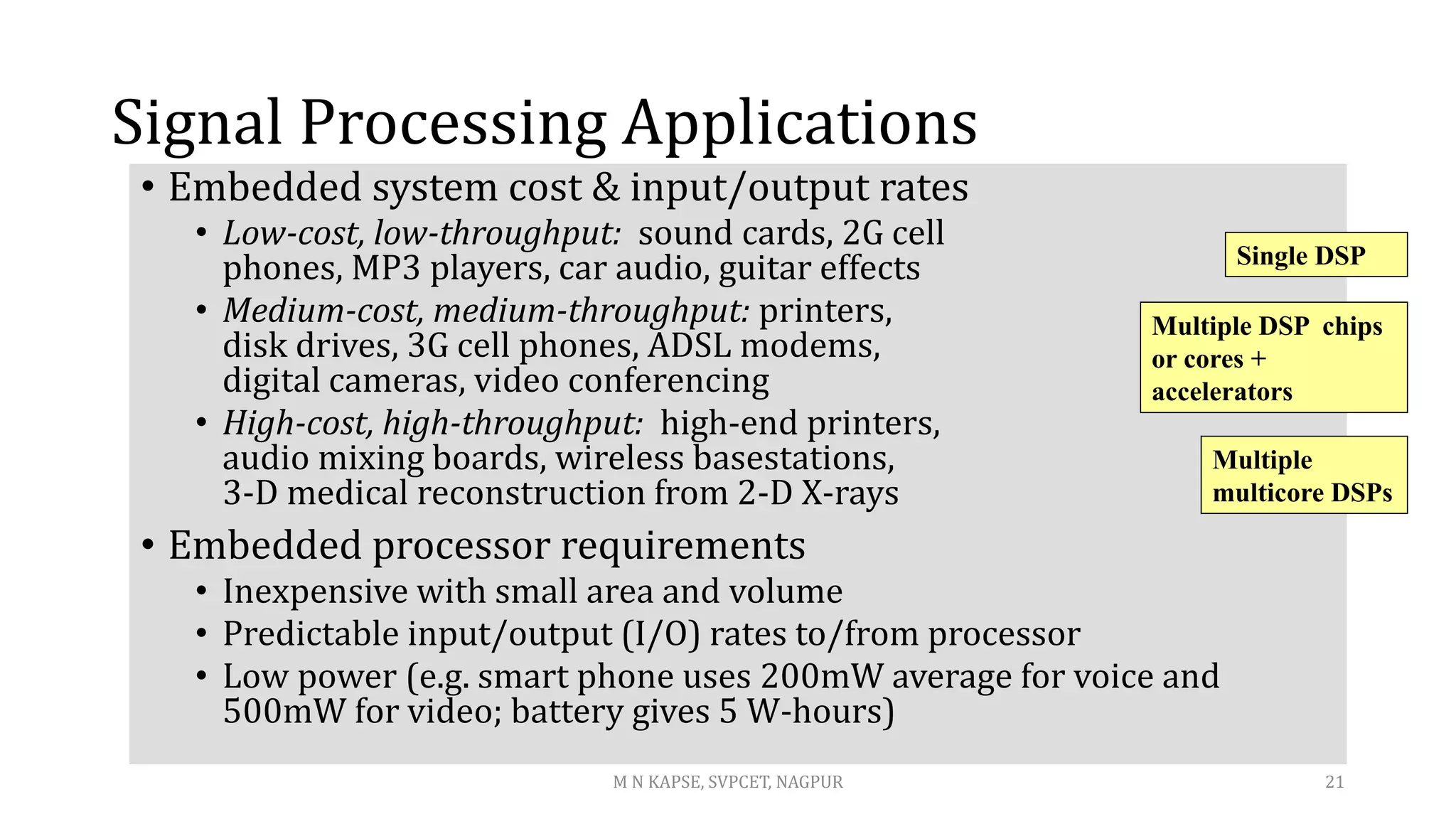
Signal Processing Applications
• Embedded system cost & input/output rates
• Low-cost, low-throughput: sound cards, 2G cell
phones, MP3 players, car audio, guitar effects
• Medium-cost, medium-throughput: printers,
disk drives, 3G cell phones, ADSL modems,
digital cameras, video conferencing
• High-cost, high-throughput: high-end printers,
audio mixing boards, wireless basestations,
3-D medical reconstruction from 2-D X-rays
• Embedded processor requirements
• Inexpensive with small area and volume
• Predictable input/output (I/O) rates to/from processor
• Low power (e.g. smart phone uses 200mW average for voice and
500mW for video; battery gives 5 W-hours)
Single DSP
Multiple
multicore DSPs
Multiple DSP chips
or cores +
accelerators
M N KAPSE, SVPCET, NAGPUR 21
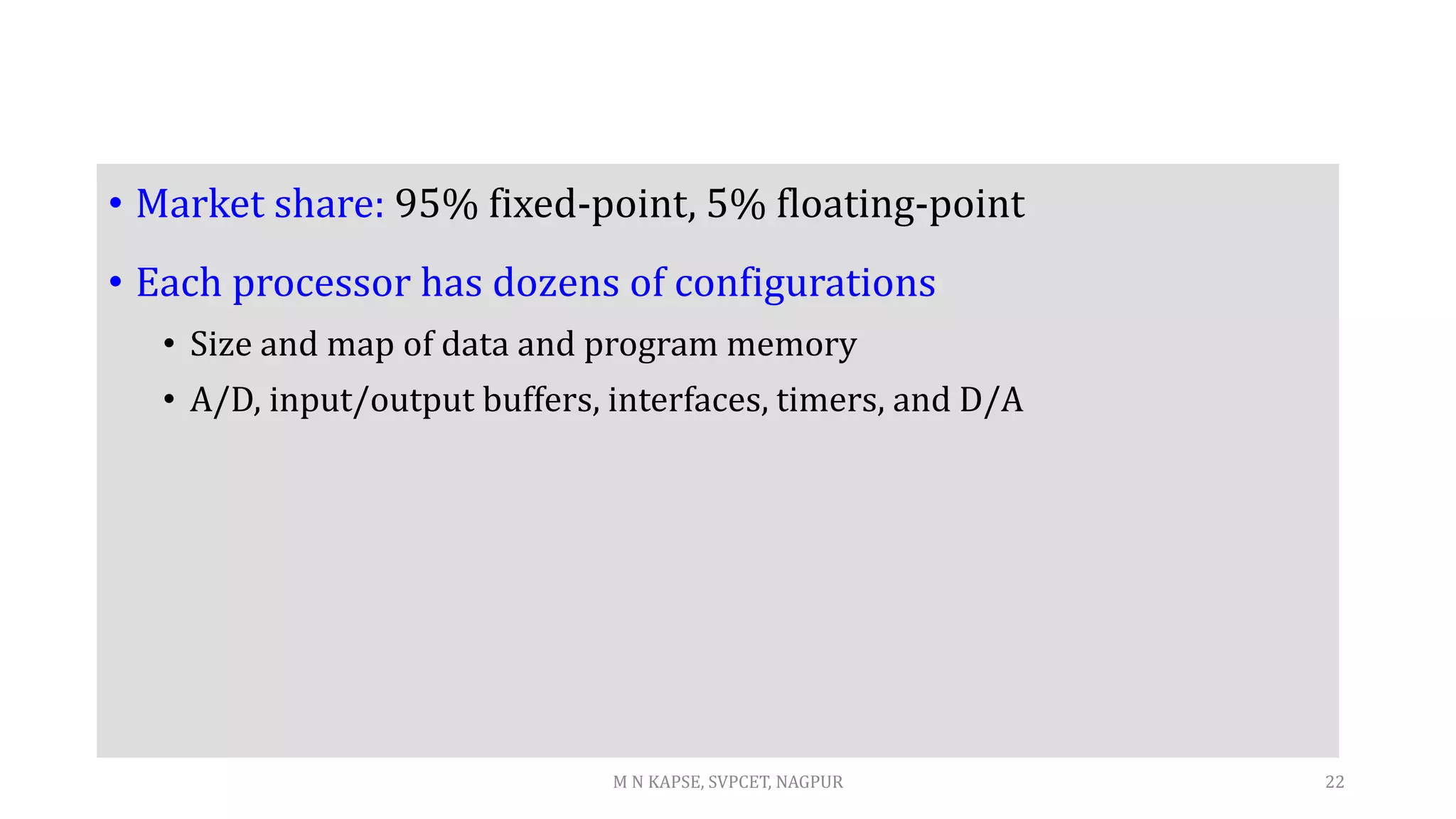
22
• Market share: 95% fixed-point, 5% floating-point
• Each processor has dozens of configurations
• Size and map of data and program memory
• A/D, input/output buffers, interfaces, timers, and D/A
M N KAPSE, SVPCET, NAGPUR
Pre-requisite :
23
• Basics understanding of DSP
• Convolution
• Filters
DSP
• Floating & Fixed
point
Maths
• Different functions &
utilities
MATLAB
Discussions
M N KAPSE, SVPCET, NAGPUR
UNIT 1:
FUNDAMENTALS OF PROGRAMMABLE DSPs
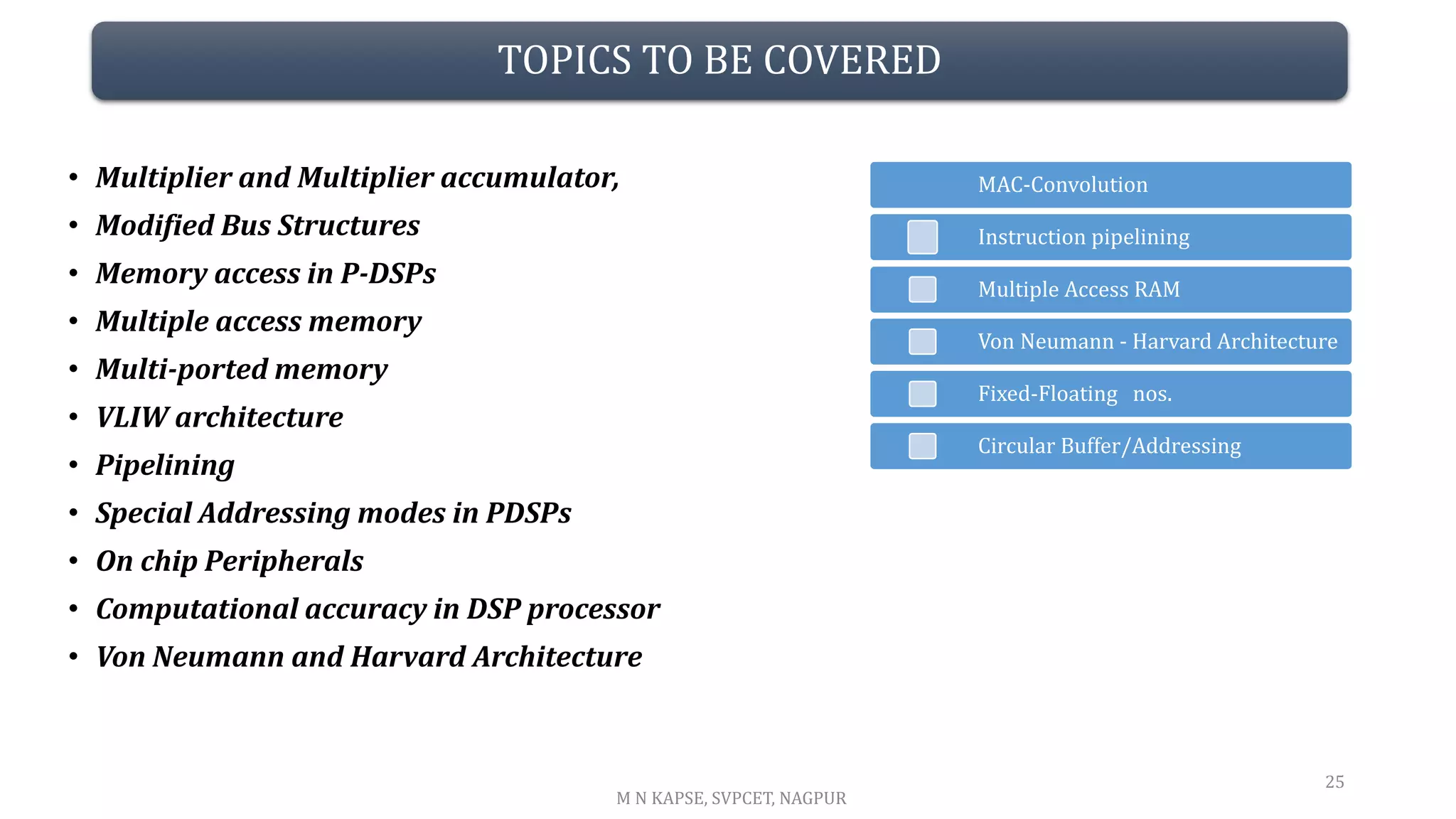
TOPICS TO BE COVERED
• Multiplier and Multiplier accumulator,
• Modified Bus Structures
• Memory access in P-DSPs
• Multiple access memory
• Multi-ported memory
• VLIW architecture
• Pipelining
• Special Addressing modes in PDSPs
• On chip Peripherals
• Computational accuracy in DSP processor
• Von Neumann and Harvard Architecture
25
M N KAPSE, SVPCET, NAGPUR
Multiple Access RAM
Instruction pipelining
MAC-Convolution
Von Neumann - Harvard Architecture
Fixed-Floating nos.
Circular Buffer/Addressing
26
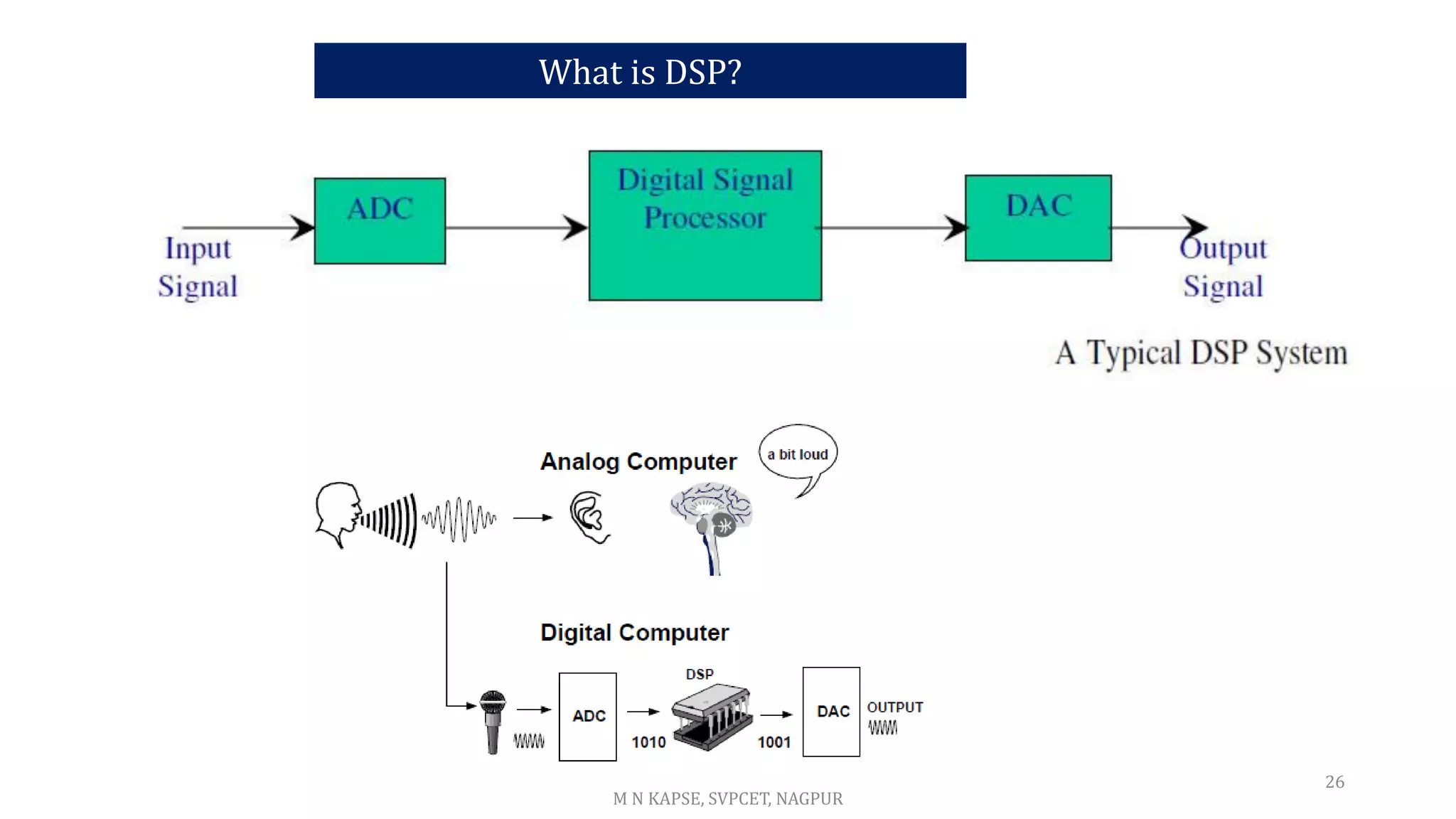
What is DSP?
M N KAPSE, SVPCET, NAGPUR
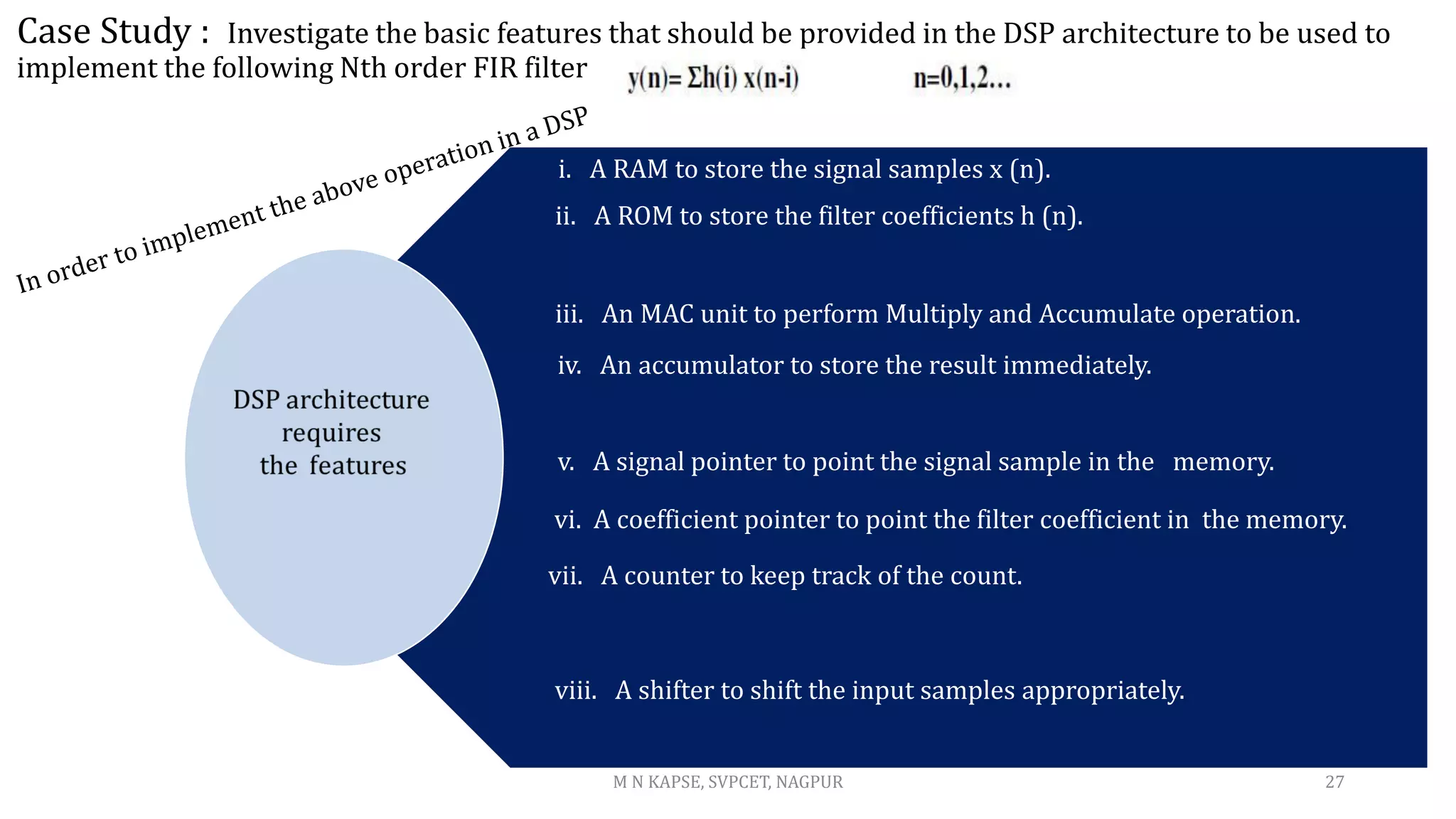
Case Study : Investigate the basic features that should be provided in the DSP architecture to be used to
implement the following Nth order FIR filter
27
M N KAPSE, SVPCET, NAGPUR
i. A RAM to store the signal samples x (n).
ii. A ROM to store the filter coefficients h (n).
iii. An MAC unit to perform Multiply and Accumulate operation.
iv. An accumulator to store the result immediately.
v. A signal pointer to point the signal sample in the memory.
vi. A coefficient pointer to point the filter coefficient in the memory.
vii. A counter to keep track of the count.
viii. A shifter to shift the input samples appropriately.
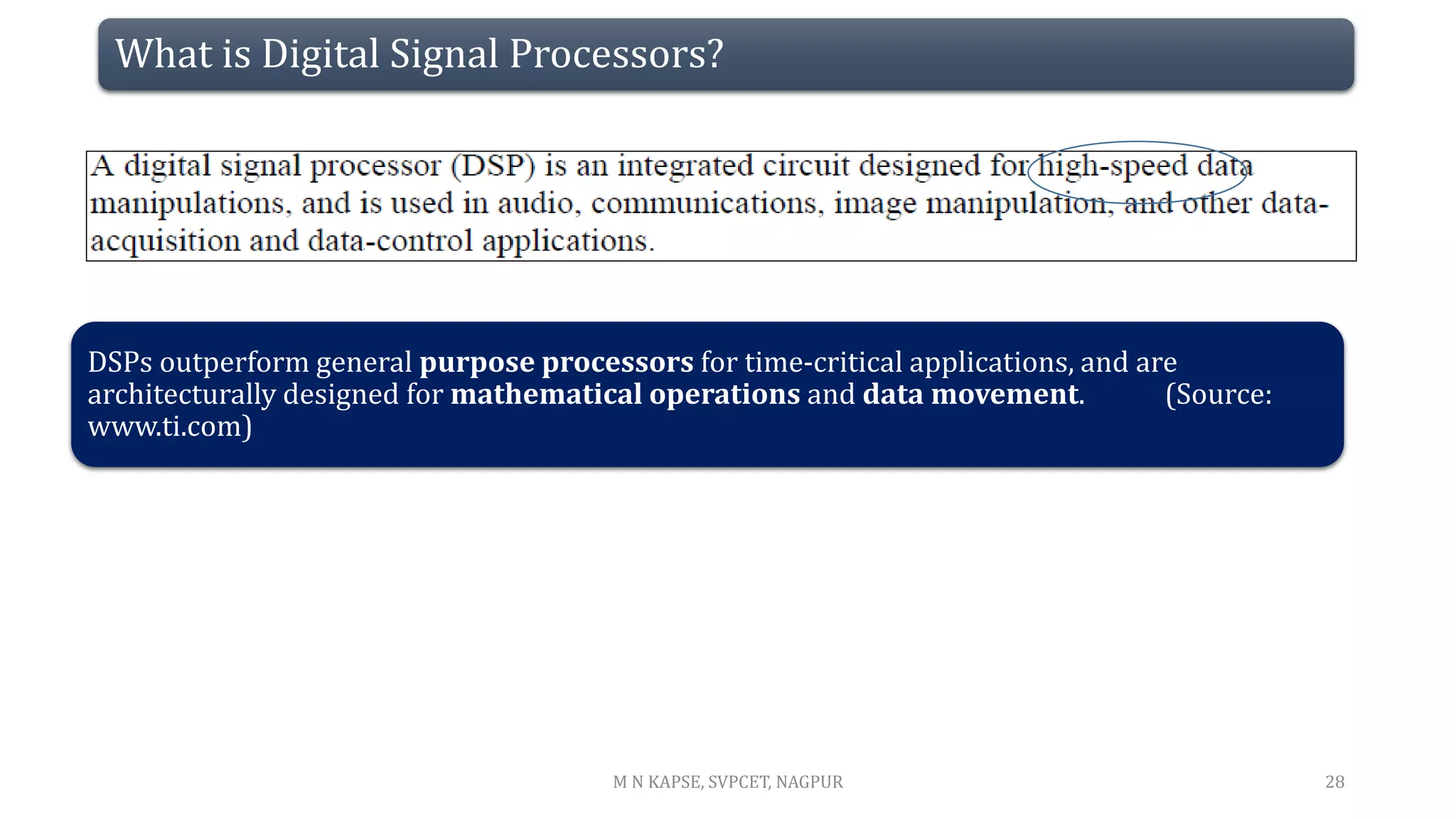
What is Digital Signal Processors?
DSPs outperform general purpose processors for time-critical applications, and are
architecturally designed for mathematical operations and data movement. (Source:
www.ti.com)
28
M N KAPSE, SVPCET, NAGPUR
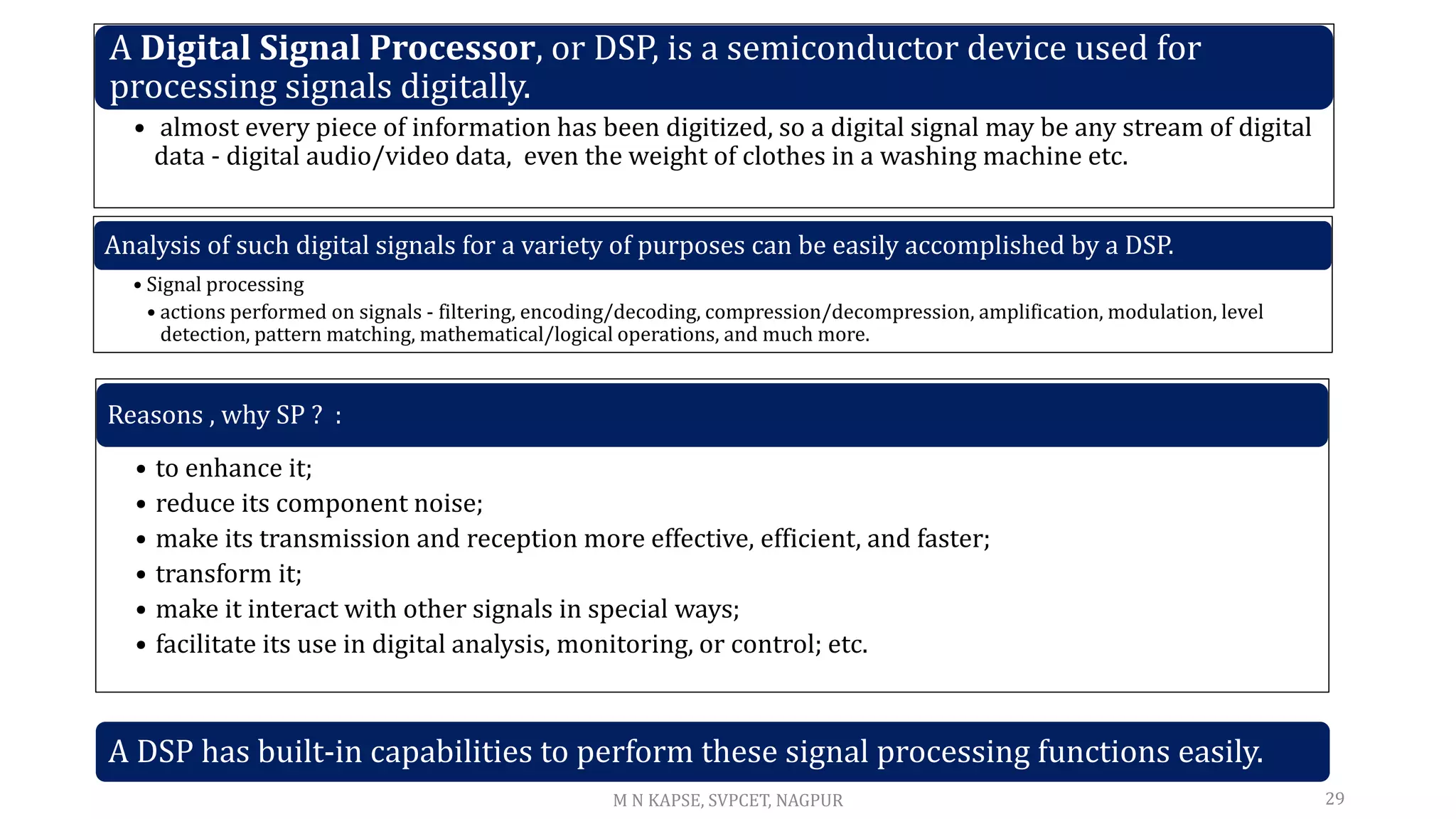
A DSP has built-in capabilities to perform these signal processing functions easily.
29
A Digital Signal Processor, or DSP, is a semiconductor device used for
processing signals digitally.
• almost every piece of information has been digitized, so a digital signal may be any stream of digital
data - digital audio/video data, even the weight of clothes in a washing machine etc.
Analysis of such digital signals for a variety of purposes can be easily accomplished by a DSP.
• Signal processing
• actions performed on signals - filtering, encoding/decoding, compression/decompression, amplification, modulation, level
detection, pattern matching, mathematical/logical operations, and much more.
Reasons , why SP ? :
• to enhance it;
• reduce its component noise;
• make its transmission and reception more effective, efficient, and faster;
• transform it;
• make it interact with other signals in special ways;
• facilitate its use in digital analysis, monitoring, or control; etc.
M N KAPSE, SVPCET, NAGPUR
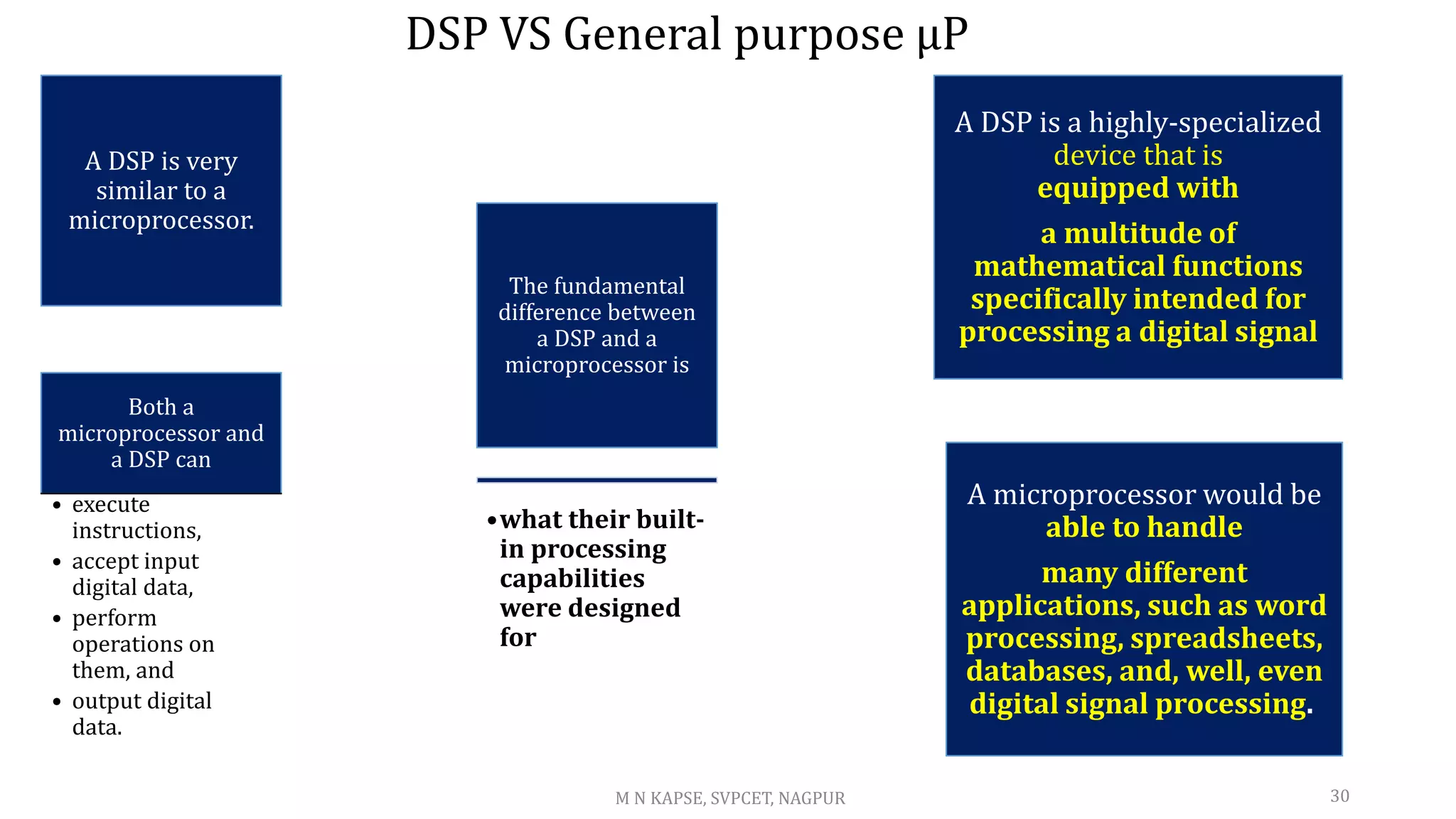
DSP VS General purpose µP
30
A DSP is very
similar to a
microprocessor.
Both a
microprocessor and
a DSP can
• execute
instructions,
• accept input
digital data,
• perform
operations on
them, and
• output digital
data.
The fundamental
difference between
a DSP and a
microprocessor is
•what their built-
in processing
capabilities
were designed
for
A DSP is a highly-specialized
device that is
equipped with
a multitude of
mathematical functions
specifically intended for
processing a digital signal
A microprocessor would be
able to handle
many different
applications, such as word
processing, spreadsheets,
databases, and, well, even
digital signal processing.
M N KAPSE, SVPCET, NAGPUR
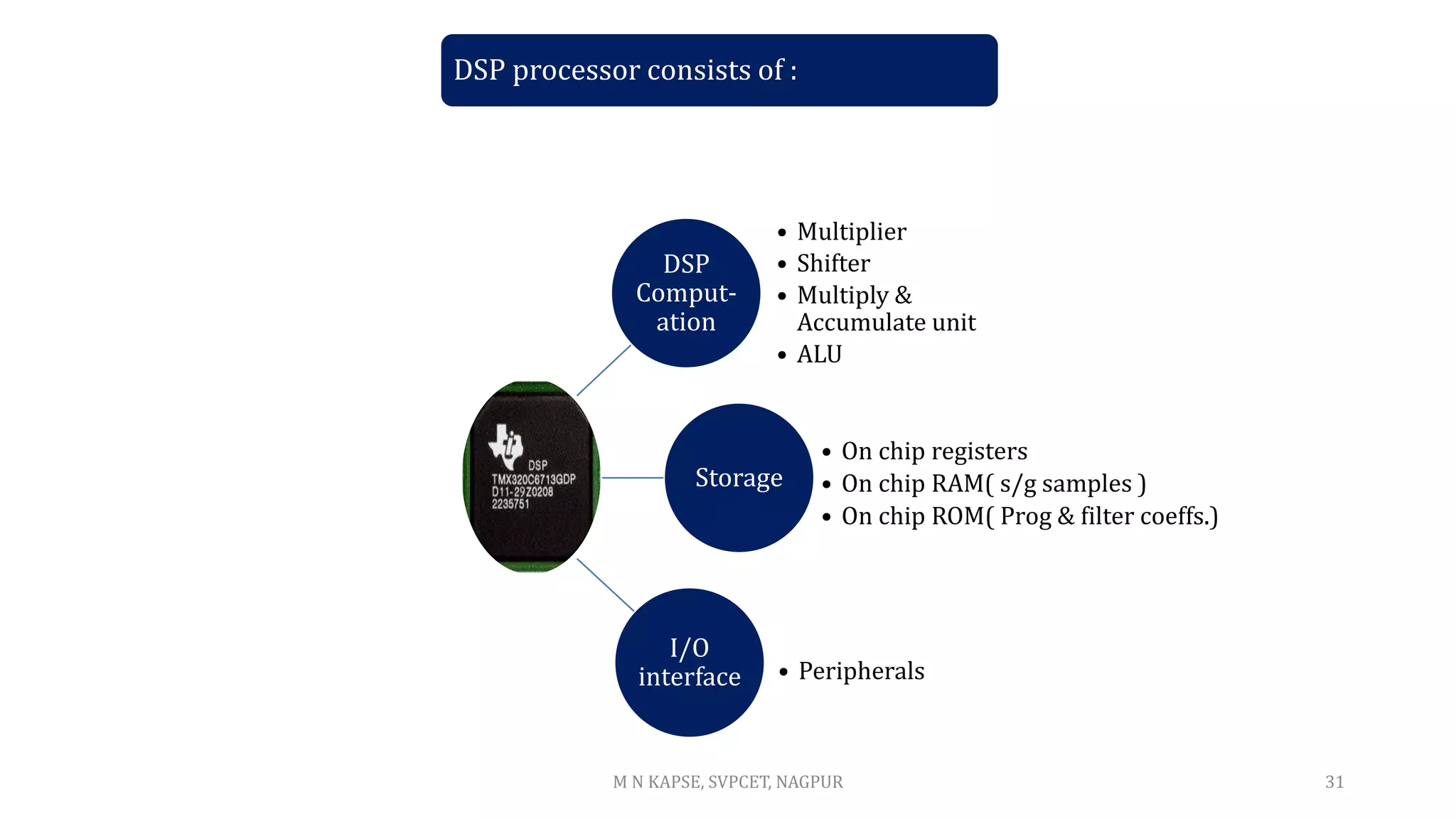
DSP
Comput-
ation
• Multiplier
• Shifter
• Multiply &
Accumulate unit
• ALU
Storage
I/O
interface
31
• On chip registers
• On chip RAM( s/g samples )
• On chip ROM( Prog & filter coeffs.)
• Peripherals
DSP processor consists of :
M N KAPSE, SVPCET, NAGPUR
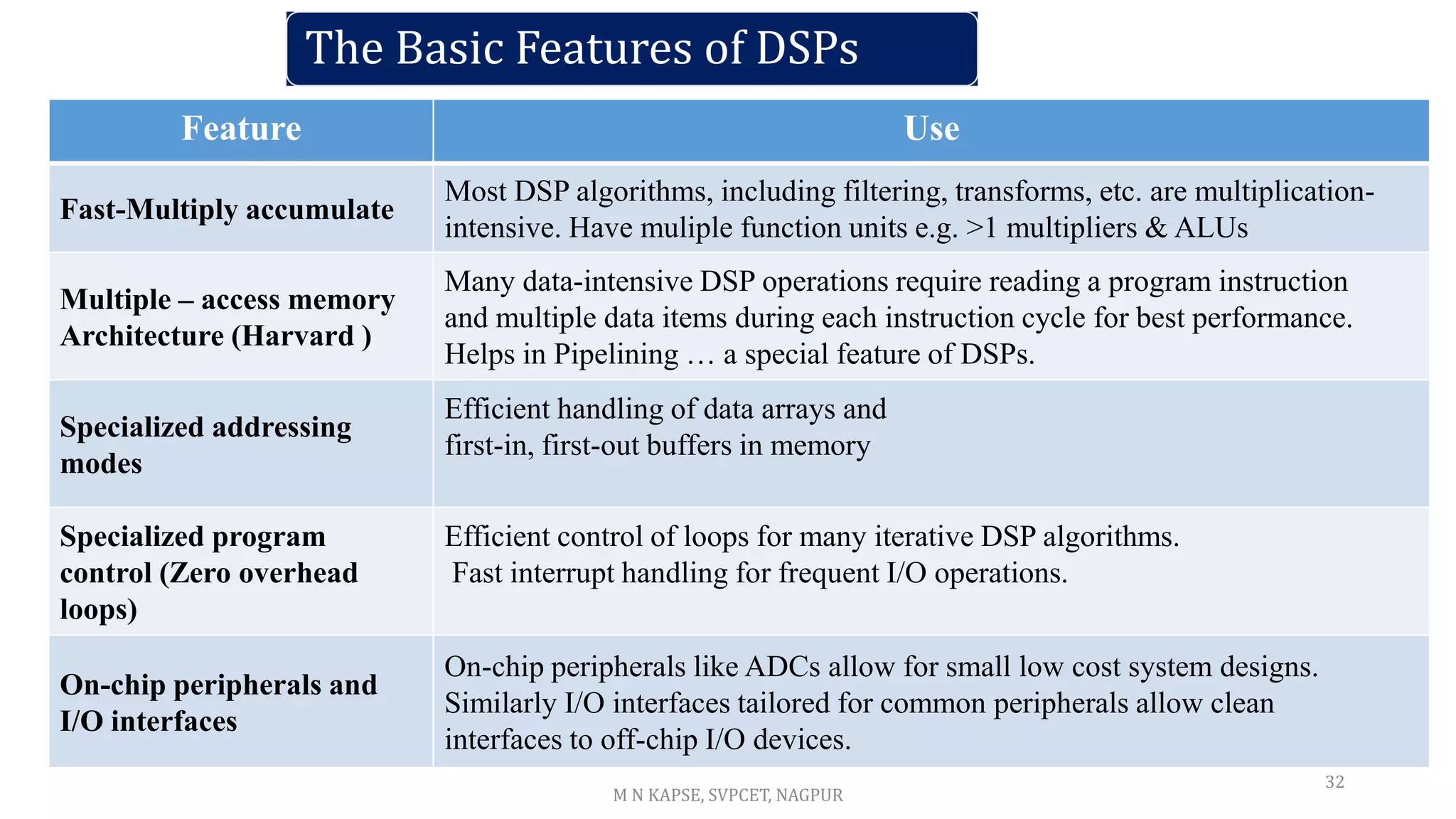
Feature Use
Fast-Multiply accumulate
Most DSP algorithms, including filtering, transforms, etc. are multiplication-
intensive. Have muliple function units e.g. >1 multipliers & ALUs
Multiple – access memory
Architecture (Harvard )
Many data-intensive DSP operations require reading a program instruction
and multiple data items during each instruction cycle for best performance.
Helps in Pipelining … a special feature of DSPs.
Specialized addressing
modes
Efficient handling of data arrays and
first-in, first-out buffers in memory
Specialized program
control (Zero overhead
loops)
Efficient control of loops for many iterative DSP algorithms.
Fast interrupt handling for frequent I/O operations.
On-chip peripherals and
I/O interfaces
On-chip peripherals like ADCs allow for small low cost system designs.
Similarly I/O interfaces tailored for common peripherals allow clean
interfaces to off-chip I/O devices.
32
The Basic Features of DSPs
M N KAPSE, SVPCET, NAGPUR
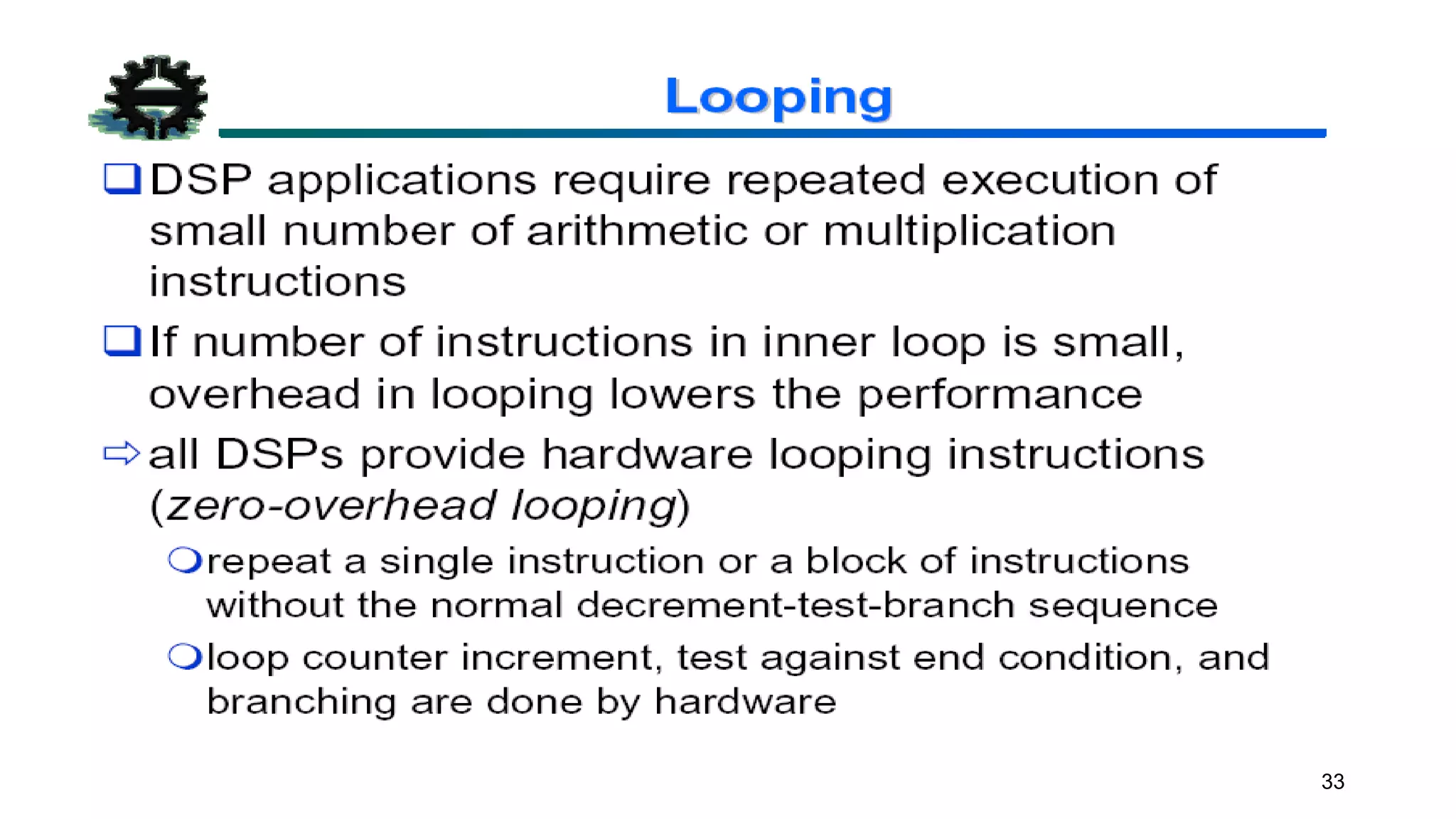
33
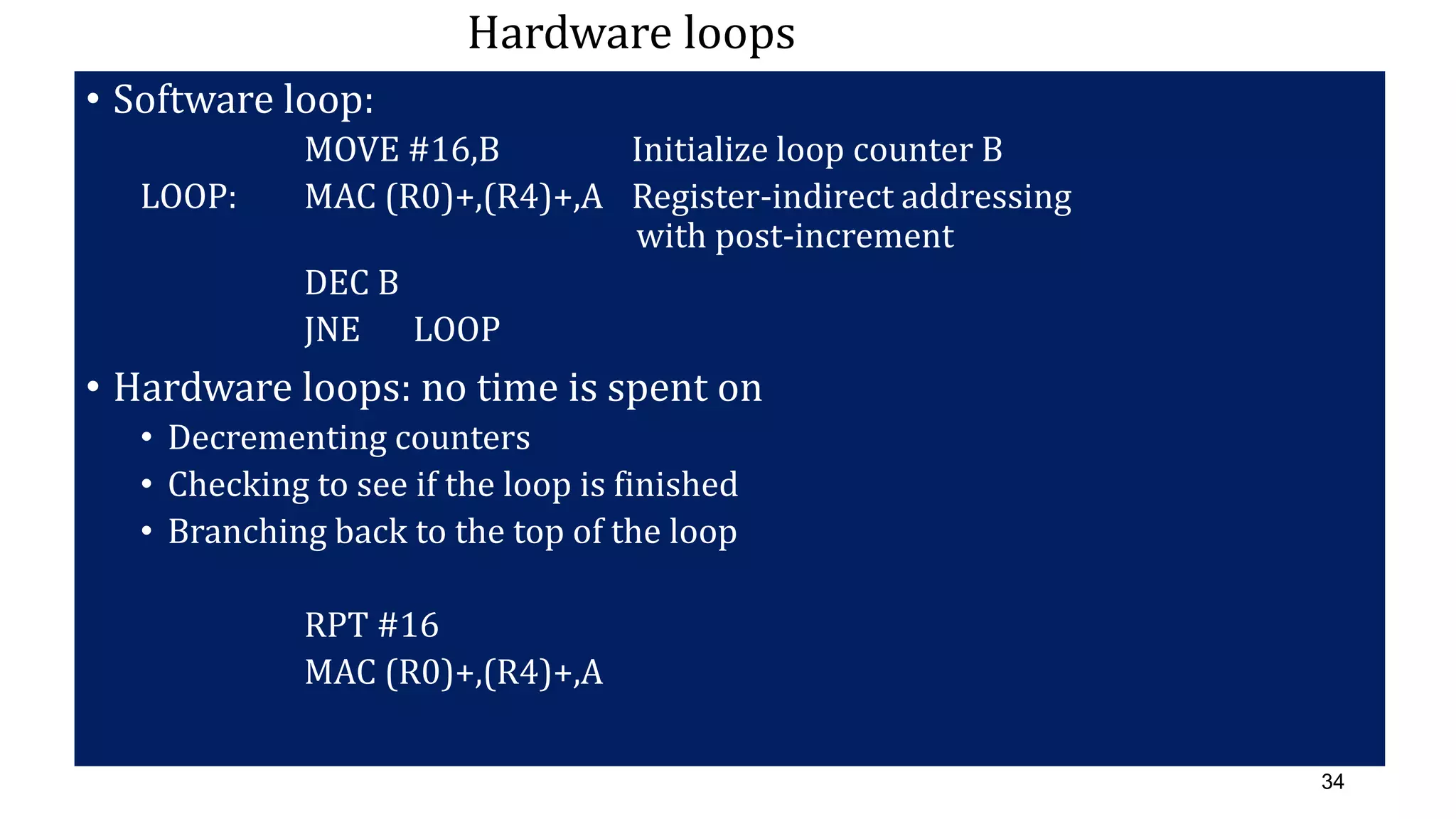
34
Hardware loops
• Software loop:
MOVE #16,B Initialize loop counter B
LOOP: MAC (R0)+,(R4)+,A Register-indirect addressing
with post-increment
DEC B
JNE LOOP
• Hardware loops: no time is spent on
• Decrementing counters
• Checking to see if the loop is finished
• Branching back to the top of the loop
RPT #16
MAC (R0)+,(R4)+,A
35
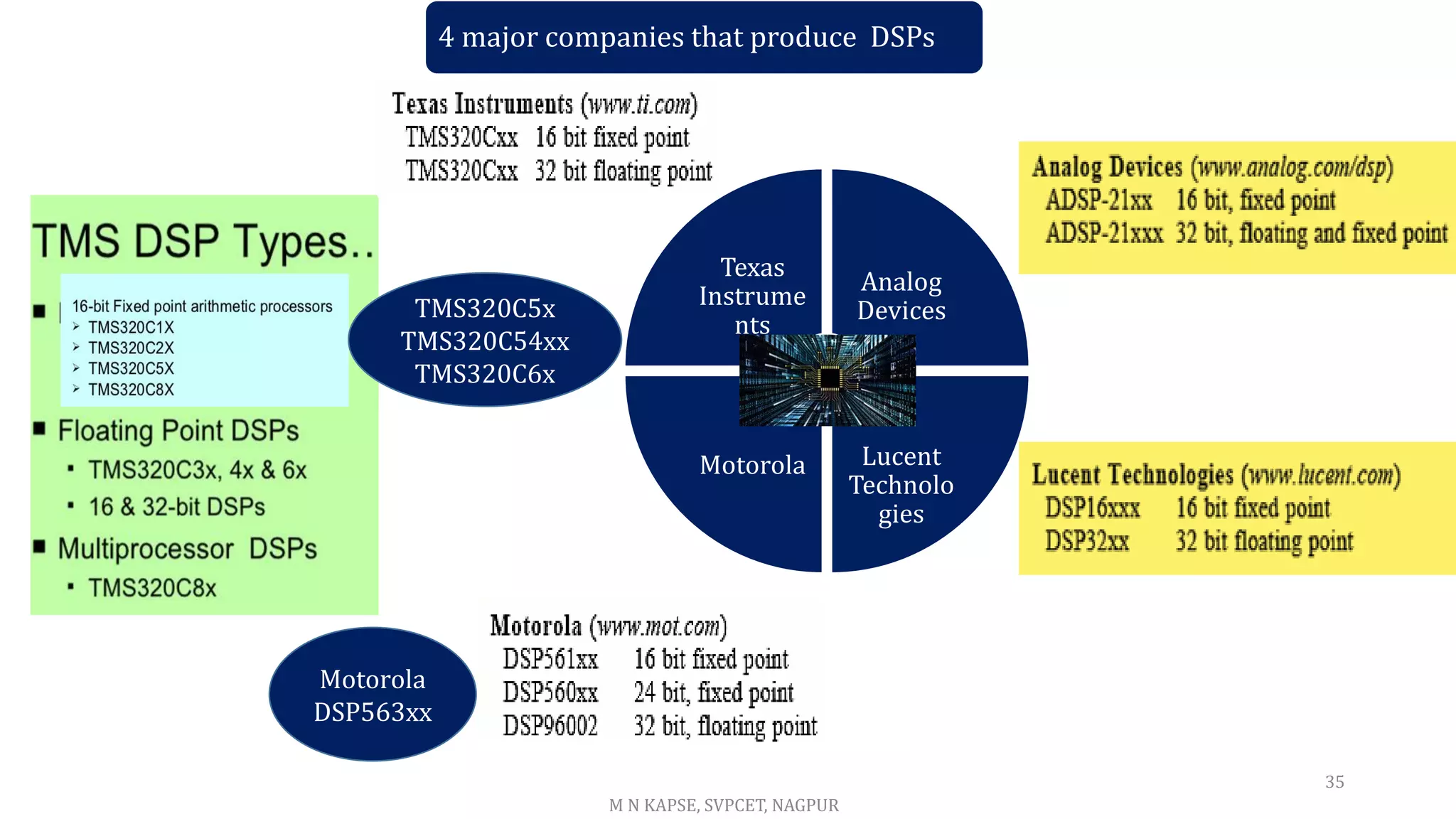
Texas
Instrume
nts
Analog
Devices
Lucent
Technolo
gies
Motorola
4 major companies that produce DSPs
M N KAPSE, SVPCET, NAGPUR
TMS320C5x
TMS320C54xx
TMS320C6x
Motorola
DSP563xx
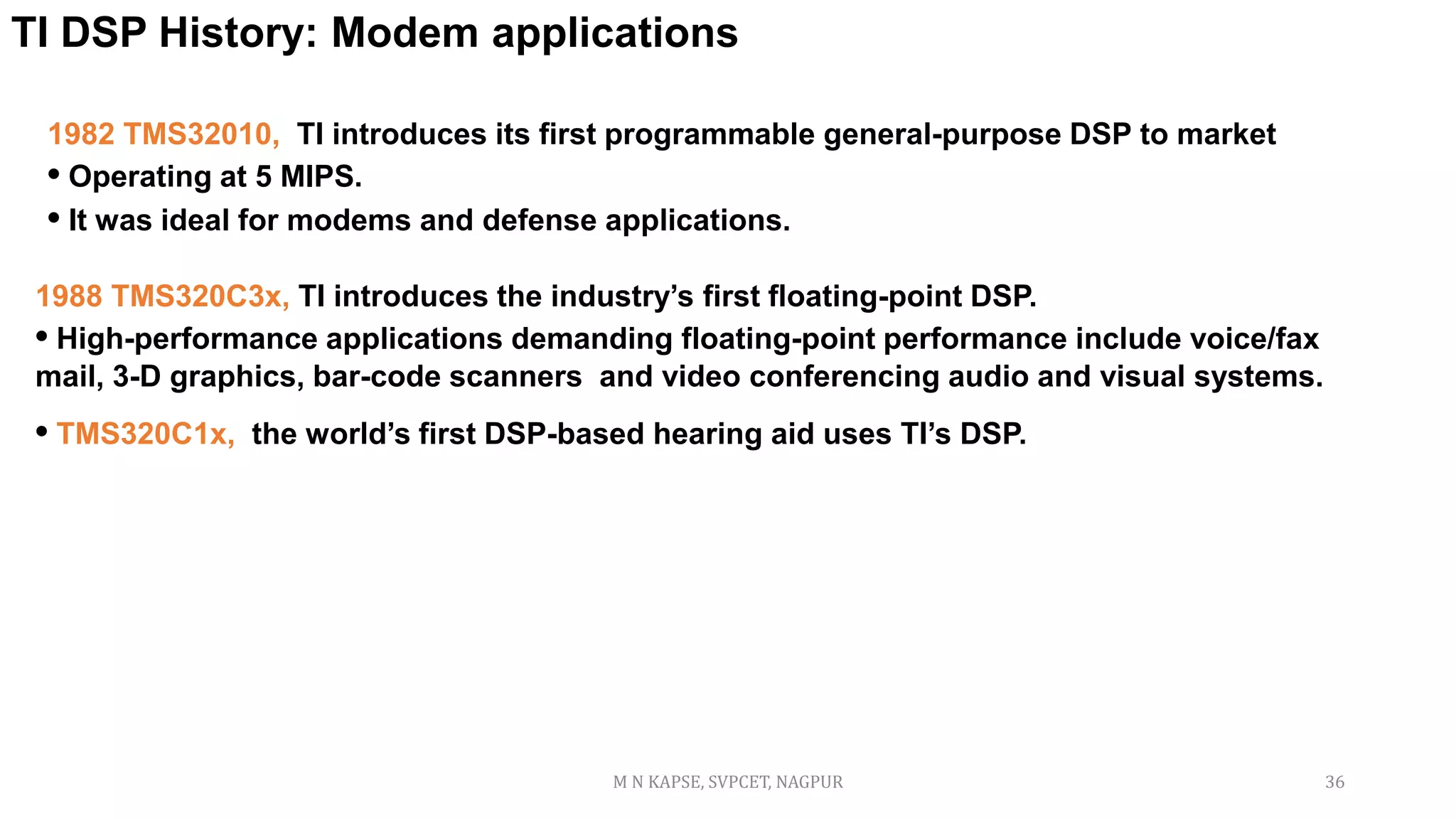
1982 TMS32010, TI introduces its first programmable general-purpose DSP to market
• Operating at 5 MIPS.
• It was ideal for modems and defense applications.
TI DSP History: Modem applications
1988 TMS320C3x, TI introduces the industry’s first floating-point DSP.
• High-performance applications demanding floating-point performance include voice/fax
mail, 3-D graphics, bar-code scanners and video conferencing audio and visual systems.
• TMS320C1x, the world’s first DSP-based hearing aid uses TI’s DSP.
M N KAPSE, SVPCET, NAGPUR 36
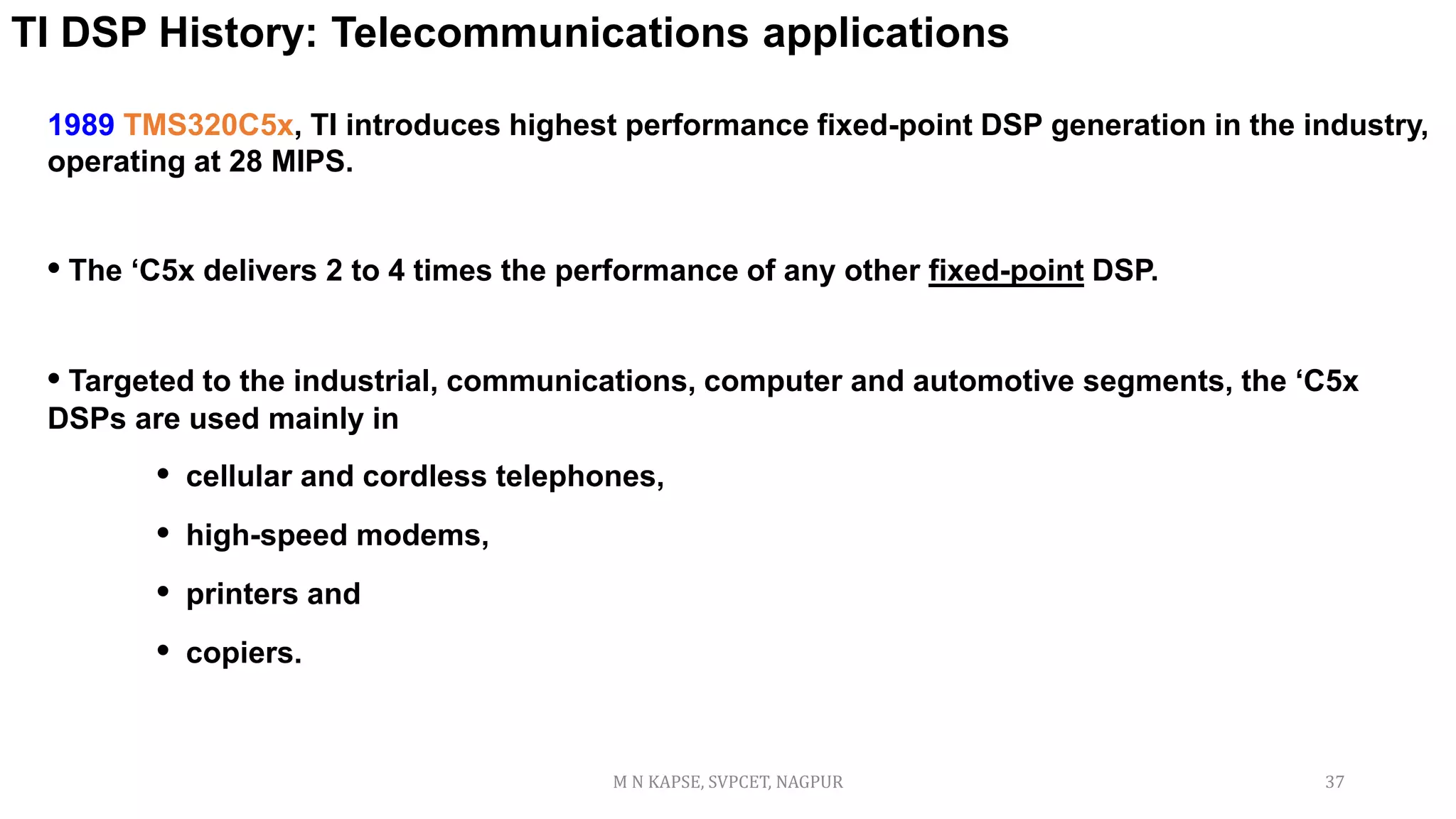
TI DSP History: Telecommunications applications
1989 TMS320C5x, TI introduces highest performance fixed-point DSP generation in the industry,
operating at 28 MIPS.
• The ‘C5x delivers 2 to 4 times the performance of any other fixed-point DSP.
• Targeted to the industrial, communications, computer and automotive segments, the ‘C5x
DSPs are used mainly in
• cellular and cordless telephones,
• high-speed modems,
• printers and
• copiers.
M N KAPSE, SVPCET, NAGPUR 37
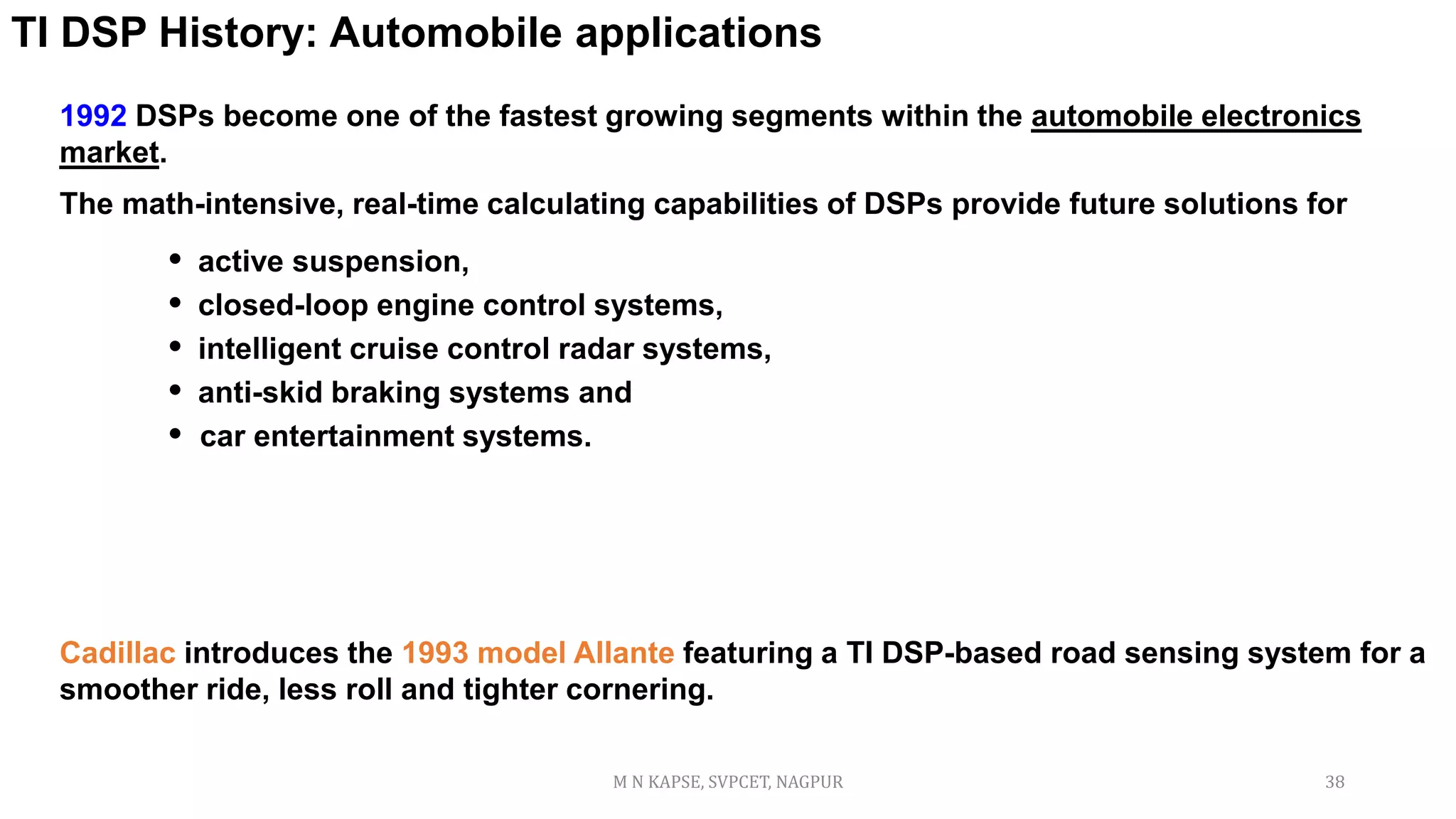
1992 DSPs become one of the fastest growing segments within the automobile electronics
market.
The math-intensive, real-time calculating capabilities of DSPs provide future solutions for
• active suspension,
• closed-loop engine control systems,
• intelligent cruise control radar systems,
• anti-skid braking systems and
• car entertainment systems.
TI DSP History: Automobile applications
Cadillac introduces the 1993 model Allante featuring a TI DSP-based road sensing system for a
smoother ride, less roll and tighter cornering.
M N KAPSE, SVPCET, NAGPUR 38
TI DSP History: Hard Disk Drive applications
1994 DSP technology enables the first uniprocessor DSP hard disc drive (HDD) from Maxtor
Corp. the 171-megabyte PCMCIA Type III HDD.
• By replacing a number of microcontrollers, drive costs were cut by 30 percent while battery
life was extended and storage capacity increased.
• In 1994, more than 95 percent of all high performance disk drives with a DSP inside contain
a TI TMS320 DSP.
1996 TI's T320C2xLP cDSP technology enables Seagate, one of the world’s largest hard disk
drive (HDD) maker, to develop the first mainstream 3.5-inch HDD to adopt a uniprocessor DSP
design, integrating logic, flash memory, and a DSP core into a single unit.
M N KAPSE, SVPCET, NAGPUR 39
1999 Provides the first complete DSP-based solution, for the secure downloading of music
off the Internet onto portable audio devices, with Liquid Audio Inc., the Fraunhofer Institute
for Integrated Circuits and SanDisk Corp.
TI DSP History: Internet applications
Announces that SANYO Electric Co., Ltd. will deliver the first Secure Digital Music Initiative
(SDMI)-compliant portable digital music player based on TI's TMS320C5000 programmable
DSPs and Liquid Audio's Secure Portable Player Platform (SP3).
Announces the industry's first 1.2 Volt TMS320C54x DSP that extends the battery life for
applications such as cochlear implants, hearing aids and wireless and telephony devices.
M N KAPSE, SVPCET, NAGPUR 40
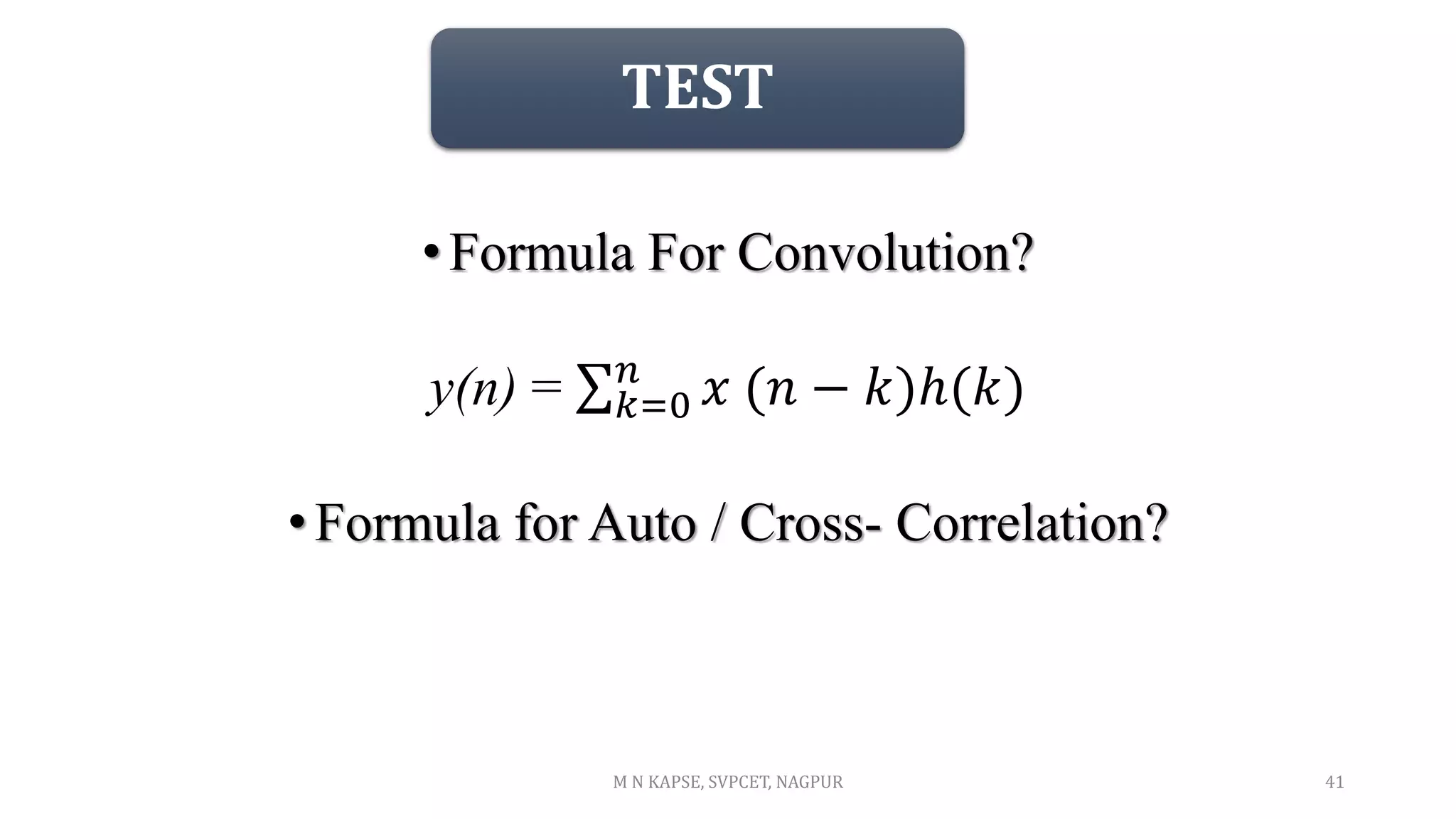
TEST
• Formula For Convolution?
y(n) = 𝑥 (𝑛 − 𝑘)ℎ(𝑘)
𝑛
𝑘=0
•Formula for Auto / Cross- Correlation?
41
M N KAPSE, SVPCET, NAGPUR
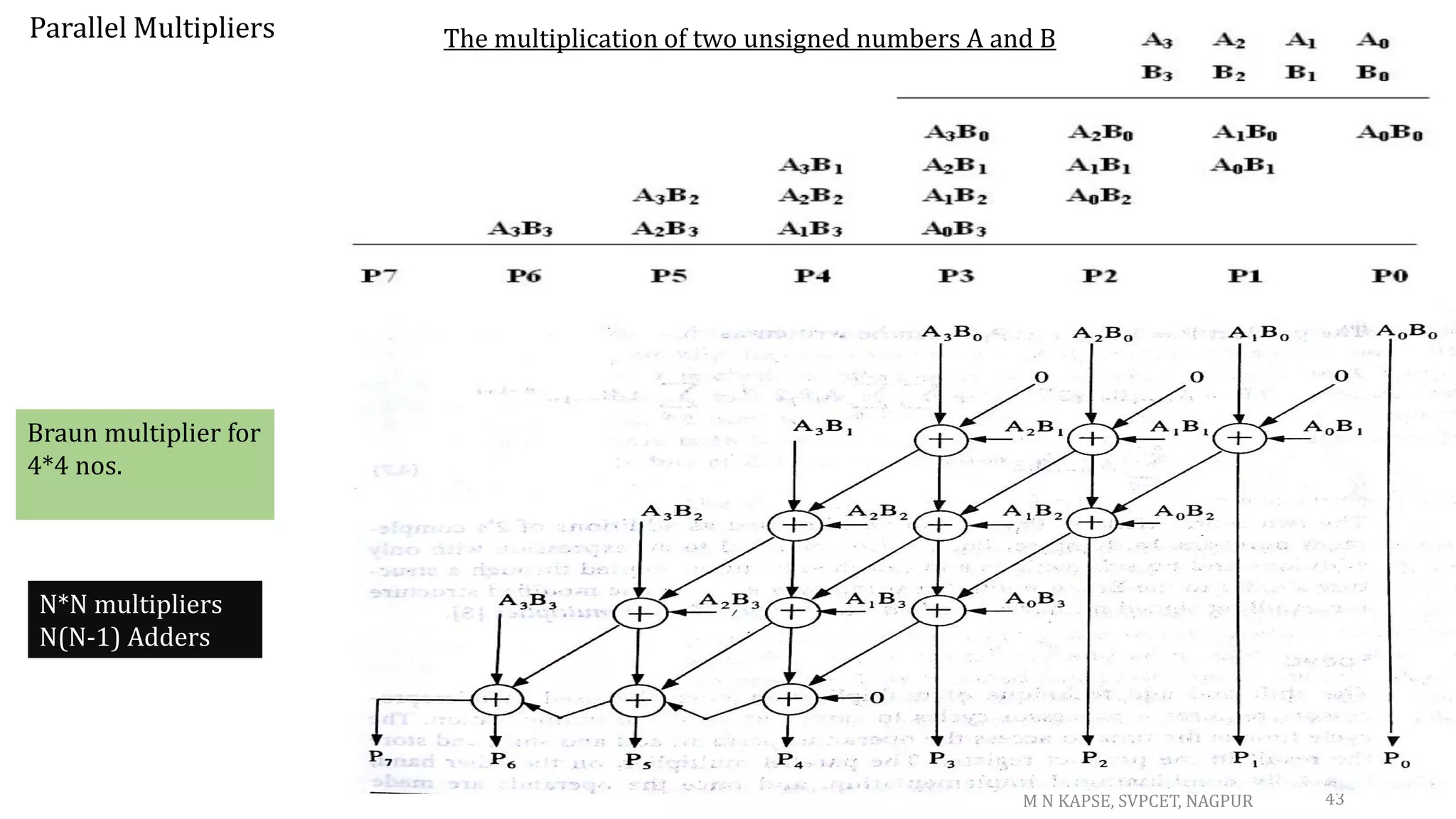
Multipliers
Single chip multipliers helps for implementing DSP functions on a VLSI chip.
Parallel multipliers replaced the traditional shift and add multipliers .
Parallel multipliers take a single processor cycle to fetch and execute the instruction and to store
the result. They are also called as Array multipliers.
The key features to be considered for a multiplier are:
a. Accuracy
b. Dynamic range
c. Speed
The number of bits used to represent the operands decide the accuracy and the dynamic range of
the multiplier.
Whereas speed is decided by the architecture employed.
If the multipliers are implemented using hardware, the speed of execution will be very high but
the circuit complexity will also increases considerably.
Thus there should be a tradeoff between the speed of execution and the circuit complexity.
Hence the choice of the architecture normally depends on the application
42
M N KAPSE, SVPCET, NAGPUR
Parallel Multipliers
43
The multiplication of two unsigned numbers A and B
M N KAPSE, SVPCET, NAGPUR
Braun multiplier for
4*4 nos.
N*N multipliers
N(N-1) Adders
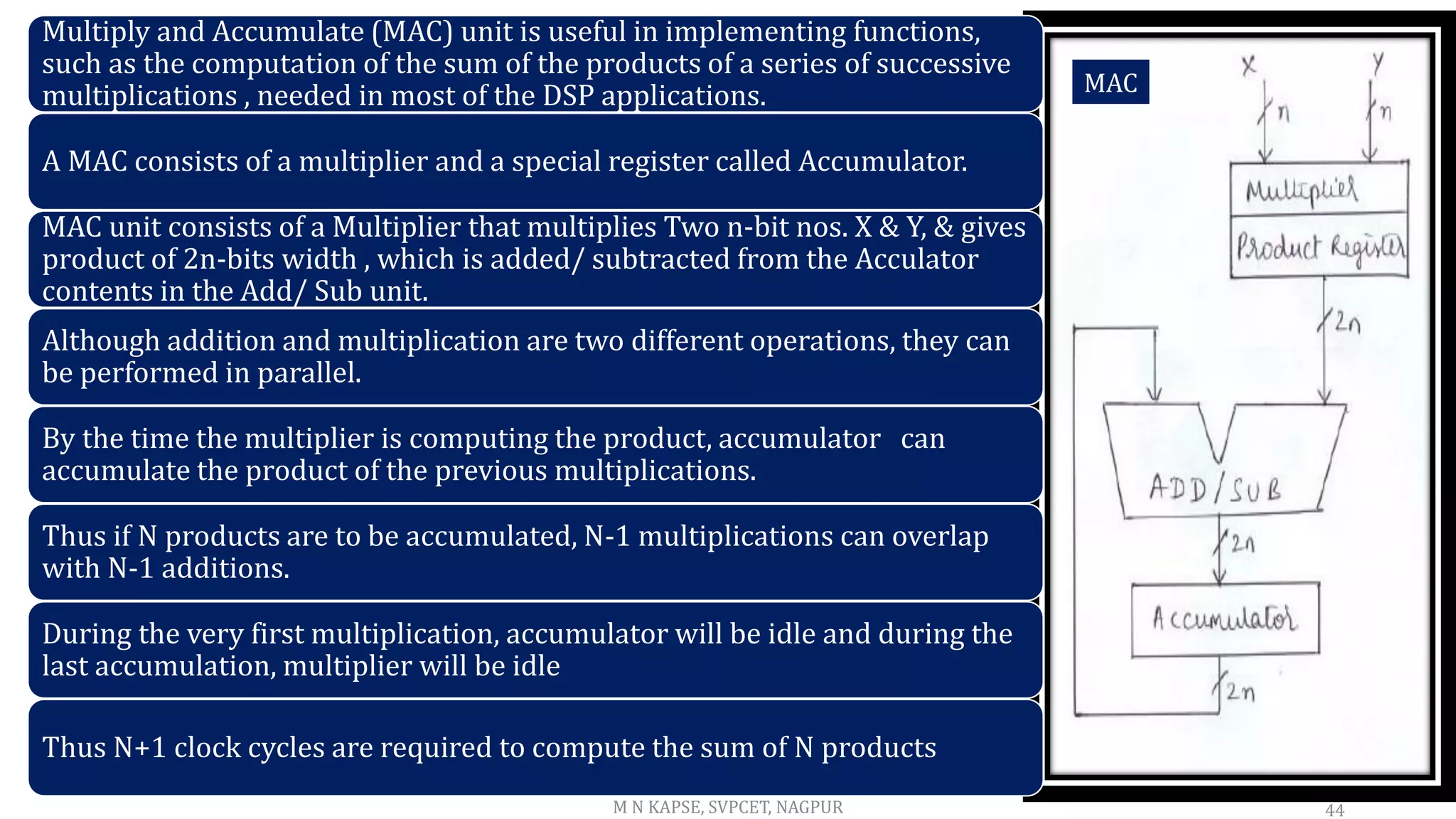
44
Multiply and Accumulate (MAC) unit is useful in implementing functions,
such as the computation of the sum of the products of a series of successive
multiplications , needed in most of the DSP applications.
A MAC consists of a multiplier and a special register called Accumulator.
MAC unit consists of a Multiplier that multiplies Two n-bit nos. X & Y, & gives
product of 2n-bits width , which is added/ subtracted from the Acculator
contents in the Add/ Sub unit.
Although addition and multiplication are two different operations, they can
be performed in parallel.
By the time the multiplier is computing the product, accumulator can
accumulate the product of the previous multiplications.
Thus if N products are to be accumulated, N-1 multiplications can overlap
with N-1 additions.
During the very first multiplication, accumulator will be idle and during the
last accumulation, multiplier will be idle
Thus N+1 clock cycles are required to compute the sum of N products
MAC
M N KAPSE, SVPCET, NAGPUR
MAC: multiply & accumulator: MAC = A*B +C
Carry-save adders (csa) sums 3 numbers efficiently!
by allowing three values to be computed we can take advantage of the csa technique
Thus the MAC is not a separated multiplier and adder but a integrated singular design.
This allows easy implementation of y[n] = Σ c[k] * x[n-k]
Hence, less area and faster than a separate multiplier andadder.
M N KAPSE, SVPCET, NAGPUR 45
MAC
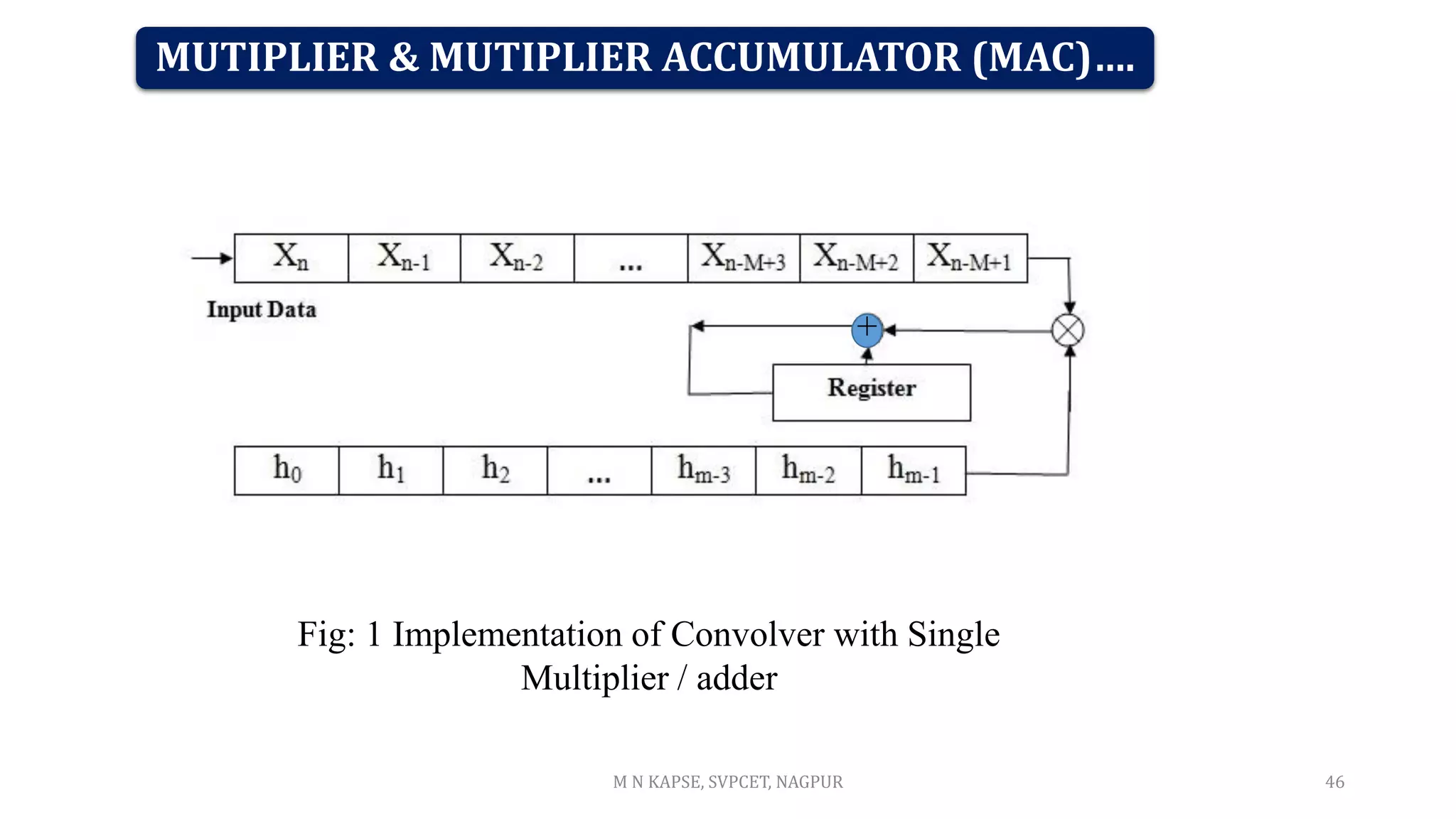
MUTIPLIER & MUTIPLIER ACCUMULATOR (MAC)….
46
Fig: 1 Implementation of Convolver with Single
Multiplier / adder
+
M N KAPSE, SVPCET, NAGPUR
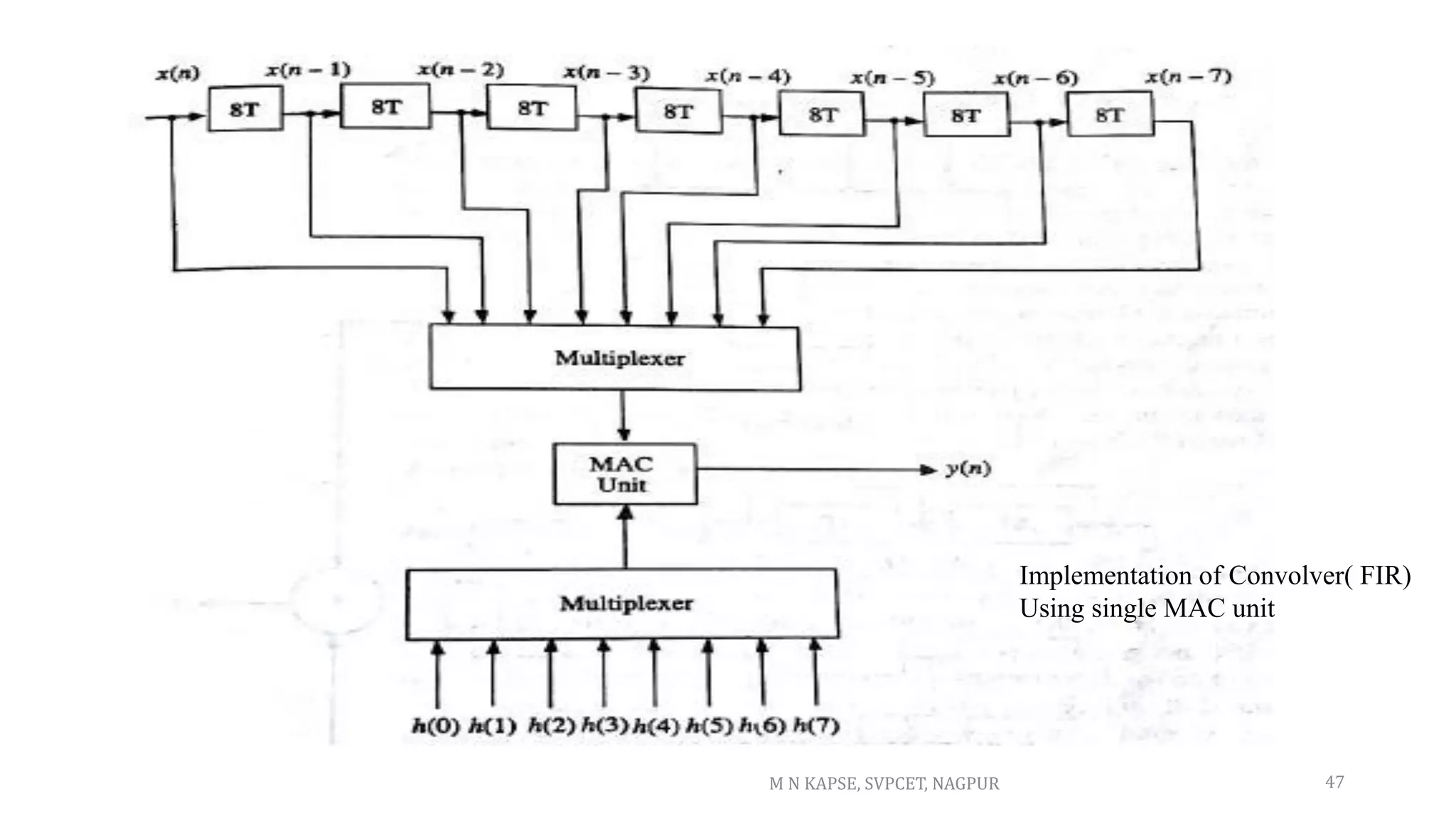
M N KAPSE, SVPCET, NAGPUR 47
Implementation of Convolver( FIR)
Using single MAC unit
M N KAPSE, SVPCET, NAGPUR 48
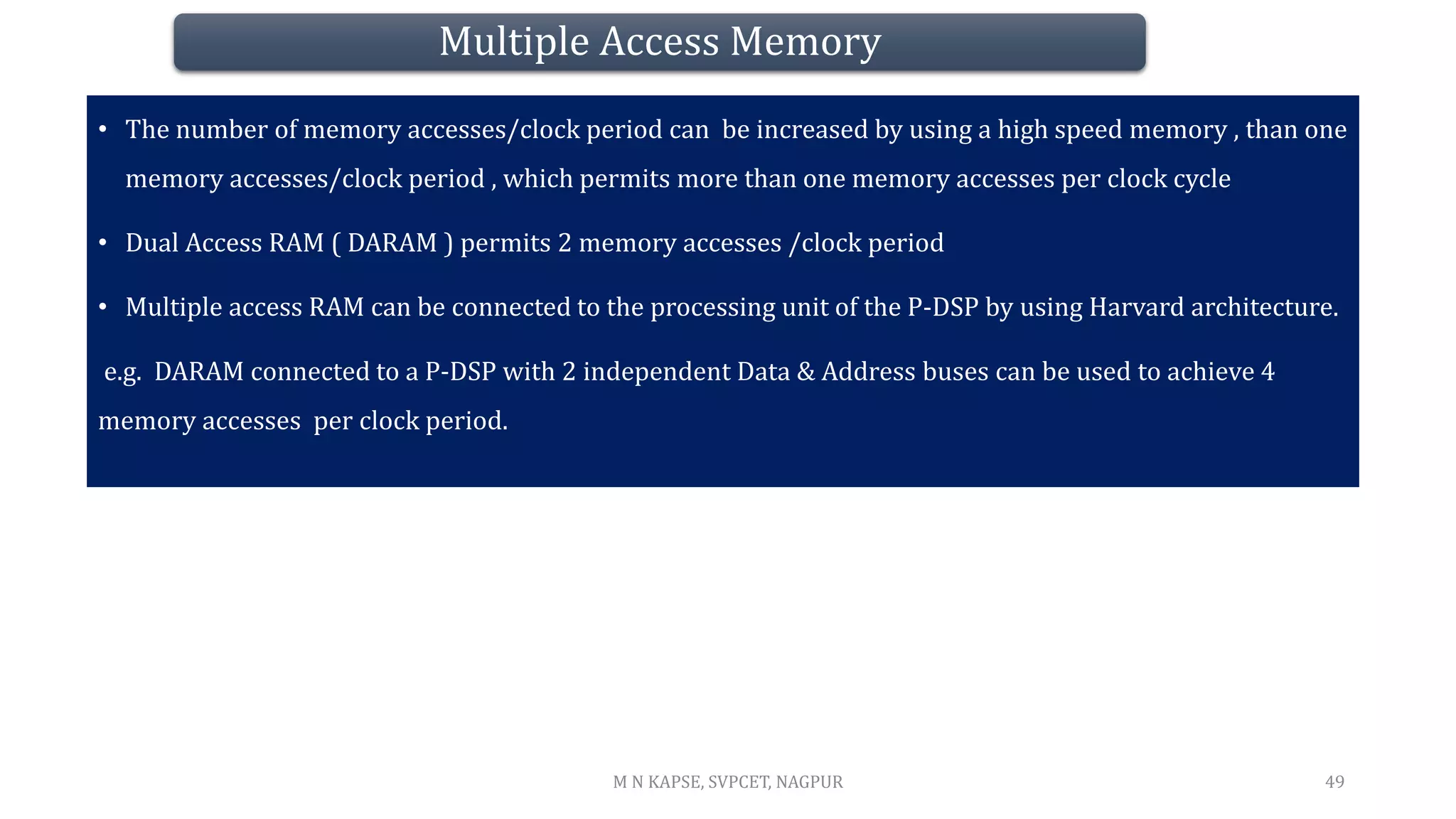
Multiple Access Memory
• The number of memory accesses/clock period can be increased by using a high speed memory , than one
memory accesses/clock period , which permits more than one memory accesses per clock cycle
• Dual Access RAM ( DARAM ) permits 2 memory accesses /clock period
• Multiple access RAM can be connected to the processing unit of the P-DSP by using Harvard architecture.
e.g. DARAM connected to a P-DSP with 2 independent Data & Address buses can be used to achieve 4
memory accesses per clock period.
49
M N KAPSE, SVPCET, NAGPUR
M N KAPSE, SVPCET, NAGPUR 50
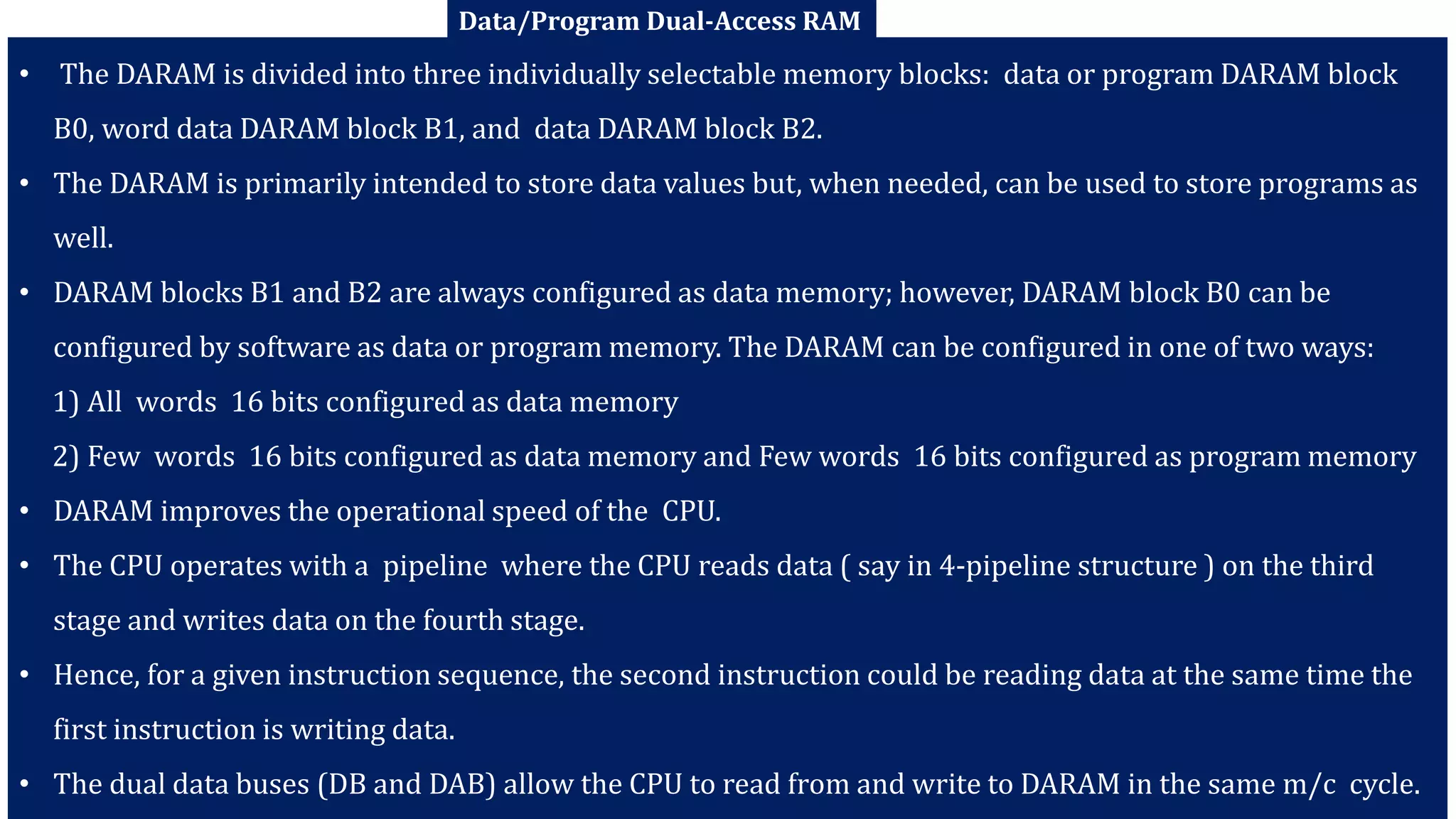
• The DARAM is divided into three individually selectable memory blocks: data or program DARAM block
B0, word data DARAM block B1, and data DARAM block B2.
• The DARAM is primarily intended to store data values but, when needed, can be used to store programs as
well.
• DARAM blocks B1 and B2 are always configured as data memory; however, DARAM block B0 can be
configured by software as data or program memory. The DARAM can be configured in one of two ways:
1) All words 16 bits configured as data memory
2) Few words 16 bits configured as data memory and Few words 16 bits configured as program memory
• DARAM improves the operational speed of the CPU.
• The CPU operates with a pipeline where the CPU reads data ( say in 4-pipeline structure ) on the third
stage and writes data on the fourth stage.
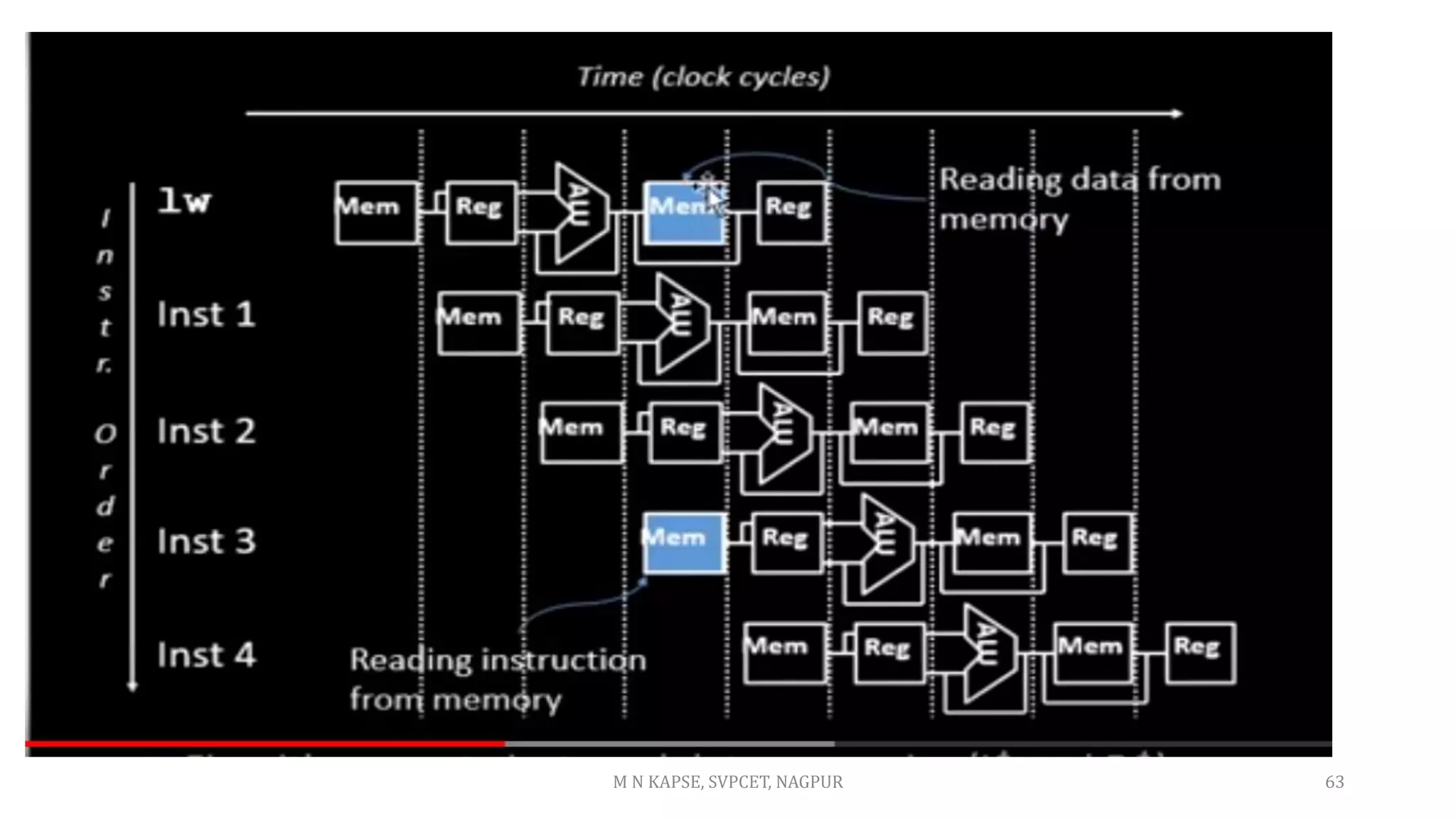
• Hence, for a given instruction sequence, the second instruction could be reading data at the same time the
first instruction is writing data.
• The dual data buses (DB and DAB) allow the CPU to read from and write to DARAM in the same m/c cycle.
Data/Program Dual-Access RAM
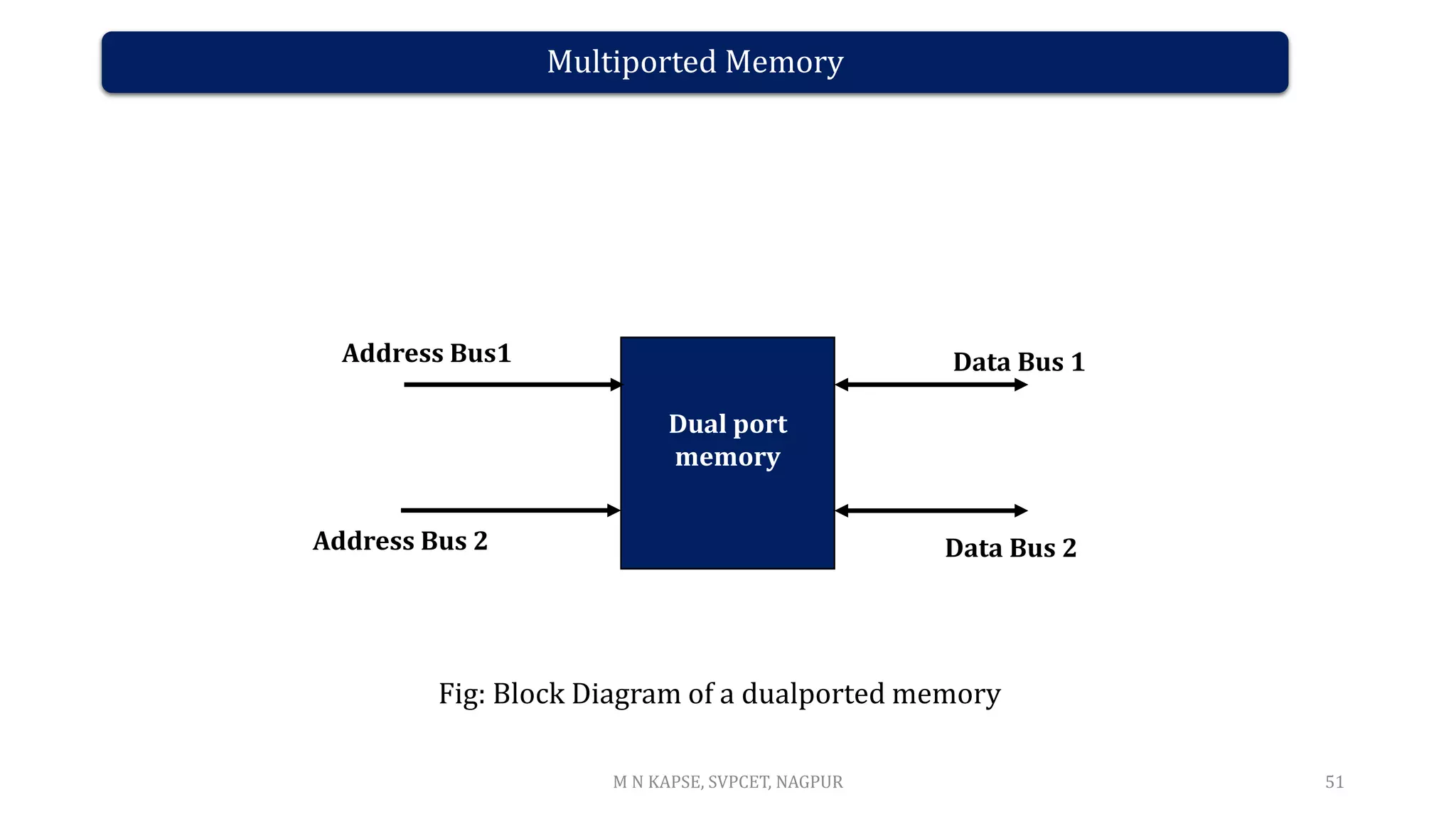
Multiported Memory
51
Dual port
memory
Address Bus 2
Data Bus 1
Address Bus1
Data Bus 2
Fig: Block Diagram of a dualported memory
M N KAPSE, SVPCET, NAGPUR
ACOE343 - Embedded Real-Time Processor Systems - Frederick University 52
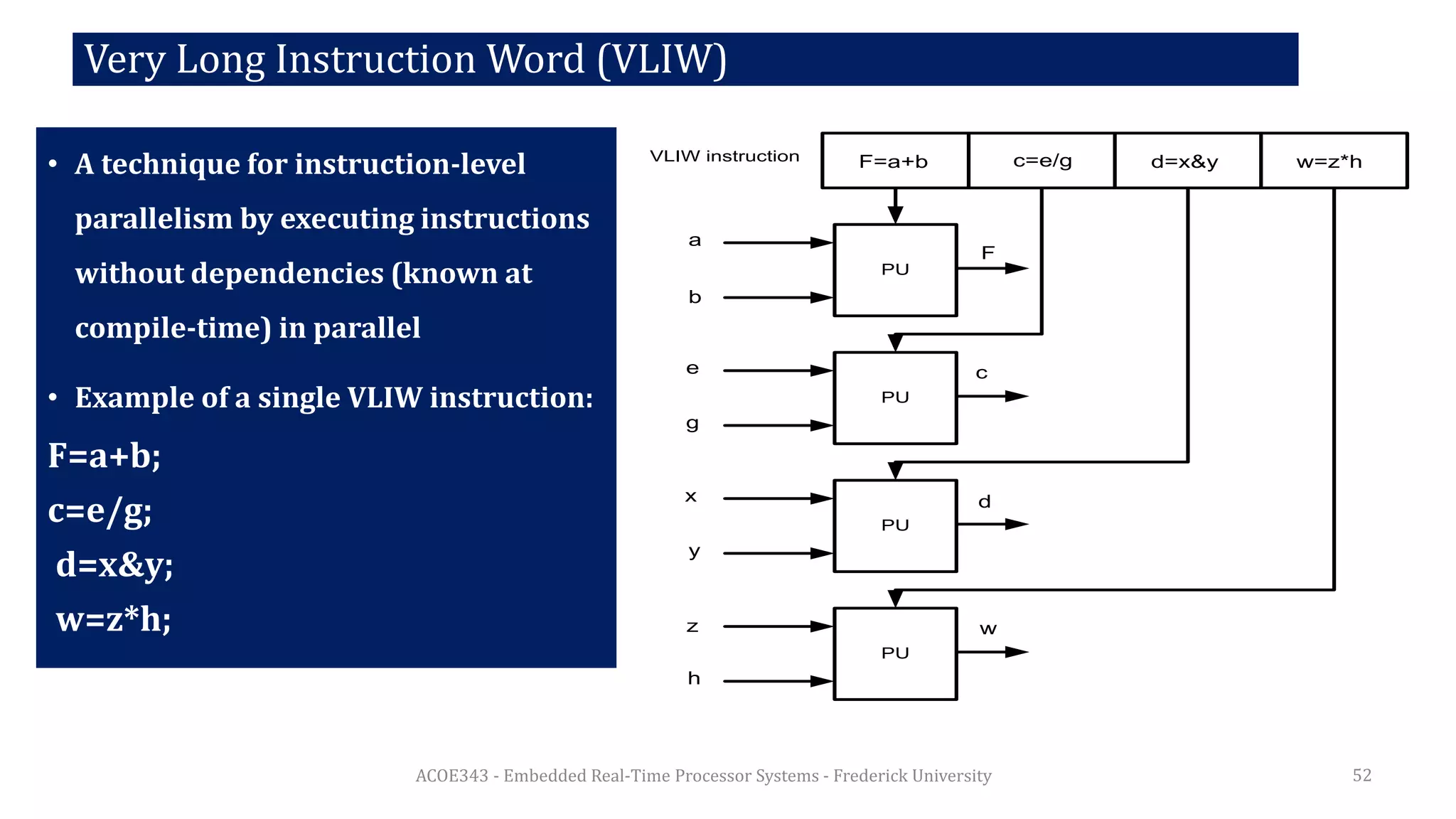
Very Long Instruction Word (VLIW)
• A technique for instruction-level
parallelism by executing instructions
without dependencies (known at
compile-time) in parallel
• Example of a single VLIW instruction:
F=a+b;
c=e/g;
d=x&y;
w=z*h;
VLIW instruction F=a+b c=e/g d=x&y w=z*h
PU
PU
PU
PU
a
b
F
c
d
w
e
g
x
y
z
h
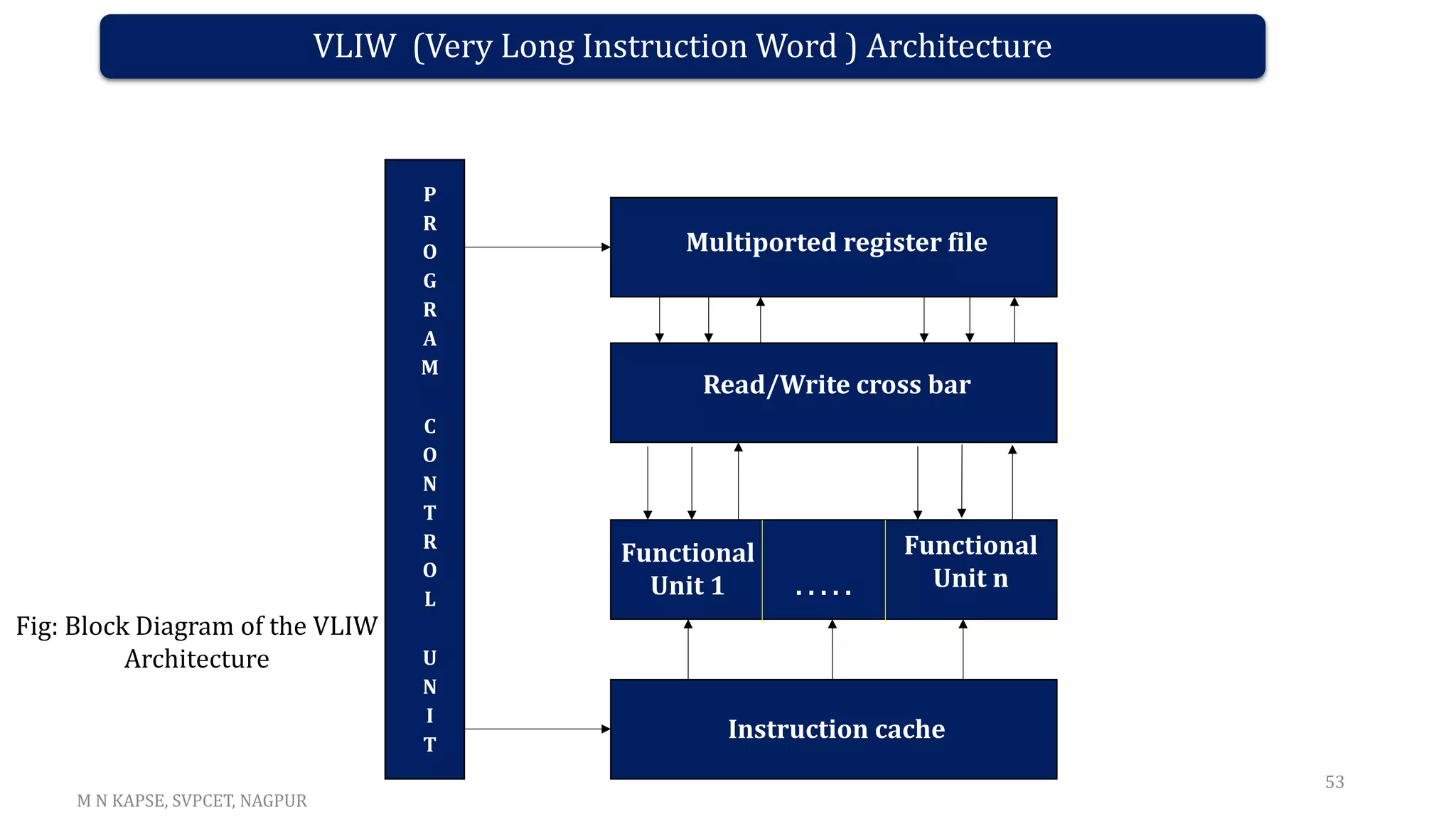
VLIW (Very Long Instruction Word ) Architecture
53
Multiported register file
Read/Write cross bar
Functional
Unit 1
Instruction cache
P
R
O
G
R
A
M
C
O
N
T
R
O
L
U
N
I
T
Functional
Unit n
. . . . .
Fig: Block Diagram of the VLIW
Architecture
M N KAPSE, SVPCET, NAGPUR
Pipelining
One of the approach for increasing the efficiency of P-DSPs and Advanced
Microprocessors.
An instruction cycle starting with the fetching of an instruction & ending with the
execution of the instruction including the time storage of the results can be split into a
number of microinstructions.
M N KAPSE, SVPCET, NAGPUR 54
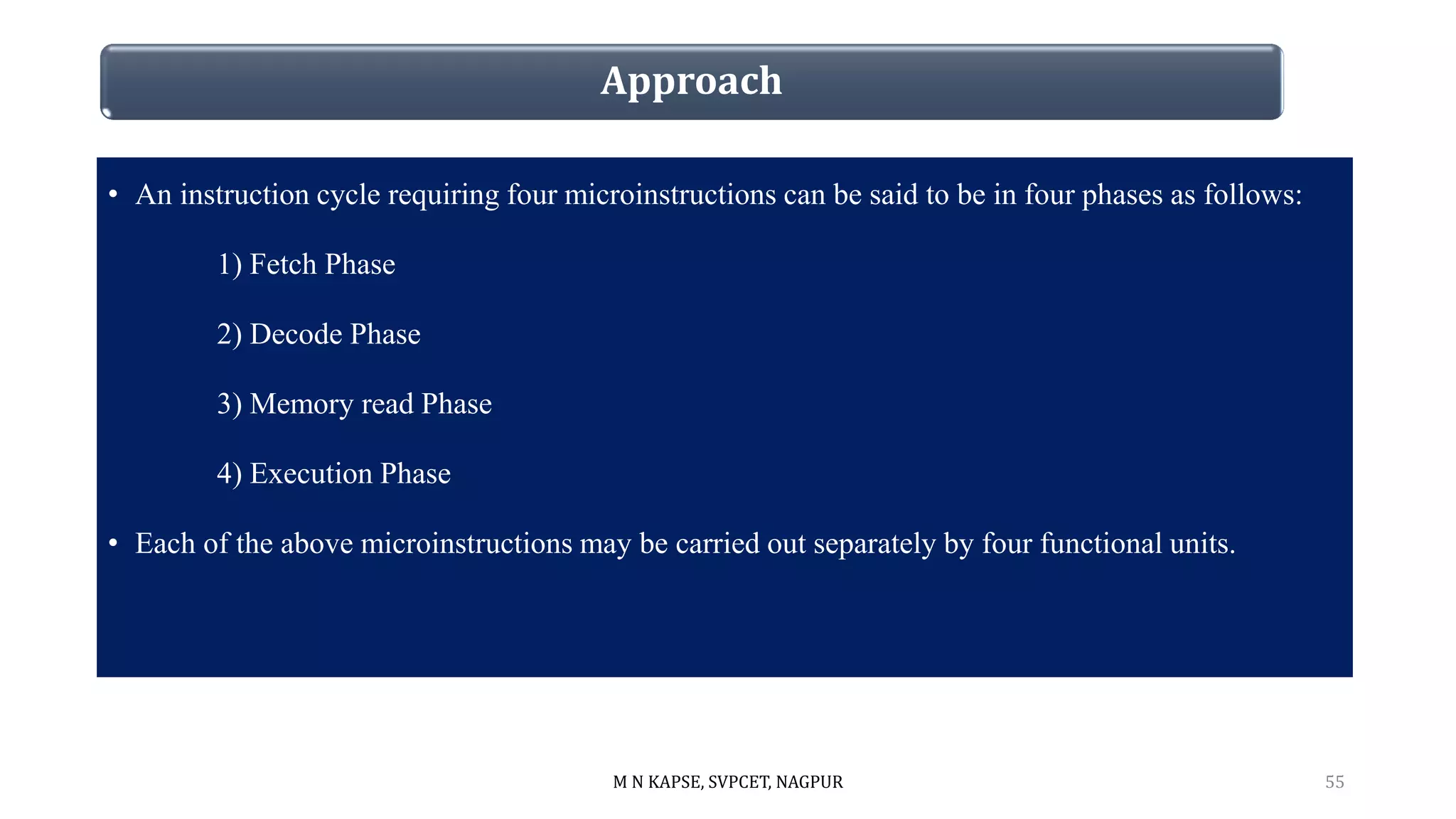
Approach
• An instruction cycle requiring four microinstructions can be said to be in four phases as follows:
1) Fetch Phase
2) Decode Phase
3) Memory read Phase
4) Execution Phase
• Each of the above microinstructions may be carried out separately by four functional units.
M N KAPSE, SVPCET, NAGPUR 55
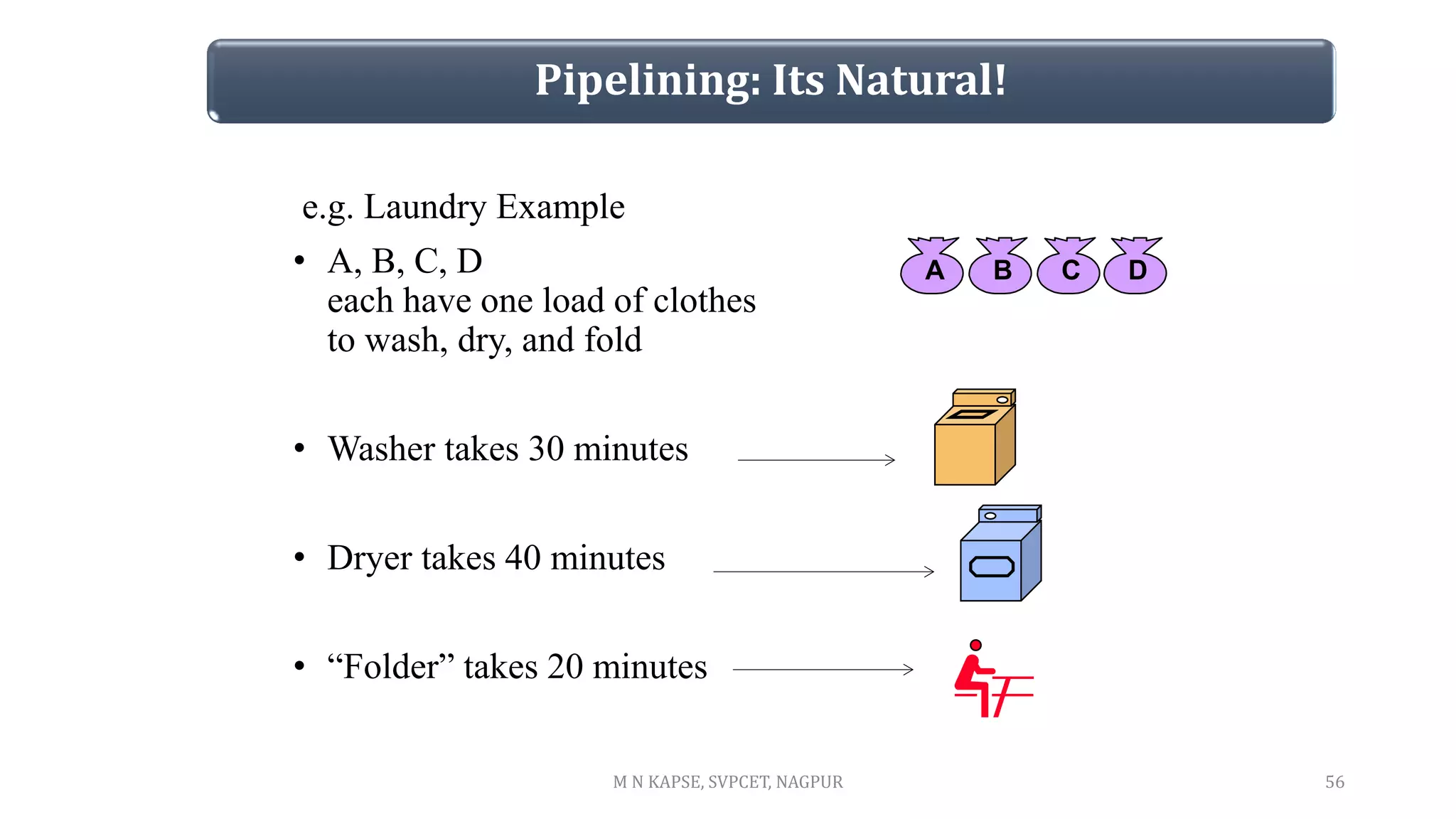
Pipelining: Its Natural!
e.g. Laundry Example
• A, B, C, D
each have one load of clothes
to wash, dry, and fold
• Washer takes 30 minutes
• Dryer takes 40 minutes
• “Folder” takes 20 minutes
A B C D
56
M N KAPSE, SVPCET, NAGPUR
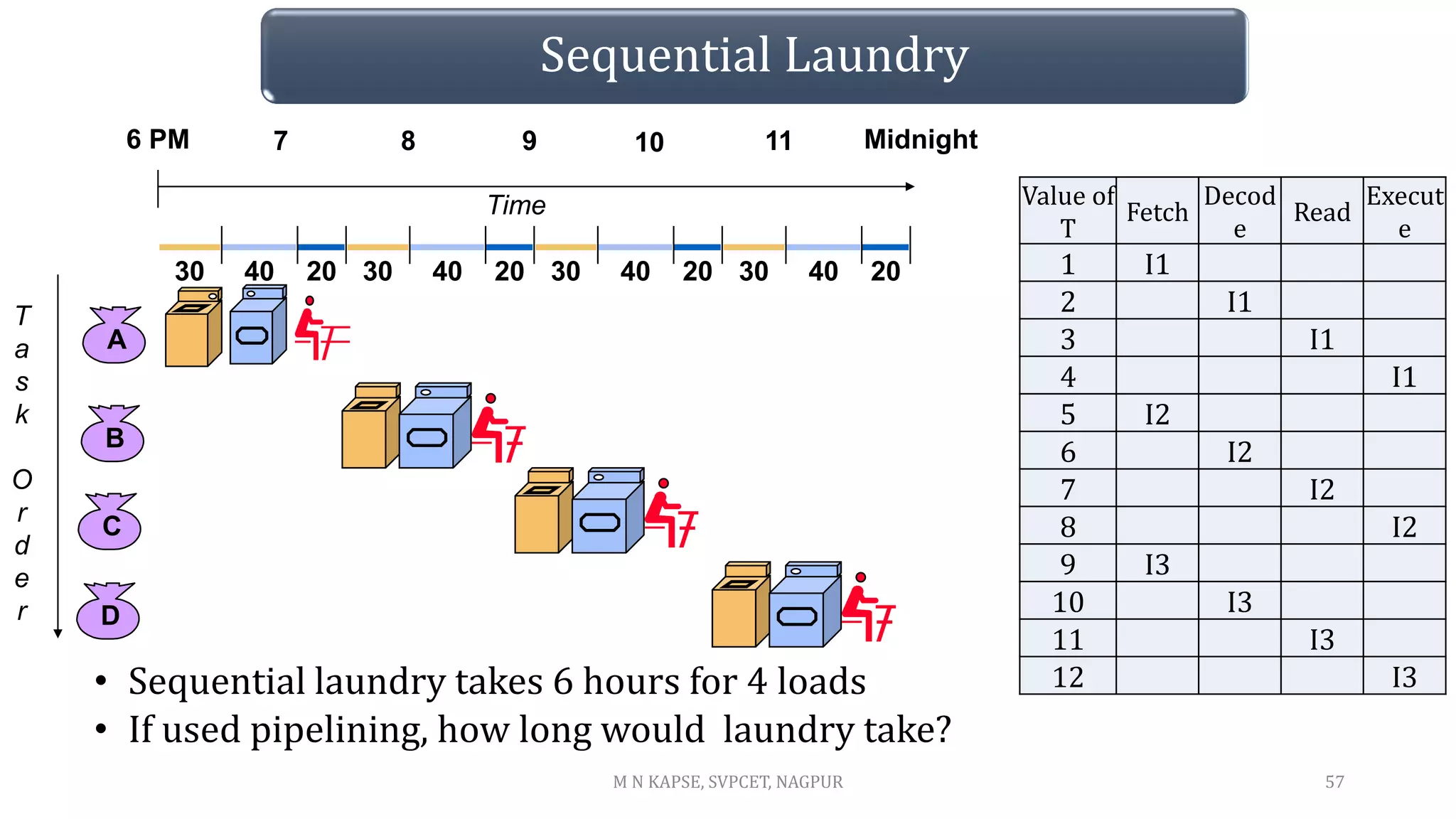
Sequential Laundry
• Sequential laundry takes 6 hours for 4 loads
• If used pipelining, how long would laundry take?
A
B
C
D
30 40 20 30 40 20 30 40 20 30 40 20
6 PM 7 8 9 10 11 Midnight
T
a
s
k
O
r
d
e
r
Time
57
M N KAPSE, SVPCET, NAGPUR
Value of
T
Fetch
Decod
e
Read
Execut
e
1 I1
2 I1
3 I1
4 I1
5 I2
6 I2
7 I2
8 I2
9 I3
10 I3
11 I3
12 I3
M N KAPSE, SVPCET, NAGPUR 58
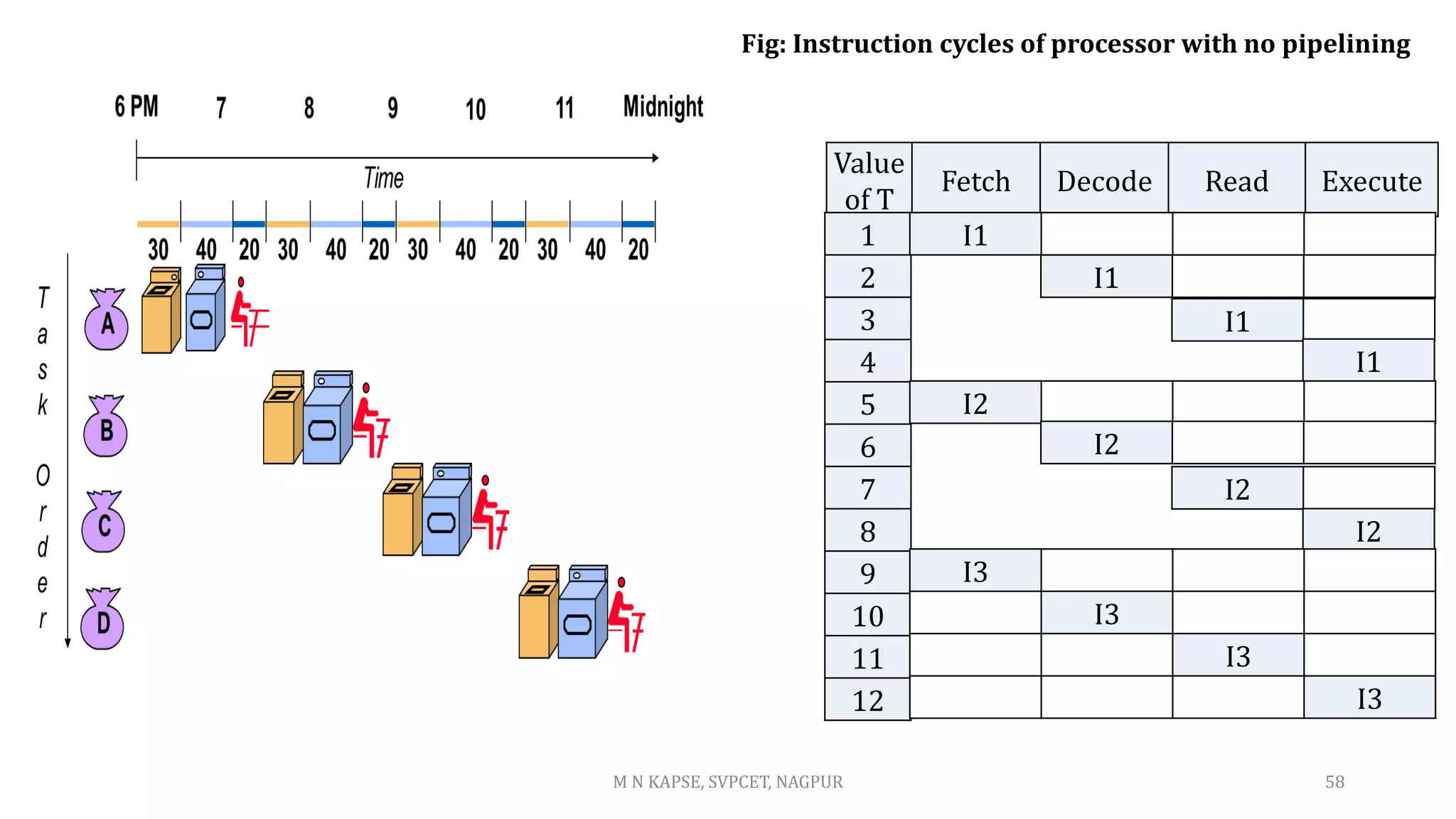
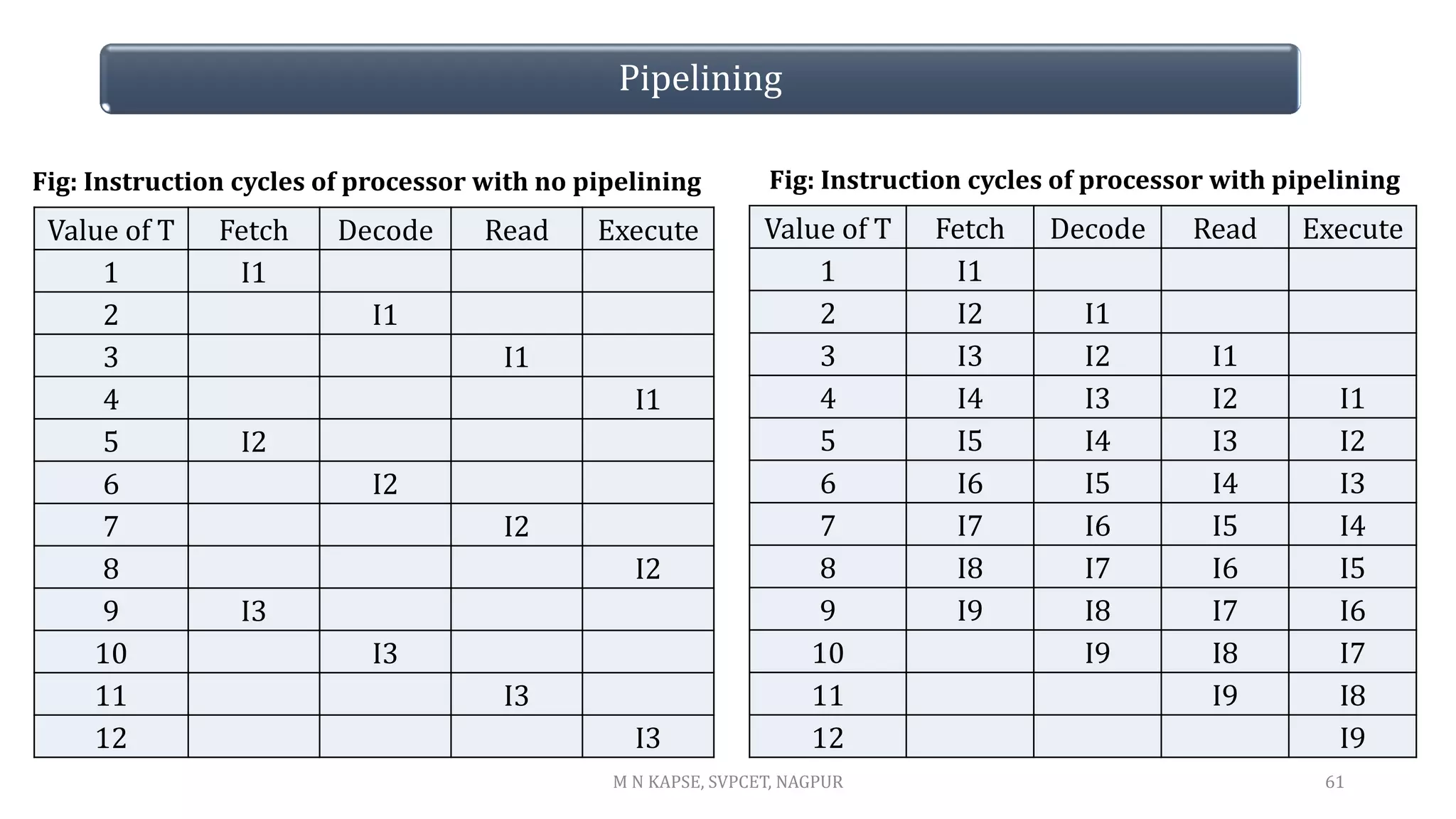
Fig: Instruction cycles of processor with no pipelining
Value
of T
Fetch Decode Read Execute
1
2
3
4
5
6
7
8
9
10
11
12
I1
I1
I1
I1
I2
I2
I2
I2
I3
I3
I3
I3
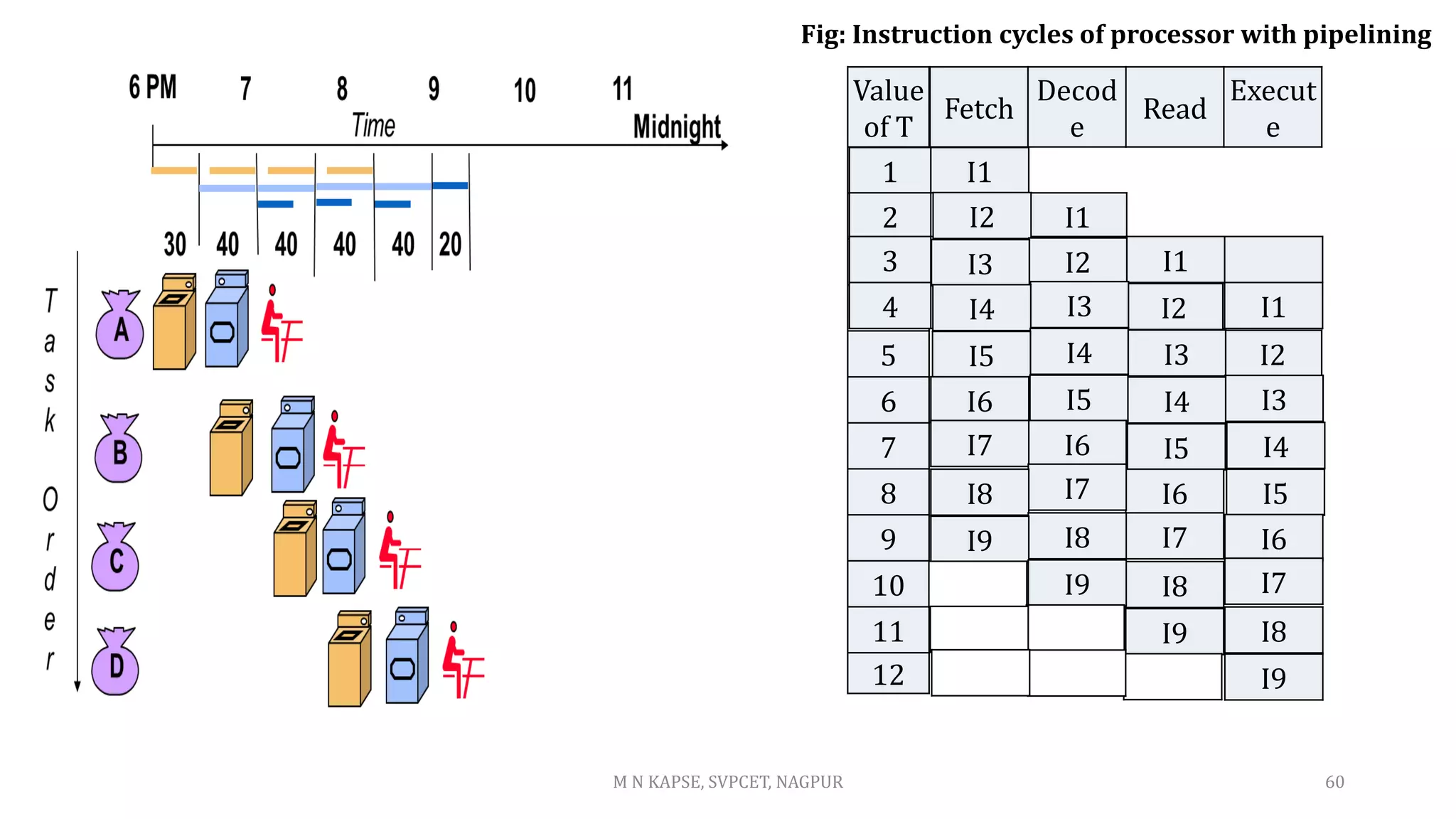
Pipelined Laundry
• Pipelined laundry takes 3.5 hours for 4 loads
A
B
C
D
6 PM 7 8 9 10 11
Midnight
T
a
s
k
O
r
d
e
r
Time
59
M N KAPSE, SVPCET, NAGPUR
30 40 40 40 40 20
M N KAPSE, SVPCET, NAGPUR 60
Value
of T
1
2
3
4
5
6
7
8
9
10
11
12
Fetch
Decod
e
Read
Execut
e
1 I1
2 I1
3 I1
4 I1
I2
I2
I2
I3
I3
I2
I3
I3
I4
I4
I4
I4
I5
I5
I5
I5
I6
I6
I6
I6
I7
I7
I7
I7
I8
I8
I8
I8
I9
I9
I9
I9
Fig: Instruction cycles of processor with pipelining
Pipelining
Value of T Fetch Decode Read Execute
1 I1
2 I1
3 I1
4 I1
5 I2
6 I2
7 I2
8 I2
9 I3
10 I3
11 I3
12 I3
61
Value of T Fetch Decode Read Execute
1 I1
2 I2 I1
3 I3 I2 I1
4 I4 I3 I2 I1
5 I5 I4 I3 I2
6 I6 I5 I4 I3
7 I7 I6 I5 I4
8 I8 I7 I6 I5
9 I9 I8 I7 I6
10 I9 I8 I7
11 I9 I8
12 I9
Fig: Instruction cycles of processor with no pipelining Fig: Instruction cycles of processor with pipelining
M N KAPSE, SVPCET, NAGPUR
Pipelining Lessons
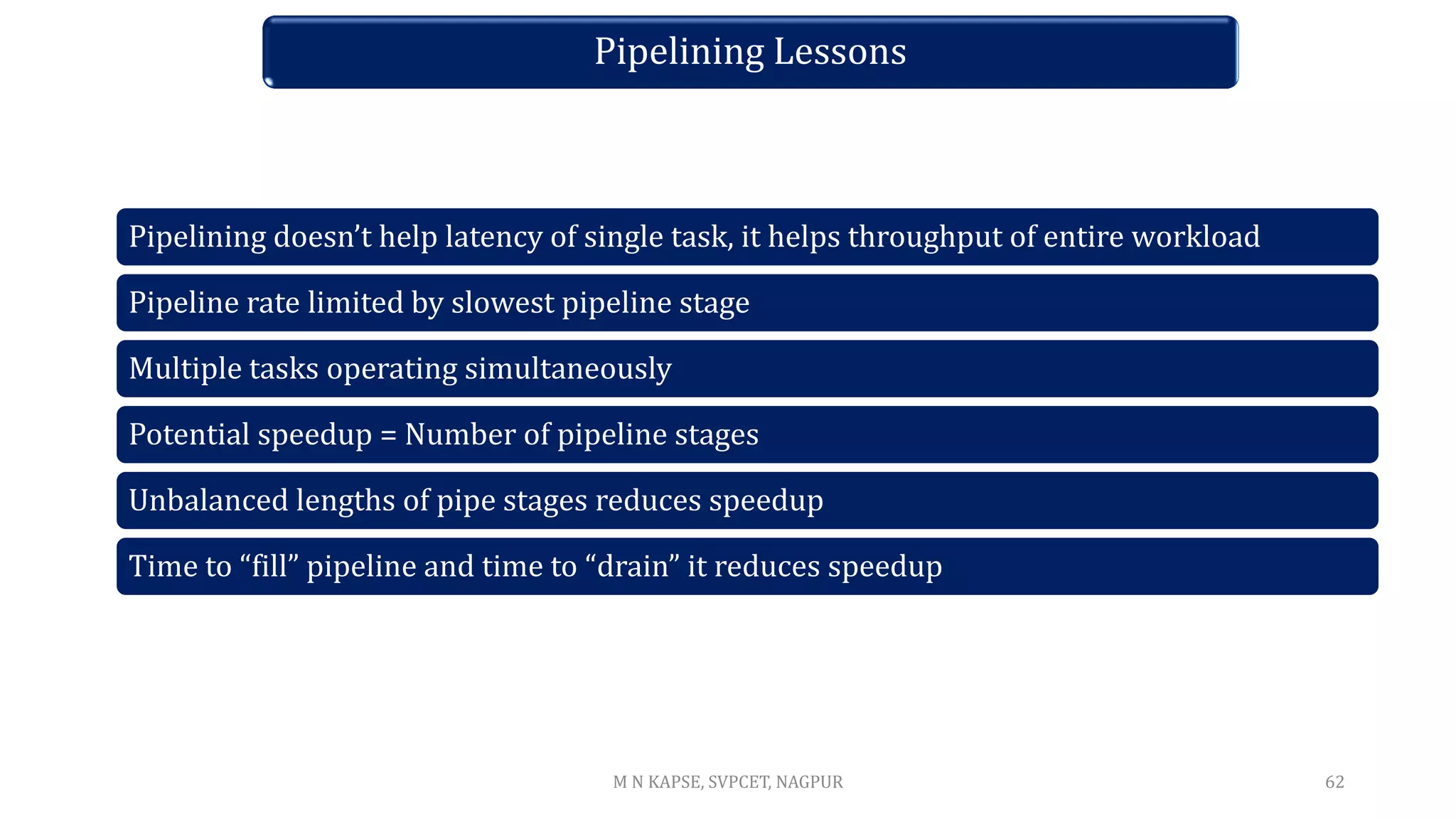
Pipelining doesn’t help latency of single task, it helps throughput of entire workload
Pipeline rate limited by slowest pipeline stage
Multiple tasks operating simultaneously
Potential speedup = Number of pipeline stages
Unbalanced lengths of pipe stages reduces speedup
Time to “fill” pipeline and time to “drain” it reduces speedup
62
M N KAPSE, SVPCET, NAGPUR
M N KAPSE, SVPCET, NAGPUR 63
Von Neuman Architecture
64
Processin
g Unit
Control
Unit
Data &
Program
memory
Data
Bus
Results
Operands
Status Opcode
Data/
Instructions
Instructions
Address
M N KAPSE, SVPCET, NAGPUR
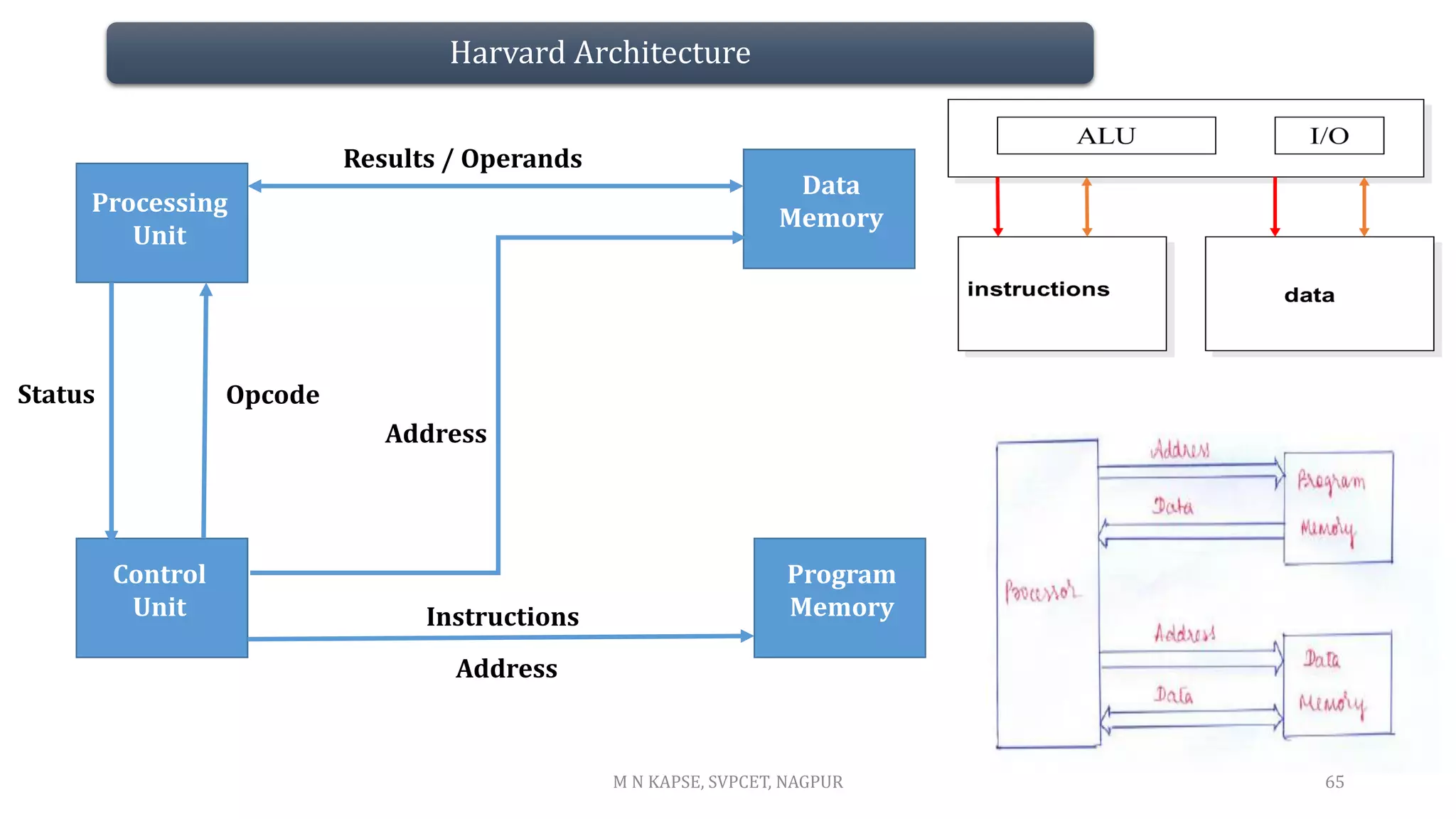
Harvard Architecture
65
Processing
Unit
Control
Unit
Program
Memory
Results / Operands
Status Opcode
Instructions
Address
Data
Memory
Address
M N KAPSE, SVPCET, NAGPUR
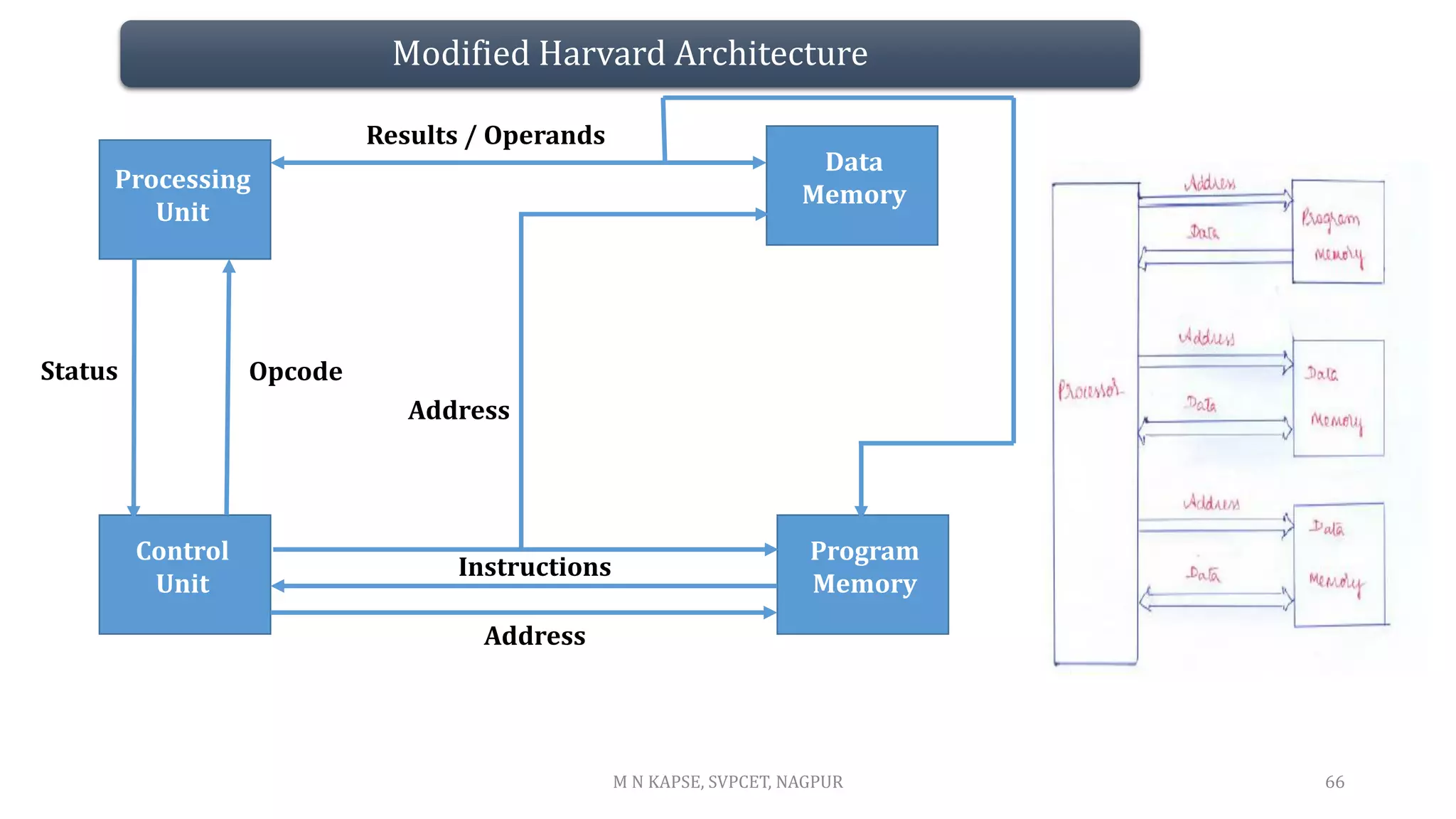
Modified Harvard Architecture
66
Processing
Unit
Control
Unit
Program
Memory
Results / Operands
Status Opcode
Instructions
Address
Data
Memory
Address
M N KAPSE, SVPCET, NAGPUR
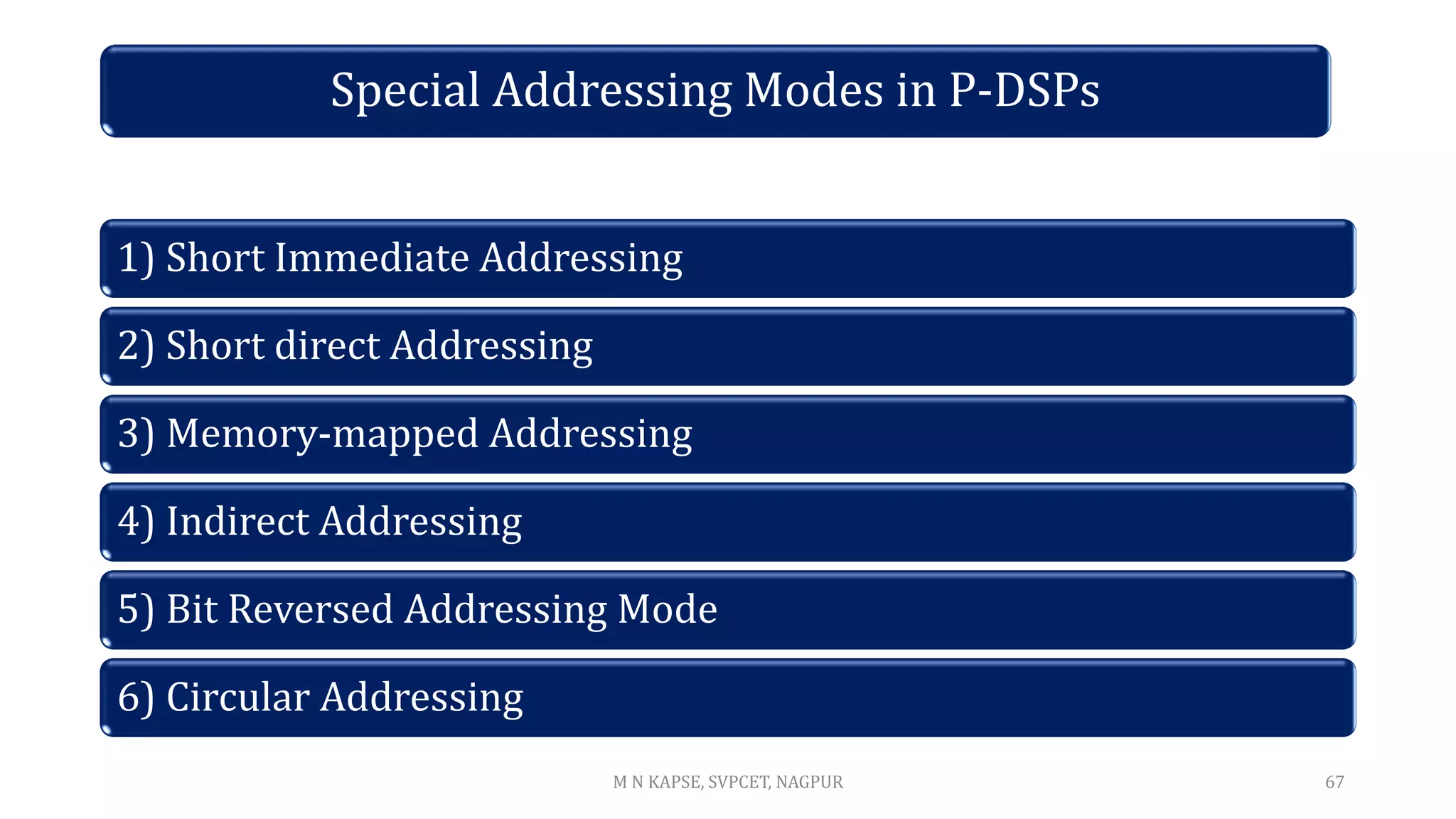
Special Addressing Modes in P-DSPs
1) Short Immediate Addressing
2) Short direct Addressing
3) Memory-mapped Addressing
4) Indirect Addressing
5) Bit Reversed Addressing Mode
6) Circular Addressing
67
M N KAPSE, SVPCET, NAGPUR
1) Short Immediate Addressing
• Permits the operand to be specified using a short constant that forms part of
a single word instruction.
• The length of the short constant depends on the instruction type & P-DSP.
• Short immediate values can be 3, 5, 8, or 9 bits in length.
68
M N KAPSE, SVPCET, NAGPUR
2) Short direct Addressing
• Permits the lower order address of the operand of an instruction to be
specified in the single word instruction.
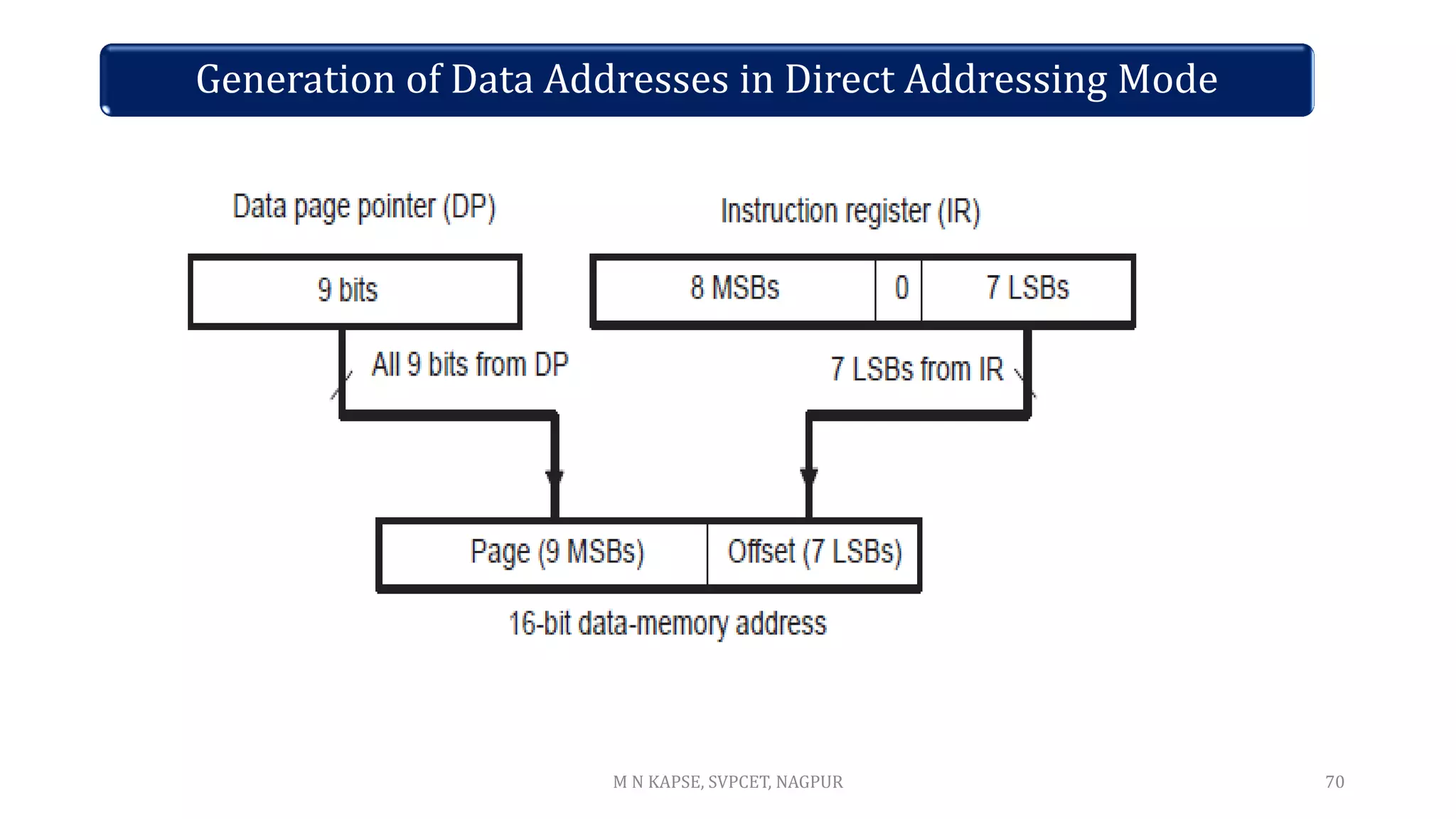
• In TI TMS320 DSPs, the higher order 9 bits of the memory are stored in the
data page pointer & only the lower 7 bits are specified as a part of the
instruction.
69
M N KAPSE, SVPCET, NAGPUR
Generation of Data Addresses in Direct Addressing Mode
M N KAPSE, SVPCET, NAGPUR 70
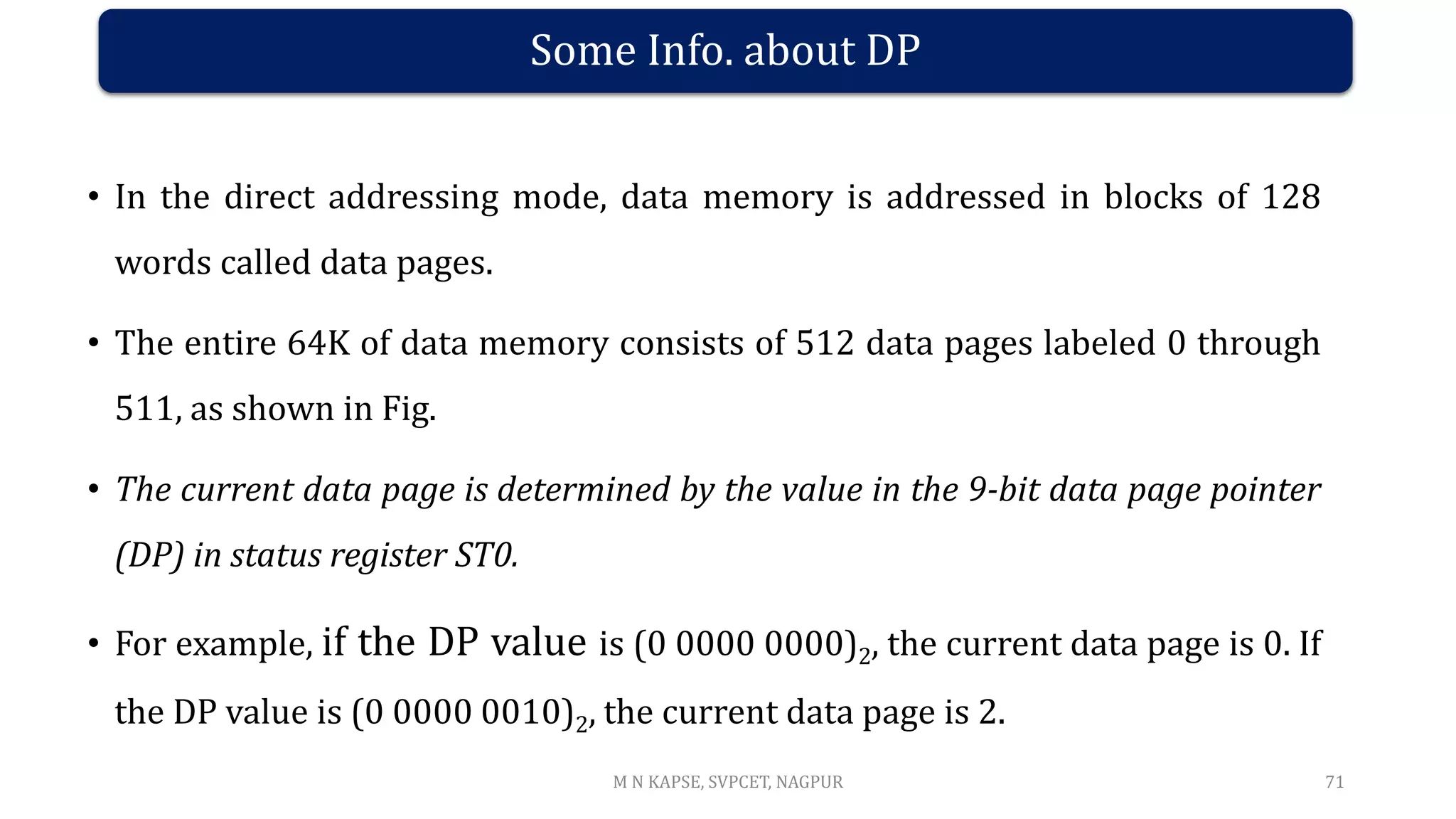
Some Info. about DP
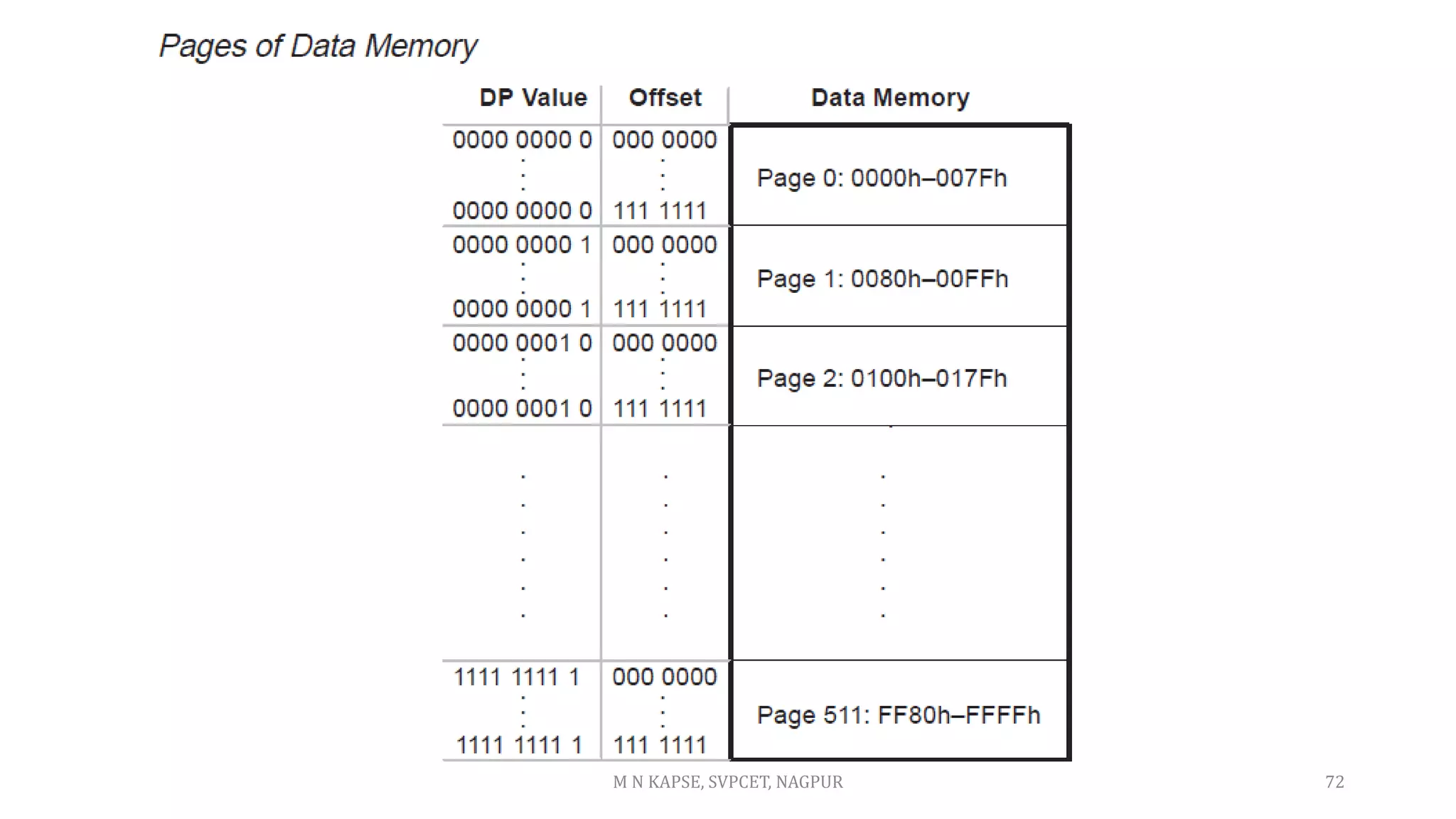
• In the direct addressing mode, data memory is addressed in blocks of 128
words called data pages.
• The entire 64K of data memory consists of 512 data pages labeled 0 through
511, as shown in Fig.
• The current data page is determined by the value in the 9-bit data page pointer
(DP) in status register ST0.
• For example, if the DP value is (0 0000 0000)2, the current data page is 0. If
the DP value is (0 0000 0010)2, the current data page is 2.
71
M N KAPSE, SVPCET, NAGPUR
72
M N KAPSE, SVPCET, NAGPUR
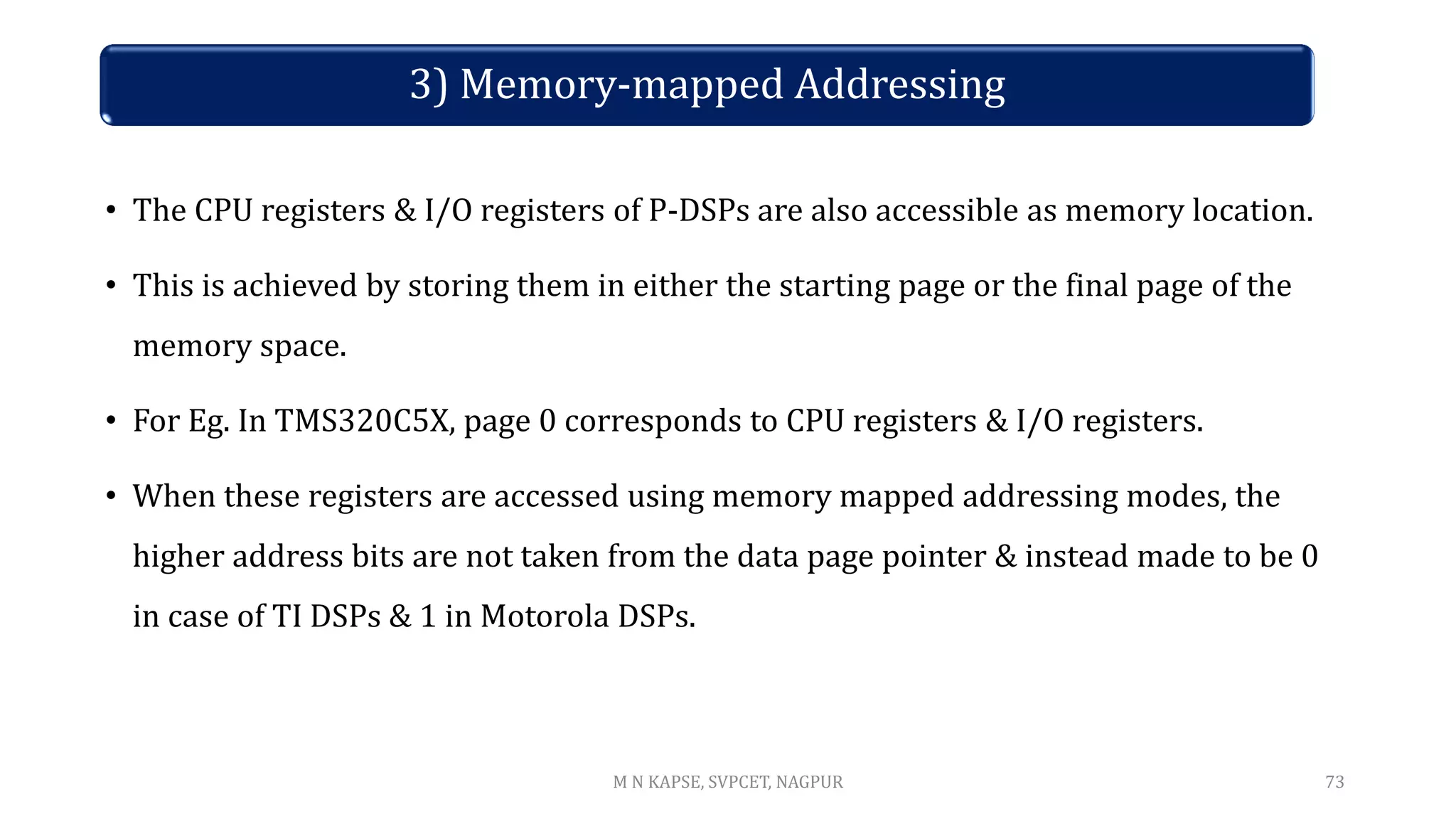
3) Memory-mapped Addressing
• The CPU registers & I/O registers of P-DSPs are also accessible as memory location.
• This is achieved by storing them in either the starting page or the final page of the
memory space.
• For Eg. In TMS320C5X, page 0 corresponds to CPU registers & I/O registers.
• When these registers are accessed using memory mapped addressing modes, the
higher address bits are not taken from the data page pointer & instead made to be 0
in case of TI DSPs & 1 in Motorola DSPs.
73
M N KAPSE, SVPCET, NAGPUR
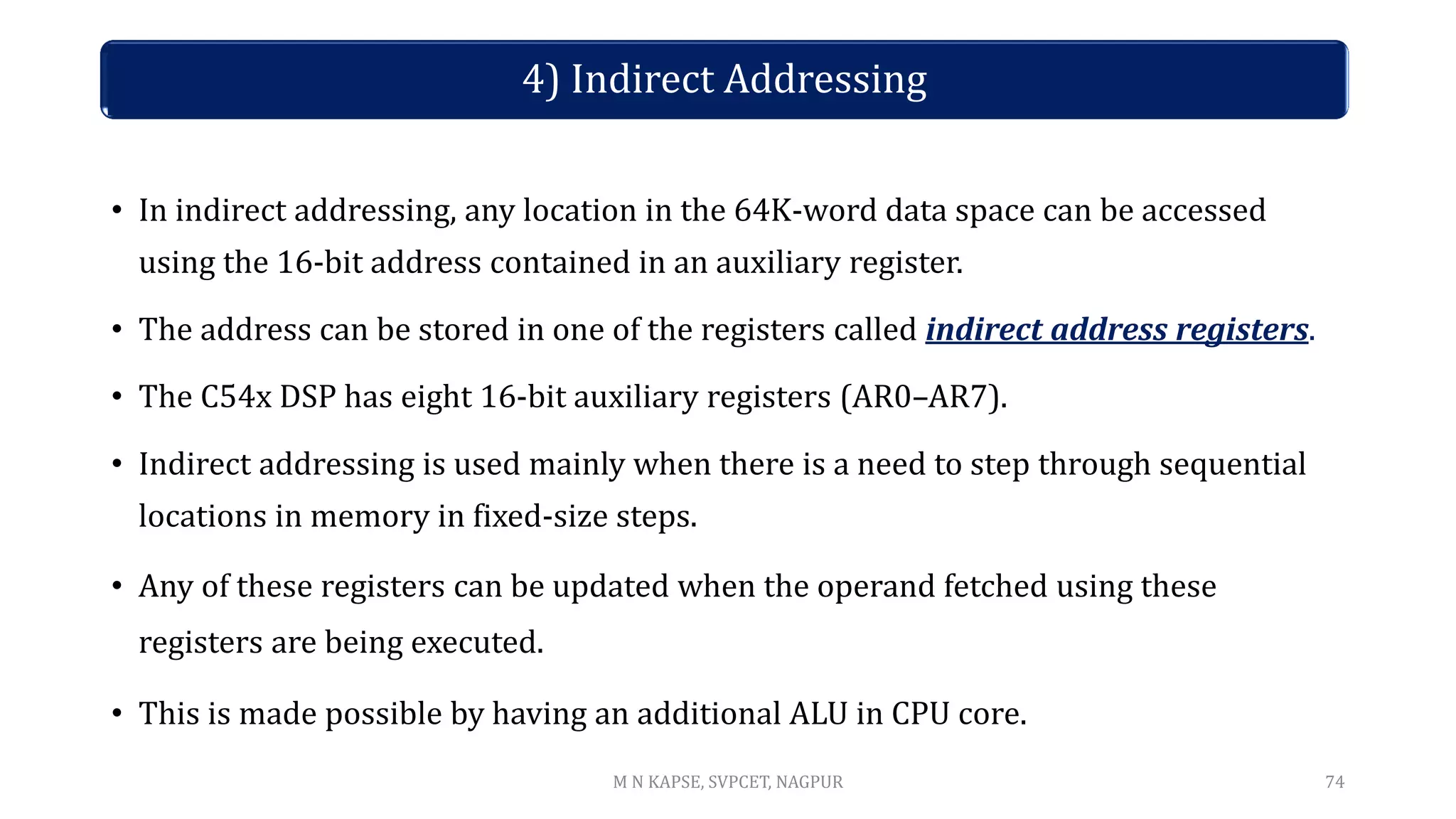
• In indirect addressing, any location in the 64K-word data space can be accessed
using the 16-bit address contained in an auxiliary register.
• The address can be stored in one of the registers called indirect address registers.
• The C54x DSP has eight 16-bit auxiliary registers (AR0–AR7).
• Indirect addressing is used mainly when there is a need to step through sequential
locations in memory in fixed-size steps.
• Any of these registers can be updated when the operand fetched using these
registers are being executed.
• This is made possible by having an additional ALU in CPU core.
74
4) Indirect Addressing
M N KAPSE, SVPCET, NAGPUR
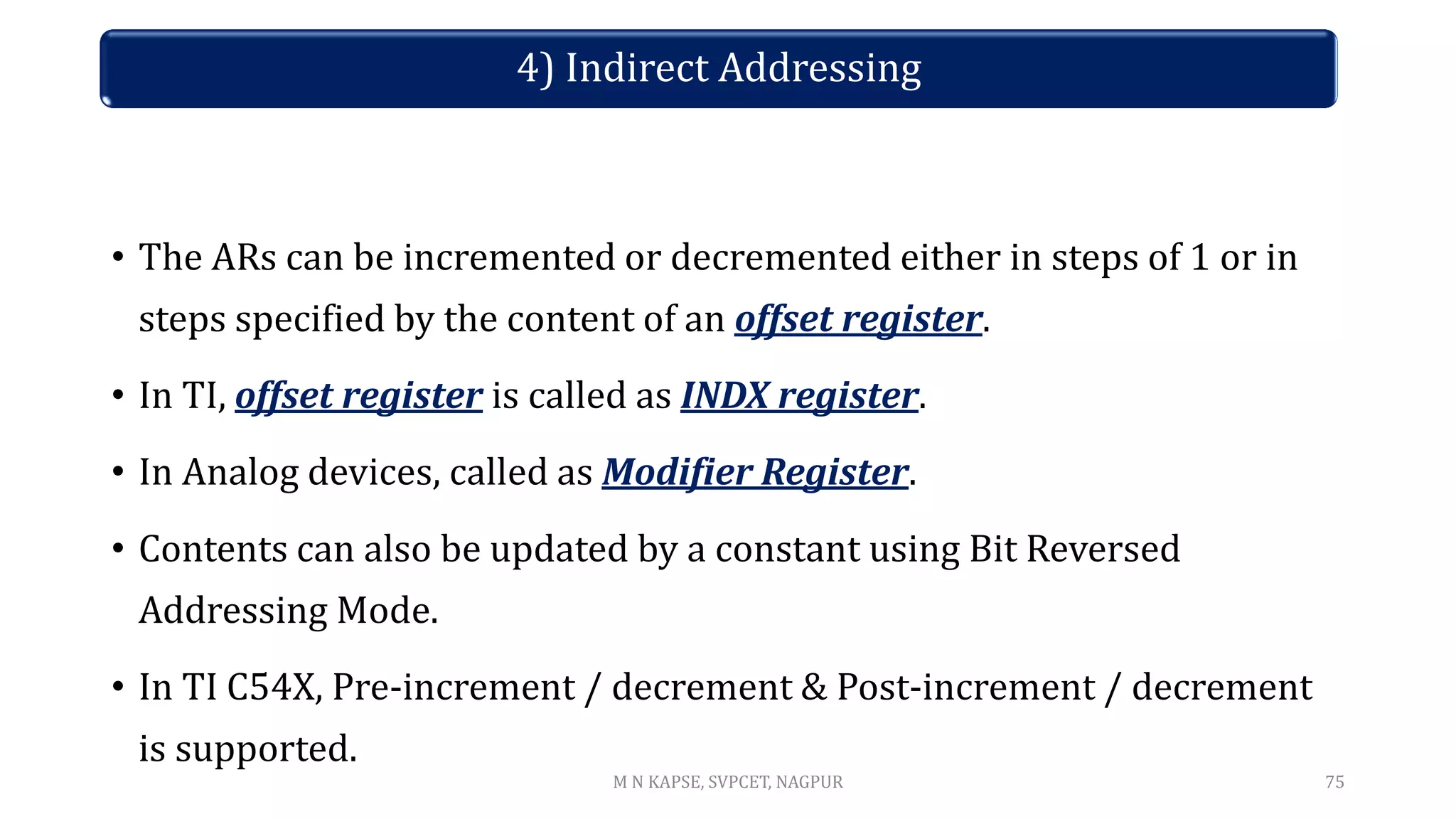
• The ARs can be incremented or decremented either in steps of 1 or in
steps specified by the content of an offset register.
• In TI, offset register is called as INDX register.
• In Analog devices, called as Modifier Register.
• Contents can also be updated by a constant using Bit Reversed
Addressing Mode.
• In TI C54X, Pre-increment / decrement & Post-increment / decrement
is supported.
75
4) Indirect Addressing
M N KAPSE, SVPCET, NAGPUR
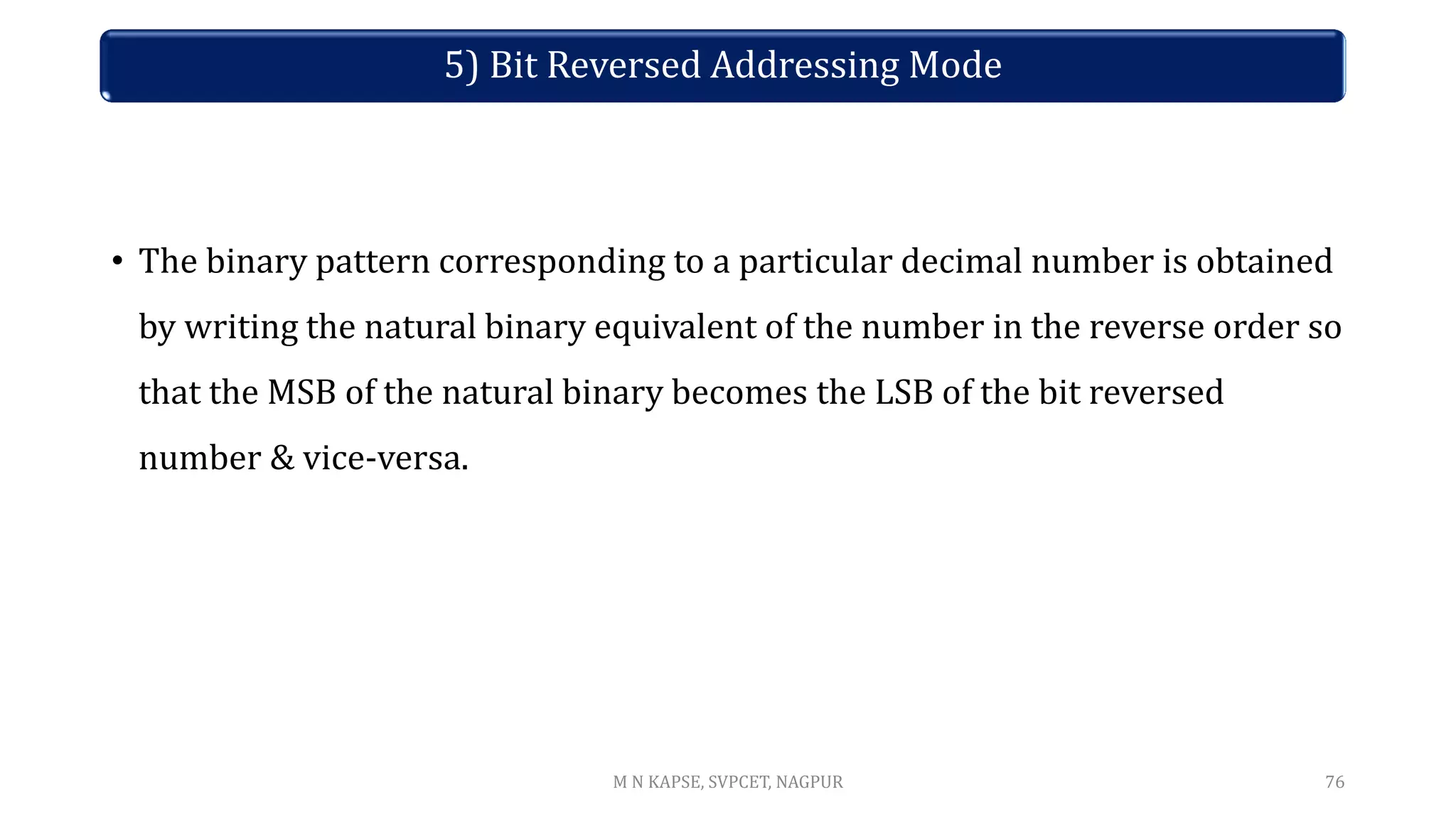
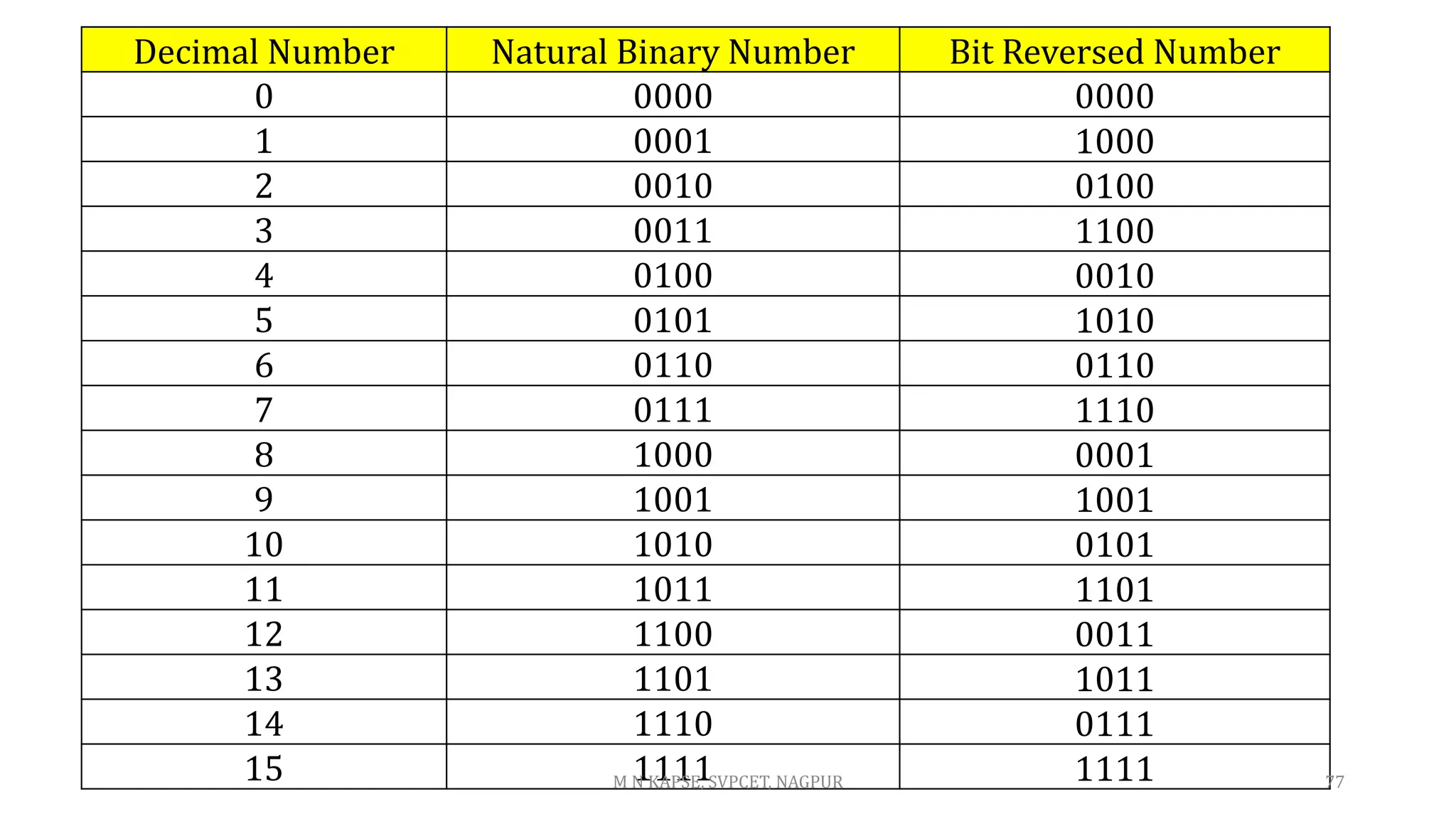
• The binary pattern corresponding to a particular decimal number is obtained
by writing the natural binary equivalent of the number in the reverse order so
that the MSB of the natural binary becomes the LSB of the bit reversed
number & vice-versa.
76
5) Bit Reversed Addressing Mode
M N KAPSE, SVPCET, NAGPUR
Decimal Number Natural Binary Number Bit Reversed Number
0 0000 0000
1 0001 1000
2 0010 0100
3 0011 1100
4 0100 0010
5 0101 1010
6 0110 0110
7 0111 1110
8 1000 0001
9 1001 1001
10 1010 0101
11 1011 1101
12 1100 0011
13 1101 1011
14 1110 0111
15 1111 1111 77
M N KAPSE, SVPCET, NAGPUR
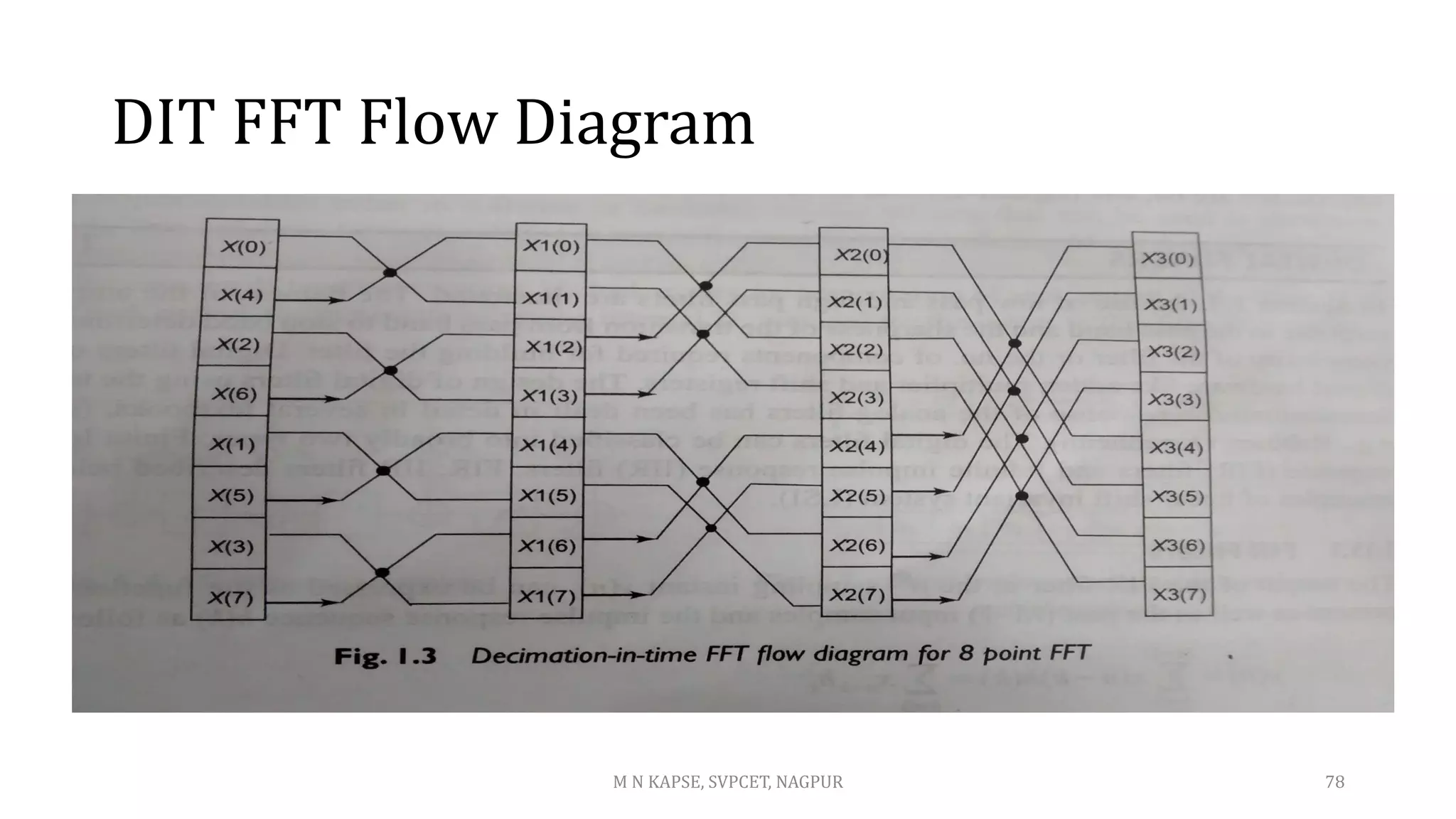
DIT FFT Flow Diagram
M N KAPSE, SVPCET, NAGPUR 78
6) Circular Addressing
• Memory can be organized as a circular buffer with the beginning memory
address & the ending memory address corresponding to this buffer defined
by the programmer.
• In this, when the address pointer is incremented, the address will be checked
with the ending memory address of the circular buffer.
• If it exceeds that, the address will be made equal to the beginning address of
the circular buffer.
79
M N KAPSE, SVPCET, NAGPUR
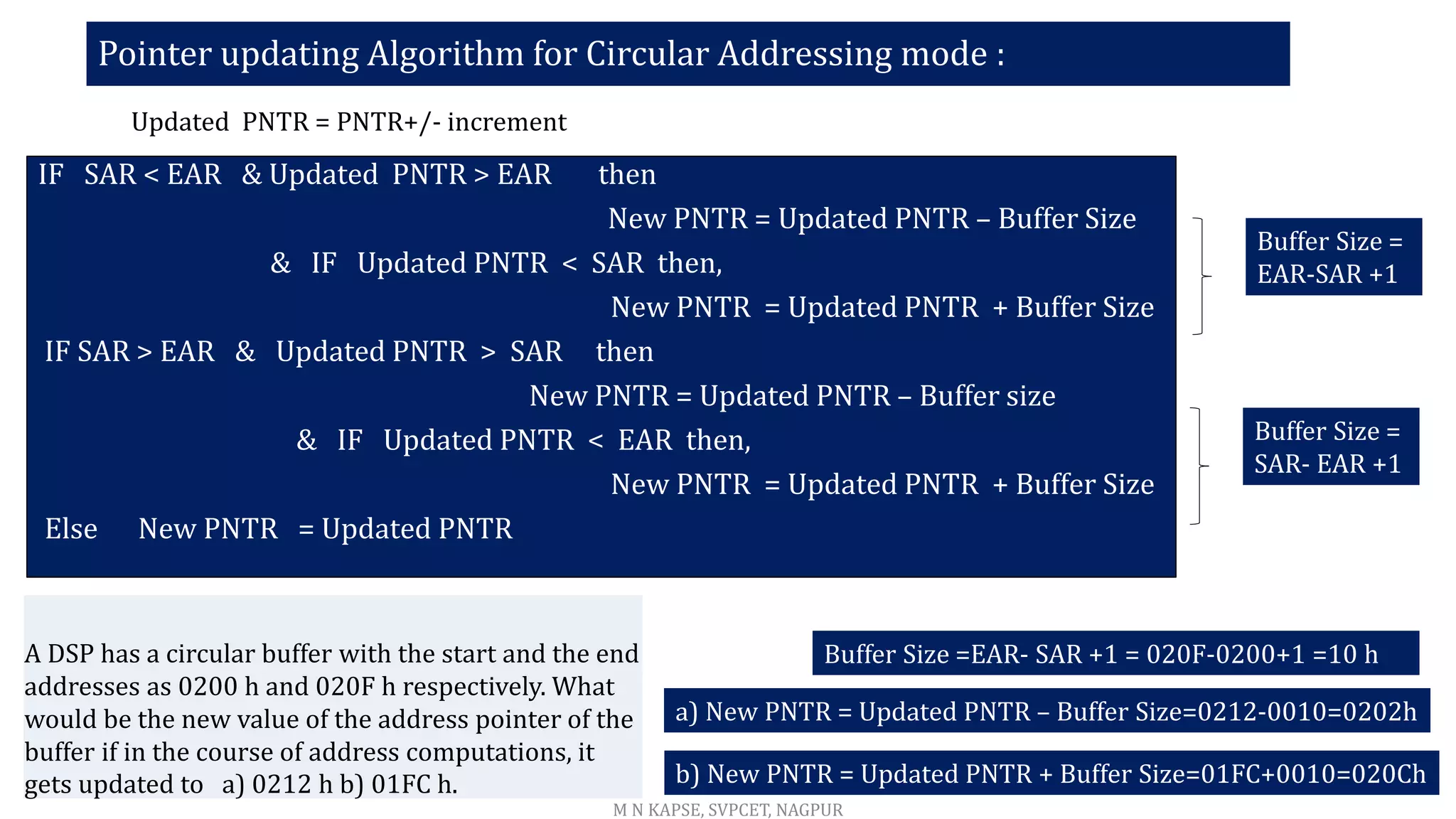
Pointer updating Algorithm for Circular Addressing mode :
IF SAR < EAR & Updated PNTR > EAR then
New PNTR = Updated PNTR – Buffer Size
& IF Updated PNTR < SAR then,
New PNTR = Updated PNTR + Buffer Size
IF SAR > EAR & Updated PNTR > SAR then
New PNTR = Updated PNTR – Buffer size
& IF Updated PNTR < EAR then,
New PNTR = Updated PNTR + Buffer Size
Else New PNTR = Updated PNTR
M N KAPSE, SVPCET, NAGPUR
80
Buffer Size =
EAR-SAR +1
Buffer Size =
SAR- EAR +1
Updated PNTR = PNTR+/- increment
A DSP has a circular buffer with the start and the end
addresses as 0200 h and 020F h respectively. What
would be the new value of the address pointer of the
buffer if in the course of address computations, it
gets updated to a) 0212 h b) 01FC h.
Buffer Size =EAR- SAR +1 = 020F-0200+1 =10 h
a) New PNTR = Updated PNTR – Buffer Size=0212-0010=0202h
b) New PNTR = Updated PNTR + Buffer Size=01FC+0010=020Ch
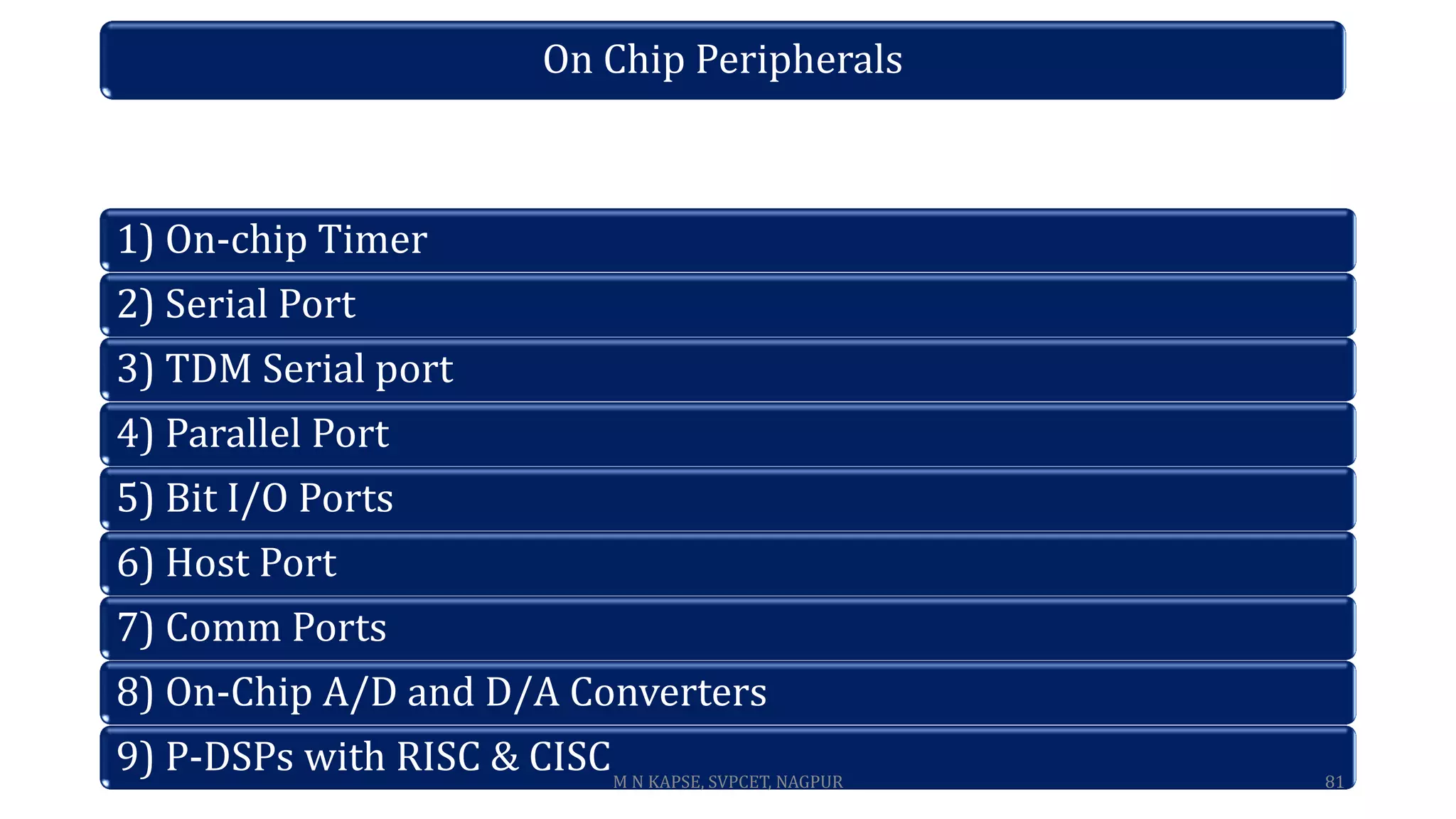
On Chip Peripherals
1) On-chip Timer
2) Serial Port
3) TDM Serial port
4) Parallel Port
5) Bit I/O Ports
6) Host Port
7) Comm Ports
8) On-Chip A/D and D/A Converters
9) P-DSPs with RISC & CISC 81
M N KAPSE, SVPCET, NAGPUR
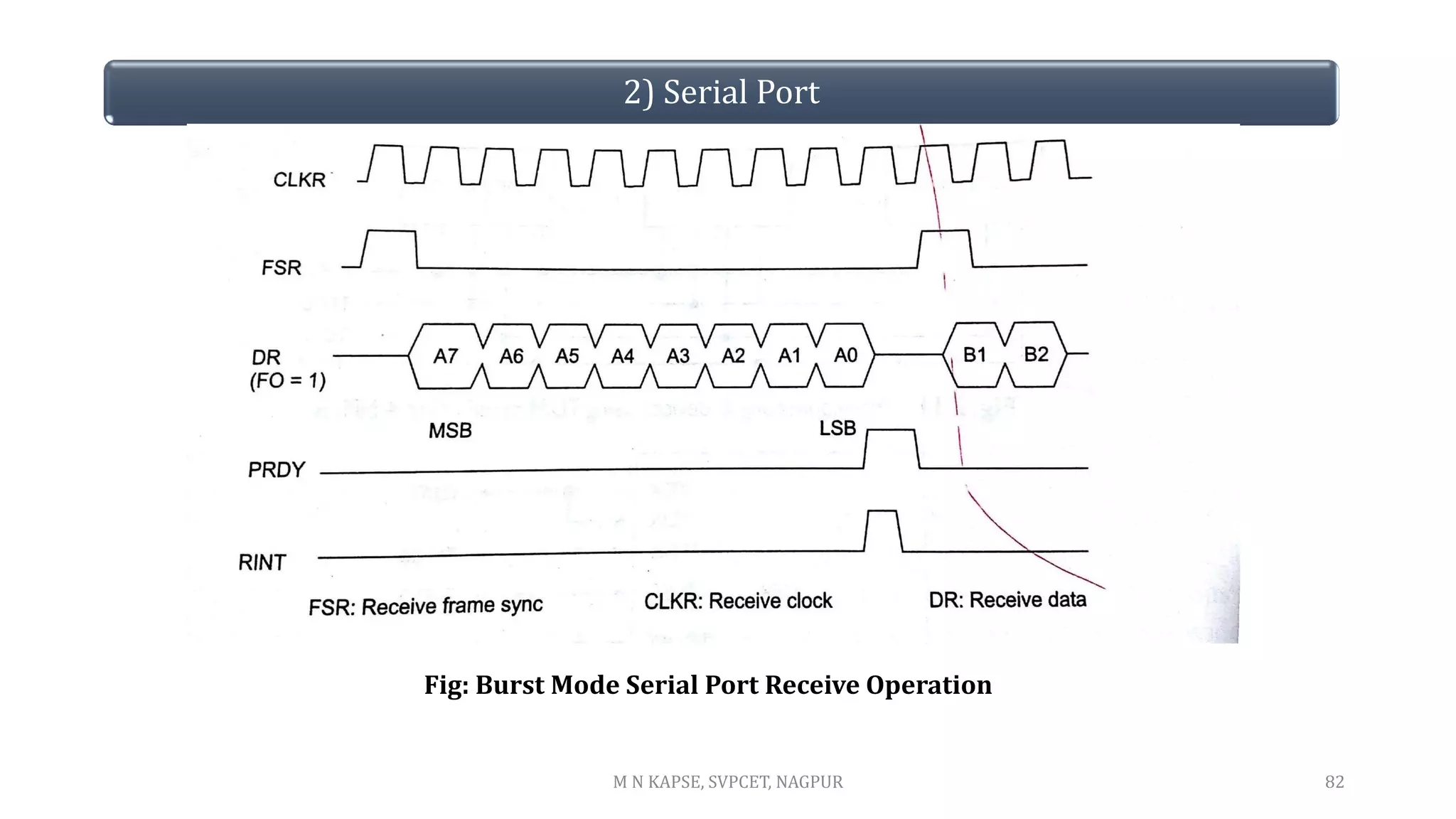
2) Serial Port
82
Fig: Burst Mode Serial Port Receive Operation
M N KAPSE, SVPCET, NAGPUR
3) TDM Serial port
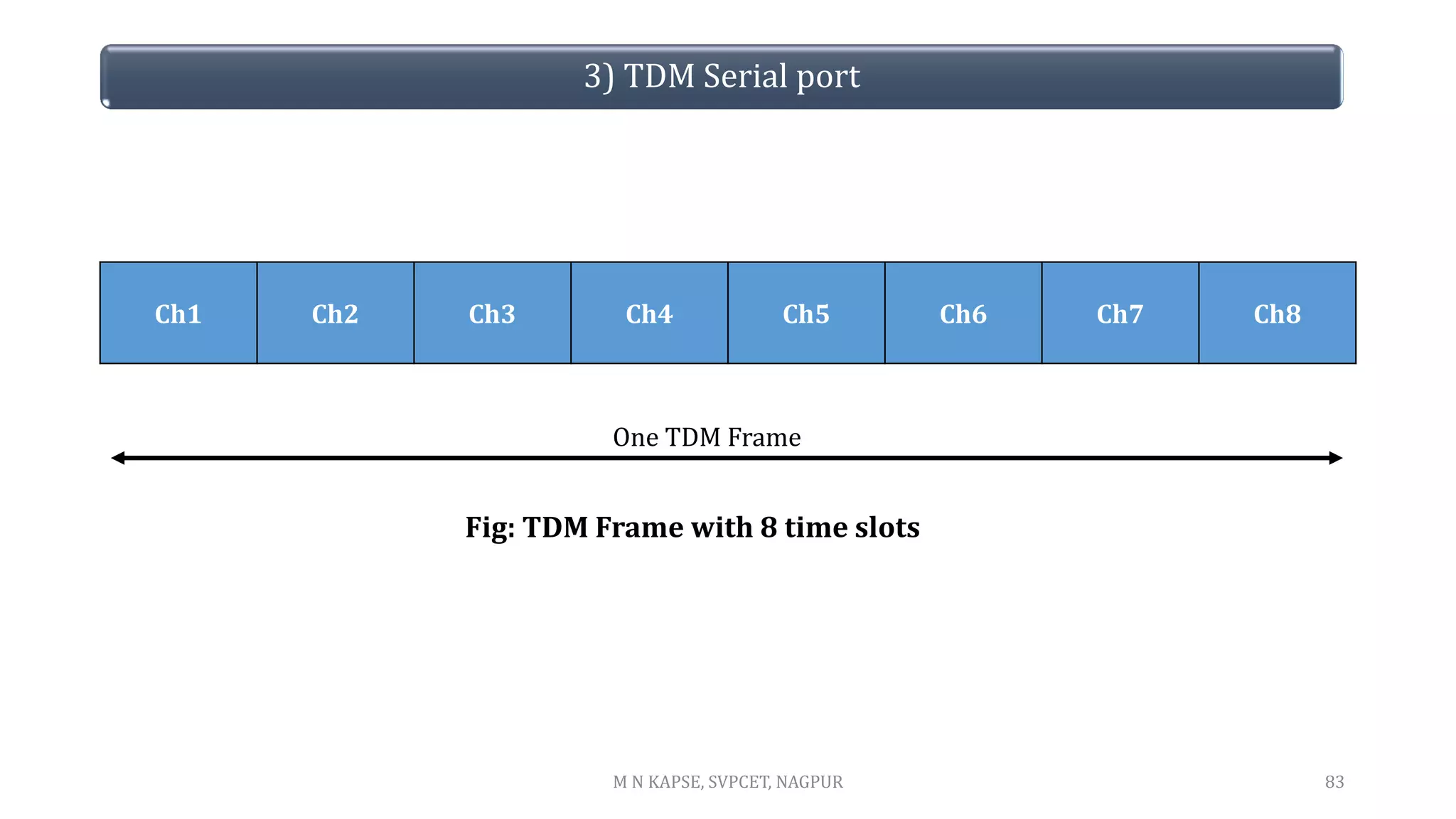
Ch1 Ch2 Ch3 Ch4 Ch5 Ch6 Ch7 Ch8
83
One TDM Frame
Fig: TDM Frame with 8 time slots
M N KAPSE, SVPCET, NAGPUR
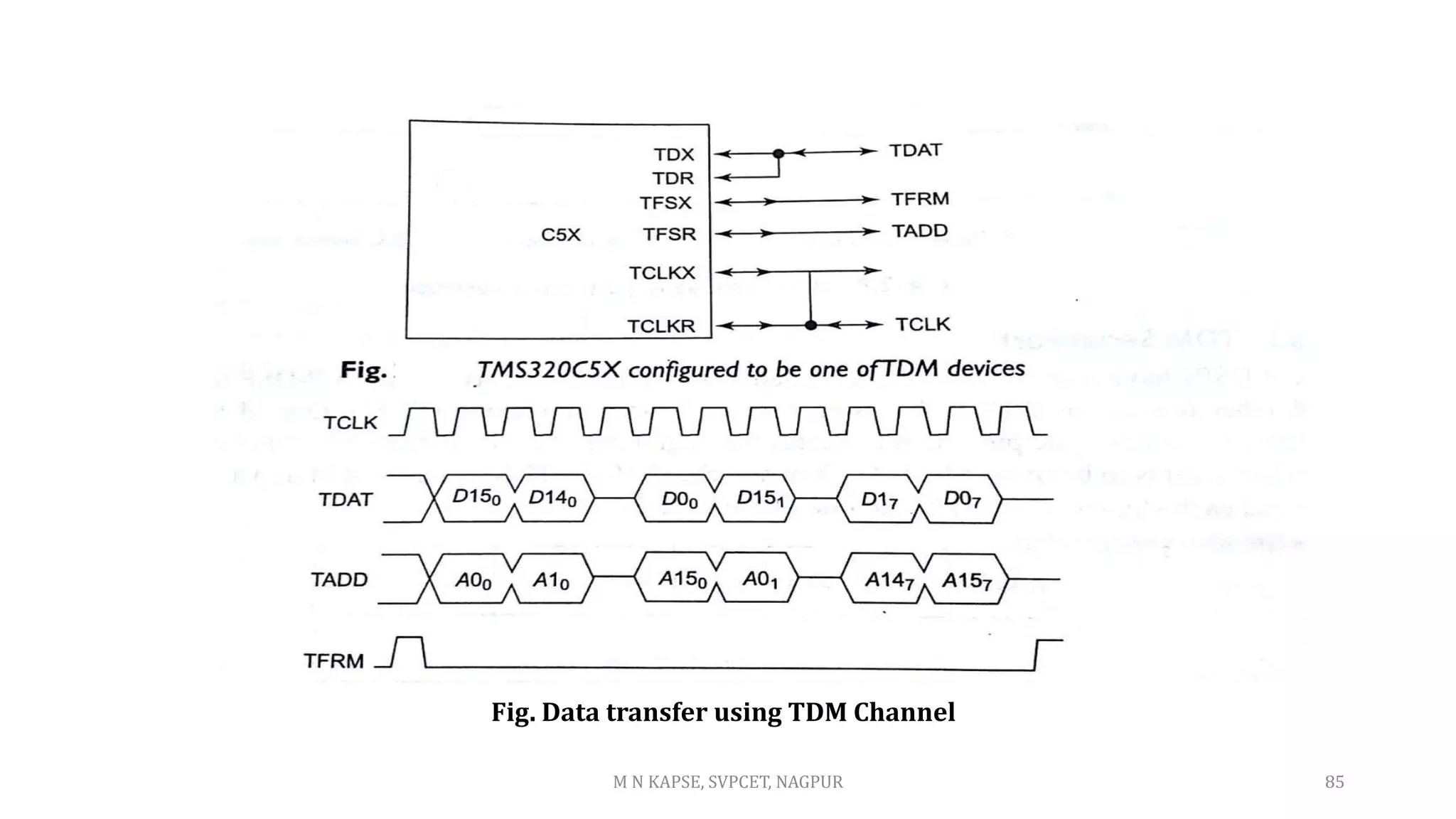
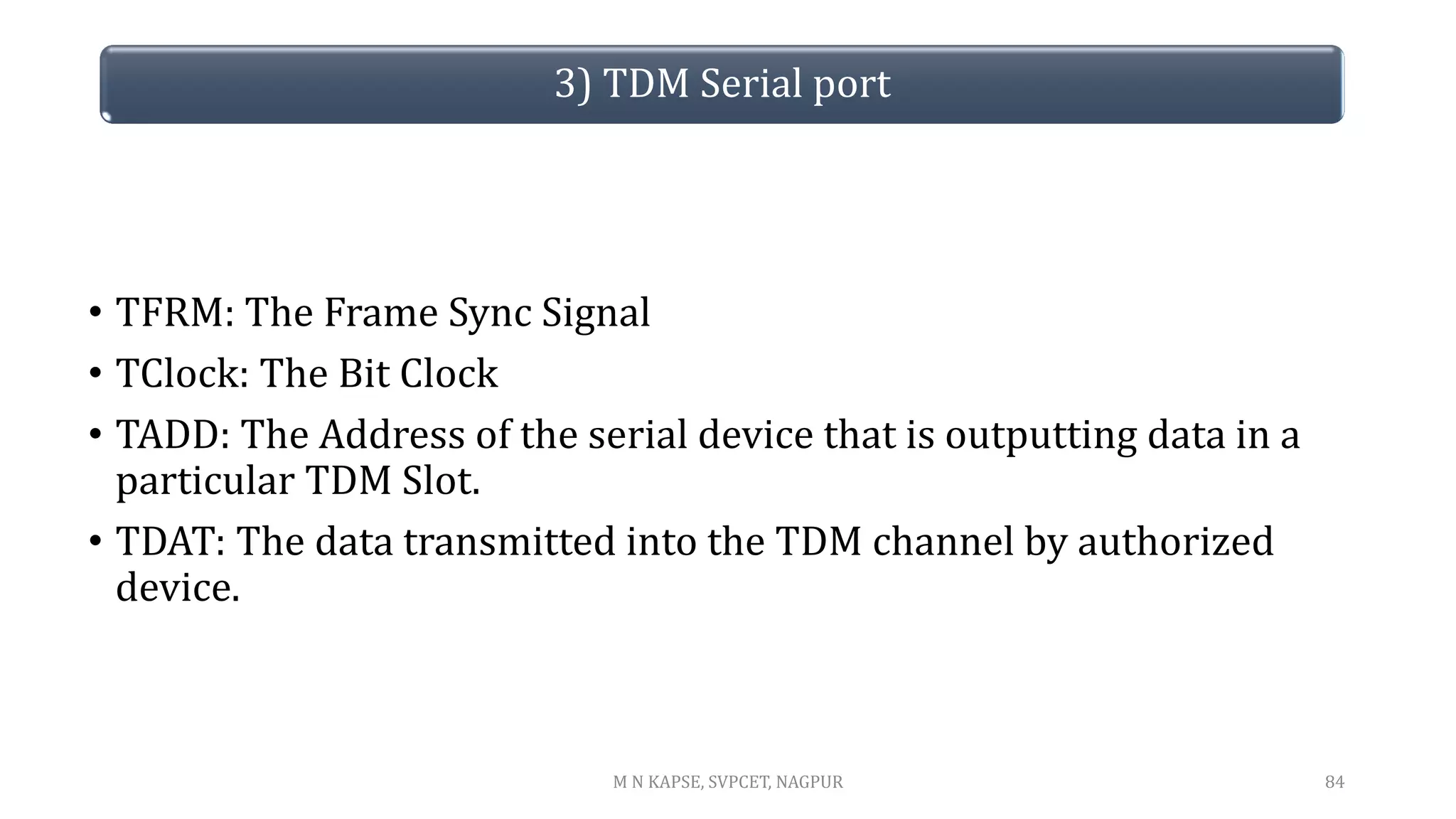
• TFRM: The Frame Sync Signal
• TClock: The Bit Clock
• TADD: The Address of the serial device that is outputting data in a
particular TDM Slot.
• TDAT: The data transmitted into the TDM channel by authorized
device.
84
3) TDM Serial port
M N KAPSE, SVPCET, NAGPUR
85
Fig. Data transfer using TDM Channel
M N KAPSE, SVPCET, NAGPUR
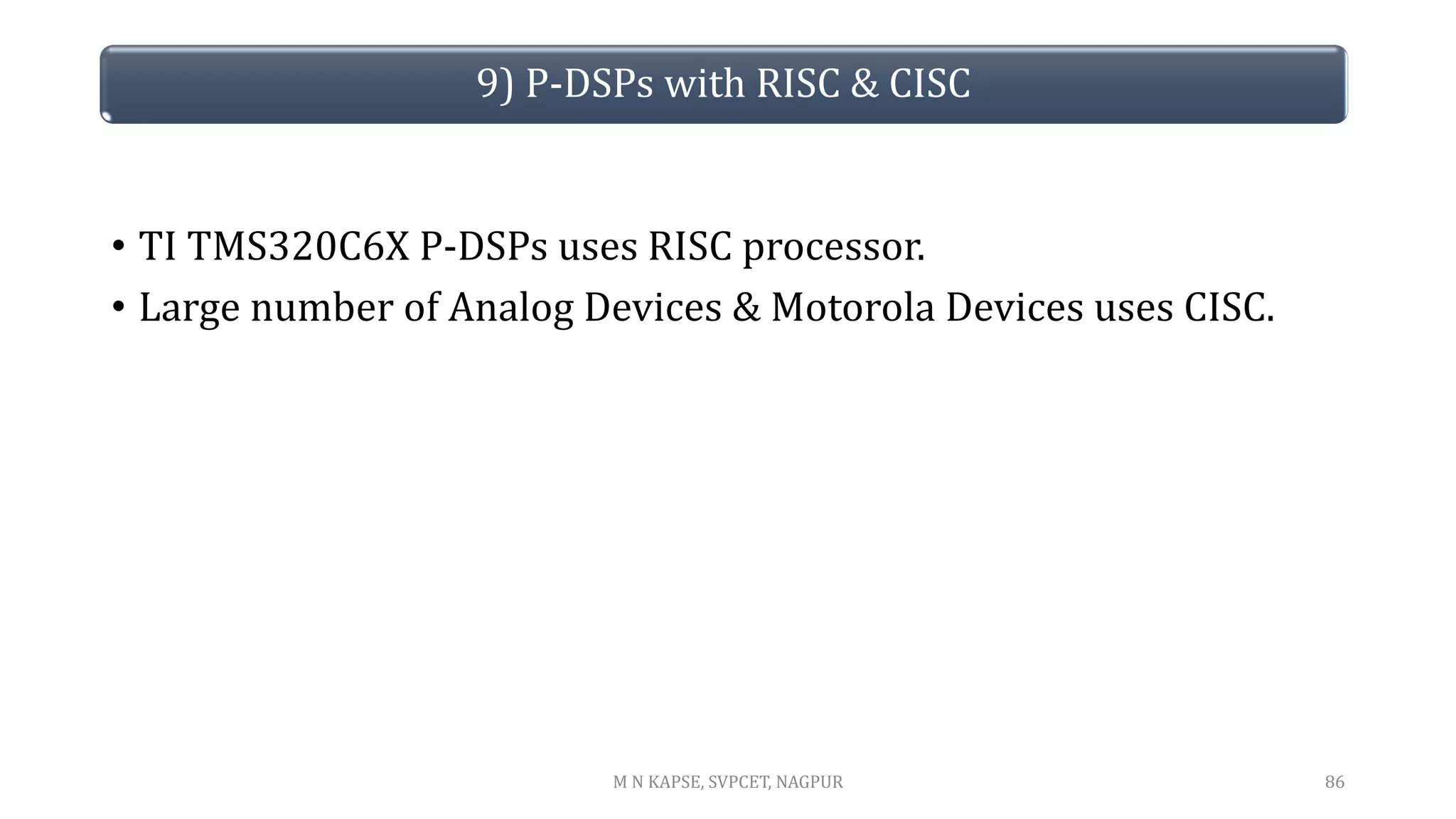
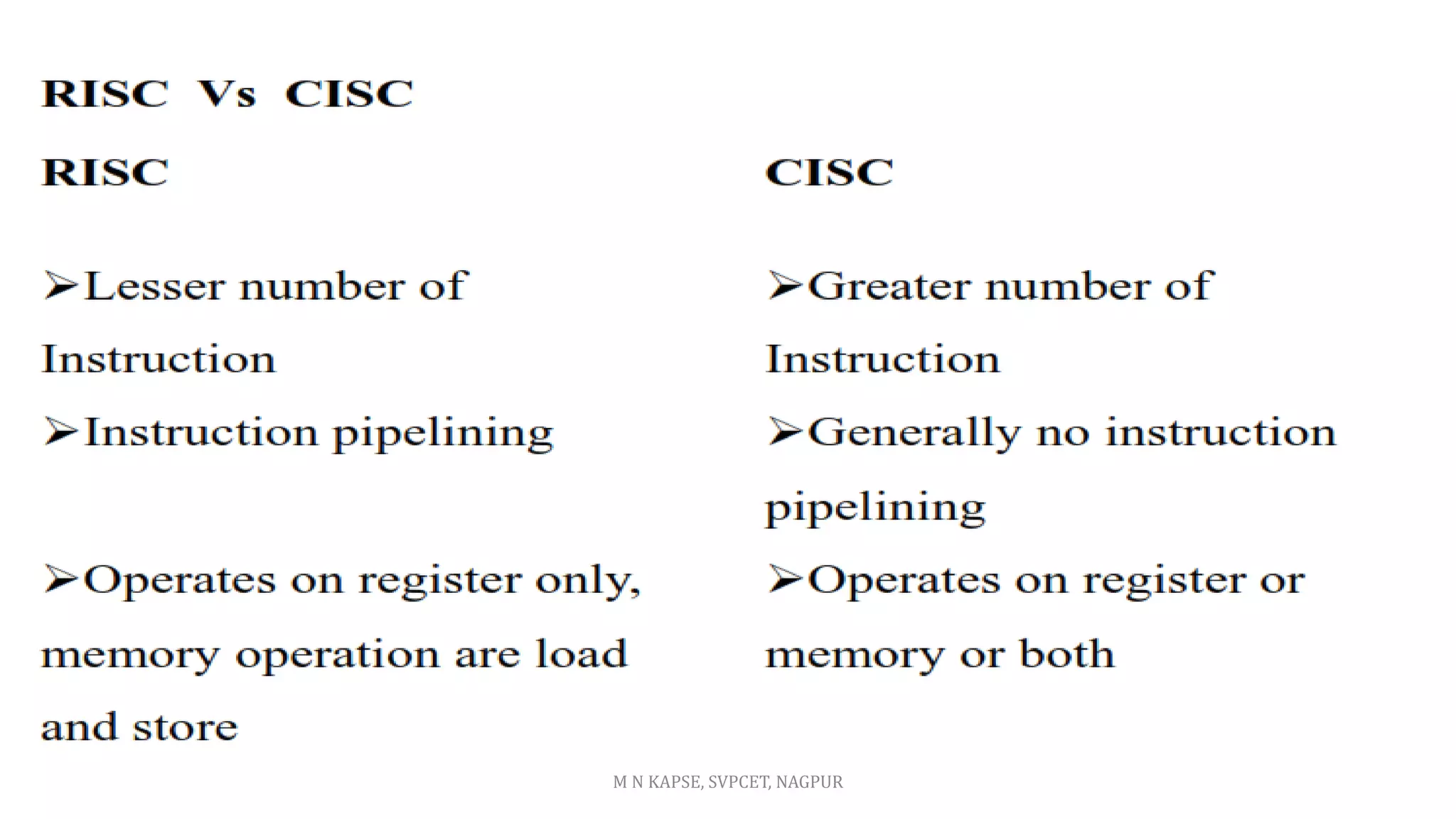
9) P-DSPs with RISC & CISC
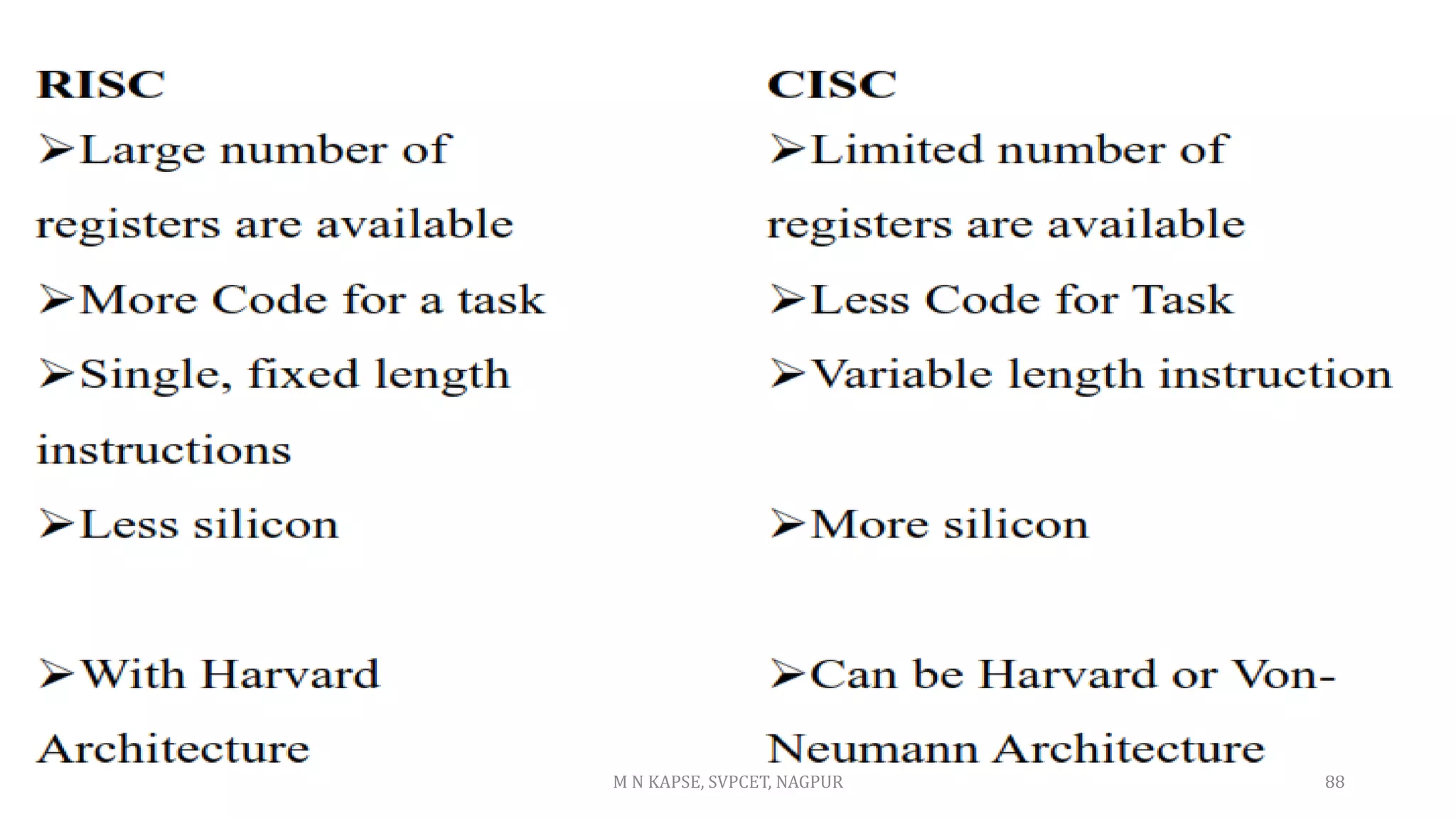
• TI TMS320C6X P-DSPs uses RISC processor.
• Large number of Analog Devices & Motorola Devices uses CISC.
86
M N KAPSE, SVPCET, NAGPUR
87
M N KAPSE, SVPCET, NAGPUR
88
M N KAPSE, SVPCET, NAGPUR
References
• Unit shipments worldwide
Blu-ray & DVD players: https://www.futuresource-consulting.com/reports/report/r/futuresource-worldwide-
home-video-market-report/i/412362
Cars & light trucks: http://www.gbm.scotiabank.com/scpt/gbm/scotiaeconomics63/GAR_2017-02-07.pdf
Digital media streamers: https://www.strategyanalytics.com/access-services/devices/connected-
home/consumer-electronics/reports/report-detail/global-connected-tv-device-vendor-share-q3-2016
Digital still cameras: http://promuser.com/markets/2017/global-digital-camera-market-report-january-2017
iPhone5: http://www.ifixit.com/Teardown/iPhone-5-Teardown/10525/
PCs/laptops: https://www.gartner.com/newsroom/id/3568420
Smart phones: http://www.gartner.com/newsroom/id/3609817
Tablets: https://www.idc.com/getdoc.jsp?containerId=prUS42272117
Video game consoles: https://www.statista.com/statistics/276768/global-unit-sales-of-video-game-consoles/
• Embedded processor resources
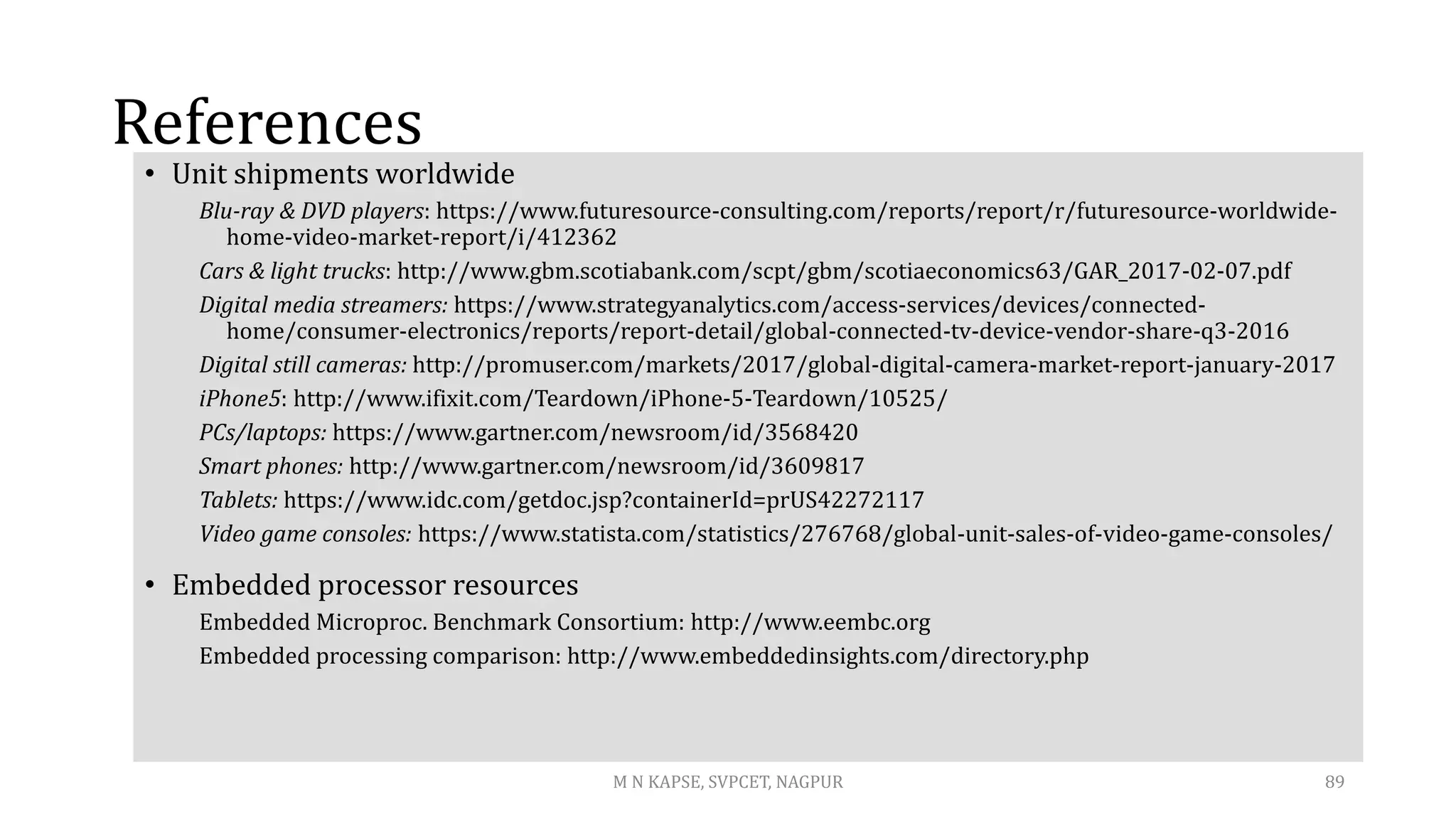
Embedded Microproc. Benchmark Consortium: http://www.eembc.org
Embedded processing comparison: http://www.embeddedinsights.com/directory.php
M N KAPSE, SVPCET, NAGPUR 89

Unit i-fundamentals of programmable DSP processors

  • 1.
    ST. VINCENT PALLOTTICOLLEGE OF ENGINEERING & TECHNOLOGY, NAGPUR DEPARTMENT OF ELECTRONICS & TELECOMMUNICATION ENGINEERING BEETE701T: DSP PROCESSOR & ARCHITECTURE Instructor :M N Kapse Email: mkapse@stvincentngp.edu.in
  • 2.
    O b j e c t i v e s 2 To study ProgrammableDSP Processors. To provide an understanding of the fundamentals of DSP techniques. To study implementation & applications of DSP techniques. To study multi-rate filters. To understand architecture of DSP processor. M N KAPSE, SVPCET, NAGPUR
  • 3.
    Outcome: By the endof this course, the students shall be able to , 3 to describe the detailed architecture, addressing mode, instruction sets of TMS320C5X to write program of DSP processor. to design & implement DSP algorithm using code composer studio to design decimation filter and interpolation filter. M N KAPSE, SVPCET, NAGPUR
  • 4.
    UNIT 1 :FUNDAMENTALS OF PROGRAMMABLE DSPs Multiplier and Multiplier accumulator Modified Bus Structures and Memory access in P-DSPs Multiple access memory Multi-ported memory. VLIW architecture, Pipelining, Special Addressing modes in PDSPs On chip Peripherals Von Neumann and Harvard Architecture, MAC Computational accuracy in DSP processor M N KAPSE, SVPCET, NAGPUR 5
  • 5.
    UNIT 2 :ARCHITECTURE OF TMS320C5X Architecture Bus Structure & memory CPU Addressing modes AL syntax M N KAPSE, SVPCET, NAGPUR 6
  • 6.
    UNIT 3 :Programming TMS320C5X Assembly language Instructions Simple ALP – Pipeline structure Operation Block Diagram of DSP starter kit Application Programs for processing real time signals. M N KAPSE, SVPCET, NAGPUR 7
  • 7.
    UNIT 4 :PROGRAMMABLE DIGITAL SIGNAL PROCESSORS Data Addressing modes of TMS320C54XX DSPs Data Addressing modes of TMS320C54XX Processors Program Control On-chip peripheral Interrupts of TMS320C54XX processors Pipeline Operation of TMS320C54XX Processors Block diagrams of internal Hardware, buses , internal memory organization. M N KAPSE, SVPCET, NAGPUR 8
  • 8.
    UNIT 5: ADVANCEDPROCESSORS Code Composer studio Architecture of TMS320C6X Architecture of Motorola DSP563XX Comparison of the features of DSP family processors M N KAPSE, SVPCET, NAGPUR 9
  • 9.
    UNIT 6: IMPLEMENTATIONOF BASIC DSP ALGORITHMS Study of time complexity of DFT and FFT algorithm Use of FFT for filtering long data sequence Interpolation filter Decimation filter Wavelet filter M N KAPSE, SVPCET, NAGPUR 10
  • 10.
    T e x t B o o k s 1. B. VenkataRamani and M. Bhaskar, Digital Signal Processors, Architecture, Programming and TMH,2004. 2. Avtar Singh, S.Srinivasan DSP Implementation using DSP microprocessor with Examples fromTMS32C54XX -Thamson 2004. 3. E. C. Ifeachor and B.W Jervis, Digital Signal Processing - A Practical approach, Pearson Publication 4. Salivahanan. Gyanapriya, Digital signal processing, TMH , Second Edition 11
  • 11.
    R e f e r e n c e B o o k s 1. DSP ProcessorFundamentals, Architectures & Features – Lapsley et al. , S. Chand & Co, 2000. 2. Digital signal processing-Jonathen Stein John Wiley 2005. 3. S.K. Mitra, Digital Signal Processing, Tata McGraw-Hill Publication, 2001. 4. B. Venkataramani, M. Bhaskar, Digital Signal Processors, McGraw Hill M N KAPSE, SVPCET, NAGPUR 12
  • 12.
    Online References https://www.ti.com/ …………..lit/ug/spru056d/spru056d.pdf https://www.bdti.com/Resources/Comp.DSP.FAQ/Part3 ………….Comp.DSP FAQ:Berkeley Design Technology, Inc http://users.ece.utexas.edu/~bevans/courses/realtime/index.html ………………..EE445S Real-Time Digital Signal Processing Laboratory http://dspfirst.gatech.edu/matlab/ ………………Educational Matlab GUIs http://dspfirst.gatech.edu/ M N KAPSE, SVPCET, NAGPUR 13
  • 13.
    Useful 14 https://youtu.be/82pYzfP7Plc .. Whatis a DSP? Why you need a Digital Signal Processor for Car Audio https://youtu.be/hDR4K5H_vis ………. I Finally Got A DSP! Lecture series on Embedded Systems by Dr.Santanu Chaudhury,Dept. of Electrical Engineering, IIT Delhi . For more details on NPTEL visit http://nptel.iitm.ac.in https://youtu.be/pcGggktOZL8 …Texas Instruments - TMS320C66x - Industry's first 10-GHz fixed/floating point DSP https://youtu.be/w3BCwdYYTU0 …Fixed Point, Floating Point - What Are the Needs of DSP Applications – Cadence https://youtu.be/rTbochn9s2w …. Digital Signal Processors Introduction Part-1 https://youtu.be/SKuywStjBLY …. M N KAPSE, SVPCET, NAGPUR
  • 14.
    Digital Signal ProcessorsIn Products 0-15 Pro-audio Amp Mixing board IP camera Multimedia In-car entertainment Tablets Why this course ???? Consumer audio Biomedical Wireless Wearable Multichannel EEG Microscopes MRI noise cancelling headphones Communications M N KAPSE, SVPCET, NAGPUR
  • 15.
    16 M N KAPSE,SVPCET, NAGPUR
  • 16.
    Typical Applications forthe TMS320 DSPs Automotive • Adaptive ride control • Antiskid brakes • Cellular telephones • Digital radios • Engine control • Navigation and global positioning • Vibration analysis • Voice commands • Anticollision radar 17 M N KAPSE, SVPCET, NAGPUR Consumer • Digital radios/TVs • Educational toys • Music synthesizers • Pagers • Power tools • Radar detectors • Solid-state answering machines General-Purpose • Adaptive filtering • Convolution • Correlation • Digital filtering • Fast Fourier transforms • Hilbert transforms • Waveform generation • Windowing
  • 17.
    Embedded Processors andSystems • Embedded system works • On application-specific tasks • “Behind the scenes” (little/no direct user interaction) • Units of consumer products shipped worldwide in 2016 1495M smart phones 50M digital media streamer 270M PCs/laptops 40M DVD/Blu-ray players 175M tablets 27M game consoles 77M cars/lt trucks 23M digital still cameras (1B+ smart phones first time in ‘14; US record 17.4M cars/lt trucks in ‘15) • How many embedded processors are in each? • How much should an embedded processor cost? • 2015: iPhone6 $676 (16GB) $942 (128GB) w/o contract 19% 19% 37% 35% 6% 5% 15% 6% M N KAPSE, SVPCET, NAGPUR 18
  • 18.
    Smart Phone ApplicationProcessors • Standalone app processors (Samsung) • Integrated baseband-app processors (Qualcomm) iPhone5 (10+ cores) • Touchscreen: Broadcom (probably 2 ARM cores) • Apps: Samsung (2 ARM + 3 GPU cores) • Audio: Cirrus Logic (1 DSP core + 1 codec) • Wi-Fi: Broadcom • Baseband: Qualcomm • Inertial sensors: STMicroelectronics Source: Statista and Strategy Analytics 42% Qualcomm, 18% Apple, 18% MediaTek, 22% Others. Samsung LSI and Spreadtrum had next two largest shares. Others: Broadcom (Avago), HiSilicon (Huawei), Intel, Marvell, Tegra (NVIDIA) “iPhone 5 Tear Down” 1H2017 Smartphone AP Market Qualcomm Apple MediaTek Others M N KAPSE, SVPCET, NAGPUR 19
  • 19.
    Market for ApplicationProcessors  Tablets $ 3.6B ‘13, $ 4.2B ‘14, $ 2.7B ’15, $ 2.1B ‘16  Phones $18.0B ‘13, $20.9B ‘14, $20.1B ’15, $21.5B ’16  32% revenue of all microprocessors in 2013 (est.) [“Tablet and Cellphone Processors Offset PC MPU Weakness,” Aug 2013] Tablet App Processor Market Statista and Strategy Analytics (1) Apple 37%, (2) Intel 18%, (3) Qualcomm 16%, (4) Others 29%. MediaTek and Samsung LSI had next two largest marker shares. HiSilicon (Huawei) performed well. Decline in 2015 and 2016 due to strong competition from large screen smartphones 1H2017 Tablet AP Market Apple Intel Qualcomm Others M N KAPSE, SVPCET, NAGPUR 20
  • 20.
    Signal Processing Applications •Embedded system cost & input/output rates • Low-cost, low-throughput: sound cards, 2G cell phones, MP3 players, car audio, guitar effects • Medium-cost, medium-throughput: printers, disk drives, 3G cell phones, ADSL modems, digital cameras, video conferencing • High-cost, high-throughput: high-end printers, audio mixing boards, wireless basestations, 3-D medical reconstruction from 2-D X-rays • Embedded processor requirements • Inexpensive with small area and volume • Predictable input/output (I/O) rates to/from processor • Low power (e.g. smart phone uses 200mW average for voice and 500mW for video; battery gives 5 W-hours) Single DSP Multiple multicore DSPs Multiple DSP chips or cores + accelerators M N KAPSE, SVPCET, NAGPUR 21
  • 21.
    22 • Market share:95% fixed-point, 5% floating-point • Each processor has dozens of configurations • Size and map of data and program memory • A/D, input/output buffers, interfaces, timers, and D/A M N KAPSE, SVPCET, NAGPUR
  • 22.
    Pre-requisite : 23 • Basicsunderstanding of DSP • Convolution • Filters DSP • Floating & Fixed point Maths • Different functions & utilities MATLAB Discussions M N KAPSE, SVPCET, NAGPUR
  • 23.
    UNIT 1: FUNDAMENTALS OFPROGRAMMABLE DSPs
  • 24.
    TOPICS TO BECOVERED • Multiplier and Multiplier accumulator, • Modified Bus Structures • Memory access in P-DSPs • Multiple access memory • Multi-ported memory • VLIW architecture • Pipelining • Special Addressing modes in PDSPs • On chip Peripherals • Computational accuracy in DSP processor • Von Neumann and Harvard Architecture 25 M N KAPSE, SVPCET, NAGPUR Multiple Access RAM Instruction pipelining MAC-Convolution Von Neumann - Harvard Architecture Fixed-Floating nos. Circular Buffer/Addressing
  • 25.
    26 What is DSP? MN KAPSE, SVPCET, NAGPUR
  • 26.
    Case Study :Investigate the basic features that should be provided in the DSP architecture to be used to implement the following Nth order FIR filter 27 M N KAPSE, SVPCET, NAGPUR i. A RAM to store the signal samples x (n). ii. A ROM to store the filter coefficients h (n). iii. An MAC unit to perform Multiply and Accumulate operation. iv. An accumulator to store the result immediately. v. A signal pointer to point the signal sample in the memory. vi. A coefficient pointer to point the filter coefficient in the memory. vii. A counter to keep track of the count. viii. A shifter to shift the input samples appropriately.
  • 27.
    What is DigitalSignal Processors? DSPs outperform general purpose processors for time-critical applications, and are architecturally designed for mathematical operations and data movement. (Source: www.ti.com) 28 M N KAPSE, SVPCET, NAGPUR
  • 28.
    A DSP hasbuilt-in capabilities to perform these signal processing functions easily. 29 A Digital Signal Processor, or DSP, is a semiconductor device used for processing signals digitally. • almost every piece of information has been digitized, so a digital signal may be any stream of digital data - digital audio/video data, even the weight of clothes in a washing machine etc. Analysis of such digital signals for a variety of purposes can be easily accomplished by a DSP. • Signal processing • actions performed on signals - filtering, encoding/decoding, compression/decompression, amplification, modulation, level detection, pattern matching, mathematical/logical operations, and much more. Reasons , why SP ? : • to enhance it; • reduce its component noise; • make its transmission and reception more effective, efficient, and faster; • transform it; • make it interact with other signals in special ways; • facilitate its use in digital analysis, monitoring, or control; etc. M N KAPSE, SVPCET, NAGPUR
  • 29.
    DSP VS Generalpurpose µP 30 A DSP is very similar to a microprocessor. Both a microprocessor and a DSP can • execute instructions, • accept input digital data, • perform operations on them, and • output digital data. The fundamental difference between a DSP and a microprocessor is •what their built- in processing capabilities were designed for A DSP is a highly-specialized device that is equipped with a multitude of mathematical functions specifically intended for processing a digital signal A microprocessor would be able to handle many different applications, such as word processing, spreadsheets, databases, and, well, even digital signal processing. M N KAPSE, SVPCET, NAGPUR
  • 30.
    DSP Comput- ation • Multiplier • Shifter •Multiply & Accumulate unit • ALU Storage I/O interface 31 • On chip registers • On chip RAM( s/g samples ) • On chip ROM( Prog & filter coeffs.) • Peripherals DSP processor consists of : M N KAPSE, SVPCET, NAGPUR
  • 31.
    Feature Use Fast-Multiply accumulate MostDSP algorithms, including filtering, transforms, etc. are multiplication- intensive. Have muliple function units e.g. >1 multipliers & ALUs Multiple – access memory Architecture (Harvard ) Many data-intensive DSP operations require reading a program instruction and multiple data items during each instruction cycle for best performance. Helps in Pipelining … a special feature of DSPs. Specialized addressing modes Efficient handling of data arrays and first-in, first-out buffers in memory Specialized program control (Zero overhead loops) Efficient control of loops for many iterative DSP algorithms. Fast interrupt handling for frequent I/O operations. On-chip peripherals and I/O interfaces On-chip peripherals like ADCs allow for small low cost system designs. Similarly I/O interfaces tailored for common peripherals allow clean interfaces to off-chip I/O devices. 32 The Basic Features of DSPs M N KAPSE, SVPCET, NAGPUR
  • 32.
  • 33.
    34 Hardware loops • Softwareloop: MOVE #16,B Initialize loop counter B LOOP: MAC (R0)+,(R4)+,A Register-indirect addressing with post-increment DEC B JNE LOOP • Hardware loops: no time is spent on • Decrementing counters • Checking to see if the loop is finished • Branching back to the top of the loop RPT #16 MAC (R0)+,(R4)+,A
  • 34.
    35 Texas Instrume nts Analog Devices Lucent Technolo gies Motorola 4 major companiesthat produce DSPs M N KAPSE, SVPCET, NAGPUR TMS320C5x TMS320C54xx TMS320C6x Motorola DSP563xx
  • 35.
    1982 TMS32010, TIintroduces its first programmable general-purpose DSP to market • Operating at 5 MIPS. • It was ideal for modems and defense applications. TI DSP History: Modem applications 1988 TMS320C3x, TI introduces the industry’s first floating-point DSP. • High-performance applications demanding floating-point performance include voice/fax mail, 3-D graphics, bar-code scanners and video conferencing audio and visual systems. • TMS320C1x, the world’s first DSP-based hearing aid uses TI’s DSP. M N KAPSE, SVPCET, NAGPUR 36
  • 36.
    TI DSP History:Telecommunications applications 1989 TMS320C5x, TI introduces highest performance fixed-point DSP generation in the industry, operating at 28 MIPS. • The ‘C5x delivers 2 to 4 times the performance of any other fixed-point DSP. • Targeted to the industrial, communications, computer and automotive segments, the ‘C5x DSPs are used mainly in • cellular and cordless telephones, • high-speed modems, • printers and • copiers. M N KAPSE, SVPCET, NAGPUR 37
  • 37.
    1992 DSPs becomeone of the fastest growing segments within the automobile electronics market. The math-intensive, real-time calculating capabilities of DSPs provide future solutions for • active suspension, • closed-loop engine control systems, • intelligent cruise control radar systems, • anti-skid braking systems and • car entertainment systems. TI DSP History: Automobile applications Cadillac introduces the 1993 model Allante featuring a TI DSP-based road sensing system for a smoother ride, less roll and tighter cornering. M N KAPSE, SVPCET, NAGPUR 38
  • 38.
    TI DSP History:Hard Disk Drive applications 1994 DSP technology enables the first uniprocessor DSP hard disc drive (HDD) from Maxtor Corp. the 171-megabyte PCMCIA Type III HDD. • By replacing a number of microcontrollers, drive costs were cut by 30 percent while battery life was extended and storage capacity increased. • In 1994, more than 95 percent of all high performance disk drives with a DSP inside contain a TI TMS320 DSP. 1996 TI's T320C2xLP cDSP technology enables Seagate, one of the world’s largest hard disk drive (HDD) maker, to develop the first mainstream 3.5-inch HDD to adopt a uniprocessor DSP design, integrating logic, flash memory, and a DSP core into a single unit. M N KAPSE, SVPCET, NAGPUR 39
  • 39.
    1999 Provides thefirst complete DSP-based solution, for the secure downloading of music off the Internet onto portable audio devices, with Liquid Audio Inc., the Fraunhofer Institute for Integrated Circuits and SanDisk Corp. TI DSP History: Internet applications Announces that SANYO Electric Co., Ltd. will deliver the first Secure Digital Music Initiative (SDMI)-compliant portable digital music player based on TI's TMS320C5000 programmable DSPs and Liquid Audio's Secure Portable Player Platform (SP3). Announces the industry's first 1.2 Volt TMS320C54x DSP that extends the battery life for applications such as cochlear implants, hearing aids and wireless and telephony devices. M N KAPSE, SVPCET, NAGPUR 40
  • 40.
    TEST • Formula ForConvolution? y(n) = 𝑥 (𝑛 − 𝑘)ℎ(𝑘) 𝑛 𝑘=0 •Formula for Auto / Cross- Correlation? 41 M N KAPSE, SVPCET, NAGPUR
  • 41.
    Multipliers Single chip multipliershelps for implementing DSP functions on a VLSI chip. Parallel multipliers replaced the traditional shift and add multipliers . Parallel multipliers take a single processor cycle to fetch and execute the instruction and to store the result. They are also called as Array multipliers. The key features to be considered for a multiplier are: a. Accuracy b. Dynamic range c. Speed The number of bits used to represent the operands decide the accuracy and the dynamic range of the multiplier. Whereas speed is decided by the architecture employed. If the multipliers are implemented using hardware, the speed of execution will be very high but the circuit complexity will also increases considerably. Thus there should be a tradeoff between the speed of execution and the circuit complexity. Hence the choice of the architecture normally depends on the application 42 M N KAPSE, SVPCET, NAGPUR
  • 42.
    Parallel Multipliers 43 The multiplicationof two unsigned numbers A and B M N KAPSE, SVPCET, NAGPUR Braun multiplier for 4*4 nos. N*N multipliers N(N-1) Adders
  • 43.
    44 Multiply and Accumulate(MAC) unit is useful in implementing functions, such as the computation of the sum of the products of a series of successive multiplications , needed in most of the DSP applications. A MAC consists of a multiplier and a special register called Accumulator. MAC unit consists of a Multiplier that multiplies Two n-bit nos. X & Y, & gives product of 2n-bits width , which is added/ subtracted from the Acculator contents in the Add/ Sub unit. Although addition and multiplication are two different operations, they can be performed in parallel. By the time the multiplier is computing the product, accumulator can accumulate the product of the previous multiplications. Thus if N products are to be accumulated, N-1 multiplications can overlap with N-1 additions. During the very first multiplication, accumulator will be idle and during the last accumulation, multiplier will be idle Thus N+1 clock cycles are required to compute the sum of N products MAC M N KAPSE, SVPCET, NAGPUR
  • 44.
    MAC: multiply &accumulator: MAC = A*B +C Carry-save adders (csa) sums 3 numbers efficiently! by allowing three values to be computed we can take advantage of the csa technique Thus the MAC is not a separated multiplier and adder but a integrated singular design. This allows easy implementation of y[n] = Σ c[k] * x[n-k] Hence, less area and faster than a separate multiplier andadder. M N KAPSE, SVPCET, NAGPUR 45 MAC
  • 45.
    MUTIPLIER & MUTIPLIERACCUMULATOR (MAC)…. 46 Fig: 1 Implementation of Convolver with Single Multiplier / adder + M N KAPSE, SVPCET, NAGPUR
  • 46.
    M N KAPSE,SVPCET, NAGPUR 47 Implementation of Convolver( FIR) Using single MAC unit
  • 47.
    M N KAPSE,SVPCET, NAGPUR 48
  • 48.
    Multiple Access Memory •The number of memory accesses/clock period can be increased by using a high speed memory , than one memory accesses/clock period , which permits more than one memory accesses per clock cycle • Dual Access RAM ( DARAM ) permits 2 memory accesses /clock period • Multiple access RAM can be connected to the processing unit of the P-DSP by using Harvard architecture. e.g. DARAM connected to a P-DSP with 2 independent Data & Address buses can be used to achieve 4 memory accesses per clock period. 49 M N KAPSE, SVPCET, NAGPUR
  • 49.
    M N KAPSE,SVPCET, NAGPUR 50 • The DARAM is divided into three individually selectable memory blocks: data or program DARAM block B0, word data DARAM block B1, and data DARAM block B2. • The DARAM is primarily intended to store data values but, when needed, can be used to store programs as well. • DARAM blocks B1 and B2 are always configured as data memory; however, DARAM block B0 can be configured by software as data or program memory. The DARAM can be configured in one of two ways: 1) All words 16 bits configured as data memory 2) Few words 16 bits configured as data memory and Few words 16 bits configured as program memory • DARAM improves the operational speed of the CPU. • The CPU operates with a pipeline where the CPU reads data ( say in 4-pipeline structure ) on the third stage and writes data on the fourth stage. • Hence, for a given instruction sequence, the second instruction could be reading data at the same time the first instruction is writing data. • The dual data buses (DB and DAB) allow the CPU to read from and write to DARAM in the same m/c cycle. Data/Program Dual-Access RAM
  • 50.
    Multiported Memory 51 Dual port memory AddressBus 2 Data Bus 1 Address Bus1 Data Bus 2 Fig: Block Diagram of a dualported memory M N KAPSE, SVPCET, NAGPUR
  • 51.
    ACOE343 - EmbeddedReal-Time Processor Systems - Frederick University 52 Very Long Instruction Word (VLIW) • A technique for instruction-level parallelism by executing instructions without dependencies (known at compile-time) in parallel • Example of a single VLIW instruction: F=a+b; c=e/g; d=x&y; w=z*h; VLIW instruction F=a+b c=e/g d=x&y w=z*h PU PU PU PU a b F c d w e g x y z h
  • 52.
    VLIW (Very LongInstruction Word ) Architecture 53 Multiported register file Read/Write cross bar Functional Unit 1 Instruction cache P R O G R A M C O N T R O L U N I T Functional Unit n . . . . . Fig: Block Diagram of the VLIW Architecture M N KAPSE, SVPCET, NAGPUR
  • 53.
    Pipelining One of theapproach for increasing the efficiency of P-DSPs and Advanced Microprocessors. An instruction cycle starting with the fetching of an instruction & ending with the execution of the instruction including the time storage of the results can be split into a number of microinstructions. M N KAPSE, SVPCET, NAGPUR 54
  • 54.
    Approach • An instructioncycle requiring four microinstructions can be said to be in four phases as follows: 1) Fetch Phase 2) Decode Phase 3) Memory read Phase 4) Execution Phase • Each of the above microinstructions may be carried out separately by four functional units. M N KAPSE, SVPCET, NAGPUR 55
  • 55.
    Pipelining: Its Natural! e.g.Laundry Example • A, B, C, D each have one load of clothes to wash, dry, and fold • Washer takes 30 minutes • Dryer takes 40 minutes • “Folder” takes 20 minutes A B C D 56 M N KAPSE, SVPCET, NAGPUR
  • 56.
    Sequential Laundry • Sequentiallaundry takes 6 hours for 4 loads • If used pipelining, how long would laundry take? A B C D 30 40 20 30 40 20 30 40 20 30 40 20 6 PM 7 8 9 10 11 Midnight T a s k O r d e r Time 57 M N KAPSE, SVPCET, NAGPUR Value of T Fetch Decod e Read Execut e 1 I1 2 I1 3 I1 4 I1 5 I2 6 I2 7 I2 8 I2 9 I3 10 I3 11 I3 12 I3
  • 57.
    M N KAPSE,SVPCET, NAGPUR 58 Fig: Instruction cycles of processor with no pipelining Value of T Fetch Decode Read Execute 1 2 3 4 5 6 7 8 9 10 11 12 I1 I1 I1 I1 I2 I2 I2 I2 I3 I3 I3 I3
  • 58.
    Pipelined Laundry • Pipelinedlaundry takes 3.5 hours for 4 loads A B C D 6 PM 7 8 9 10 11 Midnight T a s k O r d e r Time 59 M N KAPSE, SVPCET, NAGPUR 30 40 40 40 40 20
  • 59.
    M N KAPSE,SVPCET, NAGPUR 60 Value of T 1 2 3 4 5 6 7 8 9 10 11 12 Fetch Decod e Read Execut e 1 I1 2 I1 3 I1 4 I1 I2 I2 I2 I3 I3 I2 I3 I3 I4 I4 I4 I4 I5 I5 I5 I5 I6 I6 I6 I6 I7 I7 I7 I7 I8 I8 I8 I8 I9 I9 I9 I9 Fig: Instruction cycles of processor with pipelining
  • 60.
    Pipelining Value of TFetch Decode Read Execute 1 I1 2 I1 3 I1 4 I1 5 I2 6 I2 7 I2 8 I2 9 I3 10 I3 11 I3 12 I3 61 Value of T Fetch Decode Read Execute 1 I1 2 I2 I1 3 I3 I2 I1 4 I4 I3 I2 I1 5 I5 I4 I3 I2 6 I6 I5 I4 I3 7 I7 I6 I5 I4 8 I8 I7 I6 I5 9 I9 I8 I7 I6 10 I9 I8 I7 11 I9 I8 12 I9 Fig: Instruction cycles of processor with no pipelining Fig: Instruction cycles of processor with pipelining M N KAPSE, SVPCET, NAGPUR
  • 61.
    Pipelining Lessons Pipelining doesn’thelp latency of single task, it helps throughput of entire workload Pipeline rate limited by slowest pipeline stage Multiple tasks operating simultaneously Potential speedup = Number of pipeline stages Unbalanced lengths of pipe stages reduces speedup Time to “fill” pipeline and time to “drain” it reduces speedup 62 M N KAPSE, SVPCET, NAGPUR
  • 62.
    M N KAPSE,SVPCET, NAGPUR 63
  • 63.
    Von Neuman Architecture 64 Processin gUnit Control Unit Data & Program memory Data Bus Results Operands Status Opcode Data/ Instructions Instructions Address M N KAPSE, SVPCET, NAGPUR
  • 64.
    Harvard Architecture 65 Processing Unit Control Unit Program Memory Results /Operands Status Opcode Instructions Address Data Memory Address M N KAPSE, SVPCET, NAGPUR
  • 65.
    Modified Harvard Architecture 66 Processing Unit Control Unit Program Memory Results/ Operands Status Opcode Instructions Address Data Memory Address M N KAPSE, SVPCET, NAGPUR
  • 66.
    Special Addressing Modesin P-DSPs 1) Short Immediate Addressing 2) Short direct Addressing 3) Memory-mapped Addressing 4) Indirect Addressing 5) Bit Reversed Addressing Mode 6) Circular Addressing 67 M N KAPSE, SVPCET, NAGPUR
  • 67.
    1) Short ImmediateAddressing • Permits the operand to be specified using a short constant that forms part of a single word instruction. • The length of the short constant depends on the instruction type & P-DSP. • Short immediate values can be 3, 5, 8, or 9 bits in length. 68 M N KAPSE, SVPCET, NAGPUR
  • 68.
    2) Short directAddressing • Permits the lower order address of the operand of an instruction to be specified in the single word instruction. • In TI TMS320 DSPs, the higher order 9 bits of the memory are stored in the data page pointer & only the lower 7 bits are specified as a part of the instruction. 69 M N KAPSE, SVPCET, NAGPUR
  • 69.
    Generation of DataAddresses in Direct Addressing Mode M N KAPSE, SVPCET, NAGPUR 70
  • 70.
    Some Info. aboutDP • In the direct addressing mode, data memory is addressed in blocks of 128 words called data pages. • The entire 64K of data memory consists of 512 data pages labeled 0 through 511, as shown in Fig. • The current data page is determined by the value in the 9-bit data page pointer (DP) in status register ST0. • For example, if the DP value is (0 0000 0000)2, the current data page is 0. If the DP value is (0 0000 0010)2, the current data page is 2. 71 M N KAPSE, SVPCET, NAGPUR
  • 71.
    72 M N KAPSE,SVPCET, NAGPUR
  • 72.
    3) Memory-mapped Addressing •The CPU registers & I/O registers of P-DSPs are also accessible as memory location. • This is achieved by storing them in either the starting page or the final page of the memory space. • For Eg. In TMS320C5X, page 0 corresponds to CPU registers & I/O registers. • When these registers are accessed using memory mapped addressing modes, the higher address bits are not taken from the data page pointer & instead made to be 0 in case of TI DSPs & 1 in Motorola DSPs. 73 M N KAPSE, SVPCET, NAGPUR
  • 73.
    • In indirectaddressing, any location in the 64K-word data space can be accessed using the 16-bit address contained in an auxiliary register. • The address can be stored in one of the registers called indirect address registers. • The C54x DSP has eight 16-bit auxiliary registers (AR0–AR7). • Indirect addressing is used mainly when there is a need to step through sequential locations in memory in fixed-size steps. • Any of these registers can be updated when the operand fetched using these registers are being executed. • This is made possible by having an additional ALU in CPU core. 74 4) Indirect Addressing M N KAPSE, SVPCET, NAGPUR
  • 74.
    • The ARscan be incremented or decremented either in steps of 1 or in steps specified by the content of an offset register. • In TI, offset register is called as INDX register. • In Analog devices, called as Modifier Register. • Contents can also be updated by a constant using Bit Reversed Addressing Mode. • In TI C54X, Pre-increment / decrement & Post-increment / decrement is supported. 75 4) Indirect Addressing M N KAPSE, SVPCET, NAGPUR
  • 75.
    • The binarypattern corresponding to a particular decimal number is obtained by writing the natural binary equivalent of the number in the reverse order so that the MSB of the natural binary becomes the LSB of the bit reversed number & vice-versa. 76 5) Bit Reversed Addressing Mode M N KAPSE, SVPCET, NAGPUR
  • 76.
    Decimal Number NaturalBinary Number Bit Reversed Number 0 0000 0000 1 0001 1000 2 0010 0100 3 0011 1100 4 0100 0010 5 0101 1010 6 0110 0110 7 0111 1110 8 1000 0001 9 1001 1001 10 1010 0101 11 1011 1101 12 1100 0011 13 1101 1011 14 1110 0111 15 1111 1111 77 M N KAPSE, SVPCET, NAGPUR
  • 77.
    DIT FFT FlowDiagram M N KAPSE, SVPCET, NAGPUR 78
  • 78.
    6) Circular Addressing •Memory can be organized as a circular buffer with the beginning memory address & the ending memory address corresponding to this buffer defined by the programmer. • In this, when the address pointer is incremented, the address will be checked with the ending memory address of the circular buffer. • If it exceeds that, the address will be made equal to the beginning address of the circular buffer. 79 M N KAPSE, SVPCET, NAGPUR
  • 79.
    Pointer updating Algorithmfor Circular Addressing mode : IF SAR < EAR & Updated PNTR > EAR then New PNTR = Updated PNTR – Buffer Size & IF Updated PNTR < SAR then, New PNTR = Updated PNTR + Buffer Size IF SAR > EAR & Updated PNTR > SAR then New PNTR = Updated PNTR – Buffer size & IF Updated PNTR < EAR then, New PNTR = Updated PNTR + Buffer Size Else New PNTR = Updated PNTR M N KAPSE, SVPCET, NAGPUR 80 Buffer Size = EAR-SAR +1 Buffer Size = SAR- EAR +1 Updated PNTR = PNTR+/- increment A DSP has a circular buffer with the start and the end addresses as 0200 h and 020F h respectively. What would be the new value of the address pointer of the buffer if in the course of address computations, it gets updated to a) 0212 h b) 01FC h. Buffer Size =EAR- SAR +1 = 020F-0200+1 =10 h a) New PNTR = Updated PNTR – Buffer Size=0212-0010=0202h b) New PNTR = Updated PNTR + Buffer Size=01FC+0010=020Ch
  • 80.
    On Chip Peripherals 1)On-chip Timer 2) Serial Port 3) TDM Serial port 4) Parallel Port 5) Bit I/O Ports 6) Host Port 7) Comm Ports 8) On-Chip A/D and D/A Converters 9) P-DSPs with RISC & CISC 81 M N KAPSE, SVPCET, NAGPUR
  • 81.
    2) Serial Port 82 Fig:Burst Mode Serial Port Receive Operation M N KAPSE, SVPCET, NAGPUR
  • 82.
    3) TDM Serialport Ch1 Ch2 Ch3 Ch4 Ch5 Ch6 Ch7 Ch8 83 One TDM Frame Fig: TDM Frame with 8 time slots M N KAPSE, SVPCET, NAGPUR
  • 83.
    • TFRM: TheFrame Sync Signal • TClock: The Bit Clock • TADD: The Address of the serial device that is outputting data in a particular TDM Slot. • TDAT: The data transmitted into the TDM channel by authorized device. 84 3) TDM Serial port M N KAPSE, SVPCET, NAGPUR
  • 84.
    85 Fig. Data transferusing TDM Channel M N KAPSE, SVPCET, NAGPUR
  • 85.
    9) P-DSPs withRISC & CISC • TI TMS320C6X P-DSPs uses RISC processor. • Large number of Analog Devices & Motorola Devices uses CISC. 86 M N KAPSE, SVPCET, NAGPUR
  • 86.
    87 M N KAPSE,SVPCET, NAGPUR
  • 87.
    88 M N KAPSE,SVPCET, NAGPUR
  • 88.
    References • Unit shipmentsworldwide Blu-ray & DVD players: https://www.futuresource-consulting.com/reports/report/r/futuresource-worldwide- home-video-market-report/i/412362 Cars & light trucks: http://www.gbm.scotiabank.com/scpt/gbm/scotiaeconomics63/GAR_2017-02-07.pdf Digital media streamers: https://www.strategyanalytics.com/access-services/devices/connected- home/consumer-electronics/reports/report-detail/global-connected-tv-device-vendor-share-q3-2016 Digital still cameras: http://promuser.com/markets/2017/global-digital-camera-market-report-january-2017 iPhone5: http://www.ifixit.com/Teardown/iPhone-5-Teardown/10525/ PCs/laptops: https://www.gartner.com/newsroom/id/3568420 Smart phones: http://www.gartner.com/newsroom/id/3609817 Tablets: https://www.idc.com/getdoc.jsp?containerId=prUS42272117 Video game consoles: https://www.statista.com/statistics/276768/global-unit-sales-of-video-game-consoles/ • Embedded processor resources Embedded Microproc. Benchmark Consortium: http://www.eembc.org Embedded processing comparison: http://www.embeddedinsights.com/directory.php M N KAPSE, SVPCET, NAGPUR 89