RedHat Enterprise Linux Essential
     Unit 7: Standard I/O and Pipes
Objectives
Upon completion of this unit, you should be able to:

Redirect I/O channels to files

Connect commands using pipes

Use the for loops to iterate over sets of values
Standard Input and Output

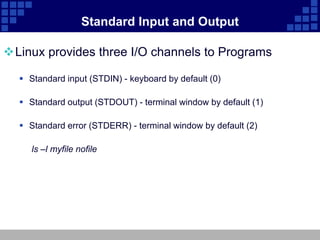
Linux provides three I/O channels to Programs

   Standard input (STDIN) - keyboard by default (0)

   Standard output (STDOUT) - terminal window by default (1)

   Standard error (STDERR) - terminal window by default (2)

     ls –l myfile nofile
Redirecting Output to a File

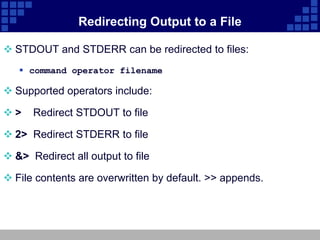
 STDOUT and STDERR can be redirected to files:
    command operator filename

 Supported operators include:

>    Redirect STDOUT to file

 2> Redirect STDERR to file

 &> Redirect all output to file

 File contents are overwritten by default. >> appends.
Redirecting Output to a File
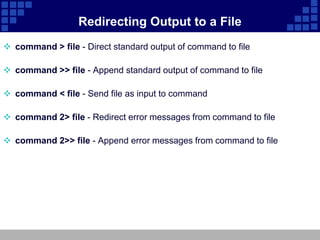
 command > file - Direct standard output of command to file

 command >> file - Append standard output of command to file

 command < file - Send file as input to command

 command 2> file - Redirect error messages from command to file

 command 2>> file - Append error messages from command to file
Redirecting Output to a File
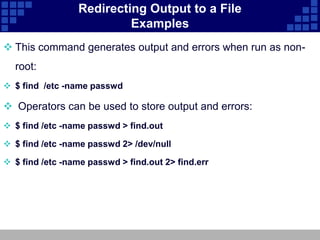
                          Examples
 This command generates output and errors when run as non-
  root:
 $ find /etc -name passwd

 Operators can be used to store output and errors:
 $ find /etc -name passwd > find.out

 $ find /etc -name passwd 2> /dev/null

 $ find /etc -name passwd > find.out 2> find.err
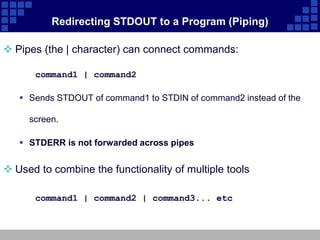
Redirecting STDOUT to a Program (Piping)

 Pipes (the | character) can connect commands:

      command1 | command2

    Sends STDOUT of command1 to STDIN of command2 instead of the

     screen.

    STDERR is not forwarded across pipes


 Used to combine the functionality of multiple tools

      command1 | command2 | command3... etc
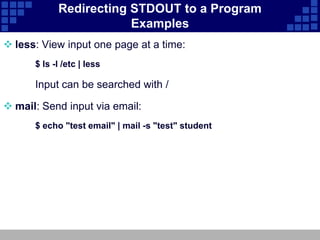
Redirecting STDOUT to a Program
                        Examples
 less: View input one page at a time:
      $ ls -l /etc | less

      Input can be searched with /

 mail: Send input via email:
      $ echo "test email" | mail -s "test" student
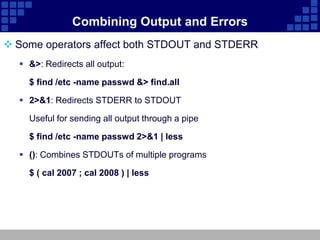
Combining Output and Errors
 Some operators affect both STDOUT and STDERR
   &>: Redirects all output:

    $ find /etc -name passwd &> find.all

   2>&1: Redirects STDERR to STDOUT

    Useful for sending all output through a pipe

    $ find /etc -name passwd 2>&1 | less

   (): Combines STDOUTs of multiple programs

    $ ( cal 2007 ; cal 2008 ) | less
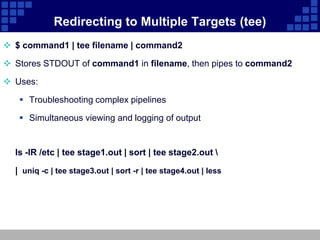
Redirecting to Multiple Targets (tee)
 $ command1 | tee filename | command2

 Stores STDOUT of command1 in filename, then pipes to command2

 Uses:

    Troubleshooting complex pipelines

    Simultaneous viewing and logging of output


  ls -lR /etc | tee stage1.out | sort | tee stage2.out 

  | uniq -c | tee stage3.out | sort -r | tee stage4.out | less
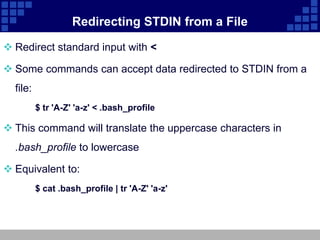
Redirecting STDIN from a File

 Redirect standard input with <

 Some commands can accept data redirected to STDIN from a
  file:
          $ tr 'A-Z' 'a-z' < .bash_profile

 This command will translate the uppercase characters in
  .bash_profile to lowercase

 Equivalent to:
          $ cat .bash_profile | tr 'A-Z' 'a-z'
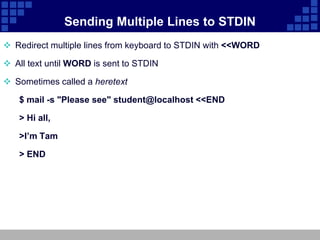
Sending Multiple Lines to STDIN
 Redirect multiple lines from keyboard to STDIN with <<WORD

 All text until WORD is sent to STDIN

 Sometimes called a heretext

   $ mail -s "Please see" student@localhost <<END

   > Hi all,

   >I’m Tam

   > END
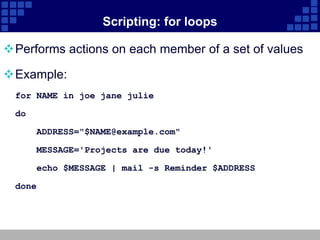
Scripting: for loops

Performs actions on each member of a set of values

Example:
  for NAME in joe jane julie

  do

       ADDRESS="$NAME@example.com"

       MESSAGE='Projects are due today!'

       echo $MESSAGE | mail -s Reminder $ADDRESS

  done
Scripting: for loops continued

 Can also use command-output and file lists:
   for num in $(seq 1 10)
     • Assigns 1-10 to $num

     • seq X Y prints the numbers X through Y

   for file in *.txt
     • Assigns names of text files to $file
example
#!/bin/bash
# alive2.sh
# Checks to see if hosts 192.168.0.1-192.168.0.20 are
  alive
# Iterate through IP addresses
for n in {1..20}; do
         host=192.168.0.$n
         ping -c2 $host &> /dev/null
         if [ $? = 0 ]; then
                 echo "$host is UP"
         else
                 echo "$host is DOWN"
         fi
done
Unit 7 standard i o

Unit 7 standard i o

  • 1.
    RedHat Enterprise LinuxEssential Unit 7: Standard I/O and Pipes
  • 2.
    Objectives Upon completion ofthis unit, you should be able to: Redirect I/O channels to files Connect commands using pipes Use the for loops to iterate over sets of values
  • 3.
    Standard Input andOutput Linux provides three I/O channels to Programs  Standard input (STDIN) - keyboard by default (0)  Standard output (STDOUT) - terminal window by default (1)  Standard error (STDERR) - terminal window by default (2) ls –l myfile nofile
  • 4.
    Redirecting Output toa File  STDOUT and STDERR can be redirected to files:  command operator filename  Supported operators include: > Redirect STDOUT to file  2> Redirect STDERR to file  &> Redirect all output to file  File contents are overwritten by default. >> appends.
  • 5.
    Redirecting Output toa File  command > file - Direct standard output of command to file  command >> file - Append standard output of command to file  command < file - Send file as input to command  command 2> file - Redirect error messages from command to file  command 2>> file - Append error messages from command to file
  • 6.
    Redirecting Output toa File Examples  This command generates output and errors when run as non- root:  $ find /etc -name passwd  Operators can be used to store output and errors:  $ find /etc -name passwd > find.out  $ find /etc -name passwd 2> /dev/null  $ find /etc -name passwd > find.out 2> find.err
  • 7.
    Redirecting STDOUT toa Program (Piping)  Pipes (the | character) can connect commands: command1 | command2  Sends STDOUT of command1 to STDIN of command2 instead of the screen.  STDERR is not forwarded across pipes  Used to combine the functionality of multiple tools command1 | command2 | command3... etc
  • 8.
    Redirecting STDOUT toa Program Examples  less: View input one page at a time: $ ls -l /etc | less Input can be searched with /  mail: Send input via email: $ echo "test email" | mail -s "test" student
  • 9.
    Combining Output andErrors  Some operators affect both STDOUT and STDERR  &>: Redirects all output: $ find /etc -name passwd &> find.all  2>&1: Redirects STDERR to STDOUT Useful for sending all output through a pipe $ find /etc -name passwd 2>&1 | less  (): Combines STDOUTs of multiple programs $ ( cal 2007 ; cal 2008 ) | less
  • 10.
    Redirecting to MultipleTargets (tee)  $ command1 | tee filename | command2  Stores STDOUT of command1 in filename, then pipes to command2  Uses:  Troubleshooting complex pipelines  Simultaneous viewing and logging of output ls -lR /etc | tee stage1.out | sort | tee stage2.out | uniq -c | tee stage3.out | sort -r | tee stage4.out | less
  • 11.
    Redirecting STDIN froma File  Redirect standard input with <  Some commands can accept data redirected to STDIN from a file: $ tr 'A-Z' 'a-z' < .bash_profile  This command will translate the uppercase characters in .bash_profile to lowercase  Equivalent to: $ cat .bash_profile | tr 'A-Z' 'a-z'
  • 12.
    Sending Multiple Linesto STDIN  Redirect multiple lines from keyboard to STDIN with <<WORD  All text until WORD is sent to STDIN  Sometimes called a heretext $ mail -s "Please see" student@localhost <<END > Hi all, >I’m Tam > END
  • 13.
    Scripting: for loops Performsactions on each member of a set of values Example: for NAME in joe jane julie do ADDRESS="$NAME@example.com" MESSAGE='Projects are due today!' echo $MESSAGE | mail -s Reminder $ADDRESS done
  • 14.
    Scripting: for loopscontinued  Can also use command-output and file lists:  for num in $(seq 1 10) • Assigns 1-10 to $num • seq X Y prints the numbers X through Y  for file in *.txt • Assigns names of text files to $file
  • 15.
    example #!/bin/bash # alive2.sh # Checksto see if hosts 192.168.0.1-192.168.0.20 are alive # Iterate through IP addresses for n in {1..20}; do host=192.168.0.$n ping -c2 $host &> /dev/null if [ $? = 0 ]; then echo "$host is UP" else echo "$host is DOWN" fi done