Unit 2 :Running commands and Getting Help
Running Commands
Some Simple commands
Getting Help
The whatis Command
The --help option
Reading Usage summaries
The man command
Navigating man Pages
The info command
Navigating info Pages
Extended Documentation
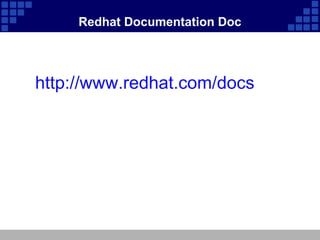
RedHat Documentation
3.
Running Commands
Commandshave the following syntax:
command [options] [arguments]
Each item is separated by a space
Options modify the command's behavior
Word options ussually proceded by “--“
Single-leeter options usually preceded by "-“
can be passed as "-a -b -c" or "-abc“
Arguments are filenames or other data needed by the command
4.
Some Simple Commands
su - username : change user ( or su username)
id username shows information on the current user
date - display date and time
cal - display calendar
5.
Getting Help
Don'ttry to memories everthing!
Many levels of help
Whatis
<command> --help
man and info
/usr/share/doc
Red Hat documentation
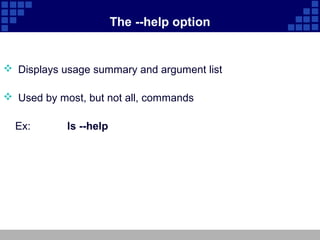
The --help option
Displays usage summary and argument list
Used by most, but not all, commands
Ex: ls --help
8.
Reading Usage Summaries
Printed by --help, man and others
Used to describe the syntax of a command
Arguments in "[ ]" are optional
Arguments in "<>" are variables
x|y|z means "x or y or z”
-abc mean "any mix of -a, -b or -c"
9.
The man command
Provides command descriptions or manuals
Almost every command has a man "page“
Pages are grouped into "chapters“
Collectively referred to as the Linux Manual
man [<chapter>] <command>
10.
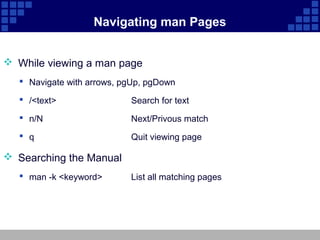
Navigating man Pages
While viewing a man page
Navigate with arrows, pgUp, pgDown
/<text> Search for text
n/N Next/Privous match
q Quit viewing page
Searching the Manual
man -k <keyword> List all matching pages
11.
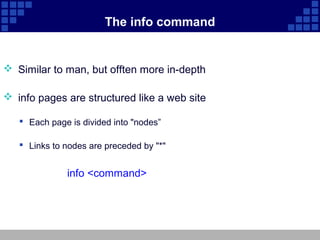
The info command
Similar to man, but offten more in-depth
info pages are structured like a web site
Each page is divided into "nodes”
Links to nodes are preceded by "*"
info <command>
12.
Navigating info Pages
While viewing an info page
Navigate with arrows, pgUp, pgDown
Tab move the next link
Enter Follow link the cursor is on
n/p/u View next/previous/up-one node
s[<text>] Search for text
Ctr + S Search for next text
q Quit vewing page
Sequence 1: Usingthe Help Tools
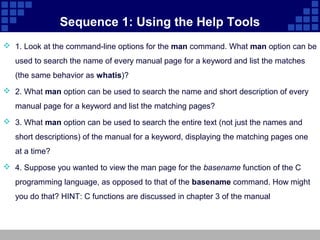
1. Look at the command-line options for the man command. What man option can be
used to search the name of every manual page for a keyword and list the matches
(the same behavior as whatis)?
2. What man option can be used to search the name and short description of every
manual page for a keyword and list the matching pages?
3. What man option can be used to search the entire text (not just the names and
short descriptions) of the manual for a keyword, displaying the matching pages one
at a time?
4. Suppose you wanted to view the man page for the basename function of the C
programming language, as opposed to that of the basename command. How might
you do that? HINT: C functions are discussed in chapter 3 of the manual
16.
Sequence 1: Usingthe Help Tools
5. What command-line options might you use to cause ls to display a long
listing of files with human-readable size descriptions (i.e., 6.8M instead of
6819467)? HINT: You will need two command-line options.
6. Given the usage description below, which of the following would be a
syntactically valid invocation of the command foo?
foo -x|-y [-abcde] FILENAME...
a. foo -x -y -a one.txt
b. foo
c. foo -y -abc one.txt two.txt
d. foo -abc one.txt two.txt three.txt
17.
Sequence 2: SolvingProblems with man
Scenario: You want to change /etc/issue again (see previous lab). This
time you want to see if there is an escape to make it print the
system's hostname.
1. Begin by consulting the man page for /etc/issue
[vmintam@localhost ~]$ man issue
Note that it says escape characters are dependent upon mingetty. Note
also the reference to mingetty(8) in the See Also section.Exit the man page
by pressing q.
2. Continue your search by looking at the mingetty man page. Do you need to
specify chapter 8 when requesting the page? Why or why not?
18.
Sequence 2: SolvingProblems with man
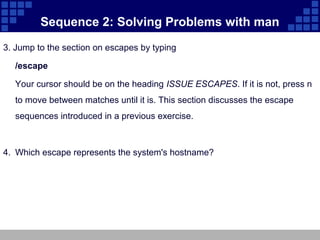
3. Jump to the section on escapes by typing
/escape
Your cursor should be on the heading ISSUE ESCAPES. If it is not, press n
to move between matches until it is. This section discusses the escape
sequences introduced in a previous exercise.
4. Which escape represents the system's hostname?
19.
Sequence 2: SolvingProblems with man
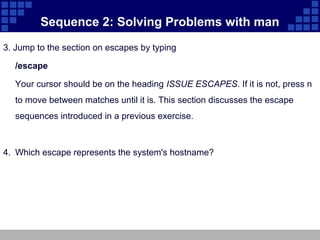
3. Jump to the section on escapes by typing
/escape
Your cursor should be on the heading ISSUE ESCAPES. If it is not, press n
to move between matches until it is. This section discusses the escape
sequences introduced in a previous exercise.
4. Which escape represents the system's hostname?
20.
Sequence 2: SolvingProblems with man
5. Open /etc/issue in nano
[root@localhost ~]# nano /etc/issue
6. Change the welcome message you added previously to include the hostname
escape. /etc/issue should now look similar to this:
Welcome to n!
Red Hat Enterprise Linux Server release 5
Kernel r on an m
7. Save the file and exit nano by pressing Ctrl-x.
8. Log out by closing your shell with the exit command. This should drop you
back to a new and improved login prompt! Try accessing other virtual terminals
and seeing how the prompt changes. Remember that you may need to press
Enter to see an updated prompt.


![Running Commands
Commands have the following syntax:
command [options] [arguments]
Each item is separated by a space
Options modify the command's behavior
Word options ussually proceded by “--“
Single-leeter options usually preceded by "-“
can be passed as "-a -b -c" or "-abc“
Arguments are filenames or other data needed by the command](https://image.slidesharecdn.com/unit2-help-120309010628-phpapp02/85/Unit2-help-3-320.jpg)
![Reading Usage Summaries
Printed by --help, man and others
Used to describe the syntax of a command
Arguments in "[ ]" are optional
Arguments in "<>" are variables
x|y|z means "x or y or z”
-abc mean "any mix of -a, -b or -c"](https://image.slidesharecdn.com/unit2-help-120309010628-phpapp02/85/Unit2-help-8-320.jpg)
![The man command
Provides command descriptions or manuals
Almost every command has a man "page“
Pages are grouped into "chapters“
Collectively referred to as the Linux Manual
man [<chapter>] <command>](https://image.slidesharecdn.com/unit2-help-120309010628-phpapp02/85/Unit2-help-9-320.jpg)
![Navigating info Pages
While viewing an info page
Navigate with arrows, pgUp, pgDown
Tab move the next link
Enter Follow link the cursor is on
n/p/u View next/previous/up-one node
s[<text>] Search for text
Ctr + S Search for next text
q Quit vewing page](https://image.slidesharecdn.com/unit2-help-120309010628-phpapp02/85/Unit2-help-12-320.jpg)
![Sequence 1: Using the Help Tools
5. What command-line options might you use to cause ls to display a long
listing of files with human-readable size descriptions (i.e., 6.8M instead of
6819467)? HINT: You will need two command-line options.
6. Given the usage description below, which of the following would be a
syntactically valid invocation of the command foo?
foo -x|-y [-abcde] FILENAME...
a. foo -x -y -a one.txt
b. foo
c. foo -y -abc one.txt two.txt
d. foo -abc one.txt two.txt three.txt](https://image.slidesharecdn.com/unit2-help-120309010628-phpapp02/85/Unit2-help-16-320.jpg)
![Sequence 2: Solving Problems with man
Scenario: You want to change /etc/issue again (see previous lab). This
time you want to see if there is an escape to make it print the
system's hostname.
1. Begin by consulting the man page for /etc/issue
[vmintam@localhost ~]$ man issue
Note that it says escape characters are dependent upon mingetty. Note
also the reference to mingetty(8) in the See Also section.Exit the man page
by pressing q.
2. Continue your search by looking at the mingetty man page. Do you need to
specify chapter 8 when requesting the page? Why or why not?](https://image.slidesharecdn.com/unit2-help-120309010628-phpapp02/85/Unit2-help-17-320.jpg)
![Sequence 2: Solving Problems with man
5. Open /etc/issue in nano
[root@localhost ~]# nano /etc/issue
6. Change the welcome message you added previously to include the hostname
escape. /etc/issue should now look similar to this:
Welcome to n!
Red Hat Enterprise Linux Server release 5
Kernel r on an m
7. Save the file and exit nano by pressing Ctrl-x.
8. Log out by closing your shell with the exit command. This should drop you
back to a new and improved login prompt! Try accessing other virtual terminals
and seeing how the prompt changes. Remember that you may need to press
Enter to see an updated prompt.](https://image.slidesharecdn.com/unit2-help-120309010628-phpapp02/85/Unit2-help-20-320.jpg)



![Unix environment [autosaved]](https://cdn.slidesharecdn.com/ss_thumbnails/unixenvironmentautosaved-151015111256-lva1-app6892-thumbnail.jpg?width=640&height=640&fit=bounds)


