Unit-7 Leadership
Concept
It is an ability to influence to other towards
achievement of goals. The leader influences the
behaviour of followers toward goal achievement
in a given situation.
Leadership is the ability to influencing a group
toward achievement of goals. It is an important
function of every manager. The success of an
organization can be measured on basis of
leaders performance.
Leadership Theories / Approach
1. Trait Approach {Till 1940s}:- This theory is the
oldest theory of leadership. According to this
theory ‘leaders are born, not made’ to be a
leader a person must have certain internal
qualities. This approach is also describe as
the ‘great man approach’. Some important
traits are:-
a. personal drive d. Self confidence
b. Desire to lead e. Business knowledge
c. Personal integrity f. Creativity g. Flexible
Traits do differentiate leaders from non leaders.
Some basic assumptions of traits theory
By birth leaders receives leadership traits.
Leadership success is largely a matter of
personality, a function of specific traits.
They differ greatly from their followers.
Traits remain unchanged across time.
Limitations
There are no universal application of traits in
all situation.
Traits do not distinguish between effective
and ineffective leaders.
This theory has little value in predicting
behaviour.
Behavioural Theories
{late 1940s to 1960s}
Behavioural theory attempts to describe what
effective leaders do? Behaviour approach is
based on the assumption that effective
leadership is the result of effective role
behaviour. The leadership effectiveness is
determined in terms of how leaders delegate
their task , how they communicate with and
motivate their followers. Leadership is the result
of behaviour of leader that differentiate leader
from non leader.
The Ohio state studies
During the 1940s and 1950s a team of
behavioural scientists at Ohio State University
lunched a project to study the leadership
behaviour. The focus of researcher was on
studying and describing the features of
leadership behaviour. From their study two
dimensions of leadership behaviour were
identified.
Consideration/thoughts:- it is described as
the extent to which the leader has supportive
work relationship characterised by warmth
and mutual trust , good relation and a respect
for feeling , ideas and suggestion of group
members. There is strong concern for
followers comfort , well being , status and
satisfaction. The leader is friendly
approachable and treat subordinate fairly.
Initiating/starting structure :- The extent to
which a leader is task oriented and concerned
with utilizing resources effectively to
accomplish group goals. The leader also
organised the task which his followers have to
do. Leaders scoring high initiating structure
could achieve high productivity.
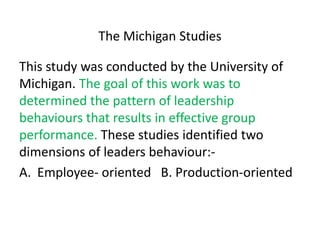
The Michigan Studies
This study was conducted by the University of
Michigan. The goal of this work was to
determined the pattern of leadership
behaviours that results in effective group
performance. These studies identified two
dimensions of leaders behaviour:-
A. Employee- oriented B. Production-oriented
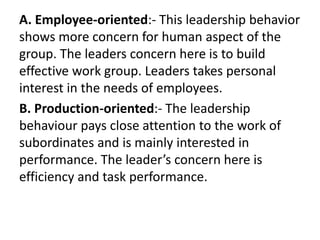
A. Employee-oriented:- This leadership behavior
shows more concern for human aspect of the
group. The leaders concern here is to build
effective work group. Leaders takes personal
interest in the needs of employees.
B. Production-oriented:- The leadership
behaviour pays close attention to the work of
subordinates and is mainly interested in
performance. The leader’s concern here is
efficiency and task performance.
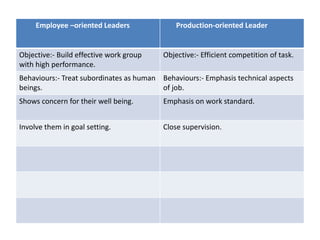
Employee –oriented Leaders Production-oriented Leader
Objective:- Build effective work group
with high performance.
Objective:- Efficient competition of task.
Behaviours:- Treat subordinates as human
beings.
Behaviours:- Emphasis technical aspects
of job.
Shows concern for their well being. Emphasis on work standard.
Involve them in goal setting. Close supervision.
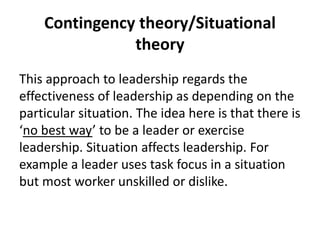
Contingency theory/Situational
theory
This approach to leadership regards the
effectiveness of leadership as depending on the
particular situation. The idea here is that there is
‘no best way’ to be a leader or exercise
leadership. Situation affects leadership. For
example a leader uses task focus in a situation
but most worker unskilled or dislike.
Fiedler’s Contingency Theory
According to Fiedler leadership should change
according to the demand of situation. Situation is
very powerful. We can not say that there is only one
style which is the best in all situation.
The main features of Fiedler’s contingency theory
A. Leader classification
The leader is classified into:-
a. Relationship oriented:- Leader must be
motivated to maintain close relationship with
followers. Interpersonal relation is to be maintain
with subordinate.
b. Task oriented:- A good leader is motivated by
task accomplishment. They are aiming to do
good job.
B. Situation classification:- It is contingency
dimension. And classified into
a. Very favourable b. Very unfavourable and
c. Moderately favourable
According to Fiedle’s there are three variable
that determine the favourableness.
Leader- member relation:- It refers to the
degree of confidence , trust and respect
followers have in the leader. Good relation can
contribute favourable situation.
Task structure :- It refers to how routine and
predictable the work groups task are. It measures the
extent to which the task performed by subordinates
is routine or non routine.
Leader position power :- It is position based and
related with the degree of influence a leader has
over power variables such as hiring ,firing , discipline
and promotion etc.
C. Matching the leader and situation:- Leader and
situation should matched.
Task cantered leaders tend to perform best in very
favourable and very unfavourable situation. Likewise
relation cantered leaders tend to perform best in
moderately situation.
D. Improving leaders effectiveness :-
Change the leader to fit the situation
Change the situation to fit the leader

Unit 7 leadership

  • 1.
    Unit-7 Leadership Concept It isan ability to influence to other towards achievement of goals. The leader influences the behaviour of followers toward goal achievement in a given situation. Leadership is the ability to influencing a group toward achievement of goals. It is an important function of every manager. The success of an organization can be measured on basis of leaders performance.
  • 2.
    Leadership Theories /Approach 1. Trait Approach {Till 1940s}:- This theory is the oldest theory of leadership. According to this theory ‘leaders are born, not made’ to be a leader a person must have certain internal qualities. This approach is also describe as the ‘great man approach’. Some important traits are:- a. personal drive d. Self confidence b. Desire to lead e. Business knowledge c. Personal integrity f. Creativity g. Flexible
  • 3.
    Traits do differentiateleaders from non leaders. Some basic assumptions of traits theory By birth leaders receives leadership traits. Leadership success is largely a matter of personality, a function of specific traits. They differ greatly from their followers. Traits remain unchanged across time. Limitations There are no universal application of traits in all situation.
  • 4.
    Traits do notdistinguish between effective and ineffective leaders. This theory has little value in predicting behaviour.
  • 5.
    Behavioural Theories {late 1940sto 1960s} Behavioural theory attempts to describe what effective leaders do? Behaviour approach is based on the assumption that effective leadership is the result of effective role behaviour. The leadership effectiveness is determined in terms of how leaders delegate their task , how they communicate with and motivate their followers. Leadership is the result of behaviour of leader that differentiate leader from non leader.
  • 6.
    The Ohio statestudies During the 1940s and 1950s a team of behavioural scientists at Ohio State University lunched a project to study the leadership behaviour. The focus of researcher was on studying and describing the features of leadership behaviour. From their study two dimensions of leadership behaviour were identified.
  • 7.
    Consideration/thoughts:- it isdescribed as the extent to which the leader has supportive work relationship characterised by warmth and mutual trust , good relation and a respect for feeling , ideas and suggestion of group members. There is strong concern for followers comfort , well being , status and satisfaction. The leader is friendly approachable and treat subordinate fairly.
  • 8.
    Initiating/starting structure :-The extent to which a leader is task oriented and concerned with utilizing resources effectively to accomplish group goals. The leader also organised the task which his followers have to do. Leaders scoring high initiating structure could achieve high productivity.
  • 9.
    The Michigan Studies Thisstudy was conducted by the University of Michigan. The goal of this work was to determined the pattern of leadership behaviours that results in effective group performance. These studies identified two dimensions of leaders behaviour:- A. Employee- oriented B. Production-oriented
  • 10.
    A. Employee-oriented:- Thisleadership behavior shows more concern for human aspect of the group. The leaders concern here is to build effective work group. Leaders takes personal interest in the needs of employees. B. Production-oriented:- The leadership behaviour pays close attention to the work of subordinates and is mainly interested in performance. The leader’s concern here is efficiency and task performance.
  • 11.
    Employee –oriented LeadersProduction-oriented Leader Objective:- Build effective work group with high performance. Objective:- Efficient competition of task. Behaviours:- Treat subordinates as human beings. Behaviours:- Emphasis technical aspects of job. Shows concern for their well being. Emphasis on work standard. Involve them in goal setting. Close supervision.
  • 12.
    Contingency theory/Situational theory This approachto leadership regards the effectiveness of leadership as depending on the particular situation. The idea here is that there is ‘no best way’ to be a leader or exercise leadership. Situation affects leadership. For example a leader uses task focus in a situation but most worker unskilled or dislike.
  • 13.
    Fiedler’s Contingency Theory Accordingto Fiedler leadership should change according to the demand of situation. Situation is very powerful. We can not say that there is only one style which is the best in all situation. The main features of Fiedler’s contingency theory A. Leader classification The leader is classified into:- a. Relationship oriented:- Leader must be motivated to maintain close relationship with followers. Interpersonal relation is to be maintain with subordinate.
  • 14.
    b. Task oriented:-A good leader is motivated by task accomplishment. They are aiming to do good job. B. Situation classification:- It is contingency dimension. And classified into a. Very favourable b. Very unfavourable and c. Moderately favourable According to Fiedle’s there are three variable that determine the favourableness. Leader- member relation:- It refers to the degree of confidence , trust and respect followers have in the leader. Good relation can contribute favourable situation.
  • 15.
    Task structure :-It refers to how routine and predictable the work groups task are. It measures the extent to which the task performed by subordinates is routine or non routine. Leader position power :- It is position based and related with the degree of influence a leader has over power variables such as hiring ,firing , discipline and promotion etc. C. Matching the leader and situation:- Leader and situation should matched. Task cantered leaders tend to perform best in very favourable and very unfavourable situation. Likewise relation cantered leaders tend to perform best in moderately situation.
  • 16.
    D. Improving leaderseffectiveness :- Change the leader to fit the situation Change the situation to fit the leader