EDUC 608 Organizational Behavior Analysis and Development
RICHARD M. BAÑEZ
Presenter
ELSA C. CALLO, Ed.D.
Professor
PART II INDIVIDUAL PROCESSES IN ORGANIZATION
Perception, Attitude
and Personality
PART II INDIVIDUAL PROCESSES IN ORGANIZATION
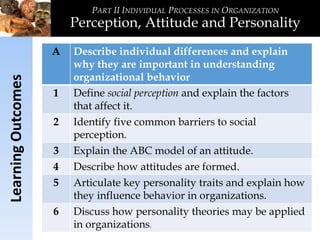
Perception, Attitude and PersonalityLearningOutcomes
A Describe individual differences and explain
why they are important in understanding
organizational behavior
1 Define social perception and explain the factors
that affect it.
2 Identify five common barriers to social
perception.
3 Explain the ABC model of an attitude.
4 Describe how attitudes are formed.
5 Articulate key personality traits and explain how
they influence behavior in organizations.
6 Discuss how personality theories may be applied
in organizations.
Describe individual differences
and explain why they are
important in understanding
organizational behavior
A Learning Outcome
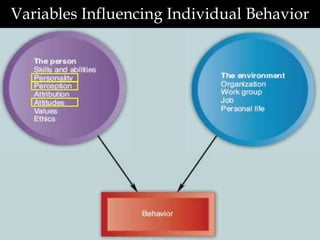
Variables Influencing Individual Behavior
Define social perception and
explain the factors that affect it.
1 Learning Outcome
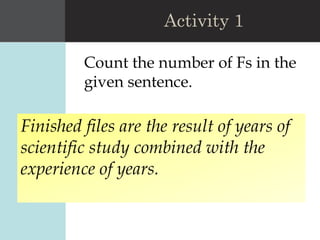
Count the number of Fs in the
given sentence.
Activity 1
Finished files are the result of years of
scientific study combined with the
experience of years.
Social
Perception
Model
Social
Perception
Target Characteristics
• Physical appearance
• Verbal communication
• Nonverbal cues
• Intentions
Perceiver Characteristics
• Familiarity with target
• Attitudes/Mood
• Self-concept
• Cognitive structure
Situational Characteristics
• Interaction context
• Strength of situational cues
Barriers
• Selective perception
• Stereotyping
• First-impression error
• Projection
• Self-fulfilling prophecies
Identify five common barriers
to social perception.
2 Learning Outcome
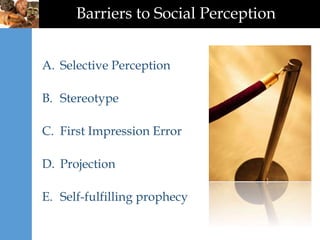
Barriers to Social Perception
A. Selective Perception
B. Stereotype
C. First Impression Error
D. Projection
E. Self-fulfilling prophecy
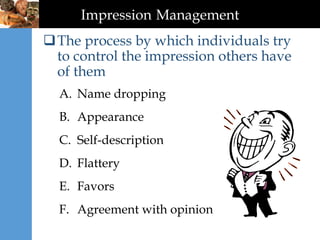
Impression Management
The process by which individuals try
to control the impression others have
of them
A. Name dropping
B. Appearance
C. Self-description
D. Flattery
E. Favors
F. Agreement with opinion
Explain the ABC model of an
attitude.
3 Learning Outcome
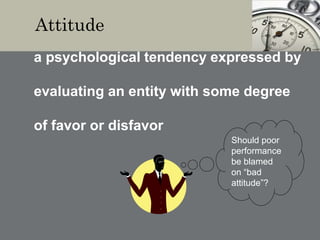
Attitude
a psychological tendency expressed by
evaluating an entity with some degree
of favor or disfavor
Should poor
performance
be blamed
on “bad
attitude”?
Model of an Attitude
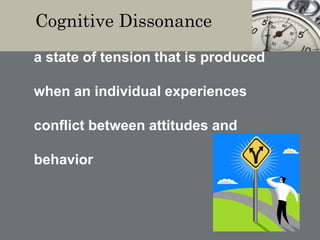
Cognitive Dissonance
a state of tension that is produced
when an individual experiences
conflict between attitudes and
behavior
Describe how attitudes are
formed.
4 Learning Outcome
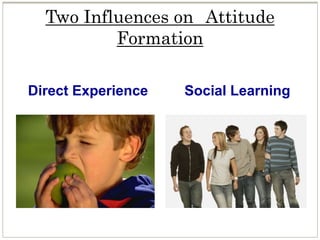
Two Influences on Attitude
Formation
Social LearningDirect Experience
© 2011 Cengage Learning. All rights reserved.
Learning by
Observing a Model
• Focus on the model
• Retain what was
observed
• Reproduce the
behavior through
practice
• Be motivated
The learner must:
Attitude–Behavior
Correspondence Requirements
• Attitude Specificity
• Attitude Relevance
• Measurement Timing
• Personality Factors
• Social Constraints
Articulate key personality traits
and explain how they influence
behavior in organizations.
5 Learning Outcome
Personality
The relatively stable set of characteristics
that influences an individual’s behavior
and lend it consistency.
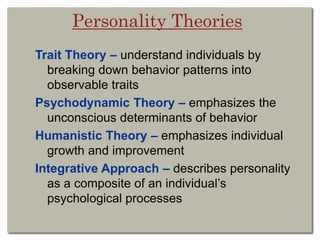
Personality Theories
Trait Theory – understand individuals by
breaking down behavior patterns into
observable traits
Psychodynamic Theory – emphasizes the
unconscious determinants of behavior
Humanistic Theory – emphasizes individual
growth and improvement
Integrative Approach – describes personality
as a composite of an individual’s
psychological processes
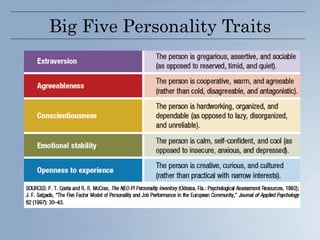
Big Five Personality Traits
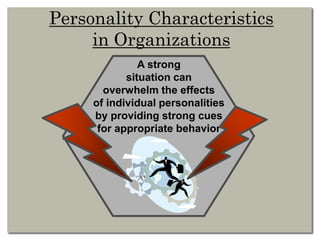
Personality Characteristics
in Organizations
A strong
situation can
overwhelm the effects
of individual personalities
by providing strong cues
for appropriate behavior
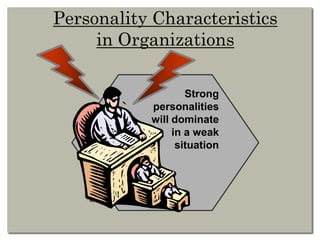
Strong
personalities
will dominate
in a weak
situation
Personality Characteristics
in Organizations
Personality Characteristics
in Organizations
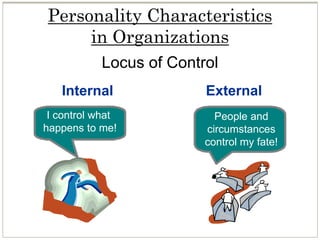
Locus of Control
Internal External
I control what
happens to me!
People and
circumstances
control my fate!
© 2011 Cengage Learning. All
rights reserved.
Self-Efficacy
beliefs and expectations about one’s
ability to accomplish a specific task
effectively
Personality Characteristics
in Organizations
Sources of self-efficacy
Prior experiences and prior success
Behavior models (observing success)
Persuasion
Assessment of current physical and
emotional capabilities
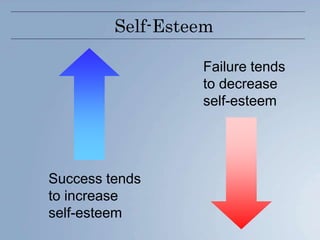
Self-Esteem
Success tends
to increase
self-esteem
Failure tends
to decrease
self-esteem
Self-Monitoring
Behavior based on cues
High self monitors
– flexible: adjust
behavior according to
the situation and the
behavior of others
– can appear
unpredictable and
inconsistent
Low self monitors
– act from internal
states rather than
from situational cues
– show consistency
– less likely to
respond to work
group norms or
supervisory
feedback
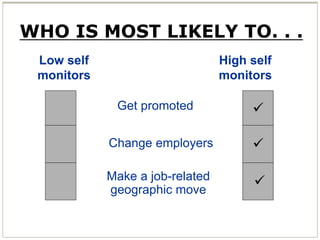
WHO IS MOST LIKELY TO. . .
Low self
monitors
High self
monitors
Get promoted
Change employers
Make a job-related
geographic move



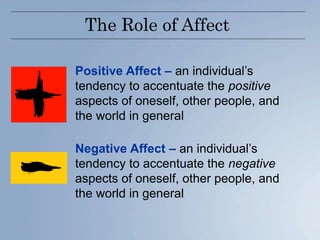
The Role of Affect
Positive Affect – an individual’s
tendency to accentuate the positive
aspects of oneself, other people, and
the world in general
Negative Affect – an individual’s
tendency to accentuate the negative
aspects of oneself, other people, and
the world in general
Discuss how personality
theories may be applied in
organizations.
6 Learning Outcome
[Projective Test]
elicits an individual’s
response to abstract stimuli
[Behavioral Measures]
personality assessments
that involve observing an
individual’s behavior in a
controlled situation
Four Measures of Personality
[Self-Report Questionnaire]
assessment involving an individual’s
responses to questions
[Myers-Briggs Type Indicator MBTI)]
instrument measuring Jung’s theory
of individual differences
Four Measures of Personality
[Based on Carl Jung’s theories]
– Human similarities/differences
understood by combining preferences
– No preferences better than others
– Understand, celebrate, and
appreciate differences
Myers-Briggs Type Indicator
In the 1940’s, Myers and Briggs
developed the MBTI to understand
individual differences by analyzing
the combinations of preferences.
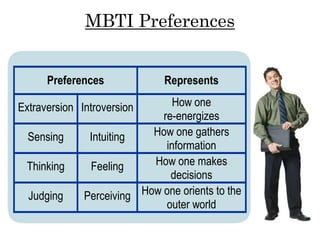
MBTI Preferences
Preferences Represents
Extraversion Introversion How one
re-energizes
Sensing Intuiting How one gathers
information
Thinking Feeling How one makes
decisions
Judging Perceiving How one orients to the
outer world
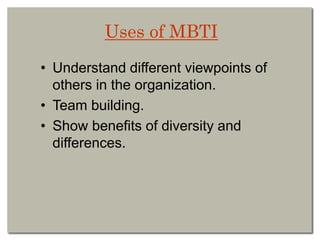
Uses of MBTI
• Understand different viewpoints of
others in the organization.
• Team building.
• Show benefits of diversity and
differences.
Perception attitude and personality

Perception attitude and personality

  • 1.
    EDUC 608 OrganizationalBehavior Analysis and Development RICHARD M. BAÑEZ Presenter ELSA C. CALLO, Ed.D. Professor PART II INDIVIDUAL PROCESSES IN ORGANIZATION Perception, Attitude and Personality
  • 2.
    PART II INDIVIDUALPROCESSES IN ORGANIZATION Perception, Attitude and PersonalityLearningOutcomes A Describe individual differences and explain why they are important in understanding organizational behavior 1 Define social perception and explain the factors that affect it. 2 Identify five common barriers to social perception. 3 Explain the ABC model of an attitude. 4 Describe how attitudes are formed. 5 Articulate key personality traits and explain how they influence behavior in organizations. 6 Discuss how personality theories may be applied in organizations.
  • 3.
    Describe individual differences andexplain why they are important in understanding organizational behavior A Learning Outcome
  • 4.
  • 5.
    Define social perceptionand explain the factors that affect it. 1 Learning Outcome
  • 6.
    Count the numberof Fs in the given sentence. Activity 1 Finished files are the result of years of scientific study combined with the experience of years.
  • 7.
    Social Perception Model Social Perception Target Characteristics • Physicalappearance • Verbal communication • Nonverbal cues • Intentions Perceiver Characteristics • Familiarity with target • Attitudes/Mood • Self-concept • Cognitive structure Situational Characteristics • Interaction context • Strength of situational cues Barriers • Selective perception • Stereotyping • First-impression error • Projection • Self-fulfilling prophecies
  • 8.
    Identify five commonbarriers to social perception. 2 Learning Outcome
  • 9.
    Barriers to SocialPerception A. Selective Perception B. Stereotype C. First Impression Error D. Projection E. Self-fulfilling prophecy
  • 10.
    Impression Management The processby which individuals try to control the impression others have of them A. Name dropping B. Appearance C. Self-description D. Flattery E. Favors F. Agreement with opinion
  • 11.
    Explain the ABCmodel of an attitude. 3 Learning Outcome
  • 12.
    Attitude a psychological tendencyexpressed by evaluating an entity with some degree of favor or disfavor Should poor performance be blamed on “bad attitude”?
  • 13.
    Model of anAttitude
  • 14.
    Cognitive Dissonance a stateof tension that is produced when an individual experiences conflict between attitudes and behavior
  • 15.
    Describe how attitudesare formed. 4 Learning Outcome
  • 16.
    Two Influences onAttitude Formation Social LearningDirect Experience
  • 17.
    © 2011 CengageLearning. All rights reserved. Learning by Observing a Model • Focus on the model • Retain what was observed • Reproduce the behavior through practice • Be motivated The learner must:
  • 18.
    Attitude–Behavior Correspondence Requirements • AttitudeSpecificity • Attitude Relevance • Measurement Timing • Personality Factors • Social Constraints
  • 19.
    Articulate key personalitytraits and explain how they influence behavior in organizations. 5 Learning Outcome
  • 20.
    Personality The relatively stableset of characteristics that influences an individual’s behavior and lend it consistency.
  • 21.
    Personality Theories Trait Theory– understand individuals by breaking down behavior patterns into observable traits Psychodynamic Theory – emphasizes the unconscious determinants of behavior Humanistic Theory – emphasizes individual growth and improvement Integrative Approach – describes personality as a composite of an individual’s psychological processes
  • 22.
  • 23.
    Personality Characteristics in Organizations Astrong situation can overwhelm the effects of individual personalities by providing strong cues for appropriate behavior
  • 24.
    Strong personalities will dominate in aweak situation Personality Characteristics in Organizations
  • 25.
    Personality Characteristics in Organizations Locusof Control Internal External I control what happens to me! People and circumstances control my fate!
  • 26.
    © 2011 CengageLearning. All rights reserved. Self-Efficacy beliefs and expectations about one’s ability to accomplish a specific task effectively
  • 27.
    Personality Characteristics in Organizations Sourcesof self-efficacy Prior experiences and prior success Behavior models (observing success) Persuasion Assessment of current physical and emotional capabilities
  • 28.
  • 29.
    Self-Monitoring Behavior based oncues High self monitors – flexible: adjust behavior according to the situation and the behavior of others – can appear unpredictable and inconsistent Low self monitors – act from internal states rather than from situational cues – show consistency – less likely to respond to work group norms or supervisory feedback
  • 30.
    WHO IS MOSTLIKELY TO. . . Low self monitors High self monitors Get promoted Change employers Make a job-related geographic move   
  • 31.
    The Role ofAffect Positive Affect – an individual’s tendency to accentuate the positive aspects of oneself, other people, and the world in general Negative Affect – an individual’s tendency to accentuate the negative aspects of oneself, other people, and the world in general
  • 32.
    Discuss how personality theoriesmay be applied in organizations. 6 Learning Outcome
  • 33.
    [Projective Test] elicits anindividual’s response to abstract stimuli [Behavioral Measures] personality assessments that involve observing an individual’s behavior in a controlled situation Four Measures of Personality
  • 34.
    [Self-Report Questionnaire] assessment involvingan individual’s responses to questions [Myers-Briggs Type Indicator MBTI)] instrument measuring Jung’s theory of individual differences Four Measures of Personality
  • 35.
    [Based on CarlJung’s theories] – Human similarities/differences understood by combining preferences – No preferences better than others – Understand, celebrate, and appreciate differences Myers-Briggs Type Indicator
  • 36.
    Myers-Briggs Type Indicator Inthe 1940’s, Myers and Briggs developed the MBTI to understand individual differences by analyzing the combinations of preferences.
  • 37.
    MBTI Preferences Preferences Represents ExtraversionIntroversion How one re-energizes Sensing Intuiting How one gathers information Thinking Feeling How one makes decisions Judging Perceiving How one orients to the outer world
  • 38.
    Uses of MBTI •Understand different viewpoints of others in the organization. • Team building. • Show benefits of diversity and differences.