This document discusses limiting reactants in chemical reactions. It explains that:
1) When reactants are combined in non-balanced ratios, one reactant will be consumed fully while excess of the other remains, with the fully-consumed reactant being the limiting reactant.
2) To determine the limiting reactant, the amounts of each reactant are converted to amounts of product, and the reactant that produces the lower amount of product is the limiting reactant.
3) Examples are provided to demonstrate this concept, including reactions involving hydrogen, oxygen, wheels, pedals and frames to make tricycles. The document cautions against common misconceptions in determining the limiting reactant.
Purpose
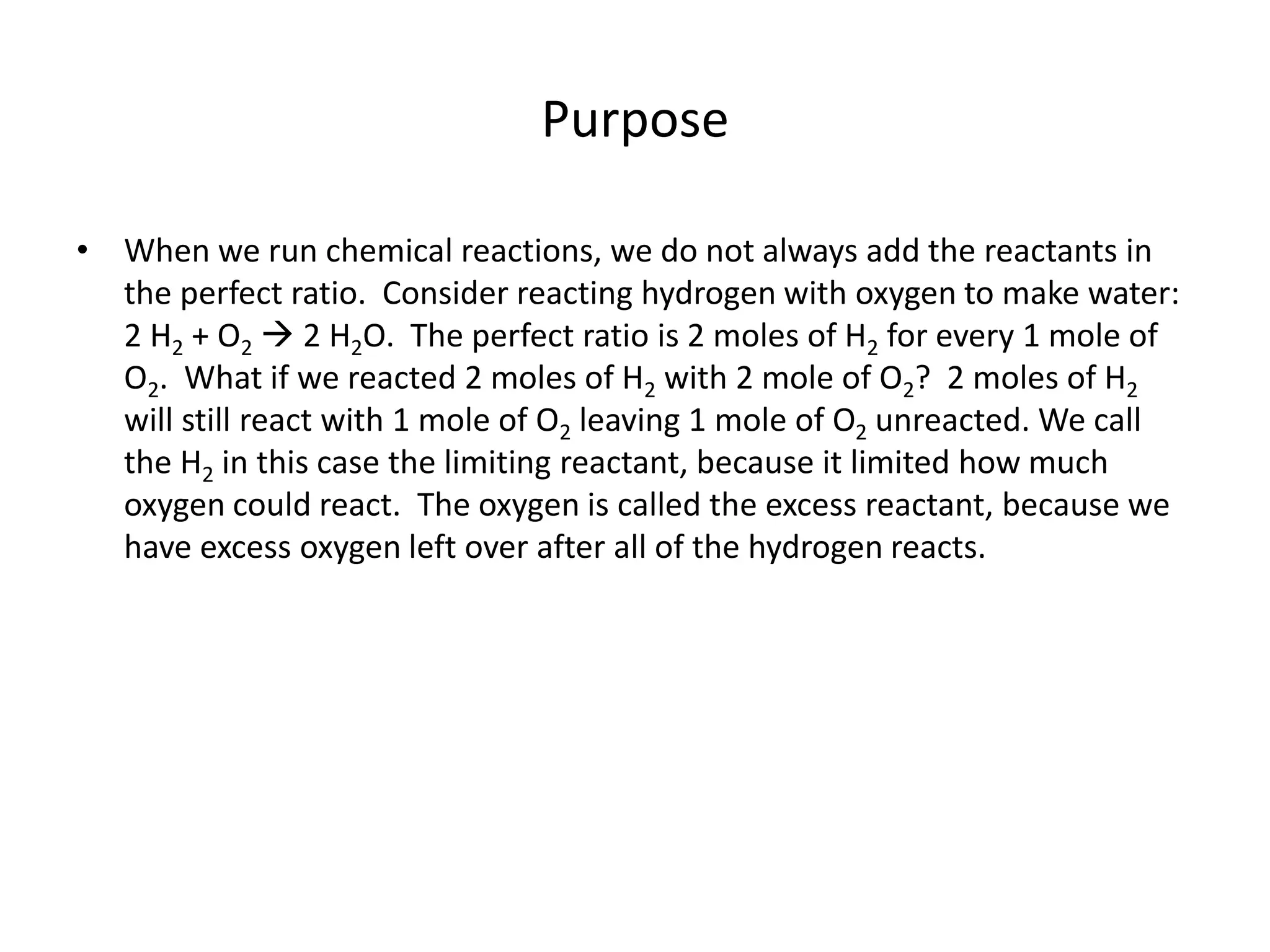
• When werun chemical reactions, we do not always add the reactants in
the perfect ratio. Consider reacting hydrogen with oxygen to make water:
2 H2 + O2 2 H2O. The perfect ratio is 2 moles of H2 for every 1 mole of
O2. What if we reacted 2 moles of H2 with 2 mole of O2? 2 moles of H2
will still react with 1 mole of O2 leaving 1 mole of O2 unreacted. We call
the H2 in this case the limiting reactant, because it limited how much
oxygen could react. The oxygen is called the excess reactant, because we
have excess oxygen left over after all of the hydrogen reacts.
3.
Method
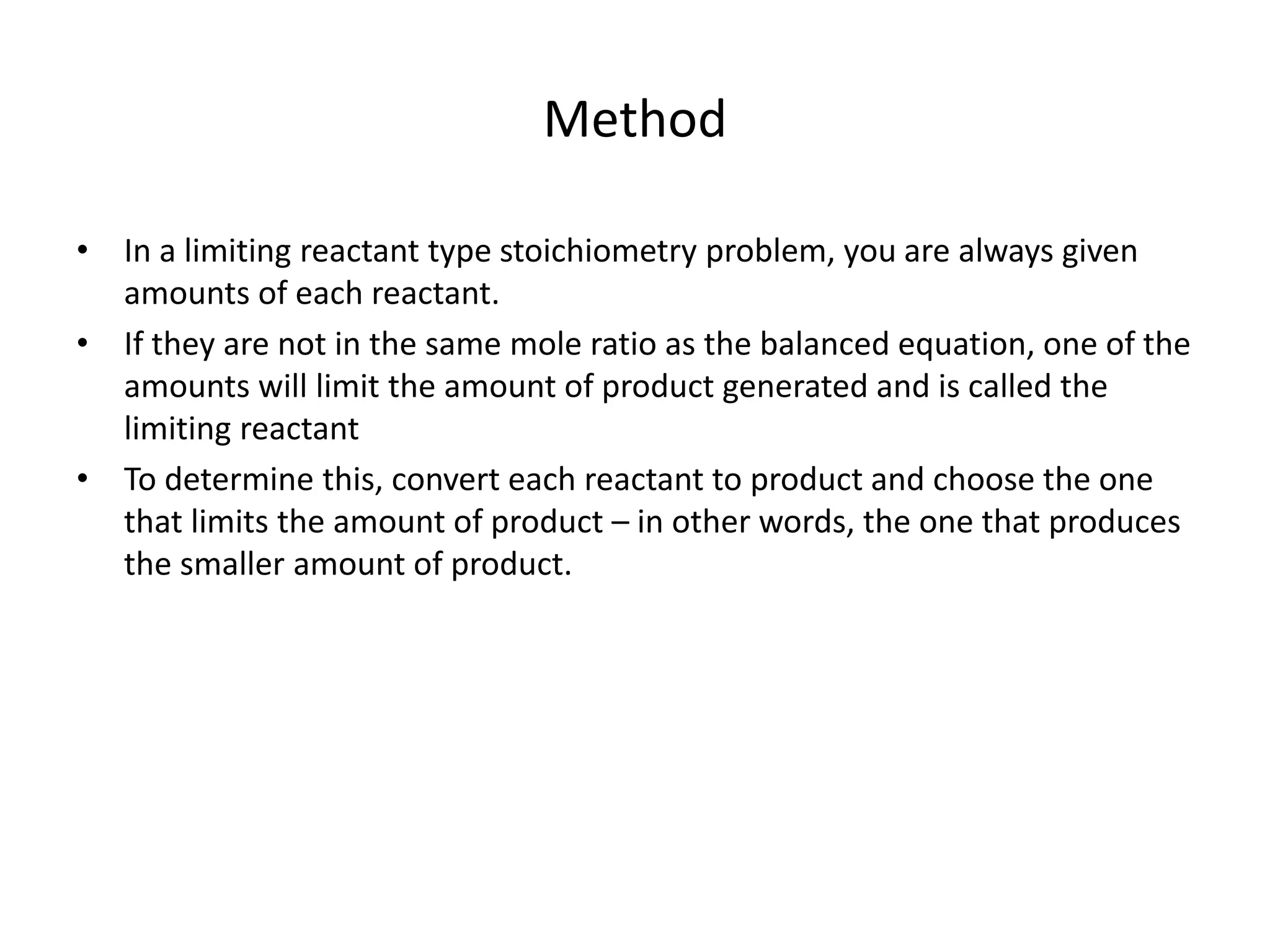
• In alimiting reactant type stoichiometry problem, you are always given
amounts of each reactant.
• If they are not in the same mole ratio as the balanced equation, one of the
amounts will limit the amount of product generated and is called the
limiting reactant
• To determine this, convert each reactant to product and choose the one
that limits the amount of product – in other words, the one that produces
the smaller amount of product.
4.
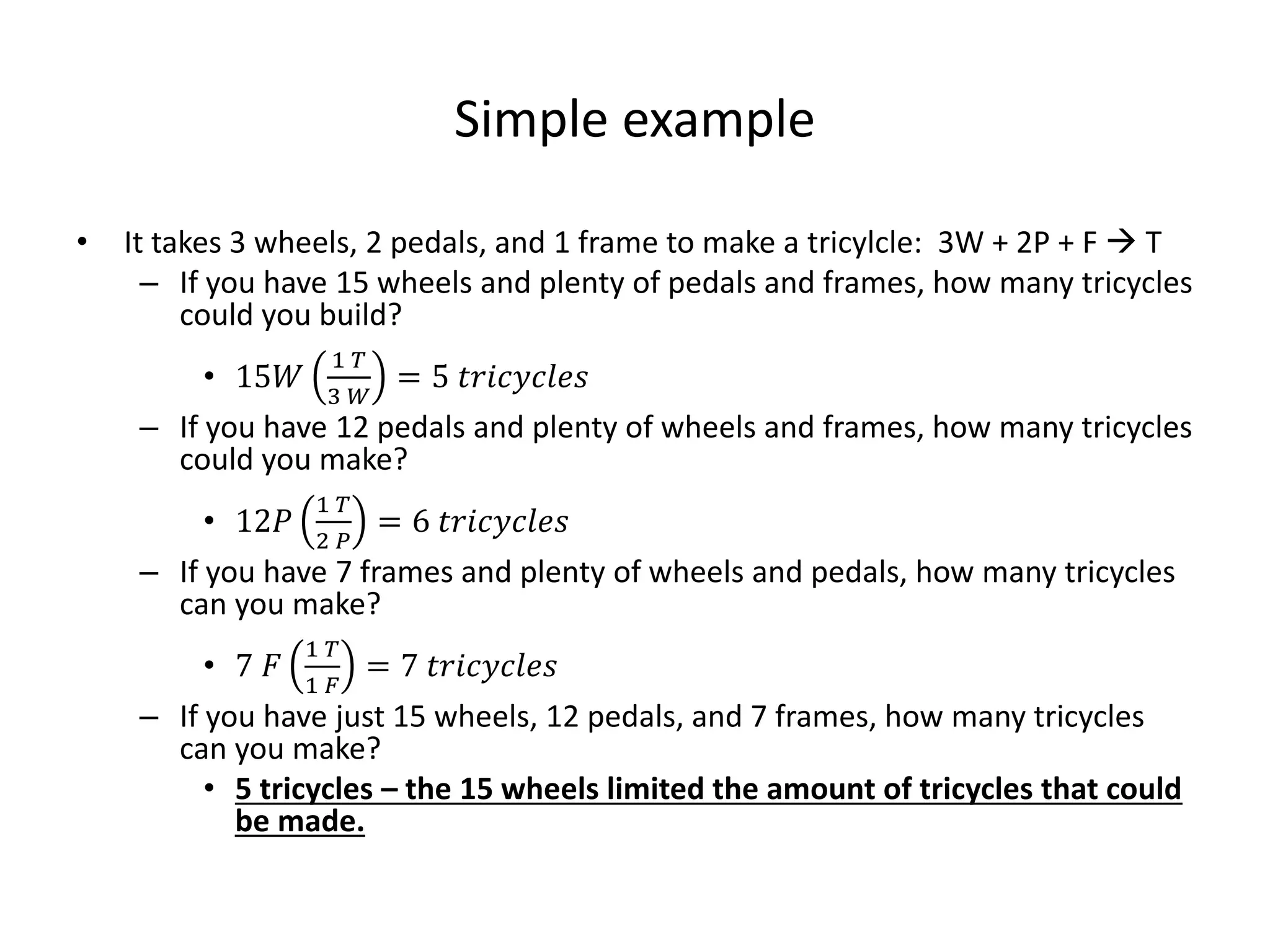
Simple example
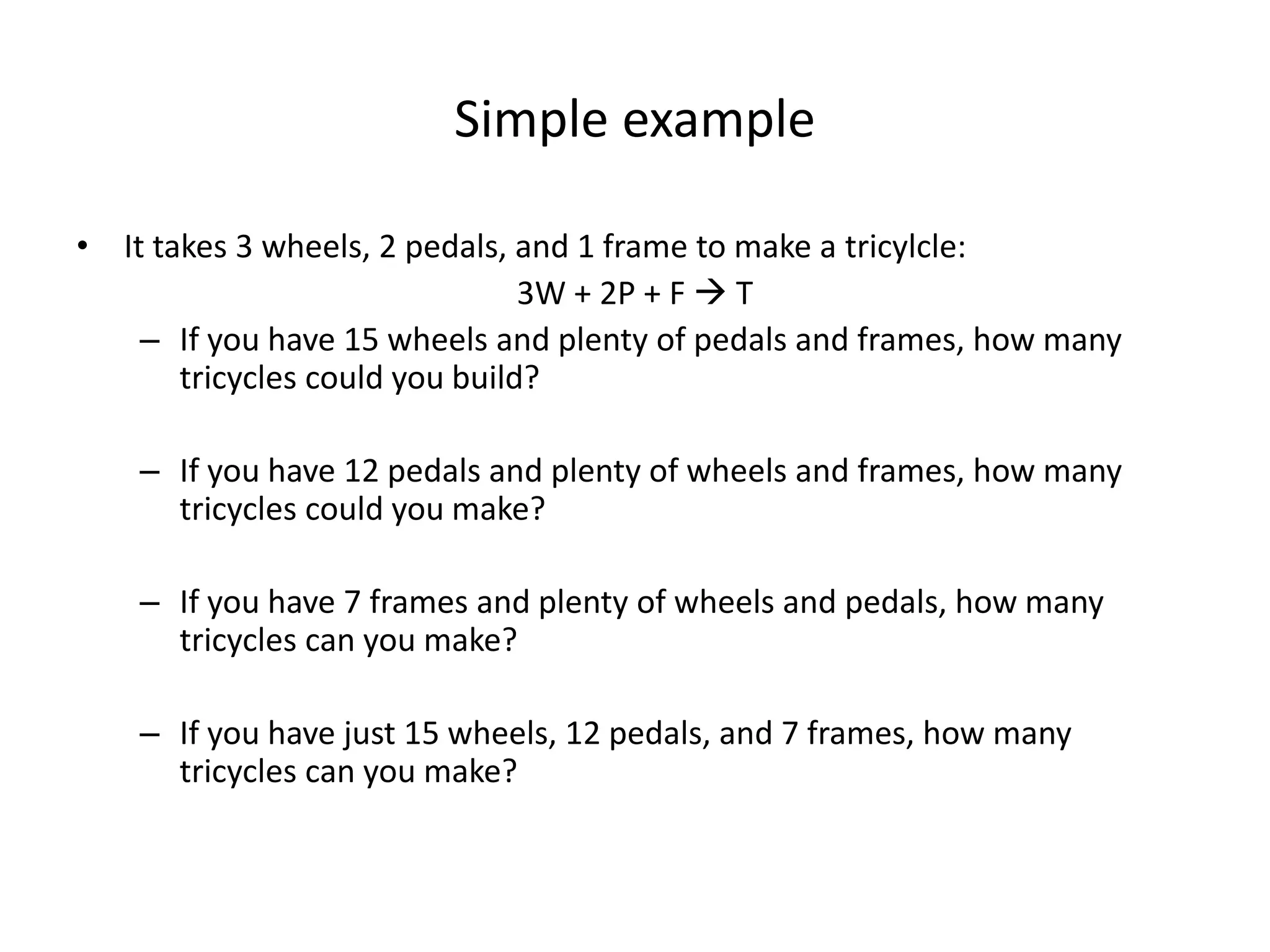
• Ittakes 3 wheels, 2 pedals, and 1 frame to make a tricylcle:
3W + 2P + F T
– If you have 15 wheels and plenty of pedals and frames, how many
tricycles could you build?
– If you have 12 pedals and plenty of wheels and frames, how many
tricycles could you make?
– If you have 7 frames and plenty of wheels and pedals, how many
tricycles can you make?
– If you have just 15 wheels, 12 pedals, and 7 frames, how many
tricycles can you make?
5.
Simple example
• Ittakes 3 wheels, 2 pedals, and 1 frame to make a tricylcle: 3W + 2P + F T
– If you have 15 wheels and plenty of pedals and frames, how many tricycles
could you build?
• 15𝑊
1 𝑇
3 𝑊
= 5 𝑡𝑟𝑖𝑐𝑦𝑐𝑙𝑒𝑠
– If you have 12 pedals and plenty of wheels and frames, how many tricycles
could you make?
• 12𝑃
1 𝑇
2 𝑃
= 6 𝑡𝑟𝑖𝑐𝑦𝑐𝑙𝑒𝑠
– If you have 7 frames and plenty of wheels and pedals, how many tricycles
can you make?
• 7 𝐹
1 𝑇
1 𝐹
= 7 𝑡𝑟𝑖𝑐𝑦𝑐𝑙𝑒𝑠
– If you have just 15 wheels, 12 pedals, and 7 frames, how many tricycles
can you make?
• 5 tricycles – the 15 wheels limited the amount of tricycles that could
be made.
6.
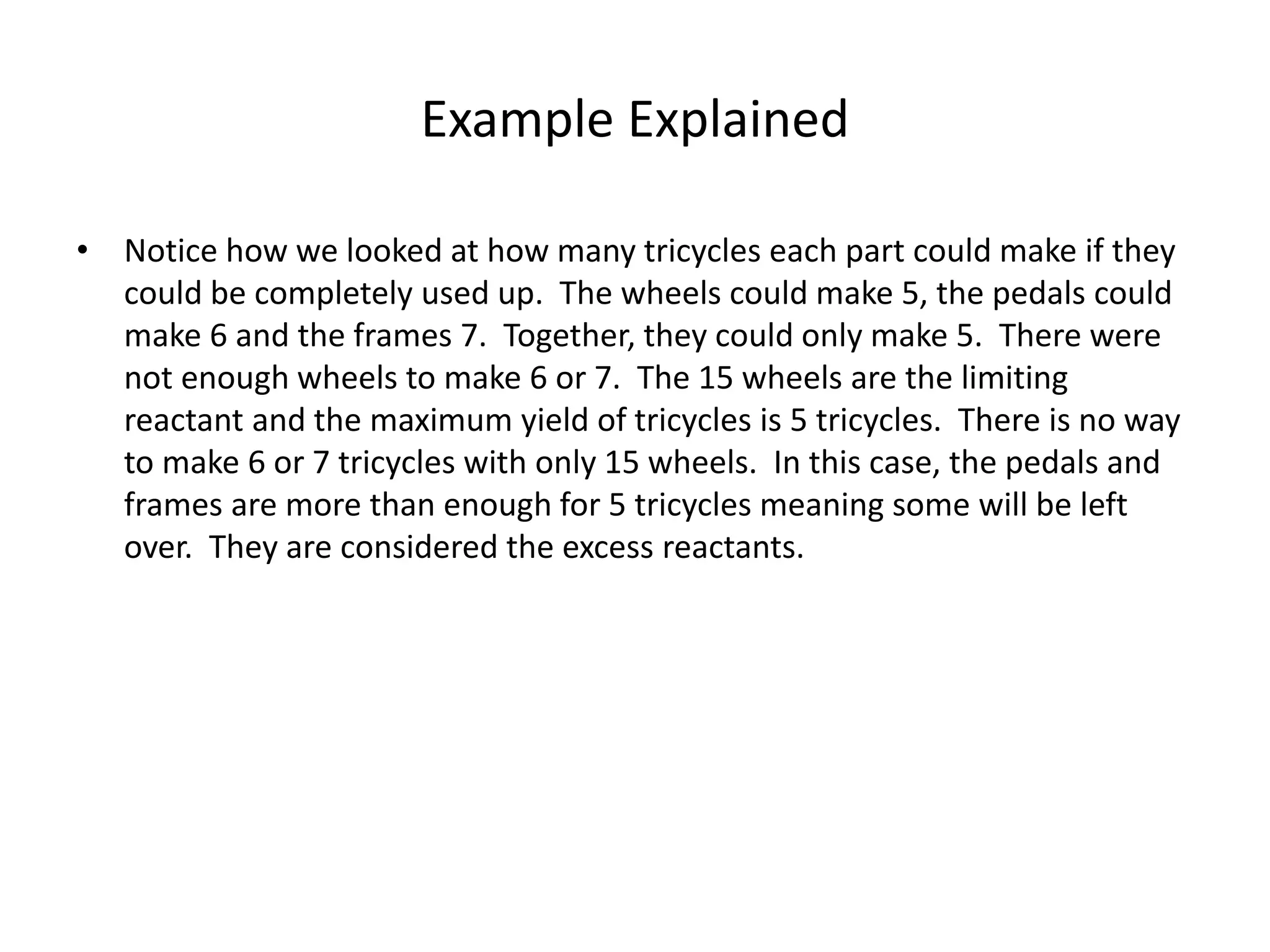
Example Explained
• Noticehow we looked at how many tricycles each part could make if they
could be completely used up. The wheels could make 5, the pedals could
make 6 and the frames 7. Together, they could only make 5. There were
not enough wheels to make 6 or 7. The 15 wheels are the limiting
reactant and the maximum yield of tricycles is 5 tricycles. There is no way
to make 6 or 7 tricycles with only 15 wheels. In this case, the pedals and
frames are more than enough for 5 tricycles meaning some will be left
over. They are considered the excess reactants.
7.
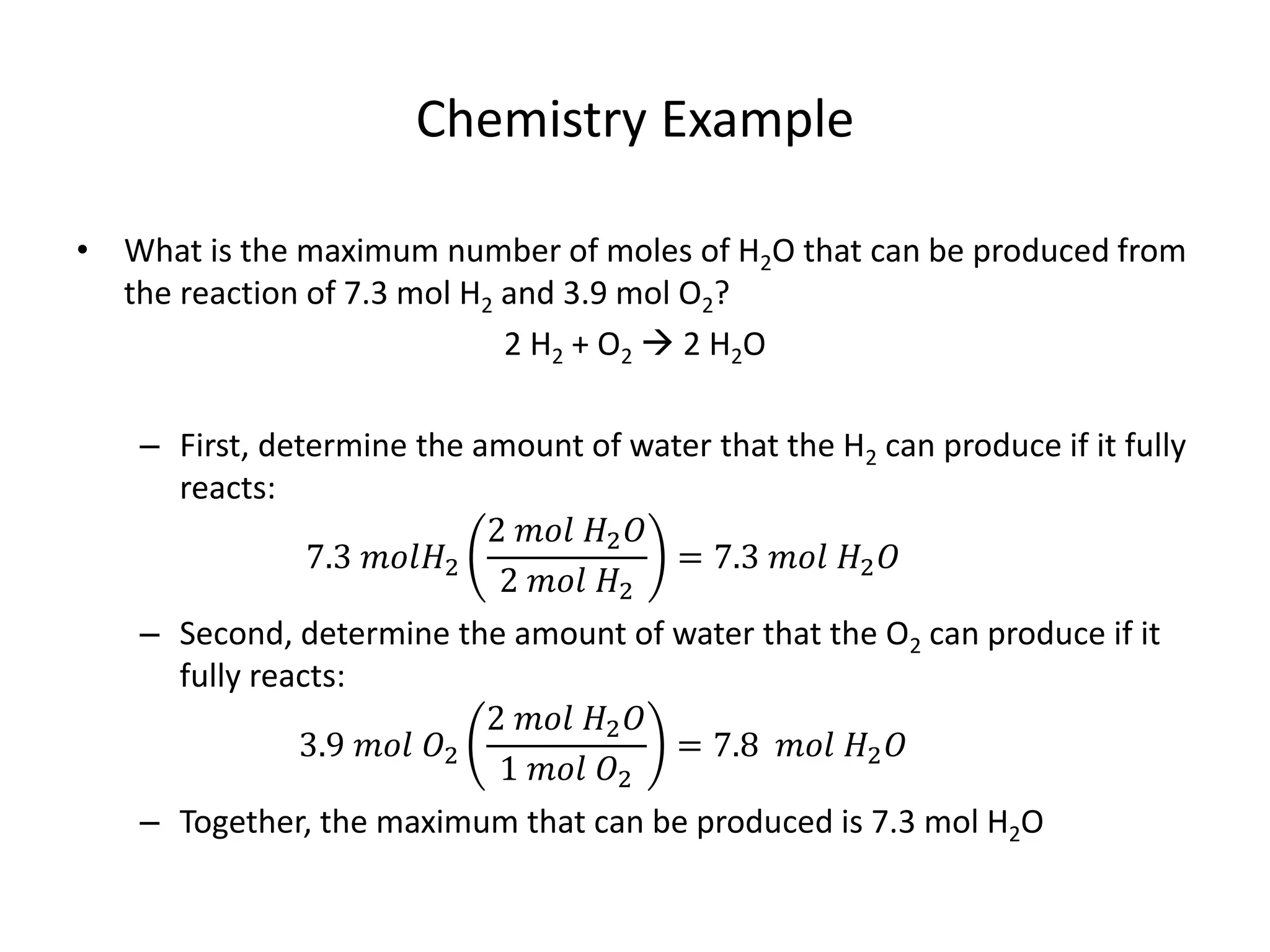
Chemistry Example
• Whatis the maximum number of moles of H2O that can be produced from
the reaction of 7.3 mol H2 and 3.9 mol O2?
2 H2 + O2 2 H2O
– First, determine the amount of water that the H2 can produce if it fully
reacts:
7.3 𝑚𝑜𝑙𝐻2
2 𝑚𝑜𝑙 𝐻2 𝑂
2 𝑚𝑜𝑙 𝐻2
= 7.3 𝑚𝑜𝑙 𝐻2 𝑂
– Second, determine the amount of water that the O2 can produce if it
fully reacts:
3.9 𝑚𝑜𝑙 𝑂2
2 𝑚𝑜𝑙 𝐻2 𝑂
1 𝑚𝑜𝑙 𝑂2
= 7.8 𝑚𝑜𝑙 𝐻2 𝑂
– Together, the maximum that can be produced is 7.3 mol H2O
8.
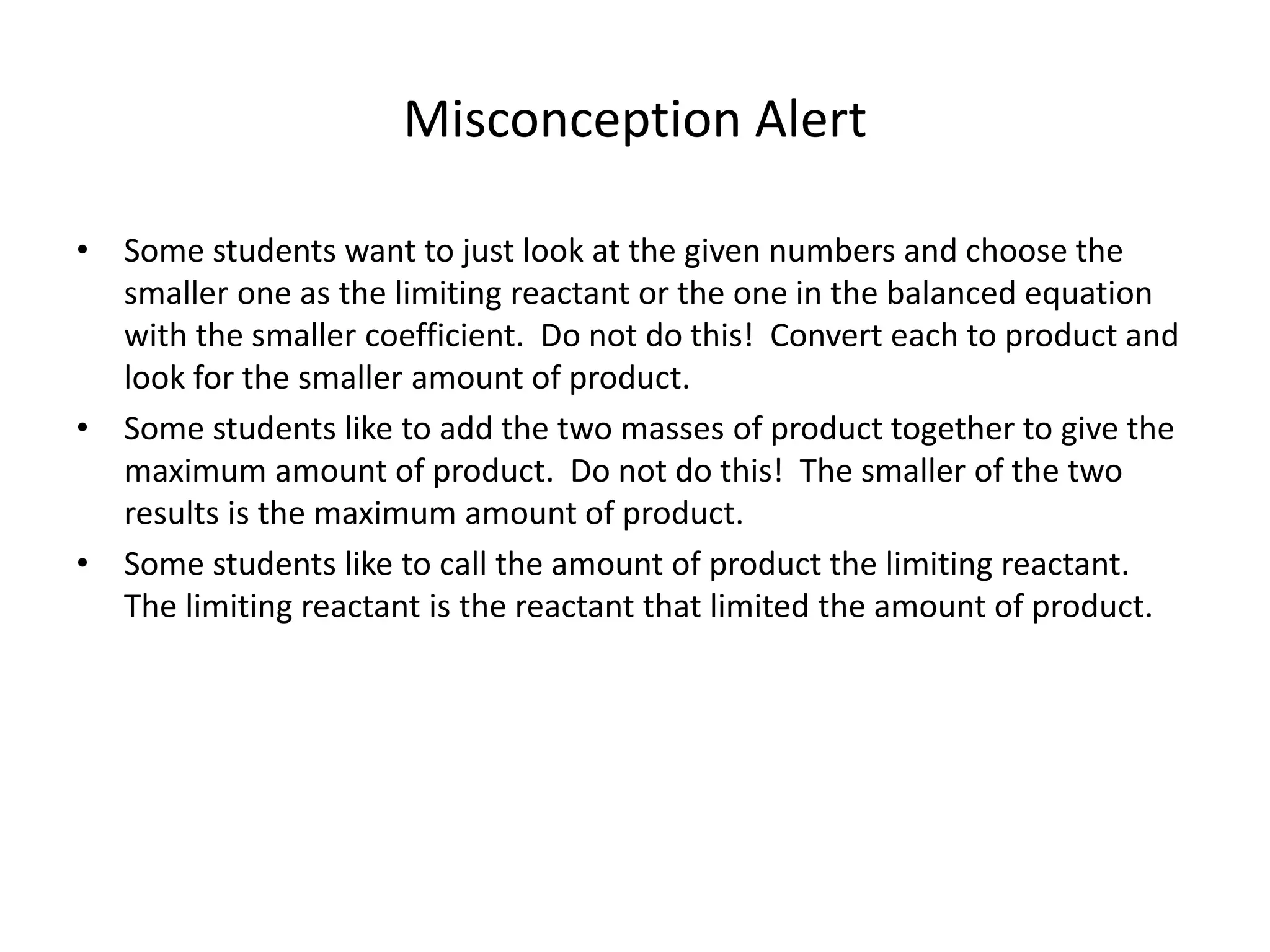
Misconception Alert
• Somestudents want to just look at the given numbers and choose the
smaller one as the limiting reactant or the one in the balanced equation
with the smaller coefficient. Do not do this! Convert each to product and
look for the smaller amount of product.
• Some students like to add the two masses of product together to give the
maximum amount of product. Do not do this! The smaller of the two
results is the maximum amount of product.
• Some students like to call the amount of product the limiting reactant.
The limiting reactant is the reactant that limited the amount of product.
9.
Pause and practice
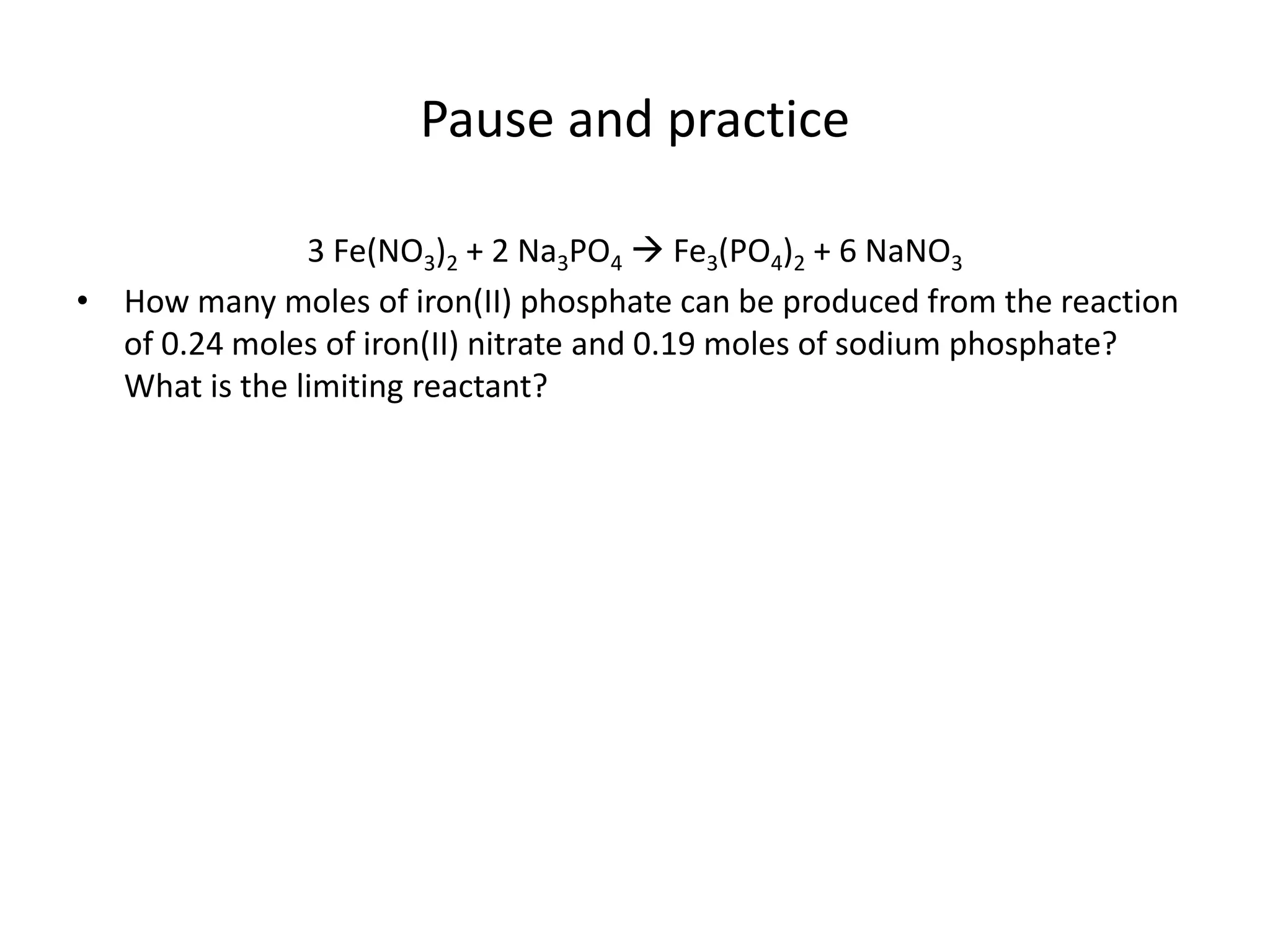
3Fe(NO3)2 + 2 Na3PO4 Fe3(PO4)2 + 6 NaNO3
• How many moles of iron(II) phosphate can be produced from the reaction
of 0.24 moles of iron(II) nitrate and 0.19 moles of sodium phosphate?
What is the limiting reactant?
10.
Pause and practiceanswer
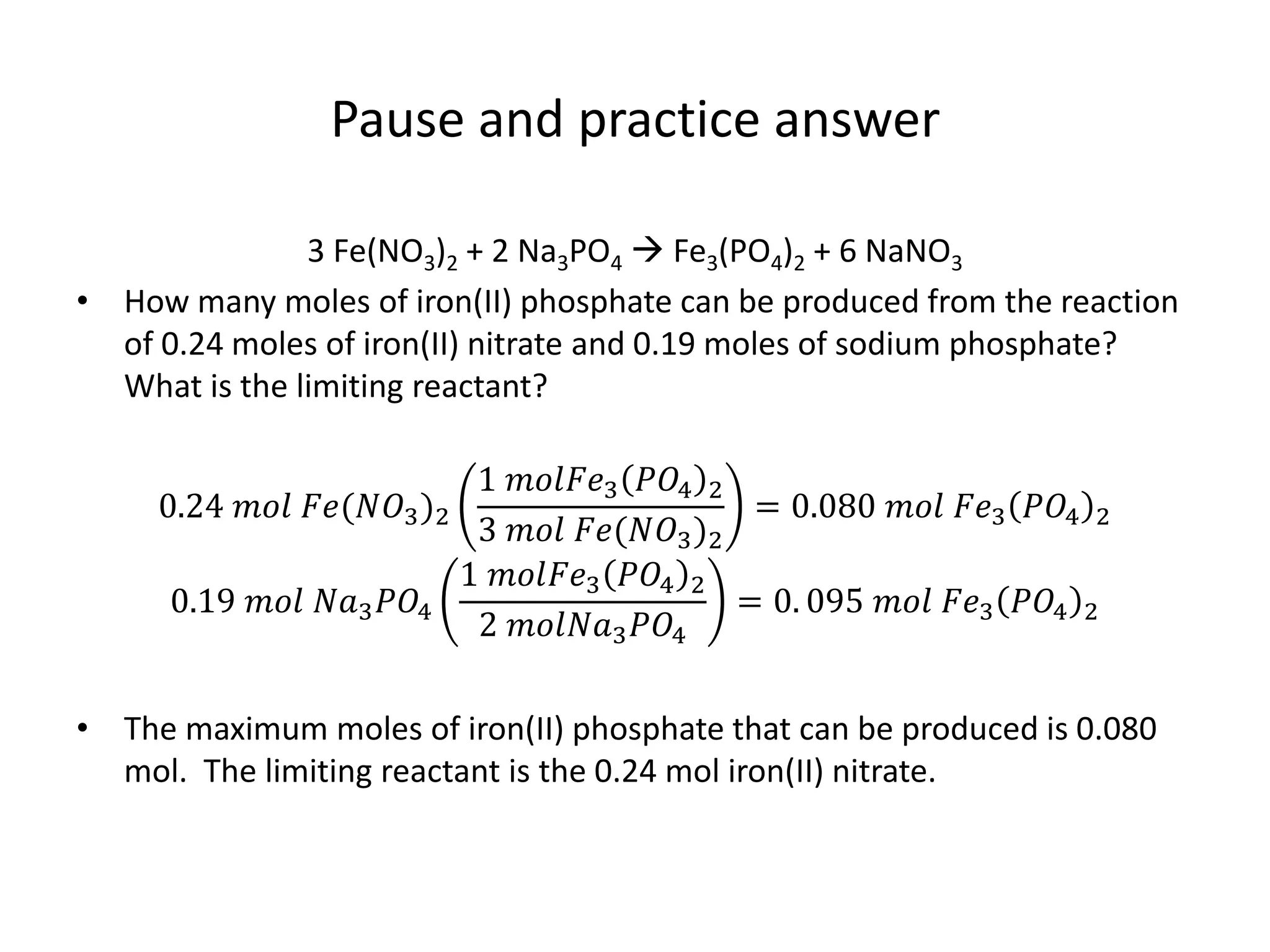
3 Fe(NO3)2 + 2 Na3PO4 Fe3(PO4)2 + 6 NaNO3
• How many moles of iron(II) phosphate can be produced from the reaction
of 0.24 moles of iron(II) nitrate and 0.19 moles of sodium phosphate?
What is the limiting reactant?
0.24 𝑚𝑜𝑙 𝐹𝑒(𝑁𝑂3)2
1 𝑚𝑜𝑙𝐹𝑒3 𝑃𝑂4 2
3 𝑚𝑜𝑙 𝐹𝑒(𝑁𝑂3)2
= 0.080 𝑚𝑜𝑙 𝐹𝑒3 𝑃𝑂4 2
0.19 𝑚𝑜𝑙 𝑁𝑎3 𝑃𝑂4
1 𝑚𝑜𝑙𝐹𝑒3 𝑃𝑂4 2
2 𝑚𝑜𝑙𝑁𝑎3 𝑃𝑂4
= 0. 095 𝑚𝑜𝑙 𝐹𝑒3 𝑃𝑂4 2
• The maximum moles of iron(II) phosphate that can be produced is 0.080
mol. The limiting reactant is the 0.24 mol iron(II) nitrate.