M V HERWADKAR ENG MED HIGH
SCHOOL
STD-VIII SUB: SCIENCE TOPIC: REPRODUCTION IN ANIMALS
NEETA PATIL
Modes of Reproduction
• There are two modes by which
animals reproduce.
(i) Sexual reproduction
(ii) Asexual reproduction
Sexual Reproduction
• Plants that reproduce sexually have male and
female reproductive parts. In animals also, males
and females have different reproductive parts or
organs. Like plants, the reproductive parts in
animals also produce gametes that fuse to form a
zygote. It is the zygote which develops into a new
individual. This type of reproduction beginning
from the fusion of male and female gametes is
called sexual reproduction.
Male Reproductive Organs
• The male reproductive
organs include a pair of
testes (singular, testis), two
sperm ducts and a penis
(Fig. 12.1). The testes
produce the male gametes
called sperms. Millions of
sperms are produced by
the testes.
• Look at Fig. which shows
the picture of a sperm.
Though sperms are very
small in size, each has a
head, a middle piece and a
tail. Does it appear to be a
single cell? Indeed, each
sperm is a single cell with
all the usual cell
components.
Female Reproductive Organs
•The female
reproductive
organs are a pair of
ovaries, oviducts
(fallopian tubes)
and the uterus
(Fig.12.3).
• The ovary produce female
gametes called ova (eggs)
(Fig. 12.4). In human beings,
a single matured egg is
released into the oviduct by
one of the ovaries every
month. Uterus is the part
where development of the
baby takes place. Like the
sperm, an egg is also a single
cell.
Fertilisation
• The first step in the process of
reproduction is the fusion of a
sperm and an ovum. When
sperms come in contact with
an egg, one of the sperms may
fuse with the egg. Such fusion
of the egg and the sperm is
called fertilisation .
•During fertilisation, the
nuclei of the sperm and
the egg fuse to form a
single nucleus. This
results in the formation
of a fertilised egg or
zygote. The zygote is the
beginning of a new
individual.
• The process of fertilisation is the meeting of an egg
cell from the mother and a sperm cell from the father.
So, the new individual inherits some characteristics
from the mother and some from the father. Look at
your brother or sister. See if you can recognise some
characters in them similar to those of your mother or
your father.
• Fertilisation which takes place inside the female body
is called internal fertilisation. Internal fertilisation
occurs in many animals including humans, cows, dogs
and hens.
Test tube baby
• In some women oviducts are blocked. These women are
unable to bear babies because sperms cannot reach the egg
for fertilisation. In such cases, doctors collect freshly released
egg and sperms and keep them together for a few hours for
IVF or in vitro fertilisation (fertilisation outside the body). In
case fertilisation occurs, the zygote is allowed to develop for
about a week and then it is placed in the mother’s uterus.
Complete development takes place in the uterus and the baby
is born like any other baby. Babies born through this
technique are called test-tube babies. This term is actually
misleading because babies cannot grow in test tubes.
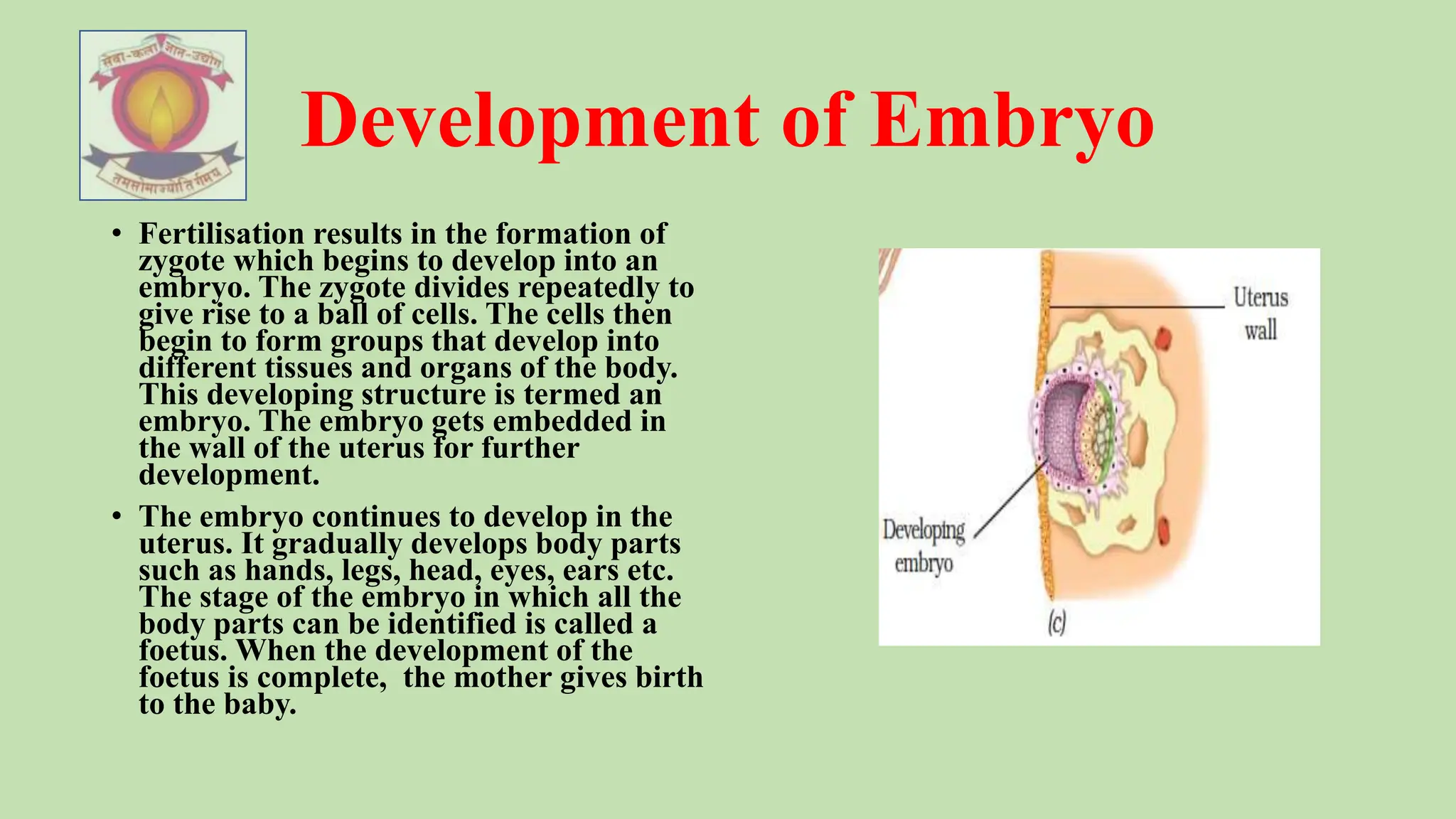
• In many animals fertilisation takes place outside the
body of the female. In these animals, fertilisation
takes place in water.
• During spring or rainy season, frogs and toads move
to ponds and slow flowing streams. When the male
and female come together in water, the female lays
hundreds of eggs. Unlike hen’s egg, frog’s egg is not
covered by a shell and it is comparatively very
delicate. A layer of jelly holds the eggs together and
provides protection to the eggs.
External fertilisation
• As the eggs are laid, the male
deposits sperms over them. Each
sperm swims randomly in water
with the help of its long tail. The
sperms come in contact with the
eggs. This results in fertilisation.
This type of fertilisation in which
the fusion of a male and a female
gamete takes place outside the
body of the female is called
external fertilisation. It is very
common in aquatic animals such
as fish, starfish, etc
•Though the animals like fish and frogs lay
hundreds of eggs and release millions of
sperms, all the eggs do not get fertilised
and develop into new individuals. This is
because the eggs and sperms get exposed to
water movement, wind and rainfall. Also,
there are other animals in the pond which
may feed on eggs. Thus, production of
large number of eggs and sperms is
necessary to ensure fertilisation of at least
a few of them.
Development of Embryo
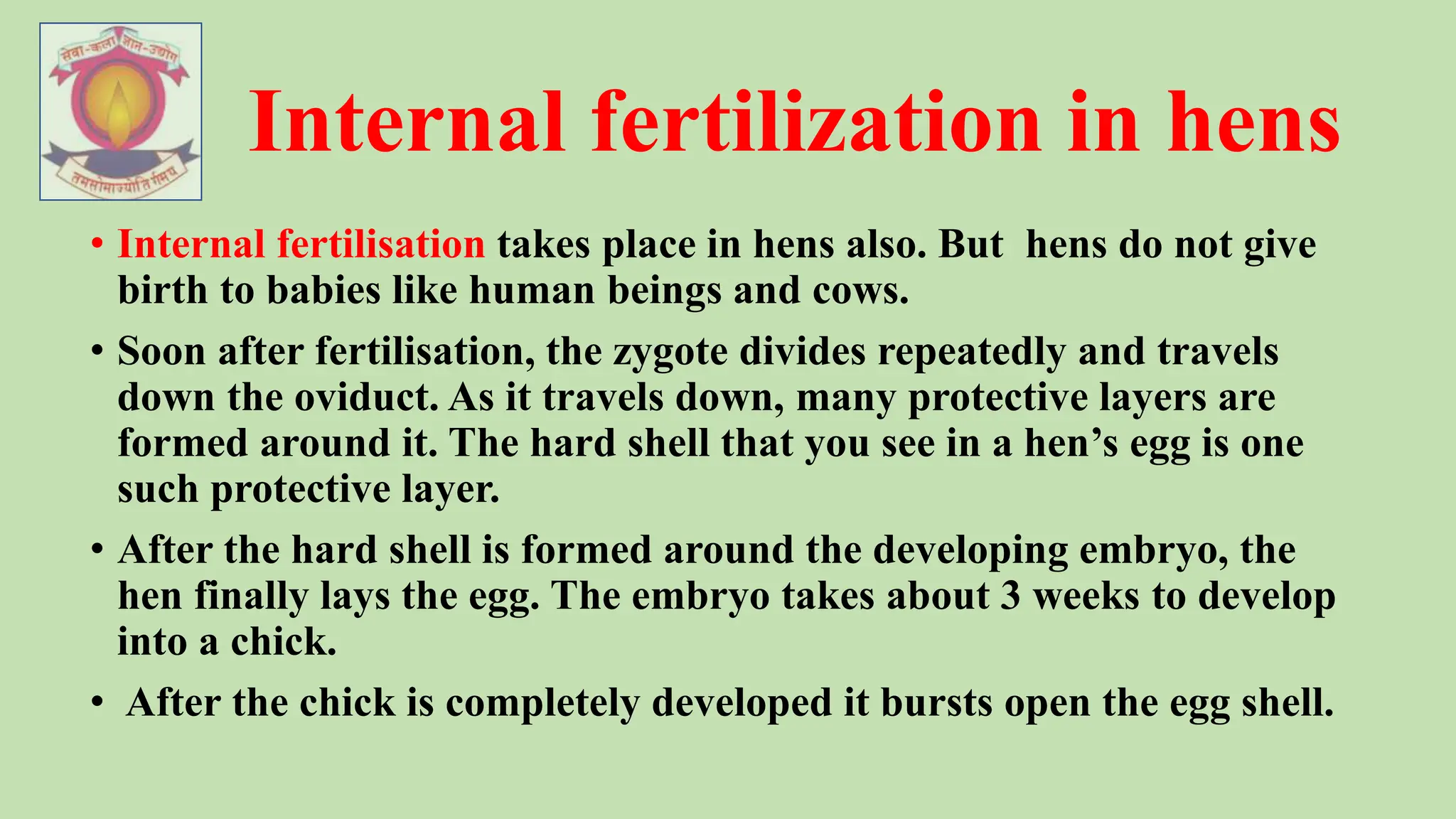
• Fertilisation results in the formation of
zygote which begins to develop into an
embryo. The zygote divides repeatedly to
give rise to a ball of cells. The cells then
begin to form groups that develop into
different tissues and organs of the body.
This developing structure is termed an
embryo. The embryo gets embedded in
the wall of the uterus for further
development.
• The embryo continues to develop in the
uterus. It gradually develops body parts
such as hands, legs, head, eyes, ears etc.
The stage of the embryo in which all the
body parts can be identified is called a
foetus. When the development of the
foetus is complete, the mother gives birth
to the baby.
Internal fertilization in hens
• Internal fertilisation takes place in hens also. But hens do not give
birth to babies like human beings and cows.
• Soon after fertilisation, the zygote divides repeatedly and travels
down the oviduct. As it travels down, many protective layers are
formed around it. The hard shell that you see in a hen’s egg is one
such protective layer.
• After the hard shell is formed around the developing embryo, the
hen finally lays the egg. The embryo takes about 3 weeks to develop
into a chick.
• After the chick is completely developed it bursts open the egg shell.
In animals which undergo external
fertilisation, development of the embryo
takes place outside the female body. The
embryos continue to grow within their
egg coverings. After the embryos develop,
the eggs hatch. You must have seen
numerous tadpoles swimming in ponds
and streams.
Viviparous and Oviparous
Animals
• Some animals give birth to young ones while some
animals lay eggs which later develop into young
ones.
• The animals which give birth to young ones are
called viviparous animals.
• Ex.Hen,Peacock,Fish etc.
• Those animals which lay eggs are called oviparous
animals.
• Ex.Cow,Dog,Human beings etc.
•The eggs of a few animals are easy to
observe because their mothers lay them
outside their bodies. These are examples
of oviparous animals. But you would
not be able to collect the eggs of a dog,
cow or cat. This is because they do not
lay eggs. The mother gives birth to the
young ones. These are examples of
viviparous animals.
•The new individuals which are born
or hatched from the eggs continue to
grow till they become adults. In some
animals, the young ones may look
very different from the adults. Recall
the life cycle of the silkworm (egg →
larva or caterpillar → pupa → adult)
. Frog is another such example.
Life cycle of frog
•Observe the different stages of frog
starting from the egg to the adult stage.
We find that there are three distinct
stages, that is,
•egg → tadpole (larva) → adult.
•Similarly, the caterpillar or the pupa of
silkworm looks very different from the
adult moth. The features that are present
in the adult are not found in these young
ones.
Zygote formation
The embryo continues to develop in
the uterus. It gradually develops
body parts such as hands, legs,
head, eyes, ears etc. The stage of
the embryo in which all the body
parts can be identified is called a
foetus (Fig. 12.9). When the
development of the foetus is
complete, the mother gives birth to
the baby.
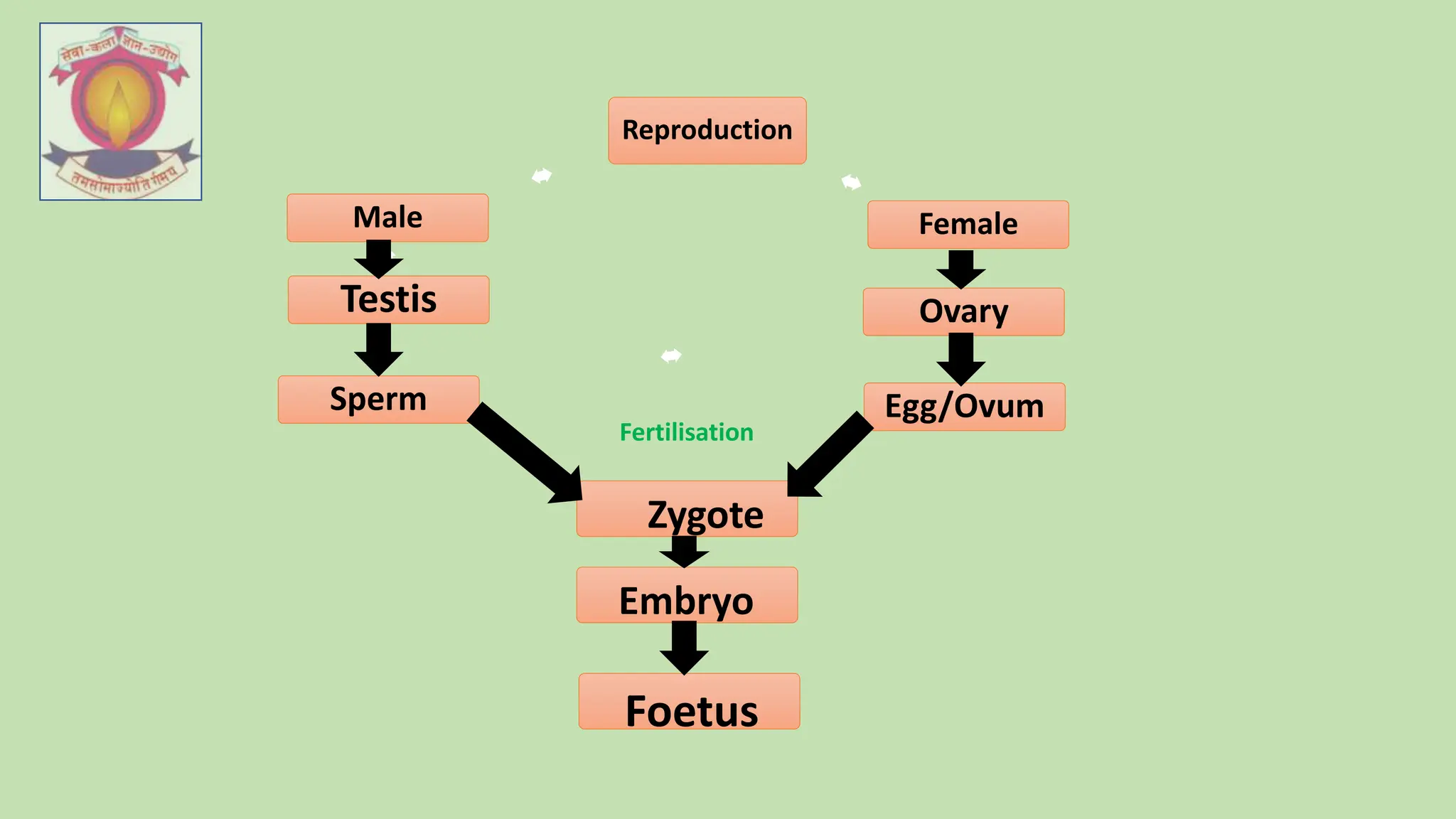
Reproduction
Female
Egg/Ovum
Ovary
Sperm
Testis
Male
Zygote
Embryo
Foetus
Fertilisation
Asexual Reproduction
•The type of reproduction in
which only a single parent is
involved is called asexual
reproduction.
Budding in Hydra
• In each hydra, there may be one or
more bulges. These bulges are the
developing new individuals and they
are called buds. In hydra the new
individuals develop as outgrowths
from a single parent. This type of
reproduction in which only a single
parent is involved is called asexual
reproduction. Since new individuals
develop from the buds in hydra, this
type of asexual reproduction is called
budding.
Binary fission in Amoeba
• Amoeba is a single-celled organism. It
begins the process of reproduction by the
division of its nucleus into two nuclei.
This is followed by division of its body
into two, each part receiving a nucleus.
Finally, two amoebae are produced from
one parent amoeba. This type of asexual
reproduction in which an animal
reproduces by dividing into two
individuals is called binary fission.
Cloning
• Cloning is the production of an
exact copy of a cell, any other
living part, or a complete
organism. Cloning of an animal
was successfully performed for
the first time by Ian Wilmut and
his colleagues at the Roslin
Institute in Edinburgh, Scotland.
They successfully cloned a sheep
named Dolly. Dolly was born on
5th July 1996 and was the first
mammal to be cloned.

REPRODUCTION IN ANIMALS.pptx.............

  • 1.
    M V HERWADKARENG MED HIGH SCHOOL STD-VIII SUB: SCIENCE TOPIC: REPRODUCTION IN ANIMALS NEETA PATIL
  • 3.
    Modes of Reproduction •There are two modes by which animals reproduce. (i) Sexual reproduction (ii) Asexual reproduction
  • 4.
    Sexual Reproduction • Plantsthat reproduce sexually have male and female reproductive parts. In animals also, males and females have different reproductive parts or organs. Like plants, the reproductive parts in animals also produce gametes that fuse to form a zygote. It is the zygote which develops into a new individual. This type of reproduction beginning from the fusion of male and female gametes is called sexual reproduction.
  • 5.
    Male Reproductive Organs •The male reproductive organs include a pair of testes (singular, testis), two sperm ducts and a penis (Fig. 12.1). The testes produce the male gametes called sperms. Millions of sperms are produced by the testes.
  • 6.
    • Look atFig. which shows the picture of a sperm. Though sperms are very small in size, each has a head, a middle piece and a tail. Does it appear to be a single cell? Indeed, each sperm is a single cell with all the usual cell components.
  • 7.
    Female Reproductive Organs •Thefemale reproductive organs are a pair of ovaries, oviducts (fallopian tubes) and the uterus (Fig.12.3).
  • 8.
    • The ovaryproduce female gametes called ova (eggs) (Fig. 12.4). In human beings, a single matured egg is released into the oviduct by one of the ovaries every month. Uterus is the part where development of the baby takes place. Like the sperm, an egg is also a single cell.
  • 9.
    Fertilisation • The firststep in the process of reproduction is the fusion of a sperm and an ovum. When sperms come in contact with an egg, one of the sperms may fuse with the egg. Such fusion of the egg and the sperm is called fertilisation .
  • 10.
    •During fertilisation, the nucleiof the sperm and the egg fuse to form a single nucleus. This results in the formation of a fertilised egg or zygote. The zygote is the beginning of a new individual.
  • 11.
    • The processof fertilisation is the meeting of an egg cell from the mother and a sperm cell from the father. So, the new individual inherits some characteristics from the mother and some from the father. Look at your brother or sister. See if you can recognise some characters in them similar to those of your mother or your father. • Fertilisation which takes place inside the female body is called internal fertilisation. Internal fertilisation occurs in many animals including humans, cows, dogs and hens.
  • 12.
    Test tube baby •In some women oviducts are blocked. These women are unable to bear babies because sperms cannot reach the egg for fertilisation. In such cases, doctors collect freshly released egg and sperms and keep them together for a few hours for IVF or in vitro fertilisation (fertilisation outside the body). In case fertilisation occurs, the zygote is allowed to develop for about a week and then it is placed in the mother’s uterus. Complete development takes place in the uterus and the baby is born like any other baby. Babies born through this technique are called test-tube babies. This term is actually misleading because babies cannot grow in test tubes.
  • 13.
    • In manyanimals fertilisation takes place outside the body of the female. In these animals, fertilisation takes place in water. • During spring or rainy season, frogs and toads move to ponds and slow flowing streams. When the male and female come together in water, the female lays hundreds of eggs. Unlike hen’s egg, frog’s egg is not covered by a shell and it is comparatively very delicate. A layer of jelly holds the eggs together and provides protection to the eggs.
  • 14.
    External fertilisation • Asthe eggs are laid, the male deposits sperms over them. Each sperm swims randomly in water with the help of its long tail. The sperms come in contact with the eggs. This results in fertilisation. This type of fertilisation in which the fusion of a male and a female gamete takes place outside the body of the female is called external fertilisation. It is very common in aquatic animals such as fish, starfish, etc
  • 15.
    •Though the animalslike fish and frogs lay hundreds of eggs and release millions of sperms, all the eggs do not get fertilised and develop into new individuals. This is because the eggs and sperms get exposed to water movement, wind and rainfall. Also, there are other animals in the pond which may feed on eggs. Thus, production of large number of eggs and sperms is necessary to ensure fertilisation of at least a few of them.
  • 16.
    Development of Embryo •Fertilisation results in the formation of zygote which begins to develop into an embryo. The zygote divides repeatedly to give rise to a ball of cells. The cells then begin to form groups that develop into different tissues and organs of the body. This developing structure is termed an embryo. The embryo gets embedded in the wall of the uterus for further development. • The embryo continues to develop in the uterus. It gradually develops body parts such as hands, legs, head, eyes, ears etc. The stage of the embryo in which all the body parts can be identified is called a foetus. When the development of the foetus is complete, the mother gives birth to the baby.
  • 17.
    Internal fertilization inhens • Internal fertilisation takes place in hens also. But hens do not give birth to babies like human beings and cows. • Soon after fertilisation, the zygote divides repeatedly and travels down the oviduct. As it travels down, many protective layers are formed around it. The hard shell that you see in a hen’s egg is one such protective layer. • After the hard shell is formed around the developing embryo, the hen finally lays the egg. The embryo takes about 3 weeks to develop into a chick. • After the chick is completely developed it bursts open the egg shell.
  • 18.
    In animals whichundergo external fertilisation, development of the embryo takes place outside the female body. The embryos continue to grow within their egg coverings. After the embryos develop, the eggs hatch. You must have seen numerous tadpoles swimming in ponds and streams.
  • 19.
    Viviparous and Oviparous Animals •Some animals give birth to young ones while some animals lay eggs which later develop into young ones. • The animals which give birth to young ones are called viviparous animals. • Ex.Hen,Peacock,Fish etc. • Those animals which lay eggs are called oviparous animals. • Ex.Cow,Dog,Human beings etc.
  • 20.
    •The eggs ofa few animals are easy to observe because their mothers lay them outside their bodies. These are examples of oviparous animals. But you would not be able to collect the eggs of a dog, cow or cat. This is because they do not lay eggs. The mother gives birth to the young ones. These are examples of viviparous animals.
  • 21.
    •The new individualswhich are born or hatched from the eggs continue to grow till they become adults. In some animals, the young ones may look very different from the adults. Recall the life cycle of the silkworm (egg → larva or caterpillar → pupa → adult) . Frog is another such example.
  • 22.
  • 23.
    •Observe the differentstages of frog starting from the egg to the adult stage. We find that there are three distinct stages, that is, •egg → tadpole (larva) → adult. •Similarly, the caterpillar or the pupa of silkworm looks very different from the adult moth. The features that are present in the adult are not found in these young ones.
  • 24.
  • 25.
    The embryo continuesto develop in the uterus. It gradually develops body parts such as hands, legs, head, eyes, ears etc. The stage of the embryo in which all the body parts can be identified is called a foetus (Fig. 12.9). When the development of the foetus is complete, the mother gives birth to the baby.
  • 26.
  • 27.
    Asexual Reproduction •The typeof reproduction in which only a single parent is involved is called asexual reproduction.
  • 28.
    Budding in Hydra •In each hydra, there may be one or more bulges. These bulges are the developing new individuals and they are called buds. In hydra the new individuals develop as outgrowths from a single parent. This type of reproduction in which only a single parent is involved is called asexual reproduction. Since new individuals develop from the buds in hydra, this type of asexual reproduction is called budding.
  • 29.
    Binary fission inAmoeba • Amoeba is a single-celled organism. It begins the process of reproduction by the division of its nucleus into two nuclei. This is followed by division of its body into two, each part receiving a nucleus. Finally, two amoebae are produced from one parent amoeba. This type of asexual reproduction in which an animal reproduces by dividing into two individuals is called binary fission.
  • 30.
    Cloning • Cloning isthe production of an exact copy of a cell, any other living part, or a complete organism. Cloning of an animal was successfully performed for the first time by Ian Wilmut and his colleagues at the Roslin Institute in Edinburgh, Scotland. They successfully cloned a sheep named Dolly. Dolly was born on 5th July 1996 and was the first mammal to be cloned.