
Phrases A phrase is a group of related words that is used as a single part of speech and does not contain a verb and its subject. Five kinds: prepositional, adjective, adverb, verbal, and appositive
Prepositional Phrases A prepositional phrase is a group of words that begin with a preposition and usually ends with a noun or pronoun. Examples: 1.  Please put the paper  in the basket . 2.  I found ten apples  under the tree .
Adjective Phrases An adjective phrase is a prepositional phrase that modifies a noun or a pronoun. Examples: That girl  in the car  is my sister. The disk  on the table  is his.
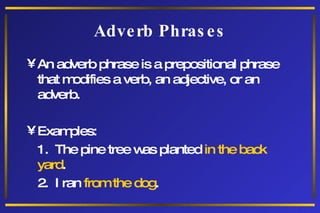
Adverb Phrases An adverb phrase is a prepositional phrase that modifies a verb, an adjective, or an adverb. Examples: 1.  The pine tree was planted  in the back yard . 2.  I ran  from the dog .
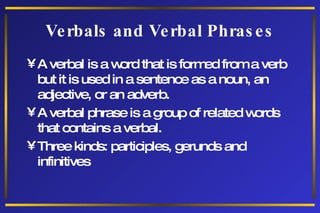
Verbals and Verbal Phrases A verbal is a word that is formed from a verb but it is used in a sentence as a noun, an adjective, or an adverb. A verbal phrase is a group of related words that contains a verbal. Three kinds: participles, gerunds and infinitives
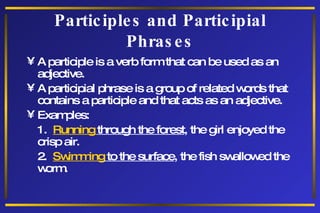
Participles and Participial Phrases A participle is a verb form that can be used as an adjective. A participial phrase is a group of related words that contains a participle and that acts as an adjective. Examples: 1.  Running  through the forest , the girl enjoyed the crisp air. 2.  Swimming  to the surface , the fish swallowed the worm.
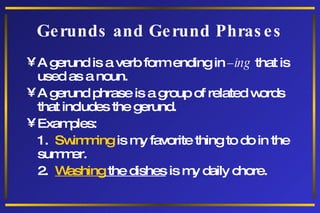
Gerunds and Gerund Phrases A gerund is a verb form ending in  –ing  that is used as a noun. A gerund phrase is a group of related words that includes the gerund. Examples: 1.  Swimming  is my favorite thing to do in the summer. 2.  Washing  the dishes  is my daily chore.
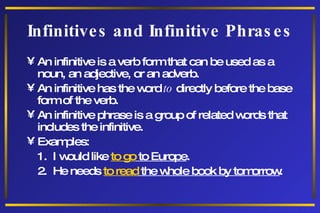
Infinitives and Infinitive Phrases An infinitive is a verb form that can be used as a noun, an adjective, or an adverb. An infinitive has the word  to  directly before the base form of the verb. An infinitive phrase is a group of related words that includes the infinitive. Examples: 1.  I would like  to go  to Europe . 2.  He needs  to read  the whole book by tomorrow .
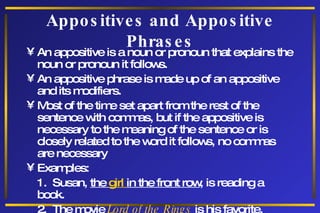
Appositives and Appositive Phrases An appositive is a noun or pronoun that explains the noun or pronoun it follows. An appositive phrase is made up of an appositive and its modifiers. Most of the time set apart from the rest of the sentence with commas, but if the appositive is necessary to the meaning of the sentence or is closely related to the word it follows, no commas are necessary Examples: 1.  Susan,  the  girl  in the front row , is reading a book. 2.  The movie  Lord of the Rings  is his favorite.
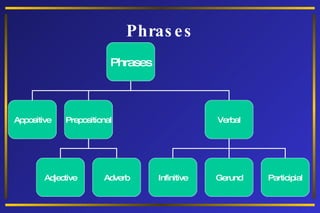
Phrases Phrases Appositive Prepositional Verbal Adjective Adverb Infinitive Gerund Participial
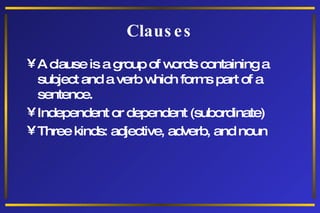
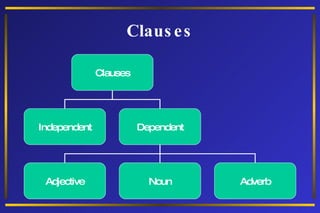
Clauses A clause is a group of words containing a subject and a verb which forms part of a sentence. Independent or dependent (subordinate) Three kinds: adjective, adverb, and noun
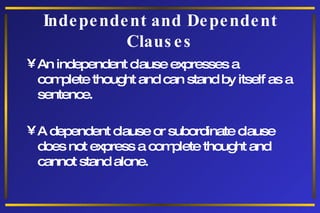
Independent and Dependent Clauses An independent clause expresses a complete thought and can stand by itself as a sentence. A dependent clause or subordinate clause does not express a complete thought and cannot stand alone.
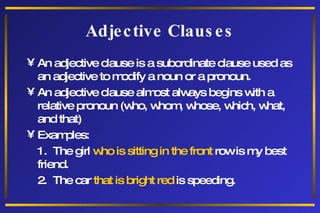
Adjective Clauses An adjective clause is a subordinate clause used as an adjective to modify a noun or a pronoun. An adjective clause almost always begins with a relative pronoun (who, whom, whose, which, what, and that) Examples: 1.  The girl  who is sitting in the front  row is my best friend. 2.  The car  that is bright red  is speeding.
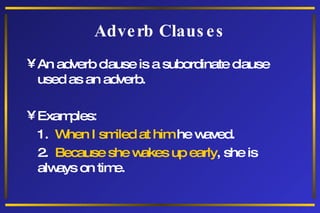
Adverb Clauses An adverb clause is a subordinate clause used as an adverb. Examples: 1.  When I smiled at him  he waved. 2.  Because she wakes up early , she is always on time.
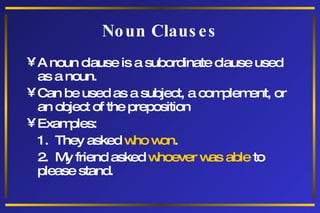
Noun Clauses A noun clause is a subordinate clause used as a noun. Can be used as a subject, a complement, or an object of the preposition Examples: 1.  They asked  who won . 2.  My friend asked  whoever was able  to please stand.
Clauses Clauses Independent Dependent Adjective Noun Adverb
Questions???
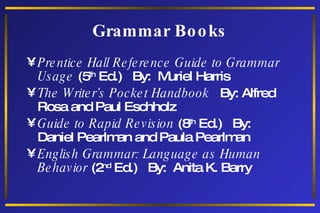
Grammar Books Prentice Hall Reference Guide to Grammar Usage  (5 th  Ed.)  By:  Muriel Harris The Writer’s Pocket Handbook   By: Alfred Rosa and Paul Eschholz Guide to Rapid Revision  (8 th  Ed.)  By:  Daniel Pearlman and Paula Pearlman English Grammar: Language as Human Behavior  (2 nd  Ed.)  By:  Anita K. Barry
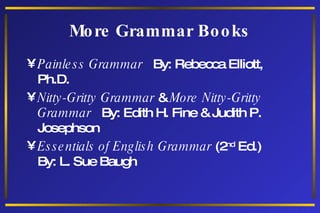
More Grammar Books Painless Grammar  By: Rebecca Elliott, Ph.D. Nitty-Gritty Grammar  &  More Nitty-Gritty Grammar   By: Edith H. Fine & Judith P. Josephson  Essentials of English Grammar  (2 nd  Ed.)  By: L. Sue Baugh

Phrases And Clauses Grammar1.15

  • 1.
    Phrases A phraseis a group of related words that is used as a single part of speech and does not contain a verb and its subject. Five kinds: prepositional, adjective, adverb, verbal, and appositive
  • 2.
    Prepositional Phrases Aprepositional phrase is a group of words that begin with a preposition and usually ends with a noun or pronoun. Examples: 1. Please put the paper in the basket . 2. I found ten apples under the tree .
  • 3.
    Adjective Phrases Anadjective phrase is a prepositional phrase that modifies a noun or a pronoun. Examples: That girl in the car is my sister. The disk on the table is his.
  • 4.
    Adverb Phrases Anadverb phrase is a prepositional phrase that modifies a verb, an adjective, or an adverb. Examples: 1. The pine tree was planted in the back yard . 2. I ran from the dog .
  • 5.
    Verbals and VerbalPhrases A verbal is a word that is formed from a verb but it is used in a sentence as a noun, an adjective, or an adverb. A verbal phrase is a group of related words that contains a verbal. Three kinds: participles, gerunds and infinitives
  • 6.
    Participles and ParticipialPhrases A participle is a verb form that can be used as an adjective. A participial phrase is a group of related words that contains a participle and that acts as an adjective. Examples: 1. Running through the forest , the girl enjoyed the crisp air. 2. Swimming to the surface , the fish swallowed the worm.
  • 7.
    Gerunds and GerundPhrases A gerund is a verb form ending in –ing that is used as a noun. A gerund phrase is a group of related words that includes the gerund. Examples: 1. Swimming is my favorite thing to do in the summer. 2. Washing the dishes is my daily chore.
  • 8.
    Infinitives and InfinitivePhrases An infinitive is a verb form that can be used as a noun, an adjective, or an adverb. An infinitive has the word to directly before the base form of the verb. An infinitive phrase is a group of related words that includes the infinitive. Examples: 1. I would like to go to Europe . 2. He needs to read the whole book by tomorrow .
  • 9.
    Appositives and AppositivePhrases An appositive is a noun or pronoun that explains the noun or pronoun it follows. An appositive phrase is made up of an appositive and its modifiers. Most of the time set apart from the rest of the sentence with commas, but if the appositive is necessary to the meaning of the sentence or is closely related to the word it follows, no commas are necessary Examples: 1. Susan, the girl in the front row , is reading a book. 2. The movie Lord of the Rings is his favorite.
  • 10.
    Phrases Phrases AppositivePrepositional Verbal Adjective Adverb Infinitive Gerund Participial
  • 11.
    Clauses A clauseis a group of words containing a subject and a verb which forms part of a sentence. Independent or dependent (subordinate) Three kinds: adjective, adverb, and noun
  • 12.
    Independent and DependentClauses An independent clause expresses a complete thought and can stand by itself as a sentence. A dependent clause or subordinate clause does not express a complete thought and cannot stand alone.
  • 13.
    Adjective Clauses Anadjective clause is a subordinate clause used as an adjective to modify a noun or a pronoun. An adjective clause almost always begins with a relative pronoun (who, whom, whose, which, what, and that) Examples: 1. The girl who is sitting in the front row is my best friend. 2. The car that is bright red is speeding.
  • 14.
    Adverb Clauses Anadverb clause is a subordinate clause used as an adverb. Examples: 1. When I smiled at him he waved. 2. Because she wakes up early , she is always on time.
  • 15.
    Noun Clauses Anoun clause is a subordinate clause used as a noun. Can be used as a subject, a complement, or an object of the preposition Examples: 1. They asked who won . 2. My friend asked whoever was able to please stand.
  • 16.
    Clauses Clauses IndependentDependent Adjective Noun Adverb
  • 17.
  • 18.
    Grammar Books PrenticeHall Reference Guide to Grammar Usage (5 th Ed.) By: Muriel Harris The Writer’s Pocket Handbook By: Alfred Rosa and Paul Eschholz Guide to Rapid Revision (8 th Ed.) By: Daniel Pearlman and Paula Pearlman English Grammar: Language as Human Behavior (2 nd Ed.) By: Anita K. Barry
  • 19.
    More Grammar BooksPainless Grammar By: Rebecca Elliott, Ph.D. Nitty-Gritty Grammar & More Nitty-Gritty Grammar By: Edith H. Fine & Judith P. Josephson Essentials of English Grammar (2 nd Ed.) By: L. Sue Baugh